





































Could Your Company Be In Scope? The New NIS 2 Reality Check
Most organisations still assume the EU’s NIS 2 Directive (2022/2555)-the continent’s most significant cyber-security overhaul in years-applies only to utilities, banks, or other “giants” under the national spotlight. That complacency now risks hard lessons. Today, the NIS 2 net is cast far wider: if your business-SaaS or cloud vendor, logistics chain operator, healthcare startup, regional MSP-delivers digital trust or service continuity to a client, partner, or public sector entity, you could sit squarely in scope, regardless of company size or classic “critical sector” tags. What determines inclusion isn’t your old sector label-it’s the actual risk and dependency your stakeholders place on you.
Most compliance blind spots first surface in a delayed deal or urgent questionnaire, not a formal warning from a regulator.
Relying on past exemptions or sector reputation will not protect you. National registers shift monthly; supply chain relationships trigger unexpected exposure; enterprise customers now ask for evidence as part of due diligence. Across Europe, real-world NIS 2 enforcement is less about abstract thresholds and more about what happens when the normal operations of your services underpin another organisation’s resilience. If you hold keys to continuity, trust, or customer data, the NIS 2 regime increasingly counts you as part of the security ecosystem.
How to Quickly Tell If NIS 2 Applies to You
Insight starts with brutally honest self-assessment-not waiting for a public registry notification. NIS 2’s “inclusion” is dynamic, changing as soon as your operations, contractual footprint, or staff headcount cross new lines. Here are the most reliable signals-a checklist your organisation should revisit regularly:
- Do you provide digital, SaaS, or managed services inside the EU-even for a single client?:
- Are you the sole or critical sub-contractor for an essential sector (utilities, health, transport)?:
- Does your company employ 50 or more staff, or report over €10 million in turnover?:
- Have you been listed or referenced as a supplier in any customer, registry, or government procurement review?:
A “yes” to any one of these warrants an immediate, full review by your compliance lead-this isn’t a task for next year’s audit. EU and national regulators strongly recommend quarterly checks, or whenever you close a significant contract, grow the team, shift the corporate structure, or undergo an onboarding with a regulated client. Because the new NIS 2 scope is not static, your legal and operational obligations can switch from “out” to “in” with a single business event.
| Key Scope Question | Triggers Review? | Evidence/Reference |
|---|---|---|
| Serve essential sector (Annex I/II)? | ✔ | ENISA sector map, major clients |
| Sole/strategic supplier to regulated org? | ✔ | Supplier registry, onboarding docs |
| ≥ 50 staff or €10M turnover? | ✔ | HR & finance records |
| Named in procurement, registry, audit? | ✔ | Contract communication, registry |
Key resources:
- ENISA NIS 2 Sectoral flowchart
- Belgian CCB National Register Guidance
- Luxembourg ILR FAQ
A company that’s out-of-scope today can be in the regulator’s line of sight with a single new client or contract signature. (ILR Luxembourg)

Master NIS 2 without spreadsheet chaos
Centralise risk, incidents, suppliers, and evidence in one clean platform.
What Are the Actual Self-Check Triggers for NIS 2? (And What to Do Next)
The real risk is being blindsided-learning you’ve been in scope for months only when a sales pipeline stalls, or a regulated customer asks for evidence you never built. NIS 2 rewrites the logic: “wait and see” is what leads to fines, contractual risk, or reputational damage. Instead, forward-looking compliance teams treat scope as a living category-one you monitor, log, and update along with every major contract or registry entry.
Step-by-Step: Reacting to Potential Scope Triggers
-
Identify the Trigger
A new major contract, doubling in staff, inclusion in a client’s supplier registry, a request for evidence in an onboarding form-each is a live trigger for scope review. -
Initiate a Comprehensive Review
Pull up your current NIS 2 applicability checklist, compare to Annex I/II sector lists, and scan your active client and supply chain flows. -
Update the Entity Registry
Ensure you log entity size, legal status, operational sector, and any change to key clients or supply chain status. -
Map and Link Relationships
Every fresh customer, partner, or supplier relationship should be explicitly mapped to NIS 2 sector criteria and registry status. -
Log the Evidence
Retain all contracts, supplier onboarding documents, client emails that reference NIS 2, HR notices of staff growth, and any national registry communications. -
Notify Your Compliance/Legal Lead
If a shift is discovered, activate the escalation plan: loop in the appointed compliance/IT head, and if needed, begin notification to regulatory or national authorities. -
Update the Statement of Applicability (SoA)
Cross-check that your controls and mapped risks reflect the latest scope and registry position.
Traceability Example: “Silent Inclusion” In Action
| Trigger | Risk Update | Control/SoA | Evidence Logged |
|---|---|---|---|
| New utility client | Supplier listed | A.5.19/A.5.20 | Onboarding + registry |
| Staff exceeds 50 | Entity threshold | Clause 4.1, 5.2 | HR file, minutes |
| Registry listing | Scope update | 4.3, A.5.19 | Registry export |
NIS 2 status is fluid-track and document changes as they happen, or risk being late to the compliance table.
How Does “Essential” Differ from “Important”? (Entity Category, Audit, Enforcement)
NIS 2 draws a sharp distinction: “essential” (Annex I) vs. “important” (Annex II) entities. Both categories must meet strict cyber-security, incident reporting, and corporate governance standards. But your designation affects how often you are audited, incident reporting obligations, registry visibility, and penalty maximums.
Essential vs Important: Core Differences
| Factor | Essential (Annex I) | Important (Annex II) |
|---|---|---|
| Sector Examples | Energy, water, transport | Digital infra, SaaS, manufacturing |
| Registry | Automatically listed | Added per threshold/event |
| Audit | Scheduled, regulator-driven | Triggered by incident/request |
| Reporting | 24–72 hrs, strict deadlines | 72 hrs, post-event |
| Disclosure | Must declare NIS 2 status | On request, contract basis |
| Penalties | Up to €10M or 2% of turnover | Up to €7M or 1.4% of turnover |
Statistical reality: In Belgium, over 2,000 new entities were added to the regulated register in the first year of NIS 2-about a 40%+ increase in scope versus legacy expectations (Belgian CCB, 2024).
For many, ‘essential’ status is discovered not in self-assessment, but when the customer finds your listing during procurement. (Belgian CCB)
Action: If in doubt, confirm status with your national register or competent authority-and don’t wait for a formal notification.
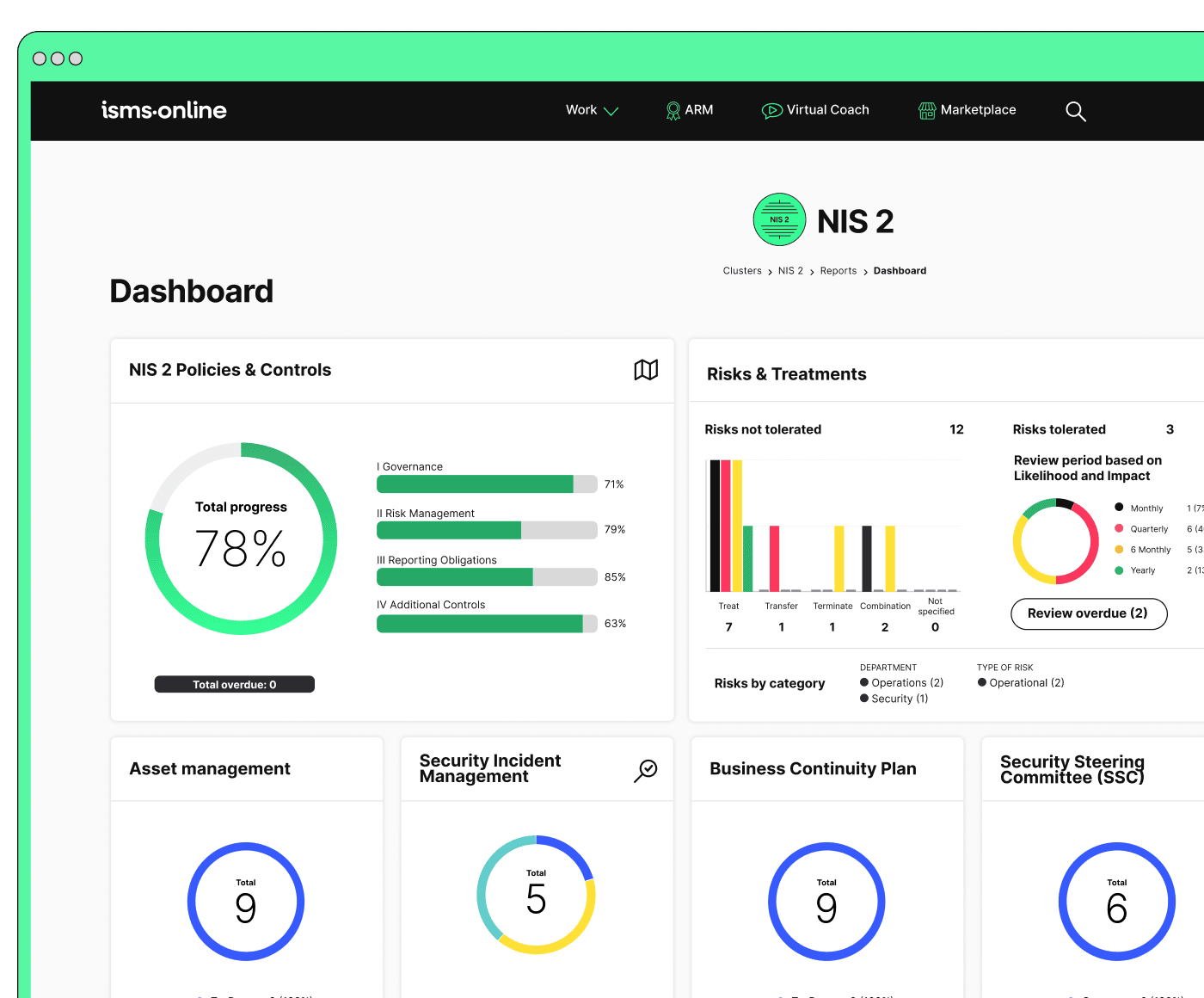
Be NIS 2-ready from day one
Launch with a proven workspace and templates – just tailor, assign, and go.
How Do Member State Variations Affect Your NIS 2 Status?
Despite EU-level convergence, every country maintains its own interpretation of the directive-not just on sector and thresholds, but on how registry onboarding, supplier status, and audit regimes play out. Your “out-of-scope” status in Ireland may be flipped by one new client in Germany, or a registry update in Spain.
Compliance borders now move with your operational footprint, not just your headquarters. (ENISA sector guidance)
Adapting to Multi-Jurisdictional Scope
- Routine National Registry Checks: These registries update regularly, often monthly as new entities, suppliers, and clients are added by sectoral authorities and as supply chains evolve.
- Indirect Inclusion Risks: Even without direct client contracts, you may gain scope status by becoming a critical sub-contractor-or through a partner’s shift.
- Contractual “Scope Immigration”: Cross-border SaaS vendors and international supply chains must monitor deals and customer data residency rigorously.
- Centralised, Automated Compliance Tracking: Use your ISMS or compliance platform to align registry, procurement, and supply chain events-traceability is now currency.
| Event/Change | Response/Action | Audit Evidence |
|---|---|---|
| New registry inclusion (country) | Alert + scope review | Registry export, workflow note |
| Major cross-border contract | Reassess scope | Contract + legal review |
| Customer demands proof | Generate compliance doc | Registry + onboarding doc |
Staying ahead of exposure means treating compliance like a live process-not a box that resets only yearly or after auditor visits.
What Evidence Do Regulators and Clients Want-And How Do You Prepare It?
The NIS 2 regime is engineered for evidence, not assertion. Authorities and enterprise buyers expect immediate, verifiable, and auditable records-not narratives or static PDFs. Gaps will be counted as non-compliance, with fines, delays, or deal-blocking consequences.
When compliance depends on evidence, confidence without documentation will not pass the audit.
Core Evidence Types for NIS 2
- Self-assessment history: Quarterly (or event-triggered) logs per ENISA/national templates; changes in client base, sector, staff, or registry listings.
- Entity data and control mapping: HR and finance records, SoA logs, supplier registry adds, governance minutes.
- Contracts and register updates: Digital archive of every contract/registry event that could affect scope.
- SoA/Control traceability: Each increment in scope logged with mapped evidence-no missing links.
Event-to-Evidence Traceability Mini-Table
| Business Event | Risk/Scope Update | Mapping/SoA | Audit Evidence |
|---|---|---|---|
| New supplier contract (EU) | Supplier mapping | A.5.19, A.5.20 | Contract, onboarding files |
| Staff crosses 50 | Entity category up | Clause 4.1, 5.2 | HR file, status register |
| Regulatory registry update | Registry review | Clause 4.3, A.5.19 | Registry export, board log |
With each row, you establish an “audit roadmap”-no single event is left incomplete along the compliance chain.
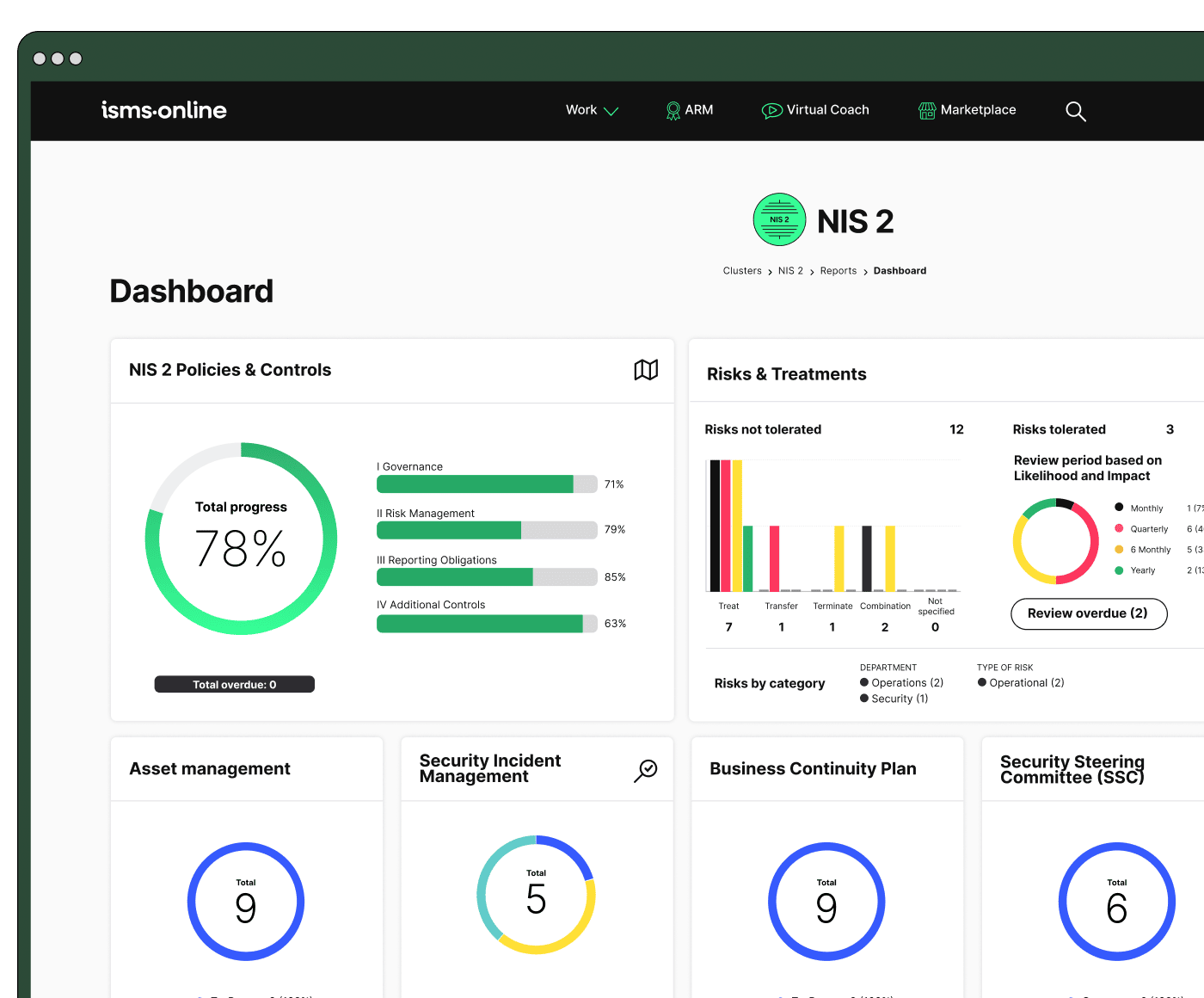
All your NIS 2, all in one place
From Articles 20–23 to audit plans – run and prove compliance, end-to-end.
Why “Live” Compliance and Supply Chain Transparency Are Essential
With NIS 2, reviews once a year-plus behind-schedule policy updates-no longer cut it. Your compliance journey is visible to both auditors and buyers every day. The real differentiator is the speed and clarity with which you deliver live registers, traceable SoA logs, and supply chain compliance affirmations-in plain language and ready for submission, before the question lands.
The speed at which you provide credible compliance evidence now shapes both trust-and deal closure.
Core Actions for Continuous Compliance
- Centralise Documents and Registers: One digital platform for contracts, registry, SoA, HR1 records, and policy acknowledgements.
- Automate Change Notifications: Every material business or supply chain change triggers a compliance and documentation workflow.
- Enable On-Demand Dashboards: Real-time reporting for compliance, legal, audit, or procurement queries-no scramble required.
- Pressure-Test Live Evidence: Run self-tests, propose internal audit dry runs, and ensure your registers remain ready for external inquiry at all times.
| Compliance Trigger | Role / Team | Action | Evidence Key |
|---|---|---|---|
| Regulated client onboarded | Compliance, IT, sales | Registry/SoA update | Client attestation, log |
| Hit staff threshold | HR, compliance, board | Status update, risk review | HR minutes, sign-off |
| Registry upgrade | Board, compliance, directors | Rapid self-assessment | Export, board note |
| Regulator query | Compliance, sales, legal | Instant doc/report export | Evidence bundle, confirmation |
How to Seamlessly Integrate ISO 27001 and Privacy (GDPR/ISO 27701) Into Your NIS 2 Programme
Splitting security, privacy, and supply chain work is a leading source of hidden risk and duplicated effort. NIS 2 was built on the backbone of the ISO 27001/27701 model-making it practical to converge controls, evidence, and process management within a single platform or ISMS.
ISO 27001 × NIS 2: Practical Bridge Table
| Expectation | Implementation Route | ISO 27001 / Annex Ref |
|---|---|---|
| Ongoing risk review | Quarterly evidence mapping | 6.1.2, 8.2, 9.1, A.5.7 |
| Live evidence | Digital SoA & register log | 7.5, A.5.1, A.5.10, 4.4 |
| Supplier chain resilience | Automated onboarding workflow | A.5.19–A.5.22 |
| Privacy integration | SAR log, GDPR mapping, data flow map | ISO 27701, GDPR Art 30, A.5.34 |
The result: your ISMS is no longer a periodic artefact-it’s your operating environment for all NIS 2 and regulatory requirements, smartly layered for each framework or obligation so you can answer every question with a click.
Leadership in Compliance: Always-On, Always Audit-Ready
The true measure of a compliance leader today is not just about being “fine-free” or staying off the regulator’s radar. It’s about building the capacity for instant, documentary proof-ensuring that audits, client requests, or regulator inquiries are simply routine, not crises.
Leadership means closing the gap between regulatory question and board-quality answer-before the outside world ever measures you.
Leadership Playbook (Quick Recap)
- Real, in-the-moment self-assessment: Every material trigger (contract, staff, jurisdiction) demands a review and documented update.
- Automate transparent communications: with all stakeholders: staff, suppliers, customers, and the board.
- Maintain a single, live register: Consolidate evidence, contracts, SoA, and onboarding logs-defensible and accessible.
- Build real-time audit trails: Preparation isnt an annual scramble; its embedded in routine processes and stakeholder engagement.
- Bridge all frameworks: NIS 2, ISO 27001/27701, and supply chain obligations all draw on the same core controls, registers, and up-to-date metrics.
- Position for strategic advantage: When the market demands proof, you dont explain or delay-you demonstrate, with the confidence and speed of a digital compliance leader.
ISMS.online unifies audit, supply chain assurance, and compliance readiness into a living proof platform-turning NIS 2 compliance from a source of risk into a lever for business trust and operational leadership.
Book a demoFrequently Asked Questions
Who actually qualifies for NIS 2, and why does coverage keep catching more companies?
You come under NIS 2 if your company has 50 or more employees or €10 million in turnover and operates in an “essential” or “important” sector listed in Annex I or II of the Directive-covering a wide net, from energy, water, finance, healthcare, and digital infrastructure to food, manufacturing, postal, and digital providers. But the rules reach further: even if you don’t hit those size thresholds, you may fall in scope if you’re a sole or strategic supplier to a critical entity, a linchpin in a regulated supply chain, or specifically named by your national authority. The line can shift suddenly-a new contract, client, supply arrangement, or tender could make you regulated overnight, regardless of last year’s “out of scope” status.
The real trap is believing that what kept you exempt last quarter will still apply after your next deal or restructuring.
To determine if you’re covered, first check the, then review your size and sector for each business line, branch, or subsidiary-national rules can create surprises. Always document critical contracts, payroll, and customer relationships as you grow.
NIS 2 Scope Triggers & What to Document
| Trigger/Event | Documentary Evidence |
|---|---|
| ≥50 employees or €10m turnover | Payroll, HR, annual accounts |
| Annex I/II sector operation | Business code, client roster |
| Sole/critical supply to regulated org | Customer contract, onboarding |
| Listed in client/supplier procurements | Tender docs, registries |
Keep an active “evidence shelf” for every material change-far easier to prove your status (or exemption) in real time as buyers, auditors, and authorities ask.
What’s the difference between “Essential” and “Important” entities – and why does it matter?
NIS 2 draws a bright line: “Essential” entities (Annex I) are the backbone of national infrastructure-energy, health, finance, digital, central administration, space. These firms see proactive, routine regulator oversight, mandatory registry, and face the highest fines (up to €10m or 2% of annual revenue). Audits and reporting happen continuously with little warning; compliance failures attract swift, high-profile action.
“Important” entities (Annex II) include manufacturers, digital services (cloud, SaaS, search), logistics, chemicals, food, postal, and research. These share the same baseline risk management and reporting duties, but enforcement is different: audits and fines are mainly event-driven-after incidents, complaints, or targeted reviews. Self-assessment and readiness matter here, but the burden is less relentless.
Both categories must prove live risk and supplier management, but what changes is immediacy: essential means you’re always on the regulator’s radar.
Table: Essential vs. Important Entities (Impact Overview)
| Entity Type | Auditing Approach | Registry | Enforcement | Example |
|---|---|---|---|---|
| Essential | Proactive, routine | Required | Severe | Power grid, central bank, telco |
| Important | Event-driven | Required | Severe | SaaS, manufacturer, food plant |
Label yourself wrong and you risk both unexpected audits and missed obligations-get it right at the start, not under pressure.
Can you look up NIS 2 coverage in a public database-or is everything self-assessment?
No, there isn’t (and won’t be) an open EU-wide NIS 2 registry for companies, clients, or buyers. Each member state keeps its own confidential list; only regulators and auditors may access it. Some (like Luxembourg or the Netherlands) invite or require companies to register themselves, but most rely on you to perform self-assessment, build evidence, and confirm your status when asked-notably during audits, enterprise tenders, or supply chain onboarding.
If you need to prove coverage (or exemption), be ready with:
- Sector/size self-assessment logs (Annex I/II, HR, finance)
- Business and payroll records (showing when you crossed in/out of scope)
- Customer, tender, and supplier documentation (for supply chain triggers)
- All communications from buyers, auditors, or national authorities
Compliance with NIS 2 isn’t a point-in-time certificate-it’s a chain of live, verifiable evidence you can produce when any buyer or auditor asks.
NIS 2 Status Evidence At-A-Glance
- Conduct baseline assessment (and record logic)
- Update after every significant contract or staffing change
- Store supporting logs and communications as they occur
- Prepare a plain-language rationale to answer due diligence questions
Treat every enterprise client or board inquiry as a mini-regulator check-smooth response now pays dividends at contract renewal or audit time.
How do country and sector overlays change NIS 2 scope for my business?
NIS 2 sets minimum requirements, but national authorities frequently make additions and exceptions. Your specific risk profile might shift with:
- Sector redefinitions (e.g., Denmark splits telecom subsectors)
- Exclusions (Germany exempts “negligible” activities)
- Lower or higher inclusion thresholds (employee count, revenue)
- Criticality rules (naming more/less sectors “strategic”)
Operating in more than one country or business sector? You must self-assess each entity or branch independently. Out-of-scope at headquarters doesn’t mean your UK or German subsidiary is exempt; your in-country client base or workforce may drag you into scope. Any major supplier engagement across borders can have a knock-on effect on obligations.
Table: National Scope Variants-What to Track
| Country/Context | Key Variance | Evidence to Compile |
|---|---|---|
| Germany | Exempts “negligible” activity | Exemption log, contracts |
| Denmark | Multiple telecom subsectors | Service portfolio docs |
| Multinational group | Each branch/entity unique | Country-by-country scope |
A compliance platform like ISMS.online helps you keep status and evidence updated for each operating entity, avoiding risky assumptions and missed local filings.
Which ongoing routines and records are essential for surviving an NIS 2 audit?
Success lies in proactive, timestamped evidence-not mere policies or empty claims. High-survival practises include:
- Quarterly or event-driven scoping: Every new key contract, staff bump, or supply chain event prompts a fresh, signed-off assessment.
- Continuously updated document shelf: Payroll, HR, SoA, supplier onboarding, contract changes-all logged as they happen and kept in one place.
- Statement of Applicability (SoA): Revisit every time a scoping or major contract event occurs-tie each control assignment directly to which entity or process is affected.
- Workflow logging: Every review, update, or registry communication gets a timestamped entry.
- Integrated supplier risk management: Onboard, risk score, and track each critical supplier, with evidence ready for every due diligence or audit.
Modern ISMS solutions (like ISMS.online) automate these routines so you never scramble for receipts or lose track of material changes that could trigger enforcement.
Bridge Table: NIS 2 Expectations and ISO 27001 Parallels
| NIS 2 Requirement | ISO 27001/27701 Clause | Operational Evidence |
|---|---|---|
| Regular scope review | Clause 4.1, A.5.19/.20/.21 | HR log, SoA, supplier files |
| Risk management & workflow | Annex A controls | Logs, onboarding docs, workflows |
| Evidence/data management | Clause 7.5, SoA, dashboard | Versioned files, audit exports |
| Privacy obligations | ISO 27701, GDPR Art. 30 | SAR log, privacy register |
A live register turns your audit posture from fire-fighting to readiness-and makes client trust far easier to prove.
If you’re unsure about NIS 2 status, what is the single smartest move?
Start with a baseline gap and evidence review now-never delay until a regulator or key client asks. Download the sector/size worksheet, map all product lines, brands, and supply chains to the latest NIS 2 Annexes, and log every significant contract or staffing change. Collate contracts, payroll, supplier onboarding, and any official communications in a continuously updated, accessible evidence folder.
Platforms like ISMS.online automate quarterly reviews and event-driven updates, maintain instant access to your SoA, and centralise audit and contract evidence. This ensures you’re always ready to answer partners, auditors, or regulators with confidence, not scramble for missing files or forgotten assessments.
Every day without clarity multiplies your risk and undermines board and client confidence. Build your live compliance shelf-because the companies with proof at their fingertips will always lead the new trust economy.
Confidence is measurable: the organisations who can produce their audit trail on demand aren’t just compliant-they’re everyone’s safest partners.
Traceability Table-Event to Evidence Example
| Triggering Event | Risk Response | ISO/Annex Reference | Evidence/Snapshot |
|---|---|---|---|
| New strategic customer | Scope review, SoA | ISO 27001 4.1, SoA | Contract, payroll, HR/board note |
| Supplier incident | Supplier audit/update | Ann. A.5.21 | Email, audit trail, registry |
| Headcount bump | Scope log update, SoA | SoA, Ann. A | Payroll, SoA revision, HR log |
When in doubt, act: test your status, log evidence, and adopt systems that keep you always ready for instant review.






