





































Why Spotting a “Significant Incident” Isn’t Optional-It’s Board-Level Survival
Not all IT failures are created equal, but under NIS 2, the true test is more than “what broke?” It’s whether you can show your board and a regulator why you called an event “significant”-or didn’t-and how quickly you acted. Escalation paralysis quietly stalks many compliance teams: delay a report and risk a spiralling crisis; jump the gun and face complaints of oversharing or panicking regulators. NIS 2 doesn’t hand you a cheat sheet. Instead, it disrupts routine by keeping its definition of a “significant incident” purposely ambiguous-sector-responsive, risk-weighted, and designed to challenge senior leaders.
The moment you hesitate is the moment the story leaves your control: speed and completeness, not uptime, define your credibility.
The law’s language in Article 23 orbits around operational and societal impact: if an incident disrupts essential services, halts critical processes, or triggers a backlash in supply chains or reputational standing, the lens flips from “technical” to “significant.” ENISA drives home that ambiguity isn’t an escape route-it’s a call for clarity written into your scenario playbooks. If your definitions and thresholds stop at “downtime,” your organisation will trail events, not manage them.
Downtime is just one marker. Real significance is about the blast radius: a 10-minute blackout on payday that freezes payroll, a brief outage in a hospital’s ordering system, a supply chain stall that blocks hundreds of retail checkouts. Minor hitches resolved in seconds, with no real-world harm, rarely require regulatory notice; but a short but public mess-up in the wrong moment can tilt regulators’ questions from technical fix to leadership fitness. The goal? Prove, with evidence, not just logs, that you acted deliberately, mapped your triggers, and had senior-level consensus well before anyone outside asked.
When Is Downtime “Significant”-And Why Is Duration Never the Deciding Factor?
Many teams default to “time out” or “tickets closed” as their incident litmus test. But for NIS 2, what counts is whether the event triggered harm that persisted beyond mere inconvenience. The fear of over-reporting can paralyse response, but history shows the real danger lies in not catching the early signs of snowballing impact-a delayed notification that leaves customers, partners, or the public out of the loop.
Fines rarely follow the initial IT error. It’s the gap between impact and documented, timely response that puts boards in regulators’ crosshairs.
So, when does downtime cross the line?
- Critical function disruption: If health, payment, grid, or key business processes go offline-at any scale-the calculus immediately changes to “significant until disproved.”
- Breadth and depth of impact: The more branches, sites, customers, or value chains affected simultaneously, or the longer critical workflows are disrupted, the higher the urgency.
- Real harm, not just hassle: If you miss an SLA, expose the business or customers to financial loss, or erode trust-or if a cascade effect puts secondary processes at risk-log the event as potential “significant” and escalate accordingly.
Even incidents that resolve “on their own” should be internally recorded, including TIMESTAMP, responsible parties, and actions taken. Describing what didn’t happen (no customer impact, no data loss, single-site only) is as important as documenting what did. The line is dynamic: a brief cloud outage at 2am in a test environment has far less consequence than 9 minutes offline at year-end, in front of 20,000 payroll recipients.
Incident Scenario: When Minutes Outweigh Excuses
Imagine a regional hospital network’s communications platform failing for just 11 minutes during a medicine order cut-off. The team patches the issue, but a shipment misses its window, with delayed treatments and a coverage gap. In post-mortem, it’s apparent the downtime mattered less than the knock-on effects, both operationally and socially. NIS 2 cares about the narrative of impact and the chain of communications; document every action, escalate by context, and plan your next simulation around this hard-earned lesson.

Master NIS 2 without spreadsheet chaos
Centralise risk, incidents, suppliers, and evidence in one clean platform.
Are There Hard Lines-Or Did the Regulator Leave It Up to Your Sector?
Most compliance leaders wish for a “magic number”-10-minute downtime or 500-user threshold-but sector context always trumps mechanical rules. While NIS 2 sets the legal baseline, sector authorities and local statutes will often “top up” with specific triggers mapped to volume, value, or population at risk. What matters is showing that you mapped your response to sector reality, not just guesswork.
Before your next audit, walk through this ISO 27001 bridge table to surface blind spots:
| Expectation | Operationalisation | ISO 27001 / Annex A Reference |
|---|---|---|
| Log/categorise every event | Record impact, escalation, and remedial actions | A.5.24, A.6.5 |
| Escalate at predefined points | Trigger real-time notifications at defined thresholds | Cl 6.1.2, A.8.15 |
| Review, improve, repeat | Schedule root-cause and learning sessions post-event | A.5.35, A.8.17 |
| Evidence chain maintained | Keep signed logs, role attribution, and comms records | A.5.27, A.5.29 |
Sector guidance examples include:
- Cloud/SaaS: >10 min, or >1 million users affected triggers immediate escalation and authority notice.
- Health/Energy: Any patient or grid impact >5 min, especially during batch or critical operations.
- Finance: Single event >€500,000 or significant market disruption requires urgent regulator reporting.
Most audit failures arise not from missing the number, but from missing the rationale -inability to demonstrate how you concluded something was, or was not, significant.
Supply chain dependencies don’t absolve the business. If a critical vendor’s outage snowballs to your customers, regulators will want to see how you recorded, escalated, and communicated the impact-not how quickly your service-level agreement let you point fingers. Internally, clarity of “who logs what and when” is as important as technical detection-simulate across roles, design playbooks for board-level buy-in, and close ambiguity before the next crisis hits.
When Your Vendor Trips Up, Why Does It Become Your Incident?
It’s tempting to downplay supplier-caused incidents as out-of-scope. NIS 2 reverses this: your regulator expects you to pull every supply chain incident through your own risk, logging, and escalation pipeline. Transparency-role attribution and chain-of-custody-closes more investigations than technical wizardry.
Your incident framework is only as strong as the weakest logbook in your vendor map. Only proactive evidence closes that gap.
Real-World Example:
A payroll vendor’s patch failure halts payments for 9 minutes on payday. Your log should trace detection (timestamp, monitoring), notification to the vendor, documentation of all communications (emails, calls, tickets), and every internal action. A clear trail showing the precise moment of detection, escalation, communication, and eventually closure-along with named personnel for every step-proves maturity, accountability, and defensibility. Vagueness, delayed reporting, missing artefacts (even with good intent) fuel regulatory suspicion.
Supply Chain Risk Control Checklist:
- Maintain an actively managed risk register: map every supplier to their contact/contract/dependency and responsible internal role.
- Ingest all supplier incidents into your incident tracker, regardless of cause.
- Document timestamped evidence for every incident phase: detection, notification, response, recovery.
- Assign a named owner for each live incident-with authority and responsibility clearly stated.
Strong playbooks include preconfigured supply chain scenarios in your tabletops, plus live, in-situ evidence capture. If uncertain, escalate for internal review, attach all correspondence, and update your playbook for any lessons learned.
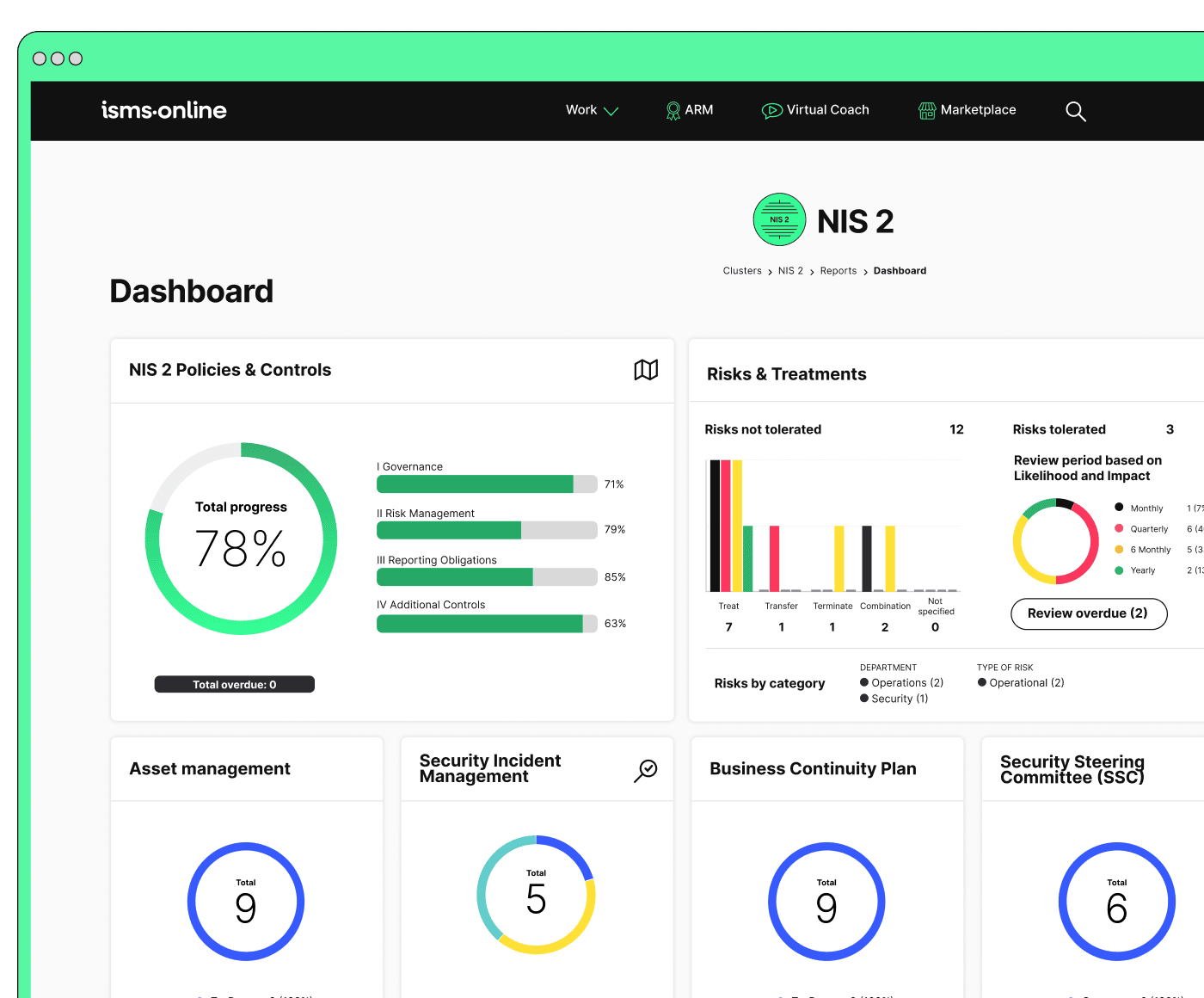
Be NIS 2-ready from day one
Launch with a proven workspace and templates – just tailor, assign, and go.
What Does Defensible Evidence Mean Under NIS 2-and How Do You Build It?
Defensibility isn’t volume; it’s cohesion, retrieval, and role attribution. NIS 2 makes explicit what ISO 27001 always implied: logs and tickets aren’t enough. Auditable evidence means linking every event to a named responder, mapped to action, and closed by a decision-maker.
Key demands:
- End-to-end chronological logging of every event phase.
- Named escalation/closure sign-offs-board-level visibility and approval are now routine.
- Record of all stakeholder communications: authorities, vendors, customers, auditors.
- Playbook-driven, role-anchored mitigation action-every step physically signed off or attested.
- Continual addenda: new facts, new actions, new mitigations logged in real time.
Here’s a model traceability table, bridging trigger, risk, control, and evidence:
| Trigger | Risk Update | Control / SoA Link | Evidence Logged |
|---|---|---|---|
| Payroll blocked | Service disruption | A.5.24, A.8.15 | System logs, vendor comms, board sign-off |
| Datacentre outage | Third-party risk | A.5.21, A.7.11 | Incident tracker, supplier notification |
| €300,000 error | Material loss | A.8.17, A.5.35 | Timeline, recovery plan, audit trail |
ISMS.online offers an embedded incident logbook, digital signature workflows, artefact attachment, role-based escalation, and auto-bundling for audit evidence-every part of the evidence chain in one, examiner-friendly place.
Regulators want a story-clear, sequential, and attributed-of who knew, who acted, and when. Not just activity, but accountability.
Checklist for Defensible Evidence:
- [✓] Linked logs of detection, notifications, decisions, and resolution.
- [✓] Named, role-mapped escalation/closure sign-off at each stage.
- [✓] All external/internal notifications stored and mapped.
- [✓] Rationale for every reporting decision, including why not to report.
- [✓] Retrieval-ready: evidence packaged in minutes, not days.
How Big Is “Local Variation”? Why One Policy Isn’t Enough for NIS 2
Leadership teams with cross-border responsibilities know: EU harmonisation has limits. Each member state can add unique triggers, reporting windows, or documentation steps. Health and banking are shaped by national guidelines that sometimes raise the bar above baseline NIS 2.
A policy manual centralised in London is little use if teams in Germany or Ireland face different templates, forms, or report deadlines. Board oversight therefore requires a live reporting matrix per country, sector, and function.
True readiness isn’t a static PDF. It’s live, mapped, version-locked role responsibilities, updated as the law and your business evolve.
ISMS.online overlays the NIS 2 map with local requirements-automating VC and approval flows, so responders always act from current knowledge. Areas covered should include:
- Country/sector reporting matrix, visible at a glance.
- Exportable, version-sealed audit packs per jurisdiction and body.
- Role-mapped, scheduled review of workflows and assigned responsibilities.
- Real-time staff comprehension logs-proof that policy updates are understood and acknowledged, not just distributed.
When deciding if a “significant” line is crossed, document the thresholds, timing, and role knowledge that shaped your decision. That chain of understanding is as auditable as the underlying event.
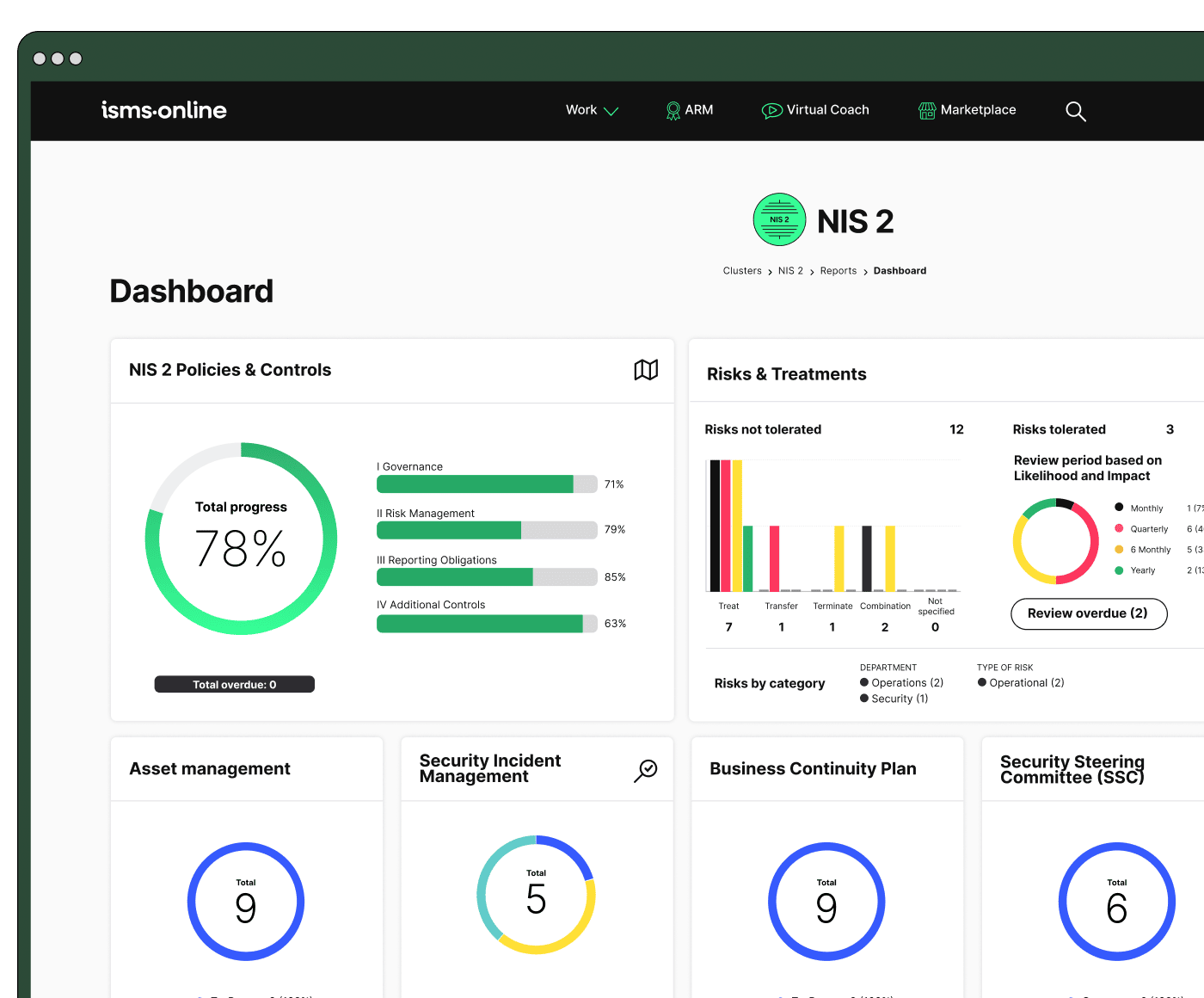
All your NIS 2, all in one place
From Articles 20–23 to audit plans – run and prove compliance, end-to-end.
What Will Investigators and Regulators Actually Review First?
Audit survivors know: it isn’t your best intentions or compliance tick-boxes, but the integrity and attribution of your evidence story that holds up. Expect investigators to:
- Ask for a natural-language summary of each phase, not just raw logs.
- Demand continuous, gapless logs bridging impact, actions, escalation, and closure.
- Require visible, attributable sign-off-a digital or physical mark at each point.
- Test version control, asking for any and all updates with date stamps.
- Request proof of “lessons learnt,” seeking evidence your process leads to improvement.
Planned discipline and chain-of-action attribution will always outshine rushed box-ticking or half-remembered logs.
ISMS.online bakes in digital sign-off, role-based workflows, and version control at every stage. Bundling, exporting, and packaging evidence for audit becomes a daily practise-no more late-night scrambles.
Why ISO 27001 and NIS 2 Together Make Your Evidence Unbreakable
ISO 27001 badges validate your process; NIS 2 provides the test. Together, they let compliance teams move from paper exfiltration to operational strength-reporting, mitigation, and resilience, not just artefacts.
| NIS 2 Demand | Operational Response | ISO 27001 / Annex A Ref |
|---|---|---|
| 24/72-hour windows | Automated escalation workflows | A.5.24, A.5.4, A.8.2, A.8.3 |
| Supply chain integrated | Linked supplier mapping | A.5.21, A.8.19, A.8.25 |
| Digital sign-off, every phase | Board-reviewed, role-mapped workflows | A.5.35 |
| Recovery evidence for all steps | Bundled logs, timestamps, reviews | A.5.27, A.5.29 |
| Stakeholder comms | Stored messages, notifications, logs | A.8.16, A.7.4 |
Your quarterly ISMS drill triggers a new vendor risk. Policy updates flow to all responders, triggering a role-mapped tabletop test, real-time evidence logging, and end-to-end review. Armed with a compliance “map” and living workflows, you produce a documentation pack for any authority at speed, with confidence, and without ambiguity.
What Does “Board-Level Readiness” Look Like in NIS 2 Incident Response-And How Do You Achieve It?
The real difference-maker is moving from a reactive incident culture to a proactive, board-owned, evidence-driven discipline. NIS 2 no longer allows compliance to be a tech-only or middle-management item: boards must signal their monitoring, sign-off, and review at every stage. Teams using ISMS.online build this as a “business habit,” not a project-bundling incident mapping, evidence chain, and live learning together.
Resilience isn’t luck. It’s the result of disciplined, attributed, iterative, and board-visible compliance, before and after the regulator arrives.
Board-level readiness means:
- Board sign-off on every stage of the escalation and closure path.
- Live demonstration of scenario-based drills, staff comprehension, and workflow improvement.
- Fast, valid, and comprehensive evidence packs, tailored per regulator, with versioning locked at each step.
- A learning loop-every event feeding future readiness, tracked, attributed, and wrapped in approvals.
Your next step:
Lead your organisation out of the audit spiral. Let your incident response deliver not just compliance, but trusted resilience-visible internally and externally, and always a step ahead of regulator and competitor alike.
Show your board-and your regulator-what certainty really looks like. Incidents are inevitable; only evidence and disciplined action set trusted teams apart.
Frequently Asked Questions
What does NIS 2 legally define as a “significant incident”-and why does it matter beyond just IT outages?
A “significant incident” in NIS 2 terms is not just an IT hiccup-it’s a legally designated event that causes noteworthy harm or disruption to your organisation, your customers, or the wider public. Under Article 23 of the NIS 2 Directive, significance is measured by the real-world impact: service outages, data loss, supplier failures, or cyberattacks that lead to serious business interruption, financial loss, reputational damage, or endangerment of public safety. Crucially, this definition reaches beyond your own systems-it applies even if the disruption starts with a partner or supplier.
Significant under the law reflects harm to people, markets, or operations-not just technical failure. It’s about consequences.
Authorities, from regulators to CSIRTs, focus on what the disruption actually did-who couldn’t access critical services, whether transactions were blocked, or whether the public was put at risk. For example, a payroll system going down on payday, a supplier data breach that impacts your own operations, or a technical failure in a patient care system could all qualify, regardless of how or where the incident originated. Local and sector-specific rules vary: financial services, healthcare, and digital infrastructure all have stricter or swifter reporting bars.
Key Insights:
- The focus is on the tangible consequences: business, customer, and societal impacts take priority over root technical causes.
- The definition of “significant” adapts by sector and jurisdiction: banks, hospitals, and digital providers each have their own triggers.
- You must document both the impact and your assessment process-including board or senior management input.
When does a service outage or downtime become a NIS 2 incident you must report?
Downtime crosses into “reportable incident” when it disrupts core business operations, key services, or causes knock-on harm to customers or the public. Regulators don’t care about every brief delay-it’s the real-world consequences that trigger notification requirements.
Typically, you must notify authorities if:
- Essential services are stopped or degraded: for a meaningful period or number of users.
- Outage duration, user impact, or financial loss exceed regulatory thresholds (these can be sector-specific).
- The incident causes reputational damage or legal liability-for example, delayed payroll, blocked patient care, or banking transaction failures.
Most agencies and sector authorities publish their own thresholds and examples. For instance:
- Cloud/hosting: Any outage over 10 minutes impacting more than one million users, or over 5% of your user base for more than one hour.
- Healthcare: Any downtime that interrupts patient care, even for a few minutes.
- Finance: Service failure resulting in €500,000+ transaction losses or halting market operations.
| Sector | Typical Event | Common Threshold |
|---|---|---|
| Cloud | Major service outage | >10 min, 1M+ users, 5%/1hr |
| Healthcare | Patient-critical system failed | Any downtime, care blocked |
| Financial | Blocked transactions | >€500k, markets interrupted |
A non-production bug or a brief delay with no operational impact is usually not reportable-but if users, revenue, or safety are affected, it almost certainly is.
How can your team objectively determine if an incident meets NIS 2 “significance” for reporting?
The right approach is a structured decision tree-never gut feeling. Tie each event to clear criteria set by your sector and jurisdiction, and require internal documentation and managerial sign-off.
Checklist to assess reportability:
- Did a core system or process stop or become seriously impaired?:
- How many users or customers were affected-and for how long?:
- Did the failure cause a cascade to third parties, partners, or the wider public?:
- Did it generate direct financial losses, legal liability, or reputational harm?:
- Is there board or C-level approval of your reporting decision?:
- Have you checked the latest sectoral/national triggers and templates?:
If any answer is “yes” or even “not sure but possible,” escalation and reporting are safest.
Every documented decision-yes or no-signals regulatory maturity and helps safeguard against future scrutiny.
Visual quick-check:
- [ ] Essential service or process affected (not test/dev)
- [ ] Number/duration/financial impact met
- [ ] Public, customer, or partner disruption incurred
- [ ] Decision logged with role and timestamp
- [ ] Local/sector tables reviewed for stricter triggers
What are the must-have documentation elements for a NIS 2 incident-what leads to audit or fines?
Role-attributed, time-sequenced, and traceable documentation is non-negotiable. Your records must tell the complete story:
- Primary logs: Raw system/SIEM/application logs preserved from first alert to closure.
- Action chronology: Stepwise record of all triage, escalation, mitigation, and closure-each step signed and timestamped.
- Board/management approvals: Confirmed sign-off at each key decision, preferably digital or legally-witnessed.
- Notification evidence: Copies of all regulator, customer, public, and internal notifications-each cross-referenced to the incident event(s).
- Official reporting templates: Use ENISA or your national regulator’s formats; informal summaries are often rejected outright.
If documentation omits a step, a sign-off, or an official template, in an audit’s eyes it didn’t happen.
Table: End-to-end traceability snapshot
| Event | Responsible | Evidence |
|---|---|---|
| SIEM/sensor alert | SecOps Lead | Log, ticket, time-stamp |
| Escalation | CISO/Board | E-mail, sign-off sheet |
| Notification sent | Legal/Comms | Submission, reply log |
| Recovery & close | IT Ops | Recovery log, sign-off |
The most common mistakes: missing a key sign-off, using ad-hoc templates, or failing to collect logs-all can lead to fines.
How do national or sector-specific rules change the NIS 2 “significant incident” threshold and reporting process?
NIS 2 is EU-wide-but every country and sector stacks on additional obligations:
- France/Germany/Netherlands: Tighter deadlines (24–48 hour notification), unique sector-specific event triggers (e.g., energy, banking).
- Healthcare, finance, digital infrastructure: Often stricter in duration/impact; sector templates and evidence demands vary.
- Regulatory curveballs: Requirements can change following major incidents or new national law-always monitor for updates.
Best practise: Build a living matrix of all relevant triggers and templates for your organisation, and assign a compliance owner to keep it up to date.
| Country / Sector | Unique Trigger or Deadline | Sector Template | Full Audit Deadline |
|---|---|---|---|
| France/Healthcare | Any >5-min clinical system loss | Yes | 30 days |
| Germany/Energy | Grid incident, any duration | Yes | 48 hours |
| NL/Banking | Transaction block >€X | Yes | 24 hours |
For multinationals or cross-sector firms, what’s a near-miss in one country becomes reportable in another-always cross-validate.
How do regulators and CSIRTs judge if your incident response and report are “good enough” for NIS 2?
Regulatory scrutiny is both prompt and detailed. Authorities want to see:
- Timeliness: Early warning usually within 24 hours; detailed update in ≤72 hours; sector updates as required.
- Completeness: All required data, context, logs, and management approvals are included-no gaps.
- Traceability: Clear, chronological thread from detection to notification, through to management review and lessons learned.
- Explicit role attribution: Every action is tied to a named owner-no “ghost” decision-makers.
- Continuous improvement: Evidence of incident review, lessons learned, and adjustments to policy/process in the aftermath ([see,]).
If your report is incomplete, late, or ambiguous in ownership, authorities may escalate to formal audit-potentially resulting in fines or regulatory interventions.
It’s not perfection regulators want-it’s proof your organisation learns, adapts, and owns every step of its incident process.
How does ISMS.online help organisations master cross-border, sectoral NIS 2 incident compliance and resilience?
ISMS.online brings together every aspect of NIS 2 reporting, incident handling, and audit traceability under one roof:
- Automated templates and workflows: mapped to every country and sector, always updated as regulations change.
- Role-based evidence gathering: All logs, notifications, actions, and sign-offs are automatically time-sequenced and versioned, eliminating manual chase and patchwork files.
- Boarddash compliance dashboards: Instantly track incident status, open risks, team readiness, and cross-jurisdictional compliance at a glance.
- Regulator-grade evidence packs: One-click export of everything-from trigger to closure, including every policy, acknowledgment, and management review.
- Live obligation tracker: Automatic notifications and workflow prompts for any new sectoral or national requirement-so you never miss a new trigger.
Incidents don’t make or break your compliance-documentation and learning do. ISMS.online turns every event into a trust-building opportunity you can prove.
Table: NIS 2 incident-proof audit trail (Annex A references)
| Trigger/Event | Risk Update / Control | ISO 27001 Annex A (2022) | Audit Evidence |
|---|---|---|---|
| SaaS outage | A.5.24: Incident mgmt | A.5.24, A.8.15 | Detection event, approvals |
| Vendor disruption | A.5.21: Supply chain | A.5.21, A.8.19 | Vendor emails, notification |
| Financial loss | A.5.35: Review / logs | A.5.35, A.8.15 | Recovery log, sign-off |
Ready to build resilience-not just pass the next audit? With ISMS.online, every incident is a step toward robust, regulator-proof compliance and board-level trust.






