





































How NIS 2 Changes the Rules for Board Accountability in Banking
You no longer have the protection of distance. Under NIS 2, board members and senior executives in EU banks are directly and personally accountable for the institution’s operational cyber resilience, disclosure duties, and security incident outcomes. Responsibility is not diluted by title or by handing off to technical teams; the law targets those in charge, and does so with explicit force.
When cyber risk becomes a boardroom matter, the shield of hierarchy shatters-compliance demands fingerprints, not fingerprints wiped away.
The Meaning of “Essential Entity”-And Why It Brings You Into the Regulatory Firing Line
For nearly all banks operating in the EU, NIS 2’s “essential entity” definition is triggered by business and sector classification, not size or cross-border presence. Once classified, you face the highest level of cyber oversight-this means unambiguous responsibility for ensuring the end-to-end efficacy of security policies, risk management, and reporting. Attempts to delegate oversight deep into the risk team or to bury decisions inside committees or the “CISO layer” will fail at audit.
Board-Driven Compliance: No More Passive Endorsement
The legal expectation is active oversight: annual risk reviews, asset inventories, policy updates, and, most importantly, live, operational incident response readiness are all formally approved and revisited in board cycles. Board inaction, were it to occur, is a non-defensible breach.
Incident Reporting: Twenty-Four Hours to Notify, Seventy-Two for Substance
When a significant security event hits, banks must inform their sector regulator within a single day-often before full facts are known, but always with an initial risk estimate. Complete, detailed disclosure must follow in seventy-two hours. This is leadership in motion, not theory: failure to notify = direct board-level exposure.
The New Consequences: Fines, Oversight, Reputation at Stake
Should boards fall short, regulatory consequences are severe: fines of up to €10m or 2% of global turnover are the start. Public reputational risk-the kind that erodes customer and shareholder trust-often emerges from poorly-handled, publicly-documented compliance failures.
The Role of Living Documentation
Regulators and auditors will expect a trail of tangible board engagement: measured approval cycles, signed minutes, live incident logs, remedial actions, and proof of incident learning. Static governance is inert and fails NIS 2 tests; ongoing documentation-refreshed, board-reviewed, and accessible-serves as the ultimate defence.
Book a demoWhy Asset Clarity and Traceability Are Now Non-Negotiable in NIS 2 Banking
Under NIS 2, ambiguity is exposure. Asset inventories and their risk histories must be system-based, owner-mapped, and audit-traceable-no more bottom-drawer spreadsheets, casual sharepoint folders, or legacy lists.
A single asset slippage can escalate swiftly from oversight to operational risk-and regulatory sanction.
Building a Living Asset Register: Beyond the Old Spreadsheet
Your asset inventory must not merely “exist”-it must be structured, live, and tie business owners to every item: servers, databases, applications, vendors, and cross-cloud services. Each entry must carry a directly linked risk profile, scheduled review interval, and clear business/recovery ownership. If one asset falls out or is “lost” in migration or decommissioning, the entire register’s credibility collapses.
Board Risk Appetite: Turning Statements Into Evidence
It is not enough to endorse a general risk appetite statement. NIS 2 expects real-world links: documented risk exceptions, control coverage, and signed periodic reviews-each provably mapped back to asset changes or risk escalations. Boards must see and approve live exceptions; IT and business units must demonstrate line-of-sight back to policy.
The Cadence of Reviews-Incident and Change, Not Just Calendar
Static, annual-only audits are obsolete. Each major incident, supply chain disruption, or business reconfiguration must trigger an out-of-cycle review, placing pressure on systems and processes to log and execute risk updates in real time.
Coverage of Cloud and Supply Chain
No loopholes remain: third-party providers, cloud workloads, and fintech partners are within scope. They must be risk-scored and periodically reassessed as living extensions of your bank’s attack surface.
Traceability Table: Evidence in Action
| Trigger | Risk Update | Control/SoA Link | Evidence Logged |
|---|---|---|---|
| New SaaS onboarding | Cloud provider risk scored | A.5.21, A.8.30 | Vendor DD file, contract, asset log |
| Decommission legacy tech | Update risk, mark as obsolete | A.8.9, A.8.32 | Decom proof, risk closure statement |
| Vendor breach | Increase vendor risk rating | A.5.19, A.5.20 | Incident report, board minutes |
A traceable asset is a controlled risk-a traceable risk is a passable audit.
ISO 27001 Bridge Table
| Expectation | Operationalisation | ISO Ref |
|---|---|---|
| Complete asset list | Live register, owner tagged | A.5.9 |
| Risk linkage | Evidence in risk register | A.8.2 |
| Board signoff & review | Minutes, SoA, audit log | 9.3, A.5.4 |

Master NIS 2 without spreadsheet chaos
Centralise risk, incidents, suppliers, and evidence in one clean platform.
Why Incident Response Policy Alone Won’t Secure Banks Under NIS 2
Paper policies don’t save reputations during a breach. Incident response is proven in action, not in documents. For banks, “tabletop tested” and “signed off” are only starting points. NIS 2 brings relentless scrutiny to every phase of the incident cycle-from detection, through escalation, to full post-mortem learning.
Incidents expose policy rot-regulators focus where comfort fails.
Detection and Escalation: Proving Readiness, Not Just Awareness
SIEM platforms, machine learning, MFA, and targeted logging are only as good as their triggers for escalation and action. Automatize escalation for all flagged events; treat manual triggers as a fallback, not a process.
The 24/72-Hour Drill: Executive Muscle Memory
Run live escalation drills: can your team detect, assess, and notify a NIS 2 reportable incident within the 24/72-hour window? If not, audit evidence will show culture decay, not resilience.
Evidence: Forensics and Chain of Custody
Auditors want direct logs: who took which action, when, and with what evidence. Chain-of-custody for forensic artefacts must be live and retrievable. Informal notes, chat logs, or vague “action taken” statements will be rejected.
Scenario Testing and Board Signoff
Only scenario-based exercises, documented in logs, demonstrating real workload and signed by management, will prove resilience and satisfy audit.
Harmonisation Across Jurisdictions
For multinational banks, harmonise templates, reporting forms, and escalation checklists across groups. Regulatory disasters often stem from jurisdictional divergence, not technical failure.
Tyre-Kicking Reviews Close Loops
Each incident (and near miss) must result in updated controls, learning logs, and fresh signatures-from IT up to the board. The mantra: “Prove the test fixed the weakness.”
Can Your Supplier Chain Stand Up To Regulatory Scrutiny?
You are only as strong as your most fragile supplier. For banks, every supply chain connection is both a business enabler and a risk multiplier. Under NIS 2, risk cannot be pushed downstream: accountability never leaves the boardroom.
Due diligence without evidence is a plain hope-auditors crush hope with logs.
Supplier Proof: Artefacts That Satisfy Auditors
Compile initial onboarding risk assessments, contractual security requirements, scenario-based stress-testing records, and periodical evidence of review. Ensure you document every phase: onboarding, contract execution, live operation, response drills, and offboarding.
Contract Hardening as the New Standard
Contracts should codify incident notification windows, supply side reporting, performance and security obligations, and explicit audit rights. Memoranda and verbal assurances are compliance failures.
Live Monitoring: Supplier Risk Dashboards
Implement supplier risk dashboards-live, not quarterly-tracking incidents, performance, and compliance flags. The visibility expectation is always current.
Workflow Traceability
Capture onboarding logs, periodic assessments, incident responses, and offboarding activities in a system that aligns with core asset and incident registers.
Offboarding: Documenting Final Control
As suppliers exit, prove all data-especially regulated and customer data-has been returned, wiped, and evidenced. “We trust our supplier” is not audit evidence.
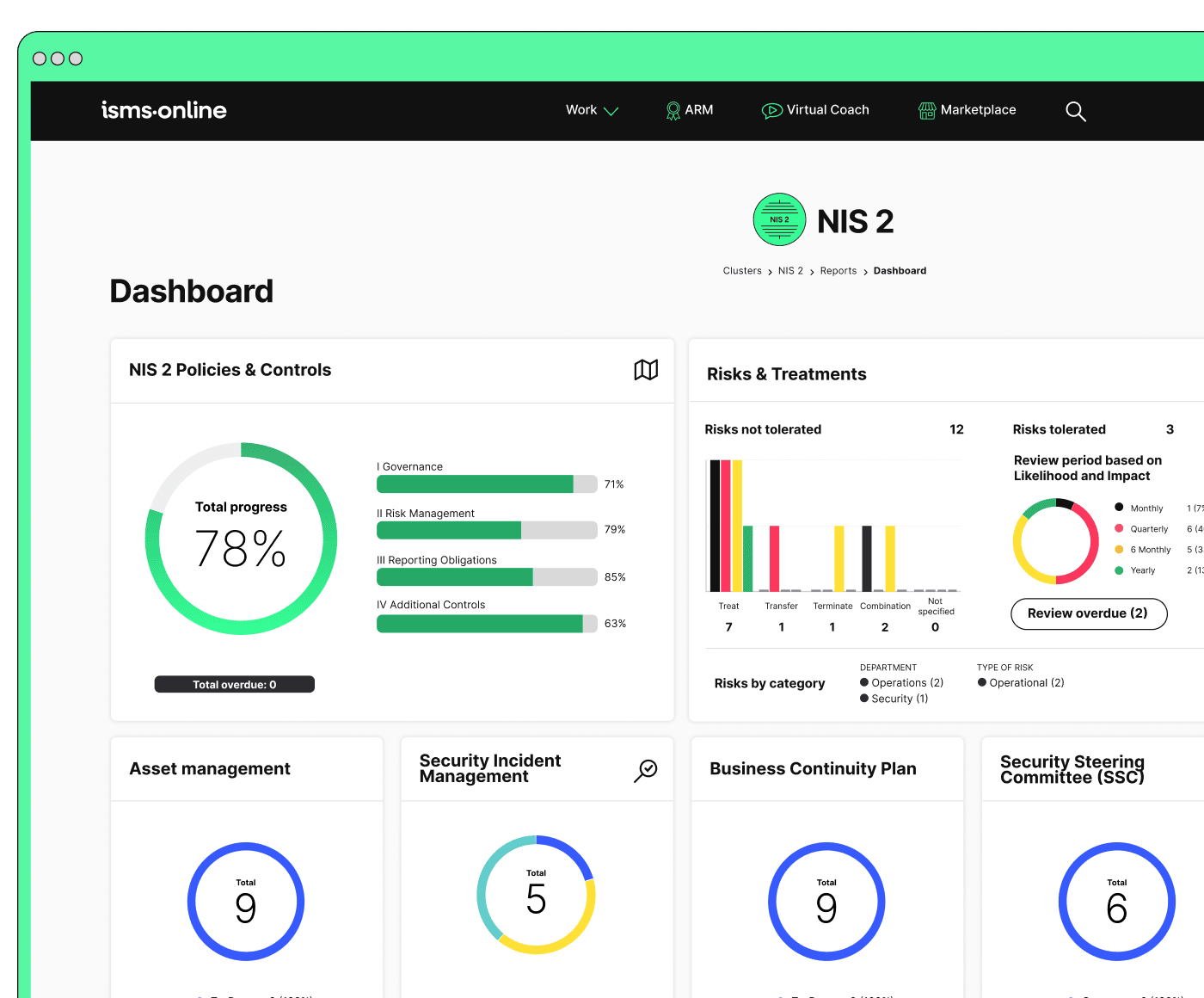
Be NIS 2-ready from day one
Launch with a proven workspace and templates – just tailor, assign, and go.
Will Your Access Controls Pass a Real NIS 2 Audit?
Access management goes beyond periodic permission reviews. Every privileged, admin, or remote access must be logged, tied to a business owner, and aligned to a certifiable workflow. Fail here, and exposure radiates straight to the CISO and board.
The Non-Negotiables: Which Events Demand Evidence?
Onboarding of new admins, role changes, and deprovisioning are the “Big Three”-risk climaxes. Automated access management, recertification cycles, and timely deprovisioning must generate logs. Missing evidence equals compliance failure.
Privilege Controls: MFA and More
Auditors require system logs for MFA on all privileged accounts, with readily accessible records of every authentication event. Policy is not enough; it must be lived.
Joiner/Mover/Leaver: Automate or Be Audited
IGA solutions should underpin the entire access workflow. Every change is logged, reviewed, and-where applicable-signed off by both IT and a business function. Manual processing invites nonconformity.
Accountability and Recertification
Who last reviewed this admin account? When was this role last recertified? You need audit logs and attribution for every event.
Key Table: Access Rights in Practise
| Event | Response | Control/SoA Link | Evidence |
|---|---|---|---|
| Admin account created | Board signoff, access log updated | A.5.18, A.8.2 | Approval record |
| Role changed | Rights recertified | A.5.15, A.5.16 | System/email logs |
| Account decommissioned | Audit log of deprovision | A.8.2 | Deprovision proof |
Does Business Continuity Live Beyond Paper at Your Bank?
For NIS 2, business continuity and disaster recovery are not static documents-they are tested systems, tied to ongoing risk management and live board engagement. A business continuity plan (BCP) is only as defensible as its last drill.
A true BCP is discovered in its proving, not its publication.
Evidence Rules: What Matters to Auditors
Auditors and regulators expect scenario/test logs, vendor participation records, asset-risk mappings, and board signoffs-materials that show engagement from leadership through technology and supply chain.
Board-Level Engagement
Prove minutes of board reviews, logs of scenario planning, and active decision-making are in hand. Engagement is not “awareness”; it requires “action and record.”
Integration: Avoid Siloed Planning
Integrate DR, backup, and incident management. Every plan should reference others, ensuring unity and resilience. Disconnects are compliance gaps.
Supplier Chain and Scenario Drills
Record evidence of supplier participation, capability feedback, and remedial learnings in scenario exercises. Supply chain is always in-scope.
Lessons Learned: Loop Closure
Every incident or drill should result in documented improvement actions and sign-offs. Static plans miss live risk.
Bridge Table: NIS 2 to ISO 27001/Annex A
| NIS 2 Requirement | ISO/Annex A Operationalisation | Required Evidence |
|---|---|---|
| Board reviews BC/DR | 9.3, A.5.29, A.5.30 | Minutes, scenario logs |
| Map critical systems | A.5.9, A.8.2, A.8.14 | Asset/risk inventory |
| Supplier drills | A.5.21, A.5.19, A.8.30 | Test records, feedback |
| Post-incident review | 10.1, A.5.27, A.8.34 | Review logs, updates |
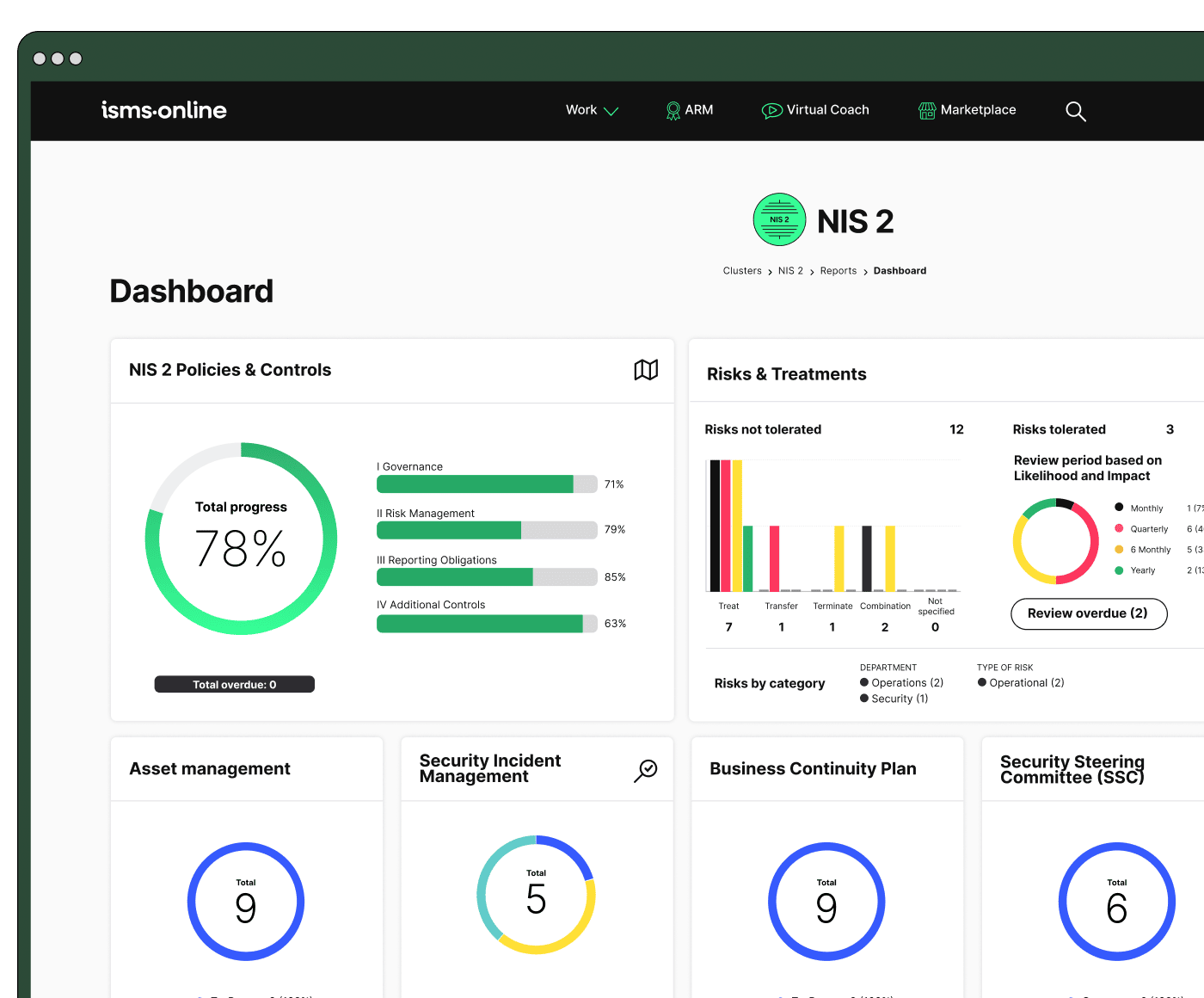
All your NIS 2, all in one place
From Articles 20–23 to audit plans – run and prove compliance, end-to-end.
How Continuous Monitoring Transforms Compliance Into Ongoing Improvement
The days of “audit snapshot” records are gone. Logs and monitoring now create an ever-refreshing feedback loop, systematically closing gaps and accelerating issue resolution before the next audit-or next breach.
A bank’s audit trail should feature progress markers, not just static compliance snapshots.
Audit-Ready Monitoring: Coverage and Evidence
Every change, event, and configuration passing through systems-especially those affecting critical confidentiality, integrity, or availability-must be logged and mapped back to control statements. Access and review should be seamless in the event of audit or investigation.
Real-Time Dashboards: A Shared Language
Progressive banks bridge business and technology by sharing real-time dashboards: SIEM, risk scores, and control status are visible to business risk owners as well as IT, closing the business-IT divide.
Closing the Improvement Loop
Every audit finding, incident, and test result is to be tracked to closure, assigned to an owner, and evidenced with documentation and timing. This is no longer best practise-it’s baseline compliance.
Bridge Table: Monitoring-Guided Improvement
| Trigger | Action | SoA Ref | Evidence |
|---|---|---|---|
| SIEM anomaly | Update and test policy | A.8.15, A.5.28 | Policy/log, approval |
| BC/DR drill failure | Retest, update plan | A.5.29, A.8.14 | Drill report, signoff |
| New reg. KPI | Update dashboards, policy | 9.3, A.5.4 | Mgmt report |
Predictive Analytics-Staying Ahead
Tech-forward banks implement predictive analytics to identify weak spots before audit findings arise. Your audit record is more than evidence; it is progress visibly documented and rapidly growing.
Ready to audit at any time-continuous improvement is your new baseline.
From Last-Minute Panic to Audit Confidence: ISMS.online for NIS 2 Banking
The intervening variable-between panic and confidence-is a system that builds compliance into your operations daily. ISMS.online eliminates spreadsheet chaos, centralises evidence, and ties controls directly to NIS 2 and ISO 27001 requirements.
A living ISMS is the best defence and most credible audit accelerator available to the modern bank.
Systematise Compliance: One Platform, Total Traceability
ISMS.online streamlines every key activity: board sign-offs, asset-risk mapping, supplier onboarding, evidence logging, and scenario planning (isms.online). Policy changes, audit findings, and incident lessons are captured, tested, and closed-against both NIS 2 directives and ISO 27001, supported by real-time dashboards.
Live Evidence, Real Decision-Making
Unified dashboards portray live risk, control, and compliance status-enabling quick, board-ready decisions, while giving external auditors and regulators the evidence they demand. Bridge frameworks with a system that adapts and grows as regulations morph.
Automated Task Management Across People and Proof
Staff engagement, supplier vigilance, and incident response from first alert to sign-off are shepherded via automated workflows, role ownership, and logged timelines-all audit-ready at any point.
Grow Compliance as Regulation Evolves
As NIS 2 triggers GDPR, ISO 27701, and soon AI governance, ISMS.online enables audit mapping and evidence logging that scale. It’s long-run compliance, not project-based firefighting.
Compliance Bridge Table
| Compliance Requirement | ISMS.online Capability | Persona Benefit |
|---|---|---|
| Board engagement tracked | Approval workflows, e-signatures | Proves diligence, audit defensibility |
| Control mapping across standards | Multi-framework dashboards | Reduces cost, boosts continuous compliance |
| Supplier risk evidenced | Live supplier compliance module | Gaps closed in real time, board confidence |
| DR/BC tests and lessons | Scenario/test logs, feedback | Measurable resilience, audit improvement |
Take the Next Step Toward Audit-Confident Banking
NIS 2 is here-the institutions that tie compliance evidence, policy, and decision-making into one living ISMS leave panic behind, turning board accountability into a force multiplier. Step into your next audit with confidence and clarity. Your reputation, revenue, and regulator relationships depend on it.
Book a demoFrequently Asked Questions
Why has NIS 2 raised the stakes for banking boards-beyond routine compliance expectations?
NIS 2 takes banking governance out of the checklist era: it puts boards directly-and personally-on the hook for cyber-security leadership, not just regulatory sign-off.
As of 2024, “essential” financial entities must go far beyond delegating cyber-responsibilities to compliance or IT teams. Newly explicit board-level duties include: actively approving and overseeing strategy, resourcing, and incident response, with each decision logged and ready for regulatory inspection. Fines now reach €10 million or 2% of global turnover, and directors face personal liability when oversight falls short (EC, 2022). This shift creates a living record: if a critical incident occurs, regulators will ask not only for policy, but for evidence that the board set appetite, debated risk, and acted-proving compliance is a visible board discipline, not a technical report in a back drawer.
Boardroom Actions That Matter Now
- Board minutes, approval logs, and risk appetite statements must be immediately accessible for any review.
- Leadership is measured by response agility-24/72-hour incident reporting is a legal deadline, not an operational stretch goal.
- Every oversight act leaves a digital trace-regulators look for accountability “fingerprints,” not just rubber stamps.
A credible board isn’t just compliant-it’s auditable, agile, and can demonstrate cyber leadership, minute by minute.
Compliance can’t hide in the back office; board commitment must shape your resilience posture at every meeting.
In what ways must banks transform asset and risk management to pass NIS 2’s “evidence test”?
Gone are the days of lazy, annual asset reviews and risk registers on spreadsheets. Under NIS 2, banks must operate a live, integrated risk and asset inventory-one that tracks all physical and digital assets, cloud services, people, and critical vendors in real-time (Deloitte, 2023). This inventory ties every asset to a risk statement and mandates a control, each formally approved by the board. External auditors now expect not only a record of what was owned, but evidence of every change, review, and board decision-linked, timestamped, and mapped to business risk.
Practical Expectations
- Inventories must include every system (on-prem, cloud, SaaS, outsourced service) and be updated whenever anything changes-no exceptions for shadow IT or vendor-managed platforms.
- Every risk must link to a control and an owner; controls cannot be theoretical-they must appear, with signatures, in the audit record.
- Omissions-assets left unclassified, or “paper controls” with no owner or timestamp-risk immediate regulatory findings.
Banks using ISMS.online can connect asset, risk, and approval data within one system, letting boards follow the entire chain from service to risk to mitigation and sign-off.
| Expectation | Operational Reality | ISO 27001 / Annex A Ref |
|---|---|---|
| Asset updates | Real-time registry | A.5.9, A.8.8 |
| Risk linkage | Control mapped & signed | 8.2, 8.3, A.8.3, A.8.8 |
| Board oversight | Digital sign-offs | Clause 5.1, A.5.36 |
What does effective, NIS 2-aligned incident response and notification look like for banks?
NIS 2 compliance means banks must wire real-time detection to real-time board decision-making, not just rely on technology. You must pair advanced monitoring (SIEM, AI/ML, cross-channel event detection) with board-approved playbooks, documented escalation contacts, and immutable logs for every step of an incident (DarkReading, 2023).
Miss a 24-hour or 72-hour reporting deadline and it’s not just a financial penalty: regulators will demand proof that the board was notified, the plan activated, and that oversight was ongoing throughout. A “fire drill” must be a living practise, with every lesson documented and acknowledged by leadership.
What Auditors Now Require
- Incident response templates and escalation contacts, with evidence of board pre-approval and real-world tests.
- Time-stamped and immutable logs tracking every action-policy, alert, decision, and communication-before, during, and after the incident.
- Evidence that every incident review led to a corrective action, with signatures from management and the board.
Compliance is not a static process-every incident is an exam, every lesson is graded by how leadership improves and documents response.
Banks embracing platforms like ISMS.online lock in these artefacts, turning stressful events into evidence of operational and leadership discipline.
| Incident Event | Evidence Required | ISO 27001 / Annex Ref |
|---|---|---|
| Major incident | Notification, escalation | A.5.26, A.5.27 |
| Policy update | Revised templates, drills | A.5.24, A.5.25 |
| After-action review | Lessons log, sign-off | A.5.27 |
How must third-party and supply chain oversight evolve to meet NIS 2’s dynamic regulatory demands?
NIS 2 transforms supplier and partner oversight into a living cycle-no more “annual” reviews or contract folders that gather dust. Every key supplier now needs risk-graded onboarding, explicit contract clauses for incident notification, performance, and audit rights, and live recertification (Lexology, 2024). Every risk change, incident, or performance dip must be automatically flagged and logged-even for cloud providers and fintech services.
Board and Regulator Demands
- Centralised logs evidencing who, when, and how every supplier was assessed, contracted, and-when needed-offboarded.
- Automated monitoring showing current criticality and recertification cycle; evidence of alerts if supplier risk changes, including related incidents.
- Contracts structured to enable rapid audit or incident response, and full access to underlying supplier logs.
If supplier data isn’t instantly traceable-across contracts, incidents, and reviews-your bank fails today’s regulatory expectations. ISMS.online embeds these links to enable teams and auditors to see the full picture within seconds.
| Supplier Lifecycle | Evidence Required | ISO 27001 / Annex Ref |
|---|---|---|
| Onboarding | Due diligence, signatures | A.5.19, A.5.20 |
| Ongoing management | Risk update, alerts | A.5.21, A.8.8 |
| Offboarding | Closure, logs | A.5.21–A.5.22, A.5.26 |
Which access and identity controls build true audit readiness under NIS 2?
NIS 2 doesn’t just require policies on paper-it requires live, continuously reviewed access logs and controls: every privilege grant, role change, or exception (such as MFA bypass) must be digitally logged, signed off by accountable owners, and subject to regular, automated review (Crowe, 2022). Also, every user’s permissions and admin rights must be automatically mapped to their business context, with role-based access controls that operate on the principle of least privilege.
What’s Expected by Auditors & Regulators
- Real-time identity governance: all privilege actions are logged, authorised, and reviewed on a recurring schedule.
- Scheduled, auditable reviews of access rights, complete with electronic signatures and clear accountability.
- System logs that unify HR, IT, and business approvers-no gaps or shadow access between different departments.
Responsibility without trackable record is no longer a compliance option-it’s a breach ready to happen.
Centralising access controls in ISMS.online makes audit evidence and policy execution seamless and authoritative.
| Action | Evidence Required | ISO 27001 / Annex Ref |
|---|---|---|
| Rights assignment | Auto-log, e-signature | A.5.16, A.8.2, A.8.5 |
| Periodic review | Review docs, logs | A.8.18 |
| MFA enforcement | Enforcement logs | A.8.5 |
How has NIS 2 elevated business continuity and disaster recovery leadership for banking executives?
Business continuity (BC) and disaster recovery (DR) now require an active, cyclical approach under NIS 2: boards must own-and be able to show-tested, up-to-date, cross-referenced plans that span all IT, OT, critical suppliers, and key people (BSI, 2023). Each test or incident triggers a plan review, logging new lessons and board re-approval. Leadership is not defined by having a plan, but by logging the drill, reviewing its success, and updating or expanding protections in real-time.
Board-Ready Evidence
- Index of BC/DR plans with version dates, links to all critical service lines, and supplier DR commitments.
- Logs of real exercises, test outcomes, and after-action reviews-all signed off by management or board.
- Documented updates after incidents, plan changes, or supplier shifts-ready for rapid audit demonstration.
ISMS.online provides a “single pane of glass” for BC/DR evidence: from exercise logs to board reviews to supplier attestations, every link is already in place-making board oversight defensible, not theoretical.
| BC/DR Event | Documented Proof | ISO 27001 / Annex Ref |
|---|---|---|
| Drill/test run | Attendee/action log | A.5.29, A.8.13, A.8.14 |
| Post-incident | Update log, sign-off | A.5.30 |
| Supplier DR proof | Attestation, logs | A.5.21, A.8.13 |
How does ISMS.online round out NIS 2 compliance for boards, risk leaders, and banking teams?
ISMS.online makes board-and-audit-ready compliance a daily discipline, not a scramble before regulatory deadlines (ISMS.online, 2024). It unifies your policies, risks, controls, incidents, and supplier reviews into a transparent, continuously auditable system.
Key Advantages for Banking Compliance Teams
- Board-verified oversight-every key decision and minute is logged, signed, and ready for instant scrutiny.
- Integrated audit trails-assets, risks, suppliers, incidents, and BC/DR are all tracked in a living, up-to-date system-no silos, no blind spots.
- Live dashboards-regulators and boards get real-time, not historic, views into compliance, risk, and improvement.
- Built-in framework mapping-ISO 27001, NIS 2, GDPR, and AI governance controls are all synchronised and cross-referenced.
When oversight, approvals, and improvement actions are logged the moment they happen, your compliance isn’t just a defensive shield-it positions your bank as a leader in both resilience and trust.
Ready to move from reactive to real-time compliance? Empower your board, compliance leaders, and operations with ISMS.online-for audit-readiness and resilience every day.
ISO 27001 ↔ NIS 2 Bridge Table
| Expectation | Evidence Needed | ISO 27001 / Annex A Reference |
|---|---|---|
| Board oversight | Approval logs, sign-off docs | Clause 5.1, A.5.4, A.5.36 |
| Swift incident resp. | Notification, drill logs | A.5.24–A.5.27 |
| Live asset control | Real-time registry, updates | A.5.9, A.8.8 |
| Supply chain proof | Contract, onboarding, logs | A.5.19–A.5.22, A.8.8 |
| Access control | Auto-logs, e-approvals, rev. | A.5.16, A.8.2, A.8.5, A.8.18 |
| BC/DR cycle | Exercise/test, update logs | A.5.29, A.5.30, A.8.13, A.8.14 |
NIS 2 Traceability Table: Trigger to Evidence
| Trigger | Risk Change/Update | SoA/Control Link | Example Evidence |
|---|---|---|---|
| Supplier incident | Criticality, risk update | A.5.20, A.5.21 | Supplier comms, minutes |
| Tech config change | Asset log, risk linkage/update | A.5.9, A.8.8, A.8.9 | Config/registry log |
| Major incident/test | BC/DR update, lessons log | A.5.29, A.8.13, A.5.30 | After-action, approval |
| Privilege change | Role review log, access update | A.5.16, A.8.2, A.8.18 | E-approval, auto logs |






