





































How Can Digital Providers Stay Audit-Ready Under NIS 2? (A Persona-Guided Action Blueprint)
You operate in a world where everything your team builds-every release, every cloud partnership, every new customer-quietly changes your regulatory risk. NIS 2 transformed the terrain for digital providers: proving due diligence, not just performing it, is now your survival skill. Audit success now hinges on more than technical controls: it’s about capturing and surfacing the right evidence, at the right time, in the workflow you already run.
What you can’t evidence, you can’t defend-whether to a regulator, a board, or your biggest customer.
This article is your map through the maze: whether you’re a Compliance Kickstarter bracing for ISO 27001, a CISO defending the resilience story to a sceptical board, a Privacy Officer boxed in by GDPR and NIS 2, or an IT Practitioner sick of manual evidence wrangling. Track your persona on the grid below; each section is laser-focused on the compliance gaps draining your time, energy, and audit confidence.
| Persona Cluster | Most Critical Sections | Core Tension |
|---|---|---|
| **Kickstarter** | 1 (Scope), 3 (Workflow), 8 (CTA) | Scope crisis triggers panic-proactive clarity required |
| **CISO** | 2 (Incident Types), 4, 6, 7, 8 | Tick-box audit vs. real resilience; board trust is earned, not self-certified |
| **Privacy Officer** | 7 (GDPR overlay), 5, 4, 8 | Evidence must prove defensibility to regulators and internal review |
| **Practitioner** | 3 (Timing), 4, 5, 6, 8 | Manual evidence = burnout, and the audit risk lands on your plate |
Read strategically. Scan for your pain-use visual “anchors” to self-orient. Ready to flip the script from audit anxiety to readiness as a competitive advantage? Let’s put you in the driver’s seat.
Are You Actually in Scope for NIS 2, or at Risk of Missing the Mark?
Most digital providers don’t realise NIS 2 applies to them-until the auditor’s email lands or a customer RFP flags an “essential entity” clause. The result? A last-minute scramble, patchwork evidence, and an avoidable regulatory mess.
Your in-scope status is dynamic: “Digital provider” covers far more than Big Tech behemoths. Online platforms, SaaS, search engines, cloud and hosting vendors, and managed services-even if you’re SME-sized, a critical B2B supplier, or an MSP-can fall under NIS 2. Key triggers aren’t size, but:
- User base: Surges push you from “out of scope” to “essential entity” fast.
- Sector alignment: Public sector or regulated clients, or their suppliers, pull you into scope.
- Third-party criticality: If your downtime or a supplier’s breach would cripple a customer, you’re exposed, regardless of headcount.
Scope isn’t what’s in your control today-it’s what’s on your contract horizon.
Action step: Use ENISA’s digital compliance toolkit. Map your contracts, user trends, and supplier dependencies monthly-not annually. Document your scope reviews, and set review trigger events: contract wins, significant growth, or new critical infrastructure hooks.
Don’t rely on “SMB” status as immunity. The line moves faster than you think.

Master NIS 2 without spreadsheet chaos
Centralise risk, incidents, suppliers, and evidence in one clean platform.
Where Does an Event End and a Reportable Incident Begin?
Getting the boundary clear between “routine event” and “reportable incident” isn’t academic-it’s where most audit failures start. NIS 2 pushes digital providers to report a wide circle: not just cyber breaches, but any service-disrupting incident, supply chain chaos, or major outage.
Incidents to report include:
- Security hacks and data leaks:
- Critical downtime: (SaaS outage, cloud/API interruptions)
- Major supplier failures:
- Software vulnerabilities with real-world user impact:
The acid test: Is there service/operational disruption? Did a customer get hit? Would a regulator, customer, or market notice? If yes, it’s almost always safer to report.
Regulators don’t penalise you for noise-they penalise you for silence or cover-ups.
Strategy: Build internal incident matrices-rate events by user impact, revenue loss, and supply chain involvement. Pre-classify common scenarios (downtime, supply breach, new zero-days, data loss) and tag escalation triggers. Include all third-party incidents that could ripple to your clients.
Cross-border impact? Prepare to notify Single Points of Contact (SpOC) in every affected EU country. If a partner or customer in another state is touched-even indirectly-notification isn’t optional.
Auditors now want your rationale for “no report” as defensible as your incident bulletins.
How Can You Actually Hit the 24/72/1-Month Evidence Deadlines?
The compliance clock resets expectations: it’s not when your team starts investigating, but the second the first alert lands-whether that’s an IDS ping, a user’s email, or a supplier’s call. Your evidence timer starts then.
Three stages, no excuses:
- Within 24 hours: Initial notification-basic incident info, affected assets, first timeline. Must show you can prove “first seen” timestamp, not just first investigation.
- Within 72 hours: Interim report-updated facts, steps taken, attached logs and comms, proof of notification or escalation if needed.
- Within one month: Final evidence pack-comprehensive root-cause, all comms including regulator/customer/supplier contacts, recovery details, management review notes.
The evidence clock ticks when you get the first inkling-not when you’re certain.
Top compliance pitfall: Failing to log alert times, evidence handling, or escalation steps in real time. Retroactively reconstructed logs often fail audit scrutiny.
Integrated platforms like ISMS.online bake in timing discipline: auto-capturing detection moments, supporting nudge notes for each escalation, and layering interim/final evidence seamlessly.
Don’t trust to memory, email threads, or fragmented tools. From T0 onward, every piece of evidence and action is your lifeline.
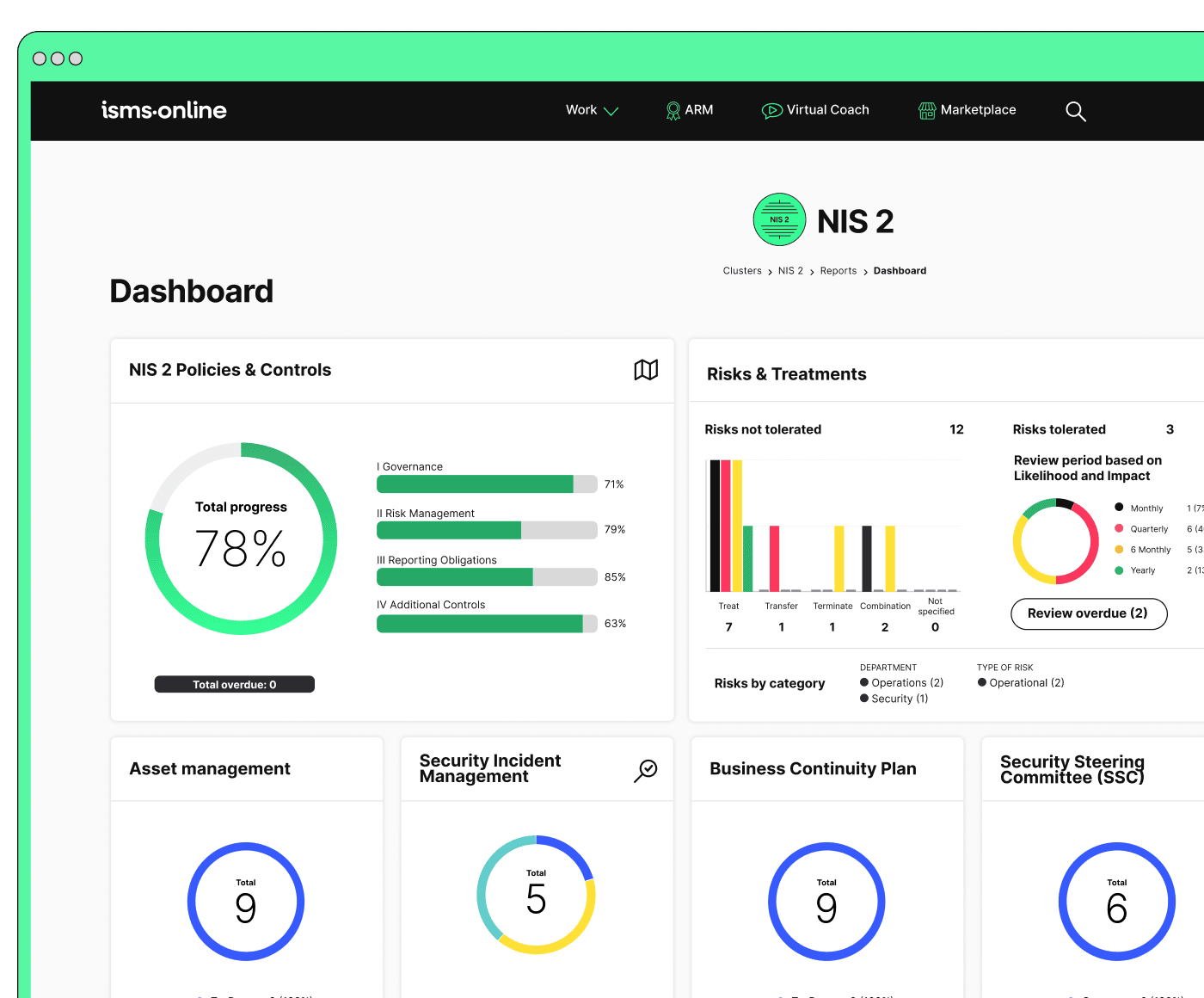
Be NIS 2-ready from day one
Launch with a proven workspace and templates – just tailor, assign, and go.
Why “Good Enough” Evidence Fails Modern NIS 2 Audits
Log files are a start-but they’re not audit evidence if they lack chain of custody, versioning, approvals, or encryption. Today, “audit-proof” means:
- Immutability: Logs, policies, and incident notes must be append-only, time-stamped, and uneditable after sign-off.
- Version control: Every change to a policy, playbook, or evidence file is mapped, signed, and tracked by who/when.
- Role-based access: Only authorised users can create or alter evidence, with every action logged for audit trails.
- Board observations: Management and risk committee sign-offs embedded in incident lifecycle, not as afterthoughts or emails.
Can you show exactly what happened, when, and who approved it-without any gaps or post-facto edits? That’s the new pass-fail line.
Integrated ISMS solutions (e.g., ISMS.online) embed these standards-across every evidence record, policy update, and incident report. Every handoff (including supply chain notification) is tracked and exportable.
ISO 27001 Bridge Table
| Expectation | Operationalisation | ISO 27001 / Annex A Reference |
|---|---|---|
| Append-only logs | Cryptographic, access-limited evidence | A.8.15, A.8.16 |
| Timestamped events | Scheduled reminders, detection audit | A.5.24, 5.25 |
| Linked approvals | Workflow sign-offs and tracked reviews | A.6.3, 6.4, 8.14 |
| Doc version control | Change logs, approval signatures | A.5.2, 7.5.3 |
| Secure backups | Encrypted, multi-location archives | A.8.13, 8.14 |
Every line above is table-stakes in an external audit under NIS 2.
Why Supply Chain and Cross-Border Reporting Are the Modern Pain Point
Most digital provider failures don’t occur inside your fortress-they happen in the cracks between your evidence and that of your suppliers, partners, or foreign operations.
When a supply chain incident hits, the evidence you must show is much more than an internal timeline:
- Timestamped notification logs to every affected supplier/customer.
- Confirmation of delivery and, where required, content of acknowledgement replies.
- Template-driven comms for inclusion/exclusion decisions, with rationale logged.
- Records of every cross-jurisdictional SpOC notification-and what follow-up occurred.
If you can’t evidence every upstream/downstream notification and response, you’re left exposed-legally and reputationally.
Solution: Ensure your ISMS or evidence platform enables modular evidence export with per-jurisdiction breakdown. No two states have identical reporting hooks; you’ll need tailored packs-pre-baked to avoid crunch-time errors. ENISA’s flow guidance is critical; adapt their checklists to your own organisational chart.
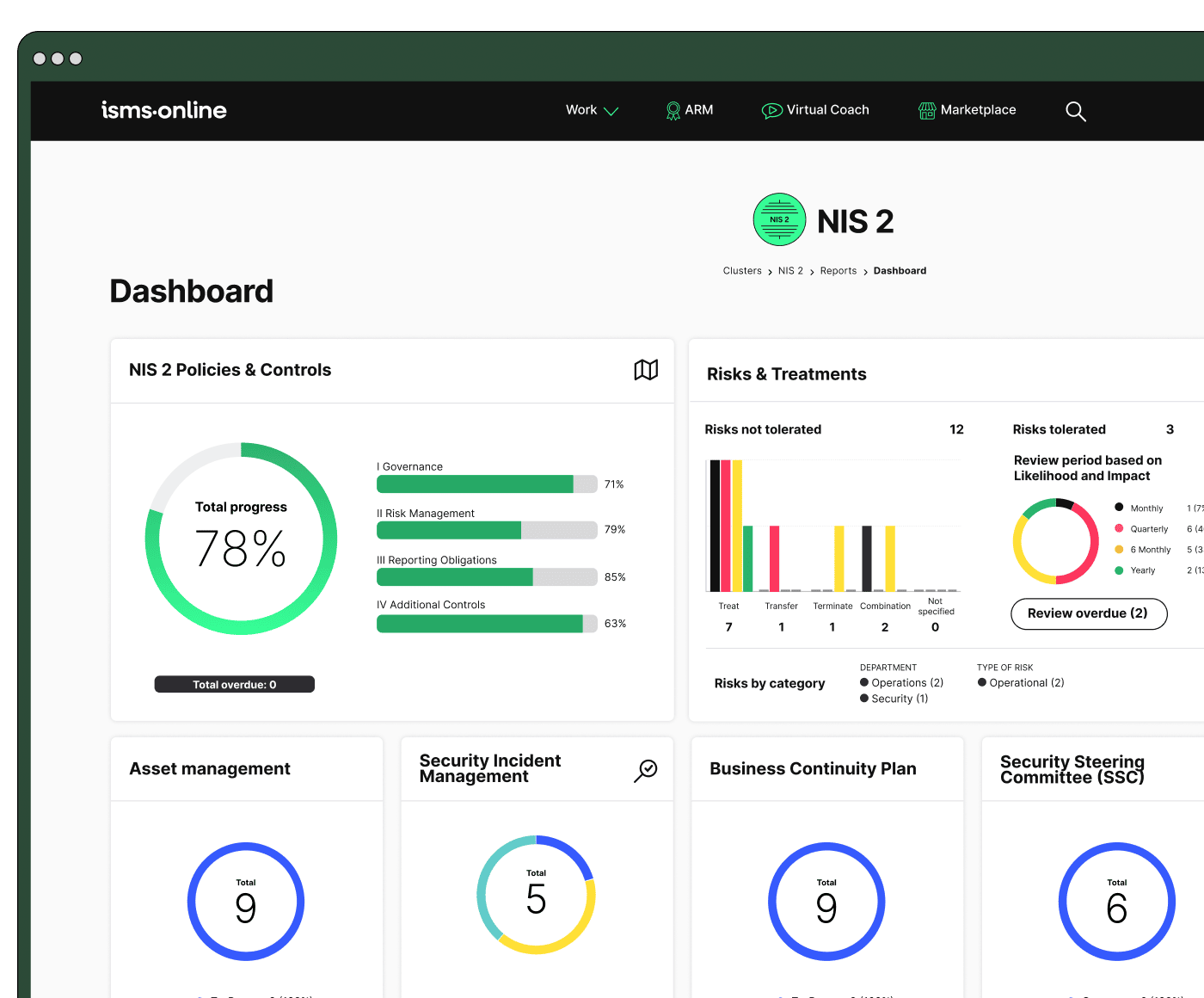
All your NIS 2, all in one place
From Articles 20–23 to audit plans – run and prove compliance, end-to-end.
How Do Regulatory Auditors Now Judge Your Compliance?
Forget folder volume. The new generation of auditors doesn’t care about your data pile-but whether your evidence tells a coherent, real-time compliance story.
They test by working backward:
- Start at incident detection-can you prove receipt to reporting chain?
- Walk through every handoff, approval, board sign-off, supplier notification.
- Hunt for brittleness: e.g., missed handoffs, unclear notification timelines, ambiguous approvals.
- Ask for process improvement evidence: were scenario tests or incident reviews conducted? Are lessons learned documented and then solved within workflows-not just written up for show?
Audit readiness today means continuously improving your process, not just documenting past wins.
The best teams bring auditors directly into ISMS dashboards, showing living evidence trails, test logs, and improvement notes. This transforms compliance from a periodic ritual into an always-on business advantage.
Continuous audit is your moat-waiting until year-end is last decade’s playbook.
Can You Survive the Evidence Demands of GDPR, NIS 2, DORA, and Sectoral Laws-Simultaneously?
Few organisations now operate in a “single-regulator” world. Digital providers usually juggle:
- NIS 2: Cyber and operational disruption (timing, supply chain, SpOCs).
- GDPR: Personal data breaches (DPA notification, SARs, evidence).
- DORA (for financials): Resilience and operational incident trails.
Every regime has its own clock, evidence list, and reporting logic. The pain? Duplicated or contradictory workflows, wasted staff time, and audit holes, especially under heat.
Audit misfires come from evidence gaps, not because your team didn’t work, but because your system missed a legal beat.
Best-in-class approach:
- Single event logs are tagged for every regime implicated (GDPR, NIS 2, DORA).
- Evidence items (incident logs, policy approvals, notification templates) are cross-mapped to relevant regime and control.
- System export supports tailored packs: CSIRT for NIS 2, DPA for GDPR, board summaries for management.
- Staff workflows flex to track 24h/72h/1-month rules-never forced to manually rerun the same reports for different authorities.
Mini-table: Evidence Mapping Example
| Evidence Item | GDPR | NIS 2 | DORA | Export Notes |
|---|---|---|---|---|
| Incident detection log | ✔️ | ✔️ | ✔️ | All regimes-each needs own timeline |
| Notification email | ✔️ | ✔️ | Template shows regime, contacts | |
| Board risk report | ✔️ | ✔️ | Board sign-off ticks multiple boxes |
Tip: Configure your ISMS to multiply evidence tags and avoid duplicating action. Defensible compliance comes from mapped controls, not duplicated effort.
Are You Ready to Move from Audit Panic to Daily Readiness?
With NIS 2, compliance isn’t static-it’s a perpetual motion machine. Audit success now rewards the team that can evidence, export, and prove every compliance link, every day, in language a regulator, auditor, or key stakeholder will trust. Leave the panic to your competitors.
True audit confidence comes when your system does the heavy lifting-mapping, tracking, and exporting defensible evidence on demand.
Frequently Asked Questions
Who must comply with NIS 2-and how should digital providers prove it to auditors?
Any digital provider-SaaS vendor, cloud host, search engine, online platform, or managed IT service-could be subject to NIS 2 if your offering supports EU critical sectors, exceeds specific user/revenue thresholds, or is vital to social or economic continuity. Smaller companies aren’t automatically excluded: if your business is a key supplier, supports an “essential entity,” or underpins critical infrastructure, liability likely applies. Scope can change overnight with new contracts, user surges, acquisition, or supply chain shifts, so static “in or out” lists are a major risk.
To satisfy an auditor, you need ongoing, transparent scope controls:
- Keep a dynamic NIS 2 scope log: that maps every product, service, and contract to ENISA’s sectoral guidance and details your inclusions, exclusions, and rationale.
- Update scope reviews at key triggers: Each new contract, major user milestone (e.g., >100,000 users), supply chain addition/loss, or relevant business change triggers a fresh risk review, logged with timestamp and reasoning.
- Maintain a scope audit trail: Every change, even edge calls, must be defensible, traceable, and supported with event-linked evidence.
| Trigger Event | Scope Update Required? | Acceptable Audit Evidence |
|---|---|---|
| New critical sector deal | Yes | Log entry, risk review |
| User base passes 100k | Yes | KPIs, updated registry |
| Supplier change | Yes | Supplier register & notes |
| Annual review only | Inadequate | Auditor: “event-based req.” |
True NIS 2 scope compliance means never being caught off guard when teams, customers, or regulators shift the category lines. If your proof is “last year’s spreadsheet,” you’re exposed. Always cross-reference ENISA’s toolkit and EUR-Lex Art. 2–3.
What actually counts as a reportable NIS 2 incident-including hidden triggers?
NIS 2 covers more than overt cyberattacks. A reportable “incident” includes:
- Major service or platform outages (even partial/intermittent, not only total).
- Critical vulnerabilities-especially those in the wild, unpatched, or impacting downstream customers.
- Significant supply chain disruptions, even if the fault lies with a third party.
- Operational, financial, or privacy damage above legal thresholds-commonly, harm to >100,000 users or >€1M loss.
- Near-miss “close calls” if they expose systemic risk.
- Events that trigger incident notification in overlapping regimes (GDPR breach, DORA digital resilience event).
What’s often missed is the need to log not just the incidents, but the decision logic: why was (or wasn’t) an event reported, who decided, and based on what data? Auditors penalise absent or shallow rationale more than over-reporting. For every material incident-whether notified or not:
- Document your rationale and calculations.:
- Log notification decisions and thresholds, including ambiguity and discussions with counsel/board.
- Capture all internal handoffs, escalation records, and “not notified” justifications.
Regulators care just as much about what you didn’t report and why. Thin or missing records are a top audit finding now.
What are the 24-hour, 72-hour, and final (1-month) NIS 2 reporting rules-and what counts as evidence?
As soon as you detect an incident (not just confirm impact), NIS 2’s reporting clock starts:
- Within 24 hours: Initial alert to national authorities (or sector SpOC). Evidence: incident log (e.g., SIEM entry), timestamp, who received/was notified, and the communication itself (even if incomplete or “just the facts known”).
- Within 72 hours: Follow up with an interim report, covering current findings, evolving risk/impact estimate, supply chain exposures, GDPR or other regulatory overlap, and all third-party engagement summaries. Attach all new notifications sent.
- Within 1 month: Deliver a final investigation narrative: root cause, timeline, response steps, board sign-off, and proof of notification to all required parties.
| Milestone | Deadline | Must Have Evidence of |
|---|---|---|
| Initial | 24h | Log/timestamp, alert copy, recipient |
| Interim | 72h | Investigation, risk, stakeholder trail |
| Final | 1 mo | Timeline, root cause, board approval |
Critically: if the same event is also subject to GDPR, DORA, or sector-specific rules, always preserve evidence packs separately-never overwrite or blend outputs.
What makes NIS 2 evidence “audit-proof” instead of just a pile of logs?
Audit-proof NIS 2 evidence must be:
- Tamper-evident: Append-only, version-locked outputs such as SIEM “locked” log exports, PDF/A or digitally signed ISMS.online reports.
- Mapped to roles and time: Every log, notification, and approval links to a named, accountable person and timestamp.
- Formally reviewed: Management and board sign-offs, post-mortems, and all major policy/procedure updates include traceable e-signatures.
- Exportable and reviewable: Evidence and audit trails can be quickly exported or cross-referenced for any regulator-no hunting through emails.
| Evidence Type | Example Audit-Grade Output |
|---|---|
| Append-only SIEM log | PDF/A export, ISMS.online evidence pack |
| Approvals, sign-offs | Signed workflow records/management review |
| Cross-border notification | Email trail with time/read receipt/archive |
| Supply chain handoff | Notification registry, recipient tracking |
Spreadsheets or generic drives without trail, locked versions, or recipient logs are likely to cause findings or fines ((https://www.isms.online/information-security/isms-online-launches-a-smarter-way-to-achieve-nis-2-compliance)).
Where do most digital providers fail in supply chain and cross-border evidence-and what’s the best fix?
Most failures involve:
- Incomplete notification logs for each supplier, customer, SpOC, or jurisdiction.
- No mapped, time-stamped registry for triggering or tracking supply chain/partner contacts.
- Lack of visual traceability-chains of events, recipients, and audit steps are scattered or missing.
To close these gaps:
- Keep a supply/customer registry: with automated notification triggers and read-receipts, all timestamped and jurisdiction-tagged.
- Use standardised notification templates that embed role, time, rationale, and attachment/index tracking.
- Visualise notification and escalation chains for every incident, so gaps in documentation are flagged *before* audit.
- Document every handoff in cross-border events (all SpOCs, customers, suppliers).
A diagram of the notification chain-events, recipients, timestamps, rationale-will give your evidence team an instant way to spot and fix gaps ahead of the next regulator review.
How do you prevent evidence gaps or duplication across NIS 2, GDPR, DORA, and sectoral rules?
Unified, multi-regime ISMS workflows are becoming the gold standard:
- Multi-tag every log, notification, and approval: for every applicable regime (NIS 2, GDPR, DORA, others).
- Build single-source, cross-linked evidence packs: each event is logged once but referenced in all required “views” for different audits or regulators.
- Never overwrite, delete, or blend evidence: even when timelines or details overlap. Each regulatory track needs a distinct but linked version.
| Overlap Trigger | Evidence Handling |
|---|---|
| GDPR and NIS 2 incident | Separate, cross-linked evidence packs |
| DORA and NIS 2, distinct times | Split notifications/evidence by regime |
| Sector + GDPR + NIS 2 | Tagged logs/reports; each view traceable |
ISMS.online’s templates and automated tagging let you create these “multi-view” packs: always versioned, always exportable, always review-ready.
What are auditors and regulators now actually looking for in NIS 2 reviews-and how do you deliver “audit-proof” workflows?
Today’s audits reward teams who maintain:
- Unbroken, named evidence chains: from detection, notification, supplier escalation, to management and board sign-off, improvement, and archive-each with who, when, and how recorded.
- Transparent notification trails: Every authority, SpOC, client, or supplier receives documented, time-stamped alerts, with receipts attached.
- Distinct, regime-specific artefacts: Nothing is blended across GDPR/DORA/NIS 2.
- Continuous improvement: Quarterly (or event-driven) reviews, not just “tick-box” annual compliance updates.
An audit should read like a story: you detected, analysed, notified, escalated, informed, reviewed, improved-no missing chapters, no back-filled prose.
Teams practising table-top simulations, walking real-incident “audit rehearsals” from trigger to sign-off, catch and fix evidence gaps before they become audit liabilities.
When you use a workflow like ISMS.online, you automate tagging, notifications, approvals, storage, and exports-turning compliance evidence into a catalyst for business trust, new contracts, and regulator confidence, rather than another stress point.
You’re not just passing an audit; you are proving, every day, that your organisation delivers more than the minimum-resilience and trust are business assets.
Every audit tells your trust story. With live, audit-ready evidence, your organisation owns the narrative-and the advantage.






