





































Is Your Digital Service Now Regulated-and Why Should Every Team Take the 2024 NIS 2 Deadline Seriously?
If you shape, operate, or secure a digital marketplace, search engine, or social platform in the EU, you are no longer on the regulatory sidelines. The updated NIS 2 Directive targets not only “critical infrastructure” but casts a wide net across digital intermediaries-marketplaces, B2B exchanges, and social networks now face direct scrutiny. Any organisation with more than 50 staff or over €10 million in annual turnover is an “important entity” under European law. That includes fast-growing SaaS startups, established B2C platforms, and virtually every business-model innovation in the digital ecosystem.
Anyone thinking this is only for utilities or banks is missing the regulatory storm heading for the digital sector.
The countdown is unambiguous: NIS 2 must be transposed and enforced by every EU Member State by October 18, 2024. There is no long grace period for stragglers; some countries may even enforce retroactively where risk events surface before full alignment. If your business is scaling and you consider reputation or revenue critical, the compliance bar is now existential-not aspirational.
What Actually Brings Your Company Into Scope?
Any SaaS product, digital content vertical, or data marketplace that surpasses the minimal “micro-entity” thresholds is on the radar. The sector lines-whether B2B or B2C, exchange, or content aggregator-are irrelevant if the headcount or turnover thresholds are breached. Founders devising market expansion, or product teams embedding new integrations, must now factor NIS 2 readiness at MVP stage.
Beyond Compliance: The Real-World Stakes
NIS 2 pushes risk from the IT back-office into the boardroom and sales pipeline. Enterprise deals, funding rounds, or even banking relationships may stall unless you demonstrate live compliance maturity. Boards are now measured not just by policies, but by the ability to evidence resilience-lack of assurance becomes market exclusion as much as it is a regulatory fault. Teams relying solely on spreadsheet evidence or siloed security projects will not pass a future audit.
A visual timeline, plotting NIS 2s widening scope from legacy marketplaces to emergent social/AI-based platforms, with October 2024 highlighted, helps align planning urgency across departments and management layers.
Book a demoFrom the Server Room to the Boardroom: Where NIS 2 Assigns Accountability (and Risk)
NIS 2 signals a paradigm shift: executive and board-level accountability is now inescapable. Technical controls alone won’t suffice; leadership bears explicit, personal duty to ensure their organisation’s cyber and operational resilience. Even if the failure is in your supply chain, the liability lands on your board.
You can outsource the infrastructure, never the duty of care or legal accountability.
Implications for Leadership, Legal, and Operations
- Personal Liability: Unreported incidents, fake compliance artefacts, or significant system outages can attract fines up to €7M or 1.4% of global turnover, along with direct legal consequences for named executives.
- Supply Chain Visibility: Your vendor’s error-be it an upstream cloud mishap, unresolved vulnerability, or missed incident notification-is now your problem. Ignorance is not a defence; the expectation is real-time detection and escalation, enforced with legal teeth.
- ISO 27001 ≠ Compliance Proxy: Certification is no longer a shield if daily controls, supplier reviews, or incident logs fail the “living document” test. Auditors now interrogate not just what you claim, but what you can prove in action.
For a Privacy or Legal Officer, discovering a vendor breach in the headlines before any internal notification exposes not only process gaps but personal risk. For IT practitioners, every access ticket and third-party connection is essentially a risk ledger entry-logged and traceable straight to board sign-off.
A live dashboard, mapping the accountability web from boardroom to operations, with red flags where supplier issues or open incidents block the compliance journey, can transform hand-waving into action.

Master NIS 2 without spreadsheet chaos
Centralise risk, incidents, suppliers, and evidence in one clean platform.
From Checklists to Continuous Resilience: How Live Risk Management Replaces Document Dumps
Audits in the NIS 2 era are dynamic, not static. The bar now is not a filled-in “register,” but a living record showing evidence of continuous control and risk management. Each change, incident, and supplier update must be logged “as it happens” – not simply listed in an annual review.
Regulations inspect for the gap between your documented process and your daily business reality-and any daylight is a compliance tripwire.
Common Failure Points-and How to Avoid Them
- Dormant Registers: Risk registers and incident logs that are updated only annually or ad hoc are instant audit red flags. Missed supplier renewals, untracked vendor outages, or old asset inventories are all liabilities.
- Supplier Mapping Blindspots: Organisations that map suppliers only during procurement or contract renewal miss ongoing changes-such as new integrations, API connections, or cloud dependencies. Missed mapping can leave risk unmonitored, and permissions unchecked.
- Operational Scenario:
- Can your team, on receipt of a “zero-day” announcement from a cloud provider, instantly identify all affected services, update the risk record, link an owner, and prove mitigation within days?
- If not, the audit scramble will expose hidden fragility.
Resilience Pathway for Every Persona
- Kickstarter & Team Lead: Uses workflow tools that automate the cycle from risk identification to owner approval, generating evidence at each step for later audit.
- Practitioner: Benefits from real-time prompts-every status change, vendor message, or detected incident can be confirmed, tagged, and entered into the record in minutes.
- Privacy Officer: Receives automated data-incident tagging and links logs to GDPR as well as NIS 2, closing the “lawful basis” and privacy-by-design loop.
- CISO/Board: Reviews a visual, board-ready dashboard of risk states, key incidents, and pending approvals-ready for regulatory review or management scrutiny at any moment.
A scenario diagram traces from a vendor’s zero-day exploit via platform-prompted risk update, to risk owner approval and final audit evidence, all in a few clicks-and no missed links.
AI and Automation Risks: How NIS 2 Makes Moderation Bias and ‘Black Box’ Decisions Everyone’s Problem
Digital providers increasingly rely on AI-driven moderation, content ranking, and fraud detection. This shift is now under the compliance microscope. Regulators demand both transparency and audit trails for every major automated intervention that could impact user rights or business risk.
No routine bias test? No documentation for AI false positives? You now face regulatory action as well as public outcry.
From Policy to Practise: Audit-Ready AI Oversight
- Regularly Test for Bias: Sector leaders are now expected to run, document, and retain bias tests for AI moderation and automation. That includes storing:
- Datasets, test results, and error rates: as auditable evidence.
- Logs of human review: for system ‘edge cases’ or over-flagged incidents; every supervisor intervention is now a compliance artefact.
- AI Bias Register In Use: An AI Bias Register documents every flagged false positive or negative (e.g., a product listing or post mistakenly blocked/unblocked), logging:
- Date/time, AI model/version, supervised review outcome, and linked evidence.
- Every escalation-manual unblocking, bias confirmation, intervention notes-is captured for final audit scrutiny.
Practical Mini-Example
Suppose a legitimate marketplace listing is blocked by an AI model for “prohibited category.” The practitioner logs: 14-June-2024, flagged content, model 2.3, intended action, human supervisor’s decision, outcome attached as PDF/screenshot. During audit, this shows either bias or robust management-demonstrating governance.
NIS 2 moves AI management from “best effort” to repeatable, documented process. Regulators expect no less. Lack of AI register is now a provable weakness.
A dashboard with an AI Bias Register, “Open Reviews,” and linked case files closes the loop-and demonstrates to both auditors and the public that issues are neither hidden nor ignored.
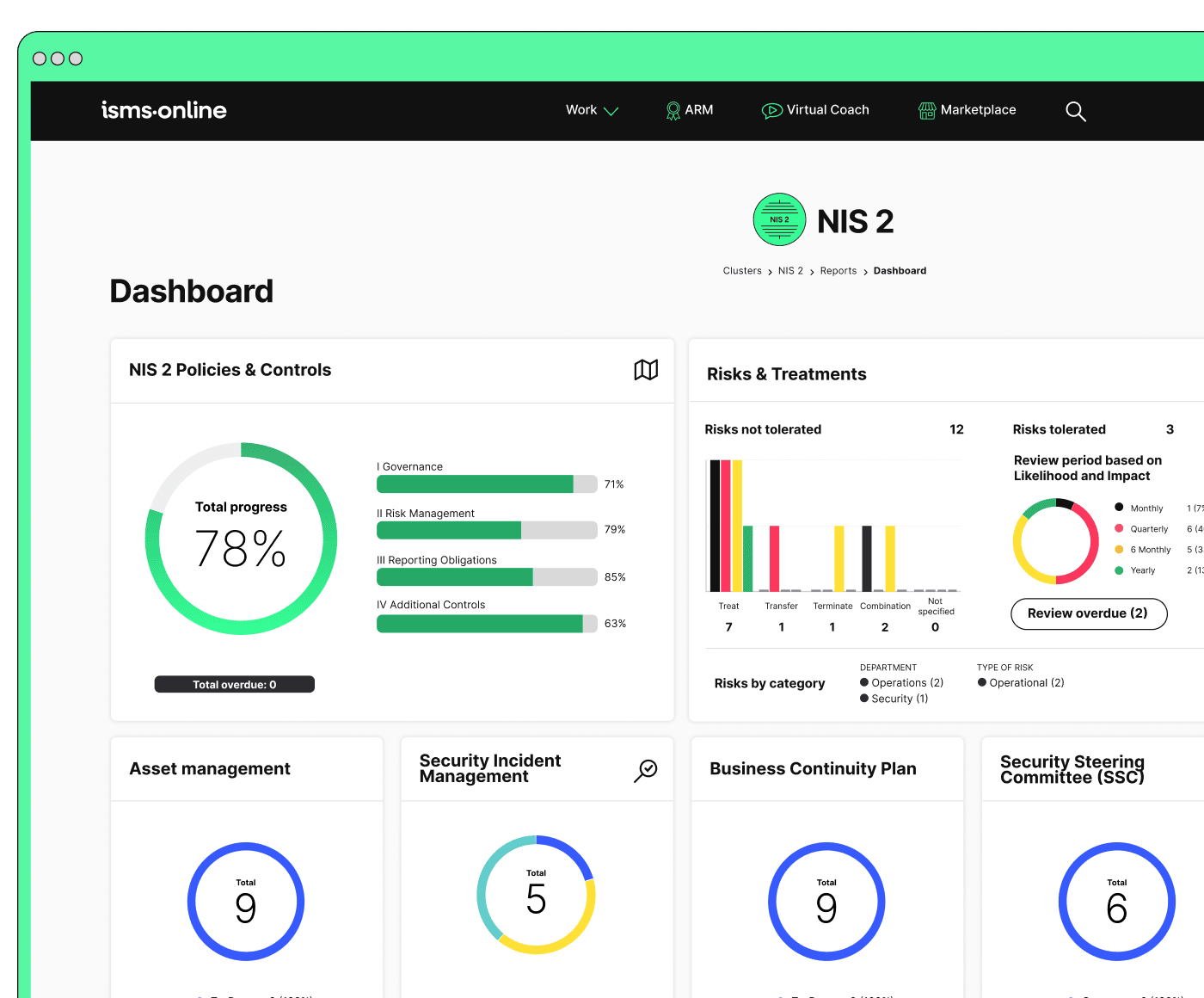
Be NIS 2-ready from day one
Launch with a proven workspace and templates – just tailor, assign, and go.
How to Report Major Incidents and Meet Every 24/72/30-Day Obligation-with No Room for Error
Major incidents are no longer internal fire drills-they are timed legal events. The NIS 2 regime is strict: the first 24 hours after a discoverable event begins the clock, and inaction or missed deadlines compound both penalty and public harm.
Every incident missed or reported late becomes a compliance-and business continuity-test you cannot afford to fail.
The Three Milestone Reporting Windows
- 24 Hours: Notifying the lead authority is mandatory-the message can be incomplete, but must be registered.
- 72 Hours: You must submit impact findings and foreseeable risk updates.
- 30 Days: Delivery of root cause and incident impact analysis-plus remedial steps taken.
Mastering Cross-Border Notification
Few digital providers operate in just one country, and incidents quickly attract legal complexity:
- Lead Authority: Usually the national cyber-security authority of your EU principal or headquarters location.
- Multi-Jurisdiction Events: Require notifying the lead authority, who then shepherds multi-state communication and ensures the appropriate CSIRTs are involved.
- Key Roles: CISO or dedicated incident responder (who logs facts and timelines), Compliance/Legal Officer (who interacts with authorities), DPO for personal data breaches.
Up-to-date contact lists and live dashboards-where selecting an affected entity launches the right template, schedule, and authority alert-are now essential operational tools.
In real-world reviews, failures in this process are cited more often than technical shortcomings.
A robust incident response dashboard-a legal as well as technical requirement-visualises clocks to each reporting window, owner assignments, responsible authorities, and pre-set escalation logic, reducing risk of legal missteps under pressure.
Supply Chain Resilience: Turning Your Vendors and Service Providers Into Proven Allies-Not Hidden Threats
No matter how strong your “internal” controls, supply chain weaknesses can be catastrophic under NIS 2. Every slow incident notification or silent vendor is now a live exposure-and no longer acceptable as a “black box.”
A supplier’s silence, previously excused, is now an audit trigger-a signal regulators will actively investigate.
Operationalising Real Supply Chain Assurance
- Automated Supplier Monitoring: Continuous registry updates, change-of-risk alerts, and contract stipulations for incident reporting supplant once-a-year, “tick box” checks.
- Contract Evidence: Renew incident notification clauses, continuity exercises, and data protection terms-then log each review and test, attaching approval evidence and timely reminders.
- Simulated Scenarios: Regular supplier incident drills, including cross-team and supplier participation, validate both the contract and real responsiveness.
No update from your supplier is not peace of mind-it’s a compliance blind spot.
Persona Snapshots
- Board / CISO: Receives real-time risk heatmaps mapping open incidents, overdue supplier reviews, and flagged escalations.
- Practitioner: Uses platform-triggered task reminders, logs supplier response status, and triggers automatic escalations.
- Privacy Officer: Ensures DPIAs and controller contracts are reviewed and logged every time the supplier list or data flow changes.
A dynamic supplier dashboard, heatmaps, and snapshot reporting tools escalate open issues-before they reach audit crisis.
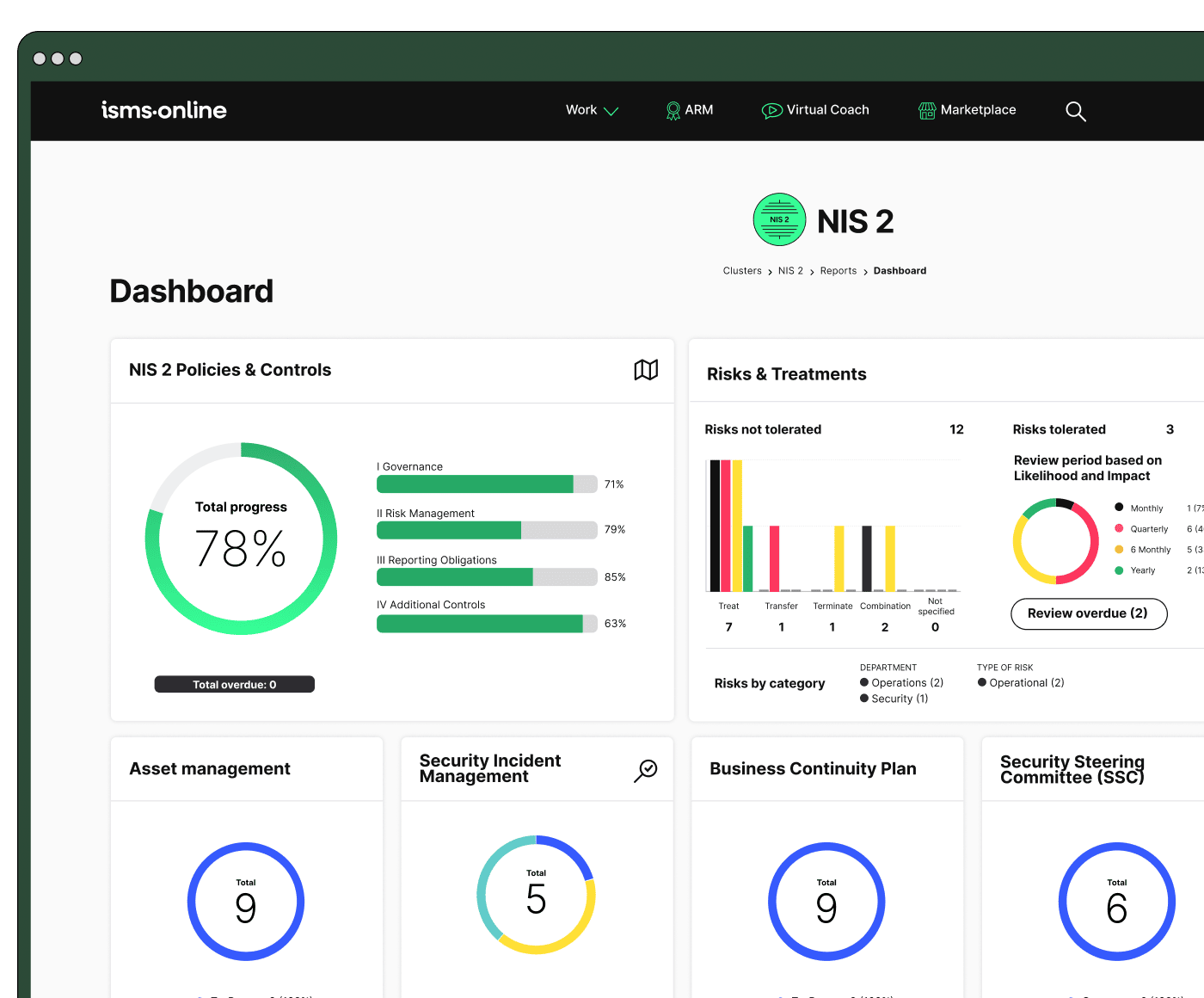
All your NIS 2, all in one place
From Articles 20–23 to audit plans – run and prove compliance, end-to-end.
Bridging to Audit-Ready: Making the ISO 27001 Table Your Team’s Secret Weapon
Audit survival under NIS 2 and ISO 27001 is anchored not by mapped “controls,” but by workflows that bridge regulation, daily action, and logged evidence. The bridge table below operationalises this, directing team assignments, platform workflow, and document retrieval into a single audit-proof routine.
| Expectation | Operationalisation | ISO 27001 / Annex A Reference |
|---|---|---|
| Real‑time incident notification | 24/72/30‑day workflow with live tracking dashboard | A5.24, A5.26 |
| Supplier risk managed continuously | Automated supplier registry + risk tiering | A5.19, A5.22 |
| AI bias/automation oversight | AI Bias Register with logs + hybrid approval chain | A8.25, A8.27, A8.7 |
| Ownership & change tracking | Named owners, control versions, time‑stamped logs | Cl9.3, A5.2, A5.4 |
How to Put This Table Into Practise:
- Before Audit: Assign each expectation to a team/process owner; use workflows to export linked evidence.
- During Audit: Respond instantly-showing dashboards, event histories, and approval evidence at a click.
- After Audit: Every change, incident, or vendor event links back to a logged, time‑stamped evidence trail-proving not only compliance, but improvement.
Mini Table: Compliance Traceability In Action
| Trigger | Risk Update | Control / SoA Link | Evidence Logged |
|---|---|---|---|
| AI moderation error flag | Bias risk re-assessed | A8.25, A8.27 | Bias test log, escalation record |
| Supplier data breach alert | Incident risk score revised | A5.19, A5.24 | Notification log, contract evidence |
| Cloud outage notification | Continuity plan reviewed | A5.29 | Recovery report, meeting minutes |
Guidance:
- Practitioner: Confirms trigger, updates risk record, links to right control.
- Owner: Approves, attaches proof.
- Audit Loop: Auditor traces each event, step, and outcome-closing the loop.
A platform dashboard printout, with every event and file traceable end-to-end, turns “audit fear” into “audit clarity.”
Winning Under NIS 2: Defining Success for the Board, Practitioner, and Privacy Leader-With ISMS.online
Success under NIS 2 goes far beyond project plans or passing audits-it becomes a daily discipline in resilience, transparency, and measurable trust. Each persona benefits from this shift in distinct ways:
- Kickstarter: Passes a first audit, accelerates deals, and turns compliance from a roadblock into a badge for customers.
- CISO / Security Leader: Gains board-level confidence with live dashboards, risk and evidence logs, and measurable reduction in audit costs and business interruption.
- Privacy Officer: Runs data protection impact assessments, proves compliance to regulators with one-click evidence, and reduces risk of surprise investigations or fines.
- Practitioner: Retires the spreadsheet chaos, replaces ad-hoc evidence-chasing with automated workflows, and earns recognition as the compliance heartbeat of the business.
The leaders who make NIS 2 a business asset-not a bureaucratic yoke-will shape the next phase of digital competition.
Real-World Success
ISMS.online instils confidence at every touchpoint. Audit moments become routine-not a scramble. Roles are clear, actions are event-driven, and evidence is always just a click away. As one Chief Security Officer at a digital marketplace put it:
“ISMS.online turned audit from panic into confidence-everything mapped, roles clear, our evidence a click away, and the board finally saw compliance as strategic, not a cost.”
Final Momentum & Identity-Rooted CTA
Now is the moment to define resilience in your sector. With ISMS.online, your compliance journey is mapped, evidence is at your fingertips, and every team-from the board to frontline practitioners-writes the next chapter of digital trust and growth.
Set your markets pace. Secure your leadership legacy. Book your tailored NIS 2 readiness review and showcase your assurance-because regulators, buyers, and partners reward those who act before the storm.
Frequently Asked Questions
How does NIS 2 reshape compliance for digital marketplaces, search engines, and social platforms in 2024?
NIS 2 is a regulatory game-changer for digital providers: from October 2024, digital marketplaces, search engines, and social platforms operating in the EU must comply with cyber and risk management rules traditionally reserved for critical infrastructure, even if they’ve never been regulated before. This applies to any organisation exceeding 50 personnel or €10 million turnover within the EU, cementing their status as “important entities” with live, ongoing obligations.
Suddenly, what was once a technical or IT-adjacent task becomes board-level and company-wide. Policies and supply-chain risk no longer sit quietly in the background-real evidence of mapped controls, incident response, and supply chain oversight is required for every function, not just the technology team. Variation exists across the EU, as each member state appoints its local NIS authority and may introduce nuances (for instance, sector-specific requirements in Belgium’s CyFun or Germany’s digital process), but the new baseline is harmonised: continuous, cross-team accountability with no safe haven for digital inaction.
Platforms should act swiftly to verify whether their activities and service footprint meet the threshold, prepare for national registration, and review dataflows that traverse country lines. If you were previously out of scope, NIS 2 brings you into the compliance spotlight almost overnight.
Timeline Table: Digital Provider Regime Evolution
| Directive | Entity Scope | Size Threshold | Reporting Cadence | Regulatory Authority |
|---|---|---|---|---|
| NIS 1 | Large cloud/infra/data operators | >250 FTE | Annual/event-based | DPA/lead regulator |
| NIS 2 | DMPs, SEPs, social platforms | >50 FTE or €10M EU | 24h/72h/30d incident | National NIS/ENISA |
Where do most companies get blindsided by board, legal, and leadership risk under NIS 2?
NIS 2 enforces personal, direct accountabilities few leadership teams have faced before. Board directors are now required to approve and periodically oversee information security and supply chain management-with legal responsibility for timely registration, ongoing incident reporting, and demonstrable control of cyber risks. Fines can reach €7 million or 1.4% of global turnover, but the real sting is public regulatory listing, audit findings against individuals, and business disruption.
Many companies are caught off guard by assuming ISO 27001 certification or a successfully passed audit will suffice. In reality, NIS 2 expects continuous, operational evidence: out-of-date Statements of Applicability, static policy packs, unlogged supplier incidents, or incomplete contract controls can all generate significant nonconformities. Relying on manual spreadsheets for vendor assurance or treating legal documentation as a formality exposes the board and company officers, not just IT staff.
The regulator no longer distinguishes between leadership and operational staff-if it's not mapped and evidenced by the board, it's non-compliant.
| Blind Spot | NIS 2 Impact | Accountability Owner |
|---|---|---|
| Missed national registration | Fines, public warning/listing | Board/company secretary |
| Stale risk/control register | Major audit finding, legal notice | Legal/compliance function |
| Supplier breach unreported | Escalating regulatory scrutiny | Procurement, Board, Legal |
What replaces “checkbox compliance” as the minimum risk management standard under NIS 2?
NIS 2 erases the illusion that annual risk assessments or desktop policy reviews equate to meaningful compliance. The new standard is “living” risk management: automated, role-based workflows with real-time registers, operational scenario testing, and audit-ready logs across all domains. Static PDF policies and one-off exercises are not defensible when auditors arrive-the expectation is for every incident, control change, supplier update, and board approval to be evidenced and traceable within workflow platforms.
Leading organisations automate their routines by:
- Using dashboards that log every incident, risk review, control change, and supply chain escalation in real time, with role-mapped accountability and instant reporting.
- Conducting regular scenario simulations and live incident drills, recording escalation paths, communications, and remediation outcomes.
- Mapping ISO 27001, ENISA, and NIS 2-specific controls to everyday operational tasks, ensuring updates track with every service, vendor, or team change.
This operationalizes compliance as a routine, not a reaction-minimising the risk of audit surprises, increasing resilience, and showing a defendable, continuous evidence trail.
How does AI-driven moderation and automation redefine risk-and what new evidence must firms maintain?
NIS 2 pulls automation, AI moderation, and content curation under its explicit compliance lens. Any “black box” process used for fraud detection, content filtering, or ranking now presents a digital risk, demanding ongoing traceability and review.
To meet regulator expectations, platforms must:
- Maintain an AI decision and bias register: logging every algorithm update, rule change, incident, and tested override, along with the owner and timestamp.
- Record human interventions in automated processes, including escalation cases and “edge” decisions.
- Map periodic audit reviews and bias-testing outcomes back to operational registers, so every change is demonstrable and auditable.
| AI Workflow Element | Compliance Expectation | Evidence |
|---|---|---|
| Algorithm update | Change register, periodic audit trails | Signed audit logs |
| Moderation override | Human escalation, clear record/resolution | Supervisor review/workflow |
| AI error/failure | Full incident trace, remediation record | Incident log, review notes |
Failing to track, test, and evidence AI outcomes not only risks regulatory findings, but can erode user trust and trigger contractual breaches with partners or vendors.
What incident reporting processes does NIS 2 enforce-and what does “on time” look like in practise?
NIS 2’s incident management regime is strict, binding, and multi-layered:
- 24 hours: Notify the national NIS authority if a probable incident may impact services or users.
- 72 hours: Submit a preliminary report covering risk, impact, and steps taken.
- 30 days: Deliver complete analysis with remediation details and root-cause evidence.
Missing any step escalates the likelihood of fines, more frequent audits, or public regulatory notice. Cross-border entities must maintain multiple reporting templates and liaise with several authorities, requiring automated workflow and time management.
To avoid process gaps:
- Implement dashboards with deadline tracking, jurisdictional contact mapping, and sequenced owner notifications.
- Assign roles in advance (Security/IT logs and resolves; Legal notifies authorities; Privacy/DPO checks for GDPR overlap).
- Pre-populate language and country-specific requirements within workflow to minimise delay.
Thorough, role-tied tracking mitigates critical moments of “clock is running” confusion that can unravel even a well-resourced team.
How does NIS 2 transform supply chain compliance from a static requirement to a “real time” expectation?
NIS 2 treats supply chain assurance as dynamic and ongoing, not something you dust off at audit time. If you rely on annual supplier questionnaires, once-a-year BC test records, or sporadic contract uploads, your approach will not satisfy supervision.
Modern supply chain compliance entails:
- Live vendor registries, with risk scoring and flags for every missed update, scenario drill, or contractual deviation.
- Incidents attributed to suppliers-whether cyber, operational, or privacy-related-logged immediately, with cross-reference to contracts and escalation workflows.
- Scenario simulations and BC tests trace supplier involvement, results, and corrective actions directly to audit folders, with timestamped team participation.
- GDPR, DORA, and other data/privacy controls linked explicitly to each supplier, updating registers and documentation on change.
Overdue or overlooked vendors don’t just present IT risks-they now become board-level exposures, with legal repercussions.
Table: NIS 2 – ISO 27001 Evidence & Workflow Bridge
| NIS 2 Demand | ISO 27001 Reference | Real-World Workflow | Audit Evidence |
|---|---|---|---|
| Incident clock management | A5.24, A5.26 | Time-stamped notification workflow | Submitted logs, email trails |
| Ongoing supplier risk monitoring | A5.19, A5.22 | Automated vendor registry, alerts | Review logs, contracts, signoff |
| AI/automation bias & error review | A8.25, A8.27, A8.7 | Bias register, algorithm audit | Supervisor log, test transcript |
| Board and control signoff | CL9.3, A5.2, A5.4 | Approval logs, SoA updates | Board minutes, SoA versions |
Table: End-to-End Traceability Example
| Trigger event | Risk update/action | ISO/Annex ref | Evidence registered |
|---|---|---|---|
| Vendor breach | New risk/action log | A5.19, A8.25 | Register, board signoff |
| User outage | BC plan/test reviewed | A5.29 | BC plan, test meeting |
| Incident root cause | SoA/incidents reviewed | A5.24, A5.26 | Protocol logs |
How do NIS 2’s goals translate into lasting value for boards, operations, legal, and vendors?
- Board & Compliance: Demonstrate audit confidence, secure zero-finding performance, and minimise headline/legal risk, anchoring trust with customers and partners.
- Security & Ops: Automate routine evidence, shift focus from paperwork to resilience, and break the spreadsheet cycle with live, role-linked dashboards.
- Legal & DPO: Seamlessly integrate GDPR, DORA, and ISO 27701 evidence-making every SAR, DPIA, or contract defensible at the regulator’s request.
- Procurement & Vendor Managers: Identify, escalate, and remediate supplier risks dynamically; ensure contracts are more than paperwork-every update and incident is logged and ready for audit.
NIS 2 is more than regulatory pressure. Teams that institutionalise compliance as evidence-backed operational excellence become magnets for trust, deals, and future partnership.
Why is acting before October 2024 a strategic opportunity-beyond compliance?
October 18, 2024, isn’t just a compliance deadline-it’s the point where security, trust, and operational value become visible in the market. Early adopters-who automate, surface evidence, and treat compliance as a growth lever-gain trading advantages, pass audits fluently, and reduce both cost and reputational risk.
Exceptional organisations treat NIS 2 as the foundation of partner trust and resilience; ISMS.online provides the live, mapped, and role-auditable platform needed to automate and centralise every facet of digital compliance. When compliance becomes routine, audit and partnership excellence follow naturally. Your next move signals not only your readiness for NIS 2, but your emergence as a leader the market wants to trust.






