





































Why Are Drinking Water Utilities Under the NIS 2 Cyber-Security Microscope?
The water sector, once considered immune to high-profile cybercrime, now finds itself thrust under a new regulatory spotlight. National and regional drinking water utilities shoulder a responsibility for both essential service continuity and public safety-yet in the digital era, every remote connection, PLC, and field device is a new portal for attack. ENISA’s latest trend reports do not mince words: hacking incidents, ransomware, and supply chain breaches are real, with recent outages affecting millions and pushing water utilities to the very limits of operational tolerance.
The line between information security and water safety grows thinner every day in your utility.
Today, “in scope” means the majority of EU drinking water suppliers-unless you operate below thresholds set for micro-entities, expect new obligations. NIS 2 leaves no loopholes: leadership is now directly accountable (not just IT, but board members who sign off on compliance). This is a sweeping change from the post-2018 compliance era where isolated teams or annual audits sufficed. Your utility’s resilience affects contracts, customer trust, and-critically-regulator scrutiny.
Recent attacks have resulted not just in lost service, but in water quality alerts, public bans, and severe fines. The reputational and operational damage lingers: loss of confidence, exclusion from contracts, and punitive oversight can define a utility’s fate for years.
Demonstrating integrated cyber and operational resilience isn’t a should-it’s now the sector’s survival line.
What’s New: NIS 2 and the Drinking Water Directive-A Compliance Crossroad
With the Drinking Water Directive (DWD) converging with NIS 2, old silos between water safety and cyber-security are obsolete. Compliance no longer means maintaining two “tick box” programmes: audit readiness now demands one living, unified risk-control system. Under these new rules, everything from remote access logs and digital metre firmware to plant safety protocols and critical supplier vetting must exist in a synchronised, review-ready evidence ecosystem.
Compliance gaps thrive when digital risk and water safety are disconnected.
The most common failure? Treating digital risk and water safety as separate; neglecting technical supply chain controls; or ignoring the criticality of accurate, living risk registers. NIS 2 and DWD require joint operationalization-mapping cyber events and water safety to controls, mitigation owners, and registers in real time.
The Digital–Piping Paradox: Where IT Meets Source Water
The DWD now mandates digital risk analysis-meaning your cyber-security stance is inseparable from water quality itself. Plant managers, IT, and safety officers must coordinate: automated metres, field laptops, remote-sensor endpoints-all surface new attack vectors that are fair game for regulatory inspection.
Executive Accountability: The Boardroom Is Now the Command Centre
With NIS 2, responsibility lands squarely in the boardroom. Leadership must not only approve but actively review and sign off on security measures, audit cycles, and control continuities. Auditors expect clear assignment of roles; regular board-level management reviews; and a paper trail linking every risk and mitigation to operational logs and supplier vetting.
Success in this regulation-driven environment means showing not just compliant policies, but decision records-proof of ongoing vigilance and improvement cycles, logged and retrievable.

Master NIS 2 without spreadsheet chaos
Centralise risk, incidents, suppliers, and evidence in one clean platform.
OT/ICS Practitioners: Technical Audit-Proofing for Plant and Field Operations
Compliance for plant operators and engineers has expanded far beyond IT basics. Routine asset inventories, password rotations, and incident logs are table stakes. The gold standard: an always-updated ledger of every device, controller, firewall, supplier access point, and legacy OT asset. Auditors routinely flag findings when SCADA controllers or unlisted field sensors are omitted from master lists.
Every audit-ready utility knows: you’re only as strong as your slowest update log, weakest access record, or oldest vendor agreement.
Supply Chain and OT Response: Drill, Don’t Just Document
Regulators now require more than incident response playbooks-they expect competency, as proven by routine cross-department drills (field, plant, IT, external supplier) with logged outcomes. Your insurer and regulator both want proof: if an external supplier with VPN access triggers an alert, or a mobile operator is slow on patching, you have logs, tests, and fast response pathways.
A false sense of security in spreadsheets is itself a high-severity risk.
OT/ICS Plant Audit Essentials
Below are core audit components now expected of drinking water sector operators:
| Area | Expectation | Sample Evidence Required |
|---|---|---|
| Asset Inventory | Complete, legacy included | Quarterly-updated device ledger |
| SCADA Risk Assessment | Every endpoint mapped & scored | Risk logs, system diagrams |
| Incident Drills | Regular, multi-team rehearsals | Drill reports, attendance logs |
| Supplier Risk | Active vendor & event tracking | Register of exposures and responses |
SoA (Statement of Applicability) becomes your map tying risk, control, and proof. The best-run utilities never scramble; all evidence is prompt, traceable, and linked.
Supply Chain Security: Eliminating Blind Spots Across the Water Utility Ecosystem
Supply chain is the new breach vector. Recent enforcement actions show that failures in supplier risk management can trigger sector-wide audits or direct penalties. Even small, niche vendors-such as firmware developers or out-of-hours maintenance contractors-can become your utility’s largest actual risk.
Gaps rarely hide among large, obvious vendors-the weak links usually show up in smaller, highly specialised or low-profile partners.
Traceability: From Trigger to Evidence
A traceability tracker is now critical: every real-world vendor event (access, breach, contract review) must connect directly to the risk register, the SoA control point, and logged evidence. Manual spreadsheets rarely withstand audit investigation.
| Trigger | Risk Update | Control/SoA Link | Evidence Logged |
|---|---|---|---|
| Vendor enables remote access | Risk score revision (↑) | A.15.1 – Supplier rel. | Risk register, approval log |
| Firmware vulnerability disclosed | New risk, role assigned | A.12.6 – Tech. vul. mgmt | Patch plan, incident log |
| 3rd-party incident notification | Emergency review | A.5 – Incident response | Comms log, corrections |
| Contract extended/updated | Re-assess risk, update | A.15.2 – Outsourcing | Contract review, approval docs |
After every supplier trigger, fresh proof-no more scavenger hunts at audit.
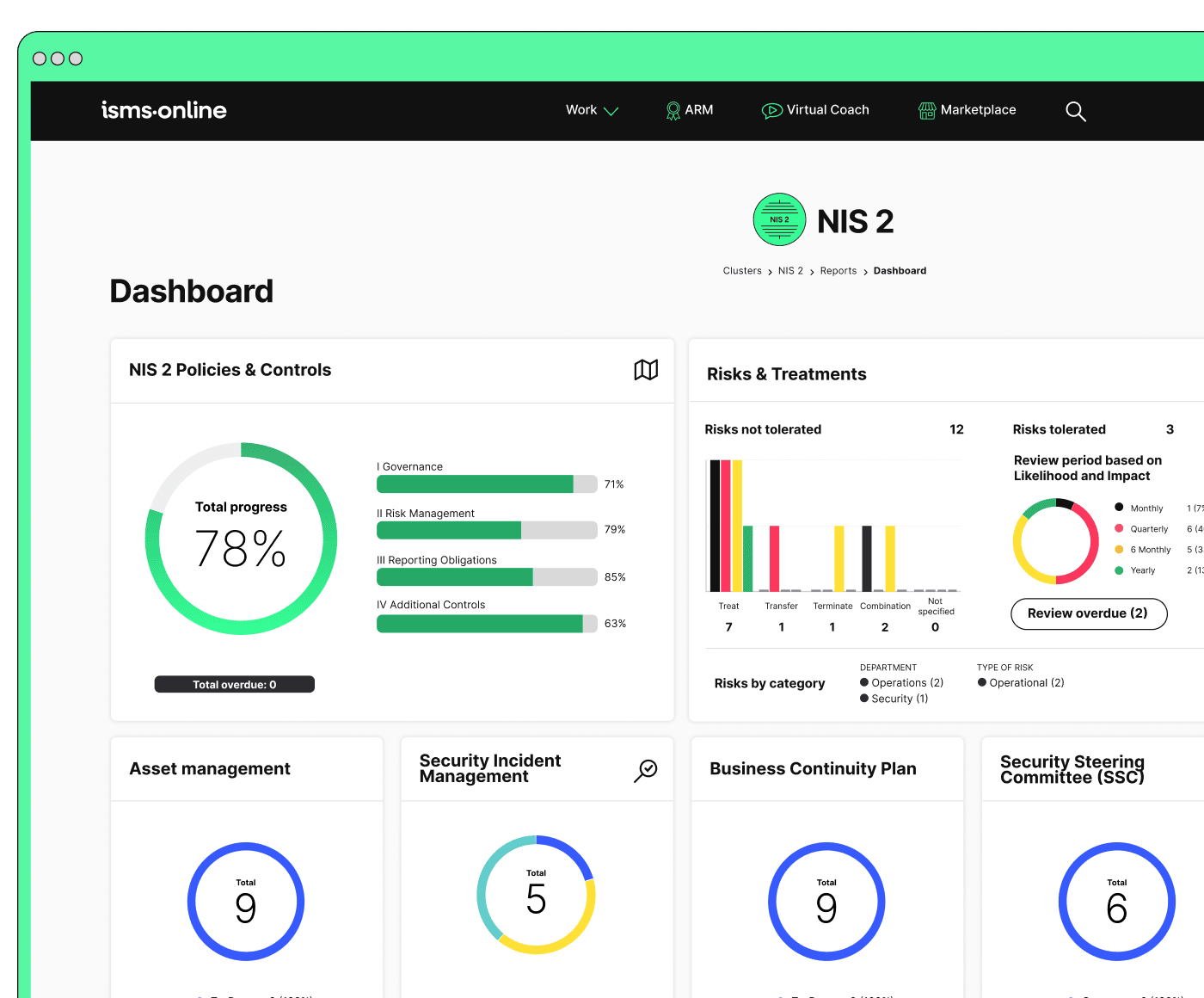
Be NIS 2-ready from day one
Launch with a proven workspace and templates – just tailor, assign, and go.
From Policy to Audit-Proof Evidence: Creating a Living Compliance System
Regulators now define “compliance” not as shelf policies, but as living, decision-logged evidence. That means digital supply chain logs, up-to-date mitigation history, and board-signed risk decisions-ready at a click. Auditors expect frequent “fire drill” audits, not just annual reviews.
In today’s regulatory climate, failing to deliver an evidence log on request is, itself, a compliance failure.
ISO 27001 Compliance Bridge Table
A ready bridge between operational reality and Annex A controls ensures defensibility:
| Expectation | Operationalisation | ISO 27001 / Annex A Reference |
|---|---|---|
| Board approves risk management | Documented risks + signoffs | 5.4, 5.7, 8.2, 8.3 |
| Living supplier register | Versioned logs, quarterly review | 5.19, 5.20, 5.21, 5.22 |
| Rapid incident evidence retrieval | Notification logs, auto alerts | 5.24, 5.26, 5.27, 5.28 |
| ENISA + DWD traceability | Linked logs/registers | 4.1, 6.1.2, 6.1.3, 12, 15 |
Audit ability is built on linking expectation to log to control-anything less is high risk.
Integrating Water Safety, Cyber Risk, and Business Continuity: How to Achieve Compliance Synergy
A new “compliance operating system” is needed: separate logs, policies, and registers will collapse under NIS 2 pressures. Boardrooms now expect one workflow binding ENISA, DWD, and ISO controls in a single dashboard. Every risk-whether plant, cyber, or supplier-must flow through a unified evidence register.
- Merged risk register: Incident, digital, water quality, and supplier risks logged in one place.
- Automated mapping: Update once, propagate across DWD-NIS 2-ISO action logs with live owner/approver.
- Dashboard review: Board and audit teams see all at a glance-risk trends, incident root cause, supplier status.
- Feedback loop: Learnings from real incidents feed directly into live controls and mitigation protocols.
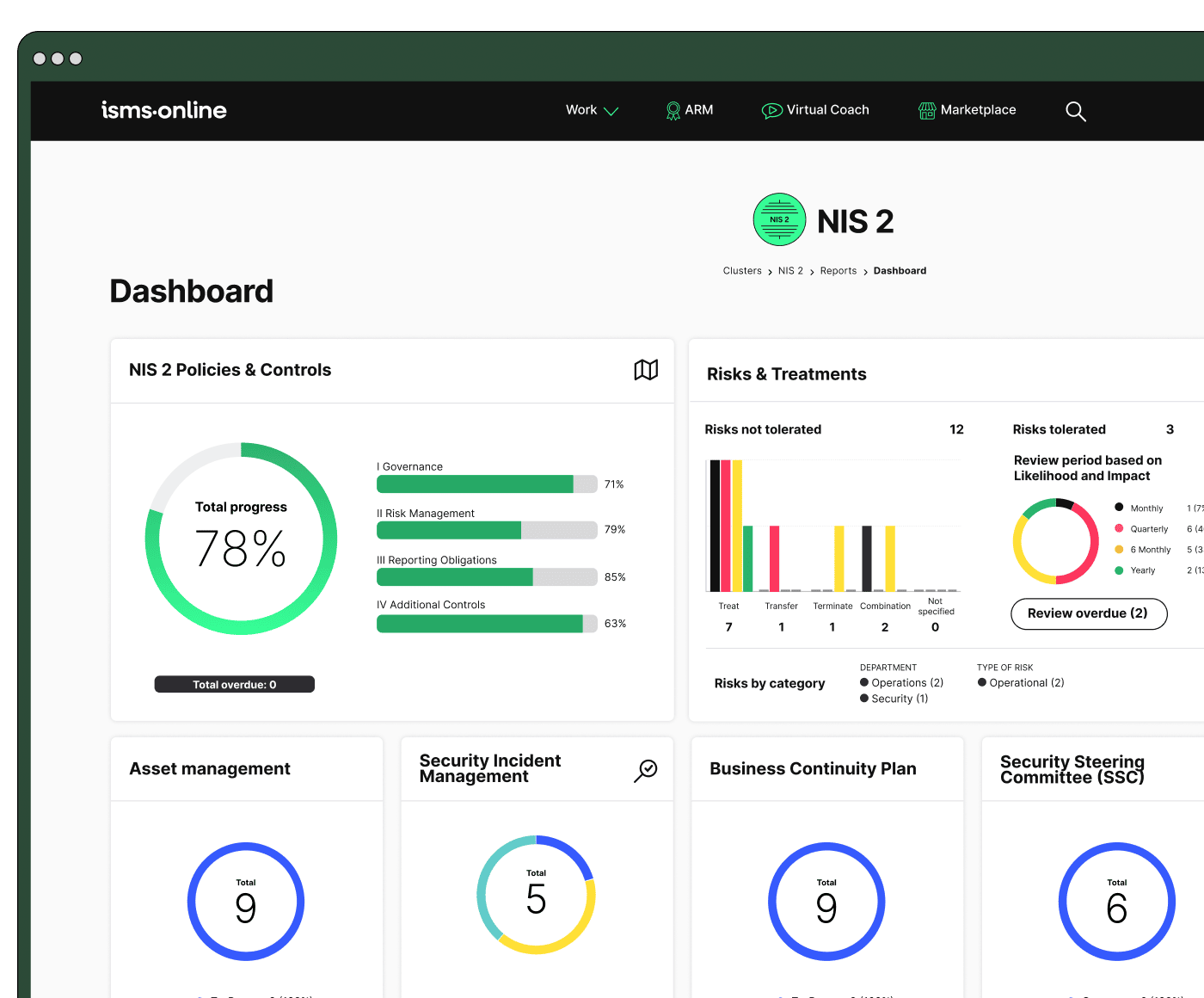
All your NIS 2, all in one place
From Articles 20–23 to audit plans – run and prove compliance, end-to-end.
Elevating Board Confidence: Leadership, Culture, and Social Proof
The currency of trust for modern utilities is “audit-proven resilience.” Board sign-off, live dashboards, and documented lessons-learned form the bedrock of this currency. Peer benchmarks, industry recognition, and tender successes follow those demonstrating a living compliance culture.
A reputation for audit-proven resilience is more than cyber-defence. It’s currency for contracts, financing, and peer recognition across Europe.
Leading firms run regular stress tests, log every major risk update, and keep their board within one click of core compliance dashboards. Data shows lower audit findings, faster incident retrievals, and higher staff engagement in those with living compliance workflows. The prize is significant: lower insurance premiums, more successful tenders, and insulation from the fallout of negative audits.
Ready to Move? ISMS.online Powers NIS 2 Drinking Water Compliance for Every Role
Boardroom, security office, plant or field-the compliance challenge now touches every seat in the utility. ISMS.online is engineered for this moment: a unified platform for live control status, evidence, risk and asset registers, with roles and responsibilities mapped for NIS 2, DWD, and ISO 27001 compliance (isms.online).
Utilities already using ISMS.online have halved average audit findings, cut evidence retrieval time from days to minutes, and streamlined board reporting (sector benchmarks, isms.online data). Staff-from operators to compliance leads-use embedded workflows to unify supplier, technical, and incident responses, moving the sector standard from fragmented to audit-proven.
Let compliance become your competitive edge: now is the time to turn resilience into operational assurance, reputational currency, and real-world proof for every stakeholder. Where will your organisation stand at the next audit cycle-and what story will your board tell?
Frequently Asked Questions
Who must comply with NIS 2 in the drinking water sector, and what triggers regulatory obligations?
Under NIS 2, any EU drinking water utility with over 50 employees, annual turnover above €10 million, or a critical sectoral role is now “in scope” for sweeping cyber-security regulation. Whether you’re a city water authority, regional provider, outsourced service manager, or supply chain partner (like a SCADA vendor or chemical supplier), regulatory obligations are triggered when you cross size thresholds or if authorities designate your services as essential to public health or national security.
This shift captures many previously exempt utilities-especially smaller operators whose systems or suppliers underpin vital water delivery in local communities. Direct water operators, essential contractors, and supply managers must prepare, as an incident, audit or reclassification can activate the regime overnight. NIS 2 extends legal duties far beyond IT, now requiring board-level ownership and operational accountability throughout the business.
What makes a drinking water entity “in scope”?
- ≥ 50 employees: or €10M+ annual turnover
- Sector designation as “essential” (via public health, economic, or security impact)
- Outsourced management, SCADA/cloud vendors, and key suppliers influencing water delivery or safety
In NIS 2’s world, resilience is defined from boardroom to tap-no exceptions for provider size or structure.
What are the core steps to achieve and sustain NIS 2 compliance for a water utility?
NIS 2 compliance for drinking water utilities is a living operational discipline, not a one-off tick-box. Key requirements:
Establish a robust Information Security Management System (ISMS)
Adopt board-approved policies and controls-ideally mapped to ISO 27001-with clear risk mapping, documented responsibilities, and regular effectiveness reviews. Policy must be actioned and traceable, not just filed.
Ongoing risk assessment and threat monitoring
Maintain a dynamic risk register covering not just classic cyber threats (ransomware, phishing), but operational risks to field devices, supply chain outages, sabotage, and digital/physical incident interplay.
Asset inventory and lifecycle tracking
Continuously log, review, and update every asset-physical (PLCs, servers), digital (SCADA, cloud, metres), and mobile. Include new deployments, retirements, and supplier-owned infrastructure.
Scenario-based incident response
Run and log simulated drills (IT, OT, supplier-driven), involving all relevant stakeholders. Review and trace lessons learned to control improvements and management actions.
Versioned, mapped documentation
Every policy approval, risk update, supplier review, and incident must have timestamped, version-controlled evidence with linkages to SoA/Annex A controls and explicit board sign-off.
Supplier and third-party oversight
Keep a living supplier risk/contract register with embedded cyber clauses, right-to-audit language, and event logs for drills, breaches, and contract changes.
Continuous management review and learning
Quarterly C-suite/board management reviews, ad hoc as needed, logging evidence of learning and adaptive change.
Daily readiness isn’t created by static docs-it’s lived control, visible in every log, not just at audit time.
How has NIS 2 (with the Drinking Water Directive) changed auditing and reporting for water utilities?
Gone are the days of siloed “IT” or “safety” audits-NIS 2 and the Drinking Water Directive demand joined-up governance and evidence. Regulators and insurers now expect:
- Unified, cross-standard risk registers: Every key risk must be mapped to NIS 2 and DWD frameworks, ideally in a single live system.
- Immediate, comprehensive evidence retrieval: Auditors often request drill/pull of all incident, supplier, and risk records in hours, not weeks.
- Management review and board sign-off records: Demonstrating real engagement-minutes, logs, corrective actions.
Industry leaders now run full-stack “dry run” audits, benchmarking retrieval and cross-functional traceability. Inability to integrate cyber, plant, and supplier evidence now means instant fines and buyer doubts.
Proactive teams treat audits as business proof-in-action-not a last-minute scramble.
Which supply chain and vendor risks are most critical, and how can utilities demonstrate robust management of these exposures?
Post-NIS 2, utilities are directly liable for supply chain risk. Top requirements:
- Cyber clauses in all contracts: Clear breach notification, right-to-audit, and drill participation expectations.
- Digital supplier risk register: Live, versioned, showing ownership and links to controls for every review, breach, or update.
- Full engagement in incident drills: Minor vendors or SaaS providers are “auditable”-must join tests, update protocols, and supply logs as needed.
- Linkage between every vendor event and system control: E.g., cloud provider breach mapped to SoA/Annex A, including logged mitigation and follow-up.
A single incomplete register or lack of contract traceability is now an audit red flag.
Your smallest supplier can trigger the sector’s largest investigation-document every action, from boardroom to backdoor.
What documentation and board involvement are needed to pass an urgent NIS 2 audit or investigation?
Expect to present:
- Risk registers and updated asset inventories spanning IT, plant, and vendor environments
- Signed, version–controlled logs: detailing policy approvals, supplier/incident events, mapped to SoA/Annex A
- Incident logs, with explicit C-suite/board review, sign-off, and post-mortem learning
- Evidence of quarterly management reviews and role-based engagement (board, ops, supplier)
- Approval trails for every change or risk–control update
- Demonstrable evidence retrieval-auditors may simulate “fire drills” expecting outputs in hours, not weeks
Auditors and regulators will not excuse missing, pseudo, or outdated evidence-real-time, living documentation is non-negotiable.
How fast must incident reporting happen, and what are the stakes if a water utility misses NIS 2 deadlines?
NIS 2 mandates:
- Initial incident report: Within 24 hours to the national CSIRT/regulator, even before full facts exist.
- Full update: Within 72 hours, showing impact and actions.
- Final report: Within a month, covering root cause and improvements.
Miss a deadline? Fines may hit €10 million or 2% of global turnover, plus regulatory censure, exclusion from contracts, and higher insurance premiums. Treat every event as test-not just of documentation but of real, practised readiness.
In the NIS 2 era, preparedness is measured in hours, not weeks-and leadership is under the spotlight.
What practical strategies unify water safety, cyber-security, and operational resilience in a NIS 2 programme?
- Single, live risk and evidence log: Covering cyber, OT, plant, and vendor events.
- Routine joint scenario drills: Coordinating all departments and contractors, logging lessons and actions.
- Assigned owners for every finding: With documentation of follow-up and sign-off.
- Quarterly board/C-suite management reviews: Recording learning and adaptation, not just approvals.
- Dedicated compliance dashboards: Automated reporting and click-and-retrieve evidence for auditors and the board after any key event.
Benchmark against ENISA, the Drinking Water Directive, ISO 27001, and sector audits to stay ahead.
Why is boardroom and C-suite engagement decisive for NIS 2 (water sector) audits?
Today’s regulators assess lived, continuous leadership engagement more than static documentation. Compliance is now defined by:
- Quarterly board/C-suite reviews of live dashboards: Actively discussing big risks, incident logs, and remedial action-not just ratifying them.
- Personal participation in incident response drills: With lessons implemented and tracked.
- Continuous, accessible evidence: Audit logs, versioned approvals, live metrics-visible proof, not just signatures.
The most robust utilities signal “compliance capital” to insurers, regulators, and customers by showing that governance is embedded at every level.
How does ISMS.online equip water utilities for end-to-end NIS 2 compliance, from boardroom to operator?
ISMS.online provides:
- Live role-based dashboards: for the board, CISO, and operations-customised for mandate and status
- Automated alerts, escalation, and reporting workflows: for contracts, incidents, supplier reviews, and quarterly management reviews
- Digital, versioned evidence banks: mapped to NIS 2, Drinking Water Directive, and ISO 27001-click-retrieval for every audit scenario
- Integrated approvals, signoffs, and management reviews: -evidence that’s lived, not fictional
- Sector benchmarking: -compare your data to industry best, flag gaps before you’re audited
When every control, contract, and incident is documented live in one place, audits become a display of operational strength-not a fire drill.
Utilities seeking unified, audit-ready compliance across NIS 2, DWD, and ISO 27001 should schedule a board demonstration and peer gap analysis-before regulators or buyers do.
Drinking Water Utilities: ISO 27001 / Annex A Compliance Bridge
| Compliance Expectation | Operationalisation | ISO 27001 / Annex A Ref |
|---|---|---|
| Unified risk register | Live system, controls/SoA mapping | 6.1.2, 8.2, Annex A 5.12 |
| 24/72h incident reporting | Automated logs, tested responses | 5.25–5.28, 5.26 |
| Board management reviews | Quarterly documented minutes | 9.3, 5.4, 5.36 |
| Supplier traceability | Versioned contracts/drill records | 5.19–5.22, 5.21, 5.30 |
Evidence Traceability Mini‑Table
| Trigger | Risk Update | SoA/Control Link | Evidence Logged |
|---|---|---|---|
| Cloud provider outage | Vendor incident log | 5.21, 5.22 | Incident note, contract, approval |
| Contamination event | Register/soA update | 6.1.2, 8.2, 9.2 | Board review, drill logs, supplier note |






