





































How Do New NIS 2 Obligations Reshape Board Accountability in the European Energy Sector?
Regulatory scrutiny in the European energy sector is moving swiftly from compliance teams to the boardroom. If your organisation generates, transmits, or distributes energy-electricity, gas, oil, district heating-or delivers critical technical or digital services to these entities, you’re almost certainly in scope for NIS 2. What’s fundamentally changed is not only the breadth of coverage but the direct, personal accountability mandated for directors, non-delegable by policy or hierarchy (ENISA: Cyber-Security in the Energy Sector).
Let’s be clear: The NIS 2 Directive, in effect from October 2024, binds the board as a collective and as individuals. No longer can responsibility be quietly spun out to a compliance manager or siloed technical lead. The directive requires organisations to designate individuals for breach notification-a role that is personally liable if notification or mitigation steps slip. Non-compliance exposes both the company and directors to formal enforcement, including fines and, in severe cases, named liability.
Cyber resilience is now judged in board minutes, not just firewall logs.
Who’s Accountable and What Can’t Be Delegated?
Article 20 (NIS 2) is explicit: every board director shares oversight of risk management measures, with clear records of their engagement, questions, and approvals. The classic “nobody told legal” defence is gone-the board is expected to actively review, challenge, and confirm continuous compliance. Even breach notification structure is prescribed: designated compliance leads are liable for coordinated incident reporting and evidence of remedial action.
How Is Cross-Border or Multinational Compliance Managed?
Any energy enterprise with assets, control rooms, or data operations spanning multiple EU states must designate a main establishment and interact with the relevant authority in each jurisdiction. National regulators (BSI for Germany, Ofgem for the UK, ANSSI for France, etc.) monitor with local nuance but aligned expectations.
The era of annual policy sign-off and reactive tick-the-box exercises is over. The only viable defence is a living, auditable record of board-driven activity and verified operational resilience. Now, with scope and exposure clarified, the focus must shift to precisely mapping and documenting your organisations assets, dependencies, and suppliers.
Book a demoWhat’s Truly “Critical” Under NIS 2-and How Do You Map and Evidence Your Energy Sector Exposure?
Determining which assets and suppliers are “critical” is the foundation of defensible NIS 2 compliance for energy organisations. Overlooking even a single supply chain dependency or underestimating a third-party’s reach can not only derail audits-it can stall real-world service restoration when incidents occur.
The most resilient operators treat asset mapping as a living discipline, not a quarterly box-tick.
Which Operations and Assets are Automatically In Scope?
Annex I of NIS 2, reinforced by national registers, makes clear that core functions-generation plants, storage facilities, transmission grids, SCADA/ICS systems, digital infrastructure providers, and any IT/OT hybrid systems-are always in scope (EU Digital Strategy). Increasingly, this also includes support services (cloud, control room operations, managed IT, and third-party platforms) if interruption could disrupt supply or safety.
How to Classify and Score Suppliers?
ENISA and national agencies require formal supplier categorisation-“essential suppliers” are those whose failure would halt critical operations, while “important suppliers” might degrade but not sever services. Importantly, third-country (non-EU) suppliers cannot escape scrutiny; contracts must explicitly require “equivalent” controls and evidence, regardless of locale.
Supplier Tier Snapshot Table
| Tier | Criteria | Examples | Evidence Required |
|---|---|---|---|
| Essential | Directly supports grid or critical services | SCADA integrators, primary IT, control room providers | Contracts, incident logs, risk assessments |
| Important | Indirect but substantial service impact | Hardware vendors, infrastructure support partners | Service logs, risk scoring, audit trails |
| Non-EU | Impacts any “critical” asset directly/indirectly | Global cloud, security, or data platform suppliers | Contractual NIS 2 clause, supplier evidence |
What Documentation Is Now Basic Audit Currency?
You’ll need a continuously updated asset inventory and a supplier register with owner assignments. Every critical vendor contract should be tagged with NIS 2 clauses and logs of incident drill participation. Joint exercises, audit logs, and a risk dashboard that ties these to board-level risk review are now best (and expected) practise (ENISA Threat Landscape).
Without the log, it didn’t happen. That’s now the compliance reality.
To operationalise this, aim for a rolling, digital record that lives outside of desktop spreadsheets-with assets, suppliers, contacts, contracts, and event logs all interlinked. With mapping in hand, your technical and organisational measures need to match the risk-precisely where most energy operators face scrutiny and improvement headroom.

Master NIS 2 without spreadsheet chaos
Centralise risk, incidents, suppliers, and evidence in one clean platform.
Where Do Most Operators Fall Short With Article 21: OT, IT, and ICS Controls and Logging?
Regulatory compliance in the energy sector isn’t just about ticking a checklist of technical and organisational controls-it’s about live, demonstrable practise. Article 21 of the NIS 2 Directive enshrines technical domains that have tripped up even mature operators: network segmentation, monitoring, access control, and incident simulation.
What are the “Must-Have” Technical and Organisational Controls?
- Segmentation and Isolation: Demarcate OT from IT. Direct connections create high-risk audit flags. Controls must be both physical (network/firewall) and logical (role, VLAN, or access policy) (ENISA).
- Continuous Monitoring: Deploy anomaly detection, real-time log review, and automated alerting for critical devices and processes.
- Multi-Factor Authentication (MFA): Mandatory for privileged accounts. Enforce by policy and validate via logs (KPMG).
- Incident Response Playbooks: Maintain live, role-specific playbooks; conduct and log simulations (SIMEX) regularly, not just on paper (ico.org.uk – NIS2).
- Log Traceability: Every asset must map to its controls, each control to its logbook, and all to a central management register.
ISO 27001 ↔ NIS 2 Bridge Table
| ISO 27001 Expectation | NIS 2 Practise | Annex Reference |
|---|---|---|
| Segregate networks | Physical and logical OT/IT boundaries | A.8.22 / NIS2 Art. 21 |
| Control access | MFA + RBAC enforcement for privileged | A.5.15 / NIS2 Art. 21 |
| Monitor/respond | Anomaly detection, SIMEX drills | A.8.16/29 / NIS2 Art.21,23 |
| Trace all controls | Asset–control–logbook–SoA chain | Cl.6/8 / NIS2 Art.21 |
Why Are Static or “Desk Audit” Controls Failing Operators?
Regulators review not just your playbooks but your logs. If incident response simulations aren’t logged (timestamped, role-tagged, and traceable), they don’t count-regardless of how advanced your route planners or asset managers might be. Logs without owner assignments, or controls without test outcomes, are leading causes of failed audits and fines (SANS).
Controls that aren’t tested - and don’t live in the logbook - aren’t controls at all, just intentions.
Audit resilience comes from real-time evidence chains. Now, let’s drill deeper into incident response, evidence handling, and the timelines that govern NIS 2 reality.
What Defines Audit-Grade Incident Response Across Tabletop, SIMEX, and Crisis in Energy?
In the energy sector, incident response never stays hypothetical. NIS 2 mandates a precise, clock-driven response: organisations must log every phase of a breach or simulation, report in tight windows, and trace after-action learning directly back to risk management.
Only live, timestamped logs turn post-incident reviews into meaningful compliance evidence.
What Timelines Are Imposed by NIS 2?
- 24 hours: First notification, with all available incident facts, to your national CSIRT/regulator.
- 72 hours: Post follow-up with impact analysis, further details, and provisional root cause.
- 30 days: File a full incident closure package-must cover mitigation, stakeholder comms, and lessons recorded.
What Evidence Is Necessary for Audit and Regulator Review?
- Incident and SIMEX Logs: Timestamped, role-linked, noting participation and outcomes.
- Restoration Evidence: Updated RTO/RPO, root-cause analysis, and recovery timelines.
- Vendor Communications: Documented third-party involvement and response.
- Board-Level Trails: Decisions/activity logged at board and regulatory interface, including remediation actions and oversight.
Traceability Table Example
| Trigger | Risk Update | Control/SoA Link | Evidence Logged |
|---|---|---|---|
| Supply chain breach | Vendor risk re-scored | Vendor IR control | Contract, drill, comm logs |
| Drill finds gap | Update to IR plan | Restoration/backup SoA | Plan, new drill scheduled |
| Missed comms deadline | Notification process fix | IR notification policy | Meeting minutes, emails |
In practise, incident logs are only as valuable as the chain of learning and plan updates they create. After every breach or significant simulation, a documented after-action review must lead to an actual, logged change in procedures, controls, or risk registers.
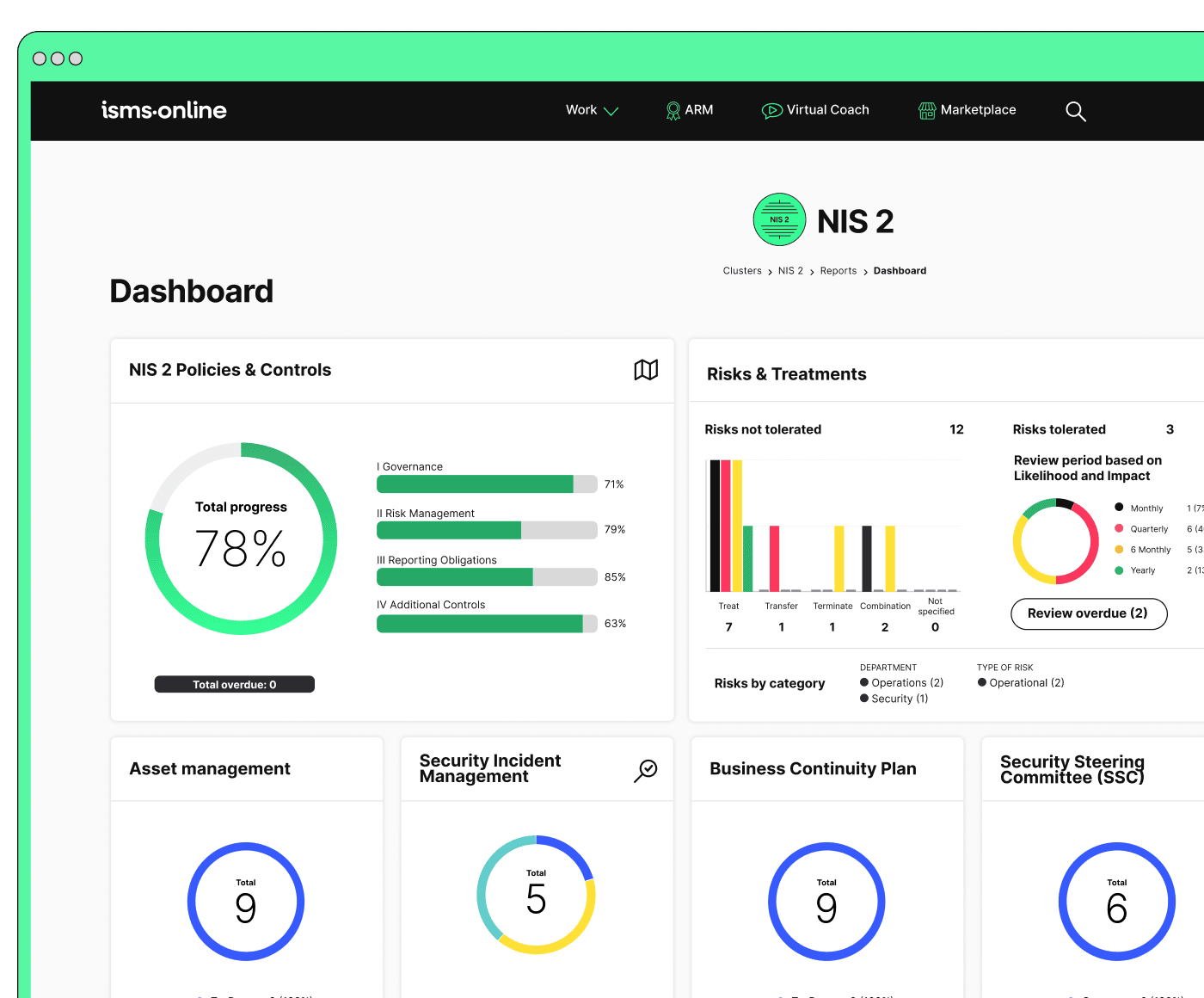
Be NIS 2-ready from day one
Launch with a proven workspace and templates – just tailor, assign, and go.
How Do Supply Chain and Contract Management Translate Into Verifiable NIS 2 Compliance?
Vendor risk remains a weak point for many energy organisations-and the area where most NIS 2 audits have teeth. It’s impossible to fake a mature supply chain risk programme. Contracts, onboarding, and ongoing review must leave clear, timestamped digital audit trails with accountability flagged at every stage.
What’s the Practitioner’s Practical Checklist for NIS 2 Supply Chain Compliance?
- Maintain a central register covering every critical vendor, contract owner, and review/action date.
- Embed NIS 2 obligations into all supplier agreements (e.g., regular evidence submission, breach notification, drill participation).
- Automate review dates, renewal deadlines, and incident-drill log reminders.
- Attach participation logs for every vendor in drills or incident simulations.
- Include offboarding checklists: confirm asset return, access revocation, and exit risk assessments completed.
What Contract Clauses Are Non-Negotiable?
- Upfront audit rights, direct evidence submission obligations.
- Notification windows for incidents (matching NIS 2).
- Participation in live/annual incident response exercises.
- Documented penalties for missed reports or failures.
Frequent Pitfalls To Avoid
- Outdated contracts (“grandfathered” suppliers without digital audit trails).
- Undefined risk owners in the register.
- Incomplete or off-schedule incident log participation.
- Manual reminders-automation gaps lead to missed regulatory milestones.
A single vendor with an unassigned or outdated contract record can undo your entire audit trail.
To meet audit standards, digital platforms should automate the cross-linking of vendor logs, evidence, and critical control mapping across the supply chain (isms.online). With contracting and evidence streamlined, avoid duplicate effort by aligning NIS 2, ISO 27001, and national regulatory requirements effectively.
How Can Energy Sector Teams Harmonise NIS 2, ISO 27001, and National Requirements for Audit-Ready Proof?
The most common (and costly) audit failures stem from evidence fragmentation: when logs, risk registers, and test outcomes live in silos. Energy sector teams that build compliance on integrated platforms find that work done for ISO 27001 supports NIS 2-with only minor adjustments for local regulators-rather than requiring parallel, duplicated effort.
Ready evidence for one standard should deliver confidence for all-fragments do not scale.
Where Are Teams Most at Risk of Audit Drag or Red Flags?
- Maintaining parallel asset and risk logs not cross-referenced between frameworks.
- Relying on static documents or periodic reviews instead of living logs and action dashboards.
- Failing to map what national regulators require on top of NIS 2 (e.g., extra BSI protocols, Ofgem’s sector-specific evidence).
Framework Overlay Map
Picture three overlapping circles:
- ISO 27001 (risk, assets, controls, SoA, test records)
- NIS 2 (incident response, supply chain, board oversight)
- National rules (country-by-country extra fields, reporting requirements)
Full audit alignment exists only in the overlap. Teams benefit by building one central digital ISMS where every control and action is mapped once, logs are linked, and all standards are referenced together.
ISO 27001 ↔ NIS 2 Bridge Table
| ISO 27001 Expectation | NIS 2 Operationalisation | Annex Reference |
|---|---|---|
| Regular risk assessment | Quarterly register/log update | Cl.6.1 / NIS2 Art.21 |
| Asset/data classification | Cross-framework ID mapping | A.5.12 / NIS2 Annex I |
| Evidence for controls | SIMEX and SoA linkage | A.8.29 / NIS2 Art.23 |
| Incident learning logged | After-action reviewed/risk link | A.5.27 / NIS2 Art.23 |
Steps to Achieve Audit-Ready Harmony
- Map your risk, asset, and supplier fields across all frameworks.
- Drive all event, test, and drill records into a central log-tag with roles, owners, and compliance domains.
- Review quarterly and annually, link every audit or board log to corresponding SoA or supply chain evidence.
- Use workflow and status dashboards for instant compliance visibility and scheduled action tracking.
Unified audit-readiness is not a luxury; it is now the baseline for regulatory resilience and operational assurance.
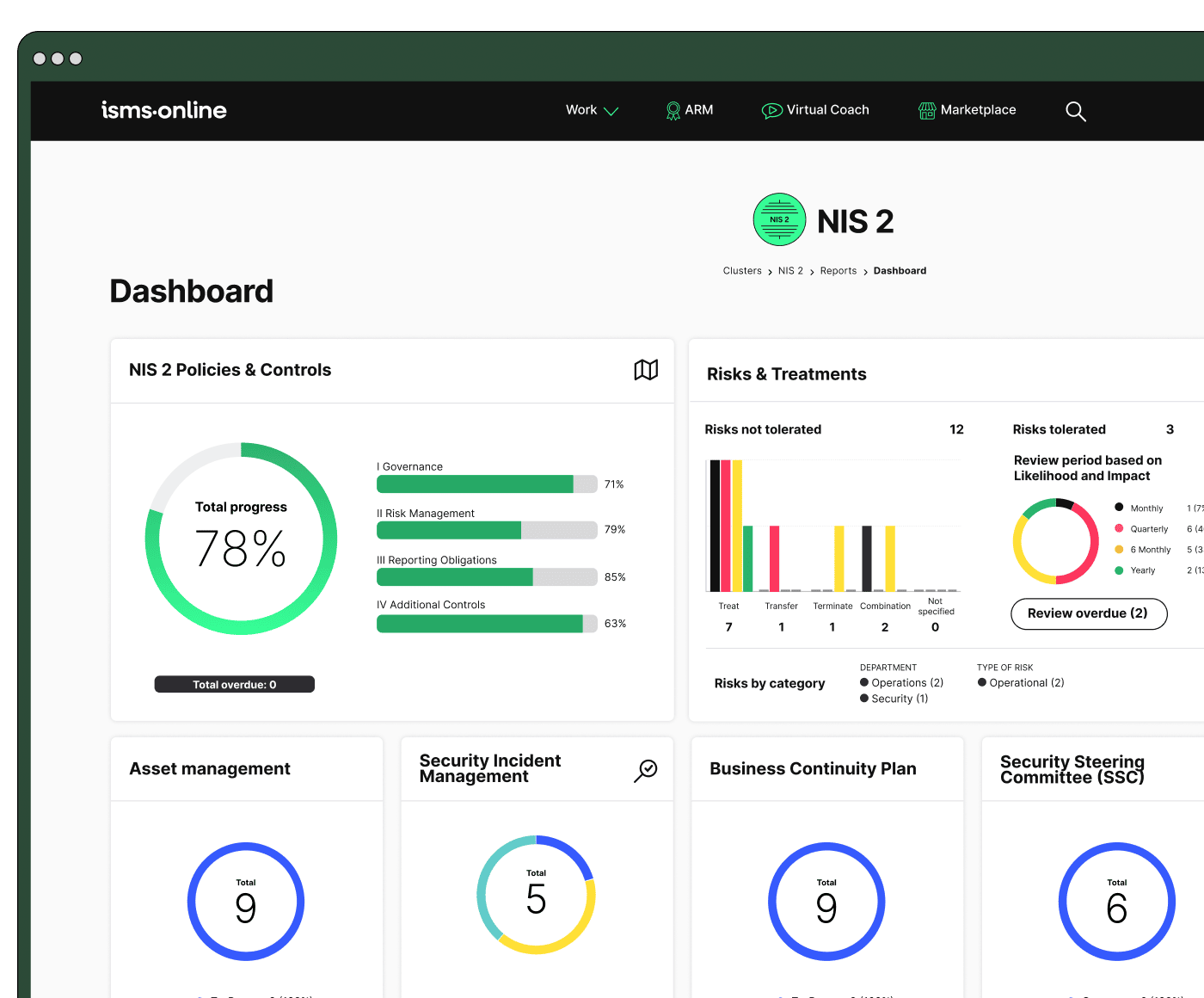
All your NIS 2, all in one place
From Articles 20–23 to audit plans – run and prove compliance, end-to-end.
What Lessons from Recent Cross-Border Energy Crises Should Direct Your Compliance Maturity?
Europe’s sectoral shocks-the Iberian Peninsula blackout, ransomware-driven Swedish municipal outages-have shattered illusions about the sufficiency of static, checkbox compliance (en.wikipedia.org; itpro.com).
Teams stumbled not on intent or policy but on slow reporting, incomplete cross-border logs, and localised risk ownership failures. The modern energy operator builds dynamic, real-time, and evidence-driven compliance:
- Centralised logging: Risks, incidents, and evidence flow into a unified dashboard, permissioned by role, country, and language as necessary.
- Automated mapping: Each action or event triggers updates across all frameworks and national peculiarities automatically.
- Continuous improvement cycles: One live incident drill per quarter, one critical contract review per month, and cross-jurisdiction analysis annually.
- Owner clarity: Every control, risk, or log must have a named owner, visible on demand.
Resilience is measured not by perfect policy but by consistent, auditable action-visible in any live test or drill.
ENISA’s Maturity Playbook
- Immediate risk mapping of all supplier relationships, with auto-linking.
- Quarterly and annual sector-specific simulations and reviews.
- Integration with contractual obligations for full rollout across supply chains.
Mature operators use workflow tools to ensure audit trails are closed, roles are clear, and every compliance cycle can withstand both scrutiny and shock.
What Steps Deliver Operational Audit-Readiness for NIS 2 in the Energy Sector-Without Spreadsheet Overload?
The divide between policy compliance and operational resilience closes only where daily practise is digitally mapped, responsibility clear, and audit evidence always at hand. ISMS.online accelerates this alignment-integrating NIS 2, ISO 27001, and national requirements into a unified workflow (isms.online).
Crossing the line from compliant on paper to audit-ready in action is where sector leaders will be made.
Frequently Asked Questions
Who determines a ‘critical’ energy entity under NIS 2, and how does this change your board’s risk obligations?
National competent authorities-like the BSI in Germany, Ofgem in the UK, or France’s ANSSI-assign ‘critical’ status under NIS 2 based on Annex I and concrete sectoral criteria. If your energy company operates essential infrastructure (electricity, oil, gas, district heating) or delivers digital/supply chain services to these, you’ll likely be formally designated as an “essential entity.” Registration is often automatic, not voluntary. Once listed, your board and executive team face a new legal regime: direct, ongoing accountability for cyber oversight, live risk management, and timely audit evidence on demand. Directors can no longer silo cyber as a technical matter-regulators expect board-level sponsorship, named responsibility in registers, and traceable decision records. Proactive checks of your status-and immediate alignment of board agendas-are required to avoid both compliance breaches and operational exposure.
Responsibility has moved from annual sign-off to continuous, demonstrable cyber vigilance at the top.
ENISA: Energy Sector Guidelines
BSI: NIS 2 Entity List (Germany)
Leadership checklist
- Confirm designation in relevant national registries-never assume exemption.
- Delegate NIS 2 compliance to a board sponsor, not “IT.”
- Set routines for reviewing risk, audits, and regulator communications.
- Map roles/responsibility in all supply-chain and registry documents.
What NIS 2 technical and organisational controls must energy firms now evidence-and how do these surpass legacy frameworks?
NIS 2 redefines “compliance” as live, operational, and evidence-driven-especially in cyber-physical contexts like SCADA/OT. You must prove that processes and controls actively reduce real-world risks, not merely exist on paper.
Priority NIS 2 controls for energy:
- Network segmentation: OT, IT, and ICS environments isolated (Article 21(2)(b)), with up-to-date diagrams and logs.
- 24/7 monitoring: SIEM tools ingest from all assets, OT included; logs must be available on request.
- Mandatory multifactor authentication: All privileged and external access, especially for OT gateways-no exceptions for “legacy” systems.
- Asset/risk registers: Updated in real-time, linking every asset, vulnerability, and incident to controls.
- Incident and drill records: Regular cyber-physical drills, fully logged and reviewed; absence of drill logs = non-compliance.
- Supplier security mapping: Contracts require NIS 2-grade controls, with auditable evidence and drill participation.
- Continuous cyber hygiene and staff training: Logs show completion and testing, not just policy delivery.
Static PDFs and annual reviews don’t cut it: Only logs, dashboards, and live evidence withstand a modern energy sector audit.
ENISA Threat Landscape: Energy
KPMG: NIS 2 Checklist for Energy Suppliers
Table: Sample Control Mapping
| Control | NIS 2 Ref. | Evidence You Need |
|---|---|---|
| Segmentation (OT/IT) | Art. 21(2)(b) | Network maps, firewall change logs |
| Monitoring | Art. 21(2)(c, d) | SIEM exports, anomaly drill logs |
| MFA | Art. 21(2)(b, f) | Auth logs, policy enforcement |
| Supplier drill logs | Art. 21(2)(d) | Signed records, contract annexes |
How do energy firms tier and monitor supplier NIS 2 compliance-to avoid inheriting third-party risk?
Supplier management is one of the largest exposures in the sector. NIS 2 mandates every vendor is formally tiered, contractually bound, and subject to real-time oversight. Non-EU suppliers require explicit contract signals of equivalence.
Supplier compliance in action:
- Tier all suppliers: Use providers’ potential impact to assign ‘essential,’ ‘important,’ or ‘non-EU’ status; update mapping after every incident.
- Onboard with proof: Require signed security policies, drill participation, and clause-level NIS 2 obligations in all new contracts.
- Ongoing evidence: Maintain logs for supplier incidents, drill attendance, and notification timelines-regulators audit these first.
- Non-EU contracts: Enforce NIS 2 equivalence, monitor documentation quality, and test exportable logs with your ISMS.
Compliant suppliers deliver drill logs and evidence proactively; those without put your board on the regulatory firing line.
Energy Central: NIS 2 Supply Chain Security
Dataguidance: Non-EU Provider NIS 2
Supplier Tier Table
| Tier | Onboarding Proof | Ongoing Evidence |
|---|---|---|
| Essential | Signed policy, drills | Incident/drill logs, spot checks |
| Important | IR clauses, attestation | Notifications, rapid drill proof |
| Non-EU | NIS 2 clause contract | Exported monitoring log, audit |
What are the incident reporting and evidence standards for energy under NIS 2?
Reportable incidents-cyber, OT, or supply chain-trigger a three-stage reporting chain: a 24h initial alert, a 72h detailed update, and a 30-day closure, each backed by time-stamped primary logs. Drill records count as incident evidence, and every event must be linked in your risk register.
Effective incident evidence management:
- Initial alert (24h): Notify regulator of breach, scope, and first response. Log every comm and step.
- 72h update: Add technical findings, exposed data/systems, and supply chain impact.
- 30-day closure: Share root cause analysis, lessons learned, and control improvements-link logs to risk treatments.
- Simulations: Treat drills as real: identical logging, review cycles, and registry integration.
- System linkage: Assign unique IDs for every incident and drill; all must be traceable to board oversight.
Without complete, sequential logs, incident response becomes indefensible-every board or regulator wants the full chain, not reconstructed memories.
TTMS: NIS 2 Implementation Guide
ICO: NIS 2 Reporting Best Practise
How can you unify NIS 2, ISO 27001, and national standards-saving audit time and ensuring continuous compliance?
Top energy firms use a single ISMS to “map once, prove many”-assigning every log, control, incident, and supplier action to relevant NIS 2 Articles, ISO 27001 controls, and national requirements; evidence packs are always export-ready for audits.
| Evidence Type | ISO 27001 Control | NIS 2 Article | National Example |
|---|---|---|---|
| Risk register | A.5.3, A.8.2 | Art. 21 | BSI §8, Ofgem Ch.4 |
| Incident log | A.5.25, A.5.26 | Art. 23/24/72/30 | ANSSI Tabletop, BSI |
| Supplier oversight | A.5.19–A.5.21 | Art. 21(2)(d) | National DSO/TSO |
- Map to multiple standards: Set unique log IDs and update mappings quarterly; regulators expect proactivity.
- Exportable bundles: Build automated evidence packs for board, auditors, and national authorities.
- Integrate controls: Use cross-referenced artefacts to demonstrate real coverage and reduce redundant work.
ICO: NIS 2 & ISO 27001 Mapping
What cyber incident lessons and audit failures are shaping today’s energy compliance strategies?
Incidents like the Iberian Peninsula blackout and Swedish ransomware attacks reveal failures in supplier proof, incident drill documentation, and loss of log continuity-leading to both outages and audit penalties.
Lessons into resilience:
- Unified dashboards: Require all logs (assets, suppliers, drills, incidents) to be visible to execs and regulators.
- Learning loops: Every event, even exercises, must produce a board-reviewed root cause and control update.
- Quarterly owner rotation: Assign and rotate root responsibility for logs and reviews.
- Fragmentation avoidance: Proactively spot and remediate evidence gaps before audits.
Audit surprises are most likely when logs are fragmented, supplier proof is missing, or drills are not formally documented.
Wikipedia: 2025 Iberian Blackout
ITPro: Swedish OT Outage
How does ISMS.online deliver NIS 2 compliance and assurance for energy sector leadership?
ISMS.online replaces your fragmented records with live, mapped audit trails-automatically linking assets, suppliers, incidents, and controls to both NIS 2 and ISO 27001. Boards and compliance teams can:
- Instantly surface overdue controls, spot drill coverage, and map contract compliance across all suppliers.
- Automate evidence gathering with reminders, up-to-date logs, and export-ready bundles for board and auditor review.
- Use sector-specific templates for Art. 21/Annex I, incident reporting, supply chain, and registry outputs.
- Cross-reference ISO 27001, NIS 2, and national frameworks-minimising rework and audit surprises.
Embedding ISMS.online means every cycle brings you closer to resilience leadership and audit certainty-where evidence isn’t a scramble, but an always-on asset.
(https://www.isms.online/)






