





































How Does NIS 2 Change the Compliance Landscape for Financial Market Infrastructures?
From October 2024, NIS 2 irrevocably reclassifies CCPs and trading venues as “essential entities,” shifting cyber-security from a routine technical requirement to a statutory governance imperative. For your team-compliance, operations, legal, and leadership-this means substantial cultural and procedural change. No longer is cyber-security a background process delegated to IT. Instead, regulators now demand continuous evidence of board-level engagement, executive accountability, and live, cross-team assurance.
Doing nothing is a decision; with NIS 2, inaction has organisational consequences.
The Directive’s reporting timelines (such as 24-hour incident notification, board-minute practises, and supply chain scrutiny) replace discretion with duty. The risk of “missing” a step is no longer theoretical: Non-compliance can trigger fines up to €10 million or 2% of annual global turnover (digital-strategy.ec.europa.eu; comarch.com). This isn’t a one-off deadline; it’s a perpetual regime of regulatory visibility.
At its heart, NIS 2 overlays the sectoral expectations of EMIR and MiFID II with a cyber risk lens, creating a context where your IT vendor’s vulnerability or an untested supply chain process can be as material as a missed financial reporting window or flawed audit scope. Accountability does not end at the CIO’s door: it sits squarely at the board table, with documented, recurring oversight.
Key shifts:
- Cyber-Security as board-level, regulator-audited capital.
- Supply chain scrutiny as a continuous, logged discipline.
- Cross-team, cross-vendor risk and incident workflow as statutory minimum.
Boardroom reality: Leadership must be able to show not only an understanding and approval of risk but a track record of action-minuted, retrievable, and regulator-facing.
Takeaway: NIS 2 is the operational thread binding tech, legal, operations, and leadership to one continuous line of accountability. Treating it as “IT’s project” exposes revenue, trust, and market access to risks your board can no longer afford to ignore.
What Does Overlap with EMIR, MiFID II, and DORA Mean for Day-to-Day Operations?
NIS 2 does not exist in isolation; for FMIs, it arrives on top of and intertwined with DORA (operational resilience), EMIR (financial risk), and MiFID II (market conduct). Each regime introduces its own definitions, reporting triggers, control expectations, and accountability structures. The practical challenge? Avoiding gaps where everyone assumes “someone else” owns an obligation.
The hardest problems start when everyone believes someone else is covering the risk.
Frictions and gaps:
- Incident Materiality: Each regime has a slightly different trigger or definition for what must be reported; mismatches lead to missing notifications or duplicated work.
- Board-Level Evidence: DORA and NIS 2 both require provable, board-level review, but with different reporting cadences and evidence expectations.
Solution: Operate a living Statement of Applicability (SoA) that maps every required control to all relevant regulations-a single ledger, dynamically updated and tied to team roles (enisa.europa.eu; nis-2-directive.com).
Why SoA Clarity Ends the Audit Guesswork
| **Expectation** | **What to operationalise** | **Who signs/owns** |
|---|---|---|
| Cyber incident logging | Unified NIS 2 / DORA path | Ops/IT-Board minutes |
| Financial resilience | EMIR process tracker | Risk officer/Board |
| Supply chain review | NIS 2 + DORA dashboard | Procurement, Legal, Execs |
A harmonised SoA exposes redundancy (remove wasted effort), reveals unowned risk, and demonstrates readiness to regulators and clients alike.
Integrated compliance is visible compliance-Frankenstein frameworks create audit liability.
Takeaway: FMIs that drive their compliance with a single, harmonised SoA will navigate the multi-regime maze faster and with more board confidence than those patching gaps under pressure.

Master NIS 2 without spreadsheet chaos
Centralise risk, incidents, suppliers, and evidence in one clean platform.
How Do You Operationalise Compliance-From Incident to Evidence Without Silo Blindspots?
Audit and breach events rarely respect organisational boundaries; nor do they align neatly with regulatory categories. NIS 2, DORA, EMIR, and MiFID II all require time-bound incident reporting, each with nuance in definitions, escalation, and evidence. Success now rests on frictionless, logged, cross-team action.
Incidents do not respect silos; neither do regulators.
Breakdowns to fix fast:
- Lost artefacts and missed steps: Over 30% of key evidence items can be misplaced or unlogged during cross-functional incident response.
- Ambiguous ownership: Incidents kick off with Operations or IT, but escalate to Compliance, Legal, and ultimately the Board-often without a shared playbook or transparent log.
Traceable Evidence-Making Every Incident Count
| **Trigger** | **Risk update** | **SoA link** | **Evidence Logged** |
|---|---|---|---|
| Cyber breach (NIS 2) | 24hr/72hr/30d workflow | A.5.24/A.5.25/A.5.26 | Incident ticket, comms log |
| Ops outage (EMIR) | Daily status update | EMIR operational clause | Ops log, board minutes |
| Market anomaly (MiFID II) | Compliance escalation | MiFID II ops policies | SIEM logs, compliance emails |
Operational must-dos:
- Routinely rehearse “from detection to regulator notification” with all key teams and the same documentation workflow.
- Automate reminders/expiry dates to prevent lapses in reporting or forensic capture.
- Standardise handover protocols between functions-no more “I assumed you logged that.”
Audit readiness isn’t a theory-it’s a reflex built from operational discipline.
Takeaway: A unified compliance dashboard and clear playbooks are vital. If a workflow, evidence, or handoff can’t be exercised or seen today, it’s at risk when it matters most.
Are You Raising Supply Chain Security or Multiplying Hassle? The New Vendor Reality Under NIS 2, DORA, and MiFID II
Gone are the days of passive, certificate-only supplier management. Procurement now stands shoulder-to-shoulder with IT and legal, tracking vendor resilience as tightly as exposure or financial risk. Under NIS 2 and DORA, supplier monitoring and artefact collection are no longer annual projects-they’re continuous, logged disciplines.
Your weakest vendor is your next headline risk.
The bar has risen:
- Every critical supplier must trigger live, dated checks on ISO credentials, recent penetration test results, and evidence of incident notification compliance (sharp.eu; honeywell.com).
- Internal procurement needs a risk and evidence renewal dashboard-missing or expired certificates, sleepwalking onboarding, or “shadow” suppliers are audit flags.
Fast-Track List: Secure Supplier Onboarding
- Check Evidence Freshness: Documents-ISO, test findings, contracts-are dated, live, and attached at onboarding.
- Contractual Controls: Every template embeds NIS 2, DORA, and ISO terms, including active evidence renewal and right-to-audit clauses.
- Ongoing Visibility: Dashboards automate renewal requests, log spot-checks, and flag expired elements or missing artefacts.
- Disrupt the Shadow Channel: Capture every critical third-party traced through ICT, business, and internal referrals.
Today, procurement is operational compliance-the most secure vendor is the most visible.
Takeaway: Make supply chain security a teamwork discipline. Procurement now closes gaps before the regulator or a client does-and is central to avoiding the next market-impacting breach.
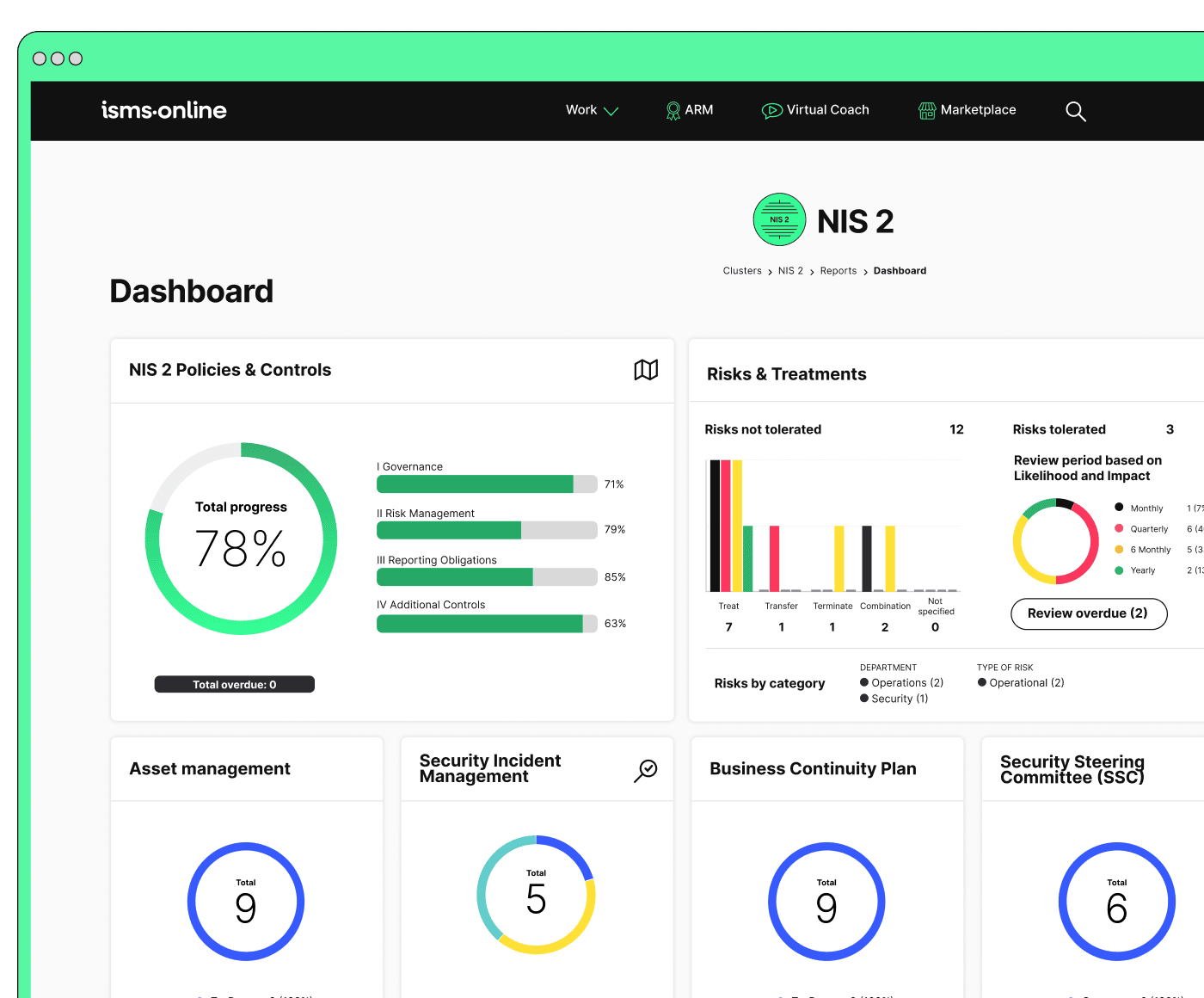
Be NIS 2-ready from day one
Launch with a proven workspace and templates – just tailor, assign, and go.
How Can Cross-Framework Mapping and a Unified Audit Trail Make or Break Your Next Review?
Auditors, regulators, and major clients increasingly expect not just compliance, but also evidential traceability-every risk, control, and incident linked dynamically to the correct regulation. If your organisation still relies on spreadsheets or disjointed trackers, gaps are inevitable.
When audit readiness is visible at a glance, panic gives way to control.
The solution: board-ready, cross-framework dashboards.
- See gaps as they emerge: Live “single pane of glass” showing which SoA controls are mapped to NIS 2, DORA, EMIR, MiFID II, and ISO 27001.
- Surface orphaned requirements: Inactive or duplicated controls are visible, enabling right-sizing and targeted improvement.
ISO 27001 Bridge Table: Live Traceability
| **Expectation** | **Operationalisation** | **ISO 27001 / Annex A Reference** |
|---|---|---|
| Board oversight | Quarterly reviews/signoffs | Cl 5.1, Cl 9.3, A.5.4, A.5.35 |
| Incident reporting | Alerts, workflow tracking | A.5.24, A.5.25, A.5.26 |
| Supply chain risk management | Renewal & evidence dashboards | A.5.19, A.5.20, A.5.21 |
| Management review closure | Meeting logs, lessons learned | Cl 9.3, A.5.27, A.5.36 |
Results:
- Compliance statuses by team, control, framework-always current, always audit-ready.
- Accelerated RFP responses and fewer audit findings, as status and evidence are collected in real time.
Takeaway: Share a live audit status map with your board-and see stress evaporate from both audit teams and business leads.
How Can Ongoing Testing and Evidence-Driven Reviews Turn Compliance from Burden to Advantage?
Compliance is becoming a continuous, proof-driven process, not a cyclical box-tick. Systematically logging every test, walkthrough, and incident as a governance artefact closes review gaps and marks maturity for both assessments and board discussions.
Continuous assurance underpins true resilience-not just audit survival.
Mandated expectations:
- Regulators and auditors require annual penetration tests, incident walkthroughs, red-teaming-and expect these to be evidenced via outcomes logged, lessons learned, and improvements tracked.
- Management reviews need to evidence a complete feedback loop: evidence → discussion → decision → implemented action.
Learning Loop: From Incident to Improvement
- Test scheduled: Assigned and tracked in the audit dashboard.
- Outcome logged: Evidence captured, lesson documented.
- Board/minute review: Decision and improvement points assigned.
- Action reference: Next scheduled test references gap closure and improvement.
If lessons aren’t recorded and actioned in the compliance register, the same findings will keep resurfacing-and regulators always notice.
Takeaway: Log, action, and use every test and review as proof. Make compliance a continuous demonstration of maturity, not a drag on operational tempo.
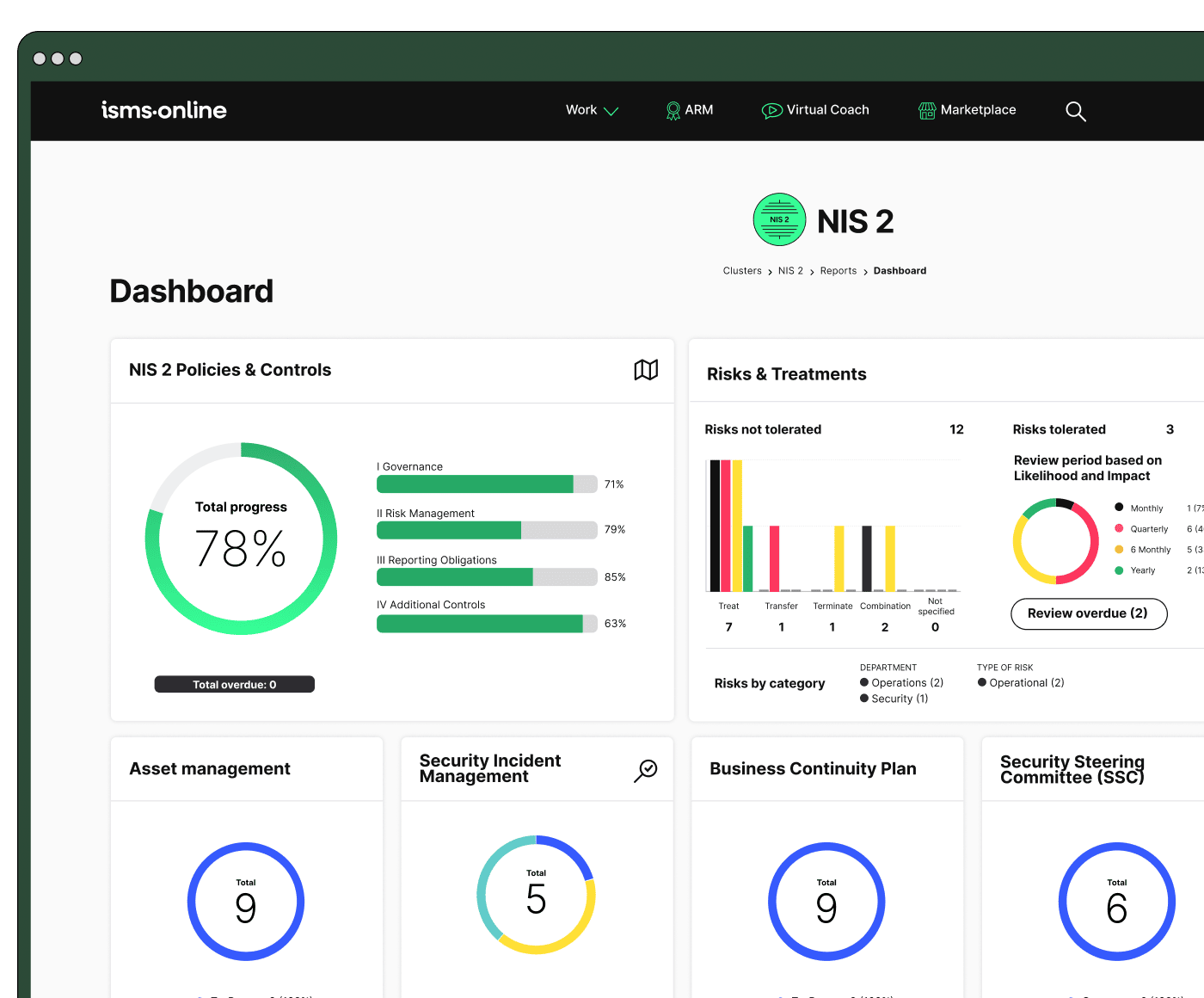
All your NIS 2, all in one place
From Articles 20–23 to audit plans – run and prove compliance, end-to-end.
Why Does NIS 2 Make Board Accountability and Executive Assurance Non-Negotiable?
Board oversight is now a codified, enforceable requirement-leadership’s engagement and approval on controls, risk, and incidents are artefacts to be proven at every audit and regulatory review. It’s no longer optional or assumed.
Leadership is not just strategy, it’s a verifiable governance artefact.
Regulators now expect:
- Board and executive ownership of policy approval, incident review, supplier oversight, and management review-all evidenced by dated, accessible logs (pwc.com; comarch.com).
- Ongoing proof of leadership engagement in live dashboards, not just annual reports.
Missing a single signoff, failing to log board training, or omitting minutes of management review can trigger fines or even director bans.
Board Accountability in Action
- Dashboards & logs: Present directors with up-to-date compliance evidence.
- Artefact chain: Every risk, incident, and control decision is traceable-leadership fingerprints are visible on all.
Daily discipline: Board-level assurance means early warning of risks, improved audit results, and enhanced regulatory standing.
Takeaway: Treat board accountability as operational hygiene, not paperwork. Make assurance a living artefact woven into every control, policy, and incident workflow.
Elevate Your ISMS.online Assurance Today-From Compliance Burden to Board-Ready Confidence
Resilience and regulatory trust depend on visibility-not just knowing what controls exist, but ensuring every team can see and exercise their compliance and response obligations. ISMS.online transforms audit pain and reactive compliance into a living, board-ready advantage for CCPs, trading venues, and any FMI adapting to NIS 2, DORA, EMIR, and MiFID II.
Maturity means every evidence gap is blocked before it widens-before auditors, clients, or the board ever have to ask.
With ISMS.online you gain:
- Automatically updated, cross-mapped Statements of Applicability for all major regulations.
- Board-level logs, evidence dashboards, and seamless workflow for every compliance requirement (isms.online).
- Guided, evidence-driven processes integrating technical, legal, procurement, and executive teams in a single real-time view of risk and resilience.
- Updates tracked against ENISA, ESMA, and ISO 27001:2022-ensuring that compliance is always current.
Shift your organisation from reactive, evidence-chasing compliance to assured, board-level readiness and continuous improvement. Use ISMS.online as your engine for visible resilience, not a last-minute audit scramble. Next time your board or auditor asks, the answer is already logged, mapped, and ready-so your team can focus on business, not bureaucracy.
Frequently Asked Questions
What major NIS 2 compliance requirements now bind CCPs and trading venues, and how is this a step-change from EMIR and MiFID II?
From October 2024, central counterparties (CCPs) and trading venues are designated as “essential entities” under NIS 2, transforming the regulatory landscape. Unlike EMIR and MiFID II-which concentrated on financial integrity and market order-NIS 2 embeds direct board accountability for cyber resilience with real-time, auditable evidence.
- Board-level oversight and attestation: Cyber-Security is now an executive function. Policies must be not just set but regularly reviewed and signed off by the board, with minutes, review cycles, and improvement actions logged and ready for regulator or auditor challenge.
- Continuous, documented risk assessment: Risk reviews now span IT systems, people, supply chain, and outsourced services, moving beyond the operational domain of EMIR and MiFID II. Evidence must include supply chain audits and incident history, not just annual checks.
- Mandatory incident reporting with strict timelines: Any “significant” cyber event demands 24-hour initial CSIRT notification, a 72-hour update, and a 30-day summary-timers that overrule or sit beside EMIR (immediate market/supervisor alerts) and MiFID II.
- Supplier governance and right-to-audit: Contracts must guarantee audit rights, security recertification, and breach notification. Reviews and actions require central, live dashboards and document trails.
- Tested business continuity: Crisis plans require regular rehearsal-not just on paper. Proof is needed for red-team results, table-top scenarios, lessons learned, and closure of improvements.
| NIS 2 Expectation | Operationalisation (Evidence) | ISO 27001 / Annex A Ref |
|---|---|---|
| Board oversight | Meeting minutes, signed SoA, logs | Cl 5.1, 9.3, A.5.4/.35 |
| Risk review | Risk register, supplier checks | A.5.19–A.5.21 |
| Incident response | 24/72/30-day workflow, artefacts | A.5.24–A.5.27 |
| Cont. improvement | Test records, closure logs | Cl 9.3, A.5.27/.36 |
Fundamental difference: EMIR/MiFID II focus on financial and market operations, but NIS 2 demands living, board-owned evidence that cyber risk and supplier management are never static. Noncompliance is now a direct board and organisational liability-with penalties that impact leadership and reputation, not just process.
How do CCPs and trading venues coordinate overlapping NIS 2, EMIR, MiFID II, and DORA obligations-without falling into audit gridlock?
The interplay of NIS 2 (cyber), DORA (ICT risk), EMIR, and MiFID II (market/ops) means a single event can launch parallel assurance, reporting, and audit obligations. Regulators expect simultaneity, not sifting.
- Trigger-and-notify fragmentation: “Significant event” (NIS 2) may overlap with “major ICT event” (DORA) or a disruption under EMIR/MiFID II. Notification deadlines and contacts rarely align.
- Oversight frequency intensifies: Both NIS 2 and DORA now require minuted board reviews and living logs. Evidence can be demanded by national and EU cross-sector teams.
- Duplication and gaps risk: Disconnected teams or fragmented tools lead to up to 30% wasted assurance effort-repeating collections or missing deadlines (Aikido Security, 2024).
- Unified library is vital: The only sustainable route is cross-mapping all artefacts-policy, log, incident, closure-to each regime as they arise, not after the fact.
| Regime | Trigger | Who Notified | Deadline | Evidence Needed |
|---|---|---|---|---|
| NIS 2 | “Significant event” | CSIRT/Authority | 24h/72h/30d | Board review, SIEM, comms |
| DORA | “Major ICT event” | Regulator, EU | Variable | Audit trail, incident logs |
| EMIR | Ops disruption | Financial Reg. | Immediate | Operations/test records |
| MiFID II | Market anomaly | Supervisor | Immediate | Trading/ops logs |
Action: Invest in ISMS and compliance platforms able to “tag once, use everywhere”-making evidence and risk updates universally visible, not stovepiped by team or regime. This sharply reduces audit fatigue and conflicting findings.
What does incident reporting and evidence management look like under NIS 2, given simultaneous regulatory scrutiny?
Incident handling is now equal parts speed, reliability, and transparency. A cyber event sets off the NIS 2 reporting timer-even if it’s also a DORA/EMIR/MiFID II issue.
- Integrated, automated incident playbooks: Every handoff from IT, legal, operations, and compliance must be logged-who knew what, when, and how it was escalated.
- Tamper-evident evidence flows: SIEM data, workflow status, and communications-plus board reviews-must be locked but accessible, supporting multiple regulatory narratives.
- Annual scenario rehearsals: Record attendance, findings, lessons and closure; real learning cycles, not theoretical.
- Responsive dashboarding: Show in real time what’s been done, escalated, or closed. Surface gaps before an auditor or regulator can.
| Trigger | Response steps | Evidence required |
|---|---|---|
| SIEM alert | Playbook, escalation, notification | SIEM event, workflow log |
| Supply chain breach | Contract review, comms, notify | Supplier logs, escalation |
| Major impact event | Board update, DSAR, regulator alert | Minutes, audit artefact |
A well-mapped evidence chain is the only safeguard when multiple regulators ask for the same log or artefact on different timelines.
At once: Run simulated multi-regime scenarios to test artefact traceability; log how evidence crosses regimes to ensure no gaps in real incidents.
What supplier and third-party controls must CCPs and venues show under NIS 2-and how is this evidenced to boards and authorities?
NIS 2 expects a living supplier risk record, underpinned by annual (or more frequent) recertification, immediate incident notification processes, and enforceable audit rights.
- Annually update every critical supplier’s compliance status: Store ongoing certifications, test results, risk/incident logs, contract changes, and corrective actions.
- Contractual “teeth” baked in: Right-to-audit, breach notification, and evidence renewal as strict contract items. Prove enforcement, not just inclusion.
- Real-time risk dashboards: For management and the board, show contract status, risks found, incidents, and resolution cycles.
- Close the loop on actions: Schedule and evidence every review, recertification, and improvement-document closure, not just intent.
| Control Focus | Required Action | Auditable Evidence |
|---|---|---|
| Onboarding | Security assessment, certifications | Tech vet, certifications |
| Ongoing compliance | Contract/policy review, recert. | Signed agreements, logs |
| Incident notification | Playbook activation, track/close | Comms logs, closure proof |
Modern supplier risk oversight is about proof, not promise; audits now expect records of both review frequency and closure of issues, not static checklists.
First step: Audit every supplier for clause coverage and live renewal, record findings, and escalate missing evidence before external auditors do.
How do unified audit trails and cross-framework mapping convert compliance pressure into strategic, board-level strength?
A single, linked control and evidence library-every artefact mapped to NIS 2, DORA, EMIR, MiFID II, and ISO 27001-is the key to reducing regulatory overhead and multiplying assurance value.
- Map every action across regimes: One incident log or control update is tagged for all frameworks, eliminating redundant collection and harmonising review cycles.
- Continuous board assurance: Dashboards show current status-what was reviewed, updated, remediated, or is at risk.
- Live gap analysis: Spot unresolved findings instantly-not weeks after the fact.
| Event | Regime Map | Evidence Logged |
|---|---|---|
| Supplier breach | NIS 2, DORA, ISO 27001 | Risk register, minutes |
| Incident escalation | NIS 2, EMIR | SIEM logs, workflow |
| Board review | All frameworks | Review minutes, SoA |
Live mapping is your audit insurance; every minute saved is one less error, and every closure builds regulatory-and board-trust capital.
Tactical move: Make board exposure to this dashboard part of the regular review cycle; proactive visibility signals strength to both boards and external reviewers.
How does continual review, lessons-learned, and improvement elevate NIS 2 compliance from routine expense to reputational capital?
NIS 2 treats improvement as an ongoing, auditable cycle-each test, review, and lesson builds a “resilience memory” bank that strengthens operations and audit defence.
- Schedule and evidence every review: Tabletop, red team, policy, and management reviews all feed records, with closed actions documented.
- Automatic reminders and closure cycles: Prove each improvement or lesson was tracked and resolved, not just logged.
- Live assurance dashboards: Management and board see real-time status and historical performance-making compliance a business asset, not sunk cost.
| Action Type | Evidence Required | Benefit |
|---|---|---|
| Test/Sim | Logs, improvement actions | Audit shield, trust accelerator |
| Incident | Closure, lesson learned | Faster recovery, regulator trust |
| Board review | Minutes, closure tracking | Reputation, audit clean sheet |
Every logged improvement is tomorrow’s audit answer-memory, proof, and operational strength originate from disciplined closure.
Apply now: Automate reminders, log evidence, track closures-turning lessons into assets the board and regulators will value.
What does direct, provable board accountability look like under NIS 2, and how do you demonstrate it under inspection?
Board members and executives personally own cyber resilience and incident oversight under NIS 2; regulators demand continuous, signed, and logged engagement.
- Frequent, recorded reviews: Live minutes, signatures, dashboard extracts, and documentation cycles-not “tick-box” annuals-are now baseline expectation.
- Signed policy, SoA, and action approvals: All documentation must be traceable to leadership, with update logs available on demand.
- Training logs for board members: Knowledge must be current, evidenced, and made available to reviewers and auditors.
- Action evidence: Closed recommendations, reviews, and board actions logged, audited, and archived-visible in dashboards.
| Oversight Element | Proof Artefact |
|---|---|
| Board review | Signed minutes/logs |
| Incident/action signoff | Workflow with signature |
| Board training | Log/attendance proof |
| Continuous improv. | Closure proof, logs |
Penalty: Failure at this level may result in fines (up to €10M or 2% of turnover) and bans on directors or board seats; noncompliance is visible and personal.
Imperative: Embed live, traceable logging of every board action and review as a standard operating procedure-not a scramble before audits.
How does ISMS.online embed these dynamic requirements and give CCPs/trading venues credible, visible resilience?
ISMS.online provides one system for orchestrating, evidencing, and automating every facet of compliance-NIS 2, DORA, EMIR, MiFID II, and ISO 27001-for CCPs, trading venues, and beyond:
- Integrated cross-framework SoA: Dynamic mapping of controls, policies, incidents, and evidence to multiple frameworks and regulators-tag once, use everywhere.
- Workflow automation: Collected evidence, closed incidents, and improvement actions are time-stamped and ready for one-click board approval or auditor review.
- Live dashboards: Supplier recerts, scenario tests, risk reviews, actions, and gaps are always visible to management, boards, and regulators.
- Unified audit trail: Every control, incident, review, and closure tied together, enabling confident, proactive oversight and faster, cleaner audits.
- Proof of resilience: Audit-ready evidence, closure status, and board approvals serve as living signals of operational trust to counterparties and authorities.
One platform, one audit trail, one truth. Resilience isn’t a file-it’s the evidence you can surface, share, and close in real time.
Move today: Transform your ISMS from a background admin system into a visible shield of board, regulator, and market trust-align every artefact to NIS 2’s demands before your next audit, and let compliance become your competitive advantage.






