





































Why Does the Food Sector Face a New Digital Evidence Ultimatum?
The food sector is under a sharper spotlight than ever: digital evidence is now the price of market entry and regulatory trust. NIS 2, ENISA guidance, and UK FSA mandates have fundamentally shifted what compliance means-not just for security teams but for everyone along the food supply chain. What kept audits moving five years ago-paper forms, scattered email trails, and PDFs-is now a liability. Today, regulators and enterprise customers expect instant, digital traceability for every incident, approval, and supplier event, with directors on the line for any lapse in the chain (enisa.europa.eu; food.gov.uk). More than a bureaucracy, this digital-first reality shapes reputations in real time.
The consequences have teeth. Missing or delayed digital logs can void contracts, trigger escalated investigations, or prompt public regulatory actions-sometimes across multiple jurisdictions. As cyber risks, food safety, and third-party governance converge, the weakest link is usually the failure to produce evidence on demand. Boards are asking for certainty, not stories.
In a live audit, trust is measured by how quickly you can produce the digital proof for any claim.
This new era demands more than last-minute panic. The only safe path is to embed defensible, digital evidence collection into the daily routines of every team-quietly, securely, and in a way that reassures boards, regulators, and buyers. When your next major contract, recall, or audit window opens, having that “heartbeat” of evidence-ready competence isn’t just nice to have-it’s the line between growth and operational risk.
What Does “Defensible Digital Evidence” Really Mean for NIS 2?
If you still think of “evidence” as a backdated report or a dusty folder, it’s time to reset expectations. Modern evidence is living, continuous, and must be retrievable at audit speed by design:
- Comprehensive digital logging: Every system event, policy approval, training completion, supplier change, and incident-securely captured, with clear timestamps and full edit trails.
- Chain of custody by default: Each document or approval leaves a fingerprint on the evidence timeline; every update, sign-off, or exception is logged and reviewable. This flow is the foundation for trust, making forgery or backdating nearly impossible.
- Unified “single source of truth”: No more risky patchwork of emails or spreadsheets-auditors demand a centralised, audit-friendly system that can instantly demonstrate “how we know” for every compliance claim.
Regulators now work from live dashboards, not static PDFs. International customers expect supply chain transparency with globally mapped logs. This is a world where even a 24-hour delay in surfacing a digital log can result in contract penalties or forced public disclosure.
True compliance means every action, every edit, and every approval is ready to be traced in seconds, not days.
A quick table shows how fragile the chain really is:
| Evidence Item | Required Proof (NIS2/FSA) | Digital Trace/Breach |
|---|---|---|
| Supplier incident notification | Timestamped alert, root cause, response | Missing approval |
| Staff training completion | eCertificate, signoff log | Outdated record |
| System log (cloud/server) | Exportable, linked to incident | Siloed/Lost data |
| Asset inventory update | Time-stamped, version history | PDF overwrite |
| Board-level approval of policy | Digital signature, access log | Misplaced file |
Even a single gap can destabilise supplier relationships, auditor trust, and public reputation. The only reliable stance is to treat every traceable, cross-referenced log as a frontline control-not just audit insurance, but business enablement.

Master NIS 2 without spreadsheet chaos
Centralise risk, incidents, suppliers, and evidence in one clean platform.
How Does Integration Across Food Safety, Security, and Supply Chain Change Compliance?
Most compliance failures don’t start with bad actors, but with siloed information: disconnected logs, fragmented approvals, and unlinked workflows. The food sector’s complexity multiplies this risk when cyber-security, food safety, and supplier management have separate evidence chains that never cross paths. NIS 2, ENISA, and modern audit teams demand a new standard-a “Compliance Triangle” that joins every event, risk, and review in a single, continuous story.
- Food safety events: (recalls, contamination alerts): Must be digitally tied to supplier logs *and* mapped to what happened next-every follow-up, escalation, and resolution.
- Third-party risk management: Onboarding, incident disclosures, and periodic supplier reviews become part of the same evidence engine as food safety and IT risk-eliminating audit gaps and reducing “unknowns” (isms.online).
- Cyber threat logs: Real-time event detection, system vulnerabilities, and response actions must align with-and not contradict-other compliance registers.
A gap in any corner of this triangle is a gap in trust-both with regulators and your most valuable clients.
This approach turns compliance from a firefighting exercise into a proactive discipline. A system engineered for integration and traceability means your security leader, procurement officer, and food safety manager all see the same live evidence, the same risk events, and the same approval status. Board and auditors can finally see a clear narrative: issues flagged, actions taken, and compliance documented from all angles-without “dead spots”.
[Food Safety]

 / \

 / \

[Cyber]--[Supply Chain]

 \ /

 \______/

 (Approvals, Logs, Review stream at centre)
This intersection isn’t just a diagram-the right digital system ensures that every department shares accountability and eliminates the single points of failure that so often derail audits and contracts.
What Makes an “Audit-Ready Evidence Chain” in Practise?
To pass NIS 2 and sector audits, you need more than folders-you need versioned, tamperproof, and action-driven evidence streams. This is the test regulators set with incident windows, whistleblower protections, and digital sign-off mandates.
- Lifecycle tracking: Every data point, from incident reporting to asset change, must show who created, edited, and approved it, with secure timestamps ensuring no retroactive changes are missed (isms.online).
- Automated notifications: The system sends and logs reminders, escalating missing sign-offs faster than human tracking ever could.
- Version control & history: All edits, comments, and approvals (and exceptions) are visible-a defence against both honest mistake and audit challenge.
- Corrective action linkage: Every risk event triggers remediation steps and requires evidence of closure-four walls that keep your audit story airtight.
- Live dashboards: Boards and managers need on-demand oversight; regulators expect exportable trails and evidence registers at every stage.
The difference between a failed and passed audit is typically a single missing link in the digital chain.
Here’s the practical traceability bridge that powers audit readiness:
| Trigger | Risk Update | Control / SoA Link | Evidence Logged |
|---|---|---|---|
| Whistleblower report | Supplier escalated risk | A.5.19, A.5.21 | Incident summary/log |
| Cyber incident alert | Incident status raised | A.5.24, A.5.25 | Log & sign-off |
| Staff training lapse | Training overdue | A.6.3 | Attestation & proof |
| Asset handoff error | Asset flagged/missing | A.7.3, A.5.11 | Exception/access log |
Rather than a backward look at compliance, this chain gives you a living, continuous stream-built on real events, easily demonstrable, and defensible under serious scrutiny.
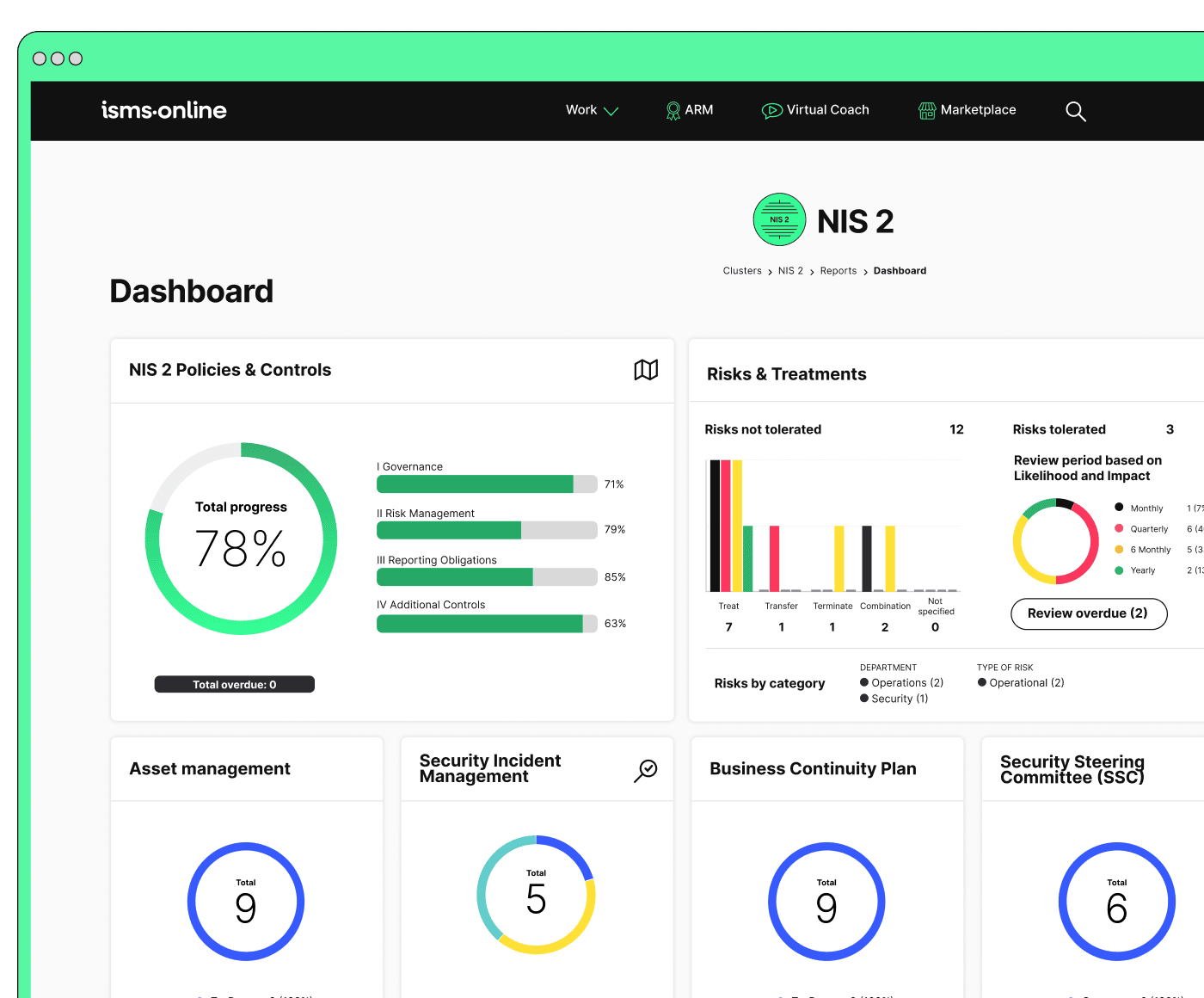
Be NIS 2-ready from day one
Launch with a proven workspace and templates – just tailor, assign, and go.
What’s the Real Cost of Delayed Reporting? Mastering NIS 2’s 24/72/30 Windows
Compliance failure in the food sector rarely comes from missing evidence-it comes from evidence produced just after the regulatory window closes. NIS 2 now enforces a three-tier system: 24-hour notifications, 72-hour escalations, and 30-day closure updates. Late compliance is treated the same as non-compliance: penalties, more rigorous future audits, and public reporting.
A living workflow system closes these gaps:
- Automated deadlines: Calendar-driven reminders for every accountable party keep everyone on pace.
- Agency-ready forms: Pre-built export templates logged with reviewer feedback ease the pain of regulatory reporting.
- Real-time audit trail: Every sign-off and delay logs itself, ensuring regulators or partners see every action-even corrective steps.
- Board/legal sign-off: Closure, escalation, and approvals are tracked together-enabling legal defensibility not just “box ticking”.
Regulators no longer accept ‘almost on time’-only digital proof for every compliance window survives scrutiny.
Deadline health, at a glance:
| Compliance Window | Alerts Auto-Issued | Reviewer Sign-Off Logged | Breach Risk |
|---|---|---|---|
| 24h Notification | ✓ | ✓ | Low |
| 72h Incident | ✓ | ✓ | <10% |
| 30-day Closure | ✓ | ✓ | <2% |
Missing any click in the chain raises your risk. The most advanced teams now treat reporting deadlines as strategic disciplines-embedding them into platform workflows where no manual handoff can bottleneck the process or slip between the cracks.
How Must Supplier & Third-Party Event Chains Evolve for NIS 2?
It’s no longer enough for food businesses to police their own records; every supplier, vendor, and outsourced partner now falls under the same digital evidence regime (enisa.europa.eu; food.ec.europa.eu). A breach in your supplier’s network, an unclosed incident in a distribution partner, or a failed vendor review can void your own audit unless every event is digitally logged and securely responded to.
A compliance-savvy platform must demonstrate:
- Supplier onboarding/offboarding: Date, responsible reviewer, initial risk check-in one system, not a spreadsheet.
- Live risk dashboarding: At-a-glance traffic-light indicators as well as time-stamped reviews with drill-down to root causes.
- Whistleblower and near-miss tracking: Dual-authority sign-off (IT/legal), immutable logs, and no manual editing close the loopholes for denial or delay.
In a real-world incident, your ability to prove supplier diligence is only as strong as your logbook-and its links.
Schematic snapshot: Supplier Chain Logic
Supplier: XYZ Logistics

 └─ Onboarding: 2023‑01‑26 | Reviewer: Legal

 └─ Annual Review: 2023‑12‑12 | Status: Green

 └─ Incident 2024‑05‑15: Data transfer breach | Status: Red

 └─ Root Cause: Closed by IT, legal signoff | Linked Evidence
This level of detail, instantly retrievable and exportable, is now essential not just for passing audits but for surviving and thriving in cross-border supply chains.
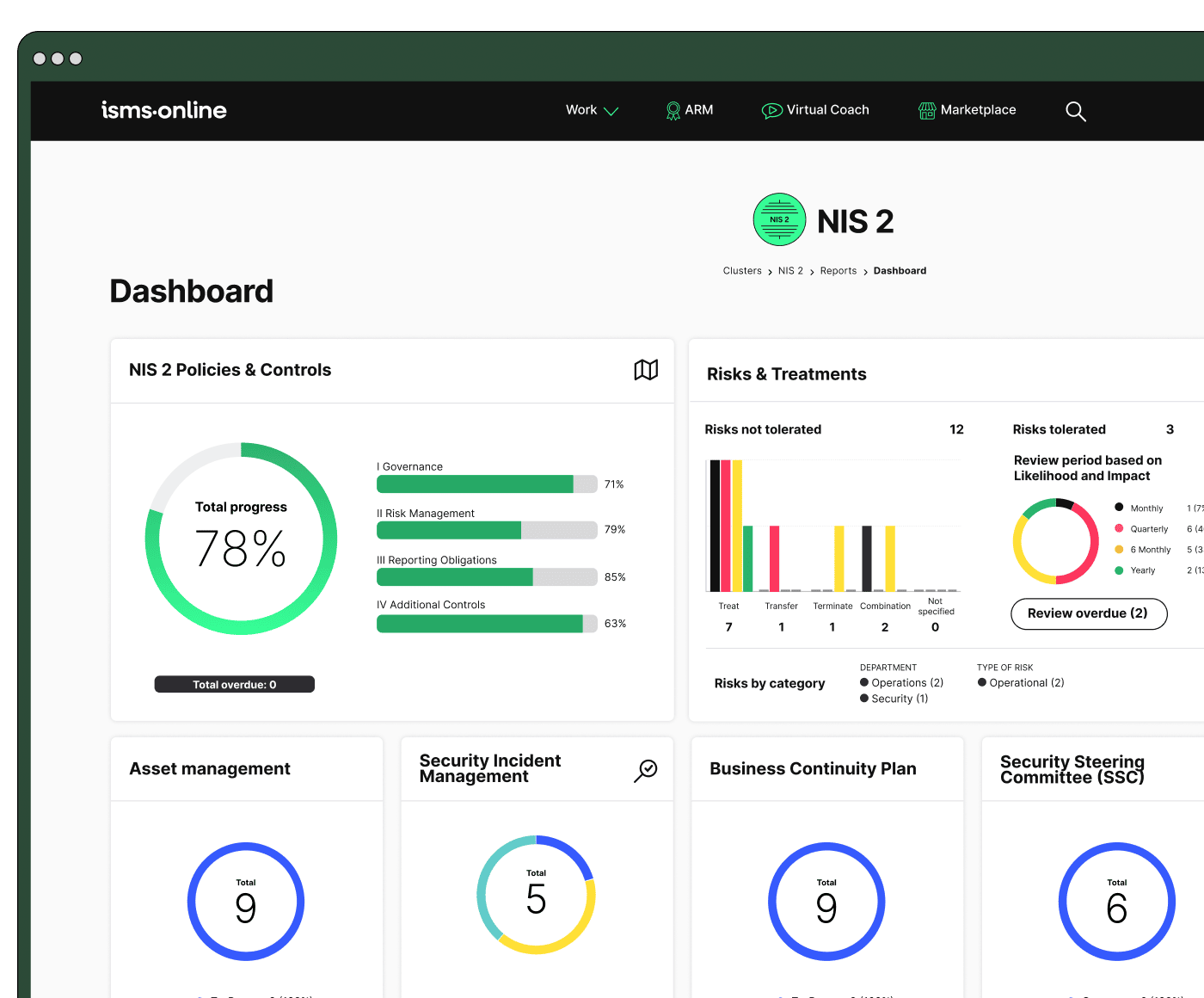
All your NIS 2, all in one place
From Articles 20–23 to audit plans – run and prove compliance, end-to-end.
How Does Closing the Evidence Loop Change Audit Outcomes?
Audit readiness lives and dies by the real-time, cross-functional evidence trail. A single missed sign-off, approval lag, or non-exportable supplier incident leaves organisations exposed-not just to failure but to escalating future audits and public reputational loss.
Modern boards want dashboards that let them trace any compliance event-across NIS 2, ISO 27001, GDPR, and food sector specifics-in seconds, not days (isms.online). Today’s auditors expect batch logs, edit trails, and cross-register reports that span every department and every link in the supply and audit chain (trackerproducts.com; dlapiper.com).
A digital audit loop is now a competitive asset-it wins buyers, reassures directors, and inflates regulatory trust.
Example: ISO 27001 ↔ NIS 2 Bridge Table
| Expectation/Trigger | Operationalisation Example | ISO 27001 / Annex A Reference |
|---|---|---|
| 24h incident notification | Auto-alert/template to FSA/regulator | A.5.24 (Incident Mgmt), A.5.25 (Events) |
| Supplier breach evidence | Supplier log, risk escalation, signoff | A.5.19 (Supplier Risk), A.5.21 (Chain) |
| Role-based approval & traceability | Linked workflow, versioned access log | A.5.2, A.5.4, A.8.9 |
| Periodic gap review/report | Dashboard reporting, audit logs | A.5.36, A.5.35, A.5.29 |
| Cross-jurisdictional evidence | Exportable, timestamped reports | A.5.31, A.5.14, A.5.13 |
In one major case, a logistics group CEO used their single digital dashboard not only to pass a surprise audit but to secure contract renewals and boost board confidence-all because every incident, approval, and supplier response was traceable across frameworks.
Why ISMS.online Is the Compliance Engine for NIS 2 and the Food Sector
Food sector leaders turn compliance stress into operational advantage-and reputational security-by embedding everything into one continuous compliance loop:
- Board-ready dashboards: Every approval, incident, supplier risk, and training event is visible and cross-mapped to both food sector and EU/UK frameworks (isms.online).
- Automated reporting calendars: Deadlines (24/72/30 days) cannot slip between the cracks when reminders and escalation paths are hard-wired into the platform.
- Live gap analysis: Built-in tools surface weak points, drive resolution, and produce the exportable registers demanded by regulators and buyers alike.
- Centralised evidence vault: Policy Packs, training logs, legal sign-off, supplier attestations: all live in a single, permissioned environment, ready for every future standard or jurisdiction (isms.online).
Audit Traceability Mini-Table
| Trigger | Source Document | Signoff / Approval | Evidence Exportable? | Dashboard Visible? |
|---|---|---|---|---|
| Supplier near-miss | Incident log | Ops/Procurement | ✓ | ✓ |
| Staff whistleblower | Concern log | Legal/Security/HR | ✓ | ✓ |
| Customer audit query | Compliance record | Board-level (PDF/Excel) | ✓ | ✓ |
Audit stress gives way to audit certainty. Staff, suppliers, and regulators are all working from the same truth-ending the era of “audit panic” with a system that transforms traceability into a strategic, reputational asset. Boards, buyers, and partners notice the shift-and so do auditors.
The right platform makes audit nervousness obsolete- audit certainty and business credibility become live metrics, not points of risk or hope.
Frequently Asked Questions
What digital evidence is required for NIS 2 compliance in the food sector, and how does it differ from “old-school” audit files?
NIS 2 demands digital, audit-ready evidence that is far more comprehensive than legacy document-based methods-requiring systems that cover your business operations, supply chain, IT/OT assets, incident management, and board sign-off, not just a static policy folder.
Today, food sector regulators and auditors expect evidence such as:
- Version-controlled, board-approved cyber-security policies: -with review dates and responsibilities logged.
- Live asset inventories: -every device, cloud service, and industrial sensor mapped to an owner, and instantly exportable (Annex A5.9, A8.1).
- Dynamic risk and incident registers: -where every risk, near-miss, or incident can be traced from first report to mitigation, with digital timestamps and escalation links.
- Role-based staff training records: -demonstrating ongoing awareness, refreshers, and certifications tied to job roles, not just annual training slides.
- Supplier evidence trails: -covering onboarding vetting, incident notifications, contract risks, and joint event management.
Unlike “traditional” audit files, NIS 2 requires all documents to be instantly retrievable, time-stamped, and digitally linked to workflows and approvals. When a regulator requests evidence, you can’t be left compiling emails or PDFs; you need a unified platform or dashboard that delivers the full chain-proof, ownership, sign-off, and export-in seconds (ENISA, 2024).
Audit readiness is now measured by the speed and completeness of your digital evidence chain, not just by having files in a folder.
Key ISO 27001 Evidence Bridges for Food NIS 2 Compliance
| Expectation | Operationalisation | ISO 27001 / Annex A Reference |
|---|---|---|
| All assets and owners tracked | Live IT/OT/Cloud registry | A5.9, A8.1, A8.9 |
| Incidents in 24–72h | Versioned, signed incident log | A5.24, A5.25, A5.26 |
| Ongoing staff training | Digital certificates, e-signature | A6.3, A8.7, A5.11, A8.13 |
| Supplier linkage + audit | Incident maps, signed logs | A5.19, A5.21, A5.20, A5.22 |
If asked today to retrieve any risk or incident-from initial alert to board signoff-would you deliver it in minutes or get lost in fragmented records?
How must incident reporting workflows be structured for NIS 2 compliance in food production and logistics?
NIS 2 enforces a digital, time-bound, and role-mapped incident reporting process where food safety, IT, and supply chain issues are interconnected and fully traceable.
Your incident workflow must:
- Trigger within 24 hours: Initial regulator and exec notification, including detailed who/what/known impact. This requires digital logs, not delayed emails.
- Update by 72 hours: Full root cause analysis, internal and external communications, supplier engagement, escalation steps, and documentation of developing actions or mitigations.
- Complete in 30 days: Remediation summary, lessons learned, control updates, and executive or buyer sign-off-with all actions time-stamped and linked to the original event (EC Food, 2024).
Manual or email-based tracking can’t meet audit expectations: NIS 2-ready companies use incident management dashboards, workflow automation, and live export features so every event and update is captured-even across departments and suppliers.
| Trigger | Risk Update/Action | Control/SoA Ref. | Evidence Logged |
|---|---|---|---|
| Supply system outage | Alert Board, escalate | A5.21, A5.22 | Email record, sign-off PDF |
| Malware detected | Investigate, remediate | A5.25, A5.26 | Incident log, root cause report |
Your digital workflow should make every action, escalation, and approval so transparent that your auditors never need to ask twice.
Does your current process auto-capture incident actions and signoffs, or would your team scramble to reconstruct steps under an audit clock?
What are the most common NIS 2 evidence and process pitfalls for food sector organisations?
Three stumbling blocks trip up most food industry compliance efforts:
- Disconnected systems: Evidence scattered between food safety, cyber, and supplier tools leads to missed data, conflicting versions, and audit-defeating gaps.
- Hand-off errors between teams: When food production, IT, and compliance do not share a playbook, a breach in “one side” (like a compromised sensor causing spoilage) often gets missed by the others, leaving risk unhandled.
- Supplier oversight blind spots: Many organisations lack digital traceability for supplier incidents-especially with cross-border partners or cloud services. Supplier incidents must be formally tracked, escalated, and tied back to your risk and contract profile.
True compliance means your digital evidence connects every team, supplier, and event-gaps become findings, findings become fines.
Solution: Integrate all evidence and processes into a single digital compliance platform, ensure defined escalation protocols for all teams, and map supplier events to risk and policy before the next audit cycle.
Why does sector cyber group and ISAC participation strengthen your NIS 2 evidence and audit trust?
Auditors, regulators, and buyers now weigh your external engagement as operational proof-not just compliance diligence. Being active in food sector cyber groups, ISACs, or national working bodies serves as a powerful signal:
- Shared sector templates/checklists: Prove your process tracks the latest real-world threats and regulatory shifts.
- Peer benchmarking: Demonstrates your controls and incident responses are validated against best-in-class food sector players (ENISA, 2024).
- Audit trust lever: Peer-reviewed evidence from active group participation increasingly leads to reduced audit friction and higher buyer trust.
Evidence shaped by your sector’s peers now holds more weight in audits than many consultancy reports.
If your audit file contains evidence of regular ISAC calls or sector group contributions, you’ll gain recognition for resilience and continuous improvement.
What digital evidence is required for whistleblower protections and cross-border supplier risk under NIS 2 in food businesses?
You must prove that your whistleblower processes and cross-border supplier incidents are tracked in a tamperproof, fully-digital audit trail, with every action and approval recorded.
Requirements include:
- Live, secure whistleblower channel: -documented from first report through to triage, investigation, remediation, and closure, with digital role assignment and timestamps.
- Supplier event linkage across borders: -joint incident logs, alerts, and signoffs with suppliers, especially non-domestic, that can be exported on short notice for regulatory review (Mazars, 2024).
For example, a near-miss in Germany escalated to a logistics supplier in France must show synchronised logs, legal and IT reviews, and closure within 72 hours-all instantly retrievable for audit.
Modern audits are less likely to fail over internal process than over missing supplier or whistleblower evidence in the digital chain.
If asked, could you surface a complete whistleblower chain and a digital supplier breach log, both with all required approvals, in a single file?
How do you know if your NIS 2 evidence management “closes the loop”-and what does this mean for audit and buyer trust?
“Closing the loop” is a step beyond compliance: it’s the ability to map every event and risk, from trigger to board sign-off, so no gap is left unaddressed, and every action is auditable on demand.
Loop-Readiness Self-Test
- Do you have a live dashboard: showing at-a-glance risk, incident, and remediation status for management and audit teams?
- Does every documented action receive a digital sign-off, timestamp, and role mapping-from first report to closure?:
- Can you export a complete event chain (employee trigger → risk update → remedial action → board sign-off) in one step, no manual assembly required?:
| Event | Update | Control / SoA Ref. | Evidence Logged |
|---|---|---|---|
| IoT breach detected | Mitigated, escalated | A5.25, A5.26 | Investigation, fix approval |
| Supplier data incident | Contract reviewed, closed | A5.21, A5.22 | Supplier comm, sign-off |
Buyers and auditors no longer judge by controls alone-they assess how effectively you demonstrate real, end-to-end issue resolution.
If your compliance file can instantly show the journey from trigger to closure, you deliver not just compliance, but audit-winning resilience-and set yourself apart as a trusted partner and buyer magnet.
Ready to turn audit anxiety into resilience leadership?
Discover how our unified platform captures every event, automates compliance records, and turns digital evidence into buyer and regulator trust-before your organisation’s next headline deadline.






