





































Is Your Health Organisation Truly Prepared for NIS 2 Cyber Risks-Or Is Risk Hiding in Plain Sight?
Every day, European healthcare providers and laboratories confront digital threats that shape not just their day-to-day operations, but also patient safety and public trust. NIS 2 is reshaping the battlefield, pulling cyber-security from an IT back-office function into the heart of executive leadership. Whether you’re overseeing clinical diagnostics or managing a regional health authority, the message is unambiguous: cyber-security isn’t a checkbox-it’s your direct legal and reputational responsibility.
Cyber incidents don’t just threaten data-they can disrupt care, delay diagnostics, and erode patient trust.
A wave of high-profile attacks has made clear what’s at stake. ENISA highlights that three-quarters of European hospitals faced ransomware in the past year; over a third reported measurable delays in care or diagnostics (ENISA, 2024). Regulators across the EU have responded with teeth: not just fines, but public naming and, in some cases, director-level disciplinary action for weak cyber-security governance (International Health Policies, 2023).
This shift is sector-wide. NIS 2’s reach extends to clinical laboratories, digital pharmacies, outsourced diagnostic platforms, and their supply chains. A weak link in any node-be it a poorly patched lab system or a vendor with lax controls-may expose your entire organisation. Recent breaches in the UK, Germany, and France were rarely the product of genius attackers, but of persistent, mundane gaps: forgotten endpoint patches, missing evidence logs, sluggish incident responses (The Guardian, 2023).
Today, leadership indifference is not benign neglect-it’s exposure. Health data is uniquely valuable, and the regulatory landscape now assigns personal liability to executives and directors for cyber-security failures. Whether your operation is a regional hospital, independent lab, or care provider with lean resources, the only risk strategy that survives this environment is one led from the top and anchored in continuous evidence.
What you can’t see can now become a penalty, a lost patient, or a front-page story. Under NIS 2, the only safe path is a proactive one.
What Does NIS 2 Actually Demand-And Are You Ready for Its New Rules?
NIS 2, enacted across the EU, doesn’t just tweak past requirements-it fundamentally recasts what operational “good” looks like in cyber-security. Health sector compliance is now a dynamic test: can your organisation prove its cyber controls work, and can it mobilise instantly during a major incident?
Every health provider or laboratory is now assessed on size, sector, and criticality-but few escape NIS 2’s net. Digital pharmacies, data-driven labs, supply chain partners, and clinical research bodies all fall under direct regulatory view (European Commission). This landscape is designed to prevent risk from hiding in operational cracks.
The stakes escalate during an incident. A ransomware hit, suspected breach, or technology failure isn’t just a “bad day”-it’s an operational emergency with clock-watching obligations: initial regulator notification within 24 hours, full report and evidence within 72 (Lexology, 2023). Failure to meet those windows exposes you to legal action, reputational damage, and-if delays affect care-contract and financial penalties.
Non-compliance exposes you to €10M penalties, 2% of turnover, contract terminations, and reputational harm-this is no longer theoretical risk.
A common blind spot: manual, ad hoc evidence management. Spreadsheet logs, self-certification questionnaires, and last-minute document hunts no longer pass muster. Regulators expect resilient, audit-trailed digital processes that provide verifiable proof of planning, incident handling, and oversight.
Integrating privacy and security is no longer optional. DPOs, information security leads, and clinical IT must work as one. Errors-especially around cross-border data flows or third-party data processing-invite deep audit and “main establishment” scrutiny, which can trigger pan-European investigations (DataGuidance, 2023).
A quick operational NIS 2-to-ISO 27001 bridge table reveals the day-to-day impact:
| Expectation | Operationalisation | ISO 27001 / Annex A Reference |
|---|---|---|
| Board-level cyber oversight | Monthly ISMS review, minutes logged, policy updates | Cl. 5.1, A.5.2, A.5.36 |
| Real-time incident reporting | 24/72 hr alert workflows, incident log automation | A.5.24, A.5.26, Cl.8.2 |
| Supplier risk management | Documented due diligence, contract mapping | A.5.19, A.5.20, A.5.21 |
| Staff awareness & training | Auditable trainings, quizzes, engagement logs | A.6.3, A.7.7, A.8.7 |
Readiness now means audit-ready digital operations, executive accountability, and zero tolerance for gaps, delays, or finger-pointing.

Master NIS 2 without spreadsheet chaos
Centralise risk, incidents, suppliers, and evidence in one clean platform.
Why Do Most Healthcare Cyber Programmes Stall-and Where Are the Biggest Gaps?
Intent does not guarantee execution. The health sector is littered with well-meant cyber initiatives that stall on practicalities: fragmented working groups, decentralised evidence, and “good enough” policies scattered across emails and drives. ENISA’s reports are stark: 60% of European health organisations still run risk and asset tracking via spreadsheets-a method that history shows leads directly to audit chaos and operational risk (ISC2, 2023).
You can’t defend clinical data with ad hoc habits-documented, automated workflow is now an audit essential.
A key reason? Burnout. IT and compliance staff, tasked with chasing evidence, logging incidents, and maintaining policy engagement, quickly run dry. Over two-thirds of sector IT leaders now explicitly attribute error spikes and missed logs to administrative fatigue (Infosecurity Magazine, 2024). The health sector’s mission focus on patients can ironically expose operations to unforced cyber errors. False economies-“just patch the urgent systems,” “we’ll revisit the supply chain audit later”-accumulate as silent risks.
Legacy technology intensifies the problem. Labs and clinics still depend on older diagnostic devices and unsupported systems-essential for patient services, but nearly impossible to patch or control. It is no surprise that ENISA studies document audit failure rates 44% higher in organisations running unmonitored business-critical systems (MedTech News, 2023).
And then there’s the supply chain. Your IT may be locked down, but a breach via a third-party lab, data processor, or maintenance partner means your board faces scrutiny. Audits and fines now follow the chain of accountability-not just the boundaries of your own building (HITRUST Alliance, 2023).
A frictionless, audit-ready system traces every risk trigger to supporting evidence:
| Trigger | Risk Update | Control / SoA Link | Evidence Logged |
|---|---|---|---|
| New supplier added | Supply chain risk | A.5.19, A.5.21 | Supplier risk register |
| Legacy system discovered | Tech vulnerability | A.8.8, A.8.9 | Device inventory |
| Phishing incident reported | User awareness gap | A.6.3, A.7.7 | Training log, quiz |
| System outage event | BCP/DR update | A.5.29, A.8.14 | Recovery plan, test |
Many audit failures result from missing evidence for supplier onboarding or incident logs-not from policy documents themselves.
What Does Resilience Look Like for Health Teams-And How Can You Build It In?
Resilience in the health sector isn’t a checkbox-it’s a rhythm of daily activity, visible and auditable at any moment. NIS 2 doesn’t just want to know that you have a plan; it wants to see that security and business continuity are being lived and tracked in real time.
Real resilience is built in real time, not just written into a policy binder.
The difference shows in four habits:
- A Living ISMS: Security, risk, and incident processes that run monthly-not just for annual audits. Organisations running active ISMS reviews experience a 40% reduction in unplanned service interruptions.
- Simulated Drills and DR Tests: Teams that run real breach and disaster drills are faster-and more effective-in both incident response and recovery (ENISA, 2023). These exercises build evidence and team confidence simultaneously.
- Role-Based Automation: Automated asset inventories, scheduled risk assessments, and incident log reminders free up busy staff and keep compliance front-of-mind without micromanagement (NHS Confederation, 2024).
- Outcome-Driven Training: Ditch passive videos. Instead, log completion, check understanding, and document incident reporting. Clinics tracking engagement see measurable shifts, from 30% to 80%+ staff cyber proficiency (PhishingBox, 2024).
A resilient health organisation benchmarks itself with real KPIs: evidence completion rates, incident closure speeds, supply-chain audit frequency, and staff training engagement-tracked in real time, not after the fact.
A resilient organisation is one where real-time KPIs-like mean time-to-detect, drill frequency, and staff awareness-are visible to leaders and auditors at all times.
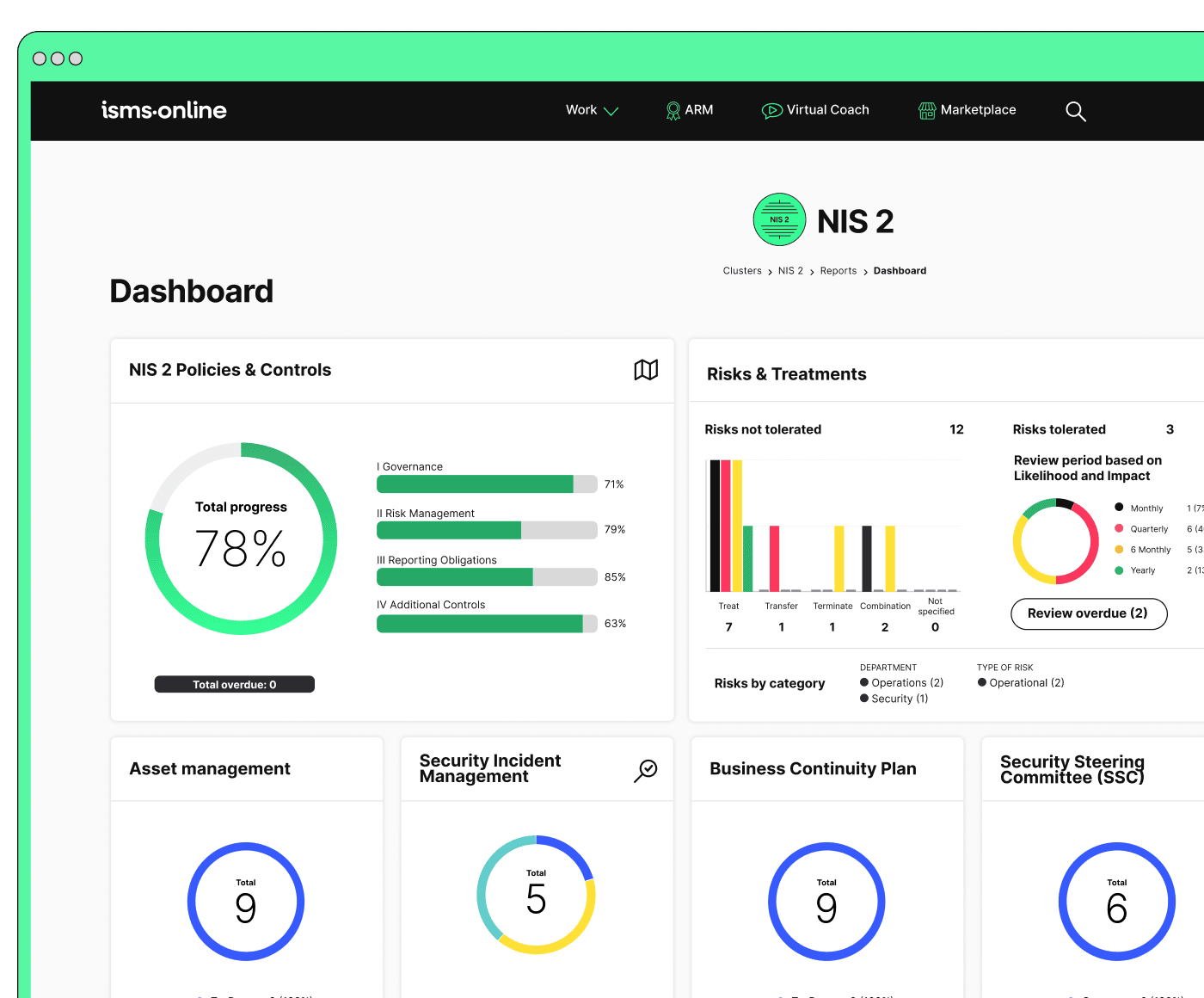
Be NIS 2-ready from day one
Launch with a proven workspace and templates – just tailor, assign, and go.
Which NIS 2 Cyber Controls Make the Biggest Impact-and How Do You Operationalise Them Now?
Compliance that makes a difference is compliance lived, not just mapped. The highest-performing healthcare teams focus on five operational levers-evidenced, automated, and visible both to leaders and auditors:
1. Living Risk Registers
A real shield against cyber disruptions is a risk register that isn’t static, but tracked, version-controlled, and linked monthly to triggers and resolutions (EU Publications).
2. Incident Response Playbooks
If playbooks live only on paper, they’re forgotten just when needed. Mature organisations revise and evidence their IR plans after every incident (not just annually) and automate evidence logging (SANS Healthcare IR).
3. Clinical Asset Controls
Every endpoint-clinical or administrative-should be in your digital inventory, risk-rated, and monitored for vulnerabilities. Unrecognised endpoints are leading sources for breaches and compliance failures (MedTech Europe, 2024).
4. Staff Training Evidence
Training is only as good as its audit trail. Log not just completion but department, date, and engagement. This is what regulators now request and penalise if missing (NIST SBIR, 2023).
5. Outcome-Driven KPIs
MTTD, incident closure rates, staff quiz participation, vendor audits. These metrics connect security activity directly to board, executive, and regulatory review.
Dashboards make KPIs visible: MTTD, training rates, supply chain audits-these are now the reporting backbone for health sector leadership.
The real shift: from scattered documentation to a single, unified dashboard capturing every policy, audit, incident, and proof, mapped to NIS 2 and ISO 27001 controls.
Where Does “Audit Readiness on Paper” Fail Versus “In Practise”-and How Do ISO 27001 & ENISA Best Practise Close the Gaps?
“Audit ready” does not mean being able to produce a binder of outdated policies or spreadsheets. NIS 2 auditors-and boards-want a verifiable, living history of compliance, showing not just “what was planned” but “what happened, when, and who proved it.”
A single, auditable platform for ISMS, risk management, and supplier due diligence turns regulatory maps from pain into proof.
ISO 27001 and ENISA’s sector guidance are designed for continual readiness and practical defensibility:
- Harmonised Evidence: Controls and KAIs can be mapped across frameworks-NIS 2, ISO 27001, ENISA-using a single ISMS that reduces duplication and confusion.
- Audit Trails: Robust systems assign version control, date-stamping, and linkage to every piece of evidence-turning audits from stressful marathons into side-effect-free check-ins.
- Unified Compliance Loop: Integrating privacy (ISO 27701), BCM (ISO 22301), and security controls means each audit cycle builds resilience, not more paperwork (ENISA, 2023).
| Expectation | Operationalisation | ISO 27001 / Annex A Reference |
|---|---|---|
| Centralised ISMS | Policy Packs, Living Risk Register | Cl. 5.2, A.5.2, A.5.9 |
| Business Continuity (BCM) | Continuity plans, tested and reviewed DR | Cl. 8.2, Cl. 8.3, A.5.29, A.8.14 |
| Supplier Security Checks | Issue/audit trails, contract reviews, metrics | A.5.19, A.5.21, A.8.30 |
| Privacy Controls Mapped | DPO evidence, cross-audit, DPIA logging | A.5.34, ISO 27701 integration |
Traceability Example Table
| Trigger Event | Risk Update | Control / SoA Link | Evidence Logged |
|---|---|---|---|
| Vendor breach notification | Third-party risk | A.5.19, A.5.21, A.8.30 | Supplier audit register |
| New device put in service | Asset management | A.8.1, A.8.9, A.8.31 | Device onboarding checklist |
| Staff fails phishing exercise | Awareness, policy | A.6.3, A.8.7 | Training retry, engagement log |
| System test / DR drill | BCM review | A.5.29, A.8.14, ISO 22301 | Recovery test report |
Audit-on-paper can grant you a temporary certificate. Audit-in-practise is what builds lasting credibility with auditors, regulators, and your board.
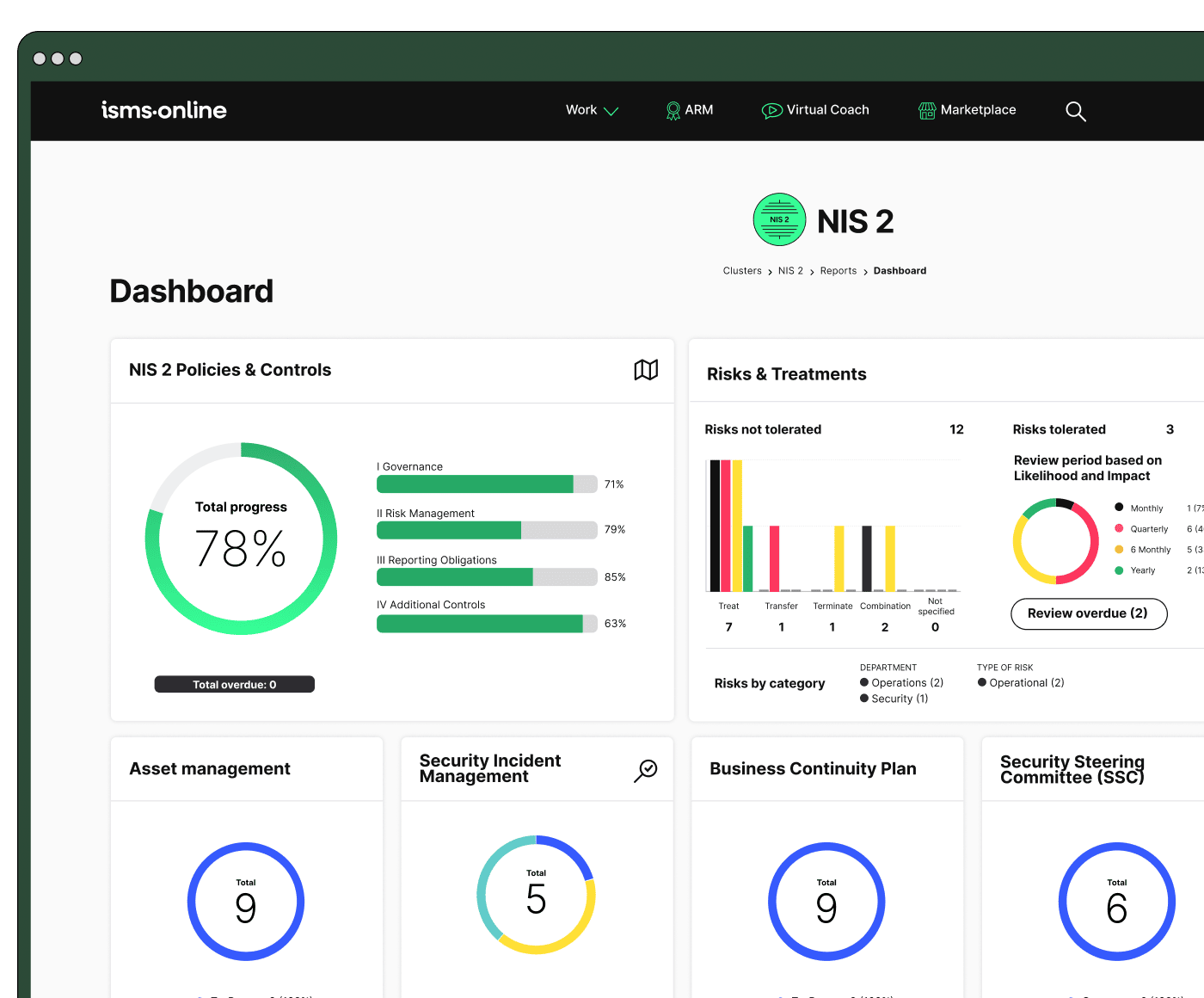
All your NIS 2, all in one place
From Articles 20–23 to audit plans – run and prove compliance, end-to-end.
Is Your Supply Chain Strengthening or Weakening Your Compliance? Securing Vendors, Labs, and Third Parties Under NIS 2
Healthcare’s digital ecosystem is only as strong as its weakest node-all the more urgent when NIS 2 assigns joint liability for supply chain breaches. The days of unchecked vendor self-attestation are gone. Now, every third-party relationship must be under active, documented scrutiny-year-round, not just at review (Sharp, 2024).
Robust supply chain security is about documented, ongoing evidence-don’t let vendor promises open unseen exposures.
How the highest-performing teams lead:
- Mandatory Contract Language: Explicit cyber-security requirements, breach notification obligations, audit rights, and service termination clauses built into every transaction (NIS 2 Art. 21 & 23) (CMS LawNow, 2023).
- Automated Supplier Onboarding and Monitoring: From access approvals to renewal and incident notification, automation is now expected practise.
- Live Risk Ratings and Audit Logs: Boards and managers continuously monitor contract health, risk ratings, and evidence of controls-triggering fast action when a supplier’s status changes (Zscaler, 2024).
- Real Penalties: Fines and regulatory scrutiny double if a breach is traced to a vendor for whom control or audit rights were weak (Lexology, 2024).
Annual audit isn’t enough. The chain of trust is now contingent on real-time reporting, periodic access reviews, and logged risk updates-proven at the click of a button.
Dashboards highlighting supplier risk ratings, audit status, and contract health help boards and clinics quickly spot and act on emerging third-party exposures.
What Does Real Audit-Readiness Look Like For Health Providers-And How Can You Make Your Cyber-Security Prove Itself Under NIS 2?
For today’s healthcare boards and compliance officers, NIS 2 enforces a simple dichotomy: can you show prompt, live, evidence-backed compliance-or is it wishful thinking? Auditors want to see live dashboards, up-to-date logs, and engagement stats-not promises or static files.
What makes the difference:
- Live KPIs: Tied straight to NIS 2 Art. 21–24. Regularly updated incident logs, supplier assessment histories, training coverage by department, and time-to-remediation metrics-all presented for board and external auditor review (ISMS.online Audit Management).
- Audit-in-Progress Dashboards: Reports of over 92% pass rates for evidence dashboard users highlight the impact (ENISA, 2024).
- Continuous Monitoring: Every breach, assessment or training session is logged in a way that’s accessible for both internal oversight and regulatory review (Forbes, 2023).
- Staff Engagement Analytics: Policy acknowledgment tracking and quiz result dashboards put real numbers behind staff readiness (ISMS.online Policy Packs).
Audit logs featuring date-stamped evidence, live KPI dashboards, and engagement scores are now the measure of operational security-not file folders.
Your next step is pragmatic: enable your IT, InfoSec, and compliance teams to preview a single source-of-truth dashboard. You’ll rapidly see if today’s evidence, incident, and supplier records are genuinely NIS 2 audit-ready-or at risk of exposing the organisation.
Confidence Capital: Take Action With ISMS.online and Lead the Sector
The divide between reactive firefighting and genuine confidence is now sector-defining. A platform built explicitly for health sector teams, mapped to NIS 2, ISO 27001, and ENISA, turns compliance from anchor into advantage.
Assure. Launch guided control sets for every department: from risk and incident management to supplier oversight and policy engagement-proven mappings to every regulatory reference support your team, whether in the OR or the boardroom.
Engage. Unify IT, clinical leads, and compliance teams in a collaborative environment. Platform-based task flows, evidence tracking, and audit prep mean less chasing, more resilience.
Prove. Surface real-time dashboards, ISO/NIS 2 bridge maps, and live logs to make audit, regulatory, and board review factual, defensible, and stress-free.
Move beyond compliance by building confidence capital. Deliver patient safety, regulatory assurance, and leadership trust from one integrated platform.
The difference between handshakes and headlines is proof: sector-readiness, audit evidence, and genuine operational assurance. ISMS.online hands you the controls, the audit logs, and the peace of mind your patients, boards, and regulators now demand.
Book your readiness assessment, preview a live evidence dashboard, or invite your leadership team into action with ISMS.online today. Lead the sector not just in compliance, but in real, provable resilience.
Frequently Asked Questions
What cyber-security controls must healthcare providers and medical labs have under NIS 2?
NIS 2 requires healthcare providers and labs to operate with real-time, evidence-backed cyber-security that spans risk management, technology, people, and leadership-protecting patient data and services from evolving digital threats.
At a minimum, providers and labs must:
- Run an annual, documented risk and asset review.: Catalogue every information asset and assign clear ownership. Boards must review and minute these audits, ensuring leadership accountability.
- Enforce strict access and encryption policies.: Only authorised personnel access sensitive data-protected by robust encryption and routine patching. This covers patient records, clinical systems, and devices, including mobile and remote endpoints.
- Log every incident and meet fast reporting timelines.: Security incidents must trigger alerts and be escalated within 24 hours, with regulators notified in 72 hours and a closure report completed within 30 days. Every step must leave a time-stamped, audit-ready log.
- Vet every supplier, contract, and ongoing relationship.: All vendors-IT and clinical-must sign agreements with explicit cyber clauses; you’ll need to retain compliance logs and monitor supplier status continuously, not just at onboarding.
- Deliver annual, outcome-based staff training.: Every role that touches patient data gets tailored, tracked cyber training at least once a year, with assessment and logs to evidence participation.
- Track executive and board engagement.: Board-level logs, meeting minutes, and decision registers document active leadership and lessons learned.
- Continuously measure effectiveness.: Must-have metrics: detection and response times, unresolved risks, staff training rates, and real-time compliance dashboards. Regulators now expect a living system-not a static policy binder.
Missing logs or slow reporting can risk patient trust and push compliance off a cliff-regulators want to see dashboards, evidence trails, and executive involvement, not just intentions.
Crosswalk Table: NIS 2 & ISO 27001/Annex A Controls
| Focus Area | Control/Action | NIS 2 Article | ISO 27001/Annex A |
|---|---|---|---|
| Risk Management | Annual review, asset inventory, board | 21, 20 | Cl.6.1, A.5.1, A.5.9 |
| Incidents | Alerts, 24/72h notification, closure | 23 | A.5.24–A.5.28, A.8.8 |
| Supply Chain | Contract clauses, logs, monitoring | 21, 26 | A.5.19–A.5.21, A.8.30 |
| Device Security | Patching, encryption, access restriction | 21 | A.8.24, A.8.25, A.7, A.8.9 |
| Staff Training | Annual, tracked, outcome-based | 21 | A.6.3, A.7.7, A.8.7 |
| Board Oversight | Logs, KPIs, board reviews | 20–23 | Cl.5.2, A.5.2, A.5.36, Cl.9 |
How do hospitals and labs keep NIS 2 cyber-security compliance alive day-to-day?
Ongoing NIS 2 compliance in healthcare isn’t a “project”-it’s a daily operational discipline that turns each risk, supplier, policy, and decision into a logged, audit-proof outcome.
- Begin with a gap assessment: -map your existing security programme to NIS 2 articles and ISO 27001 controls. Assign owners for every section: risks, suppliers, incidents, and training.
- Automate detection and reporting: Modern incident management tools should raise alerts, send notifications, and log closures within 24/72/30-day windows. Relying on manual reporting puts compliance and patient safety at constant risk.
- Centralise evidence and policies: Use an ISMS platform to store every policy, asset, and training record-versioned, linked, and audit-ready. Automation (reminders, dashboards, exports) ensures no control gets buried or lost before audit time.
- Actively manage your supplier lifecycle: Before onboarding, scrutinise every vendor; build in cyber clauses and evidence trails. Run quarterly vendor reviews and keep live monitoring dashboards.
- Bring your board into the loop: Monthly digital reviews of KPIs, risks, and action logs are now standard. Minuted discussions and formal follow-ups create an accountability shield.
- Simulate real incidents, not just checkboxes: Regularly stage cyber or business continuity drills. Log not only completion, but corrective actions, what’s learned, and board follow-up. This traceability builds the only true regulatory and insurer trust.
Resilience comes from routine, not just reaction. When every asset, incident, and training event is logged and review cycles are documented, audits become a proof of discipline-not a scramble.
What practical compliance checklist works for healthcare NIS 2 cyber-security?
A living checklist for NIS 2 compliance must connect day-to-day activity and leadership oversight-with every step leaving an audit trail.
| Area | What To Do | NIS 2 / ISO 27001 Reference |
|---|---|---|
| Risk Management | Asset inventory, board review (yearly) | Art 21 / Cl.6.1, 5.1, 5.9 |
| Incidents | Detect/alert, escalate, close (24/72/30d) | Art 23 / A.5.24–5.28, 8.8 |
| Business Continuity | Recovery test, scenario log (annually) | Art 21 / A.5.29, 8.14, 22301 |
| Supply Chain | Supplier vetting, contracts, reviews | Art 21 / A.5.19–5.21, 8.30 |
| Device Security | Patching, encryption audits (logged monthly) | Art 21 / A.8.24, 8.25, 8.8 |
| Staff Training | Annual, scored, role-based sessions | Art 21 / A.6.3, 7.7, 8.7 |
| Exec Oversight | Board log, KPI dashboard (monthly cycle) | Art 20 / Cl.5.1, 5.2, 5.36 |
| Audit Evidence | Log versioning, exports, SoA linkage | Art 21–23 / A.5.35, 5.36, Cl.9 |
Traceability Table
| Trigger | Risk/Update | Control/SoA | Evidence Logged |
|---|---|---|---|
| New staff member | Onboard record | A.6.1 / Art 21 | Training log, access review |
| Asset added/changed | Inventory upd. | A.5.9 / Art 21 | Asset list, board minutes |
| Supplier onboarding | Due diligence | A.5.19 / Art 21 | Contract, onboarding logs |
| Security incident | Response flow | A.5.24 / Art 23 | Ticket, escalation log |
| Policy updated | Board approval | Cl.5.2 / Art 20 | Review notes, signature |
What are the penalties and business risks for NIS 2 non-compliance in health?
Non-compliance isn’t just about the maximum €10 million fine-NIS 2 exposes boards, staff, and business futures to regulator scrutiny, contract loss, and public trust collapse.
- Fines: Up to €10 million or 2% of global turnover for “essential entities”-comparable with GDPR (NIS 2 Art 34).
- Director liability: Board and management can face direct investigation for governance failings (NIS 2 Art 20, 34, 36).
- Suspended services/contracts: Recurring failures may lead to contract bans, provider delisting, or public censure.
- Denied insurance: Unproven controls or absent logs can nullify cyber insurance claims after an incident.
- Lost revenue: Losing a key contract or public panel slot impedes growth; missed procurement deadlines block patient care.
- Reputational damage: Public breaches, named fines, or persistent non-conformance harm the trust you depend on-patients, staff, and funders may not return easily.
Every missed alert or policy log can tip from technical gap to existential threat-boards must now view compliance as core operational defence and public trust insurance.
Which systems and frameworks deliver defensible NIS 2 documentation for hospitals and labs?
Modern ISMS platforms and proven frameworks are now essential to tie daily compliance habits to regulator-grade evidence chambers.
- ISMS.online and similar live platforms: Centralise policy libraries, risk and asset logs, incident and supplier records, and staff training KPIs-automate record-keeping, reminders, and dashboard views for board and audit.
- ISO/IEC 27001:2022 (and ISO 27701): Standards that cross-map to NIS 2 controls; SoA documents show compliance at a glance, and audit trails are export-ready.
- ENISA Health Sector Guides: Offer sector-specific control checklists and lessons learned from real-world enforcement.
- APIs & automation: Integrate with detection, asset, or supplier tools-ensure every log/event is captured, versioned, and evidence can flow on-demand for audits.
- Dashboards for all leaders: Board and clinical/IT leaders can use live dashboards for incident status, training progress, supplier compliance, and audit timelines-building trust with auditors, insurers, and the C-suite.
When every function-clinical, technical, procurement, board-operates in a unified ISMS, nothing falls through the cracks and every compliance action leaves a live, defensible record.
How can boards and executives create NIS 2 resilience, not just pass an audit?
Board-driven compliance transforms NIS 2 from a regulatory hurdle to a competitive advantage-embedding resilience in the organisation’s fabric.
- Monthly cyber compliance reviews: Boards and execs must review KPIs for risk, incidents, assets, and staff training. All reviews and critical discussions are logged and acted on.
- Transparency via dashboards: Live drill-down access means every board member can see the status of controls, open risks, staff participation, and supplier assurance in real time.
- Framework integration: ISMS unifies ISO 27001/27701, NIS 2, BC/DR, and sector guides-removing silos and prioritising improvement.
- Pre-empt auditor and regulator requests: Quarterly walkthroughs of logs and dashboards with external auditors flag weaknesses before they’re crises; fix promptly and document changes.
- Empower named owners for every action: CISO, DPO, and critical clinical/tech/service leaders must have clear, logged ownership for each compliance routine.
- Continuous improvement: Use every incident, audit finding, and KPI miss as a learning anchor, reporting corrective action and improvement cycles to the whole organisation.
True resilience is a living discipline-when every compliance decision is logged and owned, NIS 2 moves from ‘side project’ to operational shield for patients and the whole health system.
Boards who treat evidence as business capital build unbreakable trust with partners, regulators, and patients-and set the pace for the sector.






