





































Why Does Ground Infrastructure Now Matter So Much Under NIS 2-and What’s the Real Deadline?
Space sector compliance is no longer defined by what’s in orbit-today, it’s equally about what happens on the ground. The NIS 2 Directive and ENISA/ESA guidance together reposition ground stations, data centres, terrestrial links, and mission control from their historic support roles to the heart of regulatory oversight. This shift rewrites the basic risk map for any satellite operator, prime, service provider, or downstream partner reporting into the European critical infrastructure chain. Your mission is now only as robust as your most exposed earthside node.
No team is insulated by old boundaries. Compliance is no longer a perimeter fence-it must track through cloud, vendors, and every ground handoff.
What changed? ENISA’s technical papers and ESA conformity assessments codified that incidents affecting ground operations-be it a satellite command loss, link compromise, or third-party data breach-trigger notifiable events under NIS 2. You are now “in scope” with the same regulatory urgency as any facility launching a payload. That means procurement, cloud migrations, network upgrades, and supply contracts all fall under the same audit lens.
This is not a theoretical risk. By October 2024, all EU ground operators must be able to demonstrate NIS 2 compliance, with a legal expectation that audit evidence and incident records can be produced on demand. If you’re caught in a “shadow IT” quagmire, or your real-time response capability is stuck in a policy binder, exposure is no longer a theoretical concern-it’s a live liability. COTS (Commercial Off-The-Shelf) hardware or SaaS partners? Also in scope. This is an urgent new category of regulatory attack surface.
Incidents are now triaged for cross-border impact, with ENISA statistics already recording a surge in ground segment and supply chain attacks causing service outages and cascading disruptions across affiliate networks. For many, the ground segment no longer sits in the auditor’s blind spot.
Understanding the forces driving supply chain diligence centre stage-and why every ground operation must shift from siloed paperwork to an integrated, audit-safe compliance mesh-is now mission critical.
Supply Chain Security: When “Extra Due Diligence” Becomes Mandatory
When “supply chain assurance” just meant alertness to vendor weaknesses, many relied on brand reputation and a static set of onboarding checks. NIS 2 upends that comfort. Today, your organisation must log, map, and maintain a living register of every supplier-be it upstream cloud host, ground relay, hardware provider, or managed IT service. What once passed as simple attestation now requires evidence: signed contracts demanding enforceable cyber-security, up-to-date SBOMs (Software Bills of Materials), periodic risk reviews, and clear audit trails.
Supply chain security isn’t about static policies. Auditors want timestamped corrective actions at every link.
Evidence of “supply chain hygiene” is fast becoming the real audit pass/fail threshold. ENISA’s recent guidance requires that you not only identify providers and sub-providers but also prove ongoing engagement: periodic drills, SBOM updates, and drills with actual loss/corruption simulation. If the register stagnates between onboarding cycles, or third-party claims aren’t substantiated with logs and response exercises, exposure intensifies.
Paper policies and contractual boilerplate no longer pass muster-instead, your platform must support recording and evidencing live threat notification and vendor accountability exercises. Passive oversight has been replaced by a new paradigm: dynamic, continuous monitoring and response. Third-party failures can no longer hide in the background. This is not bureaucratic overreach; recent sector penalty data confirms that static supplier registers and unenforced contracts are among the top regulatory triggers for fines and investigation.
Direct, ongoing accountability is the new bedrock-especially as cross-border criticality means an issue at a regional ground segment may instantly trigger scrutiny for partners, resellers, and national operators. Executive liability follows quickly on the heels of process drift.

Master NIS 2 without spreadsheet chaos
Centralise risk, incidents, suppliers, and evidence in one clean platform.
Accountability Gets Real: New Penalties, Reporting Windows, and Regulator Expectations
As NIS 2 rolls out, the frame of “essential entity” now automatically includes every significant partner, vendor, supply site, and remote ground asset. Whether directly operated or managed by subcontract, the expectation is for immediate visibility, traceability, and response action-especially under audit or crisis.
The clock for reporting has tightened to operational tempo: a significant incident must be disclosed to your national CSIRT or regulator within 24 hours, with a root-cause, evidence-backed report within 72. This isn’t aspirational catch-up-documented sector penalties now regularly surpass €10 million for missed reporting windows or poor communication. Delivering on these timeframes requires both automated evidence logging and strong cross-functional coordination.
What’s less appreciated, but equally mandatory, is the intersection with GDPR and other sectoral rules. Scenario: a data breach caused by a ransomware incident on a mission command system. This may require duo notification to both InfoSec authorities (under NIS 2) and the relevant DPA (under GDPR)-with separate fields, timelines, and stakeholder lists. Your compliance artefacts must meet both response streams without confusion or delay.
Failure to synchronise reporting across compliance boundaries is now seen as a major deficiency, not a minor oversight.
If response teams pause to debate: Which rule applies?, you’re already behind regulator expectations.
Having a tested, consistently updated incident response playbook-routinely exercised and role-assured-is now a board-level expectation. It’s measured both by what’s done in the first hour, and by the completeness and prerogative shown at the close of the incident lifecycle.
From Over-Documented to Actually Tested: Building Real Resilience
Space sector ground operators often field exhaustive documentation-policies, risk matrices, contractor agreements, and more. But, in the spirit of “audit by facts not folders,” ENISA and ESA audit guidelines push one truth: only living, regularly exercised controls and logs carry real audit weight.
A “living ISMS” requires regular drills across your entire operational chain-annual minimums are mandated, but risk-based cycles win auditor favour. Tests of satellite control failures, relay outages, supply chain interruptions, ransomware recovery, privileged access compromise, and full data centre failover should be conducted and logged with named participant lists, vendor involvement, and post-mortem documentation. It’s no longer sufficient to simulate only “good day” scenarios-ENISA expects drills on supply chain attack chains, embedded malware, and third-party compromises.
Resilience is what’s measured after the drill. The distance between we plan and we update from live events is now auditable.
Failure to log lessons learned, close out recurring issues, or evidence improvement actions is increasingly treated as a material risk. ESA audit teams have flagged organisations whose policies claimed best-practise but whose action logs revealed rarely tested, never-updated protocols.
Board visibility, staff engagement, and supplier integration into actual, risk-driven drills closes the “audit gap” between documentation and lived security.
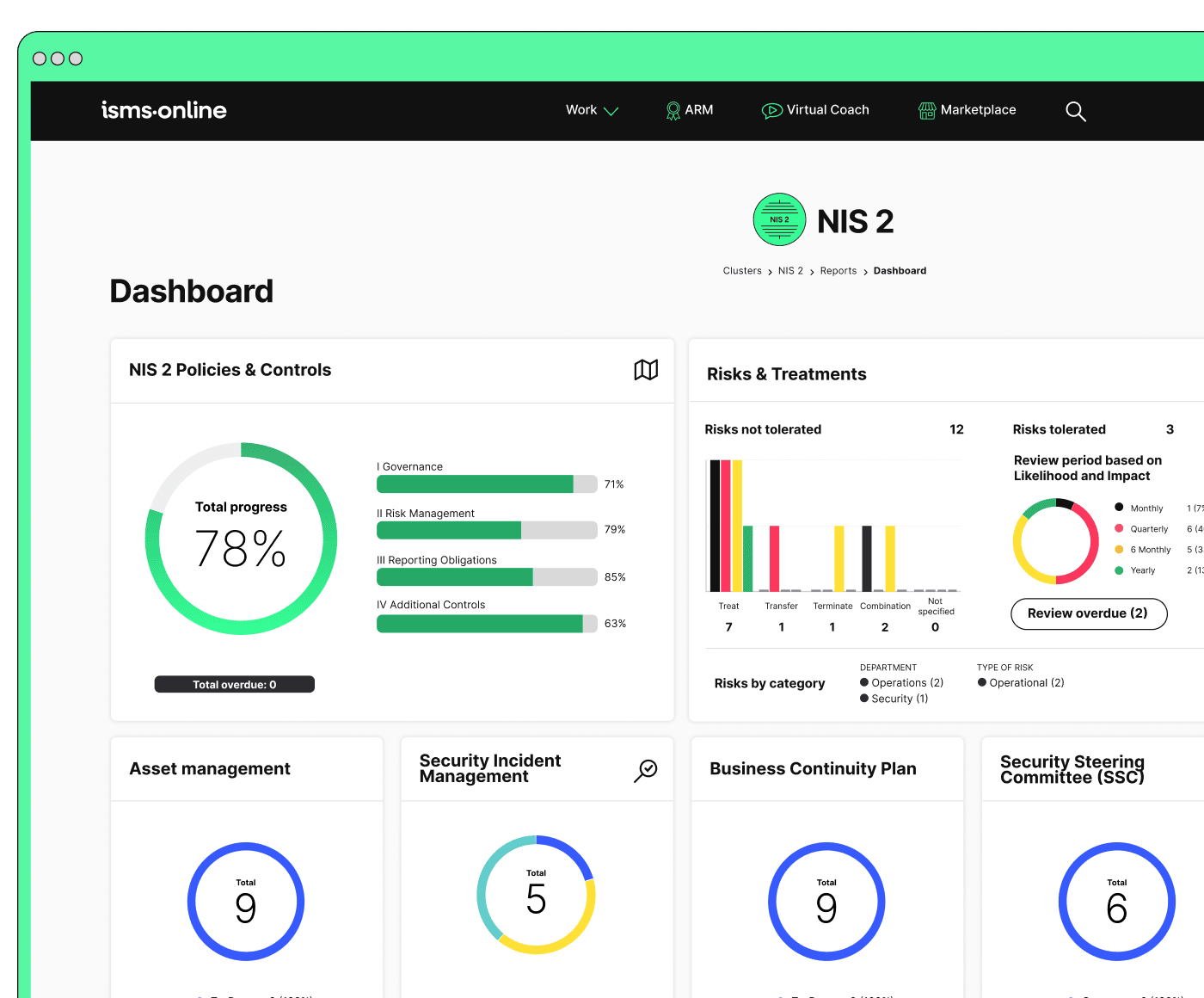
Be NIS 2-ready from day one
Launch with a proven workspace and templates – just tailor, assign, and go.
Space-Sector Technical Controls: Segmentation, Zero Trust, and Backup as Audit Frontlines
Today, “evidence of compliance” means system-level health, segmentation, and redundancy are tested and logged-not just described. Auditors now require live network and system diagrams that reflect actual segmentation: physical, logical, supplier and third-party boundaries, and backup systems. Multi-factor authentication (MFA) is required for all privileged and remote-access accounts-not just for main admin logins, but every vendor and support user as well.
Routine drills prove that backup and restore processes are fast, complete, and survivable. Logs must track incident simulations-restoring a corrupted payload, recovering from a control room compromise, and re-authorising remote access. Failover tests must be scheduled, tracked, and recorded with precise outcomes. Every supplier or subcontractor with access to ground networks must participate in the test cycle.
Audit readiness lives or dies on the ability to export logs, results, participant lists, and documented remediation steps at a moment’s notice. If a privileged account or a remote vendor access route is tested and fails, the correction and revalidation must be time-stamped and retrievable for review.
Audit-ready means audit-tested-every segment, every login, every failover, proved and logged.
Static policies are now insufficient. To pass audit and protect mission timelines, your control environment must prove coverage by way of continuously updated, role-validated, and closure-tracked logs-across every operational dimension.
Mapping Controls for Audit: From Regulation to Evidence That Passes
Auditors are no longer satisfied by seeing “policy mapped to clause.” Today, living operationalisation means evidence must directly trace from regulatory expectation to control to logged proof (isms.online, enisa.europa.eu). ESA’s assessments repeatedly cite failures where compliance paperwork is not backed by evidence of ongoing, effective action.
Mapping Table: Regulation → Control → Evidence
Here is a bridge linking regulation to operational actions you need to evidence:
| Expectation | Operationalisation | ISO 27001 / Annex A Ref |
|---|---|---|
| 24-hr incident reporting | Automated logging and alert to CSIRT/board | A.5.24, A.5.25 |
| Supply chain due diligence | Periodic supplier reviews + SBOMs | A.5.19, A.5.20, A.5.21 |
| Segmentation enforcement | Segmented networks with logged access reviews | A.8.20, A.8.22 |
| Tested backups/recovery | Drill logs, failover tests, corrective actions | A.8.14, A.8.13 |
| Lessons learned closure | Post-incident reviews, evidence of improvements | A.5.27, A.8.34 |
ISMS platforms now allow you to create artefacts and exports for every required control. That means schedules and logs showing: every incident reported, supplier review complete with corrective actions, access reviews conducted on each network segment, restoration drills with closure, and documented lessons and remediation cycles.
Traceability Mini-table: Event to Audit-Ready Evidence
See how lived events trace to logged artefacts below:
| Trigger | Risk Update | Control / SoA Link | Evidence Logged |
|---|---|---|---|
| Supplier breach | New risk/asset entry | A.5.19, A.5.21 | SBOM, comm logs, retested supplier |
| Failed backup | Recovery risk escalation | A.8.13, A.8.14 | Drill report, action remediation |
| MFA bypass | Account access review | A.5.15, A.8.5, A.8.32 | Auth log, privileged access review |
| Incident | Immediate notification | A.5.24, A.5.25 | Exportable log: incident, response, closure |
For every regulatory requirement, you need operational logs that show triggers, risk escalations, control responses, and actual evidence of closure. “One click to export” is your best protection in the audit room.
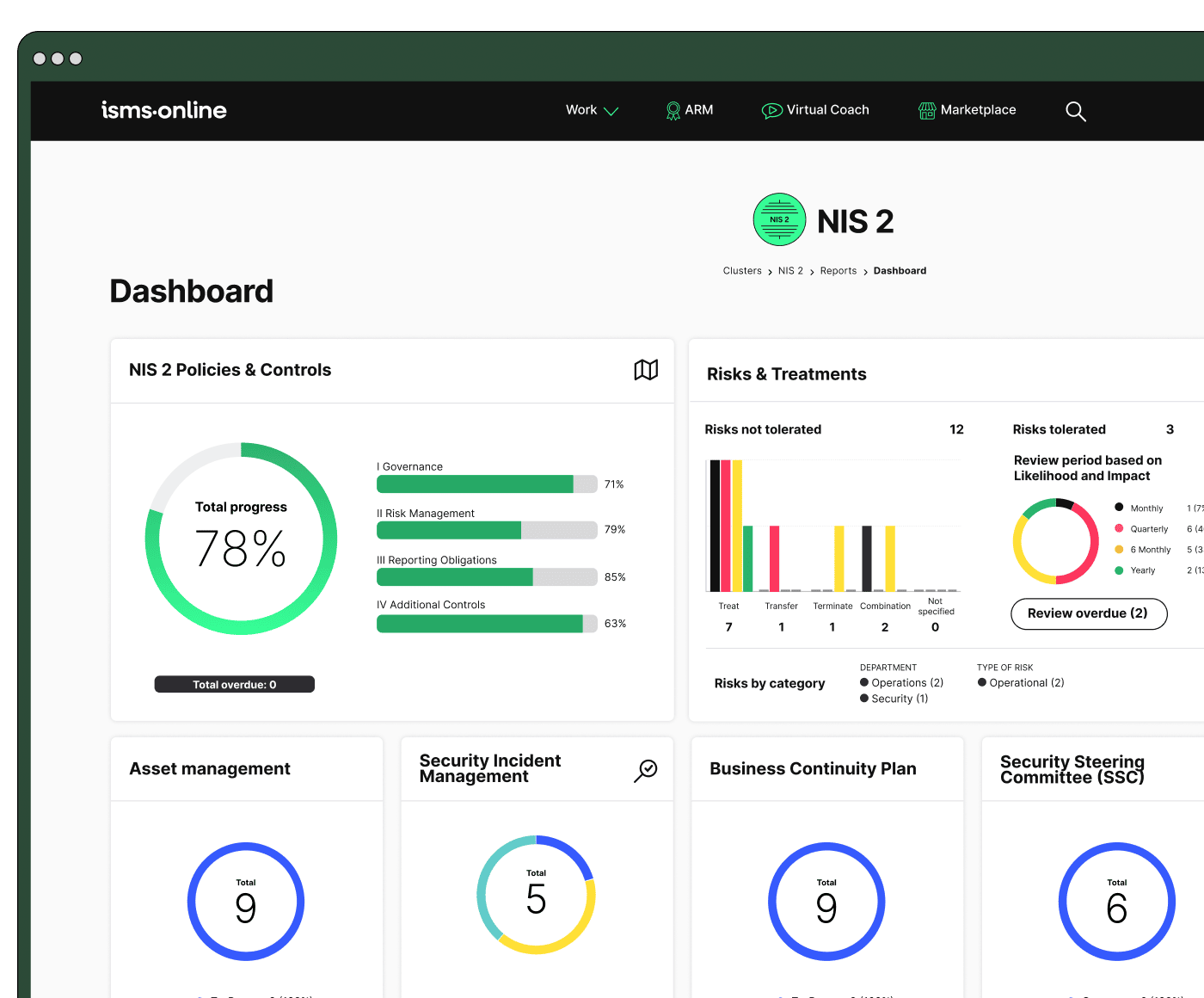
All your NIS 2, all in one place
From Articles 20–23 to audit plans – run and prove compliance, end-to-end.
The New Compliance Timeline and Why Waiting is No Longer Safe
Time is not on your side. The October 2024 NIS 2 deadline for space sector ground operations is less “launch event” and more “mission checkpoint”-the difference is measured by the ability to produce living audit artefacts, not polishing internal policy folders at the eleventh hour. Recent enforcement actions show that documented fines for failure to show closed incident logs, missing risk register entries, or incomplete audit trails are already well into the millions.
Compliance readiness is no longer about clever last-minute audits. In reality, the audit cycle is now driven by living, stress-tested drills; control-evidence mapping; and real-time logs. Platforms like ISMS.online can integrate teams, map new and legacy controls to ISO 27001/Annex A, auto-trigger evidence exports, and summarise closure trajectories (isms.online). The difference between being “prepared” and “provable” is defined by your last complete control log.
The difference between planned and proven readiness is measured by your last exportable evidence log.
Don’t wait for requests to scramble compliance. Run annual live drills, update supplier risk reviews, trace evidence closure, and enable all teams to operate above regulatory minimums. Audit defensibility is no longer an “add-on”-it defines operational survival.
Your Next Step-Sector-Ready NIS 2 Compliance with ISMS.online
Dust off that policy folder and reimagine what audit readiness means. ISMS.online’s integrated system enables every NIS 2, ISO 27001, ENISA, and ESA control to be operationalised via controls, evidence, and live exports. Incident logs, corrective actions, vendor drills, and resilience reviews are all mapped directly to legal and best-practise requirements (isms.online). If the auditor asks “show me,” your platform should provide time-stamped artefacts, full closure logs, and drill documentation on demand.
What does an exportable compliance record look like? At a minimum:
- Date/time of event:
- Action taken (incident, test, review):
- Assigned users and roles:
- Reference to policies/controls affected:
- Outcome/resolution: (including proof of closure)
- Linked evidence: (attachments, drill artefacts, comm logs)
- Timestamp and user confirmation:
Modern dashboards empower you to philtre by criterion (“all critical incidents in Q2”), review status closure in real time, map risk rotations to asset registers, and export with a click for regulators or management.
Sector resilience flows from continuous looped feedback: board, IT, legal, supply chain, operations. When each link is synchronised and made auditable, compliance is no longer a drag-it’s a competitive asset and a lasting indicator of trust.
Don’t let compliance bottleneck your mission. Make it your enduring trust asset.
Take the Next Step: Unlock Confidence, Leadership, and Board-Level Trust
Adopt a cycle of living audit readiness. Transition from static documentation to outcome-proofed compliance-giving the board, partners, and regulators operational security that scales and adapts. Move your ground segment from historic oversight into modern sector leadership. With ISMS.online, readiness is live, action settles risk, and your compliance system becomes a gold-standard trust asset in the European space sector.
Book a demoFrequently Asked Questions
How does NIS 2 redefine compliance for space ground infrastructure operators?
NIS 2 moves ground infrastructure from a supporting role into the regulatory spotlight, classifying all ground stations, mission control centres, terrestrial networks, and data nodes as “essential” or “important” entities. This extends deep, operationalised cyber-security duties to every organisation underpinning space services. Operators must meet strict, real-time controls: no more narrow focus on satellite uplinks or “on-paper” policies. Instead, you’re required to implement and evidence live risk management, continuous monitoring, and active supplier oversight-regardless of legacy status, outsourcing, or cloud architecture (see ENISA 2023 NIS 2 Guidance). All activities-changes, drills, alerts, vendor interactions-must be logged and ready to export for audit or regulator requests.
Scope expansion and critical differences
- Every ground station, TT&C site, relay, or control node that supports regulated launch, navigation, earth observation, satcom, or SSA/STM is in scope.
- Cloud-based and SaaS, virtualized or hybrid support layers are included, even if provided by third parties or outside the EU.
- All suppliers-hardware, software, integrators, managed services-must be embedded in your controls and test cycles.
Key shift: Operators are now judged on continuous evidence and live resilience rather than mere policy compliance. As of October 2024, every part of your ground segment-legacy or not-falls under active regulatory oversight. [ENISA, NIS 2 Space Guidance, 2023]
Why have aviation and energy cyber failures changed space operator obligations?
Major incidents-like the 2024 Delta Air Lines outage and the 2025 European ground control disruption-demonstrated that a weak supplier, software bug, or untested failover could paralyse not just one sector, but entire national infrastructure for hours or days (AP, 2024). ESA, ENISA, and EU lawmakers responded by codifying more frequent, realistic, and supplier-inclusive readiness checks into NIS 2.
Practical lessons applied to space sector
- Vendor, software, and supply chain audits are now required at least quarterly (not annually).
- Real incident drills must involve your supply chain, not just an internal team simulation.
- Proven notification and escalation paths (no “assume the vendor will sound the alarm”).
- Drill and incident logs now must prove closure and corrective action-not simply show intent.
A single SaaS failure can cascade from airspace to launchpad, setting off a chain reaction-compliance now demands you close every loop before the attack does.
What supply chain and third-party controls are mandatory for NIS 2 space ground compliance?
NIS 2 places real teeth behind supply chain security and vendor oversight. Operators must:
- Maintain a dynamic risk register-updating instantly for every incident, contract event, or supply chain change (ENISA Supply Chain Security 2023).
- Require and review SBOMs for every critical system, with quarterly visibility and remediation logs.
- Involve every vendor and integrator in both annual scenario-based incident drills and contract audits.
- Enforce security obligations in contracts, with breach escalation triggers and logs-“trust by contract” isn’t enough; only action and evidence count.
Traceability table: supply chain control in action
| Trigger | Risk Update | Control/SoA Link | Evidence Logged |
|---|---|---|---|
| Vendor outage | Supply risk ↑ | A.5.19, 5.21/NIS2 | Drill log, escalation record |
| SBOM review | New vulnerability | A.8.8/NIS2 | Quarterly SBOM, patching log |
| Supplier breach | Incident risk ↑ | A.5.21/8.13/NIS2 | Notification, drill retest schedule |
| Contract renewal | Control enforcement | A.5.20/NIS2 | Clause review, closure record |
What’s new: Regulators now expect exportable, time-stamped drill and closure logs for every supplier, not just tick-box onboarding documents.
How are incident reporting, penalties, and evidencing enforced under NIS 2 for space ground segments?
NIS 2 brings dramatic accountability with hard deadlines:
- Within 24 hours: Notify your national CSIRT of any suspected or known cyber incident with critical impact.
- Within 72 hours: File a detailed report covering the incident, its implications, actions, and supply chain involvement.
- Failure to meet deadlines, or to supply closure and proof, can mean fines of €5–10M or more, and loss of regulated status for repeated violations.
Required audit artefacts
- Authenticated event and incident logs-role, time, system, and outcome stamped.
- Incident registers with corrective action and closure evidence.
- Supplier escalation logs (proving hand-off, response drills, and contract closure).
- Signed management review minutes confirming closed loop and learning.
Regulatory reality: Without closure logs and management sign-off, an open incident remains a risk multiplier at your next audit-raising both penalty and reporting risk.
How do segmentation, MFA, zero trust, and backup/failover controls interconnect for NIS 2 space ground compliance?
These controls must be implemented, tested, and evidenced together-supported by up-to-date diagrams, authenticated logs, management reviews, and supplier drill logs:
- Network segmentation: Every operational function, privilege set, and vendor interface must be separated and mapped; penetration tests need documented outcomes and corrective tracking.
- MFA enforcement: Mandatory for all privileged, remote, or third-party access paths; logs must show test cycles, breaches, and closure.
- Zero trust: Access, device, and supplier boundaries must be reassessed and constrained at every significant contract or system change-static trust is a liability.
- Backup and failover drills: Backup/restoration for all critical data must be tested-suppliers included-with drill logs and retest results logged and available for audit.
Controls-to-evidence summary table
| Requirement | Control/Reference | Audit Artefact |
|---|---|---|
| Segmented network | A.8.22, NIS2:21 | Diagrams, pen-test, SoA mapping |
| MFA enforced | A.8.5, NIS2:21 | Auth logs, test cycles, closure |
| Backup/failover | A.8.13/8.14, NIS2:21 | Drill, participation log, retest plan |
| Supplier drills | A.5.21, NIS2:21 | Supplier logs, review records |
| Incident closure | A.5.24/25, NIS2:23 | Response timeline, sign-off minutes |
The parts of your system that aren’t exercised, tested, and traced to closure are now risk amplifiers, not just technical gaps.
In practise, how does an ISMS platform like ISMS.online support NIS 2 readiness and audit resilience?
ISMS.online automates and unifies NIS 2 and ISO 27001/Annex A compliance for space ground segments by:
- Logging and time-stamping every key event-risks, incidents, resolutions, vendor drills-for instant CSIRT or auditor export.
- Mapping every ISO/NIS 2 clause to operational controls and evidencing them with live data, not just intention.
- Managing supplier SBOMs, contract reviews, closure cycles, and drill participation in one place-removing email chaos and spreadsheet risk.
- Surfacing progress, open items, closure status, assets, and management reviews for operational and executive oversight.
- Enabling instant audit pack exports, so every request-from scheduled audit to unannounced regulator demand-is met with actionable, up-to-date evidence.
ISO 27001 / NIS 2 operationalisation quick table
| Expectation | Operational Evidence | ISO 27001/NIS 2 Reference |
|---|---|---|
| Live incident log | CSIRT/SIEM ready export | A.5.24/25; NIS2:23 |
| Vendor SBOM reviews | Quarterly log + closure checks | A.5.19/21; NIS2:21 |
| MFA closure | Auth/test logs & retest plan | A.8.5/8.32; NIS2:21 |
| Failover drills | Drill outputs, supplier logs | A.8.13/8.14; NIS2:21 |
| Management review | Signed minutes, tracked actions | A.5.27/8.34; NIS2:21 |
Strategic edge: ISMS.online turns regulatory compliance from a liability into an operational asset-lowering penalty risk, minimising audit fatigue, and evidencing resilience in real time for your board, partners, and regulators.
Resilience is becoming the new benchmark for compliance-live evidence, full supplier integration, and automated closure logs are now your pass mark, not the paperwork you filed last year.






