





































Why NIS 2 Makes Waste Management Cyber-Security an Executive Imperative Now
Leadership in the waste management sector is facing a new level of scrutiny. With the NIS 2 Directive now deeming waste operators as critical infrastructure, compliance isn’t a back-office checkbox; it’s a direct line from operational reality to boardroom risk. The days when cyber policies could be delegated, then filed away, have ended. Executive and senior management are personally accountable for oversight, outcomes, and-under NIS 2-face specific regulatory penalties for falling short (see UK government position). Readiness for audit, regulator, or customer requests is no longer theoretical: evidence must be instant, complete, and traceable back to responsible individuals.
Regulatory urgency is real-compliance needs named, accountable owners, not just a shelf policy.
Delays or vague answers to “Show me who’s responsible for cyber and when it was last evidenced in action” are no longer tolerated. This shift isn’t just regulatory theatre: it links strategy in the boardroom to the physical reality of field sites, supplier networks, OT/IT endpoints, and every operational asset connected to your network.
Key NIS 2 compliance expectations for waste management operators:
| Expectation | Operational Evidence | ISO 27001 / NIS 2 Ref |
|---|---|---|
| Board-level cyber risk accountability | Signed minutes, named role registry | Cl 5.3, A.5.4, NIS 2 Art. 20 |
| Live asset and change oversight | Up-to-date asset register, change log | A.5.9, A.8.9; NIS 2 Art. 21 |
| Incident/continuity tracking | 24h/72h logs, tested response docs | A.5.24–27, Art. 21, 23, 29 |
| Documented supply chain controls | Supplier contracts, risk/audit logs | A.5.19–22, Art. 21, 29 |
| Continuous board review | Mgmt review records, improvement logs | Cl 9.3, 10.1–2, Art. 21 |
True compliance is tested when evidence is requested, not when policies are written.
In effect: NIS 2 vaults waste management into regulated critical infrastructure, demanding live, board-signed proof of oversight, asset/supplier controls, and tested response. For the first time, business leadership cannot delegate ultimate accountability.
Where Do Most Waste Sector Cyber Blind Spots Hide?
Waste management operations are the crossroads of brownfield SCADA, patched IT endpoints, field laptops, and sprawling vendor touchpoints. It’s no surprise that the weakest link is nearly always an overlooked asset, connection, or legacy interface. ENISA finds that more than a quarter of sector attacks trace to “orphaned or misclassified” technology (ENISA, NIS 2 Guidance).
Gaps don’t hide-auditors and adversaries both find them, fast.
What separates resilient organisations? Not just strong policy, but a living discipline of mapping every operational change, field deployment, and supply connection into your central asset and risk register, cross-referenced with owners and evidence logs.
IT/OT Blind Spot Checklist
- Missing, stale, or incomplete asset registers
- Manual lists and emails disconnected from the ISMS
- Weak or expired OT credentials (especially on PLCs, remote endpoints)
- Orphaned third-party, cloud, or field service links
- No process to recertify asset risk after upgrades/retirements
Glossary highlight:
- PLC (Programmable Logic Controller): Automates plant/field operations; often legacy, unpatched, or default-password targets.
- SCADA (Supervisory Control & Data Acquisition): Central interface for remote control/monitoring-disruption cascades rapidly.
Whenever an asset, user, or interface falls outside of your evidence flow, a breach is waiting. Regulators and attackers both exploit gaps.
Key insight:
Static logs and siloed updates fail. A resilient ISMS builds bridges across IT–OT, actively registering every device, change, and connection.

Master NIS 2 without spreadsheet chaos
Centralise risk, incidents, suppliers, and evidence in one clean platform.
How Has NIS 2 Transformed Supply Chain Security Expectations?
NIS 2 has irreversibly raised the bar: supply chain risk management is now a continuous, audit-ready activity-not a checkbox or annual file review. Any operator must demonstrate an ongoing process to map, risk-classify, and actively monitor all suppliers-spanning IT, hardware, field engineering, software-provided services, and even field contract labour (Belgian Cyber Fundamentals).
Supply chain diligence isn’t columns in a spreadsheet-it’s a living feedback loop between procurement, operational leads, and compliance owners.
Modern supply chain security:
- Fully map every key supplier, what systems/assets they reach, and what data/OT links exist.
- Lock in cyber-security clauses and notification SLAs for all contracts, not just Tier 1.
- Trigger re-risking on every renewal, incident, major upgrade, or expansion.
- Connect supplier risk ratings and updates to live board dashboards.
| Approach | Risk Exposure | ISMS.online Capability |
|---|---|---|
| Static checks | Blind gaps, stale data | Live dashboards, ongoing traceability |
| Manual logs | Change/missed alerts | Role-based audit and review logs |
| ISMS.online platform | Dynamic, linked | Automated supplier risk mapping |
NIS 2 expects year-round vigilance. Board-level reviews, contract redlines, and documented right-to-audit are non-negotiable, all mapped and tracked live in your ISMS.
How Should You Identify and Manage “Critical” Assets for Audit?
Critical is no longer limited to “big” server racks or obvious IT-NIS 2 brings a new standard: if the loss, failure, or compromise of an asset triggers regulatory breach or essential service disruption, it’s critical. This includes field devices, service interfaces, data sets, and supplier endpoints.
Asset evidence must align with operational change-not just the annual audit calendar.
The best operators use modern ISMS platforms with automated, master asset registries. Every addition, change, or removal triggers risk (re)classification, documented sign-off, and live, timestamped audit trails (ISMS.online asset feature). If regulators ask, they’ll expect to see not just what you own-but who owns it, when it last changed, its “critical” risk status, and action taken when that changed.
| Trigger | Risk Update | Control/SoA Reference | Evidence Logged |
|---|---|---|---|
| Add/replace OT asset | Assign owner, risk, track | A.5.9, A.8.9, Art. 21 | Registry + sign-off |
| Supplier/contract update | Re-assess risk, refresh contract | A.5.19–21, Art. 21, 29 | Updated contract, risk log |
| Field/process change | Test, SOP update, sign-off log | A.5.24–27, Art. 21 | SOP/uploaded change tests |
Monthly, asset owners must justify their “critical” designations; incident response and reviews drive cross-checks.
NIS 2, in practise:
Critical asset control is continuous. Every change is immediately logged, risk-weighted, signed off, and instantly reportable in the registry.
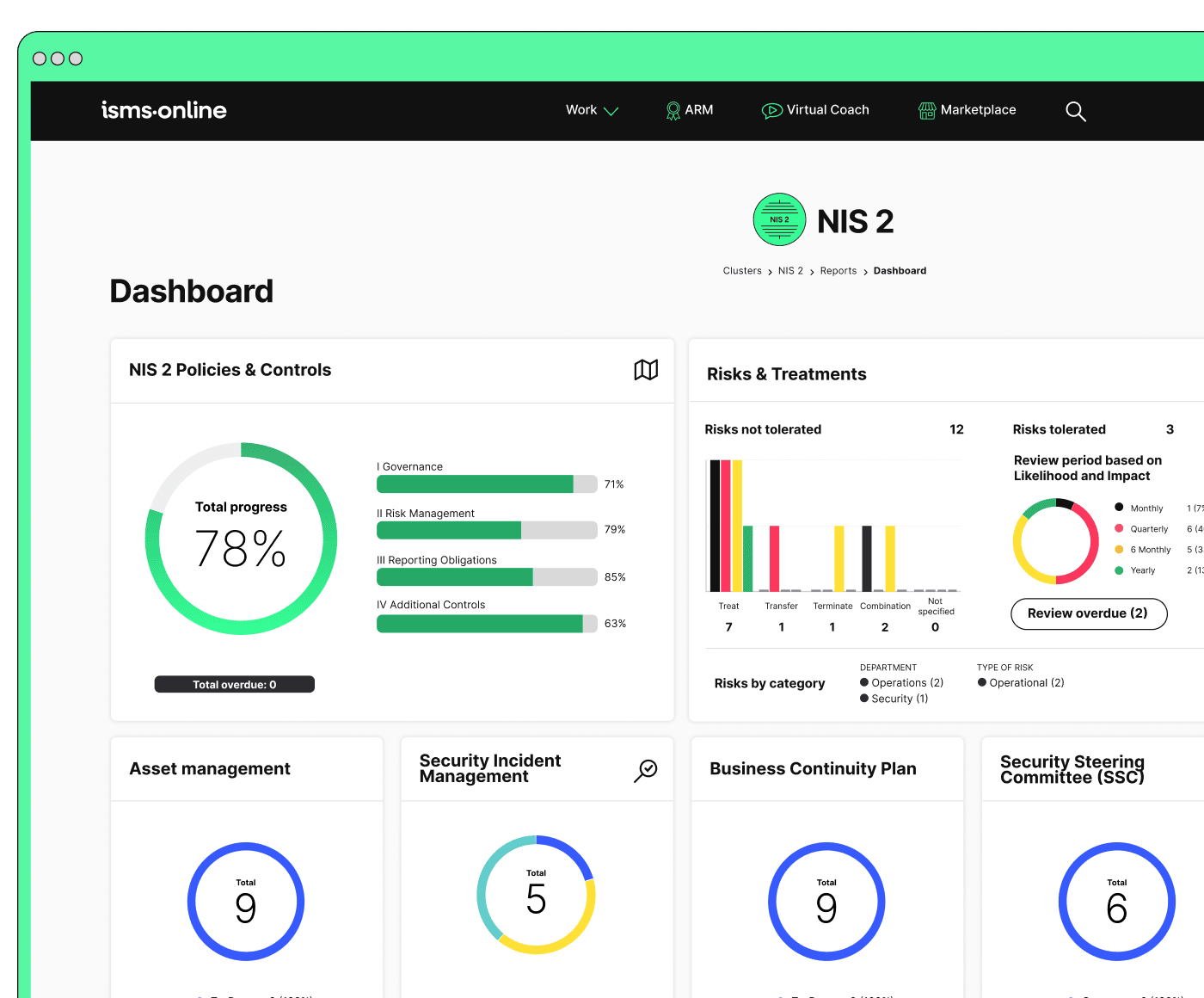
Be NIS 2-ready from day one
Launch with a proven workspace and templates – just tailor, assign, and go.
Why Bridging ISO 27001 and NIS 2 Audit Requirements Is Non-Negotiable
Audit failures are rarely a lack of documentation-they spring from disconnected evidence flows: compliance teams own ISO 27001, OT leads log events, and NIS 2 filings stand alone. Modern regulatory teams (and real-world auditors) expect live, cross-linked audit trails proving every incident, policy, asset log, and supplier review is mapped to both frameworks (EU Council NIS 2 directive).
Resilience is proven when your ISO 27001 and NIS 2 controls are visibly linked in audit logs-not in static templates.
Audit-Ready ISO 27001 ↔ NIS 2 Bridge
| Compliance Need | Operational Proof | ISO 27001/NIS 2 Ref |
|---|---|---|
| Live asset registry, signed ownership | Registry log, sign-off, approval | A.5.9–A.8.9, Art. 21 |
| Up-to-date supplier risk mapping | Renewal log, audit evidence | A.5.19–21, Art. 29 |
| Continuous board reviews and direction | Signed management reviews, KPIs | Cl 9.3, A.5.4, Art. 21 |
| Tested/recorded incident response | Drill records, lessons applied | A.5.25–27, Art. 21 |
Every control must map to a live log, approval process, and operational event-“audit trail as you operate” is the only reliable approach. Don’t wait for “audit season”; bake evidence capture into your daily ISMS.
From Policy Library to Field Operations-How Do You Make Controls Real?
Shelf policies no longer count. Every core NIS 2 or ISO 27001 control must be visible in daily activity: who owns each, who updates them, when they’re tested, and what evidence is left.
Auditors don’t just want to see that a policy exists; they want to see it in action.
Leaders automate reminders, sign-offs, and evidence capture for incident response tests, supplier reviews, asset changes, and field staff training. Evidence must be linked directly to each policy and the responsible reviewer.
| Control Context | Evidence | Owner Sign-off | Review Mechanism |
|---|---|---|---|
| Incident/drill test | Drill log, lessons | Ops lead | Scheduled review, status open |
| Backup recovery/failure | Recovery/test log | IT manager | BCP link, action tracker |
| Supplier change | Contract, risk update | Procurement lead | Renewal reminders, audit log |
Effective practise:
Schedule and automate evidence tracking. Each critical event or control update needs a sign-off visible to both field and board. Controls left untracked put you at risk.
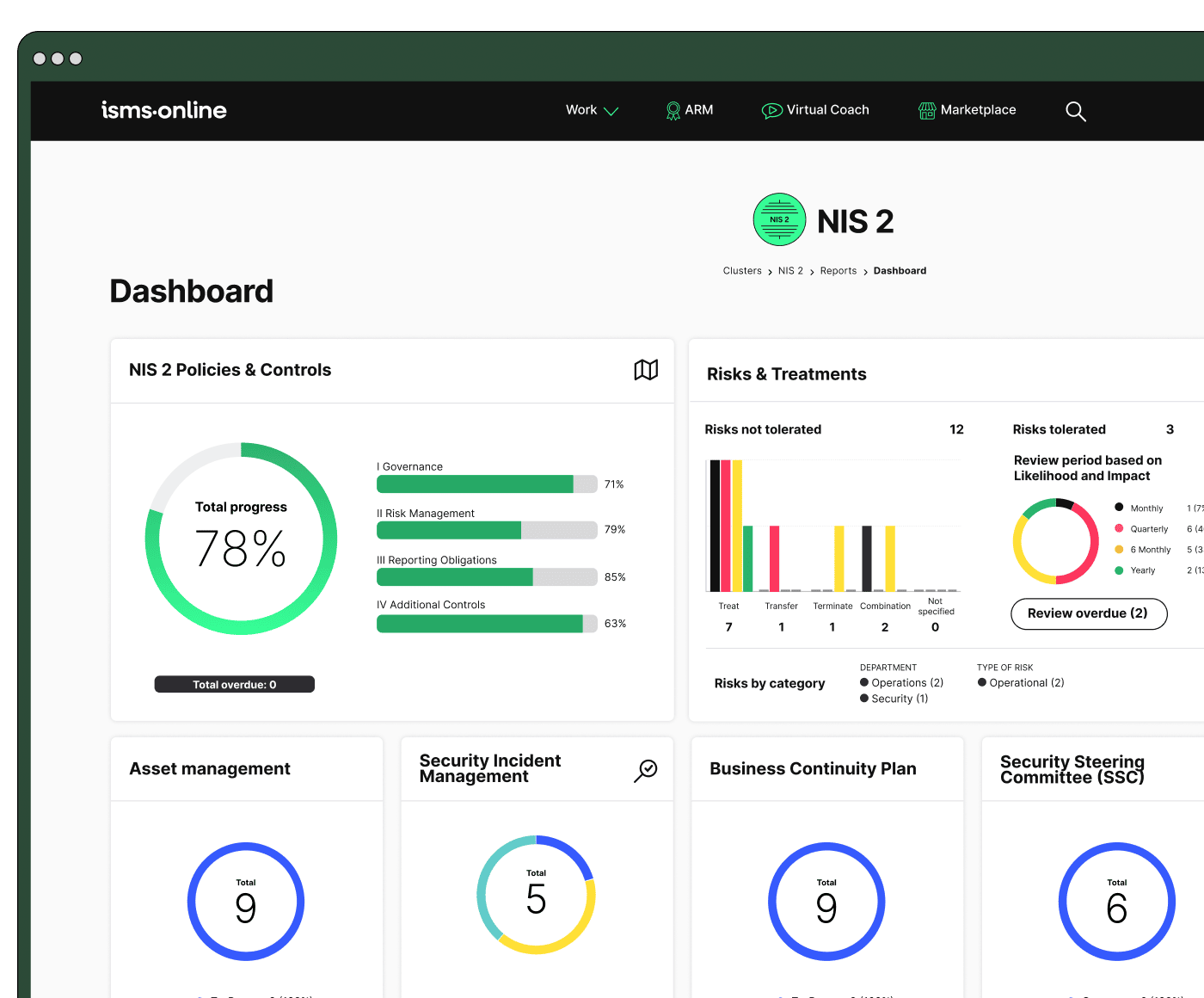
All your NIS 2, all in one place
From Articles 20–23 to audit plans – run and prove compliance, end-to-end.
Board-Ready and Audit-Proof: What Counts as Evidence Now?
Manual evidence chases are riskier than missing controls: delays, outdated logs, and version confusion all raise your risk exposure (European Commission NIS 2 briefing). Today’s gold standard is live, role-tracked evidence-current and complete at all times.
Compliance at operational and board speed is non-negotiable: regulatory risk escalates with every evidence delay.
Board members must be able to access up-to-date asset inventories, supplier lists, contract reviews, incident logs, and staff training completions-every item tracked by timestamp and permissions.
Board/Audit-Ready Evidence Table
| Evidence Class | Direct Access Needed | Board/Audit Metric |
|---|---|---|
| Asset inventory | Up-to-the-hour, versioned | % overdue reviews |
| Supplier list | Risk-classified, live | Last audit/review date |
| Incident log | Linked to controls | Drill/test frequency |
| Staff training | Completions, policy-tied | Last seen/updated |
Best practise:
Run scheduled monthly board “readiness reviews,” with direct dashboards – not PDF folders – for rapid executive sign-off and evidence checks.
Are You Traceable? Operational Controls, Evidence, and Recovery
Traceability is your compliance and resilience heart-rate. Regulators expect every supplier alert, system event, near-miss, or human slip to be tracked from incident through risk change, control activation, and evidence capture (ENISA, NIS 2 Guidance).
Real-time traceability turns today’s events into tomorrow’s audit confidence-and is the new minimum in sector compliance.
| Trigger | Risk Update | Control/SoA | Evidence Logged |
|---|---|---|---|
| Supply alert, breach | Vendor risk review | A.5.19–21 | Incident log, audit proof |
| SCADA misconfiguration | Asset/config update | A.5.9, A.8.9 | Change/Trouble ticket |
| Backup failure | BCP update, scenario test | A.5.29, A.5.30 | Recovery/test log |
| Near-miss, missed task | Training/process update | A.6.3, A.7.7 | Staff/instruction record |
Key insight:
Excellence is proven by every event triggering a control review, risk change, and fast, visible evidence chain. Make dashboards your operational audit companion.
Waste Sector Resilience: Make NIS 2 Compliance an Operational Advantage
With NIS 2, waste operators step onto a new playing field, where sector leadership is defined by evidence-backed, living compliance. ISMS.online enables your team to move from “compliance scramble” to proactive audit- and board-ready performance. A unified ISMS platform empowers live management of assets, supply chains, incidents, and staff training-so your organisation isn’t just checking boxes, but operating with provable resilience and continuous improvement (see ISMS.online asset capability).
Leadership isn’t avoiding penalties-it’s building trust with board, regulator, and customer by making compliance operational and verifiable at every level.
If you’re ready to shift from tick-box compliance to sector leadership, ask for a real-world board and evidence walk-through. Discover how ISMS.online can turn NIS 2 obligations into operational confidence, resilience, and deal-winning trust.”
Frequently Asked Questions
What new NIS 2 security controls must waste operators evidence-and who is now personally liable?
NIS 2 enforces uncompromising standards for waste operators: not just policies, but living proof of cyber resilience-delivered straight to board level, with directors accountable for every key decision. Every critical asset, supplier, and risk now demands a named, traceable owner and fresh evidence of review. Top management and board members face direct legal and financial consequences, abandoning the old “policy on file” comfort zone. Under NIS 2, regulators may issue fines up to €7 million or 1.4% of global turnover if you can’t show real, dynamic oversight-who is responsible for each control, when it was last checked, and what actions have closed the last gap ((NCSC UK, 2023)). This isn’t just box-ticking: compliance is now about living accountability.
Board accountability-what really changes?
Executives can no longer deflect to IT or “approve and forget.” Every risk register, incident plan, supplier contract, and asset inventory must be regularly signed off, tested, and-critically-owned by a real person at management or board level. For many, this means moving from annual “tick-and-file” reviews to monthly evidence flows, live dashboards, and explicit delegation logs. “Who last checked this?” is no longer rhetorical-it’s become a regulator’s first question.
| NIS 2 Security Duty | Live Evidence Required | Accountable Role |
|---|---|---|
| Asset ownership | Dynamic register, review log | Named manager/director |
| Supplier due diligence | Signed contract, cyber test results | Board/c-suite |
| Incident response | Drill logs, review sign-off | Board + technical lead |
| Risk management | Matrix, periodic updates | Review committee/director |
You don’t just need a policy anymore-you need live evidence and a person who’ll stand behind each decision, at any moment.
Where do legacy systems and manual reporting create cyber risk for waste operators, and how do you eliminate blind spots?
Legacy operational technology, outdated SCADA or PLCs, field equipment, and manual asset lists are magnets for compliance failures and cyber attacks. In 2024, ENISA found that over 25% of waste sector incidents stemmed from missed or out-of-date field assets that slipped through manual reporting ((ENISA, 2024)). Every spreadsheet “register” separated from live operations is a blind spot-when assets, contractors, or suppliers change, these registers lag behind, meaning vulnerabilities persist until the next major incident or audit reveals them.
Closing the gaps-what steps work?
- Build an integrated, automated asset register linking IT, OT, field, and third-party devices in real time.
- Make ownership of each endpoint explicit and time-bound-every new asset, change, or removal must be reviewed and signed off by a named person, not just “the IT team.”
- Require suppliers and field contractors to report changes immediately; no more annual “update and hope.”
- Use drills and live tests; review outcomes should trigger automatic audit log entries, not be left to memory or scattered files.
Every device or supplier not on your real-time register is an incident or audit failure waiting to happen.
How is supply chain evidence for waste operators now audited under NIS 2, and what do auditors expect?
The supply chain is now a central risk vector-and NIS 2 expects you to prove, not promise, active risk management. Every supplier, field contractor, or cloud platform must be risk-mapped, contractually bound by robust cyber terms, and tested annually or after major changes. Auditors now expect a living, tiered supplier risk register-including evidence that each critical provider is tracked, assigned to a business owner, and reviewed per operational change. EU enforcement in 2024 flagged legacy “checklist” approaches: auditors want dashboard-ready evidence (not static emails), traceable supplier drills and breach clauses, and proof of cross-border compliance ((CyberFundamentals BE, 2024)).
Supply chain: what’s on the radar?
| Requirement | Real Audit Evidence Example |
|---|---|
| Criticality assessment | Up-to-date tiered map (critical/essential) |
| Cyber clauses in place | Contract signed, NIS 2 obligations present |
| Active test records | Drill logs, breach simulation, owner sign |
| Compliance tracking | Dashboard with role attribution, timestamps |
Auditors demand not just contracts, but proof you re-tested, risk-scored, and named responsible owners after every supplier change.
What counts as a “critical asset” in NIS 2 for waste operators, and how must updates be tracked?
In the NIS 2 era, a “critical asset” in waste management is any technology, device, dataset, or supplier interface whose loss or breach would trigger regulatory, operational, or environmental consequences. That means not just servers, but also vehicle IoT, GPS trackers, bins, cloud platforms, and subcontractor endpoints. Every addition, replacement, transfer, or supplier integration must be flagged, risk-logged, and signed by an explicit owner. Gone are the days when annual review cycles sufficed; changing field assets or mobile endpoints must be updated live, with time-stamped logs and owner assignment.
How do you make your registry bulletproof?
- Deploy live asset management that covers the full lifecycle: onboarding, patching, decommissioning.
- Ensure every registry update logs who made the change, what the trigger was (upgrade, rollout, incident), and the action taken.
- Drill/test logs and walk-throughs become critical: they provide real evidence beyond annual “refresh”-especially for assets that move or rotate.
- Link asset registry to risk and incident logs for immediate cross-reference.
| Trigger Event | Registry Update Required | Audit/SoA Link | Example Evidence |
|---|---|---|---|
| Fleet device rollout | Assign owner, log location/change | ISO 27001 A.5.9 | Asset transfer record |
| Field tech upgrade | Update registry, risk/test log | Annex A 8.8, 8.10 | Drill/test log |
| Supplier endpoint added | Risk matrix update, access review | NIS 2 Art. 21 | Contract, review log |
| Asset decommission | Audit trail with deletion | A.8.13, SoA | Decom record, export |
Critical asset management now means real-time, owner-assigned, and fully auditable registers across IT, OT, and the supply chain.
Why must ISO 27001 and NIS 2 controls be mapped for waste operators-and how does this improve compliance?
Segregating ISO 27001 controls from NIS 2 risk areas leaves audit holes and legal exposure. Modern compliance expects every ISO 27001 Annex A control (esp. A.5.9, 5.19–5.21, 8.8–8.13) to be explicitly linked to NIS 2 obligations (esp. Article 21, 29), so each asset, control, supplier process, and incident record proves dual compliance. This mapping, ideally presented on dashboards with cross-referenced logs, is now a key audit expectation (Council of the EU, 2022); missing links are cited as material failings-especially if incidents reveal any gap.
Mapping in action-a cheat sheet
| Audit Factor | Proof Required | ISO/NIS 2 Reference | Example |
|---|---|---|---|
| Asset ownership | Signed registry, owner assignment | A.5.9 / Art. 21 | Title log, SoA extract |
| Supplier risk | Contract, incident/drill log | A.5.19–21 / Art. 29 | Drill export, reviews |
| Incident management | Drill/test log, lessons learned | A.5.25–27 / Art. 21 | Incident review, log |
| Board review | Signed review, open actions, SoA | Clause 9.3 / Art. 21 | Board meeting minute |
Integrated mapping means you avoid dual reporting, ensure every risk and event closes both regulatory loops, and empower your team to evidence resilience-before the next incident or audit.
Integrated mapping transforms compliance into a system: whatever happens, you prove exactly how you meet every line of the law in real time.
How can waste operators make compliance “evidence-ready” for board and audit-every day, not just annually?
True compliance is now “audit-anytime.” Your board, auditors, or even supply-chain clients may request proof at any point-not just after year-end. Evidence must be instantly accessible: linked to precise roles, actions, and logs for every asset, supplier, incident, and decision. Compliance is no longer about scrambling for folders; evidence platforms such as ISMS.online automate and time-stamp every change, owner assignment, and action, making “continuous audit” the safe default.
Daily habits for continuous audit-readiness
- Conduct monthly board checks using live dashboards: track incidents, asset changes, and pending tests or acknowledgements.
- Maintain live registers-not annual summaries-showing for each asset and supplier the last update and next scheduled review.
- Ensure every incident, test, or supplier change is logged, assigned, and closed in real time, with evidence at hand.
- Adapt instantly to ENISA or national guidance updates: platform roles and checklists move within weeks.
| Control Area | What Auditors Want | Timeline/Trigger |
|---|---|---|
| Asset registry | Live log, owner sign-off | Within 7 days of changes |
| Supplier tracker | Risk & test log, contract reviews | Instantly, and on event |
| Incident lessons | Close-out/action log, review | ≤48 hours from closure |
| Board review | Signed log, open risks | Monthly or on demand |
Audit-ready evidence means your team is never caught off guard-regulators or board can see resilience in action, any day.
Still chasing evidence at audit season? Step out of the scramble.
Move past outdated compliance cycles-waste sector operators using ISMS.online can finally automate evidence trails, assign live roles, and deliver true resilience, not just paperwork. Whether you need EU-waste sector templates, a walk-through of NIS 2 and ISO mapping, or ongoing operational support, now’s the time to modernise: let your next audit become the moment your team proves strength, not vulnerability.






