





































What If a Supplier Refuses NIS 2 Terms – Do You Really Have to Replace Them?
Your business faces a moment of truth when a supplier refuses to accept your NIS 2 terms. On the surface, the question seems binary: keep the supplier (and risk non-compliance), or replace them (and risk operational shock). But modern risk, regulatory pressure, and the lived reality of compliance teams make this a false dichotomy. Supplier resistance is not a fork in the road; it’s a signal for deeper mapping, measured decision-making, and a transformation of how you record, escalate, and manage risk in a world where supply chain events reverberate to the board and beyond.
Every supplier standoff is less about a single contract than a test of your organisation’s risk brain, memory, and reflexes.
NIS 2 shifts the question from “replace or retain” to “Where is the risk? Who owns the risk? Can you evidence the journey?” The right decision is not found in generic checklists but in the forensic, living records that anchor every stakeholder from the frontline compliance practitioner to the boardroom.
Why the Just Replace Them Mantra Falls Apart
Supplier refusal exposes tensions across regulatory, operational, and governance domains. Dismissing a resistant supplier outright-before documenting risk and exploring all options-can create gaps as severe as any non-compliance:
- Operational risk: Abrupt offboarding can break supply continuity, introduce customer breach, or force rushed onboarding of unvetted replacements. Even seemingly non-critical suppliers may underpin vital trust chains or system integrity (ENISA 2024).
- Liability escalation: NIS 2 and sectoral guidance now squarely place supplier oversight at the board level, not just in IT or procurement.
- Regulatory expectation: Auditors and regulators no longer tolerate armchair risk decisions-they expect a traceable, documented chain documenting evaluation, attempted remediation, escalation, and the final outcome.
NIS 2 flips the lens: the absence of strong evidence in your ISMS (Information Security Management System) is itself a risk. The organisation that drops and forgets does not show best practise-they signal gaps in governance that examiners notice and penalise.
Your first obligation is exposure mapping. Differentiate between replaceable and genuinely critical suppliers. Map each to service dependencies, contract clauses, and business continuity plans-then log every decision and review step inside your ISMS platform.
Book a demoWho Bears the Burden? Supplier Risk Shifts Board-Level Liability
A supplier’s refusal under NIS 2 carries consequences that go far beyond contractual friction or delayed projects. Today, board directors and senior management are explicitly liable for weaknesses in supply chain due diligence, escalation, and oversight.
In the eyes of regulators, undocumented effort is effort undone. Absence of evidence becomes evidence of absence.
Boards must demand time-stamped, audit-ready trails for every material supplier event-from negotiation nudges to final offboarding. Casual workarounds, phone calls, and undocumented exceptions are now risk magnets. Instead, every interaction and risk decision must live inside your ISMS:
- Negotiation logs: Record every touchpoint, resistance point, and incremental agreement.
- Decision registers: Each board, committee, or management decision about a supplier must be digitally logged, with the relevant risk acceptance, remediation plan, or exception expiry date.
- Escalation trails: Every instance where a supplier cannot be brought into line must feed up to the board, with evidence of attempted mitigation and rationale for either acceptance or exit.
European enforcement actions and sectoral studies (e.g., Mills & Reeve 2023) show that boards held personally accountable for supplier failures often face sanctions for documentation and escalation defects-regardless of whether the actual incident began elsewhere.
If your supply chain function, DPO, or IT manager cannot retrieve, in minutes, the full chain of touchpoints and evidence for each tricky supplier, your ISMS is not board-ready.

Master NIS 2 without spreadsheet chaos
Centralise risk, incidents, suppliers, and evidence in one clean platform.
Replace or Remediate? Live the Risk, Don’t Just Offboard
NIS 2 and ISO 27001:2022 mandate that you must mitigate before migrating. The nuclear option-replacing a supplier-is never the default or the only compliant path. Regulators expect to see evidence that you exhausted staged mitigation, collaborative remediation, and time-boxed exception management first.
Practical Steps for Navigating Supplier Resistance
- Segment and shield: Use technical and procedural controls to limit supplier exposure to only the necessary systems, data, or functions. This creates a buffer zone while you continue negotiations or remediation (Bitsight guide, 2024).
- Negotiate time-boxed remediation: Secure clear, documented commitments: what the supplier must remediate, by when, and what evidence will prove completion. Use third-party attestations, audits, or external verification if direct access is tough.
- Exception with expiry: Every workaround is temporary by design. Log expiry dates and automate reminders so that unresolved issues escalate before they create audit or operational holes.
- Replace only with continuity plan: If migration becomes necessary, it must tie directly to board-approved triggers (e.g., critical controls not remediated by deadline X). Substitute suppliers must have vetting, onboarding, and continuity tested in advance to avoid creating new risk or downtime.
Escalation isn’t a tactical failure; it is evidence of a healthy compliance reflex when documented, communicated, and logged.
ISMS.online enables you to automate review cycles, log exceptions, and assign escalation responsibilities so no gap is left unchecked or unowned.
Audit-Ready Evidence: How Documentation Defines Survival
Modern supply chain compliance is ruled by “living evidence.” Checklists and static reviews no longer suffice; the entire process must be time-stamped, dynamic, and instantly retrievable. Survival, both for audits and regulatory reviews, hinges on the quality of your documentation.
What Must Be Documented?
| Trigger | Risk update | Control / SoA link | Evidence logged |
|---|---|---|---|
| Supplier refusal | High risk flagged | A.5.19, A.5.21 (ISO 27001) | Email, risk register, minutes |
| Risk accepted | Board sign-off, action plan | SoA update | Board minutes, SoA, action log |
| Mitigation expired | Reviews escalated | Ongoing risk review | Calendar, audit trail |
Solutions for practitioners:
Centralise negotiation logs, risk updates, communications, and escalation chains within your ISMS. Automate reminders for exceptions expiring or remediations due. Board and legal counsel should be able to query any supplier’s “risk lineage” in real time.
For privacy and legal leads:
Audit your Data Subject Access (DSAR) and DPIA incident logs now. Any supplier touchpoint, refusal, or corrective action should line up across privacy and security evidence stores.
Visual: Supplier Risk Escalation Path
A living documentation chain is the only guarantee that your efforts and decisions are audit- and board-defensible.
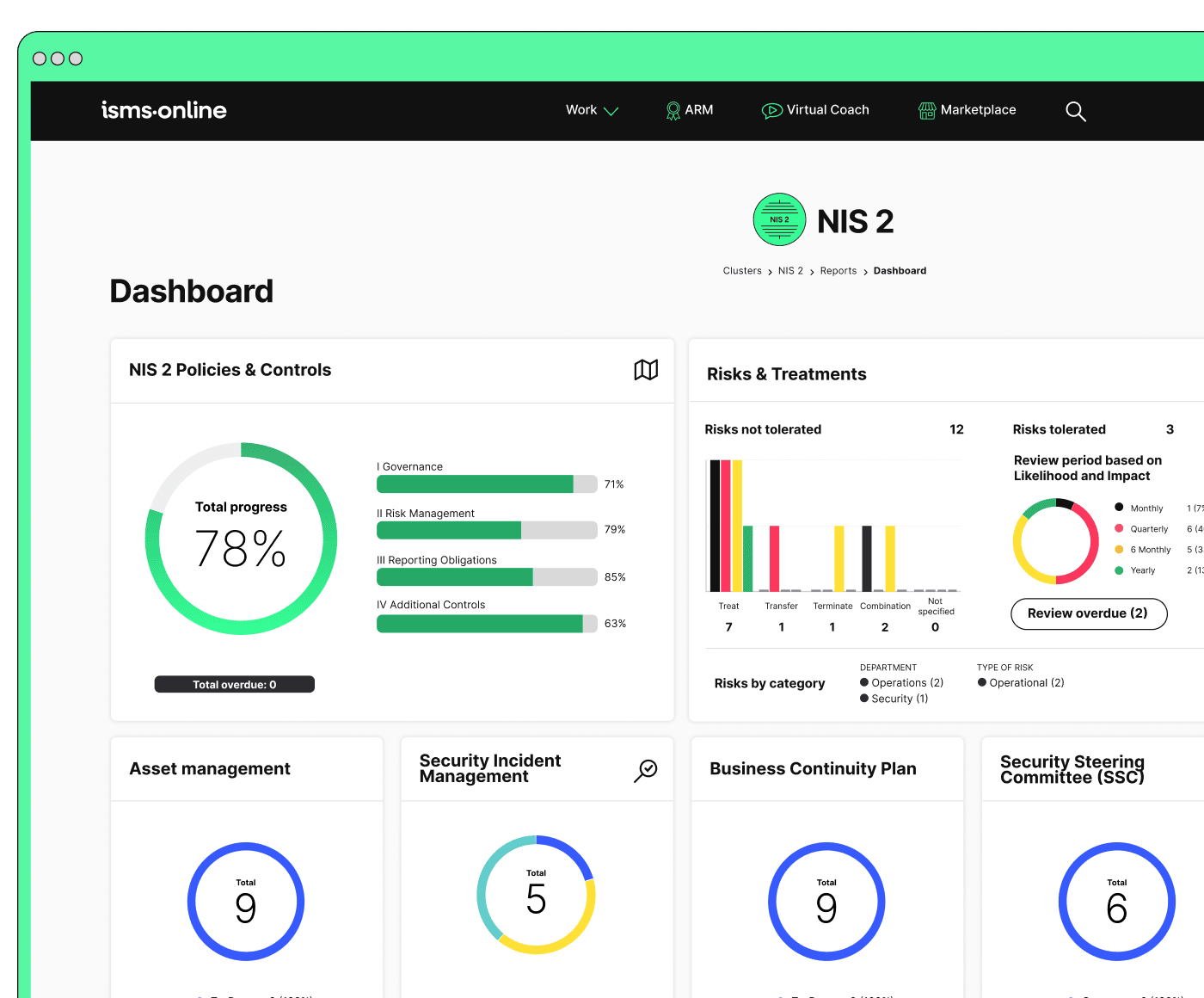
Be NIS 2-ready from day one
Launch with a proven workspace and templates – just tailor, assign, and go.
How ISO 27001:2022 Anchors Your NIS 2 Response to Supplier Risk
NIS 2 mandates outcomes; ISO 27001 provides the operational blueprint for daily compliance. Whenever a supplier incident arises, Annex A controls create a defensible trail-showing not just intent, but execution.
Bridge Table: ISO 27001 Operationalisation
| Expectation | Operationalisation | ISO Ref. |
|---|---|---|
| Supplier signs NIS 2 clauses | Contract review, risk log, board approval | A.5.19.1, A.5.21.1 |
| Conditional acceptance | Remediation, SoA update | A.5.19.2, A.5.21.2 |
| Ongoing control & monitoring | Supplier reviews, SoA refresh | A.5.19.3, A.5.21.3 |
| Full replacement | Continuity plan, exit protocol, incident review | A.5.20.1, A.5.19.1 |
This is not paperwork for its own sake-every entry builds real assurance for the board and actionable proof for auditors and regulators. ISMS.online helps by making every document, artefact, and update instantly accessible for board or audit need.
Audit-ready is not a static bonus: it’s the difference between surviving an incident and being fined despite good intentions.
Continuity by Design: Failing Forward Without the Drama
NIS 2 doesn’t just expect a business continuity plan on paper-it expects dynamic, supplier-linked resilience. Replacement only works if you already know what critical dependencies hinge on the supplier and can trigger a seamless handover.
Four Moves for Supplier Continuity
- Dependency mapping: Build out a living dependency matrix-segment suppliers by function, criticality, data scope. This lets you see in seconds where abrupt offboarding is tolerable or dangerous.
- Role-based escalation: Assign named leaders, alternates, and comms plans for transitions; log these in your ISMS for rapid activation.
- Shadow vendor pipeline: Maintain ready-vetted alternates for your most critical supplier roles, onboarding-ready in emergencies.
- Tabletop drills: Rehearse supplier loss scenarios-deploy alternates, test comms flows, and log lessons directly back into your ISMS registers for remediation and policy improvement.
Continuity that has never been tested isn’t real-it’s wishful thinking. Only crisis rehearsals and up-to-date mapping create credible resilience.
ISMS.online enables cross-team workflow, real-time document handover, and substitute role activation. Use it to ensure continuity is lived, not theoretical.
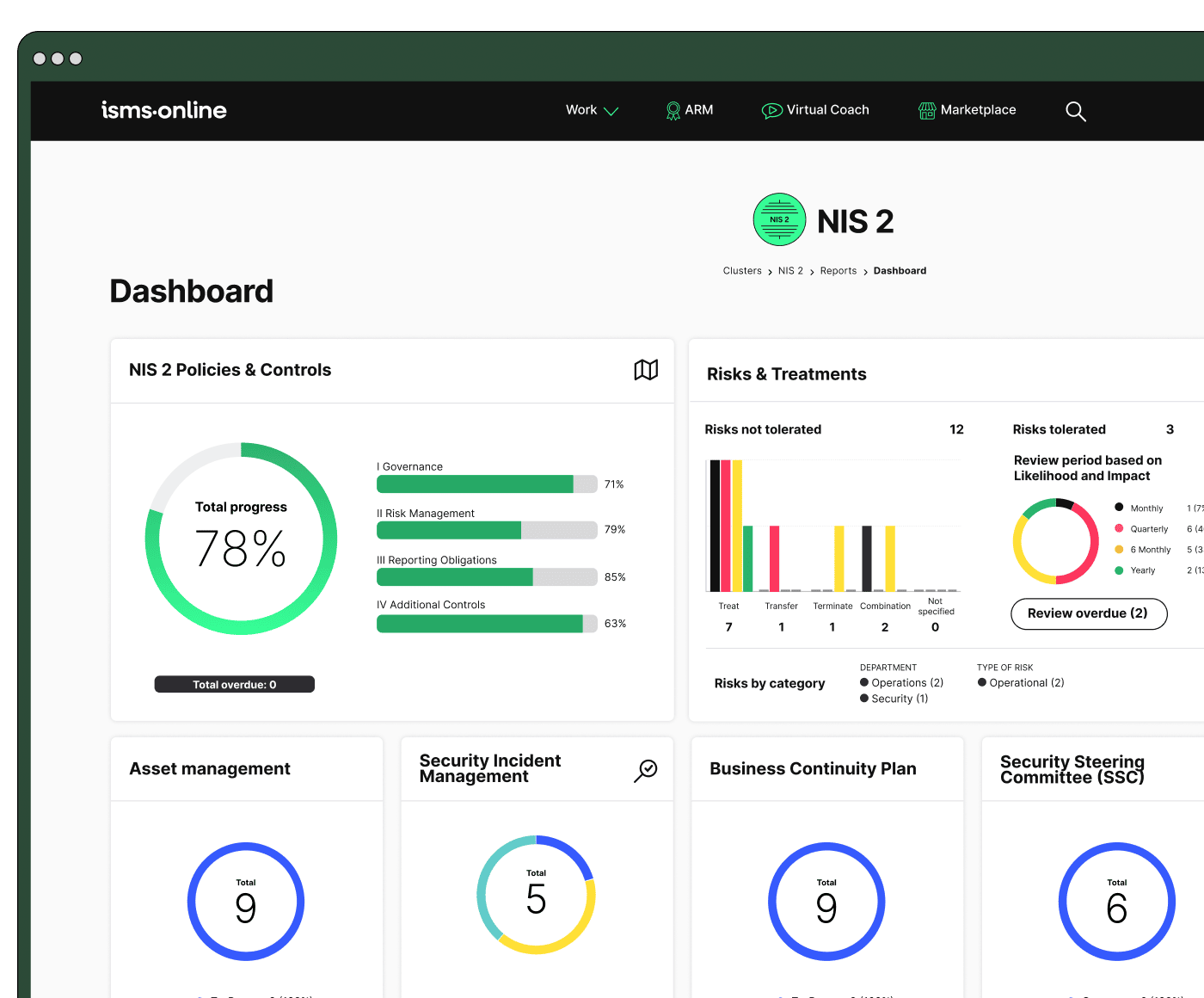
All your NIS 2, all in one place
From Articles 20–23 to audit plans – run and prove compliance, end-to-end.
Regulatory and Enforcement Trends: Staying Ahead of Compliance
Supervisors across the EU are moving from static template reviews to demanding real-time “live evidence” of compliance and risk management. What once passed as monthly reporting now requires dynamic, evidence-linked risk registers, documented escalation paths, and on-demand, exportable artefacts for both auditors and board reviewers.
ENISA roadmaps for 2024/25 demand integration of scenario tests, policy version control, and crosswalk transparency to standards like ISO 27001.
The next audit, incident, or regulatory check won’t be solved by rewriting history-but by having living, trusted records.
Trailing edge firms miss risk not in controls, but in evidence gaps and failure to adapt processes as enforcement hardens. Compliance leaders use their ISMS as a real-time cockpit, not an archive.
Making Supplier Risk a Source of Confidence: Role of ISMS.online
Resilience under NIS 2 is not just a stack of documents-it’s a living system: escalation logs, negotiation trails, audit-ready evidence registers, board-notified exceptions, and carefully mapped team handoffs. ISMS.online brings this to life:
- Instant supplier risk register updates: Flag, export, and review risk and compliance status with a click.
- Automated governance and escalation: Notify the board, automate hand-offs, and map escalation chains to actual responsibilities.
- Audit-ready artefact exports: With every decision, you log artefacts traceable straight to the SoA and controls-no more searching for “lost” evidence.
- Dashboards for all roles: From the most nervous Ops lead to the board’s Risk Chair, role-based dashboards surface bottlenecks, overdue actions, and the next handoff.
- Crisis-ready substitution logic: Ensure anyone stepping in during an escalation can see exactly what’s needed-no more transition delays.
The only compliance posture worth having is one the regulator and auditor can see-before the crisis hits.
ISMS.online transforms your documentation and workflow into a defensible business advantage. With every supply chain decision, you create the audit trail needed to stand up to scrutiny, enable board oversight, and make supplier resilience real, not notional.
Next move:
Make cross-team documentation, traceability, and resilience your daily norm. Equip your entire organisation with a unified ISMS, and make supplier risk a source of confidence before the next audit or regulatory test. If any part of your supply chain resists NIS 2, your ISMS should be ready to turn that risk into your next competitive advantage.
Frequently Asked Questions
What should your board and procurement team do if a supplier rejects NIS 2 terms-is immediate replacement required?
Immediate replacement of a supplier who refuses to accept NIS 2 compliance terms is not mandatory; your organisation must instead document a thorough risk assessment, pursue all viable mitigations, and only escalate to supplier substitution if no reasonable controls or remediations can bring risk within defensible, board- and regulator-acceptable thresholds.
NIS 2 shifts the expectation from reactive “supplier swap” to demonstrable, context-driven risk management. The new benchmark is a living, board-owned rationale-negotiations, technical workarounds, and exception paths-all tightly logged and mapped in your ISMS. Regulators and auditors now focus on process rigour, not speed, demanding clear evidence that your organisation evaluated and implemented controls beyond simply seeking a new supplier.
Every decision not logged and justified becomes a future liability-regulators scrutinise rationale, not just outcomes.
Why doesn’t NIS 2 force instant supplier replacement at the first sign of non-compliance?
The NIS 2 Directive enforces a strict risk-based approach: you are required to take “appropriate and proportionate” measures, adapting supplier oversight and mitigation to your business context (CMS Law-Now, 2024). Instead of a binary pass/fail rule, you must demonstrate staged diligence-contractual negotiation, technical constraint, monitoring, exception logging-before contemplating organisational-level disruption. Regulator scrutiny today is on the “why” behind your actions: have you proven that all less-drastic options were actively explored and reasoned through with evidence?
What mitigation steps and controls must you take before supplier replacement?
NIS 2 expects you to exhaust a spectrum of documented mitigations, all of which must show up in your ISMS and risk register:
- Contractual strengthening: Update agreements to demand right-to-audit clauses, explicit incident notifications, and binding security SLAs.
- Technical isolation: Restrict supplier access to minimum-necessary environments, embed network segmentation, and enforce encryption on sensitive data.
- Continuous monitoring: Require third-party vulnerability and compliance checks, with clear reporting timelines.
- Time-bound exceptions: Where risk remains, implement board-approved, expiry-dated exceptions with defined triggers.
- Formal escalation: Log all negotiations, rationale, and risk acceptances in registers/escalation logs, routed through legal, executive, and board layers.
- Insurance and indemnities: Institute contractual cyber risk insurance or indemnity as an additional control where direct remediation is impossible.
All actions must be mapped to controls such as ISO 27001 Annex A.5.19 (supplier relationships) and A.5.21 (critical supplier management), with status and actions kept auditable in ISMS.online ((https://www.isms.online/iso-27001/annex-a/5-19-information-security-supplier-relationships-2022/?utm_source=openai)). If, after these steps, risk is controlled to a justified, board-approved level, replacement need not occur.
What are the legal, financial, and reputational consequences of keeping a non-compliant supplier without full mitigation and documentation?
Ignoring or half-measuring risk here is costly:
- Legal and financial penalties: NIS 2 enables fines up to €10m or 2% of annual global turnover for essential entities.
- Personal board liability: Senior management and directors are increasingly targeted and personally liable if records show inadequate decision-logging or lack of board engagement.
- Loss of insurance cover: Evidence gaps or outdated risk registers may jeopardise payouts or raise premiums.
- Reputational damage: Incidents or breach reports-now often mandatory under NIS 2-can generate public, cross-regulator scrutiny, driving away clients, partners, and investor confidence (Mills & Reeve).
In risk governance, what isn’t documented is indefensible-your ISMS is the only auditable proof regulators trust.
How does rigorous ISMS documentation protect your board and organisation?
A living ISMS risk documentation trail is now your best legal defence. Regulators and auditors expect:
- Every negotiation, risk update, and attempted mitigation is logged, timestamped, and mapped to ISO controls:
- Board minutes, sign-offs, and rationale for accepting, escalating, or remediating risks are centralised:
- Exception pathways show expiry dates, responsible owners, and triggers for review or escalation:
- Continuity and fallback suppliers have been pre-vetted and cross-linked to their own risk status:
- Statements of Applicability (SoAs) reflect real, live status-not “to be implemented” placeholders:
Failure at any of these points can lead to nonconformance findings or fines, even if no breach occurs.
When does “no alternative” mean you must replace the supplier for compliance?
Final replacement becomes mandatory only after:
- All compensating (contractual, technical, insurance) controls fail to bring residual risk to an acceptable threshold.
- Board-approved, time-limited risk sponsorship expires without improvement, or risk level increases (e.g., via incident or new threat).
- External mandates (from sectoral regulators, strategic clients, or industry-specific rules) dictate zero tolerance for exceptions.
- Legal or executive consensus confirms that remaining risk is unjustifiable for business, regulatory, or ethical reasons.
At that stage, replacement must be proactively managed-mirrored in your continuity drills and fallback supplier reviews, not actioned in panic.
What is the step-by-step playbook for NIS 2-compliant supplier non-conformance response?
Here’s a mapped pipeline for board/procurement, with platform and standard linkage:
| Step | Board/Procurement Action | ISMS.online Enabler | ISO 27001 / Annex A |
|---|---|---|---|
| 1 | Log refusal, negotiations, and attempted fixes | Supplier risk mapping | A.5.19, A.5.21 |
| 2 | Escalate risk and exception register to legal, board | Task escalation/assignment | A.5.19, A.5.20 |
| 3 | Document and apply technical, contractual controls | Policy Packs/controls link | A.5.19, A.5.21 |
| 4 | Set and review time-bound exception workflows | Exception manager/alerts | A.5.19, A.5.21 |
| 5 | Pre-vet fallback suppliers and continuity options | Linked supplier projects | A.5.21, A.5.29 |
| 6 | Secure board risk acceptance/sign-off with rationale | Decision register/dashboard | A.5.20, A.5.19 |
| 7 | Export audit-ready, traceable evidence of all stages | Evidence dashboard | A.5.19/21/29 |
Traceability mini-table for risk escalations:
| Trigger | Risk update | Control/SoA link | Evidence Log |
|---|---|---|---|
| Supplier refusal | Dependency risk↑ | A.5.19, A.5.21 | Risk log, mitigation doc |
| Remediation fails | Move to replacement | A.5.21, A.5.29 | Board minutes, sign-off |
How does ISMS.online enable resilient evidence and supply chain defensibility?
ISMS.online consolidates every step: risk updates, supplier logs, escalation triggers, policy/control evidencing, expiry management, and board approvals-all natively audit-traceable and instantly exportable. No more retroactive authoring-your team demonstrates sound judgement for regulators, insurers, and customers when it matters most.
Compliance is about resilience, not reflex. The teams that catalogue and justify each decision-rather than rushing replacements-are the ones that emerge trusted and audit-ready.
Key takeaway:
NIS 2 does not force knee-jerk supplier swaps. Instead, it demands process-rich, transparent risk management-supplier replacement is required only when all mitigations fail, all exceptions expire, and board-level risk logics are exhausted and defensibly documented. Every action, debate, and rationale must be visible within your ISMS-not just to pass an audit, but to protect directors and reputation.
Identity CTA:
Take a moment now to review your most stubborn supplier case: does your risk register and ISMS evidence a live, defensible narrative if called by a regulator? If gaps remain, empower your board and procurement to move from reaction to resilience. ISMS.online makes that progression transparent, traceable, and defensible across every supplier scenario.






