





































Why Are NIS 2 and CER Colliding? The New Era of Overlap Fatigue
The 2024 regulatory calendar does more than mark a new year-it signals a collision between two transformative EU directives: NIS 2 (Network and Information Security) and CER (Critical Entities Resilience). For every organisation deemed “critical,” these laws now converge as a single force, intensifying pressure on boardrooms, compliance teams, and operational leaders. Each directive was born from crisis-cyberattack headlines, infrastructure sabotage, geopolitical shocks-but the convergence has triggered its own disruption: overlap fatigue.
When two blueprints for rescue overlap, exhaustion can outpace improvement.
Across Europe, compliance and operational leaders face a surge in duplicated evidence, parallel audits, and clashing change requests. As many as 60% of cross-regulated companies now grapple with repeated incident logging, asset registry maintenance, and audit windows covering the same event (see ec.europa.eu). With NIS 2 strengthening cyber hygiene, digital supply chain vigilance, and mandatory notification, while CER layers on physical continuity, asset resilience and rapid real-world recovery, the result is a compliance arms race.
A deeper concern is emerging: if a ransomware group knocks out your control room and a facility flood destroys backup power, both NIS 2 and CER authorities will expect answers-synchronously. The dual audit is set to become the rule, not the exception: by 2025, 70% of regulated entities are forecast to face joint digital–physical scrutiny (isms.online, jonesday.com). This raises the core, operational question-who leads in a crisis? When fires (literal or cyber) break out, do IT, Estates, or both step forward?
A compliance programme built for silos cannot succeed in this new era of overlap. Only joined-up resilience-digital and physical-will enable critical organisations to move beyond fatigue and into a leadership position.
What Exactly Is “Critical”? Untangling NIS 2 vs CER Boundaries
“Critical” status is no longer a single dimension or checklist; it’s a fluid designation defined by both digital and physical risk thresholds imposed by overlapping frameworks. Recognising and mapping “criticality” is now a strategic act, not a clerical one.
- NIS 2: focusses on digital “essential” and “important” entities: power grids, finance, hospitals, water, cloud, and digital infrastructure-where a cyber event could disrupt entire markets.
- CER: casts a broader, physical net: if physical breakdown endangers society, economy, or citizen safety, the entity is in scope, regardless of digital maturity.
Critical is context-miss the nuance, and compliance devolves into defensive firefighting.
For a cloud or data centre entity, NIS 2 pushes hard on authentication regimes and digital supplier controls. CER, at the same moment, mandates robust generators, supply chain resilience, and failover of physical facilities. This duality is echoed in healthcare, logistics, water utilities, and even municipal or regional governments.
Amid national variations, the ISA (Integrated Security Authority) patchwork is growing messier: in a minority of jurisdictions, digital and physical audits are streamlined under one umbrella, but most push for parallel asset registers, divergent evidence trails, and unique reporting chains (enisa.europa.eu, bakermckenzie.com). The EU’s own cyber-security agency, ENISA, now formally recommends integrated asset mapping and joint oversight, but the industry lags: every missed mapping risks doubling compliance work and, more critically, opens gaps when disasters blend domains.
Board-Facing Bridge: NIS 2 vs CER Duties
| Regulatory Axis | NIS 2 | CER |
|---|---|---|
| Entity Focus | Digital ‘essential/important’ | Physically critical (core) |
| Threat Vectors | Cyber disruption, supply chain | Physical failure, sabotage |
| Controls Required | Cyber-Security, reporting, supplier risk | Continuity, physical security, redundancy |
| Evidence Expectation | Incident logs, digital BIA, asset register | Facility BIA, continuity plans, physical asset register |
| Auditing Authority | Tech/Cyber Regulator/ENISA | National Resilience, Civil/Emergency |
| Overlap Risk | IT/Facility asset ambiguity | Digital/Physical response blend |

Master NIS 2 without spreadsheet chaos
Centralise risk, incidents, suppliers, and evidence in one clean platform.
Where Do Digital and Physical Failures Collide? Scenes from the Supply Chain
Production does not care for regulatory silos. In critical industries, digital and physical systems are deeply entwined-failure in one domain cascades within seconds to the other. The most exposed frontages: supply chains, equipment rooms, control centres, and frontline operations.
Typical cross-domain scenarios include:
- Port logistics: One Thursday, a terminal succumbs simultaneously to ransomware (NIS 2) and a transformer explosion (CER). Cargo halts, two incident registers are filled, and both IT and Estates try to lead, with customers and auditors circling.
- Energy utility: An update wipes out software controls (NIS 2) and a flood damages backup power (CER). Both digital and physical risk teams open BIAs, two supply chain reviews are triggered, and confusion over ownership or reporting leads to wasted hours-and increased scrutiny.
That's Estates, that's IT-split ownership multiplies operational threats.
mermaid

graph TD

 A[Physical Event: Power Outage] --> B[Facility Failure]

 A -.-> C[IT: Server Crash]

 D[Cyber Event: Malware] --> C

 C --> E[Service Interruption]

 B --> E

 E --> F[Supply Chain Disruption]

 F --> G[Regulatory Trigger: NIS 2]

 F --> H[Regulatory Trigger: CER]
Here’s what the operational flow often looks like: a single incident (cyber or physical) ripples outward, activating compliance duties across both NIS 2 and CER.
Such “hybrid incidents” are not edge cases: in 2023, more than half of Europe’s critical infrastructure providers logged at least one mixed-origin incident per quarter. Fragmented registers and siloed responses increase remediation time, risk higher audit findings, and may leave supply chain exposures unresolved. ENISA and most national regulators are now moving to mandate scenario-based BIAs that examine both domains, making integration the new standard.
How Do You Beat Overlap Fatigue? Unified BIA, One Evidence Trail
Coping with the rising complexity of dual regulations does not require hiring armies of administrators or multiplying policies. What you actually need is an integrated operating rhythm: a unified business impact assessment (BIA) and a single cross-linked evidence trail robust enough for both audits.
- Both CER and NIS 2 now demand a comprehensive BIA, with assets mapped, critical owners appointed, and all “routes to impact” modelled for both digital and physical risks.
- Cross-regulator asset mapping is now best practise: assign each asset a single record, but tag both digital and physical criticality, and highlight supply chain reach-through.
- In most member states, a consolidated evidence register-with bundled approval logs, incident notes, BIAs, and supplier documents-serves for both audits, provided every item is mapped to the proper legal reference (CER Articles 12–13 + NIS 2 Article 21).
- Advanced platforms, such as ISMS.online, automate this through scenario-driven BIAs, linked risk registers, asset and owner records, and embedded policy workflows (isms.online).
For operators in energy, food, water, IT, or logistics, joining up digital and physical controls in this way has reduced audit overhead and post-incident remediation cycles by as much as 60%.
ISO 27001 Bridge Table: Expectation → Operationalisation → Reference
| Expectation | Operationalisation | ISO 27001 / Annex A Ref |
|---|---|---|
| Asset criticality: digital + physical | Single inventory, tiered BIA | A.5.9, A.5.12, A.8.2 |
| Unified incident response | Cross-team tabletops, drill records | A.5.26, A.5.24, A.8.15 |
| Resilience proof/readiness | Review cycle integrates both domains | A.5.29, Cl 9.3 |
| Control accountability | Owner assignments in SoA/asset map | A.5.4, A.5.2, A.8.4 |
| Integrated supply chain risk | Shared supply/asset risk logs | A.5.19, A.5.20, A.8.8 |
| Evidence trail (approval, sign-off) | One register, audit cross-ref | A.5.36, A.9.2, A.5.35 |
Traceability is your resilience currency-when BIAs, incidents, and controls all point to each other, audits become confidence events.
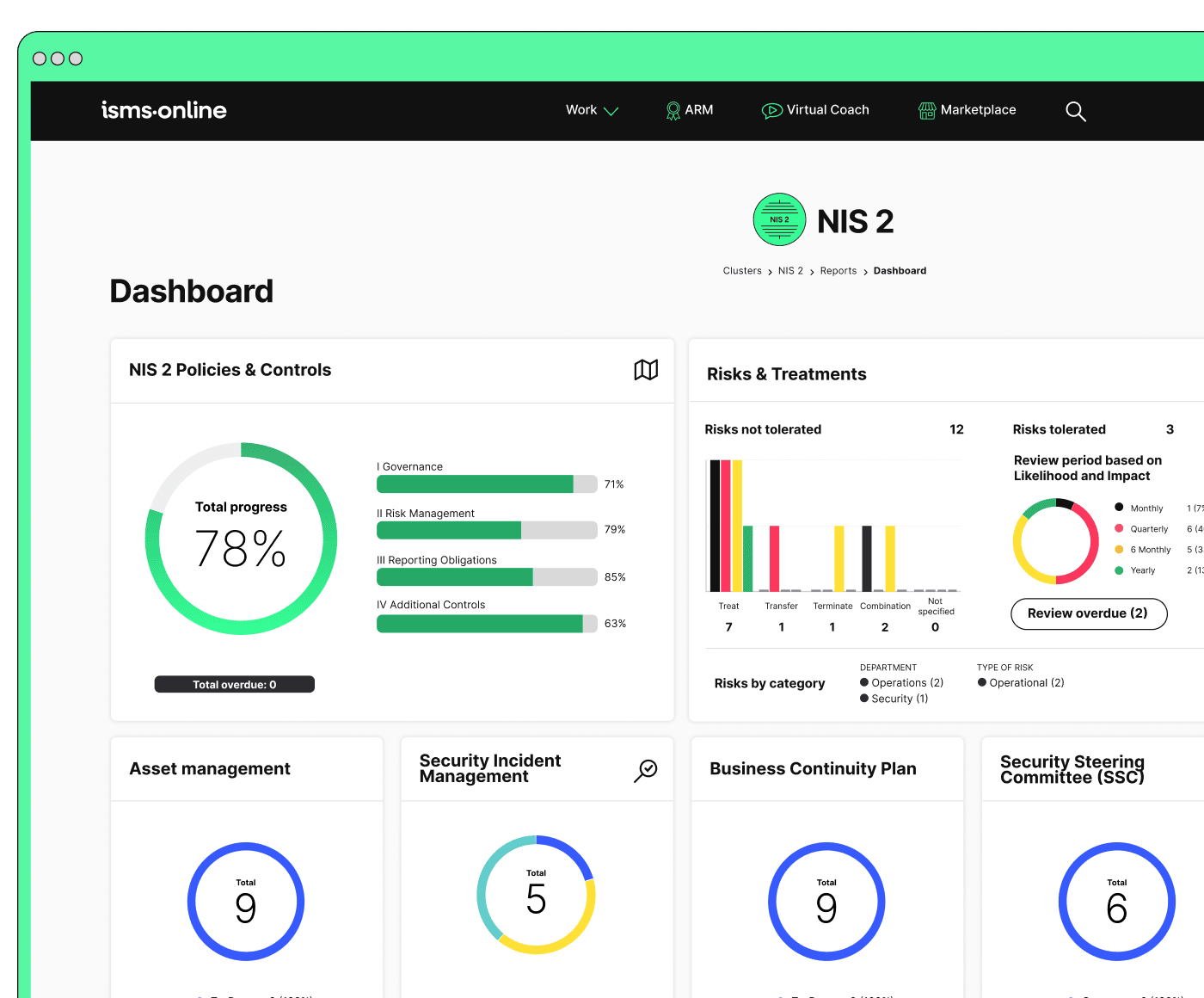
Be NIS 2-ready from day one
Launch with a proven workspace and templates – just tailor, assign, and go.
How Do You Prove It? Trigger-to-Audit Traceability That Survives Scrutiny
When regulators ask for demonstration of readiness, speed and clarity count as much as completeness. Integrated, living registers-capturing every asset, BIA, test scenario, and incident-cut through confusion. This is more than paperwork: it’s how teams insulate themselves against confusion, audit panic, and real-world fallout.
| Trigger | Risk Update | Control / SoA Link | Cross-Function Review | Evidence Logged |
|---|---|---|---|---|
| Flood + DDoS | BIA/recovery revision | A.5.29, CER Art. 12 | IT, Facilities, Legal, Board | Incident log, BIA, minutes |
| Supplier ransomware | Supplier risk review | A.5.19, NIS2 21 | Procurement, IT, Legal | BIA, incident log, contract |
| Tabletop: dual scenario | Joint BIA for facility/IT | A.5.24, A.8.8 | IT, Facilities, DPO/Legal | Test log, exec sign-off |
| Quarterly board review | Management review update | A.5.36, Cl 9.3 | Board, IT, Legal | Board pack, audit summary |
| Sabotage at energy site | Facility + supplier BIA | A.5.21, CER Art. 4 | Facilities, Security, Gov Affairs | Incident, supplier, comms |
Example: A facility sabotage triggers both supply chain and physical BIAs; all teams loop updated data into a unified incident log, which supports every legal and regulatory check-without split reporting or conflict over ownership.
Organisations now align on a quarterly board review cadence, paired with incident-driven scenario updates, not ad hoc emergencies. This rhythm meets the new bar for resilience, impresses auditors, and prevents the fire drill from becoming a liability.
Traceability isn’t paperwork-it’s your shield when questions are hard and stakes are high.
From Overlap Chaos to Continuous Readiness: The Executive Action Plan
Successful teams are moving from compliance as a chaotic annual event to treating it as a benchmark of trust and operational capacity. Both digital and operational staff share a clear aim: join up critical digital and physical risk controls to build resilience that’s both auditable and actionable.
Resilience is not a story on a slide-it’s evidence you can surface in minutes, not months.
Immediate Actions for Unified Compliance
Digital & Physical Supply Chain (Non-IT Sectors Included)
- Run unified asset/supplier mapping: In platforms like ISMS.online, maintain one register for all digital and physical components, factoring both cloud and backup fuel supply.
- Tabletop mixed-scenario incidents: Test teams in energy, food, logistics, and water on double-impact events (e.g. DDoS + power outage).
- Centralise evidence and approvals: Concentrate BIAs, contracts, logs, and sign-offs-when external authorities arrive, one trail answers both sets of questions.
- Quarterly board reviews: Use dashboards that display cross-team progress and readiness, not just “compliance checked” ticks.
- Legal and privacy alignment: Involve counsel early, especially for reporting triggers that span cyber and physical impact, or tie dual compliance clauses into supplier contracts (isms.online).
Well-structured, living registers and a joined-up mindset can transform audit season from a scramble into an opportunity to prove trust.
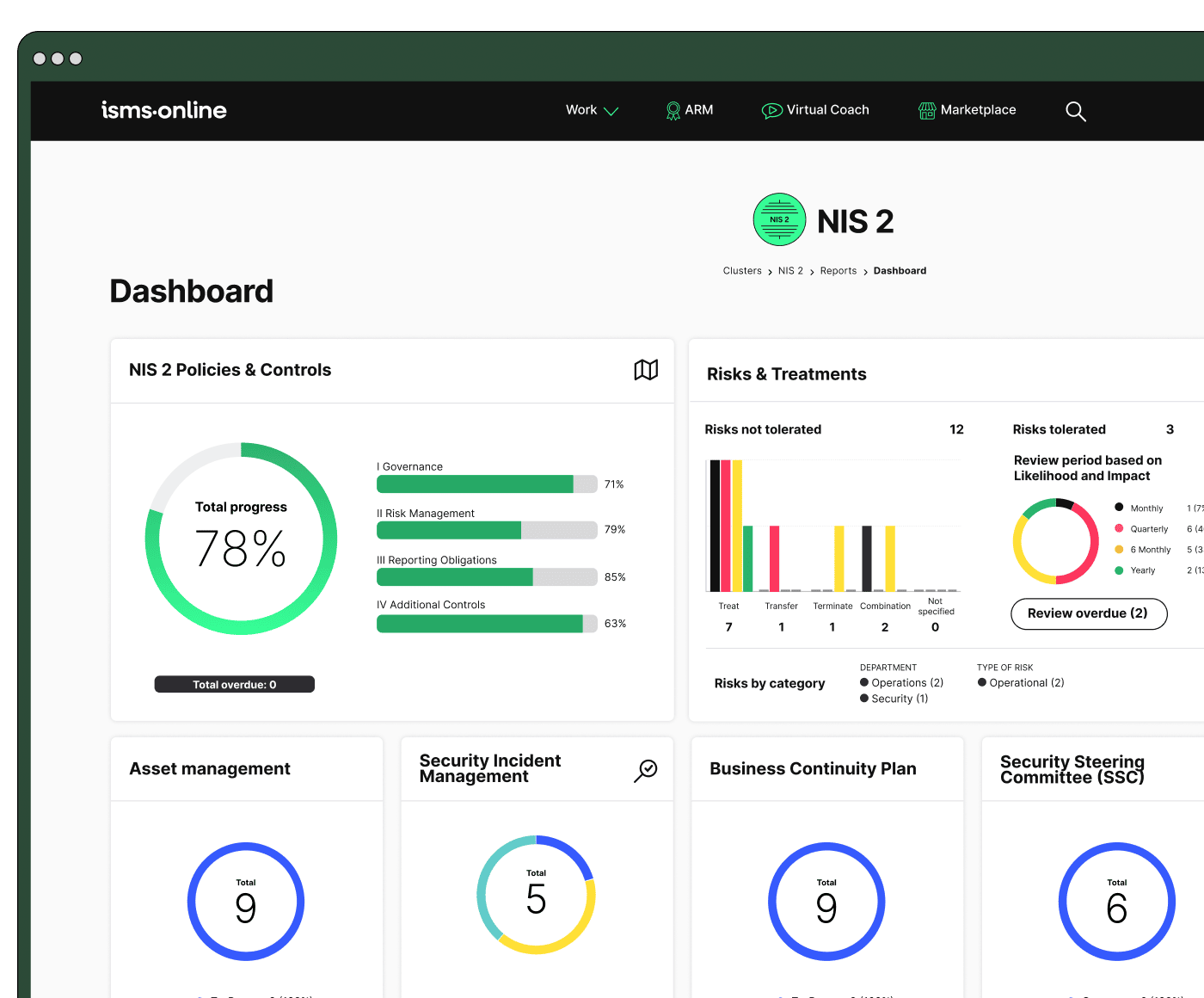
All your NIS 2, all in one place
From Articles 20–23 to audit plans – run and prove compliance, end-to-end.
Unified Resilience Starts Now: Move Beyond Overlap with ISMS.online
As regulators conduct more joint audits and demand faster reporting, separated records or “split brain” approaches multiply risk. Compliance fatigue is real, but so is the competitive advantage for teams that rise to the joined-up resilience standard. The goal is to convert friction into long-term improvement-not just fault avoidance.
In a world wired for compliance chaos, the teams who integrate resilience win-while others chase their tails.
Across sectors, ISMS.online is becoming the backbone for this shift. The platform centralises every control, asset, BIA, incident, and supply chain artefact; each element mapped to the relevant NIS 2 and CER duties, so there’s no ambiguity or lost evidence. Dashboards, dual-use templates, historic audit logs, and living BIAs enable continuous review and rapid recovery (isms.online). Sector-specific controls maps and clarity-first checklists let you anticipate overlap, rather than react. When challenges come, compliance is documented in one accurate, unified system-anchoring confidence from the boardroom to the supply chain.
Start Building Unified Resilience with ISMS.online Today
The practical path forward for any “critical” entity is clear: join up digital and physical risk controls through one evidence trail, making overlap an asset-not a liability. The moment to rebuild your operating model is now.
Discover how ISMS.online can centralise admin, evidence, approvals, and controls so your team leads with resilience, not just compliance.
Request a clarity-first board demo, map your asset landscape for overlap friction, or launch a unified BIA template within your environment. Each action replaces weeks of manual catch-up with minutes of evidence-backed readiness.
Teams that move first become the new benchmark: not just for passing audits, but for real-world resilience, trust, and leadership in critical services.
Frequently Asked Questions
Who qualifies as a “critical entity” under NIS 2 and CER, and what is the operational difference?
A “critical entity” is any organisation whose disruption could seriously harm essential societal or economic functions, but NIS 2 and CER directives define and operationalise this status through distinct regulatory prisms. Under NIS 2, the EU classifies “essential entities” (energy, digital infrastructure, healthcare, finance, transport) and “important entities” (logistics, food, post, digital services), with a focus on the security and resilience of digital and networked operations [1]. CER, by contrast, targets the continuity of critical services by protecting physical infrastructure: any operator whose assets, sites, or processes-if disrupted-could endanger public safety or the functioning of the economy falls under CER [2]. Unlike NIS 2’s concentration on cyber and digital supply chain, CER mandates operational redundancy, site access controls, and disaster recovery across sectors from energy and water to health, logistics, and public administration.
Many large organisations now straddle both regimes-a digital attack on a utility or hospital triggers NIS 2, while a flood or power failure invokes CER duties. To avoid blind spots, compliance leaders need dual-classified asset and threat registers, mapped to cyber and physical risk domains, and reviewed regularly by both digital and operational teams.
NIS 2 vs CER: Entity Scope and Focus at a Glance
| Directive | Entity Types | Main Focus | Core Sectors |
|---|---|---|---|
| NIS 2 | Essential, Important | Cyber/digital resilience | Energy, Transport, Health, Finance |
| CER | Critical | Physical/operational | Energy, Water, Health, Infrastructure |
If you provide services essential to society’s digital or physical backbone, you likely answer to both regimes-prepare your registers, plans, and reporting for dual scrutiny.
Where do organisations most struggle to comply with both NIS 2 and CER?
Dual compliance often translates to duplication and disjointed processes, causing inefficiency, audit friction, and regulatory risk. EU Commission studies show over two thirds of organisations in scope for both directives experience “overlap fatigue”, with duplicated asset logs, siloed incident responses, and unclear joint ownership for risk and evidence [3]. Supply chain vulnerabilities present a particular challenge: IT and operational risk teams may run parallel registers and supplier assessments, failing to surface hybrid threats-such as ransomware shutting down building controls or physical outages disabling digital systems [4].
Audit findings frequently reveal missed “crosswalk” risks and evidence trapped in professional silos. Regulatory teams risk being surprised by issues the other hasn’t tracked-whether it’s a water treatment plant’s digital controls or a hospital’s backup power. Effective compliance increasingly depends on unifying registers, ownership, and review cycles, so teams see risks and controls wherever they surface.
The costliest compliance failure is the risk that slips between cyber and physical domains-the hybrid threat no team saw in full, or correctly logged for audit.
What does a unified approach to NIS 2 and CER compliance look like?
A resilient, audit-ready compliance approach merges asset, risk, and incident records for both digital and physical domains. The core building blocks are:
- A single, up-to-date Business Impact Assessment (BIA): mapping both digital and operational assets, processes, and dependencies.
- Unified asset and supplier registers: , cross-tagged for “critical” and “essential” status under both directives, allowing dual audits and live risk attribution.
- Joint incident and scenario testing: operational and IT teams run through scenarios together (e.g., ransomware plus power outage) with joint sign-off and board oversight.
- A single cross-referenced Statement of Applicability (SoA): , mapping every key control to relevant NIS 2/CER clauses and to supporting ISO or sectoral standards [5].
- Board-level dashboards: reporting on joint risk posture, testing status, and supply chain vulnerabilities-all feeding into quarterly reviews for leadership and regulatory submission.
| Key Input | Unified Output / Evidence |
|---|---|
| Asset inventory (IT + ops) | Dual-mapped BIA with risk ownership |
| Incident logs (digital/phy) | Unified register, joint review, shared RACI |
| Supplier risk assessment | Combined supplier table, joint audits |
| Controls / SoA | NIS 2/CER/ISO cross-reference table |
This approach sharply reduces audit findings, eliminates duplicated effort, and accelerates response to both cyber and physical crises according to best practise from ENISA and sector regulators [6].
What controls and evidence will auditors demand under NIS 2 and CER?
Auditors expect mapped, robust, and live documentation linking every control and event to regulatory requirements-spanning both cyber and physical threats. Minimal expectations now include:
- Unified BIA: covering digital and physical risk, refreshed annually and after incidents.
- SoA mapping every control: to NIS 2 (especially Article 21) and CER (Articles 12/13), including ISO 27001, 22301, and sector-specific standards.
- Combined supplier/incident/evidence logs: with ownership tags and clear board/leadership visibility, drawing on ENISA/EC templates [7].
- Proof of scenario testing: joint exercises across domains, with logs and management sign-off.
- Quarterly cross-functional reviews: documented in board or management meeting minutes.
Example Traceability Table
| Trigger Event | Risk Update | SoA/Control Ref | Evidence Logged |
|---|---|---|---|
| Ransomware + Flood | IT & BCP update | ISO A.5.29, CER 12/13 | Incident log, BIA, board record |
| Supplier outage | Vendor review | ISO A.5.19, NIS 2 Art.21 | Supply contract, test log |
Each “event” links to a specific article, mapped control, and live evidence record-auditor-ready at all times.
Does ISO 27001 or 22301 certification automatically cover NIS 2 and CER? Where are the gaps?
ISO 27001 (information security) and ISO 22301 (business continuity) are the minimum backbone-neither is a full substitute, but both serve as strong scaffolding. NIS 2 and CER introduce unique requirements:
- NIS 2: 24-hour cyber incident reporting, board-level accountability, and expanded supply chain assessment (esp. for digital service providers/essential operators).
- CER: Detailed physical/operational resilience with sector-by-sector specific mandates, redundancy tests, and national authority oversight.
Recent industry evidence confirms that teams with live crosswalks from ISO controls to legal clauses pass audits more efficiently and avoid regulatory findings [8]. To close the gaps, run traceability tables for each BIA, SoA, major asset, and control. Map not just your control framework, but also your testing, scenario, and evidence cycles.
| Regulatory Expectation | Operations Practise | ISO Control |
|---|---|---|
| Unified (digital+physical) BIA | Dual-mapped BIA live & tested | 22301:8/9 |
| 24hr incident notification | Incident resp. drills/logs | 27001:A.5.24/25 |
| Supplier risk mapping | Combined supply audits | 27001:A.5.19 |
| Quarterly cross-review | Management review records | 27001:9.3 |
How must supply chain risk management adapt for both NIS 2 and CER?
Supply chain risk is now inseparable from cyber and operational resilience-auditors and regulators look for:
- A single supplier register: , with each vendor classified and reviewed for both digital and operational exposure.
- Contractual clauses: referencing dual-regime compliance: notification timelines, resilience, redundancy, and disaster recovery obligations for both NIS 2 and CER.
- Annual (or scenario-driven) supplier risk and business continuity audits: spanning IT and physical inputs-jointly owned by both teams.
- Evidence logs: linking corrective actions to relevant legal clauses for both digital and operational resilience [].
Organisations that build unified supplier risk dashboards have cut audit findings by 30–50% and responded faster to both digital and physical supply disruptions.
What must boards and leadership prioritise to avoid regulatory chaos under dual regimes?
Boards must mandate quarterly integrated reviews-not annual “panic” audits. Best practise today includes:
- Live dashboards: digital and physical risk exposure, incident response status, supply chain disruptions.
- Unified incident and supplier registers: continuously updated and jointly reviewed by IT, operational, legal, and board reps.
- Routine scenario testing: , with documentation of cross-domain exercises and lessons learned, signed off by management.
- Single-source evidence: all registers, controls, and playbooks visible to both digital and operational leads and ready for any audit or regulatory inspection.
As sector expectations rise, platforms like ISMS.online are tuned for precisely this continuous, dual-regime oversight-accelerating review response, supporting management sign-off, and shrinking audit preparation from months to days [9].
The first to unify compliance, asset, and evidence platforms become sector benchmarks for resilience-trusted by regulators and customers alike.
How does ISMS.online directly reduce the risk and workload for dual NIS 2 and CER compliance?
ISMS.online is purpose-built to handle overlapping and convergent regulatory frameworks. Teams can:
- Map every asset, control, incident, and supplier to multiple directives: (NIS 2, CER, ISO, sector-specific) within a live, single-source environment.
- Upload and update evidence once: dual-tag BIAs, incident logs, and supplier audits, all traceable to each relevant legal clause.
- Automate quarterly reviews: with role-based reminders, dashboard reporting, management sign-off, and regulator-ready audit exports.
- Benchmark against sector leaders: leverage unified, continuously updated playbooks, controls, and process templates proven across digital and operational resilience.
ISMS.online collapses duplication, safeguards against audit gaps, and accelerates time to demonstrable compliance.
Ready to close the gap between cyber and operational risk? Centralise your registers, eliminate audit silos, and give your board the assurance-and sector reputation-that comes from integrated resilience. [10]






