





































Are You Really Ready for the Red Zone? Where Laws Collide on Your Watch
The cascade of new European regulations means your organisation is now operating in a “red zone”-where NIS 2, DORA, and the EU AI Act intersect. This is more than just a flurry of paperwork; it’s a crucible that exposes leaders, boards, and practitioners to personal liability, real-time scrutiny, and relentless audit expectations (European Commission – Board Duties).
Gone are the days when security protocols stopped at IT’s server room. Today, directors are held answerable if risk, privacy, or technology compliance fall through a gap-whether that’s a missed NIS 2 incident, a DORA oversight, or an AI Act lapse. Enforcement is ratcheting up as regulators coordinate cross-sector inspections (Swiss Re event), and plausibility deniability is a relic.
Security rules used to end at IT’s door-today, liability lands on yours.
If your approach to compliance still lives in project-specific checklists or scattered spreadsheets, the red zone is lurking underneath. Where do your reporting lines, accountabilities, and real evidence-trails begin and end? Are you sure your supply chain or your AI models won’t launch a 72-hour clock across three legal regimes at once? The answer, increasingly, decides who bears the cost of the next regulatory investigation-or audit failure (PwC mapping). Siloes no longer protect IT, privacy, or risk teams; they multiply exposure.
Holistic compliance is now a board-level question of resilience-not just a box-ticking exercise. Where procedures, logs, and responsibilities join up, you survive; where there’s confusion or blame-passing, you’re exposed. So ask yourself: could you explain, evidence, and defend every step in the red zone if regulators combined forces tomorrow? (Information Security Forum).
Where Do the Rules Overlap-And Where Do They Really Clash?
It’s easy to assume these new laws are “one more compliance regime to slot into the programme.” In reality, DORA, NIS 2, and the AI Act each define boundaries, reporting, and controls in ways that rarely-if ever-line up. Testing your compliance plan against the fine print reveals deep, practical cracks:
Sector and Scope: The Jigsaw Isn’t Symmetrical
- NIS 2: applies broadly to “essential and important” sectors, from energy to IT.
- DORA: zeroes in on financial institutions and their critical third-party providers-think banks, insurers, and payment services.
- EU AI Act: cuts across every sector if “high-risk” AI is in play, regardless of whether you’re a fintech, hospital, or SaaS vendor (ENISA sector guidance).
Reporting: The Clock Is Always Different
- DORA: expects “significant” ICT incidents-including supplier failures-to be reported in 4/24/72-hour cycles depending on impact.
- NIS 2: locks in a 24-hour “early warning”, then demands updates and a close-out report.
- AI Act: pushes for “as soon as possible” notification, tying the focus to harm, bias, or explainability, with less clarity on timing (Clifford Chance analysis).
Controls: Apples, Oranges, and Dragons
- DORA: Penetration testing, third-party monitoring, operational resilience.
- AI Act: Explainability, mitigating bias, “human oversight” of models.
- NIS 2: Risk, continuity, and supply chain integrity with wider business process coverage (ISACA mapping).
The same supplier glitch could spark three reporting regimes, with three materiality tests-and three audits.
DORA’s rules frequently override NIS 2 for financial players, while AI obligations flow into every tool or workflow where “significant automation” decides outcomes. Boards that treat these laws as isolated islands often discover after an incident that no one has mapped the floodplain in between (BSI playbook).

Master NIS 2 without spreadsheet chaos
Centralise risk, incidents, suppliers, and evidence in one clean platform.
How Does One Incident Now Spark a Cross-Regulator Audit Crossfire?
Incidents are no longer domain-specific-every major event is a litmus test for multi-regulator response. If ransomware hits a critical business system, or a new AI model triggers a data leak, you may find yourself fielding simultaneous notifications and evidence requests from finance, cyber-security, privacy, and AI authorities across Europe (FSB, 2023).
A Single Crisis Now Triggers:
- DORA: Finance regulator demands a detailed incident notification, root cause, and supplier accountability checks.
- NIS 2: The national competent authority starts the 24-hour clock and later calls for mitigation and stakeholder communications.
- GDPR: Any data exposure routes to privacy regulators, with fines if timelines or logs are incomplete.
- EU AI Act: If AI is implicated, you need evidence of explainability, monitoring, and error recording across the decision process.
Each law defines “significant” or “material” differently. DORA and NIS 2 demand logs, live evidence, and documented handoffs across teams. AI Act may require access to training data, model logs, and post-incident correction steps (ENISA crosswalk note).
Too many teams shuffle parallel logbooks-smart leaders unify evidence as part of a single ISMS or compliance loop.
To satisfy all regimes, centralise your evidence-generation. ISO 27001’s Statement of Applicability (SoA) becomes your map, showing how incident controls, owner responsibilities, and process handoffs are coordinated. Companies that rely on isolated logging miss key links-and auditors aren’t forgiving (BaFin audit results).
Can your current ISMS create one evidence pack to satisfy all three authorities-within days? If not, a breach may expose the cracks before you’re ready.
Is Your Supply Chain Now a House of Cards?
Today’s compliance red zone is built on a foundation of third-party risk. SaaS downtime, a supply chain cyber-attack, or AI drift in a vendor’s model instantly raise the stakes. One weak vendor can create a domino effect of DORA, NIS 2, and AI Act incidents (Factlines/ENISA).
Procurement departments tend to focus on contract clauses, often overlooking regulatory overlays-a seemingly minor vendor glitch may trigger three escalation points: DORA’s “critical ICT provider”, NIS 2’s “essential supplier”, and AI Act’s “high-risk system.” If you aren’t mapping this overlap, your board’s liability grows with every new tool or integration.
Every new vendor, partner, or embedded app can turn into a compliance domino.
Supervisors are escalating supplier scrutiny: not just contractual compliance, but on-demand proof of mapped controls, exposure reviews, and incident cross-logging (ISACA EU supply chain studies). Boards are expected to sign off; regulators hold them explicitly responsible for weak due diligence (EDPB/BaFin notice).
One-Minute Supply Chain Check: 3 Practical Steps
- Map your top ten suppliers across all three regimes-not just contracts, but event-reporting, logs, and board oversight.
- Test your evidence trail: simulate a supplier-triggered incident-can you trace reporting obligations for NIS 2, DORA, AI Act, and GDPR?
- Update your risk register-flag direct and indirect suppliers, assign ownership, and validate evidence logs.
Cross-framework risk visualisation is now as vital as cash-flow reporting-make it board-level, not back-office.
Traceability Mini-Table: Bridging Risk to Controls
| Trigger (Event) | Risk Update | Control / SoA Link | Evidence Logged |
|---|---|---|---|
| Cloud vendor outage | “Essential supplier failure” | ISO 27001 A.5.19, DORA Art. 28, NIS 2 Art. 21 | Supplier log, incident analysis, SLA update |
| AI model hallucination | “AI decision error” | ISO 27001 A.8.7, AI Act Art. 61 | AI audit log, explanation record, Board memo |
| SaaS data leak | “Supply chain breach” | ISO 27001 A.5.21, NIS 2 Art. 23 | DPO review, incident notification |
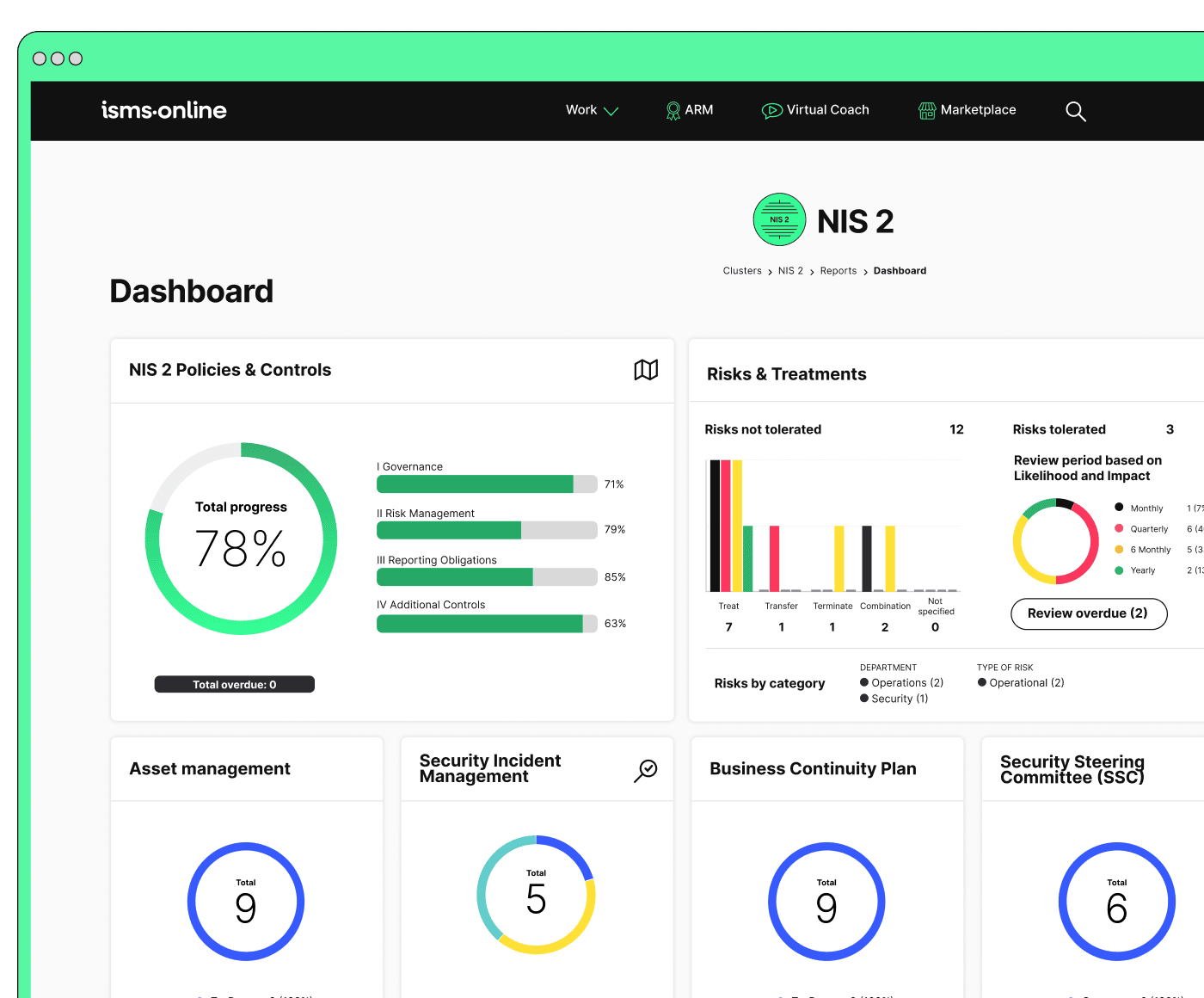
Be NIS 2-ready from day one
Launch with a proven workspace and templates – just tailor, assign, and go.
Is Compliance Fatigue Draining Your Time and Talent?
The most underestimated threat is compliance fatigue. As regulations become more complex and intertwined, compliance work has ballooned while outcomes have not improved. According to a recent ISF survey, over 80% of European CISOs say compliance cycle times have doubled in the last two years (ISF findings). Talent churn and morale slippage were cited as the key risks to long-term resilience.
Burnout is the breach you won’t see until it’s too late.
Short-term fixes-parallel checklists, one-off audits, heroic sprints-don’t scale. They mask deeper fragility and set teams up for rework, not readiness. By contrast, leading teams invest in always-on compliance: controls that are mapped once and tracked daily, continuous logs replacing manual compilations, dashboards uniting compliance, privacy, and risk (ENISA “Living Compliance Loop”).
Competitive advantage now flows to those who automate workflows, cross-map controls for multiple laws, and operationalise dashboards for comprehensive, board-ready oversight. These teams demonstrate measurable “resilience capital”-compliance that repays its investment through reduced audit hours, fewer findings, and higher staff engagement (BCG compliance ROI).
If complexity feels like the default-change the system, not just the checklist.
How Can Unified Frameworks and ISO 27001 Bridge the Regulatory Divide?
Unified control frameworks (UCF, CCF, ISO 27001) and a resilient ISMS are now the only credible foundation for sustainable multi-law compliance. When you map controls centrally, auto-tag risks, and ensure roles and evidence are cross-referenced for every regime, you turn chaos into readiness (Spring 2024 UCF pilot).
A single ISMS anchored in ISO 27001 and mapped to DORA, NIS 2, and the AI Act enables you to satisfy all regimes when the next incident or audit arrives. Automated SoA mapping, continuous events logging, and dual-use evidence let you respond to regulators with speed and confidence (BSI/ENISA guidance). This integrated strategy slashes audit prep times from months to days-and hardens the board’s ability to prove oversight (Diligent GRC analysis).
Unified mapping gives you audit-ready proof-no matter which regulator knocks.
ISO 27001 Compliance Bridge: Cross-Regulator Table
| Auditor Expectation | Operationalisation | ISO 27001 / Annex A Reference |
|---|---|---|
| Multi-framework incident reporting | Automated, mapped logs | A.5.24, A.5.25, A.5.26, A.8.15 |
| Unified supply chain risk | Central risk register | A.5.19, A.5.20, A.8.29, A.8.32 |
| Audit trails for every control | Role-based access, logging, event capture | A.8.15, A.8.16, A.8.17, A.5.31 |
| Privacy, AI, and cyber integrated | SoA cross-mapping, evidence reuse, cultureshift | A.5.34, A.8.7, A.8.25, SoA crossmap |
Proving Readiness: Simulation Drill
Simulate a supplier breach, AI model error, or data leak this week. Could your ISMS output evidence packs for all three major frameworks before regulators arrive?
If you’re not sure, it’s time to automate SoA tagging and linkage. Your future audit trail should let you trace, in real time: trigger → risk update → controller responsibility → evidence. If each step bridges all regimes, your compliance goes from fragile to resilient (PharmaVoice case).
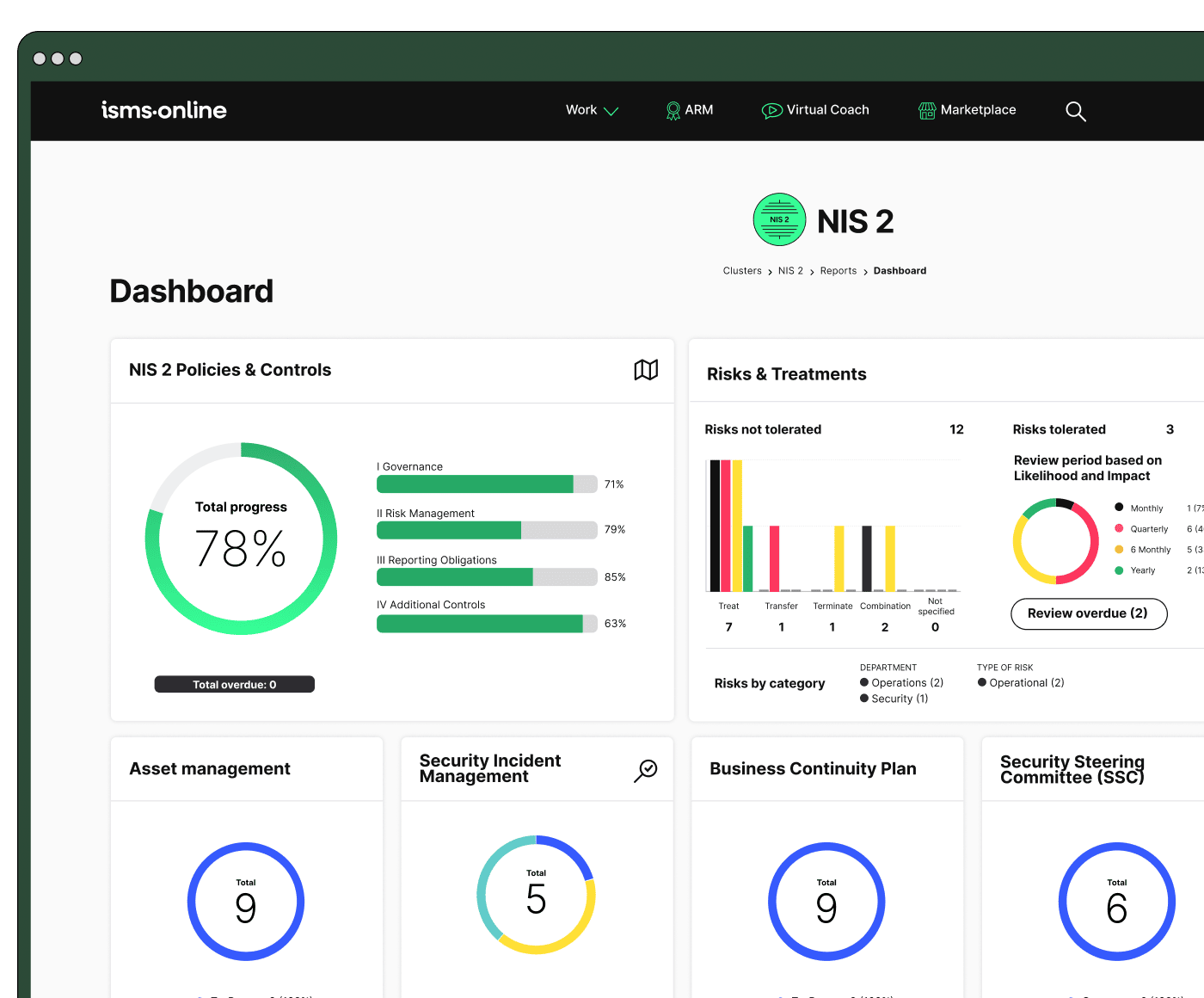
All your NIS 2, all in one place
From Articles 20–23 to audit plans – run and prove compliance, end-to-end.
From Crisis Fighting to Resilience: ISMS.online as Your Multi-Law Bridge
Checklists alone don’t scale resilience-integrated system engineering does. Teams at the forefront now embed ISMS.online to operationalise compliance, automate audit logs, and unify controls across regulators. Supervisors and boards seek ISMS.online outputs to prove compliance in financial, SaaS, public, and infrastructure settings (ISMS.online case studies).
True resilience is never built on a checklist-it’s engineered into every workflow.
How ISMS.online Revolutionises Multi-Regulator Readiness:
- Central Audit Register: Every incident, mapped to the right law, logged once-never duplicated.
- Supplier Management: Evidence packs pull from contracts, risk reviews, and real-time logs into the SoA for direct board oversight.
- Policy Engagement: Staff engagement is traceable via linked Policy Packs, To-dos, and acknowledgement flows; audit stats update in real time.
- Board Dashboards: Control status, incident logs, and risk analytics are live-so the C-suite doesn’t wait for the next regulatory email to learn where they stand.
This “always-on” approach demonstrates living compliance to external authorities and stakeholders, offering built-in assurance that your resilience is perpetual-not just a pre-audit sprint.
Become the Compliance Resilience Leader with ISMS.online
Every leader reading this is standing at a regulatory crossroads. You can react to each new law with fragments and paperwork, or you can own your resilience capital. ISMS.online is the bridge-connecting NIS 2, DORA, the EU AI Act, and whatever comes next.
Resilience isn’t a luxury in the red zone. It’s what separates those who lead from those who endure.
Now isn’t just the time to pass your next audit-it’s time to become the benchmark your sector and board rely on. Book your readiness assessment. Equip your evidence, risk registers, and dashboards for the world regulators are building-today. When the red zone closes in, make sure your organisation is the one with the bridge, not the blind spot.
Frequently Asked Questions
Where do NIS 2, DORA, and the EU AI Act overlap, and why does this create relentless compliance friction?
NIS 2, DORA, and the EU AI Act most sharply intersect at incident reporting, supply chain diligence, and the demand for live, faultless risk documentation-yet each regime defines urgency, eligibility, and evidence with its own dialect. The result: your team could face three (or more) simultaneous regulatory alarms for a single incident, with divergent deadlines, language, and reportable outcomes. Under NIS 2, health and digital infrastructure providers may have just 24 hours for initial notification, 72 hours for a detailed update, and a month for a root cause analysis; DORA compresses this sequence for financial services to a four-hour window for “major ICT” breaches, rolling updates, and thorough month-end diagnosis; the AI Act invokes immediate notification for “high-risk” AI failures, while GDPR triggers an independent 72-hour window if personal data is affected.
A single service failure or breach can spark a cross-regulatory domino effect-where every wrong move multiplies exposure, investigation, and board-level risk.
Routine cross-checking by cyber, privacy, and sector regulators means timeline misalignment can result in compulsory audits, public penalties, or even direct managerial liability. Unified evidence trails, reporting clocks, and mapped controls through an integrated ISMS such as ISMS.online don’t just eliminate duplication-they fundamentally change how your organisation can move from reactive firefighting to routine, provable compliance.
Comparative Regulatory Requirements
Before you can harmonise action, you must clarify the contrasts:
| Requirement | NIS 2 (Cyber/Infra) | DORA (Finance) | EU AI Act & GDPR |
|---|---|---|---|
| Initial Notification | 24h/72h/final | 4h/updates/1 month | Immediate / 72h |
| Supply Chain Diligence | Supplier audit, contract locks | ICT risk, regulator access | AI vendor/logic tracing |
| Evidence Demands | Logs, registers | Live monitoring/audits | AI logs, risk/provenance |
Who falls within scope for NIS 2, DORA, and the EU AI Act-and where do hidden traps lurk?
Scope creep is a real and mounting threat; organisations are increasingly swept into multiple regimes, sometimes overnight and unintentionally. NIS 2 now sweeps up both “essential” operators (energy, health, digital infra, etc.) and “important” entities, which may be SaaS, hosting, or data analytics vendors serving regulated clients, sometimes at thresholds as low as 50 staff or €10M turnover. DORA’s net covers every financial services player and virtually any ICT supplier touching their operations-irrespective of geography. The AI Act radically widens reach: if your team builds, deploys, or simply uses “high-risk” AI, regardless of size or vertical, you’re regulated. That puts mid-tier SaaS, fintechs, healthcare app builders, and managed service providers deeply in the compliance dragnet.
Scope no longer follows sector lines-it follows contracts, code, and cross-border data flows.
Expanding into a new sector, layering AI-powered features, or onboarding a new regulated client may instantly activate obligations you never previously faced. Always review new deals, service launches, or jurisdiction moves with a compliance lens to avoid “trapdoors” and last-minute regulatory firefighting.
Overlap and Exposure Table
A single product or service can trip multiple regimes.
| Entity/Service | NIS 2 | DORA | EU AI Act | Compliance Trap |
|---|---|---|---|---|
| SaaS for healthcare | Yes | Indirect | If AI in use | “Essential entity” triggers multi-regime risk |
| IT vendor to finance | Yes | Yes | If AI/risk | DORA covers *all* ICT suppliers, not just banks |
| EU AI app (SaaS) | Varies | No | Yes | Non-sector AI use = instant regulation |
| Intl. cloud provider | Yes | Yes | Yes | Multi-jurisdiction triggers all three |
How do incident reporting triggers diverge? What’s at stake if you get sequences or facts misaligned?
No two frameworks use the same incident definition, severity threshold, or timing. Here’s how the divergence lands operationally:
- NIS 2: 24-hour early warning, 72-hour comprehensive report, final cause analysis at 1 month-specifying scope in critical infrastructure or digital supply.
- DORA: Four-hour “major ICT incident” window, ongoing status rolls, final report in a month for financial ecosystem participants and suppliers.
- EU AI Act: “Immediate” reporting expected for “high-risk” AI incidents; if data privacy breached, GDPR triggers a separate 72-hour clock.
Slip on timing, select the wrong regulator, or misclassify an incident and you risk parallel investigations, audit mandates, or public enforcement. Regulatory agencies now routinely cross-check disclosures, exposing discrepancies or lag anywhere in your ecosystem.
Regulators judge readiness minute by minute-and every agency cross-references your timeline, not just your technology.
Comparison of Incident Reporting
| Regime | Initial Deadline | Follow-ups | Retrospective/Final |
|---|---|---|---|
| DORA | 4 hours | Ongoing, ad hoc | 1 month (root cause, lessons) |
| NIS 2 | 24 hours | 72 hours (detail) | 1 month |
| AI Act/GDPR | Immediate/72h | Situation-dependent | Upon request/case-by-case |
Where do supply chain and vendor obligations bite hardest-and how do you prevent overload or inherited risk?
Regulators have shifted focus beyond your perimeter-your supply chain now defines your regulatory exposure. NIS 2 requires rigorous supplier audits, notification and evidence clauses in contracts, and documented risk assessments covering direct and upstream vendors. DORA turns up pressure in finance and tech: third-party ICT risk must be managed continuously, your contracts must grant regulatory access to provider records, and live risk logs must be available on demand. The AI Act adds its own layer: documented testing, development, and explainability records must accompany high-risk AI systems end-to-end.
When your supplier stumbles, your compliance clock and reporting window start-they may not even inform you before you’re already exposed.
Maintaining up-to-date registers, stringent contracts, and automated vendor diligence reporting is no longer “good practise”-it’s operational survival. A scattered or PDF-based approach courts audit failure and business risk.
Supply Chain Control Table
| Requirement | NIS 2 | DORA (ICT/Finance) | EU AI Act |
|---|---|---|---|
| Annual supplier review | Yes | Continuous, contract-bound | Mandatory for high-risk AI |
| Incident contract clause | Yes | Regulator audit/read access | AI lifecycle traceability |
| Live evidence/logs | Audit logs/registers | Real-time, system-level | Testing, explainability |
Does compliance with one regime protect you under the others-or does it trigger hidden audit and board risks?
No regime exists in a vacuum. While DORA establishes lex specialis for financial ICT risk, NIS 2 and the AI Act layer additional obligations, especially for governance, supply chain, and data handling. The AI Act requires explicit bias monitoring, continuous traceability, and incident logs that neither DORA nor NIS 2 fully address. GDPR’s data breach triggers may operate in parallel, often sparked by AI or cyber incidents. Regulators collaborate, expecting that organisations harmonise evidence and schedules-not simply tick separate checklists.
Passing one audit is no shield against cross-examination or audit spiral. Unified, mapped controls is the only defensible stance.
Relying on piecemeal policies leaves your board, DPO, COO, and CIO exposed to personal regulatory scrutiny when agencies spot gaps, conflicting statements, or missed deadlines.
What operational structure reliably harmonises cross-regime compliance, and where does board and audit risk concentrate without it?
Leading organisations now deploy a Common Control Framework (CCF), mapped to ISO 27001 (and annexes) within an integrated, live ISMS platform. This model remaps every regulatory clause into a single Statement of Applicability, ensures all incidents and vendor diligence are tracked against a unified control matrix, and provides rolled-up evidence dashboards for instant board or C-level assurance.
Attempting “compliance by silo” is a recipe for evidence duplication, staff fatigue, missed triggers-and board or director exposure if failures cascade.
Regime Harmonisation Traceability Table
| Event Trigger | Risk Register Update | Control / SoA Link | Evidence Logged |
|---|---|---|---|
| Vendor outage | Third-party supply risk | ISO 27001 A.15, DORA Ch.4, NIS 2 Art.12 | Notification logs, contracts |
| AI model anomaly | AI risk flagged | AI Act Art.13, ISO27001, Risk Owner | AI logs, testing evidence |
| Data breach | Data risk register | GDPR, NIS 2 Art.23, DORA incident | Breach report, remedy |
How does adopting integrated, mesh compliance bolster board trust and organisational resilience?
You cannot game the regulatory regime-but you can take command of the mesh: integrating evidence trails, incident clocks, and board KPIs. An operational ISMS unifies audit logs, policy changes, and live vendor assurance, giving directors immediate confidence and helping teams weather both routine and extraordinary regulatory events. In a world where regulatory complexity only grows, proactive crosswalk reviews, continuous policy mapping, and actionable dashboards transform compliance from a burden into a strategic asset-driving resilience, trust, and market advantage.
Your move: Elevate your ISMS from checklist to boardroom platform, validate your compliance mesh, and invite the audit. When evidence and confidence move together, every regime-NIS 2, DORA, EU AI Act-becomes catalyst rather than constraint.






