





































What Sets NIS 2 Apart from GDPR? Understanding the Two Regimes
Every organisation digitising operations or scaling across Europe faces a double imperative: NIS 2 and the GDPR. Each seems monumental on its own, and for many, they now overlap at the weakest moment-in the fog of crisis. The GDPR, for years the global watermark for personal data protection, mapped the rights of individuals and the responsibilities of organisations. But NIS 2 reshapes the field: suddenly, resilience-technical, operational, and supply chain-becomes a frontline requirement at national and EU levels.
When attack and accident converge, the difference between disruption and disaster often comes down to who owns each regulation’s clock.
Where the GDPR frames your duty as a data custodian (wherever your servers or teams live), NIS 2 demands that you act as a digital stronghold for entire sectors and supply chains. GDPR centres on safeguarding EU residents’ information-privacy as a human right. NIS 2 targets systematic risk: protecting continuity, critical infrastructure, and the public through operational robustness, not just confidentiality.
In practise, this means NIS 2 covers a defined set of critical and important sectors: from healthcare to energy, telecoms to essential public administration. It’s the digital immune system of Europe-less about what you hold, more about what could fall when your organisation falters (ENISA). GDPR, on the other hand, stretches its reach wherever European personal data travels, binding anyone-be it a US SaaS vendor, a UK startup, or a Singapore payment gateway-who interacts with EU resident data (EDPB).
The triggers differ dramatically. GDPR fires up whenever personal data is mishandled, regardless of the root cause. NIS 2, by contrast, responds to any event that threatens essential digital operations-ransomware that halts hospitals, DDoS attacks that disrupt payment rails, or supplier failings that ripple into healthcare, water, energy, or finance. In reality, many breaches trip both: ransomware that leaks records demands GDPR reporting; system outages that stall service trigger NIS 2.
Nobody gets to choose one or the other. GDPR’s bite is famous-mega-fines, headline enforcement. NIS 2 brings a new sharpness: expanded fines, real-time sector audits, board accountability, and explicit reach up the supply chain (EUR-Lex). Europe’s cyber compliance future belongs to organisations that operate at the intersection-where privacy and resilience aren’t an either/or, but the intertwined DNA of digital trust.
Who Must Comply? Entity Scope, Sector Triggers, and Overlap
You, your vendors, your board-all live on the compliance map. The logic that draws your organisation into NIS 2 or GDPR’s orbit is different, but digital complexity now blurs their boundaries at the points of most risk. Leadership today means knowing exactly when your incident will cascade into regulatory double jeopardy.
When a breach launches two regulatory clocks, missing one isn’t an excuse-it’s an escalation.
NIS 2 zeroes in on operators of essential and important services-energy grids, hospitals, digital providers, public sector agencies (Fieldfisher). “Essential” covers those whose disruption harms society at scale. “Important” can include SaaS businesses deeply bound into the national tech ecosystem. Even SMEs and non-profits can be pulled in if designated as “vital”-size offers less refuge than ever.
GDPR is indifferent to sector or size-just the presence of EU citizen data suffices. A one-person shop using a US-based CRM, a global e-commerce platform, or a local authority with a school admissions portal: if data moves in or out of the EEA, GDPR applies.
But here’s the rub: In a cloud-first, API-tangled economy, both regimes often converge. A SaaS company breaches a hospital’s records-NIS 2 for the business interruption, GDPR for the privacy loss. A ransomware attack locks a water provider-NIS 2 because citizens can’t shower or cook, GDPR if customer records leak.
| Entity Type | NIS 2 Coverage | GDPR Coverage | Dual-Trigger Scenario |
|---|---|---|---|
| Cloud Provider | Essential/Important | Processor/Controller | Outage + data loss |
| Hospital | Essential | Controller | Ransomware halts care; data exfil |
| HR SaaS | Important | Controller | Supply chain hit, employee data leak |
| Non-profit | Usually exempt | Controller | Donor data breach |
Most organisations must operationalise dual compliance. The question is not “Will this breach require both?” but “How do I ensure I meet all obligations-at pace, in public, and on record?”
When both hit, regulators expect harmonised action: immediate, precise, and never contradictory. That means role-specific notification checklists, cross-mapped evidence logs, and a playbook where operational and privacy leads close the loop together (Noerr).

Master NIS 2 without spreadsheet chaos
Centralise risk, incidents, suppliers, and evidence in one clean platform.
Fines and Penalties: How Much, Who Decides, and What Hurts Most
The threat of financial penalties is often what gets compliance budgets approved-and what triggers the real panic when a breach occurs. But the enforcement mechanics, and who pays, have never been more different, or more personal.
The impact of a fine is fleeting. The impact of a public compliance failure is perpetual.
GDPR fines can reach €20 million or 4% of global revenue (whichever is higher)-levied for grave violations like failure to report data breach, lack of lawful processing, or ignoring data subject rights (EDPB Enforcement Tracker). Lower-level slip-ups (bad records, consent ambiguity) run up to €10 million or 2%.
NIS 2 fines have real teeth for boards. Essential entities meet a €10 million/2% ceiling; “important” entities, €7 million/1.4% (EUR-Lex NIS 2). But the innovation is governance: persistent mismanagement, breached notification timelines, and technical unpreparedness can lead to executive bans, sector-wide suspensions (think “can’t run a bank or hospital again for X years”), and the public shaming of individuals.
| Regime | Max Fine | Direct Targets | Unique Risk Lever |
|---|---|---|---|
| GDPR | €20m/4% turnover | Organisation | Mega-fines, DPA audit |
| NIS 2 (Essential) | €10m/2% turnover | Board, Organisation | Executive bans |
| NIS 2 (Important) | €7m/1.4% turnover | Organisation | Supply bans |
Can you be fined twice? “Ne bis in idem” bars double punishment for the same facts but, in most cases, regulators can stack or sequence operational and privacy penalties. Miss a dual deadline or fail two sets of duties, two fines may follow.
The “hidden” fine is operational: losing trust, failing supplier audits, or being required to disclose failure publicly. For critical suppliers, a gap in NIS 2 due diligence severs contracts faster than most fines can be levied (TechRadar). The financial headline is often less costly than the operational fallout.
Who Enforces? Regulators, Audit, and Incident Response
When a major event surfaces, you’ll deal not with one regulator but a matrix of interconnected authorities-each assessing your response, evidence, and tone in real-time.
NIS 2 Enforcement: Sector and National Agencies
Depending on your industry, a sectoral authority-energy, communications, health-or a national CSIRT oversees compliance (Clifford Chance). Powers are real: unannounced audits, log and evidence inspections, interviews at all staff levels, and-crucially-sanctions at the board level.
GDPR Enforcement: Data Protection Authorities (DPAs)
GDPR is monitored by national DPAs, working in tandem through the European Data Protection Board when cross-border issues arise. Investigations can range from targeted queries to coordinated pan-EU probes-requiring alignment between your privacy, technical, and legal teams.
Dual Regime: The Era of Coordinated Joint Response
A ransomware event disabling operations and leaking PII now triggers simultaneous reviews by CSIRT, DPA, sectoral supervisors, and sometimes competition authorities (ENISA Incident Handling). Maintaining distinct, well-documented lines for each is vital-any contradiction leads to rapid escalation.
Live Boardroom Table: Trigger → Update → Control → Evidence
| Trigger Event | Risk Update | SoA/Clause Ref | Evidence Logged |
|---|---|---|---|
| Ransomware disables ops | Service outage/data at risk | A.5.24, A.5.29 | Sys logs, IR report |
| PII exfiltration | GDPR/DP notification needed | A.5.25, A.5.35 | DPO report, audit logs |
| Supplier system failure | Third-party impact check | A.5.21, A.5.3 | Comms, risk logs |
| Missed notification | Legal escalation | A.5.36 | Regulator comms, mail |
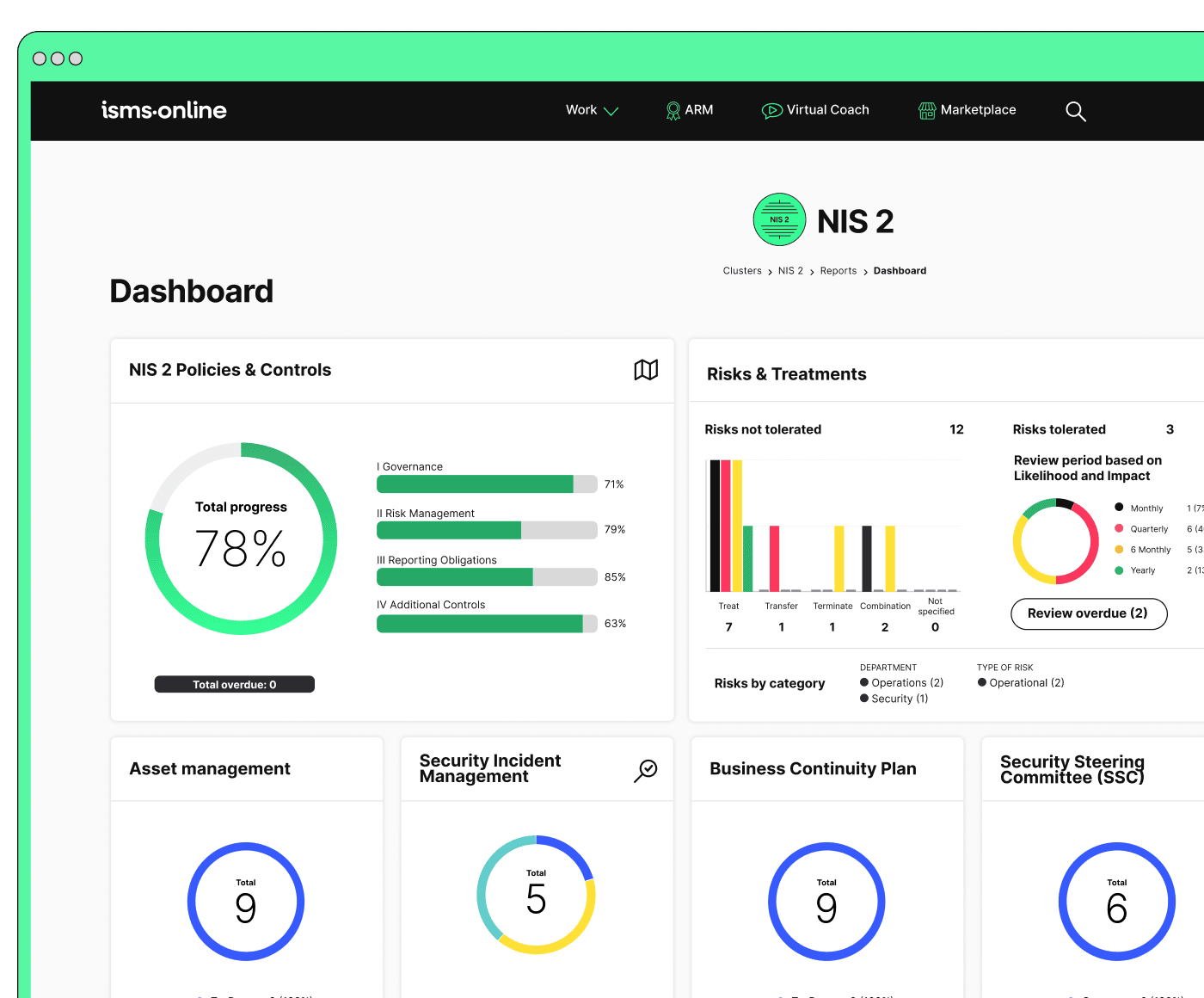
Be NIS 2-ready from day one
Launch with a proven workspace and templates – just tailor, assign, and go.
What Are My Daily Duties? Reporting, Evidence, and Response Playbooks
For all the rhetoric, success is measured not in documentation submitted, but in actions proven and accounted for when seconds count. Policy alone doesn’t pass an audit-evidence of operational reality does.
An incident that is not evidenced is a risk multiplied.
Incident Notification: Dual Timers, Critical Windows
- NIS 2 requires an initial alert within 24 hours (even if facts are preliminary), a detailed update in 72 hours, and ongoing liaison with authorities. Timers start on event awareness, not on confirmation (ENISA Guidance).
- GDPR sets a 72-hour deadline for reporting personal data breaches-complete with justification logs for every hour of delay.
Evidence Standard: Live, Not Retro
“Document after the fact” is obsolete. Platforms now provide live system logs, workflow timestamps, and cross-team playbooks triggered by event classifiers. The best teams pre-map the people, processes, and controls for each incident type-no ad hoc huddles or spreadsheet chases (ISMS.online Unified Dashboard).
Unified evidence links matter: your DPO, CISO, IT, and even the CEO may need to sign off. Regulatory narratives expect not just what was done, but who signed off, when, and with what supporting context.
Dual Regime Practicalities
- Map every duty (notification, evidence, action) to *both* regimes-incident type, authority, and deadline.
- Use shared templates and role-linked checklists: harmonise but don’t duplicate.
- Maintain a single narrative across board sign-offs and after-action reports.
Controls Mapping & Audit: Operationalising Compliance and Gaining Trust
Your live controls and audit narratives are not just checkboxes-they are your shield and your audit passport. EU authorities look for operational proof: link your risk registers, supplier due diligence, incident handling, and policy acknowledgements into one evidence system.
Only organisations with systemic traceability truly move from ticking the box to real defence.
ISO 27001 Operational Bridge Table
| Expectation | Action (Operationalised) | ISO/Annex A Ref |
|---|---|---|
| Rapid incident response | Automated playbooks, IR runbook | A.5.24, A.5.29, A.5.36 |
| Board accountability | Review meetings, sign-off log | 9.3, A.5.4 |
| Supplier resilience | Evidence of TPRM, contract trail | A.5.21, A.7.13, A.8.30 |
| Audit/evidence archive | Secure digital logs, audit chain | A.5.12, A.7.4, A.5.35 |
| GDPR notification | DPO pack sign-off, comms records | A.5.25, A.5.35, A.5.3 |
With a unified platform, every control is linked to an operational artefact-an incident notification, a risk update, a policy change, or a supplier check. This doesn’t just defend audits: it enables true continuity when your teams or tools change.
Traceability Table:
| Trigger | Risk Signal | SoA Link | Evidence |
|---|---|---|---|
| Supplier breach | TPRM risk increased | A.5.21 | Vendor comms, SoA update |
| Social engineering | Incident response | A.5.24 | IR log, training cert |
The result: a compliance programme that produces reliable truth-in-action for auditors, the board, and-when it counts-regulators.
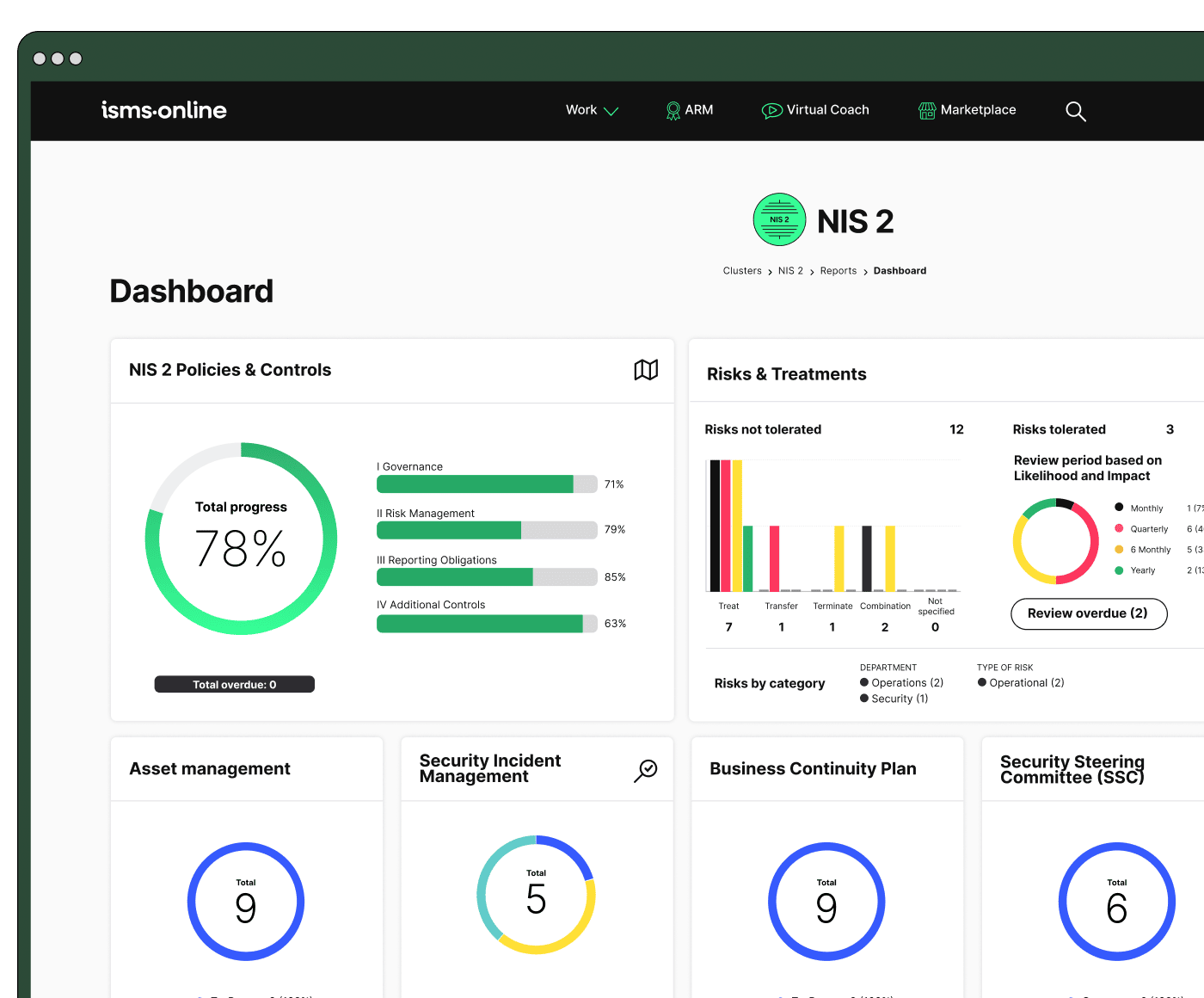
All your NIS 2, all in one place
From Articles 20–23 to audit plans – run and prove compliance, end-to-end.
Compliance Forward-Unify, Automate, Assure
The dual-regime era means that compliance success and organisational reputation depend on disciplined, linked systems-not heroic improvisation. Checklists cannot keep pace. Only unified platforms, real-time dashboards, and systematised evidence can absorb and reflect regulatory pressure from all sides.
Consistency wins trust. Automation wins scalability.
Unified dashboards-including ISMS.online’s Unified Dashboard-deliver real-time pulse: incident clocks, audit trails, controls “heat maps,” sector philtres, and historic registers. Modern compliance is a workflow: incident triggers update all linked obligations, risk logs, and regulatory notifications before deadlines are missed. When every compliance play is auto-logged and cross-referenced, you not only reduce audit burden, you become the company whose compliance is its competitive advantage.
| Workflow Step | Action | System Response | Ultimate Outcome |
|---|---|---|---|
| Incident detected | Alert + playbook fire | Notification templates load | Regulatory timers start, evidence ready |
| Supply chain alert | Vendor failure flagged | TPRM/risk auto-update | Audit log, board alert |
| Policy expiry | Compliance owner ping | Approval check, audit trail log | Up-to-date SoA, ISO-ready status |
| Audit evidence request | Artefact match | Evidence surfaced, mapped | Fast, defensible audit pass |
Key Impact Statistics
- 84% of EU CISOs cite unified dashboarding and automated evidence mapping as critical in passing NIS 2 and GDPR audits (ENISA, 2024).
- Organisations with systematised compliance reduce audit prep time by 55% and halve the number of supply-chain-induced incidents.
Own Your Compliance Story-Lead the Next Audit, Don’t Survive It
In the dual-regime reality, leadership is defined by your ability to act, evidence, and respond ahead of the headlines. The highest-performing organisations prepare their audits, evidence logs, and regulatory responses as a continuous process-visible and defensible at every stage.
ISMS.online was built for precisely this era: to integrate, automate, and unify your Security, Privacy, and Resilience programmes inside one platform, linking workflows, logs, controls, and sign-offs. This is the backbone for decisive action when the clock is ticking, changed personnel or suppliers arrive, and new regimes unfold.
If you lead compliance, privacy, risk, or IT, set the pace for your board, your suppliers, and your audit teams. Invite your senior security officer, privacy lead, or risk owner to a workflow mapping review, and demand that every tool lives up to the complexity of your obligations. The right system will make your compliance programme the yardstick by which your industry is measured-proving readiness, resilience, and trust, long before a headline test.
Frequently Asked Questions
How do fines and enforcement powers diverge between NIS 2 and GDPR-and why does your board need to face both?
Both NIS 2 and GDPR carry headline-grabbing fines designed to jolt directors into action, but the real threat to your organisation lies in the personal and operational consequences that reach far beyond the numbers. GDPR empowers regulators to levy penalties up to €20 million or 4% of global turnover, and its reach extends to any entity processing EU personal data, regardless of sector or geography. NIS 2 sets maximums of €10 million (or 2% of total turnover) for “essential entities,” and €7 million (or 1.4%) for “important entities.” But unlike GDPR-which rarely targets individuals-NIS 2 enforcement uniquely extends to executive suspensions and operational restrictions for repeated or severe failures,.
| Regime | Max Fine % | Max Fine (€) | Coverage | Board/Personal Risk |
|---|---|---|---|---|
| GDPR | 4% | €20 million | All processors/controllers | DPO may be named |
| NIS 2 | 2% / 1.4% | €10m/€7m | Essential/Important sectors | Executive ban, business halt |
A headline fine is, increasingly, just the start: repeat failures can freeze your executive careers and force your business to halt operations.
The distinction matters because NIS 2, unlike GDPR, gives regulators direct tools to target decision-makers-a lone incident can mean not just a fine, but loss of authority for boards or key managers. If a ransomware attack compromises patient data and critical services, you must navigate both regimes. GDPR may forbid double-fining for the same data breach (“ne bis in idem”), but NIS 2 can still trigger penalties if operational resilience, technical response, or supply chain oversight also falter (RGPD.com: NIS2/GDPR enforcement).
Practical mandate: Log annual governance reviews, risk acceptance, and technical oversight for both NIS 2 and GDPR. Creating one auditable record per regime turns regulatory scrutiny into organisational proof of due diligence-and makes the difference between a warning and a ban.
Which organisations, sectors, or service lines are in scope for NIS 2, GDPR, or both-and how does a dual regime transform your compliance operations?
GDPR covers any organisation processing EU personal data, regardless of size or sector: a SaaS vendor handling EU staff records; a US-based marketing agency with EU customers; or a local nonprofit processing membership data. The scope hinges on data flows, not headcount or industry.
NIS 2 zeroes in on “essential” and “important” sectors-critical infrastructure (health, energy, water, digital infrastructure), public administration, cloud/SaaS, B2B suppliers, and core managed service providers. Critically, there is no blanket SME exemption: if your products or data support vital functions or pose systemic risk, you’re in scope. Regulators rely on ENISA’s sector mapping to draw the line.
| Entity Example | NIS 2 | GDPR | Scenario |
|---|---|---|---|
| Regional hospital | Yes | Yes | Ransomware hits care and patient data |
| Payroll SaaS | Maybe | Yes | Supplier breach disrupts data/services |
| Local HR consultancy | No | Yes | Processor loses employee data |
| Electricity grid | Yes | Yes | Service disruption, regulator alert |
A dual-regime scenario is common: a cloud SaaS payroll vendor for a major bank must document personal data safeguards (GDPR) and operational resilience, supplier controls, and incident response (NIS 2). Both demand incident logs, notifications, and proof of ongoing governance.
Leadership call: Embed regime mapping into your ISMS-tag every entity, product, or supplier for both GDPR and NIS 2 duties. Update mapping after any business, technology, or contract change, and review your exposure at least annually.
Where do incident reporting rules and notification timelines diverge-what dual triggers demand parallel response?
Incident response under GDPR and NIS 2 is not one-size-fits-all-each uses different triggers, deadlines, and authorities. Getting it wrong amplifies investigation risk, board scrutiny, and even fines.
NIS 2 reporting:
- Trigger: Any significant cyber threat, supply chain disruption, or system impact that threatens critical services or data.
- Timeline: 24 hours from detection for an initial alert to national CSIRT or sector regulator, followed by a 72-hour detailed report and continuous updates until resolved.
- Authority: National cyber authority or sector regulator, technical audit depth (e.g., CSIRT).
GDPR reporting:
- Trigger: Any personal data breach “likely to result in a risk to rights and freedoms.”
- Timeline: 72 hours from discovery to notify the Data Protection Authority (DPA), plus affected individuals if high risk.
- Authority: National DPA; legal focus on breach description, mitigation.
| Regime | Report To | Trigger | Initial Timeline | Continuous Updates |
|---|---|---|---|---|
| NIS 2 | CSIRT/Sector | Operational threat, supply chain | 24 hours | Until closed |
| GDPR | DPA | Risk to rights/freedoms | 72 hours | Facts change |
A ransomware outage exposing payroll data demands dual reports: your CSIRT wants forensics and mitigation logs, your DPA asks for affected numbers and remedial actions.
In practise, dual-trigger incidents mean prepping and filing diagnosed, cross-referenced evidence for both authorities. Auditors increasingly backcheck timelines and content between regimes.
Action: Pre-build evidence packs and notification templates for both regimes in your ISMS, and rehearse “blended” incidents so teams respond appropriately under pressure.
Who are the auditors and enforcers for NIS 2 and GDPR, and how does personal accountability differ?
NIS 2 audits and enforcement rest with national cyber authorities (CSIRTs) or sector supervisors with broad technical and business continuity powers-they can inspect logs, practises, and board minutes, and escalate to executive bans or operating restrictions after persistent failure (Clifford Chance: NIS2 legal note). Recurring oversight failures mean your CISO, CEO, or ops leaders may face professional bans.
GDPR enforcement is run by data protection authorities (DPAs) focused on processing, breach forms, and legal obligations; naming individuals is rare (outside wilful neglect or repeated incidents).
| Regime | Who Enforces | Board/Executive Risk | Typical Evidence Required |
|---|---|---|---|
| NIS 2 | CSIRT/sector lead | Executive ban, ops restriction | Incident logs, supply risk, minutes |
| GDPR | DPA/EDPB | DPO named, rare board action | Data breach forms, consent trails |
Best approach: Build audit-ready ISMS records-logs, approvals, supply contracts, board minutes-one system, dual evidence chains. Regularly test your retrieval speed; slow, scattered documentation is often an early warning for auditors and may tip the scale toward escalated sanctions.
What artefacts, records, and operational habits form audit-ready evidence for both regimes-how do you sustain this without burning out your team?
A “single source of truth” ISMS transforms dual-compliance admin from a headache into a defensible strength. Link risk register, incident log, board reviews, and supplier diligence into a unified system so you’re not fighting on two fronts.
Bridge table: ISO 27001/Annex A mapping for dual-regime preparation
| Expectation | Operationalisation | ISO 27001 / Annex A |
|---|---|---|
| Incident logging | ISMS connects NIS 2 & GDPR notification playbooks | 5.24 / A.5.25 /.5.26 |
| Board approval | Minutes & sign-offs archived in ISMS | Clause 9.3 / Annex A |
| Supplier risk mgmt | Diligence, contracts, and TPRM workflows linked | 5.19 / A.5.20 |
| Control mapping | Matrix crosswalk of NIS 2 and GDPR controls | Annex A / SoA |
Consistency beats ad hoc: integrated artefact management streamlines board sign-off, CSIRT queries, and DPA audits alike.
Sustain compliance by:
- Simulating dual-regime incidents annually (ransomware, supply chain, system failure); record logs, decisions, and recovery timings.
- Archiving artefacts: not just policies, but completed incident forms, board minutes, supply risk evidencing-ready in one click.
- Updating your mappings for every significant personnel, systems, or product shift so accountability never blurs.
Can a single event-say, a supplier outage or ransomware-activate both NIS 2 and GDPR, and how do you prove readiness (and avoid compound penalties)?
Absolutely: SaaS vendor outages, supply chain breaches, or ransomware can ignite both NIS 2 and GDPR, particularly when services and datasets intertwine. The “ne bis in idem” principle prevents duplicate data fines, but doesn’t shield you from compounded technical, continuity, or board-level penalties under NIS 2.
Table: End-to-End Audit Traceability
| Trigger | Risk/Status Update | Control / SoA | Artefact Logged |
|---|---|---|---|
| SaaS vendor breach | “3rd-party, infra/data” | 5.19/5.24/A.5.26 | Vendor contract, logs, board minute |
| Data breach in supply | “Privacy + service loss” | 5.21/Annex A | DPA & CSIRT notifications |
| Repeat disruptions | “Ongoing supply risk” | A.5.19/Annex A | TPRM audit record, incident drill |
Your ISMS is the only place evidence both clears fines and wins new trust-mapping TPRM, risk, incident, and board actions across all regimes.
Proof, not promises: Use your ISMS to log every supplier event, incident, and risk decision for audit readiness. Build dual-authority reporting dashboards; ensure board reviews visualise both regulatory maps and artefact status to close gaps before they trigger fines or bans.
What are the essential steps-across leadership, operations, and supply chain-to anchor dual NIS 2 and GDPR compliance from 2024 on?
Leadership:
- Assign visible responsibility for each regime; ensure your platform visualises real-time dual-regime status.
- Schedule annual board review and sign-off for both NIS 2 and GDPR risk/compliance, retain minutes for three years minimum.
- Tie M&A, new service onboarding, or jurisdictional expansion directly to updated regime assessments.
Operations:
- Automate dual-regime incident playbooks; keep notification templates current for both C-suite and shop floor.
- Validate TPRM on-boarding and review quarterly; rapid flagging of significant supply chain events to board compliance lead.
Supply Chain:
- Archive all diligence, risk decisions, incidents, and supplier changes; link directly to ISMS controls and current SoA.
- Rehearse joint incident scenarios-annual ransomware and supplier event drills-with board, DSIRT, and legal present.
Consistency wins trust. Automation enables scale. The right ISMS transforms compliance from cost centre to competitive asset.
Next step:
Explore ISMS.online’s Unified Dashboard: see live dual regime status, map supply chain exposure, and retrieve audit artefacts on demand. Download a dual-regime compliance checklist or schedule an internal audit mapping to futureproof your outcomes:






