





































Are Regulatory Mandates the Same as Voluntary Certifications?
No, an ISO 27001 certificate is not the same as regulatory proof of NIS 2 compliance—and the difference shapes how you lead, how fast you’re trusted, and whether you pass an audit with confidence or face corrective scrutiny. Regulatory mandates, such as the European NIS 2 Directive, require continuous, day-to-day demonstration of effective security, whereas voluntary certifications like ISO 27001 are structured frameworks that can accelerate—but never replace—ongoing evidence.
NIS 2 was engineered to create a living ecosystem of security, not just add a badge to your wall. The directive explicitly demands “appropriate and proportionate technical, operational and organisational measures on a continuous basis” (europa.eu). Compliance is measured by real-world defensive strength—proven through logs, reports, and lived practise. Boards and CISOs across Europe are learning that audits are no longer a one-and-done, badge-checking exercise. What matters is what your teams can surface, demonstrate, and trace, today—not the status of a certificate you earned last year.
ISO 27001’s value endures: its structure is globally respected, powerfully shapes procurement, and expedites trust with clients and partners. But even the most rigorous standard cannot replace a platform of living evidence—a dynamic record of risks, incidents, management reviews, and staff engagement. Legal and sector guidance isn’t ambiguous: certification may help, but only continuous, defensible proof will insulate your team from fines or downtime (gov.uk; dhenet.nl).
For those still hoping to “pass on paper,” NIS 2 brings a new and relentless inspection lens. Only operational controls—current, tested, and traced—will cut through regulatory scrutiny.
Bridge Table: Legal Expectations vs. ISO 27001 / Annex A Controls
Every real-world compliance journey is a bridge, not a shortcut. Heres how the key expectations align—and where they demand extra vigilance:
| Expectation | Operationalisation | ISO 27001 / Annex A Reference |
|---|---|---|
| Policy & Control Doc | Signed, versioned, and distributed | A.5.1, A.5.37, Cl.7.5 |
| Risk Register | Living, reviewed, risk-linked evidence | A.5.3, A.8.2, A.8.8, Cl.6.1.2 |
| Incident Response | 24/72-hour tests, notifications | A.5.24, A.5.26, Cl.8.2, Cl.8.3 |
| Supply Chain Security | Supplier mapping, monitoring cadence | A.5.19–A.5.22, Cl.8.1, Cl.6.1.3 |
| Backup & Continuity | Tested, time-stamped recovery evidence | A.8.13, A.5.29, A.5.30, Cl.8.2 |
| Audit Trail | Platform-based approvals, defensible logs | A.5.35, Cl.9.2, Cl.10.1 |
Build your compliance journey on facts, not assumptions—the bridge from certification to resilience is evidence.
Book a demoDoes NIS 2 Legally Require ISO 27001 Certification?
There is no clause in the NIS 2 Directive that requires you to hold an ISO 27001 certificate. Instead, regulated entities must “prove effective, ongoing control” with their own live operational evidence. The Directive’s focus is not on completed certifications, but on a persistent state of operational maturity and technical accountability.
However, compliance is never one-size-fits-all. Some national regulators, such as Denmark and France’s ANSSI, do encourage frameworks—sometimes specifying ISO 27001 or national variants. This can “raise the floor” and reward those who invest in structure. Always verify sector and national guidance; NIS 2 gives considerable enforcement leeway to each EU member state.
Certification brings plenty of pragmatic value. Audit trips are smoother when your controls, policies, and evidence are mapped using standardised frameworks. ISO 27001, in particular, aligns teams around globally recognised language, and makes the messy job of stitching together regulatory evidence much less painful. Strategic teams pursue ISO more for commercial trust and speed than as a direct legal shield.
Legal counsel uniformly warns: a certificate without fresh, verifiable records makes for dangerous ground. The badge amplifies trust—only if your technical, operational, and management controls stand up to live inspection.

Master NIS 2 without spreadsheet chaos
Centralise risk, incidents, suppliers, and evidence in one clean platform.
Why Do Organisations Pursue ISO 27001 if It’s Not Mandatory?
The economic logic is simple: while laws are the baseline, trust is a currency—and ISO 27001 remains one of its most effective signals. Many deal pipelines, especially those involving enterprise clients and government buyers, require ISO 27001 as a condition of entry. Even when not required by law, the certification acts as risk transfer, assuring customers, partners, and sometimes insurers that your controls are assessed against a globally-proven framework.
Operationally, ISO 27001 brings discipline. Its requirements force organisations to consolidate policies, document risks effectively, link evidence to controls, and engage every tier of your business in ongoing security. The result? Audit scramble becomes a coordinated routine, onboarding new frameworks (SOC 2, GDPR, sectoral overlays) is less disruptive, and staff actually know their role in compliance.
For multinationals or rapidly scaling entities, alternatives like NIST CSF, ENS, or TISAX may meet local demands—but rarely carry the broad procurement power or cross-jurisdictional familiarity of ISO 27001. Platforms such as ISMS.online allow hybrid strategies: harmonising ISO workflows, mapping them to NIS 2, and automating gap analysis and evidence collection.
Teams most often succeed when they blend ISO’s structure with region-specific evidence—retaining the flexibility to address every auditor, buyer, or regulator with confidence.
What Proof Do Regulators and Clients Really Accept?
No badge alone is ever enough. Regulators, auditors, and forward-looking supply chain partners all demand ongoing, living proof: the ability to trace decisions, demonstrate change, and react to incidents—at any stage. Recent audits show ISO 27001-aligned policies and controls offer about 70–80% coverage for NIS 2, but close inspection focuses on these:
- Current, status-stamped risk registers
- Evidence of live incident log and responses within required windows (often 24/72 hours)
- Up-to-date policy docs, management reviews, and change logs
- Proof of recurring staff training and attendance
- Supply chain reviews mapped and date-stamped
- Role-specific, defensible workflows from policy review to incident test
ISMS platforms help operationalise this evidence, but “tick-box” logs or backdated records fail scrutiny. Gaps or mismatches between your controls and daily operations are flagged, and certificates can be disregarded if the supporting workflow isn’t live.
3 Essential Tests for Your NIS 2 Evidence Log
- Records are *current*, with traceable updates.
- Incident response *matched* to policies and controls.
- Executive approvals *timestamped* for every key change.
If any of these are missing at audit time, both board trust and regulatory protection are at immediate risk.
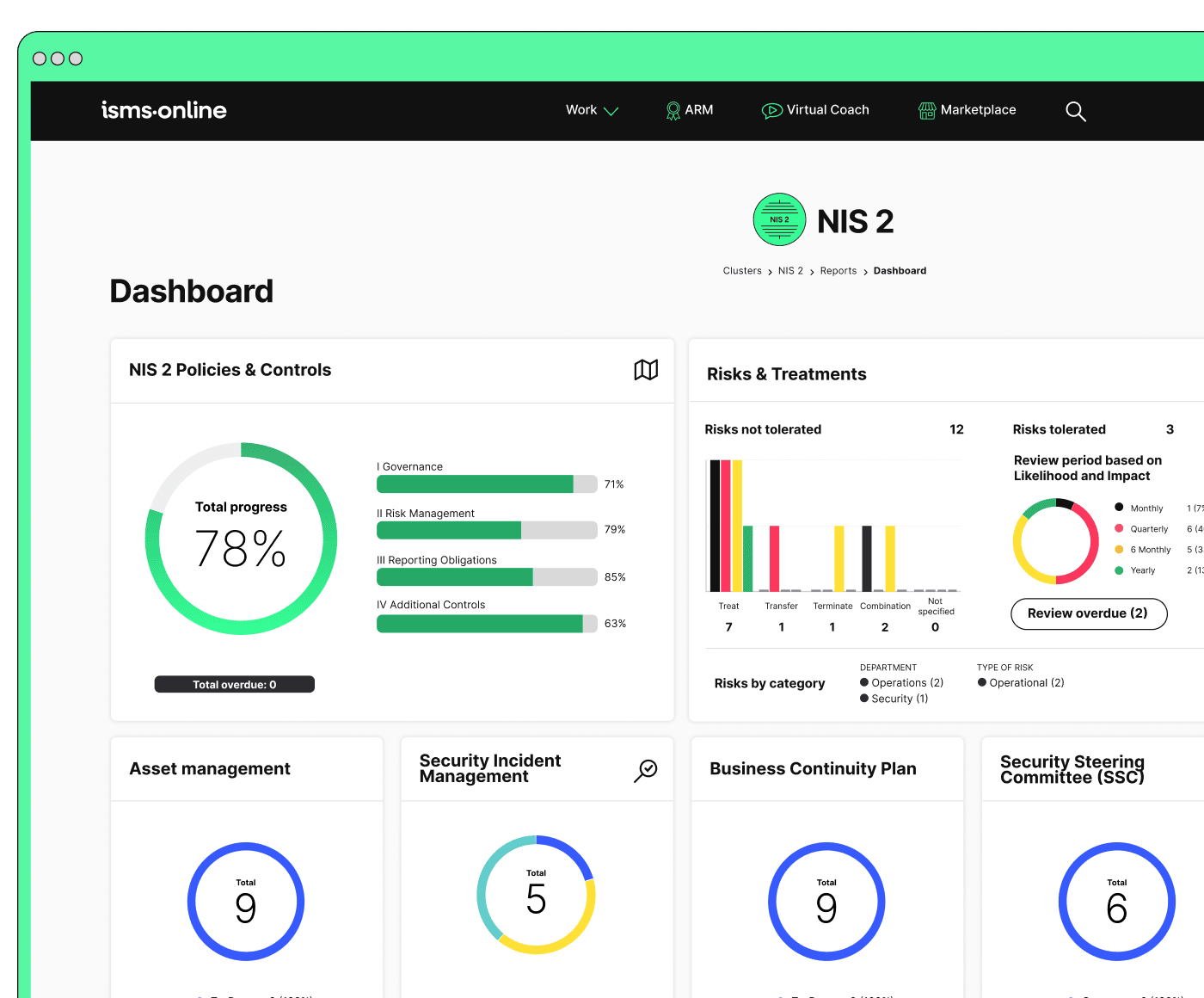
Be NIS 2-ready from day one
Launch with a proven workspace and templates – just tailor, assign, and go.
Where Does ISO 27001 Overlap With (or Miss) NIS 2?
Most authorities find ISO 27001 and Annex A controls provide about 80% direct overlap with NIS 2—a reassuring index for audit teams. Core domains—risk, business continuity, incident handling, supply chain security—map closely.
Where do gaps remain? NIS 2 sets higher bars and “living” expectations for:
- Fast incident reporting (24 to 72 hours, with evidence)
- Demonstrable executive/board oversight and responsibility
- Real-time, active monitoring of supply chain risks and supplier performance
Traceability Mini-Table: From Trigger to Evidence
| Trigger | Risk Update | Control / SoA Link | Evidence Logged |
|---|---|---|---|
| Security incident | Added to risk register | A.5.25, A.5.26 | Incident log, mgmt notification |
| Supplier fails audit | Supplier risk reassessed | A.5.19–A.5.22 | Supplier review, updated SoA |
| Policy changed | Change logged (who/when) | A.5.37, A.6.2, Cl.7.5 | Audit trail, new version number |
| Incident test run | Response plan updated | A.5.26, A.5.27, Cl.10.2 | Post-mortem or test report |
| Supply chain review due? | Review frequency tracked | A.5.21, Cl.8.1 | Date-stamped supplier audit log |
Note which details auditors are seeking: not just a certificate or static SoA, but living links between triggers, controls, and proofs. ISMS platforms like ours speed up this journey: you log once, see instantly where you have (or lack) full chain-of-custody.
Where ISO 27001’s rigidity leaves gaps—especially in response speed or uniquely local requirements—layering live mapping, reviews, and supply chain cadence closes the divide (isms.online).
Do National Rules and Audit Realities Change What Compliance Means?
Always—because every country’s enforcement practise is shaped by its own history, sector exposure, and incident patterns (ecb.europa.eu). Spain’s ENS, Belgium’s CyFun, and Germany’s BSI all specify local workflows and reporting standards (ccn-cert.cni.es; bafin.de).
Failing to speak the “native language” of compliance—by missing local documentation style or reporting cadence—can stall audits, regardless of how complete your core ISMS may be. Living systems, with layered workflows and multi-country audit modes, are preferred by national authorities (cyberwiser.eu).
If leading compliance means anything, it’s this: your proof must be both globally credible and locally native. Unified ISMS platforms help overlay national obligations on global frameworks, turning complexity into a competitive advantage.
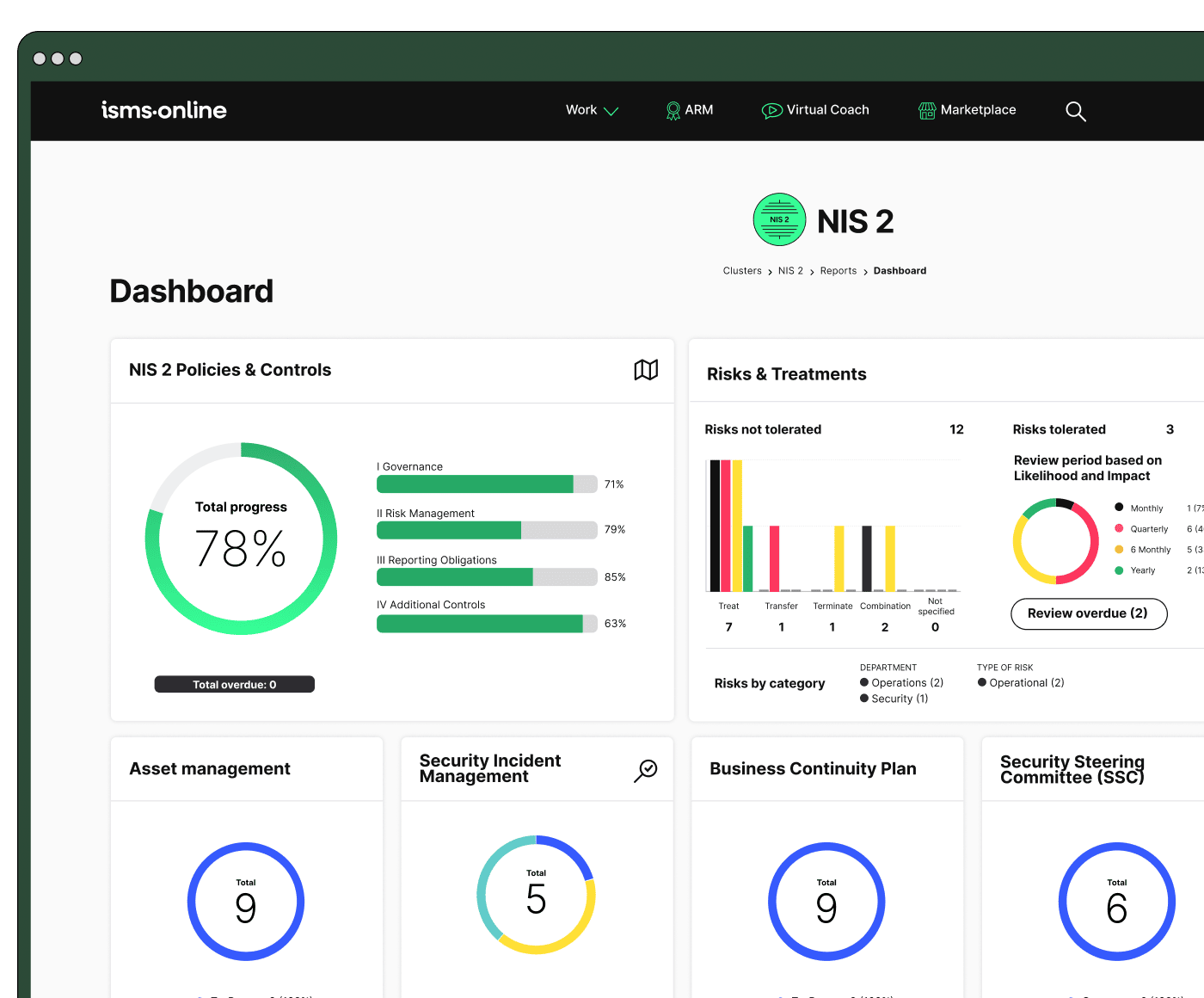
All your NIS 2, all in one place
From Articles 20–23 to audit plans – run and prove compliance, end-to-end.
Should Boards Budget for ISO 27001 Certification on the Path to NIS 2?
If you intend to build actual resilience—and not merely clear today’s minimum requirement—the answer is yes. ISO 27001 costs more than doing nothing, but pays back through procurement agility, audit readiness, and risk capital. Insurers are already mandating ISO 27001 for preferred rates, and big buyers treat it as a non-negotiable baseline.
Board pushback is understandable in today’s economy—questions about ROI and disruption are real. Yet, the financial and reputational cost of failed compliance, lost contracts, or insurance denials is always greater.
Strategic leaders invest ahead: treating ISO 27001 as a capital asset, not as GOFAI (good old-fashioned audit insurance), builds compounding trust and positions your organisation for the next regulatory wave (isms.online).
Experience Resilient Compliance with ISMS.online Today
Modern compliance is about agility, evidence, and operational speed—not just paperwork. ISMS.online is purpose-built for organisations navigating NIS 2, ISO 27001, and the fast-evolving mesh of national and sector frameworks. The platform unites procurement proof, board dashboards, incident logs, and living workflow—all mapped, searchable, and ready for real-world audit. (isms.online)
When auditors, clients, or insurers demand instant evidence—supply chain logs, policy change, incident recovery—you can surface, annotate, and prove within minutes. Unified compliance platforms slash duplication, speed up audits, and empower your organisation as a leader in trust.
Build your compliance story on proof, not hope. Architect your own resilience capital—because your next audit or deal won’t wait for you to catch up.
Your next step: Experience audit-ready compliance, deal acceleration, and operational resilience with ISMS.online. Now is the time to build trust, inspire confidence, and always pass with living proof.
Frequently Asked Questions
Do regulators require ISO 27001 certification to satisfy NIS 2, or does active operational evidence carry greater weight?
Regulators do not require ISO 27001 certification to meet NIS 2; instead, they scrutinise real-time, operational proof that your cyber-security controls are effective and continuously managed.
While ISO 27001 offers a structured approach and is widely used as a “trust badge” during audits or procurement, the NIS 2 Directive is clear: only ongoing, demonstrable security practises—like up-to-date risk registers, operational incident logs, staff training records, and live management reviews—fulfil compliance (EU Digital Strategy, 2022). National authorities consistently emphasise that certifications are supportive but not decisive ((https://www.dhenet.nl/nieuws/toon-aanwijzen-nis-2-en-de-rol-van-iso-27001)). Auditors want to see living evidence—current, mapped, and rooted in daily business, not just the existence of a standard or an expired certificate.
A certificate may impress a buyer, but a regulator wants proof you’re genuinely operational and resilient every day.
If your organisation treats certificates as the endpoint of compliance, you risk costly audit failures. Real compliance means building systems that produce and surface live, actionable evidence—making your operating model defensible at any time.
What’s the difference in practise?
- NIS 2 expects living records: Frequent updates to risk and incident management, documented decisions, and regular testing.
- ISO 27001 is voluntary: Recognised and valuable in the marketplace, but not a regulatory demand under NIS 2.
- Audits go deep: Authorities request workflows and logs showing active risk reduction, not just static files.
Focus on your “living proof”—updated logs, workflows, and decision trails. Certificates open doors, but operational evidence is what closes the gap under real-world scrutiny.
Does NIS 2 make ISO 27001 certification legally mandatory, or is effective governance enough?
NIS 2 does not obligate organisations to obtain ISO 27001 certification; it requires “appropriate and proportionate” technical and organisational measures, tailored to each entity’s sector and national context ((https://www.cms-lawnow.com/ealerts/2023/02/roadmap-for-nis-2-implementation-what-organisations-should-know?sc_lang=en)).
ISO 27001 offers a reliable framework for building your governance model, but each EU member state—and even each industry sector—interprets NIS 2 using their own minimum evidence and reporting rules. For instance, France and Germany require explicit mapping to national standards (ANSSI, 2023), and in some cases, sector-specific certification may be recognised over ISO 27001. National regulators can treat ISO 27001 as proof of best practise, but this is rarely enough by itself.
You must:
- Directly map ISO 27001 controls to national law and sector requirements before each audit
- Update evidence, templates, and workflows to match local formats (including language)
- Seek legal and compliance guidance before assuming a certificate “ticks all boxes”
Check your regulator’s checklist—certification helps, but it’s always operational, local, and sector requirements that trigger pass or fail.
Why do companies invest in ISO 27001 when NIS 2 doesn’t demand it?
Businesses pursue ISO 27001 because it unlocks commercial opportunities, accelerates procurement, lowers insurance costs, and streamlines internal compliance—not because it’s legally required for NIS 2.
Enterprise customers and insurers increasingly expect ISO 27001 for vendor selection and premium pricing (TrustArc, 2023). For internal teams, ISO-based platforms sharply reduce audit prep time and enable one-click mapping of controls across multiple frameworks ((https://isqa.org.uk/iso-27001-benefits/)), eliminating fragmented evidence trails. Internationally, ISO 27001 is a near-universal language for “baseline” trust—especially valuable in cross-border operations (Netwrix, 2024).
- Commercial leverage: Central to larger tenders and procurement policies.
- Efficiency: Single control mappings work across NIS 2, GDPR, and supply chain requirements, reducing rework.
- Board trust: Certification smooths risk discussions and convinces internal and external stakeholders your process is robust.
ISO 27001 is the backbone for trust. NIS 2 compliance, meanwhile, is proven daily through the agility of your evidence, not the stamp on your wall.
Effective organisations use ISO 27001 to harmonise and future-proof their risk, privacy, and audit readiness even when it’s not directly required.
What operational evidence do NIS 2 regulators require—and is a certificate enough?
NIS 2 regulators require demonstrable, up-to-date operational evidence mapped to local requirements—not just a certificate.
They typically scrutinise:
- Regularly maintained, current risk registers and documented threat analyses
- Detailed, timestamped incident and business continuity logs, including supplier risks
- Results of recent penetration tests and incident/test drill outcomes
- Board- or management-level review records and signed, acknowledged policies
- Evidence of rapid notification ability (24/72-hour reporting) and robust workflow logs ((https://ico.org.uk/for-organisations/guide-to-nis-2-directive/))
Annual-only documentation or static certifications will not suffice: regulators increasingly demand live, screen-shared evidence during audits (TÜV SÜD; (https://scc-cyber-security.com/knowledge-centre/nis-2-directive-evidence/)). Local non-conformance—especially failure to evidence supplier diligence or maintain live logs—is a leading cause of audit findings ((https://cyber-risk-gov.com/nis-2-iso-27001-compliance/)).
Audit Bridge Table: Essential Evidence Types
| Evidence Required | NIS 2 Context | ISO 27001 Clause |
|---|---|---|
| Updated risk/threat register | Art. 21 | 6.1, 8.2 |
| Live incident management log | Art. 23 (24/72h) | A.5.25, A.8.15 |
| Supply chain oversight records | Art. 21 (suppliers) | A.5.19–A.5.21 |
| Proof of continuity planning | Art. 29 | A.5.29 |
| Management reviews & sign-offs | Art. 20 | 5.2, 9.2, 9.3 |
Where audits used to be mostly paperwork, they’re now focused on living systems—current logs, recent risk assessments, updated policies, and agile reporting capabilities. That’s the difference between “certificate-held” and “truly compliant.”
Where do ISO 27001 and NIS 2 overlap, and what common gaps derail audits?
ISO 27001 aligns with NIS 2 in covering risk management, asset inventory, incident handling, and continuity planning—roughly 60–80% of the compliance ground ((https://www2.deloitte.com/nl/nl/pages/risk/articles/intro-nis2-directive.html)). However, the last 20%—usually involving timing, local documentation, and ongoing evidence—often causes audit failures.
Typical overlaps:
- Continuous risk management and role assignment
- Documented incident plan and workflow testing
- Managed asset register and business continuity documentation
- Controlled access and privilege assignment
Frequent gaps:
- Rapid incident notification: Uncommon in standard ISO setups; NIS 2 mandates 24/72-hour reporting
- Board involvement: NIS 2 Art. 20 demands specific, documented top management accountability
- Supplier due diligence: NIS 2 requires live, mapped oversight well beyond ISO’s default
- Always-on evidence: NIS 2 audits require logs and reviews updated throughout the year, not only at review time (Moss Adams, 2023)
- Localization gaps: Evidence must fit country and sector rules—not just ISO “best practise” standards ((https://noyb.eu/en/nis-2-certification))
ISO 27001–NIS 2 Gap Analysis Table
| Expectation | ISO 27001 Feature | NIS 2 Addition | Audit Ask Example |
|---|---|---|---|
| Ongoing risk register | 6.1, 8.2 | Local threat alignment | Recent event logs show live update |
| Fast incident notification | A.5.25, A.8.15 | 24/72h, authority format | Workflow demo, response logs |
| Supplier risk management | A.5.19–A.5.21 | National/sector mapping | Vendor due diligence records |
| Board sign-off | 5.2, 9.3 | Specific approval log | Signed mgmt minutes, actions |
Filling these last-mile gaps requires a flexible, localised ISMS platform and close legal or regulatory engagement.
How do national rules and sector specifics affect NIS 2 compliance across the EU?
Every Member State and sector customises NIS 2 compliance—undercutting the myth of “universal certification.” Your evidence must be agile and localised.
Belgium’s CyFun accepts ISO/IEC evidence as strong proof, but Spain’s ENS, Germany’s BaFin, and France’s ANSSI require national-language templates, specific documentation, or particular audit workflows ((https://www.ecb.europa.eu/paym/intro/mip-online/2023/html/NIS2_directive.en.html); (https://www.bafin.de/EN/Aufsicht/IT_und_Cybersicherheit/NIS2-Richtlinie/nis2-richtlinie_node_en.html); (https://www.ccn-cert.cni.es/publico/ens.html)). Audits may include screen-sharing live evidence, rapid log translation, and sector-specific “show me” demonstrations ((https://www.cyberwiser.eu/content/nis-2-directive-ready-or-not)).
Compliance agility—your ability to update, package, and deliver evidence to any authority, in any format—has become as vital as your certification.
Leading platforms like ISMS.online enable:
- Exporting audit packs matched to national and sectoral formats/languages
- Multi-country control mapping and gap checking
- Dashboards that display real-time status for auditors or risk committees
- Sector-based template adaptation and permissioning
Stay ahead by making evidence localization and agility your standard, not your backup plan.
Does ISO 27001 certification bring positive ROI for NIS 2 compliance or just extra overhead?
The upfront costs of ISO 27001 are usually outweighed by value: more deals closed, easier insurance renewal, fewer business interruptions, and auditor-ready evidence always on hand.
- Insurance leverage: Increasingly, cyber insurers demand ISO 27001 for coverage and discount rates ((https://www.aon.com/getmedia/9b465a9a-5e9e-4ee8-b2c0-d904bf606eb7/na-nis2-directive-cyber-insurance.pdf))
- Procurement wins: Buyers, especially large enterprises and public bodies, look for certification up front (Latham & Watkins)
- Audit and resilience benefits: Ongoing oversight and a unified platform reduce audit fatigue, speed up response, and keep business moving (EY, 2023)
- Operational compounding: Platforms like ISMS.online integrate multiple frameworks, cutting both audit and cross-mapping costs year over year ((https://www.isms.online/blog/how-much-does-it-cost-to-get-iso-27001-certification/))
Boards should analyse the risk of audit failure or lost deals against the cost of platform and certification—allowing for the ongoing reduction in time, gaps, and insurance premiums.
Early investment in ISO 27001 and a living ISMS sets you apart from slow-moving competitors and positions you for the next shift—whether buyer-driven or regulator-forced.
Can ISMS.online combine ISO 27001 and NIS 2 compliance for cross-country audits and localised evidence?
Absolutely. ISMS.online’s mapped ISMS platform allows you to evidence both ISO 27001 and NIS 2 compliance—supporting localised templates, workflows, and audit packs for multiple countries and sectors ((https://www.isms.online/iso-27001/iso-27001-2022-changes/)).
Key features for unified, customizable compliance:
- Control library mapping: Instantly aligns policies, evidence, and risks with both ISO and national requirements, supporting rapid localization.
- Auto-generated audit packs: Exports in national languages, formats, and sector templates—saving critical time before audits.
- Live dashboards: Monitors compliance in real time for IT, legal, procurement, and the board, enabling cross-team evidence gathering.
- Workflow collaboration: Tracks all management reviews, sign-offs, and incident responses, ensuring every action is logged and audit-ready.
- Agile adaptation: Updates to logs, records, and evidence can be made to match evolving regulator or buyer demands—no need to rebuild from scratch.
The teams who move first benefit most: faster audits, less rework, and a reputation as the go-to supplier for informed buyers and risk-conscious clients.
ISO 27001 / NIS 2 Bridge Snapshot
| Expectation | Operationalisation | ISO/NIS 2 Reference |
|---|---|---|
| Ongoing documentation | Dynamic, live logs & registers | 6.1/8.2, Art. 21 |
| Fast incident reporting | 24/72-hour workflows | A.5.25, Art. 23 |
| Supplier due diligence | Current contracts/questionnaires | A.5.19–A.5.21, Art. 21 |
| Leadership engagement | Board sign-offs, review minutes | 5.2, 9.3, Art. 20 |
| Evidence localization | Country/sector reporting | ISMS platform & Art. 25 |
Evidence Traceability Mini-Table
| Trigger | Update Action | Control Link | Evidence Logged |
|---|---|---|---|
| Ransomware hit | Update risk register | 6.1, Art. 21 | Log entry, risk meeting notes |
| New supplier | Review supplier file | A.5.19–A.5.21 | Contract, compliance survey |
| Mgmt review | Log sign-off | 5.2, 9.3, Art. 20 | Signed minutes, action items |
When your ISMS evolves from static documentation to a living discipline—tracking every risk, review, and response in real time—you’re always audit-ready, procurable, and trusted in every market you enter.






