





































Does Having ISO 27001 Guarantee NIS 2 Compliance-or Does It Just Raise the Bar?
Earning an ISO 27001 certificate is a significant achievement-your organisation now demonstrates a mature, documented approach to information security management. But does this blue badge on your wall truly guarantee compliance with the far-reaching demands of the NIS 2 Directive? The short answer is: no-ISO 27001 alone does not equal NIS 2 compliance. In fact, treating certification as a compliance finish line is one of the fastest ways to fall into costly gaps under the new regulations.
Trusting a badge alone creates hidden vulnerabilities in your compliance posture.
ISO 27001 equips you with policy frameworks, risk registers, and management reviews-fundamentals for any credible security programme. However, ENISA and sector regulators are clear: NIS 2 is about continuous, live resilience, not one-off point-in-time assurance. Their focus now falls on whether your policies work in the real world: is your board actively engaged, are incidents reported within strict timelines, and do you have traceable workflows that stand up to regulator scrutiny immediately-not just after a quarterly tidy-up? (ENISA, “NIS Directive Compliance Overview”)
Many compliance teams, driven by audit deadlines or client demands, understandably cling to the hope that an ISO certificate is a “get out of gaol free” card. But auditors, buyers, and regulators now look for evidence in motion-not merely paperwork in a binder.
ISO 27001: Strength and Blind Spots
ISO 27001 is unmatched in its ability to formalise security leadership, assign roles, and structure control documentation. But by design, it does not compel you to prove that board sign-offs, incident escalations, or supplier risk reviews are happening in real time. NIS 2 raises the stakes: you must demonstrate that these processes are not just documented, but are actively performed and logged, with evidence tied to individual roles and legal duties.
Key takeaways:
- ISO 27001 qualifies you to enter-NIS 2 demands you remain continuously audit-ready.
- True compliance means living logs, self-updating evidence, and traceable ownership, surfaced on demand.
Passing an audit is reassuring. Surviving scrutiny is resilience.
Book a demoWhy ISO Certificates Alone Fail the NIS 2 Audit: Practitioner Pain Points
If you’ve survived an ISO audit, you know the pressure to deliver thorough risk registers, policies, and meeting minutes. Yet, for NIS 2, this is merely table stakes. The new audits probe your operational truth-not just your paperwork. It’s not enough to show that risks were assessed or that policies exist; you must demonstrate that incident response timelines, role-based ownership, and live process controls are operating-not just documented for annual review.
A certificate is only the launchpad, never the finish line.
Operational Reality: The New Audit Lens
The NIS 2 auditor’s demands are sharper and faster:
- Timelines matter: You must be able to produce logs proving you escalated and reported incidents within 24 or 72 hours, as required. Failing to show this triggers immediate compliance concerns-even when your ISMS is sound on paper.
- Named responsibility: Gone are the days of “InfoSec Team” as a catch-all. NIS 2 requires incident and control logs to tie actions directly to individuals-board members, DPOs, or operators.
- Incident proof, not process: An ISO audit might accept a policy checklist. An NIS 2 audit demands a digital trail: who logged the issue, who triaged it, which mitigation action was triggered, and how communication flowed to authorities and leadership.
Certification helps; living, up-to-date proof keeps you safe.
Practitioner Move: “Capture the Everyday”
Empower your compliance and technical teams to capture evidence as you work: screenshots of incident hand-offs, exports of live dashboards, and copies of board review actions, all anchored to roles and dates. Proof is earned in real time-not created overnight before an audit.

Master NIS 2 without spreadsheet chaos
Centralise risk, incidents, suppliers, and evidence in one clean platform.
What Makes NIS 2 Different? Law, Consequences, and Personal Accountability
ISO 27001 is voluntary; NIS 2 is enforceable law, with real consequences for leadership, practitioners, and the board. Beyond public scrutiny, personal fines and criminal liability mean directors must involve themselves in ISMS decisions, risk sign-offs, and major incident response. The days of treating compliance as “the security team’s job” are over.
Law, Accountability, and Public Exposure
Compliance under NIS 2 is no longer a private matter. Regulators can demand active evidence of board involvement-signed minutes, documented risk reviews, up-to-date management dashboards-at any time. Failure to provide this information can result in public reports, fines, or even criminal charges for senior leaders (csdmed.mc, ENISA Implementation Guide).
Compliance is not a document. It’s continuous, documented action and tracked accountability.
Legal Officer Perspective
Privacy and legal roles are now on the line. You must be able to produce role-attributed logs tying every critical workflow-DPIAs, breach notifications, vendor escalations-to a named, responsible individual. Incomplete evidence spells exposure; defensibility demands traceability, timeliness, and ownership.
Where Are the Critical Evidence Gaps? Boards, Incidents, and Supply Chain
Most NIS 2 audit failures now trace back to missing, incomplete, or generic evidence-especially in board involvement, incident management, and supply chain security.
Board Involvement & Traceable Sign-Offs
NIS 2 redefines what counts as board engagement. Annual management reviews (ISO staple) are not enough-you now need signed meeting minutes, specific action logs, and rapidly retrievable evidence that the board is reviewing and responding to evolving threats and risks, not simply rubber-stamping reports.
Supplier Security: More Than a Checklist
Auditors demand formally documented risk assessments, contract review dates, and due diligence that trigger on onboarding, offboarding, or changing supplier relationships-not generic “supplier due diligence performed” statements.
Ongoing, role-anchored documentation is now the only way to plug these evidence gaps.
Practical Play: Building the Evidence Library
Task compliance operators to attach artefacts-screenshots, emails, export logs-to incident responses, vendor checks, and board risk discussions. Over time, you’ll build an evidence library that’s both defensible and audit-ready, outpacing static, outdated document stores.
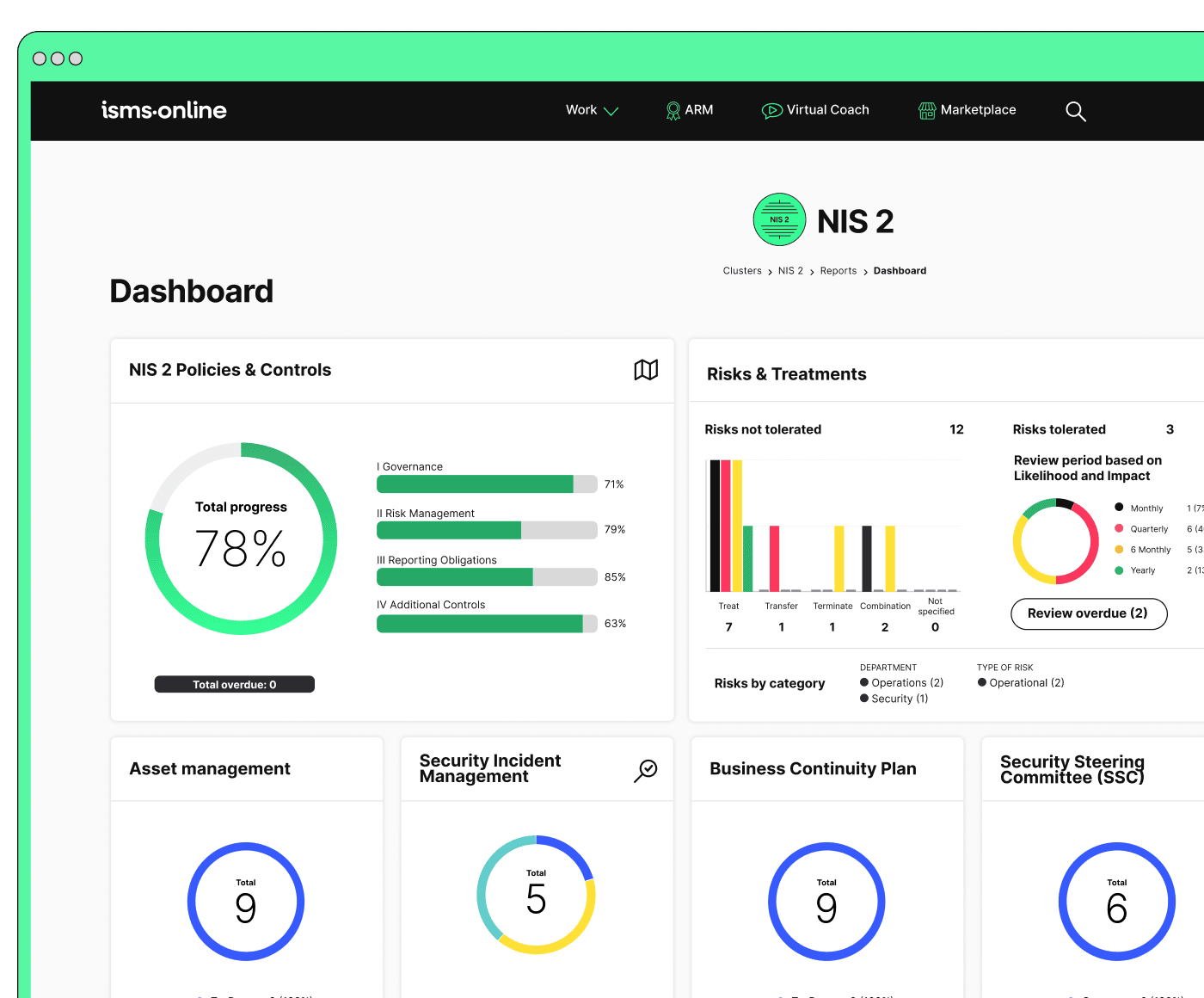
Be NIS 2-ready from day one
Launch with a proven workspace and templates – just tailor, assign, and go.
How Do You Map ISO 27001 to NIS 2? From Control to Living Evidence
ISO 27001 offers an unmatched foundation for structured controls and policies, but the game changer is mapping these controls into the living, traceable evidence streams that NIS 2 demands.
Key move: Use mapping tools (e.g., ENISA, ISACA) only as the start. Build a living mapping system that ties every requirement to an in-motion control: a dashboard export, a chain-of-evidence workflow, a live approval, or a monthly board update.
| Expectation | Operationalisation | ISO 27001/Annex Ref |
|---|---|---|
| 24h incident notification to regulator | Incident playbook, incident log | A.5, 6.1.3 |
| Board accountability for security | Training records, risk committee | 5.1, 5.2, 9.3 |
| Supplier risk assessment & contract logs | Vendor register, contract review | A.15.1, 15.2, 6.1.2 |
“Effective mapping only works when each check has a living artefact-proof you can surface instantly.”
Confidence Trigger
Create links between mappings and dashboard exports, live logs, or workflow screenshots. You’ll convert mapping from a risk register into living proof-empowering you to win any audit review.
Traceability: The Next Compliance Frontier-From Trigger to Living Evidence
NIS 2 makes traceability-the clear, time-stamped chain from risk trigger to control action to evidence-non-negotiable. Auditors want to see not just control lists but living chains: who detected an issue, who owned the update, which policy it touched, and what evidence remains.
| Trigger | Risk Update | SoA/Control Link | Evidence Logged |
|---|---|---|---|
| Security incident | Breach registered | A.5, Art. 23 | Incident log, notification email |
| Board training session | Risk ownership move | 5.2, Art. 20/21 | Attendees, agenda, minutes |
| Vendor onboarding | Supply chain update | 6.1.2, 15.1 | Due diligence, contract |
Export and annotate these breadcrumbs at every major event-auditor confidence will track along with your operational readiness.
Proof is a chain, not a ticket.
Why Traditional Tooling Fails
Patchwork tracking-relying on Excel and generic document shares-collapses under traceability demands. ISMS platforms with role-based evidence linking, on-demand exports, and live status dashboards set you ahead.
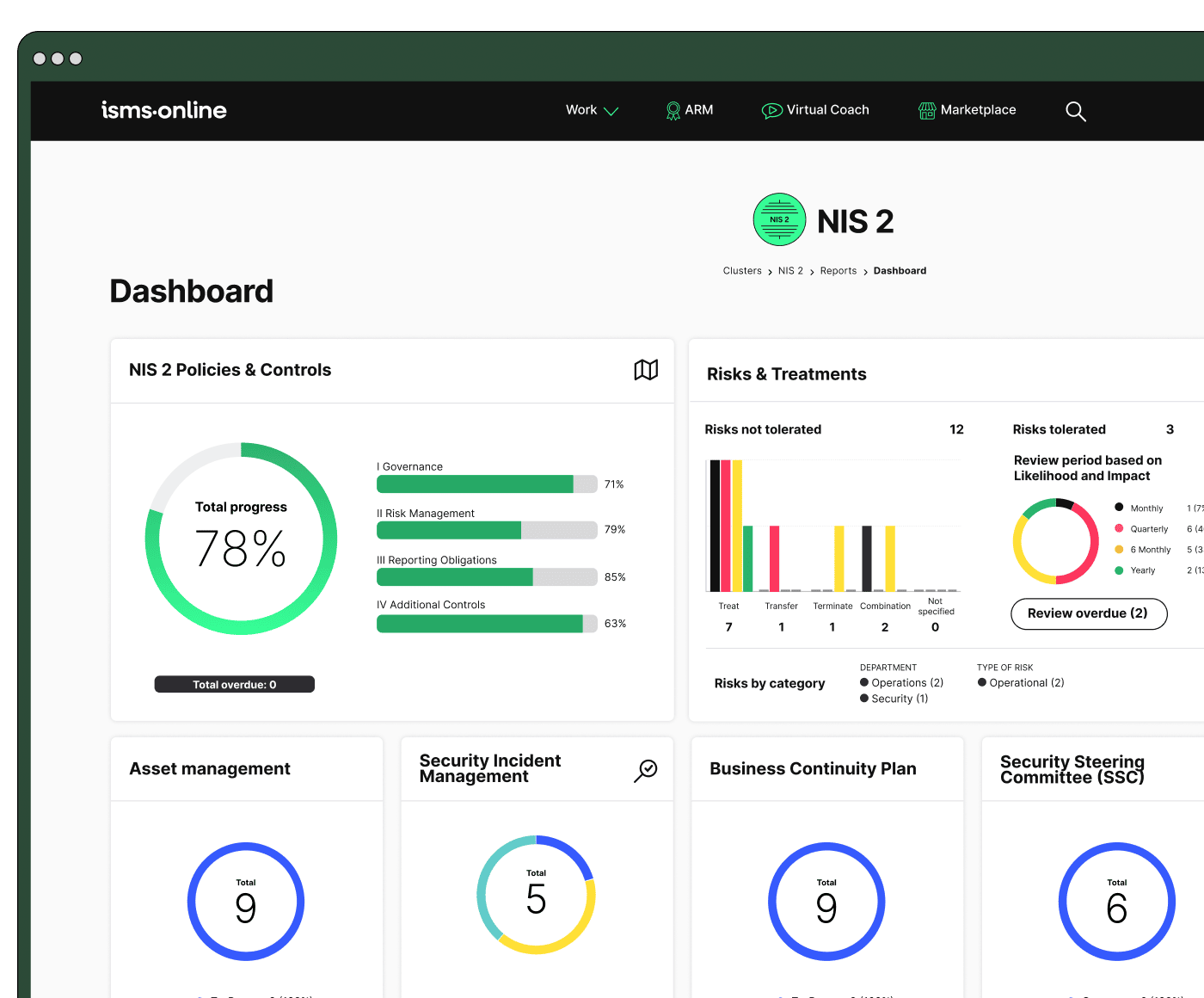
All your NIS 2, all in one place
From Articles 20–23 to audit plans – run and prove compliance, end-to-end.
What Do Sector and Board Audits Demand that ISO Alone Can’t Deliver?
Sector overlays drive up the demands: energy, finance, and digital infrastructure now require board-specific risk updates, sector-aware incident handling, and in-the-moment review evidence that ISO alone cannot supply (enisa.europa.eu, pwc.de).
Sector context is the new compliance differentiator.
Case Reminder: When a healthcare provider was spot-audited, their historical ISO documentation was accepted, but inability to produce real-time board and incident evidence led to more stringent oversight and public reporting.
The guidance: build living overlays-dashboards and event-driven logs-into your model from Day 1.
How Do You Stay Ahead? From Paperwork to Living, Board-Ready Compliance
Routine trumps panic. Resilient teams embed monthly evidence reviews, live dashboard walk-throughs, incident simulations, and on-demand evidence exports as standard operating procedure-not as annual audit fire drills.
Resilience is confirmed when the board, auditor, and regulator all see the same up-to-date evidence, without scramble or delay.
Build your cadence:
- Monthly evidence walks: for your executive and board.
- Quarterly incident exercises,: each producing new evidence.
- Spot-checks: -screenshots, logs, and role-based exports-circulated without warning.
- Continuous traceability: in your ISMS, with every event and risk “breadcrumbed” and retrievable.
“Certainty in compliance is forged daily-not in a last-minute scramble.”
Take the leap from static, annual compliance to dynamic, living resilience. Lead as the team whose compliance is evident, export-ready, and trusted-by regulators, boards, and customers alike.
ISO 27001–NIS 2 Operationalisation: Traceability Table
| Expectation | Result in Practise | ISO 27001 / Annex Ref |
|---|---|---|
| Incident detected within 24h | Live log, exportable for authority review | A.5, 6.1.3 |
| Board annual review | Signed minutes, action owners tracked | 5.1, 5.2, 9.3 |
| Vendor contract reviewed on change | Contract and vendor register with dates | A.15.1, A.15.2 |
| Risk update after major event | Dashboard update, linked to SoA | 6.1.2, A.6.1 |
| Evidence logged for audit | Exported, time-stamped, role-linked | All controls |
| Trigger | Risk Update | SoA/Control Link | Evidence Logged |
|---|---|---|---|
| New SaaS vendor | Supply chain risk | 15.1, 15.2 | Due diligence, signed log |
| Cyber incident | Breach registry | 16.1, 6.1.3 | Incident log, email, export |
| Role change in ops | Updated ownership | 5.2, 9.3 | Signed agenda, meeting note |
Ready to move beyond paper compliance? ISMS.online delivers board-ready, role-anchored, and sector-tuned living evidence-and keeps you ahead of the evolving regulatory curve.
Frequently Asked Questions
Who in your organisation is legally accountable for aligning ISO 27001 with NIS 2-board or operational leads?
NIS 2 anchors non-transferable legal accountability at the board or management body level-even when day-to-day evidence work is split across operational leads. Unlike legacy compliance models, executive directors must personally “own” continuous cyber risk oversight, with decisions and actions formally minuted and linked to routine risk management (NIS 2 Art. 20; ENISA, 2023). While your information security or compliance manager coordinates the evidence, the board cannot simply delegate its responsibility. Evidence must show the board’s active engagement-recurring cyber risk discussions, signed-off action logs, and explicit approval of compliance gaps and remedies. Operational managers should ensure every critical process (e.g., incident notification, vendor due diligence, staff and board training) has a named evidence owner, traceable evidence trail, and live status. The most effective organisations create a cadence of board-reviewed compliance dashboards and rolling registers, making governance visible and defensible at every meeting-not just at audit time.
Practical board–operational division
- Board: Cyber risk as a standing agenda, documented sign-offs, formal action logs, proof of attendance and engagement in security matters.
- Operational leads: Named evidence registrars for incidences, vendors, logs, and training, feeding live status into dashboards.
- Audit-readiness: Rolling evidence reviews, not “annual uplift”; rapid access to export-ready proof for any regulatory inquiry.
Boards must demonstrate daily ownership of cyber oversight-delegation is support, not escape, from liability.
Why is ISO 27001 on its own never enough for NIS 2-and how real are the risks?
Treating a valid ISO 27001 certificate as “job done” for NIS 2 compliance exposes the company-and its directors-to significant regulatory, financial, and personal exposure. NIS 2 allows for personal liability for directors if incident reporting, supply chain diligence, or board engagement requirements are missed-even if the certificate is up to date (NIS 2 Art. 20; ENISA, 2023). Recent audits and enforcement actions in Germany, Belgium, and the Netherlands show that boards relying on annual certifications without live, role-attributed oversight have been fined and publicly named-sometimes resulting in loss of key contracts or market trust. D&O insurance may specifically exclude coverage if legal duties set by NIS 2 are not fulfilled in substance, not just in form. Real resilience (and legal shelter) only comes with continuous, evidenced proof of board oversight, real-time risk logging, and actionable engagement records.
Cascading risks if you “just” rely on ISO 27001
| Risk Type | ISO 27001-Only Outcome | NIS 2 Outcome |
|---|---|---|
| Legal | Certificate suffices until an event | Board can be fined and prosecuted for inaction |
| Reputational | “Certified” status perceived as safe | Regulatory notices/fines destroy trust |
| Insurance | D&O covers “compliance programme” | Gaps can void claim for NIS 2-specific duties |
| Tender/Client | Certification unlocks tenders | Non-compliance blocks deals instantly |
How can you confidently map ISO 27001 controls to every NIS 2 requirement-and spot the real gaps?
Start by turning your ISO 27001 system from an “annual audit archive” into a living compliance map. Use your Statement of Applicability (SoA), risk register, and control documents as the core, then apply a reliable NIS 2 mapping framework (see ENISA or leading national authority crosswalks). For each NIS 2 clause, explicitly link the matching ISO controls and note where ISO’s process, pace, or scope falls short (e.g., ISO requires an incident log, NIS 2 requires formal notification within 24/72h and live tracking). Invite Legal, Security, HR, and board sponsors to stress-test the mapping in quarterly review cycles. Any “evidence orphan”-a NIS 2 demand with no matching, live, role-attributed proof-must be filled with a new operational process and ready-to-export artefact.
ISO 27001–NIS 2 Cross-Mapping Table (Audit-Ready Example)
| NIS 2 Article/Obligation | Operational Practise | ISO 27001/Annex A Ref |
|---|---|---|
| Board cyber-security oversight | Signed board agendas/minutes and recurring risk reviews | 5.3, 9.3, A.6.3 |
| 24h/72h incident notification | Automated incident reports, log exports and notifications | A.5.24, A.5.26 |
| Supply chain risk management | Vendor review schedule, latest diligence + contracts | A.5.19–A.5.22 |
| Live evidence, rolling dashboards | Dynamic compliance dashboard with owner-stamped artefacts | 9.1, A.5.28, A.8.15 |
What happens if you present only ISO policies and certificates in a NIS 2 audit?
Presenting “paper-only” ISO 27001 policies or certificates during a NIS 2 audit is now a high-risk strategy. Regulators routinely flag static, unaudited evidence as superficial-and can issue fines, correction mandates, or even public notices naming your firm as noncompliant (Cristie Cyber, s-rminform, 2024). Auditors now expect on-demand, exportable logs for incidents, real proof of vendor diligence, and-most crucially-signed board minutes demonstrating risk oversight and action. Continuous logs, live dashboards, and role-attributed registers are the minimum; presenting last year’s evidence file or a one-off report is viewed as evidence of neglect. Every single regulatory enforcement in the past year penalised firms that could not demonstrate both current and historical proof of action, ownership, and traceability.
Proof Table: Evidence That Passes Scrutiny
| Operational Trigger | Action Documented | Control/Annex Link | Logged Proof (Exportable) |
|---|---|---|---|
| New SaaS vendor onboarded | Diligence file and review signed | A.5.19–A.5.22 | Vendor file, sign-off, date/timestamp |
| Security incident triggered | Incident update, notification sent | A.5.24–A.5.26 | Logfile, email export, owner/name |
| Board quarterly risk review | Risk actions, sign-offs minuted | 5.3, 9.3, A.6.3 | Signed agenda, action log, attendee |
Which NIS 2 tripwires most often trigger audit failures for ISO 27001-certified companies-and how can you sidestep them?
The main failure points for NIS 2 audits among ISO 27001-certified organisations are:
- Incident notification timelines: No 24h/72h log exports, or notifications not traceable to named owners.
- Vendor/supply chain diligence: Outdated risk files, lack of escalation process, or no proof of remedial action.
- Board engagement: Lack of routine minuted attendance, cyber-risk on agendas, or training records for directors.
- Sector overlays: Healthcare/digital/energy companies missing overlays beyond ISO’s general controls.
- Continuous evidence: Relying on annual audits rather than rolling, live dashboards.
Sidestep failures by embedding ownership-assigning a named lead for each compliance pillar (incidents, supply chain, board training). Schedule exports and board reviews at least quarterly. Review mapping and evidence status after each significant change-breach, audit, or regulatory update. Broaden your compliance lens: ISO 27001 sets the floor, not the ceiling. Responsive systems trump rigid documentation every time.
What forms of evidence do NIS 2 regulators and auditors actually accept-and what makes for “exemplary” compliance?
Regulators accept and reward live, role-attributed, routinely exportable evidence:
- Incident logs and notifications: Automated, time-stamped logs and copies of DPA notifications, owned by a named staff member, with exports on request.
- Board training and meeting records: Signed attendance, cyber-risk matters as a recurring agenda point, minuted actions and follow-up.
- Vendor diligence: Up-to-date, owner-stamped files tracking onboarding, reviews, escalation, and exit/termination actions.
- Rolling evidence dashboards: Not just annual audits-proof should be visible, assignable, and ready for demonstration *any day of the week*.
- Sector overlays: For regulated sectors, maintain overlays mapped to both NIS 2 and sector regulation, with assigned local and group owners.
- Map every artefact both ways: One click traces evidence to both NIS 2 clause and ISO 27001/Annex A ref-supporting both regulatory and internal audits.
Audit readiness is a living discipline-organisations that prove daily compliance turn regulatory liability into a leadership asset.
When you shift from periodic paperwork to rolling, owner-driven compliance, you erase doubt from every room-be it the board, a regulator’s office, or your client’s next contract review. Your board, your market, and your customers will notice the difference. ISMS.online makes this shift operational: real-time evidence dashboards, automated mapping, and live review so you’re ready for the audit the day it’s called. See how your compliance team can transform NIS 2 from chore to confidence with a tailored walk-through focused on your priorities.






