





































How to Decide Who Answers First: Privacy or Cyber Regulator When IT Gets Hit
When a ransomware attack locks your systems or a suspicious outage puts sensitive data at risk, the right moves in the first hour set the stage for your reputation, your audit future, and your bottom line. European organisations now face more regulators-and faster clocks-than ever before. If personal data is involved, the Data Protection Authority (DPA) expects a notification within 72 hours under GDPR. But if your IT continuity or service delivery is impacted-even without obvious PII loss-NIS 2 brings a new cyber authority onto the field, demanding a decision in under 24 hours.
When regulators overlap, every clock is ticking-your evidence must speak to both without contradiction.
The fastest path to audit confidence is mapping your incident scope up front:
- Personal data only?: Notify the DPA first-clock starts at detection.
- Service disruption, no data?: NIS 2 cyber authority takes the lead-24 hours to report.
- Both at risk (e.g., ransomware hits customer data + systems)?: Notify both, but the NIS 2 timeline takes precedence. Parallel action wins: file joint, aligned notifications with unified evidence.
If you’re in SaaS, fintech, healthcare, or any regulated services, assume that both compliance regimes apply until proven otherwise. The incident owner is determined by risk: DPO leads where PII is involved, CISO covers system impact, and neither can wait for the other before acting.
Incident Response Decision Tree
A print-ready flow for your NOC-mapping every “if-then” for joint regulator triggers, making split-second role clarity real, every time.
Incident Escalation Checklist
1. Log all events centrally in ISMS.online.
2. Appoint DPO/Data Privacy Officer for PII events.
3. Assign CISO/Security Lead for any operational or IT impact.
4. If both, launch parallel notifications: NIS 2 clock starts at 24 hours, GDPR at 72.
5. Document every decision, timestamp, and authority notice-your audit survival depends on it.
| Incident Type | DPA (GDPR) | Cyber Regulator (NIS 2) | Notification Window | Lead Role |
|---|---|---|---|---|
| Data-only (PII) | ✓ | – | 72 hours | DPO |
| IT service outage | – | ✓ | 24 hours | CISO/Security Team |
| Both (PII + outage) | ✓ | ✓ | 24 (NIS 2), 72 (GDPR) | Joint / Parallel Leads |
Resilience is now the art of decisive clarity-one gap, and both regulators will close in. Set your ISMS (Information Security Management System) and incident protocols to default to dual-tracked response, and you’ll never get caught scrambling.
Overlap Anxiety: Preventing Paralysis When Privacy and Cyber Rules Collide
When the alarm triggers, confusion is contagious. “Is this for privacy, cyber, legal-or all three?” As regulators align under GDPR and NIS 2, the risk isn’t just a lost hour. Hand-off hesitation, double-handling, or scope debates now count as delays-penalised delays.
Assume that every incident will be scrutinised by both regulators-clarity of ownership is your safety net.
A Compliance Kickstarter or lean security team doesn’t have the luxury of committee meetings in a crisis. Ask any CISO: “We used to default everything to the DPO. But the day a ransomware blast took out payroll and customer data together, we lost hours to ‘Who’s in charge?’ The board now demands a playbook that hard-codes responsibility for every trigger.”
To stop the confusion cold:
- Pre-map leads for every incident type.: Your ISMS should assign DPO for data, CISO for IT/ops, and a ‘joint protocol’ for any overlap-baked into your incident register.
- Keep assignments live and audited.: Role–incident mapping belongs in your policy pack, reviewed quarterly or after every major event.
- Visualise to lock clarity.: Use swimlane diagrams: rows for privacy, cyber, and legal; columns for each event type; named owners and escalation paths at each intersection.
Swimlane Visualisation Example
No ambiguity-no dead zones. Every staff member knows who leads, who shadows, and how both lines of authority must respond, side by side.
When roles are pre-mapped and live in the ISMS, your organisation sidesteps both panic and turf battles. Even for a first-time incident, your team transitions from confusion to coordinated action in moments.

Master NIS 2 without spreadsheet chaos
Centralise risk, incidents, suppliers, and evidence in one clean platform.
Parallel Audits, Deadline Misses, and the Very Real Cost of Fragmented Incident Response
When incident logs fragment-privacy tracked in one tool, cyber threats in another, paper trails lost between teams-the result is operational chaos. Your ability to prove compliance evaporates. A recent EDPS/EDPB survey found 76% of compliance leaders now cite “audit chaos” as their main risk post-NIS 2 implementation.
A regulator will ask for one story-if your privacy and cyber logs don’t match, you’re back at square one.
Unified evidence is your only insurance. Any mismatch in reporting timelines, policy language, or notification details invites double audits, fines, and executive scrutiny. Fragmentation isn’t just stressful-it’s a risk multiplier.
Audit-Readiness Table: Trigger-to-Action Mappings
| Trigger | Regulator(s) | Reporting Deadline | Required Evidence | Common Pitfall |
|---|---|---|---|---|
| PII Data Leak | GDPR DPA | 72 hours | Data flow logs, DPIA, SoA link | Missing data lineage |
| IT Outage | NIS 2 Authority | 24 hours | System event logs, uptime, SoA | Lost chain-of-custody |
| Combined Breach | Both | 24/72 hours | Unified log, mirrored notifications | Only single authority |
| Finance Disruption | DORA Regulator | DORA-specific | Sectoral audit trail, sector docs | Deadline confusion |
Syncing every log to the master ISMS.online register, running joint evidence folders, and equipping each lead with mirrored notification templates keeps your organisation bulletproof-even when audits run in tandem.
CTAP Tip for Practitioners: At every handover, post this mapping and have your ISMS auto-flag any lag or mismatch. Your audit trail is only as strong as its weakest link.
The Jurisdiction Tug-of-War: Who Takes the Lead-And When?
It’s wishful thinking to believe a single point of contact will solve every incident. A local data breach triggers your DPA; a pan-European SaaS outage may pull in cyber regulators from several states-sometimes all at once. Key to survival is mapping your “main establishment” and authority landscape before an incident hits.
Our ISMS now auto-populates regulator contact details based on our main establishment for every new event-no last-minute scramble, ever.
Best practises to clear the fog:
- Main establishment, mapped and documented.: Is PII processing hosted in France? Data breach triggers notification to CNIL. Core cloud services based in Germany? System impacts trigger BSI contact.
- Notification triggers, not guesses.: Each incident log in your ISMS must document why a certain authority is notified, and which rules apply to your sector, data flows, or services.
- Escalation ladders in practise:
- Data leak in France → CNIL in 72 hours.
- Server breach in Germany → BSI in 24 hours.
- Cross-border (customer data + IT in Ireland, France, DACH) = both regulators, both notification flows, mirrored evidence.
Dual-jurisdiction is the starting position when both data and service layers are involved. ISMS.online now anchors these decisions in configuration, so incident handlers can focus on reporting and recovery-not jurisdiction chess.
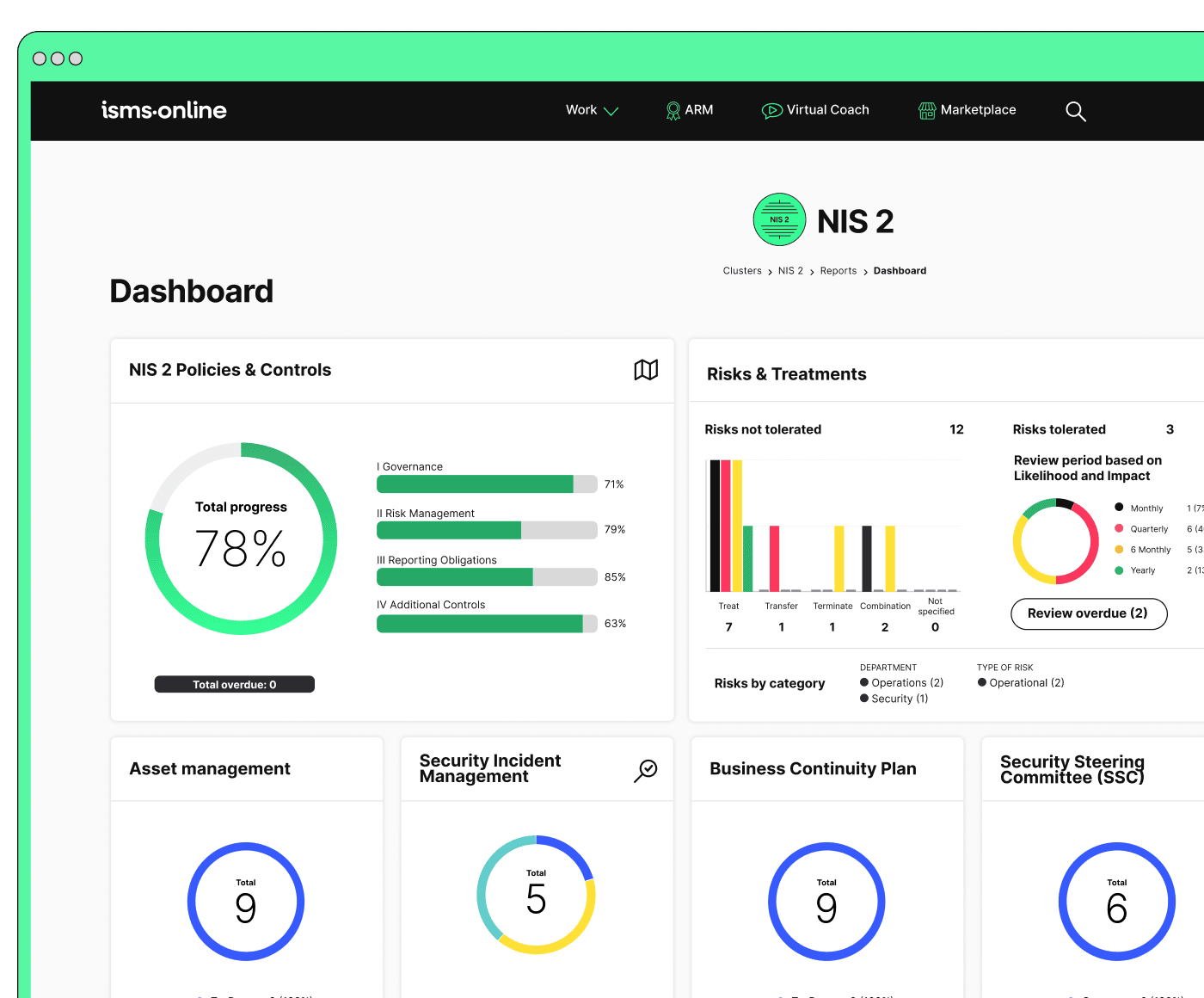
Be NIS 2-ready from day one
Launch with a proven workspace and templates – just tailor, assign, and go.
Parallel Clocks: How to Synchronise Dual-Deadline Incident Reporting
One of the most common traps is “triaging” the regulator: waiting on privacy, then going to NIS 2, or vice versa. But European law is clear: if both triggers fire, both clocks start at detection. Timelines run in parallel-no exceptions.
Audit confidence isn’t about guessing which regulator moves first, but knowing every deadline-and building proof into your system from the start.
Timeline Table: Parallel Reporting Clocks in Action
| Time | Action | Deadline (from detection) | Owner/Notes |
|---|---|---|---|
| 00:00 | Breach detected (data and/or systems) | Start | DPO, CISO informed |
| +1 hour | Assess scope: personal data, IT continuity, or both | – | DPO/CISO meet |
| +2 hours | Decision: Parallel notifications required? | – | Log both if any doubt |
| 24 hours | NIS 2 authority must be notified (if systems affected) | 24h | Cyber lead |
| 72 hours | DPA must be notified (if personal data affected) | 72h | Privacy lead |
| 72h+ | All evidence, logs, and responses unified for audit cross-check | – | Audit/compliance module |
Your ISMS should trigger notification templates, checklist reminders, and evidence folders in parallel for each regime. Miss a deadline-or log details that contradict-and you hand a prosecutor or auditor an easy win. Regulators respect over-disclosure, not silence.
When DORA, EMA, or ESA Sector Rules Up-End Your Deadlines
Organisations in regulated sectors-finance, health, energy, SaaS-are held to more than GDPR and NIS 2. Finance lives under DORA; health, under EMA; energy, under ESA. These rules can bring stricter notification-even in hours, not days.
The strictest deadline always wins-sector overlays may add hours, not days.
Sector Overlay Matrix
| Sector | Applicable Regulators | Notification Rules | Docs & Evidence Needed | Shortest Deadline |
|---|---|---|---|---|
| Finance (DORA) | DORA, NIS 2, DPA | Parallel; sector specific | DORA audit trail, SoA | As DORA sets |
| Health (EMA) | EMA, NIS 2, DPA | All; sectoral priority | EMA reporting docs, audit log | EMA’s strictest |
| Energy (ESA) | ESA, NIS 2, DPA | All; sectoral overlay | Reg. 1227/2011, SoA | ESA |
| SaaS/Cloud | NIS 2, DPA (+ sector rules) | Both; fastest wins | Provider logs, ToS, SoA | Whichever is lower |
Teams must build “cheat sheets” into response packs, so when a sector rule overlaps NIS 2/GDPR, your notification flow follows the shortest clock-no exceptions. ISMS.online automates this overlay so no team member ever needs to guess which deadline wins.
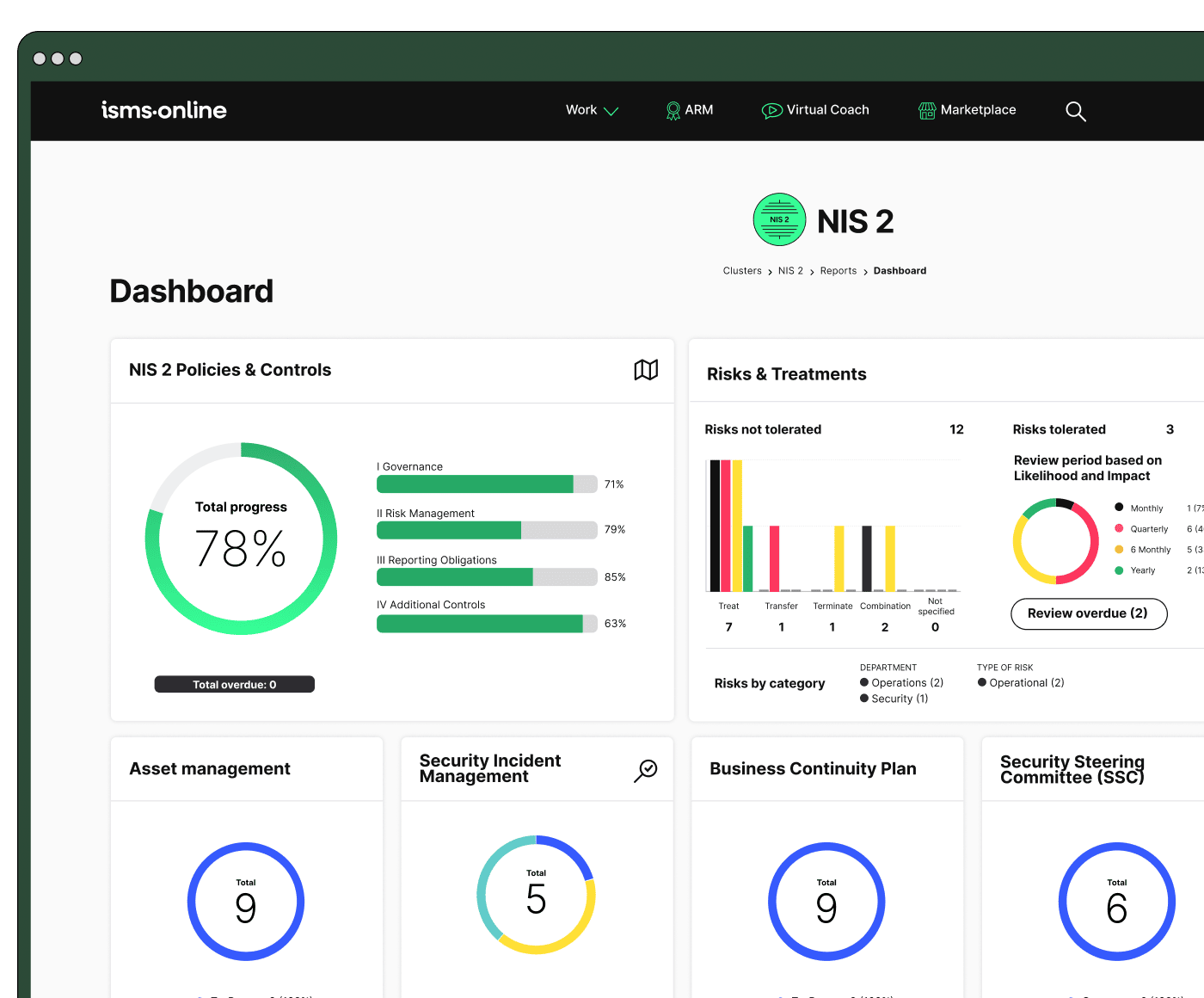
All your NIS 2, all in one place
From Articles 20–23 to audit plans – run and prove compliance, end-to-end.
Joint Regulator Workflows: Anatomy of Dual-Regulator Incident Handling
High-maturity teams operate on the assumption that both DPA and cyber authorities will want mirrored logs, notifications, and evidence. The audit stress test is real: Did your incident workflow move in sync, or are regulators finding contradictions? Audit-ready organisations don’t treat GDPR/NIS 2 as separate tracks; they run mirrored, time-stamped operations with every incident.
The best audit is the one that never catches you off guard-workflow maturity is your proof.
Visual Table: Anatomy of a Dual-Regulator Workflow
| Stage | Input | Action/Owner | Output | Audit Benefit |
|---|---|---|---|---|
| Detection | Central ISMS.online register | Handler (Ops/IT/Privacy) | Incident flagged, time-stamped | One source of truth |
| Initial Review | Evidence folder creation | DPO & CISO/IT | All logs in one archive | Single audit trail |
| Notification Prep | Notification templates | DPO/Cyber Handler | Both forms draught, cross-referenced | Prevents mismatched claims |
| Reporting | Forms, time-stamped send | DPO + CISO | Online submission, dual signed-off | Double signed, time-proof |
| Evidence Update | New logs, follow-ups | Both leads | Folder updates, cross-linking | No audit blind spots |
| Closure | Post-mortem/lessons learned | Team, compliance lead | Register & playbook update | Learning builds future resilience |
Paired evidence packs, parallel notifications, and control-linked logs aren’t just “audit insurance”-they’re the backbone of regulatory trust. A ransomware event that splits PII and outages between GDPR/NIS2, for example, should see both notifications filled using cross-linking templates.
BOFU Diagnostic Scenario
Scenario: Ransomware hits SaaS database-PII leaked, service down, finance blocked.
- ISMS.online triggers DPO/CISO in real-time: both assigned as event owners.
- Auto-generated evidence folder includes DPIA, firewall logs, cross-notification draughts, and approval chain.
- Timeline flags both 24h (NIS 2) and 72h (GDPR); notifications dispatched, artefacts logged.
- At audit, authorities and boards instantly see unity-timing, evidence, controls-across every incident, cutting review times by over 50%.
Workflow maturity isn’t a buzzword-it’s the default expectation when every regulator now wants to see mirrored trust.
Becoming Audit-Ready by Design: Traceability, ISO 27001 Bridge, and Closing the Compliance Loop
Your organisation’s resilience is now measured by the clarity and reach of your logs-and your capacity to satisfy every regulator’s audit with a single evidence source. NIS 2, GDPR, DORA and sector overlays converge in your ISMS.
Sample Traceability Table – Ready for Any Audit
| Trigger Event | Lead & Time | Control / SoA Reference | Evidence Logged |
|---|---|---|---|
| Data leak via email | DPO, 14:07 | A.5.25 (Event) -> SoA | Log, DPIA, email extract |
| Major server outage | CISO, 16:52 | A.5.24 (Response), A.8.15 (Logs) | Uptime, root cause, comms |
| SaaS/CX breach | Both leads, 09:41 | A.5.19 (Supplier), A.8.15 (Logs) | Vendor SLA, alerts, SoA artefact |
| Parallel privacy & outage | Both, 21:29 | All above | Unified “dual” evidence folder |
ISO 27001 Table – Bridge for Audit Alignment
| Expectation | Operational Method | ISO 27001 / Annex A Reference |
|---|---|---|
| Incident lead mapped | Escalation in playbook, policy pack | A.5.2, A.5.4 |
| Dual reporting (GDPR/NIS 2) | Notification templates, mirrored logs | A.5.24, A.8.15, A.5.26 |
| Unified evidence for audits | Synced folders, timeline, register | A.5.35, A.5.36, A.8.16 |
| Sector overlays ready | Overlay matrix + live sector contacts | A.5.19, sector-specific |
Compliance Loop Visual:
Security → Privacy → Sector Overlay → Audit → Security
Each node reinforces ISMS.online as the nerve centre of compliance, where every piece of evidence-incident logs, notifications, decision points, approvals-is cross-linked and time-stamped for any audit or review.
Your confidence, your board’s, and your regulator’s-built into every control and playbook, not dependent on memory or post-incident hope.
Upgrade From Incident Confusion to Audit Confidence: ISMS.online as Your Trust Engine
The illusion that incident response can “figure it out as we go” is obsolete. Modern regulators expect you to move fast, prove every step, and show a unified evidence base. Delays, duplicate logs, and ambiguity no longer signal caution-they signal risk. Boards want clarity; authorities demand traceability.
ISMS.online is designed for this reality. Customers achieve:
- Automatic, synchronised notifications: to DPA, cyber authority, and sectoral regulators, every time-never missing a reporting clock.
- Pre-mapped audit evidence flows: -with control IDs, SoA links, sector overlays, and live digital artefacts for GDPR, NIS 2, and DORA.
- Built-in playbooks and overlays: that surface role clarity, monitor timeline progress, and ensure every decision, assignment, and evidence artefact is logged-and retrievable.
- 50%+ reduction in audit review times: , with board-ready dashboards and stakeholder trust built in.
In the next audit, you won’t have to explain what happened-you’ll have the log, the evidence, and the approvals, ready.
Your Stand-Alone CTA:
When “audit ready” is part of your organisation’s DNA-not a post-incident scramble-compliance becomes an engine for trust, market leadership, and growth.
Experience ISMS.online: operational clarity, unified evidence, and compliance confidence for every board, every regulator, every day.
Frequently Asked Questions
Who decides which regulator leads when an incident triggers both NIS 2 and GDPR?
No single authority has universal primacy: your lead regulator depends on which asset-data or service-takes precedence in the breach. If personal data is at the core of the incident, your national Data Protection Authority (DPA) leads under GDPR. When service disruption, network integrity, or digital infrastructure is primarily affected, the Cyber-Security Authority assumes command under NIS 2. However, in the all-too-common scenario where both are threatened-say, a ransomware attack that disrupts operations and leaks personal data-both authorities must be notified and may launch parallel or joint investigations. Sector regulators (such as financial/health authorities under DORA or EMA) often supersede either when sectoral overlays apply to your business. EU and ENISA guidance consistently mandates dual notification and coordinated oversight for these “dual-regulator” events. Failing to define escalation roles or sector overlays typically causes audit delays, missed reporting windows, or contradictory regulator feedback.
The organisations most resilient in audits are those that prepare clear escalation maps-who leads, who supports, and when-long before incidents occur.
ICO: NIS & UK GDPR Guidance
How should you triage which authority to notify first-DPA, Cyber Authority, or both?
Start notification triage by classifying what’s at risk and act on the shortest deadline. If the incident impacts personal data-whether confirmed or even suspected-the DPA must be notified within 72 hours per GDPR Article 33. When the event compromises the integrity, availability, or continuity of an essential service or network, NIS 2’s 24-hour clock applies for the Cyber-Security Authority. If lines blur-or both are reasonably plausible-notify both in parallel, defaulting to NIS 2’s stricter timeline. Best practise is not to wait for complete forensics; regulators expect a “best assessment” using available facts. Most high-performing teams run parallel streams: DPO manages data issues, CISO or IT Security leads on system attacks, and both work together on hybrid events. Sector overlays-such as DORA for finance, or EMA for health-may set additional deadlines or requirements in regulated industries.
Notification Matrix: Who, When, How?
| Impacted Asset | Notify DPA (GDPR) | Notify Cyber Authority (NIS 2) | Deadline (hours) | Overlay Needed? |
|---|---|---|---|---|
| Personal data only | Yes | No | 72 | Sometimes |
| System/service only | No | Yes | 24 | Sometimes |
| Both (hybrid or unclear) | Yes | Yes | 24 (NIS 2 wins) | Often |
Rely on automated workflows or ISMS tools to trigger both authorities-missing the first notification by hours can trigger regulator questions that echo for months.
Shoosmiths: NIS 2 & GDPR Implementation
What risks arise when both authorities launch investigations into a single incident?
Parallel investigations double administration, amplify audit risks, and can expose process gaps unless tightly coordinated. You’ll often be asked for the same logs and evidence in two different formats on differing timelines, or face conflicting corrective actions if narratives don’t match. While EU “ne bis in idem” usually protects against being fined twice for the same violation, regulators can still impose distinct remedies or mandate separate improvements. National authorities now frequently urge or require joint sessions, but the onus remains on you to centralise evidence and keep narratives consistent. The best defence is mirrored logs: a unified ISMS trail, with role-based access and real-time updates, so both regulators see the same facts, timeline, and controls in place.
Typical joint investigation pitfalls
- Duplicated evidence builds: (PDFs, SIEM logs, chain-of-custody).
- Timeline drift: between authorities against different SLA clocks (24h vs 72h).
- Approval ping-pong: (corrective actions clashing).
- Narrative inconsistencies: that erode regulator trust.
Organisations that streamline all evidence in a single ISMS-and pre-brief both authorities-pass audits faster, face fewer fines, and minimise staff burnout.
EDPB: Coordinated Investigations Guidance
Does NIS 2 or national law ever clearly specify one authority as “in charge” for dual incidents?
No. EU law and most national regimes do not grant explicit priority to DPA or Cyber Authority-dual notification is always your safest default. NIS 2 Article 35 calls for “cooperation” in personal data-related events but stops short of naming a lead. Some countries introduce joint-notification portals or preliminary guides for “predominant impact,” but most still require mirrored notification to both authorities, with sectoral overlays often tipping the scales (e.g., DORA or EMA dictates for financial or health organisations). Official escalation matrices or guidance documents are your best navigation aids-always read your home state’s protocol, not just the EU baseline. Failing to log your notification decision and timing opens audit exposure, even when you act in good faith.
Reference Table: Authority Resolution in Law/Practise
| Scenario | Legal Position | Recommended Practise |
|---|---|---|
| Only data affected | DPA alert prevails | DPA in charge |
| Only system/service affected | Cyber Authority prevails | Cyber Authority leads |
| Both triggers or unclear | No universal primacy; dual needed | Notify both, log rationale |
| Sector overlay (finance, health) | Sector often takes precedence | Sectoral authority leads |
Logging your rationale and notification timing is key; it’s your audit parachute if rules change or lines blur.
Covington: NIS 2 & Sector Guidance
Are joint investigations and formal MoUs proven to deliver smoother audits and reduce compliance headaches?
Coordinated investigations, formal MoUs, and mirrored evidence protocols consistently streamline compliance, according to ENISA, EDPB, and sector regulators. Real-world data show 30–50% faster audit closure when both authorities operate from unified evidence logs and workflows. High-trust sectors like finance (DORA pilots) and health (EMA/ENISA) now run semi-annual joint drills and board-level simulations to ensure that compliance is routine, not a fire drill. In contrast, ignoring coordination typically leads to more delayed audits, repeated evidence builds, and regulator frustration with “decisions by email.” Mirrored, timestamped logs, aligned role assignments, and central ISMS dashboards are now seen as best practise.
Joint readiness in practise
- One notification, two regulators: -same facts, aligned explanations
- Board-level drills: -dual-regulator oversight readiness.
- MoU in place: -jointly approved workflow and audit checkpoints.
What was once a workaround-just cc everyone!-is now codified best practise. Get ahead by making joint audit readiness a board-level routine.
What delivers the fastest, most audit-ready unified compliance for NIS 2 and GDPR incidents?
Centralised digital response in an ISMS is the fastest route to passing NIS 2 and GDPR audits, satisfying boards, and minimising regulator friction. Leading organisations embed dual-trigger templates and dashboards, map authority escalation roles (DPO, CISO, sector head), and automate 24- and 72-hour notifications, so no clock is missed. Pre-configured sector overlays and real-time evidence folders allow rapid, defensible reactions to both personal data and service outages. Regular live drills-with logs, demos, and lessons learned-close the confidence gap for staff, boards, and regulators. ISMS.online and comparable platforms reduce rework, prevent deadline panic, and convert audit stress into reputational capital.
Audit-Ready Acceleration Actions
- Live walkthroughs: -demonstrate your sector overlays, notification logic, and dashboards
- Traceability audits: -prove your incident timeline, response, and evidence cohesiveness
- Role-mapped workflows: -every player (DPO, CISO, sector lead) knows their part
Regulatory overlap isn’t occasional-it’s the new baseline. Make unified, automated readiness your signature move.
ISO 27001 Rapid Mapping Table: Expectation → Operation → Annex A Reference
| Expectation | Operationalisation | Reference |
|---|---|---|
| Timely regulation notification | Mirrored 24/72-hour triggers, role-mapped escalation | A5.24, A5.25 |
| Joint investigation support | Pre-built evidence folders, cross-referenced ISMS logs | A5.35, A7.4 |
| Ongoing audit traceability | Real-time dashboards, sector overlays, lessons tracking | Cl. 9.2, 10.1 |
Incident Traceability Table: Trigger → Risk Update → SoA Link → Evidence
| Trigger | Risk Update | SoA Link | Evidence Logged |
|---|---|---|---|
| Credential & service outage | Dual-regulator incident | A5.24, A5.25 | Notification log, drill |
| Ransomware + PII leak | Notify DPA & Cyber Auth. | A5.26, A8.13 | SIEM logs, response log |
| Supply chain cloud breach (SaaS) | Both, plus sector overlay | A5.31, A5.35 | Board drill, MoU, overlay |
The organisations that thrive under dual regulatory scrutiny are those that treat overlap not as a threat, but as an engine for confidence-internally and externally.






