





































Cyber resilience is the ability to prepare for, withstand, recover from and adapt to cyber attacks, on the assumption that some attacks will get through. It accepts that perfect prevention is impossible, so it shifts the goal from never being breached to staying operational and trustworthy when a breach happens. Cyber resilience is what keeps the business running, and your data protected, even on a bad day.
- Prepare: know your assets, threats and controls, and plan how you will respond before an incident occurs.
- Withstand: contain attacks so they cause limited damage and critical services keep running.
- Recover: restore systems, data and operations quickly and in a known order.
- Adapt: learn from each incident and feed the lessons back into your controls and plans.
Cyber resilience vs cyber security
Cyber security and cyber resilience are related but they answer different questions. Cyber security tries to prevent attacks: firewalls, access controls, patching and monitoring all exist to keep attackers out. Cyber resilience starts from the assumption that some attacks will succeed anyway, and focuses on withstanding and recovering from them. You need both. Strong security reduces how often you are breached; resilience decides how badly a breach hurts you when prevention fails.

The practical difference is mindset. A pure security view measures success by the number of blocked threats. A resilience view measures success by how quickly you detect, contain and recover, and how little your customers notice. Treating the two as one thing is a common mistake: organisations invest heavily in prevention, then discover during a real incident that they have no rehearsed way to keep operating or to prove to regulators what happened.
Cyber resilience and the EU Cyber Resilience Act
The phrase “cyber resilience” is used in two distinct ways, and it helps to keep them apart. The first is the discipline described above: an organisation’s overall ability to absorb and recover from attacks. The second is the EU Cyber Resilience Act, a specific product-security law that sets cyber security requirements for products with digital elements sold in the EU, covering things like secure development, vulnerability handling and security updates across a product’s lifecycle.
The two overlap but are not the same. The Act is about the security of products you make or sell; cyber resilience the discipline is about the resilience of your whole organisation. Building organisational cyber resilience helps you meet product-level obligations, but it is broader. Other regulation pulls in the same direction: the EU’s NIS 2 Directive raises cyber resilience duties for essential and important entities, requiring risk management, incident handling and reporting that look a lot like the prepare, withstand, recover and adapt cycle.

There's a bigger picture behind this.
This page covers one part of business resilience. Real Resilience — IO’s framework for connecting security, privacy and AI governance — is where the full picture comes together.
How cyber resilience fits into business resilience
Cyber resilience is essential, but it is one input to a wider picture rather than the whole of it. Operational resilience is broader: it asks whether your important business services keep running through any disruption, whether that disruption is a cyber attack, a supplier failure, a power outage or a pandemic. Cyber resilience is the part of that picture concerned specifically with cyber threats.
Above both sits the question of business resilience as a whole, your organisation’s overall ability to anticipate disruption, keep operating and emerge stronger. The fragmentation trap is treating cyber resilience as a separate silo owned by IT, disconnected from continuity, privacy and risk. When those functions run on different tools and different evidence, no one has a single source of truth, response is slow, and the same control gets documented several times for several audits. Cyber resilience earns its value when it plugs into the wider resilience model rather than standing alone.
Cyber resilience and the Resilience Loop
Real cyber resilience needs more than security controls. The attacks that hurt most steal data and abuse trust, so resilience also depends on how you protect personal information and how you govern the AI systems you increasingly rely on. ISMS.online’s Resilience Loop treats these as one connected operating model rather than three separate programmes.
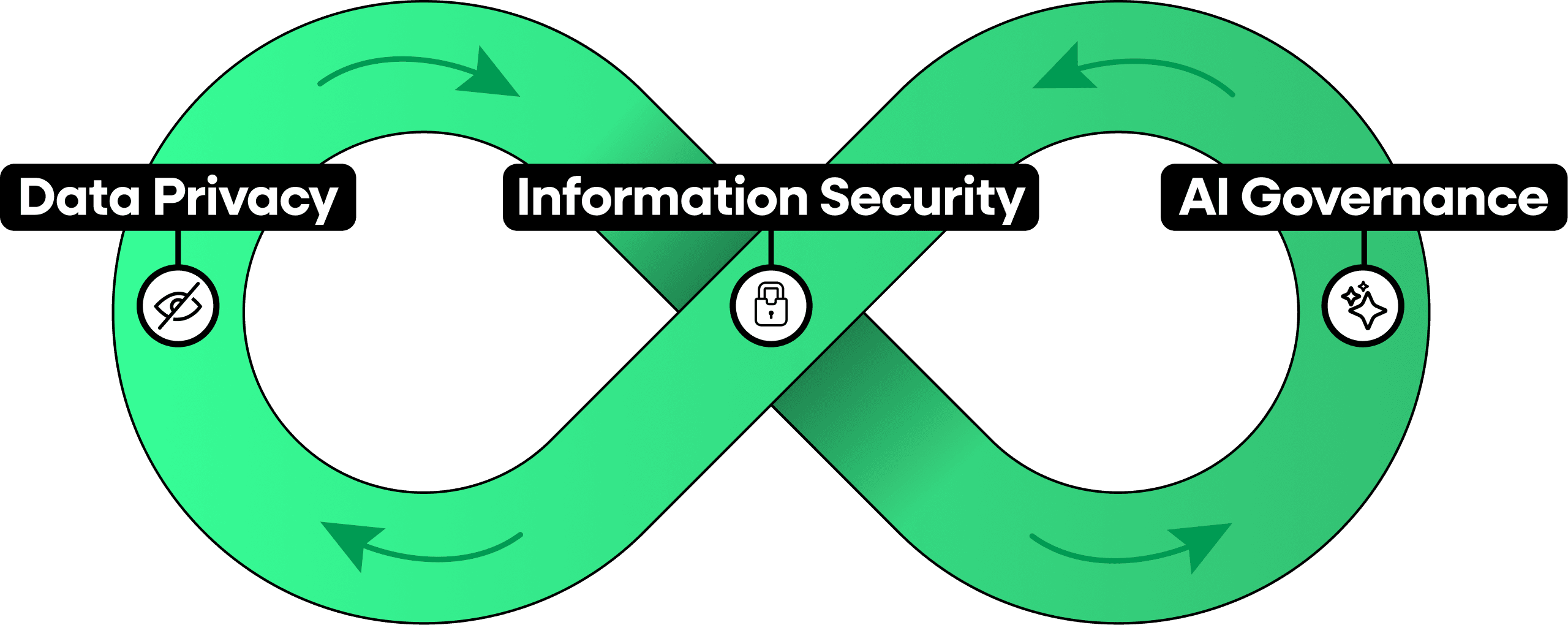
The Loop joins three domains into a single system:
- Information security: protect systems and data against attack, the core of cyber resilience, anchored by ISO 27001.
- Data privacy: govern personal data so a breach does not become a regulatory and trust crisis, anchored by ISO 27701.
- AI governance: manage the risks of the AI systems now woven through operations, anchored by ISO 42001.
Run these as one and a control mapped for security also serves privacy and AI governance, evidence captured once surfaces against every framework, and an incident is understood across all three lenses at the same time. That is what makes cyber resilience defensible rather than partial.

Manage all your compliance, all in one place
ISMS.online supports over 100 standards and regulations, giving you a single platform for all your compliance needs.
How to build cyber resilience
The biggest barrier to cyber resilience is not a lack of tools, it is fragmentation. When controls live in one system, evidence in spreadsheets, incident plans in a document no one has opened in a year, and audit prep in yet another place, you get duplicated effort, no single source of truth and a slow, uncertain response when something actually goes wrong. Resilience comes from joining these up.
The way to build it is a single chain that runs from controls to evidence to recovery:
- Shared controls: define one common control set, map each control once and reuse it across every framework instead of rebuilding it per standard.
- Shared evidence: capture proof once and surface it against ISO 27001, NIS 2, the EU Cyber Resilience Act and any other lens, so audits draw on the same current record.
- Faster response: with controls and evidence in one place, you detect, contain and report incidents quickly and consistently.
- Trustable posture and genuine resilience: a live, defensible view of where you stand, which is what lets you recover and adapt rather than scramble.
ISO 27001 is the certifiable core of this. It gives you a recognised information security management system, a risk-based control set and independent certification that proves your security is managed, not improvised. Because it is built around continual improvement, it directly supports the adapt step of cyber resilience. From there, the same approach extends to wider continuity and recovery: see how to build business resilience to take the chain beyond cyber into the whole organisation.
Two questions sit underneath that. The cyber resilience framework sets out which functions to cover and which recognised standards supply them. The cyber resilience strategy decides what you fund first when you cannot do everything at once.
Why choose ISMS.online for cyber resilience?
Most tools help you tick boxes. ISMS.online helps you build resilience you can prove.
- Cyber resilience you can evidence: connect controls, incident response and recovery to live proof, so resilience is demonstrable rather than assumed.
- One connected system: manage information security, data privacy and AI governance together in a single platform, not three disconnected tools.
- Certifiable by design: every action maps to ISO 27001, ISO 27701, ISO 42001 and ISO 22301, so your resilience is provable.
- Evidence on demand: show regulators, auditors and customers proof of resilience, not promises.
- Informed by deep expertise: guided implementation from real specialists, not no touch automation that hides the risk.
- Continuous, not periodic: a live view of your risk and controls, instead of an annual scramble before an audit.
- Built for regulated markets: designed for organisations where security, privacy and trust drive the buying decision.
Explore the ISMS.online business resilience platform to see how it works in practice.
FAQs
What is the difference between cyber security and cyber resilience?
Cyber security tries to prevent attacks from succeeding, while cyber resilience assumes some attacks will get through and focuses on withstanding and recovering from them. Security reduces how often you are breached; resilience limits the damage when a breach happens. You need both working together.
What is the EU Cyber Resilience Act?
The EU Cyber Resilience Act is a product-security law that sets cyber security requirements for products with digital elements sold in the EU, covering secure development, vulnerability handling and security updates across the product lifecycle. It is distinct from cyber resilience the discipline, which is about an organisation’s overall ability to withstand and recover from attacks.
How do you measure cyber resilience?
Measure cyber resilience by how well you prepare, withstand, recover and adapt rather than by blocked threats alone. Useful indicators include time to detect and contain an incident, time to recover critical services, coverage and currency of controls, results of tested recovery plans, and the strength of the evidence you can produce on demand. For a scored version of this using NIST’s four maturity tiers, see how to measure cyber resilience.
Is ISO 27001 a cyber resilience standard?
ISO 27001 is an information security management standard, and it is the certifiable core of cyber resilience. It provides a risk-based control set, independent certification and a continual improvement cycle that supports the adapt step of resilience. For full cyber resilience, pair it with continuity and recovery practices such as those in ISO 22301.






