





































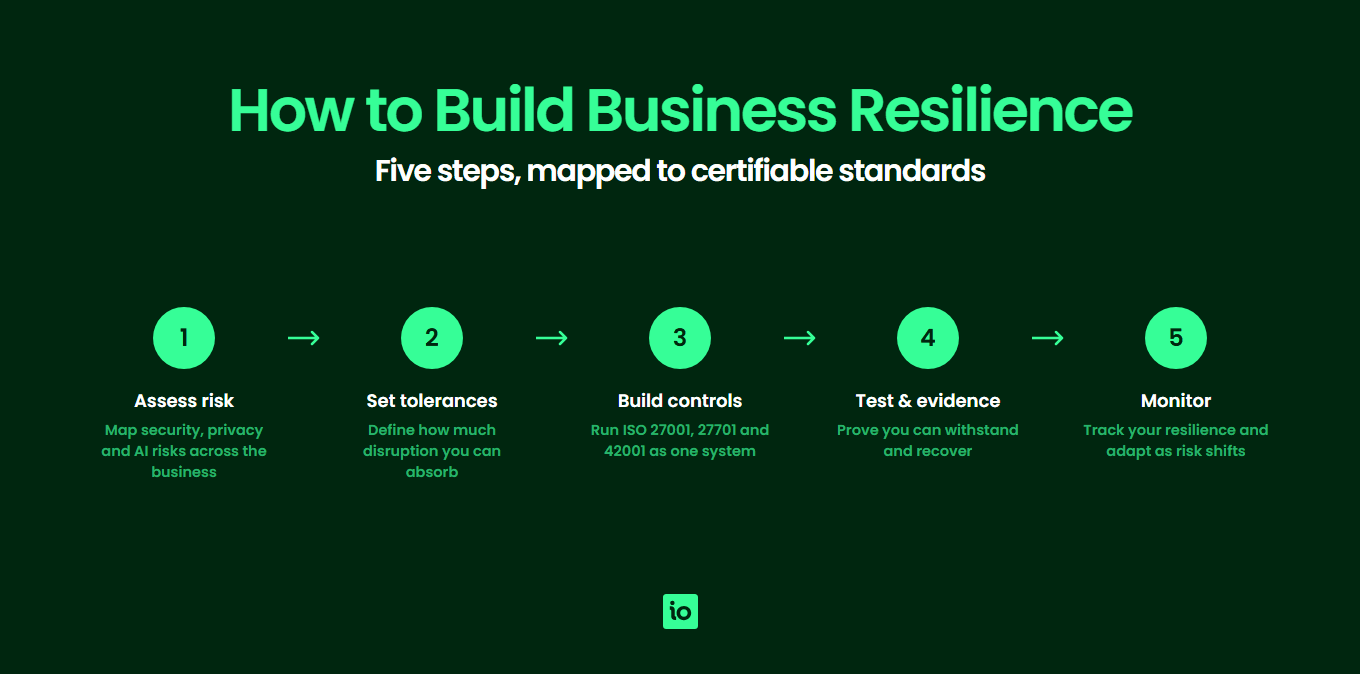
To build business resilience, work through five steps: assess your security, privacy and AI risks; set impact tolerances; build and connect your controls; test and evidence them; and monitor continuously. Done well, each step maps to a certifiable standard, so the resilience you build is resilience you can prove.
What makes a business resilient?
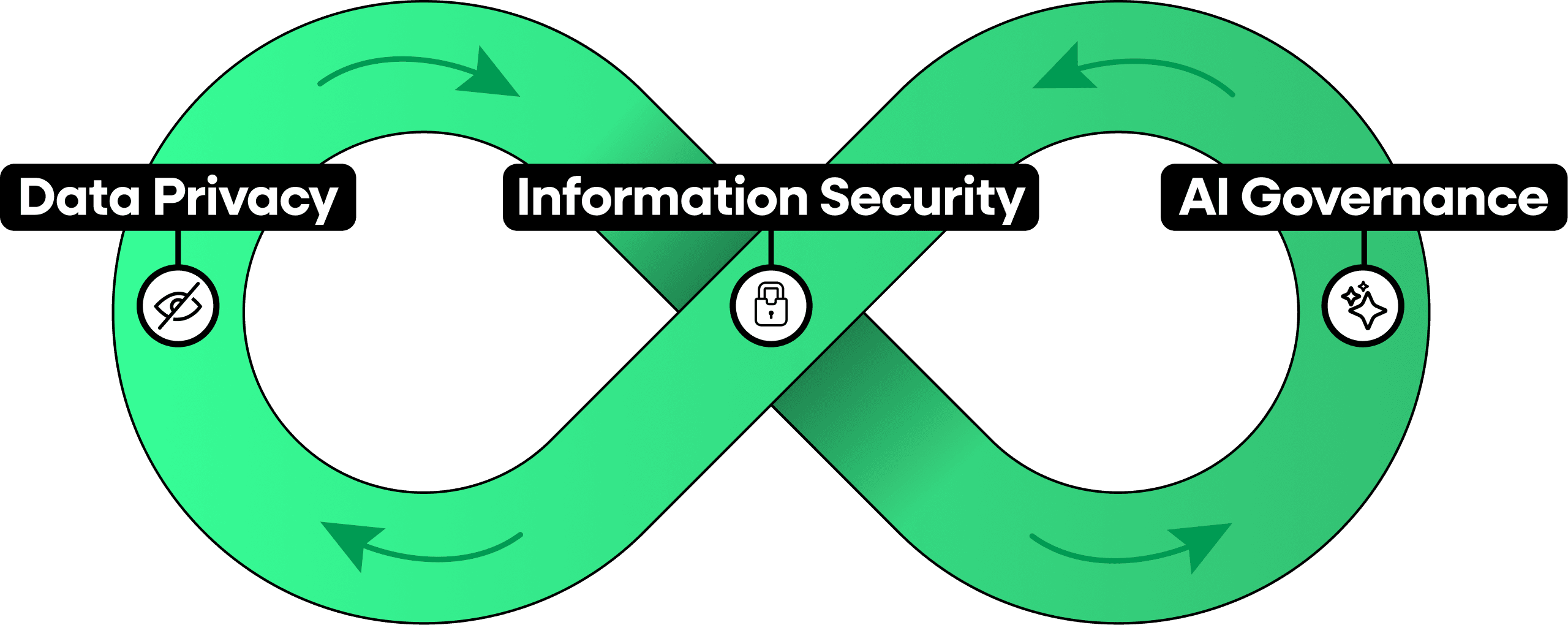
A resilient business is not the one with the most certificates. It is the one that can anticipate disruption, keep critical operations running, recover within agreed tolerances and adapt as risks change. That capability comes from managing security, privacy and AI risk as one connected system, the Resilience Loop, rather than as separate projects.

Get started easily with a personal product demo
One of our onboarding specialists will walk you through our platform to help you get started with confidence.
The five steps to build business resilience
1. Assess your risks
Start by mapping the risks across information security, data privacy and AI. A structured ISO 27001 risk assessment gives you the foundation, extended to cover privacy and AI so nothing falls through the gaps.
2. Set your impact tolerances
Decide how much disruption the business can absorb before it causes intolerable harm. This is the language UK regulators use in their operational resilience rules, and it turns “we should be resilient” into measurable targets.
3. Build and connect your controls
Implement your controls as one system rather than three. Running ISO 27001, ISO 27701 and ISO 42001 together is how the Resilience Loop becomes operational.
4. Test and evidence resilience
Run scenarios, test recovery and capture the evidence as you go. This is where the “prove it” advantage lives: you are not just claiming resilience, you are demonstrating it to regulators, auditors and customers.
5. Monitor continuously
Resilience is never finished. Track your controls and risks continuously, and adapt as threats, technology and regulation shift, so your evidence is always current rather than a year out of date.

Manage all your compliance, all in one place
ISMS.online supports over 100 standards and regulations, giving you a single platform for all your compliance needs.
Why do resilience plans fail?
Resilience plans usually fail for predictable reasons: they are built in silos, so security, privacy and AI risk never connect; they are static, written once and left on a shelf; they are never tested, so the first real test is a live incident; and they have no agreed impact tolerances, so no one knows what “recovered” actually means. Avoiding those four traps is most of the battle.
Do you need this if you already have business continuity?
Yes. Business continuity is essential, but it covers disruption response, not the full picture of modern risk. Building business resilience extends your continuity work to include the security, privacy and AI risks that increasingly cause the disruption in the first place. See business resilience vs business continuity and the ISO 22301 standard for how the two fit together.
Building resilience in your sector
The five steps are the same everywhere. What changes is which regulator is asking, which services cannot stop and what evidence is expected of you.
- Financial services and payments: DORA, FCA and Bank of England expectations.
- Managed IT and software: Proving resilience to enterprise customers who audit you.
- Telecoms and networks: Telecoms Security Act duties and network availability.
- Healthcare and health tech: NHS DSPT, patient safety and clinical continuity.
Why choose ISMS.online to build resilience?
Most tools help you tick boxes. ISMS.online helps you build resilience you can prove.
- One connected system: manage information security, data privacy and AI governance together in a single platform, not three disconnected tools.
- Certifiable by design: every action maps to ISO 27001, ISO 27701, ISO 42001 and ISO 22301, so your resilience is provable.
- Evidence on demand: show regulators, auditors and customers proof of resilience, not promises.
- Informed by deep expertise: guided implementation from real specialists, not no touch automation that hides the risk.
- Continuous, not periodic: a live view of your risk and controls, instead of an annual scramble before an audit.
- Built for regulated markets: designed for organisations where security, privacy and trust drive the buying decision.
Explore the ISMS.online business resilience platform to see how it works in practice.
FAQs
How long does it take to build business resilience?
The first version of a connected, certifiable approach can be in place in a matter of weeks, especially with a platform that maps your work to the relevant standards. Resilience itself is continuous, so it matures over time rather than finishing on a fixed date.
How do you improve business resilience?
Improve it by closing the gaps between security, privacy and AI risk, setting clear impact tolerances, testing recovery regularly and monitoring continuously. Each cycle of testing and evidencing raises your maturity.
What is a business resilience plan?
A business resilience plan sets out how your organisation will anticipate, withstand, recover from and adapt to disruption across security, privacy and AI risk. It is broader than a continuity plan and is best built using the five steps above and the Resilience Loop model.






