





































Business resilience is the ability of an organisation to continuously manage security, privacy and AI risks, withstand disruption, and recover quickly while maintaining operations and trust. It is the difference between proving you were secure yesterday and proving you can handle whatever happens tomorrow.
A genuinely resilient organisation can do four things well:
- Anticipate the security, privacy and AI risks heading its way
- Withstand disruption without losing the operations that matter most
- Recover quickly when something does go wrong
- Adapt as threats, technology and regulation keep changing
That is a broader idea than compliance. Compliance is a point in time snapshot that proves you met a standard. Resilience is the continuous capability that keeps you standing when that snapshot is out of date.
What does business resilience actually mean?
Most definitions stop at “bouncing back” from an incident. That is reactive, and it is only half the story. Real business resilience is proactive as well as reactive: it is built before disruption arrives, tested under pressure, and improved continuously.
It also spans the whole organisation rather than a single team. Information security, data privacy and AI governance are no longer separate problems to be solved in silos. They are interconnected risks that have to be managed as one system. When they are, resilience stops being a vague aspiration and becomes something you can measure, evidence and prove.
What are the objectives of business resilience?
The objectives of business resilience are practical, not abstract. A resilient organisation aims to:
- Protect critical operations, data and services from disruption
- Meet the rising expectations of regulators, customers and boards
- Reduce the financial and reputational cost of incidents when they happen
- Recover within tolerances the business has agreed in advance
- Maintain the trust that wins and retains customers in regulated markets

There's a bigger picture behind this.
This page covers one part of business resilience. Real Resilience — IO’s framework for connecting security, privacy and AI governance — is where the full picture comes together.
What are the core components of business resilience?
Business resilience is built on three connected domains that, together, we call the Resilience Loop: information security, data privacy and AI governance. Manage them as one continuous system and each strengthens the others. Manage them in isolation and the gaps between them become your biggest risk.
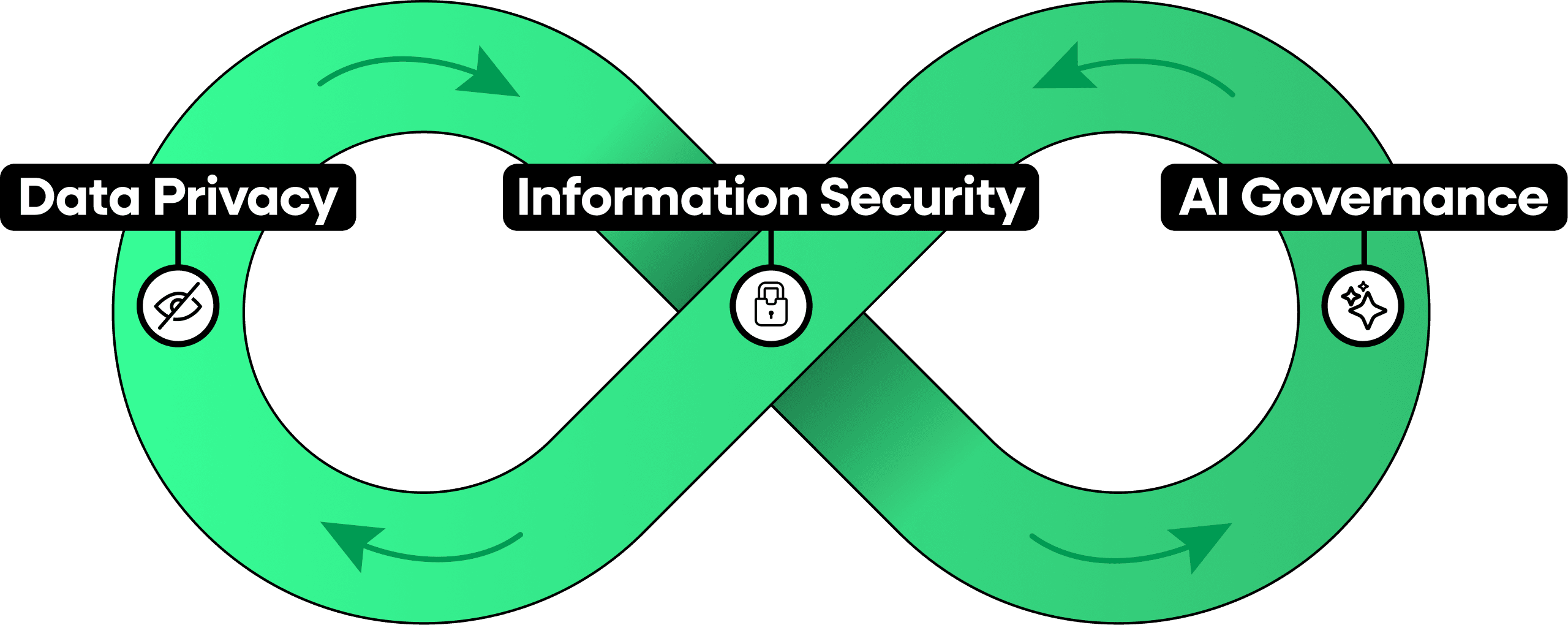
- Information security protects the confidentiality, integrity and availability of your data, anchored in ISO 27001.
- Data privacy governs how personal information is collected and used, anchored in ISO 27701 and the UK GDPR.
- AI governance manages the risks of building and using AI responsibly, anchored in ISO 42001.
Read our full guide to the Resilience Loop to see how the three domains reinforce one another.
How is business resilience different from compliance?
Compliance asks “did we meet the standard?” Resilience asks “can we handle what happens next?” The two are not rivals. Certification is how you prove, to regulators and customers, that your resilience holds up under real conditions. For a closer look at the relationship, see compliance vs resilience.

Start your free trial
Want to explore?
Sign up for your free trial today and get hands on with all the compliance features that ISMS.online has to offer
Why does business resilience matter now?
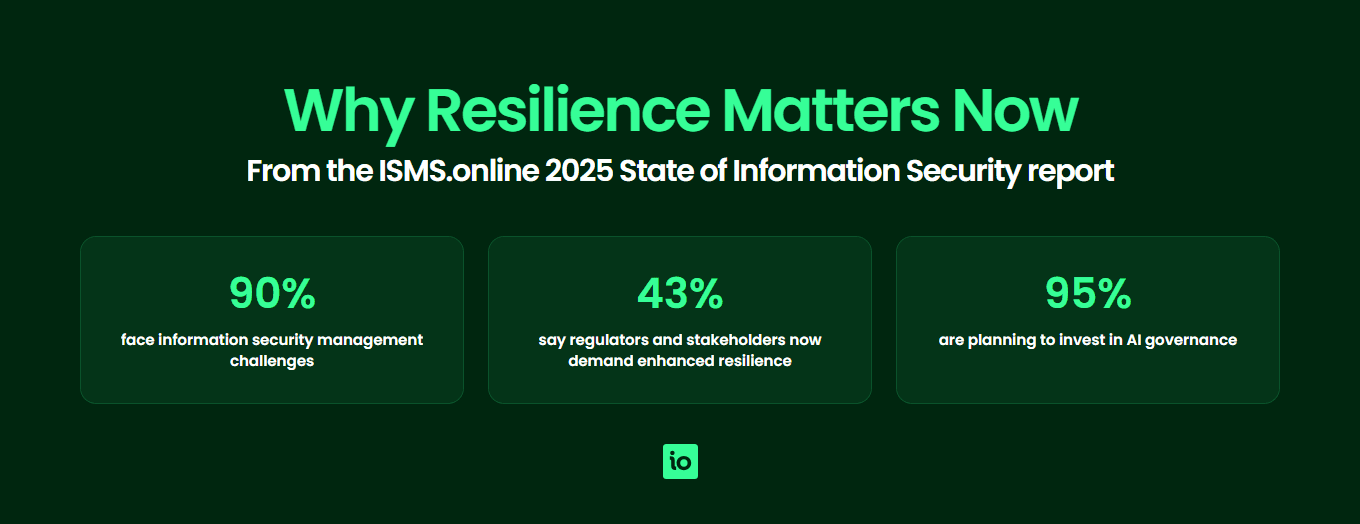
For UK organisations, the regulatory direction is clear. The FCA and PRA operational resilience rules, the Bank of England’s reporting expectations, DORA for financial services, the EU Cyber Resilience Act and the UK Cyber Security and Resilience Bill all point the same way: regulators now expect you to evidence resilience, not just claim compliance.
At the same time, the governance, risk and compliance software market is growing at low to mid teens each year, and the language is shifting from “continuity” towards “resilience”. Investing slightly ahead of that curve is how you build authority before the crowd arrives.
What are the different types of resilience?
The term is used for several related but distinct disciplines, and the differences matter because each one is measured and evidenced differently.
- Organisational resilience: whether the organisation can adapt and keep delivering its purpose over the long term.
- Operational resilience: the regulated view, built on important business services and impact tolerances.
- Cyber resilience: withstanding and recovering from attack rather than only trying to prevent it.
- Business continuity: keeping critical activities running through a disruption, whatever caused it.
Why choose ISMS.online for business resilience?
Most tools help you tick boxes. ISMS.online helps you build resilience you can prove.
- One connected system: manage information security, data privacy and AI governance together in a single platform, not three disconnected tools.
- Certifiable by design: every action maps to ISO 27001, ISO 27701, ISO 42001 and ISO 22301, so your resilience is provable.
- Evidence on demand: show regulators, auditors and customers proof of resilience, not promises.
- Informed by deep expertise: guided implementation from real specialists, not no touch automation that hides the risk.
- Continuous, not periodic: a live view of your risk and controls, instead of an annual scramble before an audit.
- Built for regulated markets: designed for organisations where security, privacy and trust drive the buying decision.
Explore the ISMS.online business resilience platform to see how it works in practice.
FAQs
Is business resilience the same as business continuity?
No. Business continuity keeps your critical operations running during a disruption, and it is an important part of resilience, but it is not the whole picture. Business resilience is the wider, continuous capability across security, privacy and AI risk. See business resilience vs business continuity for the full comparison.
What are the three pillars of business resilience?
The three pillars of business resilience are information security, data privacy and AI governance, connected as the Resilience Loop. Together they cover the risks a modern organisation has to manage to stay resilient.
How do you measure business resilience?
You measure it by your maturity across the Resilience Loop and your ability to recover within agreed impact tolerances. The practical route is to build business resilience step by step and evidence each control.
Is business resilience only for large companies?
No. Organisations of every size face security, privacy and AI risk, and smaller firms often feel disruption hardest. A connected, certifiable approach scales down as well as up.






