





































Business resilience for financial services is the ability to keep delivering your important business services through disruption, while continuously managing security, privacy and AI risk, and proving it to the FCA, PRA and your customers. In UK and EU finance it is now a regulatory expectation, not a nice to have.
A resilient financial firm can do four things:
- Anticipate the cyber, third-party and operational risks that threaten its services
- Withstand disruption while staying within agreed impact tolerances
- Recover critical payment, trading and customer services quickly
- Adapt as threats, technology and regulation keep moving
Why does resilience matter so much in finance?
Finance is the most heavily targeted and most heavily regulated sector for resilience. Firms sit on concentrated pools of money and data, depend on a small number of shared technology providers, and face regulators who now expect disruption to be planned for rather than explained away. The result is a sector where the cost of getting resilience wrong is measured in fines, lost licences and lost trust.


Free yourself from a mountain of spreadsheets
Embed, expand and scale your compliance, without the mess. IO gives you the resilience and confidence to grow securely.
What regulations govern resilience in financial services?
Several regimes apply at once, and they share the same logic: identify your important services, decide how much disruption you can tolerate, and prove you can stay within that limit.
| Regulation | Who it applies to | What it requires |
|---|---|---|
| DORA | EU financial entities and their ICT providers, including UK firms serving the EU | ICT risk management, incident reporting, resilience testing and third-party risk, in force since January 2025 |
| FCA PS21/3 | FCA-regulated firms, including banks, insurers, investment, payment and e-money firms | Identify important business services, set impact tolerances, map and test, with full compliance expected from 31 March 2025 |
| PRA SS1/21 | Banks, building societies and PRA-designated investment firms | Matching operational resilience expectations, supervised alongside the FCA |
| Bank of England | Financial market infrastructure such as payment systems and clearing houses | Operational resilience expectations and threat-led testing through CBEST |
For the detail on impact tolerances, mapping and testing, see our guide to operational resilience.
How the Resilience Loop applies to finance
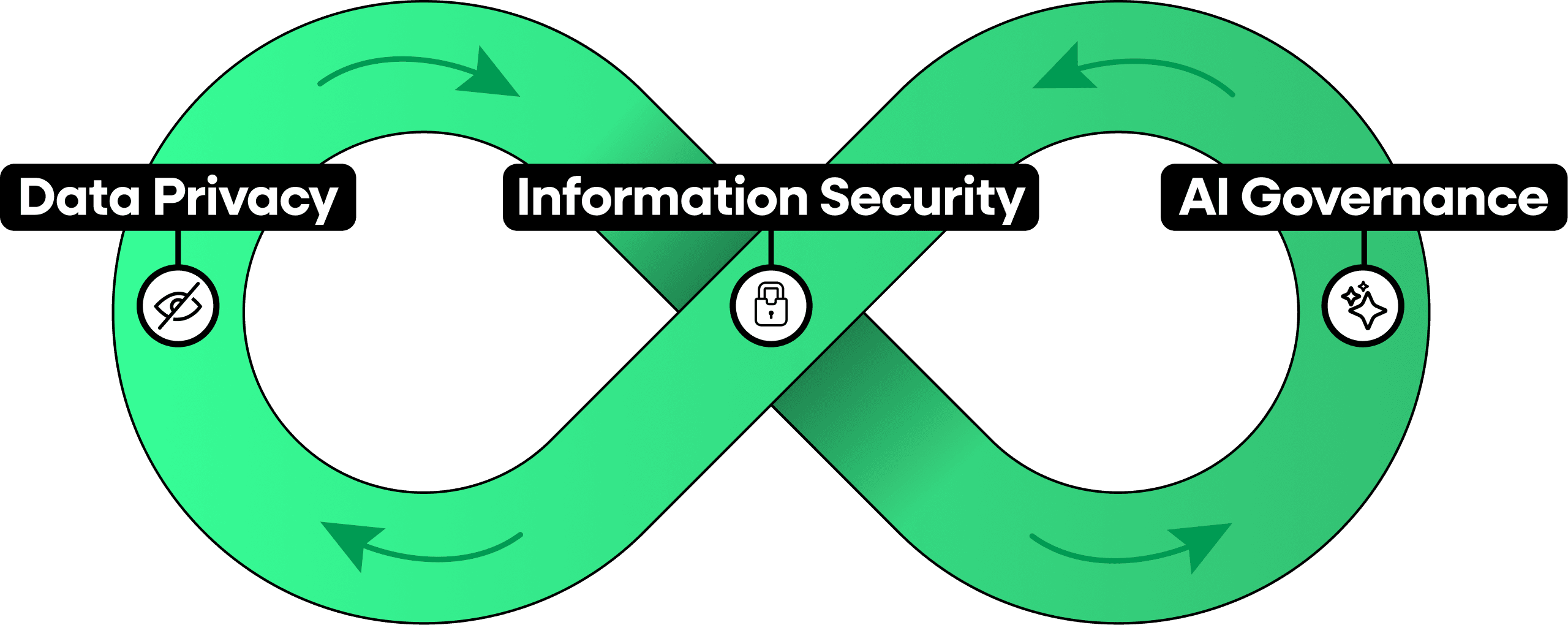
Most disruption in finance now starts in one of three places: a security failure, a privacy breach or an ungoverned AI system. Managing them as one connected system, the Resilience Loop, is what turns scattered compliance into genuine resilience.

Get started easily with a personal product demo
One of our onboarding specialists will walk you through our platform to help you get started with confidence.
How do financial firms build and prove resilience?
The practical route is the same one the regulators describe: identify important business services, set impact tolerances, map the people, processes and suppliers behind them, test against severe scenarios and keep a current, defensible self-assessment. The firms that do this well treat evidence as a by-product of day-to-day operations, not an annual scramble. Our guide to how to build business resilience sets out the steps, and ISO 22301 underpins the continuity side.
Why choose ISMS.online for financial services resilience?
Most tools help you tick boxes. ISMS.online helps you build resilience you can prove.
- Built for the FCA, PRA and DORA: map your controls to the operational resilience rules your regulators actually enforce.
- One connected system: manage information security, data privacy and AI governance together in a single platform, not three disconnected tools.
- Certifiable by design: every action maps to ISO 27001, ISO 27701, ISO 42001 and ISO 22301, so your resilience is provable.
- Evidence on demand: show regulators, auditors and customers proof of resilience, not promises.
- Informed by deep expertise: guided implementation from real specialists, not no touch automation that hides the risk.
- Continuous, not periodic: a live view of your risk and controls, instead of an annual scramble before an audit.
- Built for regulated markets: designed for organisations where security, privacy and trust drive the buying decision.
Explore the ISMS.online business resilience platform to see how it works in practice.
FAQs
Does DORA apply to UK financial firms?
It often does. DORA applies to EU financial entities and the ICT providers that serve them, so UK firms with EU operations or EU clients are usually in scope. UK firms also have their own regime through the FCA and PRA, so most large firms are managing both at once.
What is an important business service?
An important business service is a service a firm provides to an external customer that, if disrupted, could cause intolerable harm to customers or threaten market stability, for example processing payments or executing trades. UK operational resilience rules require firms to identify these services and set impact tolerances for each.
How does ISO 27001 help with operational resilience?
ISO 27001 gives you a structured, certifiable way to identify and treat information security risks, which is the core of DORA and the FCA and PRA rules. Combined with privacy and AI governance through the Resilience Loop, it provides much of the evidence a regulator expects.






