





































Proving your business resilience means showing current, structured and defensible evidence that you can withstand disruption and recover – not merely asserting that you are prepared. A certificate on the wall or a policy in a drawer is a promise; proof is the live, organised trail of controls, tests and decisions that backs that promise up. The organisations that win trust today are the ones that can produce that evidence on demand, not the ones that talk a good game.
- Current: evidence reflects how the organisation operates now, not how it operated at the last audit.
- Structured: it is organised against recognised controls and frameworks, so anyone can find and follow it.
- Defensible: it stands up to challenge from an auditor, a regulator or a demanding customer.
- Continuous: it is maintained as a living record, not assembled in a panic before each review.
What does it mean to prove resilience?
For years, proving resilience meant pointing at a point-in-time certificate. You passed an audit, you framed the badge, and you moved on for another year. That model is breaking down. Customers, boards and regulators now want evidence that is current – they want to know what your posture looks like today, not what it looked like on audit day twelve months ago.
The shift is best summed up as proof, not promises. A promise says “we take security seriously”. Proof says “here is the control, here is the test we ran last month, here is who owns it, and here is the record showing it works”. One is a statement of intent; the other is something an auditor or a procurement team can verify. As disruption from cyber attacks to supply chain failures becomes more frequent, the gap between asserting resilience and being able to demonstrate resilience to auditors is exactly where trust is won or lost.
This is why a resilience self assessment matters. Knowing where you stand – honestly, against a recognised structure – is the first step to being able to prove it to anyone else. You cannot evidence what you have not measured. The pillar page on business resilience sets out the bigger picture; this page is about the part that gets skipped: how you actually prove it.
How does governance turn into proof?
Resilience is downstream of governance. Good governance, done well, is what produces evidence you can stand behind. The chain runs in one direction, and each link depends on the one before it.
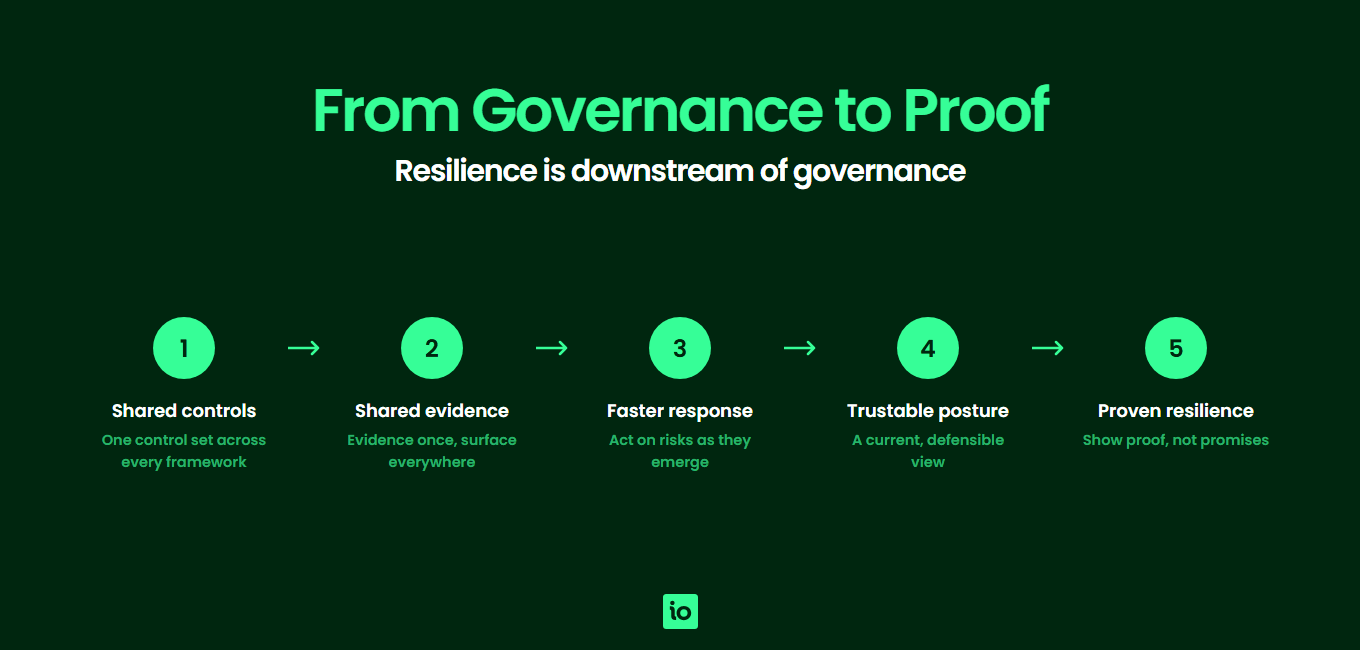
- Shared controls: you define a control once – access management, incident response, supplier due diligence – and apply it across every obligation it touches, instead of re-writing it per framework.
- Shared evidence: each control produces evidence once, and that evidence is surfaced against every framework that needs it. The work of proving a control is done a single time.
- Faster response: when controls and evidence are connected and current, you can see where you are exposed and act quickly when something changes, rather than starting from scratch.
- Trustable posture: a posture built on live controls and real evidence is one that holds up to scrutiny – your security and compliance position is something you can show, not just describe.
- Proven resilience: at the end of the chain, resilience stops being a claim and becomes a demonstrable property of the organisation.
Skip a link and the chain breaks. Controls without evidence are unprovable. Evidence that is scattered cannot drive a fast response. A posture you cannot show is not trustable. This is the core of the relationship between compliance and resilience: compliance gives you the controls, but only connected, current evidence turns those controls into resilience you can prove.

There's a bigger picture behind this.
This page covers one part of business resilience. Real Resilience — IO’s framework for connecting security, privacy and AI governance — is where the full picture comes together.
How do you actually evidence resilience?
Proving resilience is a method, not a one-off project. The practical steps are consistent whoever your audience is – a regulator, a board, or a customer’s procurement team.
- Identify your important services: pin down the services that, if disrupted, would harm customers, the market or the organisation itself. These are what you must be able to protect and recover.
- Set tolerances: define how much disruption each important service can absorb before the impact becomes unacceptable. Tolerances make resilience measurable.
- Map dependencies: trace the people, processes, technology and suppliers each service relies on, so you know what has to hold up for the service to keep running.
- Test against scenarios: run severe but plausible scenarios and record what happens. Tests are some of the most credible evidence you can produce, because they show the controls working under pressure.
- Keep a current self-assessment: maintain a living view of your posture against a recognised structure, updated as things change, so the evidence is always ready.
This method sits at the heart of operational resilience, where regulators increasingly expect firms to identify important services and prove they can stay within tolerance. For the wider programme it fits into, see how to build business resilience end to end, and the business resilience framework that gives the whole thing a backbone.
Why can most organisations not prove it?
Most organisations are not short of effort – they are short of structure. The evidence exists, but it is scattered across spreadsheets, shared drives, email threads and individual people’s heads. Nothing is the single source of truth. When an audit or a customer questionnaire lands, the same evidence is hunted down and re-collected from scratch, often by people who have done it three times already this year.
That fragmentation has a real cost: duplicated effort, audit fatigue, conflicting versions of the truth, and a response to change that is always one step behind. Worse, it makes proof brittle – if the one person who knows where the evidence lives is on leave, you cannot demonstrate anything.
The answer is a common control set. You map a control once and use it everywhere; you capture its evidence once and surface it against every framework that asks for it. Frameworks stop being separate mountains to climb and become lenses over one set of controls. A structured self-assessment then gives you an honest, current read on where you stand – the foundation for proof that is ready before anyone asks for it, rather than reconstructed under pressure. To see how this position is scored over time, look at the resilience score.
Does proof have to span security, privacy and AI?
Yes. Resilience cannot be proven in one domain while the others are left exposed. A breach of personal data, a failure of an AI system, or a security incident each undermine trust in the same way – and increasingly the same disruption touches all three at once. This is the idea behind ISMS.online’s Resilience Loop: information security, data privacy and AI governance working as one connected operating model rather than three disconnected silos.
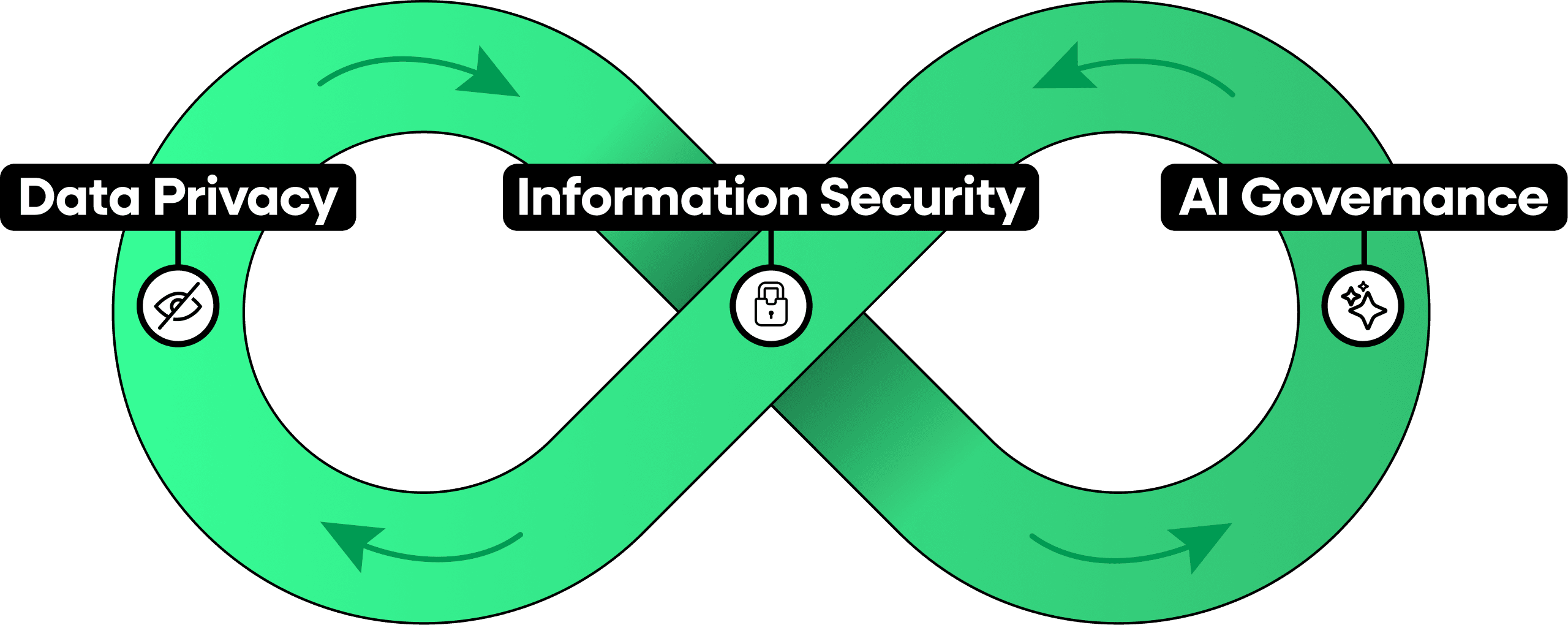
The three domains map cleanly onto recognised standards. Information security is anchored by ISO 27001. Data privacy is anchored by ISO 27701. AI governance is anchored by ISO 42001. When these share one control set and one evidence base, proving resilience across all three becomes a single, coherent effort instead of three competing ones. The Resilience Loop shows how the domains reinforce each other.

Start your free trial
Want to explore?
Sign up for your free trial today and get hands on with all the compliance features that ISMS.online has to offer
Why choose ISMS.online for proving resilience?
Most tools help you tick boxes. ISMS.online helps you build resilience you can prove.
- Audit-ready by default: everyday work in the platform becomes structured, current evidence, so proof is a by-product of getting things done rather than a separate scramble.
- One connected system: manage information security, data privacy and AI governance together in a single platform, not three disconnected tools.
- Certifiable by design: every action maps to ISO 27001, ISO 27701, ISO 42001 and ISO 22301, so your resilience is provable.
- Evidence on demand: show regulators, auditors and customers proof of resilience, not promises.
- Informed by deep expertise: guided implementation from real specialists, not no touch automation that hides the risk.
- Continuous, not periodic: a live view of your risk and controls, instead of an annual scramble before an audit.
- Built for regulated markets: designed for organisations where security, privacy and trust drive the buying decision.
Explore the ISMS.online business resilience platform to see how it works in practice.
FAQs
What is the difference between compliance and proof of resilience?
Compliance shows you have the right controls in place against a standard at a point in time. Proof of resilience goes further: it is the current, structured and defensible evidence that those controls actually work and that you can withstand and recover from disruption. Compliance is the foundation; proof of resilience is what you build on top by keeping the evidence live and connected.
How often should resilience evidence be refreshed?
Continuously, not annually. The point of modern resilience evidence is that it reflects how you operate now, so it should update as controls, suppliers, services and risks change. Some evidence, such as scenario tests, follows a planned cycle, but the underlying self-assessment of your posture should be a living record you can show at any time rather than something rebuilt before each audit.
What evidence do auditors and customers actually want?
They want evidence that is current, organised against recognised controls, and traceable to an owner. In practice that means documented controls, records of tests and incidents, a clear map of important services and their dependencies, and a self-assessment of your posture that is up to date. The common thread is that it must be verifiable – something they can follow and challenge, not a claim they have to take on trust.
Can you certify business resilience?
There is no single certificate that says business resilience. Instead, resilience is proven through related certifications and evidence – business continuity through ISO 22301, information security through ISO 27001, privacy through ISO 27701 and AI governance through ISO 42001 – combined with current operational evidence such as tests and self-assessments. Building those on one common control set is what lets you demonstrate resilience as a whole rather than in disconnected pieces.






