





































What Is Risk Management Software?
Risk management software is a platform for capturing, evaluating, and managing risks across your organisation — from information security and IT, to suppliers, operations, and compliance.
Instead of using disconnected spreadsheets and ad-hoc documents, a good risk management solution lets you:
- Maintain a structured risk register
- Assess risk likelihood and impact in a consistent way
- Define and track risk treatment actions
- Link risks to policies, controls, and projects
- Track ownership and approvals for risk decisions
- Monitor progress and trends using KPIs
- Export risk data and evidence in CSV/Excel for auditors or stakeholders
The result is a single, governed system that turns risk management from a one-off exercise into an ongoing, demonstrable process.
Who Needs Risk Management Software?
Any organisation that cares about security, continuity, privacy, or regulatory compliance needs structured risk management — but two motivation groups feel this most strongly:
1. Comply — “We Need Risk Management for Certification”
These organisations are typically:
- New to formal risk management
- Preparing for frameworks like ISO 27001, ISO 27701, SOC 2, NIS 2, or GDPR
- Keeping risk logs in spreadsheets, if at all
- Unsure how to demonstrate a “risk-based approach” to auditors
Risk management software gives them:
- A clear risk register
- A consistent assessment method
- Traceable treatment actions and approvals
- Evidence that aligns directly with certification expectations
2. Strengthen — “We Need Scalable, Continuous Risk Governance”
These organisations already have some risk processes but now face:
- Growth in systems, suppliers, and services
- Multiple compliance frameworks and recurring audits
- Cross-departmental risks that are hard to coordinate
- The need for real oversight, not just static registers
For them, risk management software is about maturity and scale: turning risk into a living, maintained discipline.
Why Risk Management Software Matters More Than Ever
Risk is rising on all fronts — particularly cyber and operational risk. Market and partner data consistently show that a large majority of organisations experience incidents each year, and a significant proportion suffer actual breaches or major disruptions.
At the same time, auditors, regulators, and customers expect to see:
- A documented risk methodology
- A current, structured risk register
- Clear ownership and accountability
- Evidence of treatment and follow-up
- Links between risks, controls, and policies
Risk management software makes this practical by giving you one governed system to capture, act on, and evidence risk decisions.

ISO 27001 made easy
An 81% Headstart from day one
We’ve done the hard work for you, giving you an 81% Headstart from the moment you log on. All you have to do is fill in the blanks.
What Does the Best Risk Management Software Include?
1. Central Risk Register
A single, structured place to record:
- Risk descriptions
- Affected assets, processes, or services
- Likelihood, impact, and overall risk level
- Current status (open, in treatment, closed)
ISMS.online supports structured risk registers as part of its risk management functionality.
2. Consistent Risk Assessment & Evaluation
The platform should support a repeatable approach for:
- Assessing and scoring risks
- Recording how assessments were made
- Updating scores as treatments are completed
ISMS.online lets you capture assessments and store results alongside treatments, tasks, and related evidence.
3. Risk Treatment Planning & Action Tracking
Good risk software doesn’t stop at scoring — it drives action:
- Define how each risk will be treated (mitigate, accept, transfer, avoid)
- Create tasks for implementing controls or improvements
- Track updates until actions are complete
ISMS.online supports risk treatment planning with linked tasks, updates, and progress tracking.
4. Governance, Approvals & Ownership
Risk management is a governance activity. Your tool should enable:
- Assigning risk owners and action owners
- Approvals for key decisions and treatment plans
- Review cycles and sign-offs
- Stakeholder visibility over responsibilities
ISMS.online includes tasks, approvals, notifications, and stakeholder mapping so accountability and decision-making are clearly recorded.
5. Linkage to Policies, Controls & Projects
Risks are managed through:
- Policies
- Technical and organisational controls
- Projects and improvement work
ISMS.online provides structured documentation, policy packs, and project phases, so you can connect risks to the controls and initiatives that actually treat them.
6. KPI-Based Risk & Compliance Monitoring
You need metrics to understand whether you’re improving, such as:
- Number of open risks by category
- Overdue risk treatments
- Overall risk exposure trends
ISMS.online includes KPI capability, letting you track ongoing performance against your risk and compliance objectives.
7. Evidence & Exportable Reporting
For certifications, regulators, or customers, you’ll need to show your work:
- Exportable risk registers (CSV/Excel)
- Treatment histories and task logs
- Approval and review records
ISMS.online supports CSV/Excel exports so you can share risk evidence in audit-friendly formats.
How to Evaluate the Best Risk Management Software
When comparing platforms, ask:
- ✔ Does it provide a clear, structured risk register with consistent scoring?
- ✔ Can I assign owners and track treatment actions through to completion?
- ✔ Are decisions and approvals logged and auditable?
- ✔ Can I link risks to policies, controls, and projects?
- ✔ Does it offer KPIs to monitor risk and compliance performance?
- ✔ Are CSV/Excel exports available for audits and reporting?
- ✔ Is it straightforward enough that non-specialists will actually use it?
A “yes” to these questions is a strong indicator the software will support real-world governance, not just documentation.
The Best Risk Management Software
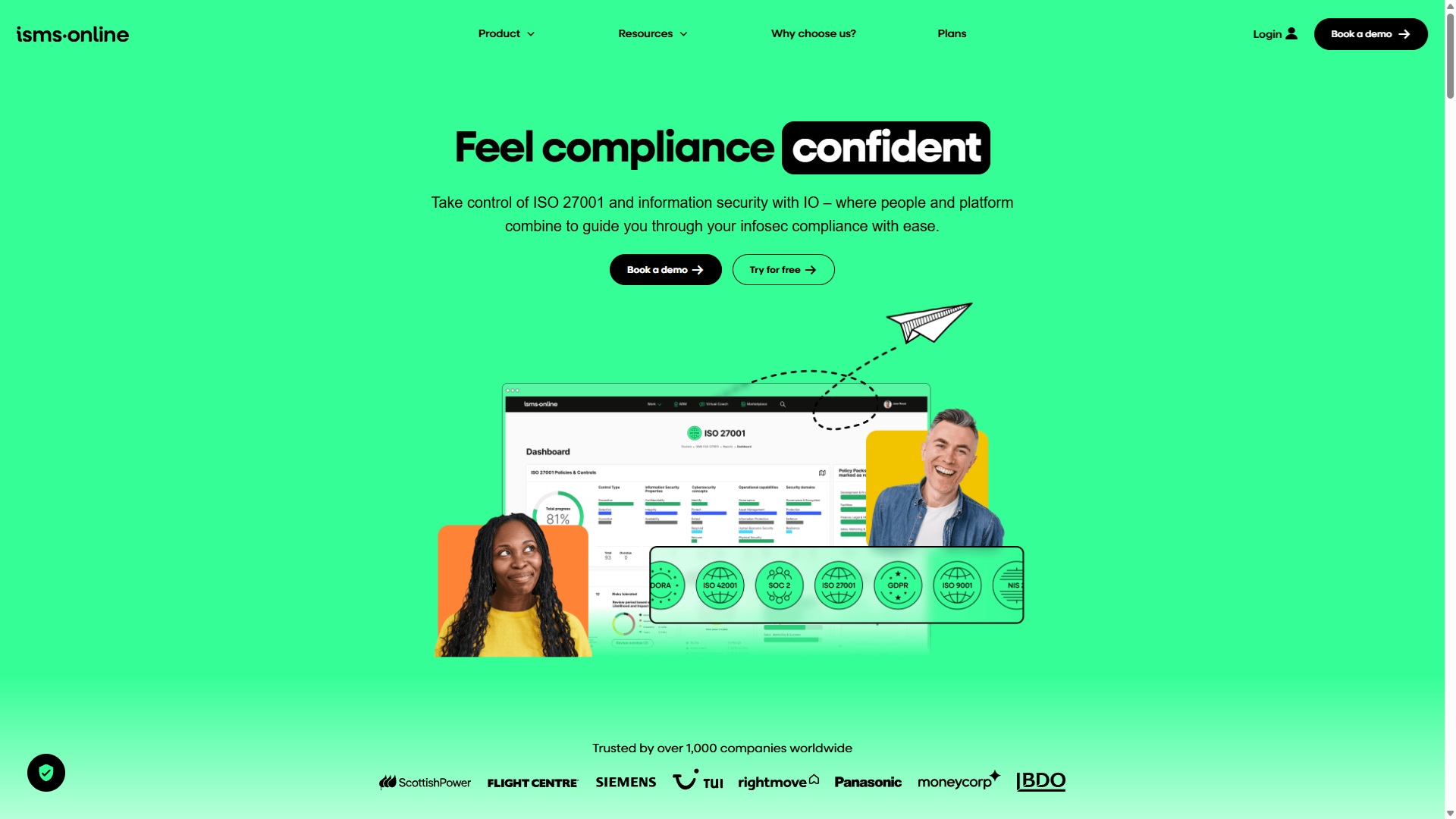
ISMS.online
ISMS.online provides a governance-first environment for risk management by combining:
- Structured risk registers and assessment fields
- Risk treatment planning with linked tasks and updates
- Approvals and workflows that capture key decisions
- Policy and document management via policy packs and controlled documents
- KPI tracking for ongoing risk and compliance monitoring
- Stakeholder mapping to clarify who owns each risk and action
- Project phases and deliverables for risk-related initiatives
- CSV/Excel exports for sharing risk and evidence data with auditors
Because risk is central to frameworks like ISO 27001, ISO 27701, SOC 2, and NIS 2, this integrated approach makes it easier to show how risks, controls, policies, and actions fit together in one coherent system.

Free yourself from a mountain of spreadsheets
Embed, expand and scale your compliance, without the mess. IO gives you the resilience and confidence to grow securely.
Benefits of Risk Management Software
- Replaces fragile spreadsheets with structured, auditable records
- Makes ownership and accountability for risks crystal clear
- Helps prioritise effort on the most important risks
- Simplifies audit and customer assurance
- Supports continuous improvement instead of one-off risk reviews
- Gives leadership a clearer view of organisational risk exposure
Common Mistakes When Choosing Risk Management Software
- Treating risk as a static register instead of an ongoing process
- Ignoring governance (approvals, owners, reviews)
- Choosing tools that don’t link risks to actions, controls, and evidence
- Overlooking export/reporting needs for audits
- Buying a system so complex that no one actually uses it
- Not planning for multi-framework and future regulatory needs
How ISMS.online Can Help
The best risk management software doesn’t just log risks — it provides a governed, auditable, action-oriented environment where risks are assessed, treated, tracked, and evidenced over time.
ISMS.online offers a strong, integrated platform for risk management that combines risk registers, treatments, governance, KPIs, and exportable evidence — ideal for organisations that want to embed risk-based thinking at the core of their compliance and security programmes. Get a guided tour and book a demo today.
FAQs About Risk Management Software
Is risk management software only for large enterprises?
No. Smaller organisations under certification or customer pressure often benefit even more because they lack spare capacity for manual, spreadsheet-heavy risk processes.
Does risk management software help with ISO 27001?
Yes. ISO 27001 is fundamentally risk-based, and a structured risk register plus treatment records are essential for certification.
Can it be used for non-IT risks too?
Yes — many platforms (including ISMS.online) can be used for broader organisational risks if you choose to model them there.
Does it replace technical security tools?
No. It sits above them, governing how risks are identified, assessed, and treated — rather than directly blocking threats.






