















What Core Competences Make Your ISMS Business Case Stand Out?
A compelling business case starts by mapping your organisation’s core strengths—not assuming frameworks or checklists alone will see you through. Audit committees, risk leads, and board sponsors demand evidence that your ISMS is built from the ground up on actual capabilities, not duct-taped roles or tacit knowledge. Elevate the conversation beyond generic resource lists: what technical controls, policy interpretation skills, and audit responses are proven in your environment?
Typical Competence Gaps Versus High-Performance Capabilities
| Area | Average Team | High-Performance ISMS Team |
|---|---|---|
| Policy Translation | Ad-hoc, tribal | Documented, re-usable |
| Evidence Retrieval | Manual, delayed | Platform-driven, instant |
| Audit Prep | Stress week | Continuous, practised |
| Board Reporting | Incident-based | Predictive, live dashboards |
Mapping Real-World Strengths, Not Checklists
Your ISMS succeeds when you can instantly align your most reliable people and workflows to concrete certification requirements. This relies on:
- Team members who understand both the language and context of ISO 27001 clauses, and can translate them into process with minimal noise.
- Control owners who surface evidence—not just update tracking sheets.
- Leadership that has rehearsed audit Q&A, not just circulated reminders.
By surfacing these capabilities early, your business case signals operational maturity and readiness—not dependency on third parties or short-term fixes.
Unlocking these core competences changes the narrative from firefighting to trusted, repeatable control. ISMS.online’s approach formalises these strengths, turning individual heroics into systemic resilience.
Book a demoHow Can You Quantify the Financial and Operational Benefits of an ISMS Investment?
Every compliance lead is eventually asked one question: is this investment shifting your organisation’s risk profile, or just padding process? The answer is found in quantifiable savings, cycle speed, avoided incidents, and the operational signals that trace back to better decisions.
Making Numbers Mean Something—ROI, Risk, and Board Confidence
You win support when you link every compliance milestone to business outcomes:
- Cost savings from reduced consultant hours and auditor day rates
- Shorter sales cycles due to faster RFP or client security clearance
- Lower insurance premiums from verifiable, platform-driven policy enforcement
- Averted fines and loss from measurable reduction in unmitigated risk
When the board can see risk reduction, not just cost control, you get capital to build on your terms.
The operational benefits are just as potent. ISMS.online gives your leadership real-time cost tracking and risk quantification, letting budget holders forecast future spend—not scramble at audit season.
ISMS Investment Benefits – Sample Metrics
| Outcome | Without ISMS.online | With ISMS.online |
|---|---|---|
| Audit Duration | 12–18 weeks | 4–6 weeks |
| Evidence Collection | Manual, fragmented | Instant, platform-central |
| Annual Fines/Disrupts | High, unpredictable | Reduced, documented |
| New Deal Time | Blocked by missing evidence | Cleared in RFP review |
Reducing frustration at procurement, strengthening your renewals, and elevating your market posture—this is how quantifiable, unified ISMS investments shift organisational gravity.
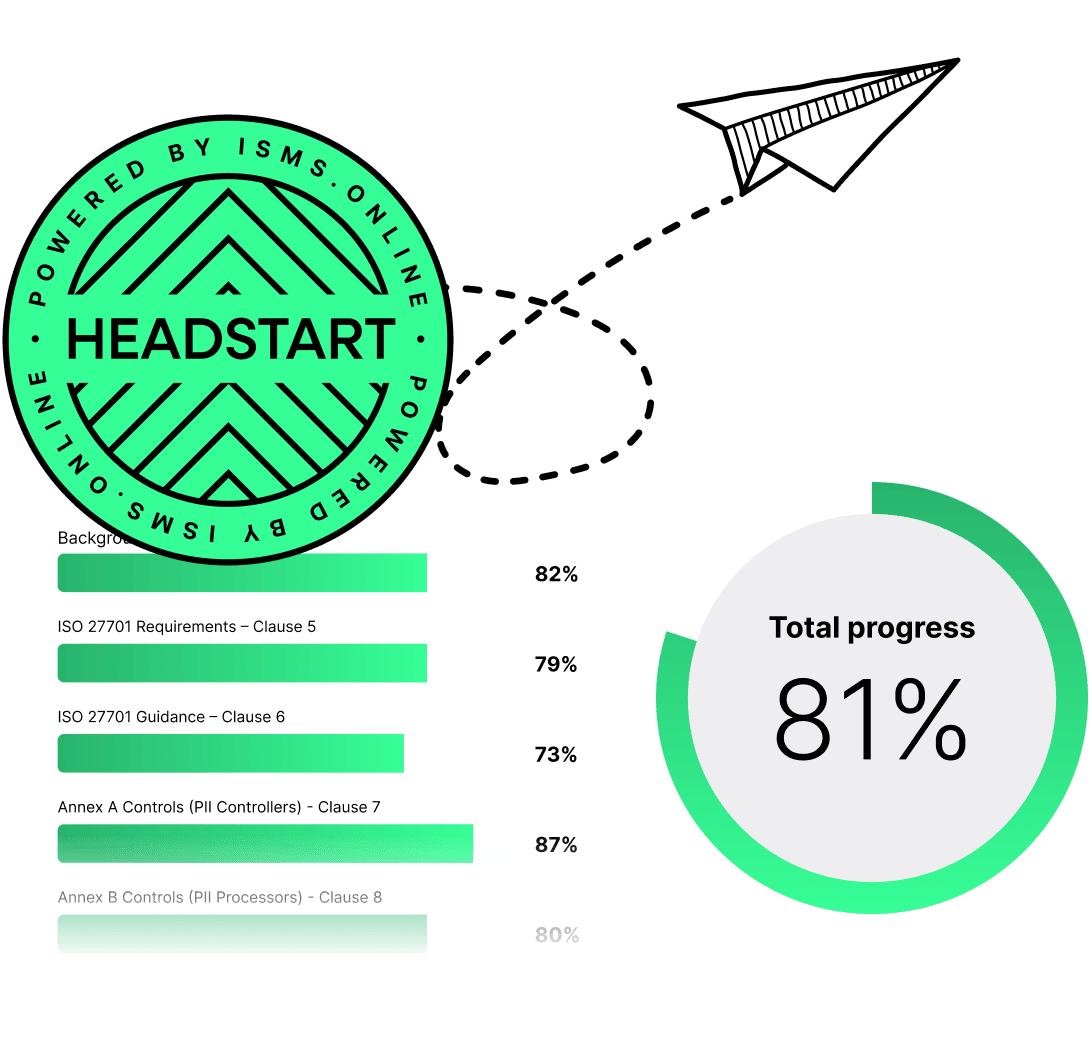
ISO 27001 made easy
An 81% Headstart from day one
We’ve done the hard work for you, giving you an 81% Headstart from the moment you log on. All you have to do is fill in the blanks.
Why Should You Evaluate Your In-House Compliance Capabilities Before Investing?
Success with an ISMS isn’t about what “could work” for others—it’s about what has worked for you, and what will hold under scrutiny next quarter. Compliance outcomes are determined less by the depth of your framework and more by your team’s operational muscle: can they respond to audit findings, manage control handoffs, or escalate risk without ambiguity?
When Self-Knowledge is Your Best Defence
Compliance audits uncover more than technical gaps—they expose overreliance on a handful of “knowledge keepers,” or the brittleness of ad-hoc fixes. A solid in-house assessment reveals:
- Which controls fail when team members are out, or when roles shift during reorgs
- Where evidence consistently lags, risking project slip or audit fatigue
- When “good enough” processes leave vulnerabilities open for months
True confidence isn’t claimed. It’s demonstrated in audit Q&A and incident review—every single time.
Bring systematic audits into your routine. ISMS.online’s diagnostics and capability mapping help you cut straight to the structural reality—showing what you can keep in-house, and what genuinely needs external support. The result: investment only where your return is clear.
How Can Accurate Cost Analysis Enhance Your ISMS Business Case?
Serious compliance is advanced math—vague budget ranges are simply voids where risk accumulates. By mapping every cost, observable and otherwise, to business value, you build a justification no auditor or CFO can ignore.
Balancing Today’s Spending with Tomorrow’s Security
Direct costs—implementing controls, licencing frameworks, onboarding expertise—are only part of the picture. Your future savings hinge on tracing:
- FTE time restored by platformization and automation
- Market access unlocked by reduced certification lag
- The delta between self-implemented and supported solutions (consultancy burnout is a hidden cost for all but the largest teams)
- Quantifiable risk transfer: how each dollar spent contracts liability
Framing ISMS Costs for Stakeholder Buy-In
| Cost | Short-Term View | Strategic View |
|---|---|---|
| Platform | Licence/implementation | Years of controlled, repeatable ROI |
| Controls | Project overhead | Attestation leverage, sales wins |
| Training | Lost days during ramp-up | Fewer audit findings, lower churn |
| External Help | One-off fix | Avoided long-term dependence |
Board-level confidence isn’t bought by the hour. It’s built by defending every budget line with exposed risk or tangible ROI.
Our solution gives you a cost map that survives the annual board review and keeps you in command.

Free yourself from a mountain of spreadsheets
Embed, expand and scale your compliance, without the mess. IO gives you the resilience and confidence to grow securely.
When Is the Optimal Time to Launch Your ISMS Investment?
Waiting to start compliance “until we’re bigger” or “once issues materialise” guarantees exposure at the worst moment. The optimal trigger is pattern-based: internal readiness plus external drivers like client mandates or regulatory escalation.
Recognising Readiness in Real Time
Look out for:
- Multiple client requests for updated certifications in RFPs
- Surges in team hours spent chasing artefacts for stakeholder reports
- New market entry (U.S., EU cloud, healthcare) with requirements you can no longer DIY
- A focused query from your board or investors about resilience or breach liability
ISMS Investment Timing Triggers
| Trigger | Action |
|---|---|
| Missing deals/RFPs | Initiate ISMS project scope/reporting |
| Audit cycle backlog | Move manual evidence into platform pipeline |
| Regulatory environment shift | Map new standards into ISMS workflow |
| Leadership risk query | Present platform-enabled readiness |
Proactive timing isn’t just favoured. It goes on your report card—to boards, auditors, and customers alike.
ISMS.online primes you to seize timing signals—transforming intent into proof and readiness into competitive edge.
Where Do Your Current Compliance Processes Fall Short?
Every organisation tells itself, “Our compliance stack is strong,”—until auditors or regulators probe access logs, dormant controls, or expired asset maps. The silent killer isn’t outright failure; it’s the small, unchecked exceptions and process decay that turn readiness into risk.
Diagnosing Why Gaps Happen—And How to Close Them
Spot real gaps where behaviours diverge from documented controls:
- Overlapping or orphaned responsibilities in enforcement (who “owns” an overdue approval?)
- Evidence or log trails that exist, but are unsearchable or archived in silos
- Decay in repeat processes: annual access reviews without cross-year consistency
- Controls mapped to too few people—single points of failure
A missing control doesn’t shout. It waits until the audit cycle puts your team under fluorescent light.
ISMS.online brings blind spots to the surface, linking workflows to dashboards and surfacing overdue, incomplete, or orphaned actions in real time. This is how continuous improvement becomes more than a slide deck promise.

Manage all your compliance, all in one place
ISMS.online supports over 100 standards and regulations, giving you a single platform for all your compliance needs.
How Do Digital Automation Tools Transform Compliance Efficiency?
Manual compliance is a treadmill your best people quit—or get stuck fighting the same fires at every audit. Automation isn’t about removing the human element; it’s about removing repetition, lag, and loss of control. Compliance teams live by their response time, evidence retrieval, and ability to proactively detect issues.
The Real Impact of Automation—And Why It Changes the Stakes
When you automate what can be systematised, you:
- Free up high-value personnel for critical analysis and real incident response
- Reduce audit “sprint” cycles from weeks to days, or from days to hours
- Gain platform-enabled chain of custody for every change, approval, or exception
- Create a living repository of readiness that pre-empts most auditor queries
Automation builds trust in outcomes—not just processes. It documents what actually happened, not what should have.
Automated dashboards, workflow routing, integrated evidence management—ISMS.online brings these tools together not for convenience, but so that your compliance maturity is visible, measurable, and self-updating.
Book a Demo With ISMS.online Today
At its core, an ISMS is about more than passing an audit. It’s about creating a verifiable, resilient, and leadership-backed assurance posture that supports all parts of your business. Leadership in compliance means surfacing readiness before it’s demanded—making status visible, quelling board doubts, and giving customers confidence that your risk controls won’t slide under stress.
See It to Lead It—Live
Our walkthrough gives you first-hand access to how seamless accountability, predictive dashboards, and integrated compliance evidence work. You’ll benchmark your team’s current position and see where even incremental improvements cascade to real audit, customer, and financial wins.
Cultivate a reputation where readiness is tangible, progress is visible daily, and the best people want to build with your organisation. Choose proof over platitudes.
Book a demoFrequently Asked Questions
What core competences define ISMS business case strength with your board and assessors?
Leadership is rarely moved by frameworks alone—they want proof that your team can enforce compliance as a living process, not a one-time document handoff. Your business case stands out when you pinpoint which internal skills and resource owners align with ISO 27001 controls, and can show evidence on demand, not in response to a scramble. Start by mapping each requirement to everyday operations: asset registers tied to change logs, access management rooted in task assignment, and incident responses tested against last year’s audit realities.
- Technical execution: Can your team enforce controls and update configurations without relying on outside help each quarter?
- Policy intelligence: Does the organisation translate formal requirements into day-to-day practices, or does policy remain theoretical?
- Evidence readiness: Are audit records and approvals stored, linked, and accessible within three clicks—or three frantic afternoons?
When these touchpoints are systematised, your business case transforms from wishful to actionable. You move decisiveness to the front foot—with every audit seen as an exercise in team fluency, not fire drills. Board-level confidence is solidified not by what you claim, but by the competence you demonstrate before the third-party auditor ever asks.
How can your ISMS business case quantify financial and operational returns that win decision-maker support?
Moving stakeholder opinion is less about explaining ISO requirements, more about connecting compliance investment to dollars saved, deals won, and risk defused. Begin by reframing spend as opportunity seized—reduced consultancy days, shorter sales cycles unlocked by faster cert turnaround, and risk controls that actually cut insurance penalties. It’s not about promises: proof is in historic data and forecasted savings.
Cost and Impact of a Platform-Driven ISMS
| Manual Workflow | Platform-Driven Workflow | |
|---|---|---|
| Audit Cycle | 16–22 weeks | 4–7 weeks |
| Evidence Gathering | Fragmented | Searchable & linked |
| Insurance Premiums | £120k/year | £85k/year (with verified controls) |
| Sales Blockages | 5–7 per year | 1–2 (with live certification) |
A mature business case puts these gains in plain numbers: contracts not lost to audit backlogs, FTE hours released to projects, risk reduction mapped to premium cuts and capital savings. Reference external norms—2025 ISACA survey data shows 42% average audit cost reduction after ISMS centralization. Make every line in your financial analysis a lever for executive buy-in by translating risk mitigation and policy alignment directly to shareholder value.
Why is a deep in-house compliance capability assessment a non-negotiable precursor to outside spend?
You can’t outsource ownership. Before investing in platforms or services, a forthright review of your team’s compliance spine will reveal what technology can enhance—and what only disciplined, accountable humans can sustain. Where does operational resilience falter? Who owns evidence if your lead admin leaves or your IT engineer takes on a high-priority project? “We thought that was covered” is what gets cited in failed audits and board queries.
Rigorous capability mapping will surface:
- Control bottlenecks when roles overlap or vacate
- Weaknesses where evidence is anecdotal versus structured
- A gap between policy headlines and daily risk practice
Take the diagnostic further: simulate a surprise audit or control test and observe the workflow. How many approvals can you prove in one hour, one click, one dashboard? Our clients find that as much as 30–50% of externally scoped compliance work shrinks after in-house operations are fully assessed—redirecting budget to where it creates visible, board-valued gains. Internal discipline, not tool adoption, is the leading indicator of audit success and regulatory resilience.
When should decisive organisations act on ISMS investment signals—and what do they risk by hesitating?
The right time is not after a breach or failed audit—it’s when repeat patterns surface: delayed RFPs, clients requesting up-to-date certs, evidence gaps flagged on internal audits, and policy signoffs lagging well past deadlines. “Everyone else is waiting” is not a strategy—regulators, competitors, and potential partners move faster than your inertia.
Key indicators:
- New legislation on the horizon for your sector/geography
- Last audit failed or nearly failed for documentation reasons
- Ongoing manual patchwork in evidence gathering or tracking
- Executive pressure to demonstrate maturity in front of stakeholders
Inaction becomes visible risk in internal dashboards and public trust metrics. Harvard Business Review found organisations that pre-empt regulation with compliance modernization increase retention by 14% over those lagging behind.
Act in the window between the first compliance shake and the market’s adoption curve peak. When market signals and internal friction converge, leadership is measured by who creates momentum before the next external shock.
How does integrated automation—and live visibility—convert compliance overload into measurable operational advantage?
Automated workflows alone won’t rescue a compliance programme, but the combination of orchestration and real-time visibility moves your ISMS from a weight on everyone’s schedule to a baseline for operational performance. Launching a unified platform, feeding evidence into linked, live dashboards, and triggering periodic, role-based reminders creates a self-updating attestation posture—one you can rely on even when staff change or audit stress peaks.
Key Features of an Integrated ISMS Platform:
- Linked evidence libraries tied to ISO controls
- Approval chains mapped to policy obligations, not just internal politics
- Incident and risk logs that track closeout, not just reporting
- Scenario-driven task routing—proving practice, not process
Quantitative impact: An Accenture 2024 report showed companies shifting to full-cycle, visibility-driven ISMS platforms reduced audit timelines by 57% and detected process faults 23% faster. The difference—delivering always-ready attestation—makes your compliance a selling point, not just a pass/fail checkbox.
You build reputation not by surviving audits—but by making readiness your organisation's operational constant.