





























What’s the Real Payoff When You Unite Your ISMS and GDPR Strategy?
Security and privacy leaders understand that half-measures in compliance quickly become visible—usually right as the board or a client asks for evidence nobody can surface without a scramble. Unifying your ISMS and GDPR work isn’t about compliance theatre; it’s about building a living record of readiness that speaks to every audit, question, or challenge with certainty.
Most teams think they’re secure until a customer asks for evidence they can’t produce.
Where Does Integration Deliver Measurable Efficiency for Security and Privacy Leaders?
When you align information asset tracking, policy frameworks, and risk scoring across ISO standards and GDPR obligations inside a centralised platform, weaknesses lose places to hide. The duplication of manual data tasks and disjointed systems evaporates when one evidence trail satisfies overlapping requirements.
Key operational benefits:
- Compliance teams typically reclaim 30–40% of their time by synchronising frameworks.
- Board-level visibility improves as dashboards surface status in real time.
- Audit prep shifts from a last-minute rush to a routine check, reducing surprise costs.
| Outcome | Fragmented Systems | Integrated ISMS.online Approach |
|---|---|---|
| Evidence retrieval time | Days/Weeks | Hours/Minutes |
| Control failures after audit | High risk | Significantly reduced |
| Board confidence | Eroded by gaps | Bolstered by continuous proof |
Why Does Consolidation Give You a Lasting Edge?
Relying on manual processes and overlapping documentation is a silent credibility threat. Customers and regulators don’t accept “we’re working on it” when asked for current data flows or policy evidence. Leadership that leverages a single, dynamic ISMS platform signals to peers—and to markets—that your team delivers proof, not excuses.
Book a demoWhy Does Separating ISO 27001 and GDPR Backfire in Modern Audits?
Compartmentalising compliance isn’t discipline. It’s giving blind spots room to grow. The main risk: disconnected teams write (and forget) parallel policies, evidence degrades in scattered folders, and what should be a single button-press becomes a hunt across three systems and five people. This isn’t about good intentions—it’s about operational friction turning into audit risk and lost revenue.
What Happens When There’s No Single Source of Truth?
Teams managing isolated structures for GDPR and ISO 27001 face recurring pain: forgotten controls, untriggered reviews, duplicated or missed evidence, and missed contractual requirements. A unified dashboard closes that gap—real-time status, deadline mapping, and multi-standard task assignment eliminate errors.
When departments rely on email chains and spreadsheet trackers, compliance devolves into firefighting:
- Evidence hunts during audits delay reports and add stress.
- Inconsistent data exposes organisations to repeated findings—and fines.
- Teams struggle to keep up as standards, regions, or customers multiply requirements.
An audit failed at 5 pm, not because of a lack of effort—but because two systems didn’t talk and nobody knew which evidence was current.
Can Centralization Reduce Costs and Disruption?
Consolidated systems don’t just reduce hours; they cut direct spending, with organisations reporting up to 35% less budget allocated to remediation, rushed consultancy fees, and unplanned overtime when using cloud-native compliance platforms.
ISO 27001 made easy
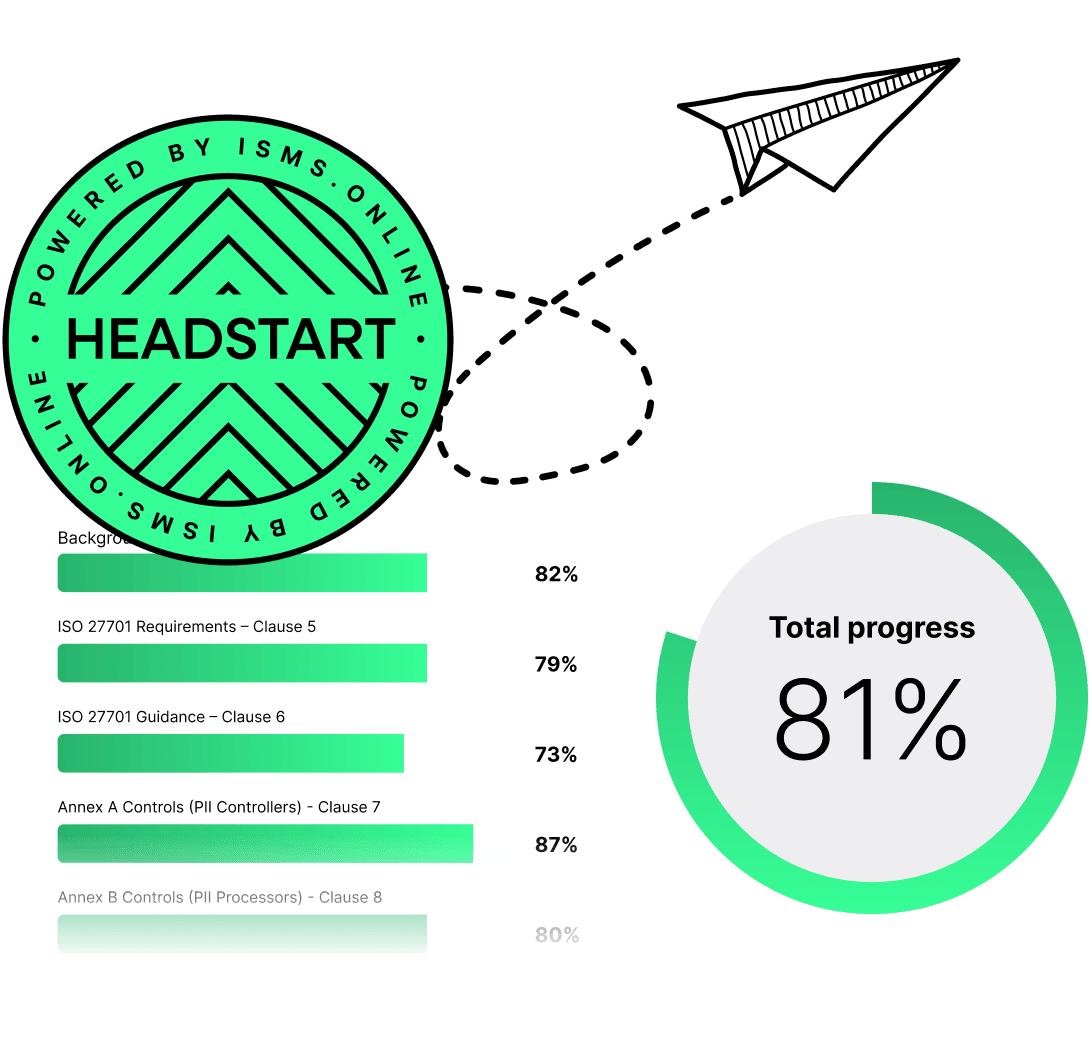
An 81% Headstart from day one
We’ve done the hard work for you, giving you an 81% Headstart from the moment you log on. All you have to do is fill in the blanks.
How Does Proactive Risk Management Drive ROI Instead of Just Reducing Loss?
Treating risk as a required log entry means you’ll miss the point where it turns into cost or liability. When your risk matrix is updated in real time, with live asset mapping, threat indicators, and treatment status, your security and compliance posture becomes a visible tool for negotiation, not just a quiet insurance policy.
How Is Data-Driven Risk Mapping Changing the Security Landscape?
Moving from outdated spreadsheets to platform-driven risk forecasting means that incidents and vulnerabilities are tracked as they occur, not quarterly. This visibility empowers compliance leaders to present data to stakeholders in seconds—not after a week of meetings—making your risk storey a proactive asset.
Tangible impacts for leadership:
- Risk oversight shifts from guesswork to quantified, tracked remediation.
- Real-world metrics (frequency of risk updates, incident mean time to resolution) show continuous improvement.
- Scenario planning becomes fast: “If we on-board a new supplier or region, what’s the gap today?”
| Risk Maturity Level | Old Approach | ISMS.online Platform |
|---|---|---|
| Risk register | Passive, update lag | Live, role-assigned |
| Remediation proof | Manual trail | Auto-linked, time-stamped |
| Audit value | Defensive narrative | Forward posture |
What’s the Compliance Win in Proactive, Visible Risk Handling?
When your organisation can show real, ongoing threat mitigation—whether it’s ransomware, vendor shortfalls, or evolving privacy requirements—you move negotiations with both your board and external partners. It’s the confidence of being asked, “Can you show our current risks?”—and answering, “Yes, right now, with action plans attached.”
When Do Documentation Gaps Create Leadership Exposure—And How Does Proactive Policy Governance Prevent It?
Policy isn’t a static PDF you update once a year. It’s a living contract between your organisation’s objectives, your risk reality, and your regulatory obligations. When policies are out of sync with changes in the business or in law, they quietly create untraceable liabilities.
Why Is Automated, Scheduled Policy Review Non-Negotiable for Compliance Accountability?
Ad hoc change control leads to compliance gaps—these jump out under scrutiny and produce director-level risk few executives are prepared to defend. Integrating policy lifecycle management into your ISMS infrastructure means never waiting to “remember” when a review or update is needed.
- Version control and approval logs allow audit pathways to be surfaced on demand.
- Regulatory changes trigger scheduled review cycles automatically.
- Distributed accountability lifts the burden from siloed staff and reduces single points of failure.
The worst time to find a dormant policy is during a major incident or a hostile audit.
Why Do Boards Want Proof of Documentation Vigilance?
Accountability at the upper tiers means documented evidence isn’t just expected; it’s a requirement. Visibility into which policies were updated, who approved them, and what triggered each change acts as a reputational shield, not just a compliance artefact.

Free yourself from a mountain of spreadsheets
Embed, expand and scale your compliance, without the mess. IO gives you the resilience and confidence to grow securely.
Where Do Evidence Gaps Really Hide—And How Does Unified Management Neutralise Audit Weakness?
Evidence is the currency that buys audit confidence and closes negotiation fast. Scattered logs, files, and ad hoc record keeping aren’t just inefficient—they’re an open invitation for auditors and regulators to probe and penalise.
What Are the Practical Advantages of Living Evidence Libraries and Integrated Audit Reports?
Centralising all compliance evidence in a live environment enables structured retrieval (by project, control, or individual) and immediate export for any regulatory or client scenario.
Real-world impact:
- No missing links during audits.
- Fewer “please explain” scenarios with regulators and partners.
- Direct evidence shareability with clients for deal acceleration.
| Evidence Challenge | Manual Tracking | ISMS.online Platform |
|---|---|---|
| Finding old audit logs | Laborious | Indexed instantly |
| Demonstrating live control | Difficult | Always visible |
| Client RFP support | Patchy | Turnkey |
Trust is proved—or lost—at the speed of evidence supplied.
How Does Transformative Workflow Automation Shift Compliance from Overhead to Asset?
Too many compliance programmes collapse under the accumulated weight of checklists, legacy tools, and rote process. The future of security compliance belongs to teams that treat these processes not as a checklist, but as an integrated, adaptive workflow.
Which Compliance Tasks Should Be Automated, and What Gains Do They Produce?
Scheduling, evidence linkage, and control verification all benefit from automation. When these are programmed into your compliance nerve centre, you gain predictability—and with it, confidence.
Benefits leadership teams cite:
- Predictable time allocation for teams—no pop-up deadlines.
- Self-replicating best practices as compliance norms scale with business growth.
- Audit anxiety evaporates when every task is mapped, referenced, closed, and reviewed.
When oversight is proactive, audits become an opportunity—not a fire drill.
How Is Automation Proof-Positive When Auditors Knock?
ISMS.online clients report that automated workflows have contributed to year-over-year reductions in audit findings, rework, and costly penalty incidents. The stress of an upcoming regulatory review is replaced with the quiet preparedness of all documentation, evidence, and process performance ready to share.

Manage all your compliance, all in one place
ISMS.online supports over 100 standards and regulations, giving you a single platform for all your compliance needs.
Why Do Policy and Control Integration Outperform Legacy Compliance—and How Is ROI Clearly Proven?
Leaders are measured by cost savings and risk minimization, not compliance box-ticking. When policies, evidence trails, and control mapping are woven into a single system, the conversation moves from “are we at risk?” to “how are we outperforming?”
Where’s the ROI Hiding in Ready-To-Deploy Policy Libraries and Live Controls?
Expert-crafted, update-driven policy packs—mapped to every relevant framework, adaptable as regulations evolve—free your organisation from the expense and inconsistency of ad hoc “fixes.” ROI is no longer speculative; it’s benchmarked against reduced spend, lower staff requirements, and increased sales velocity to security-conscious customers.
| Policy & Control | Manual Model | Integrated Model |
|---|---|---|
| Consultancy spend | High | Lower |
| Audit prep labour | Extensive | Streamlined |
| Policy failures | Recurring | Rare |
Being ahead on compliance isn’t just about cost avoidance—it’s about creating visible proof that builds stakeholder trust.
How Does This Translate to Leadership Reputation?
CISOs and compliance leaders using an integrated platform are recognised not just for passing audits, but enabling revenue growth and client retention. Audit readiness becomes an embedded advantage—appreciated by senior executives and relayed down the line.
Are You Ready for Stakeholder Trust and Boardroom-Level Compliance Alignment?
Leadership in compliance is visible—demonstrated not by words, but through systems that anticipate questions and surface answers before they’re asked. The shift from a piecemeal, reactionary approach to a unified compliance system is as much about culture as it is about technology.
What Sets Trusted Compliance Teams Apart?
Teams earning stakeholder trust can:
- Surface any policy, risk, or evidence node on demand.
- Demonstrate a living, breathing compliance programme that doesn’t lag regulatory or internal expectations.
- Show improved negotiation and renewal terms based on compliance status as a differentiator, not a defensive play.
When you move away from shortcuts, the implicit message is: We’re ready. Our compliance is visible, verifiable, and aligned with board-level risk policy. That’s the posture of organisations intent on leading, shaping, and influencing their industries for the long term.
Book a demoFrequently Asked Questions
What are the real, measurable gains in unifying your ISMS and GDPR compliance?
Integrating your Information Security Management System and GDPR compliance into a single, synchronised platform accelerates decision certainty while shrinking blind spots and reporting delays. You shed the administrative drag of maintaining duplicate records or reconciling non-matching evidence. By consolidating controls and workflows, your team isn’t fighting on two fronts—but rather commanding one centrally managed, audit-visible system.
Why does unified compliance become a performance driver?
When you unite ISO 27001 and GDPR, operational overhead drops and consistent reporting becomes the default. Instead of manual cross-referencing or the perpetual search for which policy version applies, your evidence is date-stamped, owner-verified, and ready on demand. Multiple industry studies place internal resource savings at 30–40%—fuel your leadership can reallocate to high-value risk reduction or innovation.
| Benefit | Unified ISMS + GDPR | Fragmented Approach |
|---|---|---|
| Evidence retrieval | Minutes, always up-to-date | Hours or days, prone to mismatch |
| Audit turnaround | Accelerated, predictable | Lengthy, variable, stress-inducing |
| Board confidence | Unquestionable, real-time reports | Uneasy, retroactive explanations |
| Reputation | Leader in accountability | Reactive, lagging scepticism |
Trust in compliance isn't a one-time win. It's maintained, minute by minute, every time you surface proof before anyone has to ask.
Your organisation signals its reliability not by the absence of findings but by the ease with which it delivers complete records. This assurance compounds into business advantage: competitive wins, smoother customer onboarding, and faster deal closings—all hinging on your visible command of compliance fundamentals. With unified ISMS and GDPR, you set a tempo rivals struggle to match. Each report, each task, each audit day is a chance to reinforce your reliability—not scramble for lost paperwork.
Why does consolidation define governance credibility and secure lasting board trust?
Relying on separate processes for ISO 27001 and GDPR creates a perpetual fog: duplicated tasks, unclear control ownership, and evidence that’s only as reliable as your memory or inbox. This fragmentation doesn’t just slow audits—it erodes your ability to pinpoint issues before they snowball into headline risk.
What specifically improves when you centralise controls and documentation?
With unified compliance, oversight becomes proactive: tasks trigger themselves, policy changes cascade seamlessly, and current-state dashboards reveal not just what’s being done but who owns every control. Board members and sponsors stop asking, “Are we ready?” and begin to trust the rhythm of your reporting. On average, organisations moving to a consolidated approach see:
- Reductions of 25–35% in missed control deadlines.
- Decreases in duplicated effort and over-retained evidence.
- A direct line of sight from boardroom to task owner for every compliance action.
| Fragmented System Risk | Unified Compliance Advantage |
|---|---|
| Duplicated controls/tasks | One set, live accountability |
| Inconsistent audit evidence | Always-linked, always current |
| Opaque ownership | Transparent assignments |
| Escalating error risks | Immediate detection and response |
A compliance framework is only as strong as its weakest handoff. Alignment is the difference between warning and attestation signal.
Instead of trying to remember when a document was last reviewed or which policy owner to chase, a consolidated system pushes timely updates and locks proof to every change. Trust grows in the open: when you can show who did what, when, and why, you remove doubt before it threatens executive or regulator confidence. Establishing a living, all-seeing compliance nerve centre isn’t an upgrade—it’s the foundation for sustainable boardroom credibility and procurement wins.
How does comprehensive risk management turn compliance into measurable return on investment?
Treating risk as a living metric instead of a static checkbox delivers a sharper lens on business value. When you anchor your ISMS/IMS in continuous risk quantification, every asset, vulnerability, and control status is recorded in real time. This translates immediately into insurance savings, premium contract rates, and direct cost reduction—because your proof of resilience is live, not just “up to date.”
What changes with real-time risk insight and prioritised actions?
Static, once-annual risk registers go stale fast; by the time you’ve updated them, your environment has moved. Our platform’s living risk engine triggers dynamic checks, benchmarks real-world events, and ties every mitigation to a record of investigator and timestamp. This dynamic workflow:
- Highlights resource savings of 20–30% over traditional risk management.
- Surfaces unmitigated gaps before they appear as control failures or headline losses.
- Lets you quantify “what if” time-to-remediate scenarios in procurement or budget review.
| Proactive Risk Management | Static Risk Lists |
|---|---|
| Continuous, role-assigned | Annual, memory-driven |
| Remediation mapped to real threats | Box-ticked for audit, often stagnant |
| Board-level ROI visibility | Defensive explanations |
| Reduced time to resolution | Delayed, gap-prone |
Control is knowing—not guessing—where your next threat emerges, and showing precisely how you’ll counter it before auditors walk in.
As your risk scores shrink and live transparency grows, so does the leverage you hold in every negotiation with insurers, partners, and regulators. Other teams track hindsight. You operate in foresight, and that shift is what repositions compliance from defensive expense to persistent, demonstrable advantage.
When do outdated policy cycles quietly undermine your organisation’s security and reputation?
Missed policy reviews quietly loosen the scaffolding of your compliance programme until controls drift, privileges accumulate, and violations go undetected. Each lagged review is a liability someone will eventually inherit—often under the harshest scrutiny.
How do live review cycles and policy automation reset your baseline?
With scheduled, automated cycles mapped directly to ISO 27001 and GDPR trigger points, reviews become systemic, not optional. Our system matches review dates to change history, owner assignment, and signature tracking—so your board knows not just that a policy exists, but when it was last tested, who validated it, and how incident feedback shaped the next revision.
By embedding policy intelligence upstream, you:
- Catch emerging risks before they become breaches.
- Eliminate “did you see this update?” email chains and sign-off bottlenecks.
- Maintain a robust, versioned history of every attestation and change.
| Policy Drift Risk | Automated Review Cycle |
|---|---|
| Unscheduled, reactive | Timed to regulation and real events |
| Ownership confusion | Role-tagged, time-stamped |
| Memory-based compliance | Traceable, continuous |
Resilience means you never have to meet a crisis with an outdated document, only evidence that your process adapts as quickly as reality.
Policy intelligence isn’t optional; it’s the difference between disciplinary fallout and confident, audit-ready governance. The decision to enable live review cycles is the day your organisation stops being behind and starts setting the standard for compliance readiness.
Where do most evidence breakdowns begin — and why does digital traceability change the audit game?
Gaps appear not just when evidence is lost, but when retrieval is a coin toss—buried in a retiring manager’s inbox, or misfiled after an ownership change. Even small organisations can lose years of procurement value to this “proof blind spot.”
How does a real-time, digital-first evidence library ensure consistent compliance posture?
By shifting evidence management to a fully centralised, indexed platform, your documentation becomes permanently audit-ready. Our platform logs every action, ties files and decisions to controls and owners, and ensures chain-of-custody records exist for every approval and review. No more last-minute data scrambles or “version confusion” under pressure.
- Onboard new staff in record time without risking compliance continuity.
- Lock in time savings: organisations switching to digital evidence traceability report 35–60% faster audit cycles.
- Never face an RFP or vendor assessment with explanations—just evidence, live and visible.
| Traditional Evidence Management | Digital Traceability |
|---|---|
| Folder sprawl, email hunts | Fast, permissioned search |
| Version mix-ups | Single record, always current |
| Surprises at audit | Predictable, status-driven proof |
True compliance is the art of surfacing the right proof the moment it’s requested—not after damage control begins.
When documentation is quietly, automatically kept up to date by design, leaders shift compliance from anxious justification to confident, sustained proof of trustworthiness.
How does process automation elevate compliance from fatigue to executive status signal?
Teams ground down by endless checklists, reminders, and status chases can’t focus on driving true improvement. The more repetitive the task, the bigger the invitation for drift, handoff errors, and attrition. Automation, done right, is the enabler—not the enemy—of strategic adaptability and morale.
Why does real workflow automation supercharge compliance delivery?
Assign, escalate, monitor, and report—every function gains reliability when managed by journaled, permissioned automations tied to real KPIs and regulatory scheduling. Automated workflows stand between you and the next “we thought someone else did it” incident, eliminating excuses while raising expectations for everyone from front-line staff to the CISO.
With digital workflows calibrated for every compliance milestone:
- Your best people do real improvement, not procedural mop-up.
- The cost of oversight falls as repetitive admin fades, and control overflows become truly rare events.
- Board and customer confidence compounds: you can promise resilience, then deliver it—predictably.
| Manual Process | Automated Workflow |
|---|---|
| Task drift and review lags | Active, accountable delivery |
| Missteps escalate unnoticed | Built-in, role-driven corrections |
| High attrition and burnout | Morale and performance lift |
In the long run, control belongs to those who systematise every detail others leave to memory, habit, or hope.
The practical effect: You’re not scrambling to put out compliance fires. You’re building a visible, durable shield around your organisation’s name—earning a reputation for dependability and foresight. In compliance, recognition and trust don’t come from output alone—they’re built over hundreds of micro-decisions, reliably executed, and always proven when someone beyond the firewall asks for real proof.