





































What Are the Cost Drains Lurking in Your Compliance Operation?
Regulatory compliance teams rarely see where time, budget, and momentum quietly disappear—until audit findings or missed deadlines surface. The opportunity isn’t about doing more; it’s about tracing lost hours, fragmented controls, and reactive evidence hunts back to their source. For information security leaders, quantifying these drains is the difference between compliance considered a necessary evil and compliance as a platform for growth.
Where Do Compliance Inefficiencies Hide—and Why Do They Escalate?
Most security functions operate with mismatched templates, evidence scattered across folders, and policies that drift out of alignment with evolving frameworks. Issues like duplication, unclear control ownership, or data living in email chains remain invisible until tension peaks—at certification or audit. These latent inefficiencies:
- Inflate operational costs each certification cycle.
- Lead to last-minute resource pulls that stall strategic projects.
- Turn simple risk reviews into week-long firefights.
Signs Your Organisation Is Leaking Value
- Audits regularly reveal “gaps” thought covered.
- Staff spend hours locating previous evidence.
- Compliance tasks require escalation instead of flowing predictably.
Why Early Detection Powers High-Trust Compliance
Identifying these issues before they threaten certification is a performance edge. Our platform’s approach aligns evidence trails, centralises ownership, and applies CI/CD thinking to compliance, saving an average of 20–30% on audit prep time.
Book a demoWhich Elements Build a Business Case That Wins Board Approval?
Every information security investment faces scrutiny: Is this platform or approach a cost, or does it enable measurable mitigation, readiness, and financial return? The strongest business cases minimise abstraction and maximise direct links between risk, risk owner, and value created.
Which Metrics Move CISOs and Compliance Teams?
An effective ISMS business case always includes:
- Time reclaimed from manual certification work (quantified in staff hours and project savings).
- Board-facing risk heatmaps that translate control gaps into potential cost exposures.
- Evidence that integrates seamlessly into executive reports, reshaping compliance into a visibility asset.
Four Pillars of a Board-Ready ISMS Business Case
| Pillar | How It’s Proved | Impact on Buying Decision |
|---|---|---|
| Time Saved | Audit prep reduction, automation | Frees resources for proactive work |
| Risk Alignment | Quantified reduction in exposures | Raises board confidence |
| Executive Evidence | Dashboard/summary roll-up | Reduces boardroom friction |
| Documentation Quality | Single-source, version-controlled | Minimises legal and audit risk |
Why an Integrated Approach Forges Confidence—and Approval
Compliance programmes that tie risk insights directly to budget flows and board-level deliverables gain rapid internal support. The direct visibility our platform creates turns audits from combative exercises into scheduled milestones.
ISO 27001 made easy
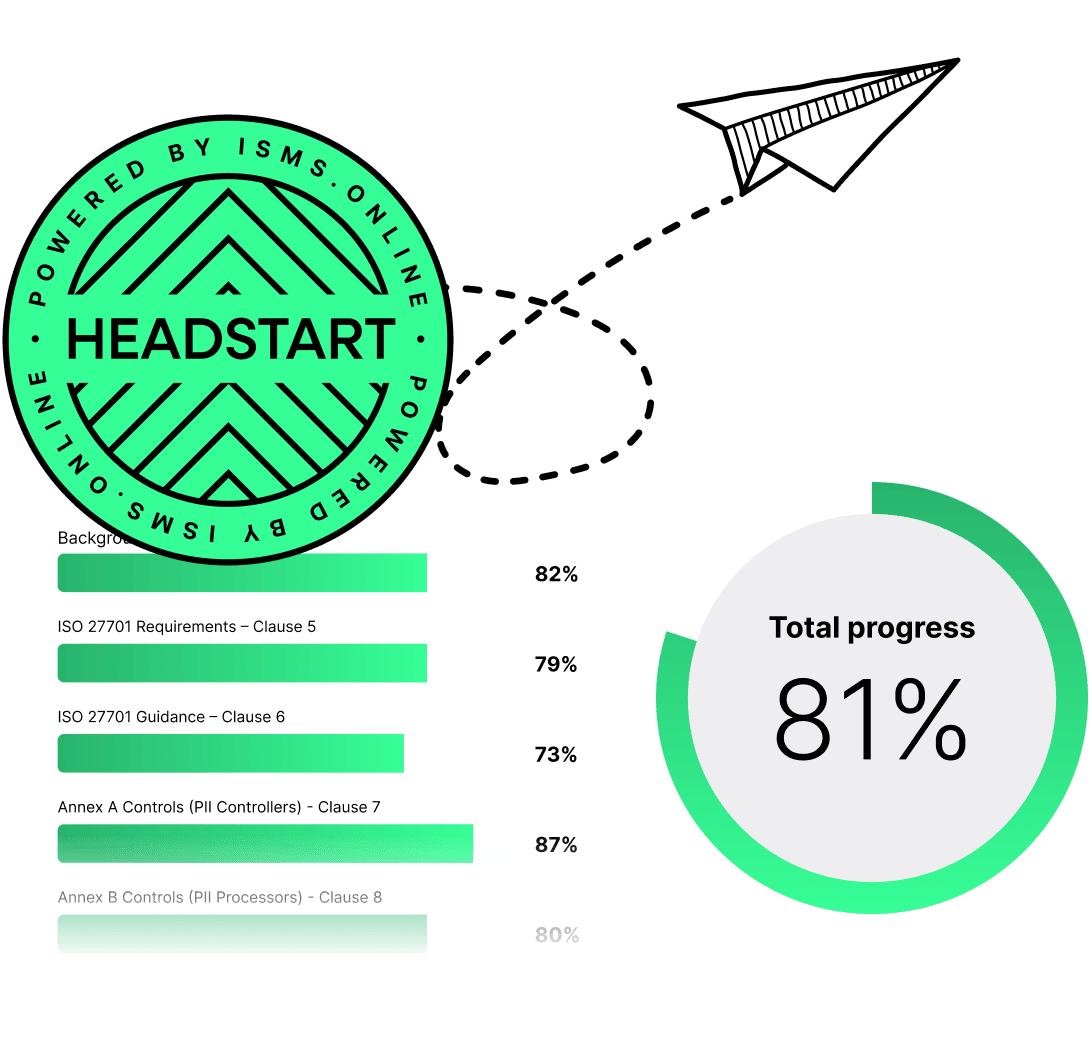
An 81% Headstart from day one
We’ve done the hard work for you, giving you an 81% Headstart from the moment you log on. All you have to do is fill in the blanks.
How Does Context Define the Success of Your ISMS Business Case?
No two compliance functions face the same environment. Boards in highly regulated sectors value certification as insurance; SaaS scale-ups view it as the passkey to larger deals. Without contextual mapping—to sector, frameworks, and internal resources—cases flounder and fail to win sponsor support.
What External and Internal Factors Change the Game?
External drivers:
- Regulatory regime shifts (e.g., GDPR, NIS2) tightening required controls.
- Customer expectations around controls, attestations, and supply chain transparency.
- Industry-specific compliance cycles or RFP gating questions.
Internal levers:
- Current staff workload and ability to sustain manual evidence generation.
- Maturity of existing documentation and lifecycle management.
- Appetite for automation and visible accountability.
Proven Contextual Alignment Strategies
- Map each business case section to a current or pending regulatory/tender obligation.
- Align controls and policies with the actual, not aspirational, operational footprint.
- Use resource visuals (Gantt, swimlane, RACI) to reveal breaks in process fluency.
Context-Driven Cases Stand Up to Scrutiny
Organisations that neglect contextual tension lose board confidence and see risk drift. Our system embeds contextual cues and guides, reducing the translation burden on compliance leaders.
Why Do Manual Methods Quietly Sabotage Efficiency and ROI?
The cost of “good enough” compliance is rarely calculated. Spreadsheets and email trails make process ownership ambiguous, evidence archiving unreliable, and reporting slow. These legacy methods create friction that’s only visible when things go wrong—at recertification crunch or critical incident review.
Manual Pitfalls: How Fragmentation Eats Resources
Organisations dependent on manual logs and ad-hoc updates face:
- Evidence lost between teams and re-created at cost.
- Inconsistent document versions causing audit pushback.
- Compliance fatigue: high performers burned out by unnecessary double-work.
Efficiency Gains from Systemic Transition
Platform consolidation delivers:
- Real-time task visibility and auto-escalation for overdue items.
- Automated drift detection: alerting you to misalignments before audit day.
- Template-based policy frameworks updated as regulations shift.
Manual compliance is tolerable—until one incident costs more than a decade of automation.

Free yourself from a mountain of spreadsheets
Embed, expand and scale your compliance, without the mess. IO gives you the resilience and confidence to grow securely.
What Does a Methodical Evaluation Reveal About ROI Hidden in Your Workflow?
Systematic, independent evaluation is the fulcrum that shifts compliance from obligation to value-driver. By mapping every recurring, avoidable task and surfacing gaps at stakeholder friction points, you create a business case not on theory, but on provable short-term wins and long-term protection.
Key Steps for Unlocking ROI
- Run gap assessments comparing policy, evidence, and risks across frameworks.
- Overlay compliance process maps to reveal duplicate or conflicting tasks.
- Quantify the impact of unresolved findings and manual cycles, then project savings against lifecycle costs.
ROI Map for Modern ISMS Evaluation
| Opportunity | How to Uncover | Value Unlocked |
|---|---|---|
| Duplicated effort | Gap analysis, version tracking | Immediate staff hour savings |
| Missed requirements | Stakeholder mapping, audit logs | Lowers audit failure risk |
| Fragmented ownership | Process swimlanes, RACI analysis | Accountability = time to closure |
| Late evidence delivery | Task flows, escalation mapping | Shorter cycles, higher quality |
How Stakeholders Use Data-Driven Proof to Drive Change
Compliance officers and CISOs who walk the board through these mapped points routinely see funding approved in half the typical cycle—and maintain post-project support, since outcomes remain visible and measurable.
What Strategic Advantage Is Unlocked by Integrated Risk and Control Management?
Splitting controls, risks, and evidence destroys the chain of trust that underpins real compliance. Boards and auditors don’t want promises; they want transparent, checkable proof. Connecting these elements transforms compliance from a cost sink into a platform for resilience, faster time-to-market, and elevated brand trust.
Operationalizing Unified Evidence
By linking risk registers with control process flows and automated evidence repositories, your ISMS becomes a living system—dynamic, responsive, and always up to the challenge.
Integrated Controls Deliver:
- Real-time visibility: see risk posture immediately, not quarterly.
- Ownership routes that enable quick, effective close-out of findings.
- Ready-to-report trail for audit demands or third-party validation.
Why Systemic Integration Lowers Risk—and Cost
Unified dashboards mean reduced toolsprawl, less training, and lowest possible error rates. Our system’s structure is frequently referenced by third-party auditors for helping clients cut nonconformity rates in half.

Manage all your compliance, all in one place
ISMS.online supports over 100 standards and regulations, giving you a single platform for all your compliance needs.
How Do Automation and Centralization Shift the Compliance Equation?
Process centralization doesn’t simply reduce effort—it changes the scope of what’s possible for your team. With automation handling routine evidence collection, reminders, and evidence mapping, you move from after-the-fact proof to always-on protection.
Concrete Impacts of Centralization and Automation
- Accelerated audit cycles—weeks shaved, not hours gained.
- A single, versioned source for all documentation, monitored for drift or external changes.
- Consistent, up-to-date policy libraries accessible to governance and frontline staff alike.
Impact Metrics Before and After ISMS Centralization
| Metric | Manual/Legacy | With Platform |
|---|---|---|
| Audit cycle time | 6–12 weeks | 2–4 weeks |
| Staff hours/week | 12–20 | 5–8 |
| Evidence retrieval | Ad hoc/manual search | 1-click search |
| Audit findings | 3–5/major audit | <2, typically none |
By bringing these impacts to the fore, our platform earns its keep not just by tick-boxing, but by reshaping your operational horizon.
Why Tomorrow’s Leaders Make Their Business Case Before the Audit Arrives
Every security lead, IT manager, and compliance champion faces a choice: explain process gaps in the boardroom, or preempt questions with evidence, insight, and confidence. The future belongs to those who prepare—not react.
What Secure Leadership Looks Like in Practice
The teams who command trust don’t just show up to audits ready; they prove readiness every day, in every stakeholder interaction. They don’t fear new frameworks—they onboard them without drama because process, evidence, and ownership is already in place. We provide the means; you provide the momentum.
Be the organisation that redefines what readiness looks like—trusted, proactive, and always ahead.
Book a demoFrequently Asked Questions
What hidden compliance inefficiencies quietly erode your protection and keep results below board-level expectations?
Small inefficiencies compound, silently draining resources and creating operational bottlenecks long before problems surface in an audit. Your risk registers, evidence folders, and policy updates may look presentable—but the moment they scatter into different hands, platforms, or team silos, your ISMS shifts from asset to liability.
Latent Leaks in Your Compliance Foundation
- Fragmented evidence: Documentation stored in personal drives or forgotten folders creates a “data sink”—invisible until deadline panic hits.
- Ownership drift: Key tasks and responsibilities shift over time, breaking the chain of traceability your auditors—and your board—expect.
- Rework tax: Locating, rewriting, or duplicating existing materials burns staff hours and morale, hiding sharp losses in your operational budget.
Evidence-based leaders counter these silent rent-seekers by deploying real-time dashboards, automated prompts, and single-source repositories—ensuring evidence is never lost in translation or turnover. As a result, teams stop scrambling and start preempting: audit cycles shrink, fatigue drops, and the operational tempo becomes a selling point to executive sponsors.
If you can’t see the risk, you can’t manage it. Evidence is a leadership weapon, not a compliance afterthought.
Embed rigour before you need reputation repair. That’s how organisations move from “compliant in theory” to “credible in practice,” making certification an asset, not a stress test.
How do the right business case building blocks separate leadership-ready ISMS from costly exercises in bureaucracy?
Strong business cases distil complexity into actionable metrics and strategic gains. An ISMS that persuades your CFO, CISO, or CEO does more than list controls: it ties every activity and investment to a measurable reduction in risk, time, or capital loss—backed by data, not promises.
Building True Decision Certainty
- Cost benefit clarity: The ROI comes not just from passing an audit, but from saving hours, containing legal exposure, and keeping your pipeline open to lucrative deals.
- Risk translation: Risks aren’t abstract; they’re quantifiable losses tied to fines, breach remediation, client trust, and lost competitive momentum.
- Audit posture intelligence: Integrated dashboards move you from “reporting fatigue” to instant updates, arming your leadership with answers before questions arise.
Information Security Management Systems reach their full value when every control, owner, and evidence path is mapped—and when those maps can be navigated seamlessly, even as teams shift. Our approach centres on connected components: risk banks, live evidence, role-based visibility, and unified SoA tracking, making proof a daily default—not an audit-season panic button.
Informed risk is the only shield that makes leadership sleep a little better at night.
Persuasion doesn’t start with features. It’s born in the confidence your next executive briefing delivers—quantified outcomes, defensible investment, seamless transitions even as the risk landscape shifts.
Why does strategic context—not compliance for its own sake—decide whether your ISMS is a force-multiplier or a hinderance?
Every regulation, from GDPR to HIPAA or NIS2, is designed to change. Strategies don’t fail because they’re wrong—they fail because they’re context-blind: the processes that made sense for last year’s threat profile become a drag as new regulations, contracts, or markets emerge.
Where Context Signals Outpace Routine
- Regulatory drift: Teams that chase current frameworks without horizon scanning risk building in legacy obligations, then scrambling as industry standards shift.
- Resource asymmetry: If your ISMS doesn’t account for where your best talent is concentrated, vital tasks get missed, duplicated, or delayed—creating unacknowledged exposure.
- Board alignment gap: Without real-time mapping between operational controls and high-level business objectives, compliance becomes expense—not insurance.
Winning leaders treat context as a moving target and embed adaptive dashboards, regulatory triggers, and resource visualisation into their ISMS. That traction pays off in fewer surprises, faster pivots, and the confidence to say “we saw this coming” no matter what the next audit, RFP, or incident demands.
The only ISMS that earns trust is the one that adapts before the environment forces change.
When your system contextualises every control as both risk shield and business enabler, your competitors are left justifying expenses while your team demonstrates value.
How does overreliance on manual processes become the hidden saboteur of your organisation’s security and audit priorities?
Manual systems seem manageable—until they trigger operational entropy so great that your best staff start feeling like problem magnets. Spreadsheet trackers, emails with “final” in their filename, and manual reminders erode not only efficiency, but trust in the data every report and decision rests on.
The Quiet Cost of Compounded Error
- Static tracking: Every manual handoff is a bet that nothing will slip through the cracks.
- Reactive evidence: Folders named “For Audit” are battle scars, not best practices.
- Reluctant expertise drain: High talent turns into high turnover as frustration with broken systems outweighs compensation.
Where machine-driven notifications, real-time evidence pointers, and versioned document repositories become common language, teams feel lifted—not loaded. Your ISMS.online implementation doesn’t just relieve acute pain: it recalibrates how the organisation thinks about security and documentation, promising future-proof headroom as obligations intensify.
A control that only exists in a spreadsheet is security theatre. It fails when stakes get real.
When the cost of misstep outpaces the effort to fix, status shifts to those who automate diligence—not just effort. That’s the mark every CISO wants on their resume by the next board review.
How can a systematic evaluation process expose hidden ROI and shift compliance from reporting burden to reputation asset?
Surface-level reviews only confirm what’s already half-known. Gates are meant to keep out threats, but real risk wounds come from the inside—tasks assumed to be covered, or data fields left blank until the finding arrives.
The Value in Relentless Gap Mapping
- Auditable actionability: Mapping every policy, risk, and evidence owner kills dead space and chases out duplicate work.
- Stakeholder integration: A true ISMS business case doesn’t pitch perfection; it makes workflows so visible and responsive that even reluctant teams become process believers.
- Outcomes tracking: The best plans surface not only the “set pieces” that pass audits, but also the edge cases that drive future improvement and candid executive conversation.
When compliance quantifies its own upgrades—shaving days off audit prep, reducing duplicated attestations to zero, and moving from “what if” to “here’s proof”—the ROI becomes a board-level narrative, not a subject for debate.
Auditors may provoke the question, but only systems built for candour deliver the answer before it’s demanded.
Business case ROI isn’t a brochure metric. It’s lived out in the moments when your team delivers answers at 2 AM or sidesteps a vendor exposure that a competitor has to explain next quarter.
How does integrating risk and control management ensure your ISMS isn’t simply a reactive formality—but the basis of reputational trust and contract certainty?
Risk registers, control documentation, and evidence logs often become siloed, turning real security into a paperwork exercise. When these silos are breached—because of a missed closure, a vanished owner, or a lost file—the fallout isn’t just delay: it’s lost revenue, brand erosion, and sometimes legal jeopardy.
Convergence Creates Continuity
- Unified dashboards: When evidence, risk, and controls interlock in one platform, oversight moves from defensive confirmation to active defence.
- Role accountability: Who updated what, when—even as the team changes—should never be a mystery.
- Audit velocity: Integrated systems collapse time-to-close for remediation, clean up recurring findings, and give your organisation a posture of “earned trust” during diligence and contract review.
Proof comes when an unexpected issue is fixed before escalation. The ultimate status symbol? Being the organisation that solves compliance issues before they disrupt your business, earning recurring wins—first in due diligence, then in every board-level conversation thereafter.
Trust is built in quiet hours, not audit crises. True integration shows up where others improvise.
Data-backed identity never needs a third party to vouch for it. That’s where reputation earns compound interest, deal after deal, review after review.






