





































How Can Clause 4.1 Transform Your ISMS From Paper Policy to Operational Lifeline?
Clause 4.1 shouldn’t feel like checking a box-it’s your system’s living, strategic pulse-point. The best ISMS implementations treat “understanding the organisation and its context” as a mechanism for true defence, not bureaucracy. Whether you’re a Compliance Kickstarter racing toward that first audit or a practitioner burned by false certainty, this is where you shift from theoretical controls to a reality-anchored security posture.
If you capture only what you expect, you’ll lose to what you don’t.
The organisations that thrive seldom “complete” context-they show it changing, living, and influencing every control. This means using a register, context map, or dashboard that tracks the beating heart of your company: new markets, technology bursts, staff churn, compliance pivots. Each context entry is evidence of foresight, not just a line item for your next audit.
You’ll discover that context lives everywhere: in the way you pitch risk at a board review, how your privacy officer deciphers another contractual clause, in the tension Ops feels around a new SaaS deployment. Great ISMS platforms don’t push you to dump this into a hidden spreadsheet; they put context registers front and centre, assign owners, and systematise reviews.
How Do You Turn Context Into a Living, Actionable Record?
Start with these non-negotiables:
- Document the environment around you-internal factors (mergers, staff growth, tech moves), external pressures (regulators, new clients, evolving attacks).
- Place your register where its visible, interactive, and updated-tied directly to KPIs and action planning.
- Assign clear owners: typically the CISO or designated ISMS lead, but true value lies in harnessing the insight of department heads and front-liners.
The magic is ongoing review. Context isnt static-you need a mechanism to trigger updates: annual schedules, post-incident logbooks, or market change spikes. At each review, youre not just ensuring compliance, youre testing if your sense of the real world is keeping pace with evolving threats. When organisations treat reviews as a signal of learning, audits become not just easier-they become proof of resilience.
Book a demoWhat Practical Steps Move Context Work From Theory Into Everyday Security?
The difference between ticking a box and building resilience is in your process. Kickstarters and seasoned practitioners alike must treat Clause 4.1 as a call to operational embeddedness-where context isn’t background noise but the first indicator of upcoming risk.
You don’t fall victim to threats you see coming-risk strikes when context is ignored.
How Do You Identify and Capture the Real Factors Shaping Your Risk Posture?
First, command an honest assessment of your internal landscape: new partnerships, business process redesigns, tech migrations, emerging skill gaps. Don’t let this stay in the heads of your Ops team or CISO-write these insights into your context map.
Next, look outside: which regulators are tightening their posture? What’s accelerating in your supply chain or customer base? Who’s entering your market and changing expectations?
Industry leaders use dynamic context registers integrated into their ISMS to:
- Catalogue internal and external pressures in real time (audit logs, risk dashboards)
- Flag changes with automated alerts (new law, major breach, customer feedback)
- Link context directly to controls and KPIs, so nothing falls out of sync (bsi.co.uk, ico.org.uk)
How Is the Right Location for Context Management Decided?
The platform you use will determine whether context is actioned or forgotten. Embedding context logs within your ISMS means you gain:
- Continual audit readiness with instant access to updates
- Evidence trails required by standards bodies and auditors – A collaborative, versioned history that shows why changes occurred.
When a fintech firm noticed rising scrutiny, the real differentiator wasn’t their risk register-it was the two-week cycle from context change to supplier audits, backed by ISMS workflow and versioned signatures.
Invest in visibility: context left to “Update Quarterly” tasks on a static spreadsheet won’t save you when an auditor-or regulator-asks why a market move wasn’t caught.
ISO 27001 made easy
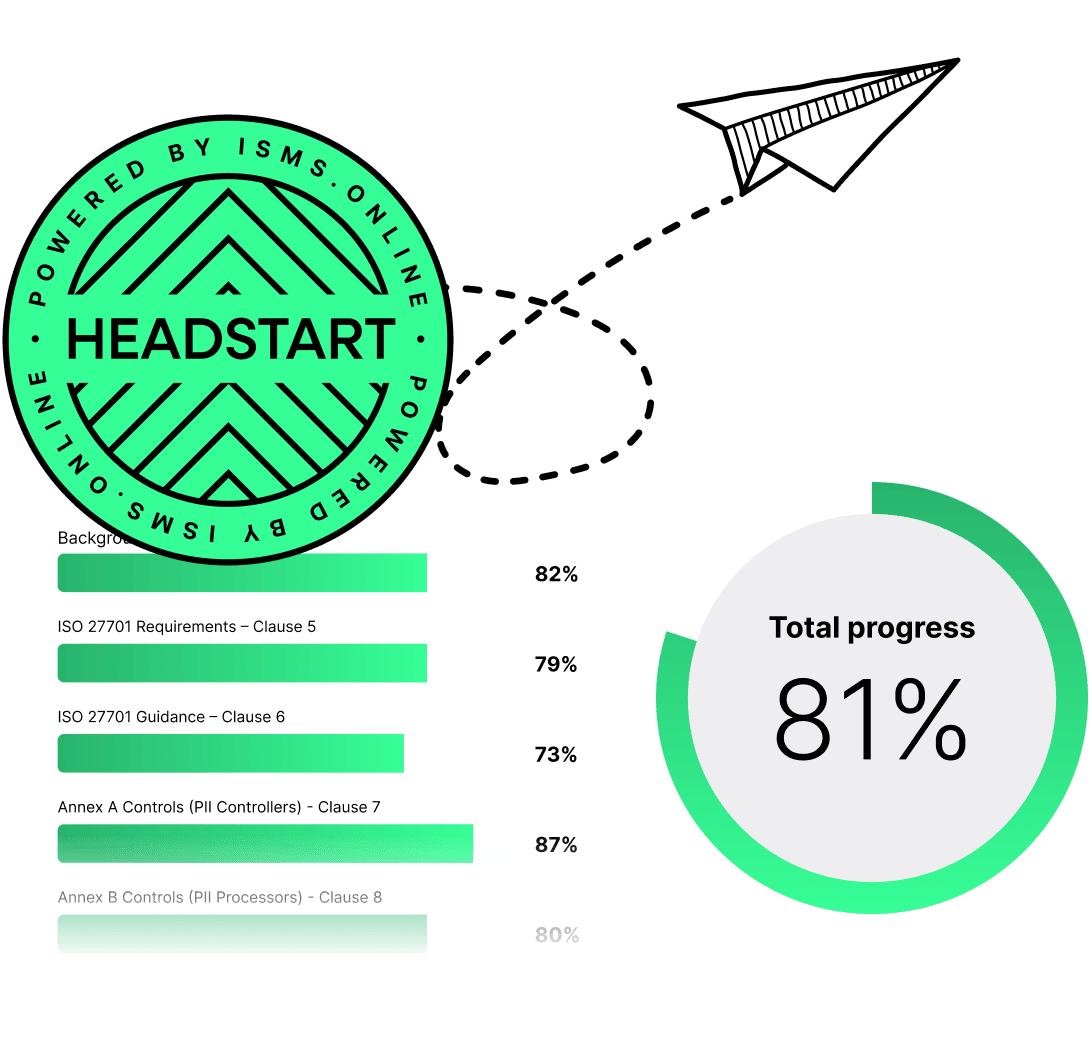
An 81% Headstart from day one
We’ve done the hard work for you, giving you an 81% Headstart from the moment you log on. All you have to do is fill in the blanks.
How Does Stakeholder Mapping Prevent Blind Spots and Build Trust?
The most significant failing in ISMS maturity? Seeing context as a solitary exec or CISO’s job. Effective Clause 4.1 implementation depends on mapping, reviewing, and acting on a complete mesh of stakeholder needs-from board directors to contract signers, to staff, customers, suppliers, and even regulators.
Most serious security incidents begin not with a technical flaw, but with overlooked people.
How Do You Build and Maintain a Stakeholder Register That Delivers Value?
Step one: Broaden your map. Stakeholder analysis must reach beyond the C-suite-capture input from:
- Sales (customer security demands often drive urgent changes)
- Operations (process realities and bottlenecks)
- IT and engineering (where controls become reality)
- Legal and regulatory (privacy, contractual risks)
Track pain points, expectations, and reported concerns, connecting these directly to ISMS register entries. Use a platform where the stakeholder matrix links to workflows-feedback is not just “noted,” but actioned, versioned, and reviewed.
ISACA research shows that organisations regularly mapping, discussing, and acting on stakeholder needs see lower rates of audit findings and unplanned outages.
What Proves You’re Listening?
At each planning cycle and after major business events (incidents, deals, strategy changes), you must:
- Review and update your register with new/shifted names, obligations, pain points
- Have every review logged, signed, and acted upon-no step left as hearsay Lasting trust grows not from policy alone, but from demonstrated, actionable listening. When a transport company heard new customer worries around data in the supply chain, their response was logged in the system and closed with a zero-findings renewal at audit.
Why Do Legal, Regulatory, and Market Pressures Deserve Centre Stage?
Treating laws and regulations as “checkpoints” instead of living context is a recipe for missed obligations and failed audits. Clause 4.1 places these external obligations as multipliers of your actual risk-your threat landscape evolves as fast as new regulations are published.
A regulation missed today becomes tomorrow’s contract block or audit failure.
How Do You Turn Legal and Regulatory Change Into a Proactive Asset?
Maintain a compliance register for all obligations-laws, regulations, contracts, codes of conduct, framework requirements-and tie each to the exact process, department, or ISMS asset it affects. ISMS.online users often map:
- GDPR, CCPA, DORA, HIPAA, PCI DSS, and sectoral standards to their risk register and control set
- Pending obligations sourced from industry bulletins and legal alerts, always one click from escalation
- Every update with a date, owner, and traceable decision record, ready for any auditor’s scrutiny (dataguidance.com, gartner.com)
Assign real owners for horizon scanning-risk, privacy, legal, or designated compliance leads. Enforce a scheduled review cycle and implement action triggers for significant changes.
Organisations that promptly rewrite policy and controls after a new law, and log those updates, earn regulator trust and reduce lag windows. One SaaS provider used rapid mapping to maintain uninterrupted customer trust and avoid delay penalties.
What Evidence Will Pass an Audit?
Regularly-updated registers, mapping tables, logs of policy amendments, and executive sign-offs-all maintained in your ISMS, ready for export.
Ignoring legal and market context is not just high-risk: in highly regulated sectors, it’s a business killer.

Free yourself from a mountain of spreadsheets
Embed, expand and scale your compliance, without the mess. IO gives you the resilience and confidence to grow securely.
How Can You Make Your Security Objectives Prove Real Alignment to Context?
For Clause 4.1, organisational objectives aren’t wish lists-they are testable hypotheses, tied directly to context and demonstrable through evidence. Compliance Kickstarters and Strengthen ICPs must show every security target is a response to a real internal or external need.
Disconnect context from controls, and you’ll never be audit ready-or trusted by the C-suite.
How Do You Build “Living” Objectives That Auditors Trust?
- Start with your organisational strategy, not a recycled security checklist.
- Translate drivers into measurable objectives: “ISO 27001 by Q4,” “Eliminate legacy PII risk,” “Halve incident response times.”
- Assign owners and version control each objective in your ISMS.
- Explicitly map objectives to entries in your context and compliance register; link every security target to a traceable real-world factor (iso.org, cpni.gov.uk).
Table: Context-Objective Linkage Example
| Objective | Context Link | Proof |
|---|---|---|
| Reduce audit time | Vendor shift | Prep dashboard |
| Pass DORA by 24Q2 | Reg change | Signed mapping/form |
| US expansion | Market entry | Board approval min. |
How Do You Keep Objectives Updating With the World?
Review and validate every 3-6 months-or when significant changes hit. Update stale objectives, close those met, and escalate or split ambiguous ones. Vetted, signed, and living objectives become pain-free at audit-and, more importantly, build credibility with senior management.
Objectives left untouched become a source of findings and undermine your entire ISMS effort.
What Methods Guide You to Honest Capability and Constraint Analysis?
Security can’t succeed where ambition ignores constraint. Clause 4.1 expects you to scan capabilities and bottlenecks-then prove you can back your plan with resources. Here’s why practitioners and leadership cannot afford to skim this step.
Show your limits, then show your plan-that’s real trust.
How Do You Profile Skills and Resource Gaps With Real Evidence?
Conduct a structured gap analysis at least once a year, but ideally at every incident or major shift:
- List all critical roles, skill-sets, and technology dependencies needed for your ISMS outcomes.
- Identify shortages-areas like cloud expertise, regulatory training, vendor assurance, or process automation.
- Map these to your control roster, noting risk scores higher where gaps exist.
Key proof elements:
- Completed upskilling and training programmes (with records stored in your ISMS)
- Action logs or minutes showing escalation/resourcing of known pain points
- Regular updates and lessons-learned from incident reviews or audits (sans.org, cyberark.com)
Real-world example: When a SaaS firm documented its limited cloud vendor experience, it was able to secure external support in advance-turning a weakness into audit-proofed preparation.
Burying or ignoring your bottlenecks backfires under audit and at the sharp end of risk.
How Are Blockers Tracked and Resolved for Continual Improvement?
Assign owners to every constraint. Log mitigation steps-whether it’s scheduled vendor onboarding, additional training, or process redesign. Escalate to the board or a dedicated risk committee if issues can’t be resolved internally, and keep a versioned record for every decision.
Proactive, honest reporting-showing what you’re doing with what you have-is a powerful differentiator for auditors, customers, and even staff trust.

Manage all your compliance, all in one place
ISMS.online supports over 100 standards and regulations, giving you a single platform for all your compliance needs.
How Do You Connect Context, Risk, and Control for Credible Security?
A context register means nothing by itself unless its content flows directly into risk and control decisions. Clause 4.1 expects a dynamic, documented link between changes in context and updates to your risk register and controls. That’s what turns compliance from static paperwork to demonstrable vigilance.
When context isn’t connected, controls die on the vine; when aligned, controls truly manage your risk.
What Ensures Context Levels Up Your Risk Management?
- Every meaningful context revision (new law, supplier, customer, market, or incident) must trigger a review of the related risks. A well-integrated ISMS aids by automating alerts, assigning reviews, and tracking completion.
- Controls then adjust-new mitigations, retirements, or strengthens-directly tied to these reviews.
- Strong platforms show every context-risks-controls relationship in evidence-ready form, and auditors increasingly expect to see that “living linkage” (riskmanagementmonitor.com, infosectoday.com).
Table: Context–Risk–Control Trace Matrix
| Context Change | Risk ID | Control Ref. | Audit Trail |
|---|---|---|---|
| GDPR update | R-17 | A.5.31 | Signed impact log |
| Vendor onboarding | R-09 | A.5.19 | Workflow trigger |
| New market | R-06 | A.5.5 | Board minutes |
Smart companies design “change triggers” in their ISMS so that even minor shifts prompt a traceable review-demonstrating not just compliance, but active risk management.
What Proves an Actionable Context, Audit After Audit?
Maintain change logs, register versions, and governance minutes for every impact event. A context update should cascade to risk and control adjustment, signed by all relevant owners. This closes the loop from context to execution-ensuring nothing slips through unseen.
In practice, a healthcare company updating its device context register rapidly adjusted controls, showcased traceable action, and earned glowing audit reviews.
What Distinguishes Audit-Ready Evidence From the “Just Trust Me” Approach?
Auditors want a trail: version-controlled, owned, and reviewed. Clause 4.1’s context requirement isn’t satisfied by nice policy documents or board presentations-it needs signed, living records tying updates to action and closure.
Auditors don’t hunt for theoretical compliance; they look for operational proof.
What Types of Evidence Should Stakeholders Maintain?
- Register and change logs with date/time stamps and owner signatures
- Digitally-signed closure of context review cycles (annual, quarterly, triggered)
- Meeting minutes, escalation/mitigation logs, and signed-off improvements
- Third-party audit attestation or independent reviews
Each persona’s review, from practitioner to board level, leaves its own proof:
- Practitioners update gap logs and registers.
- Compliance leads close reviews and file lessons-learned with sign-off.
- CISOs and boards sign escalation and approve closures.
- External auditors verify the cycle, checking for independence and completeness (itgovernance.co.uk, auditconnect.com).
Table: Audit-Grade Evidence and Review
| Role | Evidence Type | Proof Element |
|---|---|---|
| Practitioner | Change log, context update | Signed-off register |
| CISO/Board | Governance reports, closures | Board minutes |
| Auditor | Independent review, cycles | Audit validation |
How Is This Operationalized in ISMS.online?
Living context logs-tagged, versioned, and owner-assigned. Platform-based sign-offs and evidence packs pre-built for each audit or governance checkpoint. Actioned evidence, not passive reports, closes audit risk.
Organisations using proactive sign-off cycles and issue logs have converted near-misses into audit highlights, earning demonstrable trust from both external and internal stakeholders.
What Feedback Loops and Review Cycles Make Context Truly Resilient?
Your ISMS is only as alive as its feedback loop. Clause 4.1 comes to life through scheduled and event-driven reviews, supported by real stakeholder engagement. This is where context becomes more than compliance; it becomes a defence mechanism and an engine for trust.
The stakeholders and lessons you skip in review surface as surprises in your next audit.
What Review Mechanisms Close the ISMS Context Loop?
- Quarterly/annual review cycles recorded in the governance calendar-mandated, signed, and version-controlled
- Post-incident and ad hoc reviews triggered by near-misses, major events, or external risks
- Stakeholder engagement: direct feedback, policy acknowledgment tracking, action logs, and collaborative review sessions (theirm.org, csoonline.com)
Modern ISMS platforms, like ISMS.online, streamline these cycles with automated reminders, stakeholder prompts, and ready-to-export review packs. Only a truly operational feedback loop guarantees continual context relevance, audit readiness, and resilience.
Table: Resilient Engagement Cycle
| Review Cycle | Stakeholders Involved | Record Type |
|---|---|---|
| Scheduled review | CISO, Managers, Board | Governance logs |
| Incident review | Security, IT, Ops | Lessons-learned log |
| Audit pre-check | Compliance, Audit | Signed checklist |
Regular engagement converts “context” from a theoretical exercise into an always-on, competitive asset-helping you identify risks and seize opportunities before others.
How Can You Turn Every Context Change Into Opportunity?
Make review outcomes visible, celebrate resolved issues, and assign owners to every lesson-learned. Whether you’re solo or board-level, the feedback loop ensures Clause 4.1 isn’t just covered-it’s a driver of organisational advantage and trust.
Why ISMS.online Is the Fastest Route to a Living, Audit-Ready Context
Bridging the gap between policy and reality is what separates audit successes from failures. ISMS.online’s context module, built to anticipate and resolve all the complexity surfaced in Clause 4.1, delivers an operational foundation-not just a compliance claim sheet.
You gain these edges:
- Step-by-step fill guidance in language everyone understands, not just security experts
- Version-stamped change logs and digital sign-offs, eliminating evidence-chaos at audit
- Automated reminders, stakeholder prompts, and review cycles-so context never falls out of date
- Dynamic workflows: every regulatory and market change instantly routes to the right owner, triggers risk and control reviews, and stores audit-grade proof in a living, ownership-tracked location
ISMS.online was purpose-built for organisations running lean compliance teams-compliance kickstarters, CISOs, privacy officers, or hands-on practitioners. Real companies have leveraged its dynamic registers to intercept regulatory shifts, lock down new supplier contracts, and drive a pace of review that outpaces risk and audit expectations.
Audit-ready context is grown, not filled-let your record of vigilance, action, and learning prove your value in every audit and customer conversation.
Ready to turn every Clause 4.1 update into your strongest control?
ISMS.online activates your context, closes the loop, and transforms compliance from overhead into operational trust and business advantage.
Frequently Asked Questions
Who should own Clause 4.1 “context mapping,” and how does it shape your ISMS’s resilience?
Ownership of Clause 4.1 context mapping is best assigned to your ISMS Lead, CISO, or another appointed ISMS manager-but lasting resilience emerges only when it’s an active, shared responsibility across business functions. Clause 4.1 requires your organisation to systematically capture and adapt to all internal and external issues that affect information security. When ownership sits with a single person or department and context is seen as a checkbox task, risks quickly slip through. Instead, integrating regular input from IT, HR, Legal, Operations, and Sales ensures context reflects real-world changes and prepares your ISMS for audit rigour.
Many audit findings stem from context registers that are out-of-date, incomplete, or limited to siloed perspectives. Auditors increasingly look for evidence of a living process: context logs that include multi-departmental input, visible change records, and links between business events and security controls. By establishing clear ownership with cross-functional collaboration-such as embedding context review into quarterly risk committee meetings-you create a resilient ISMS that evolves alongside your organisation. ISMS.online and similar platforms support this accountability by tracking who contributed, when, and what actions resulted.
Resilience comes not from one owner, but from shared vigilance-context that’s updated together, adapts together.
Why single-owner context fails audits
- Siloed management often overlooks shifts outside one department’s view.
- Critical business or regulatory changes go undocumented, creating audit blind spots.
- Cross-functional processes are proven to reduce nonconformity findings and build audit confidence.
What’s the step-by-step approach for mapping and keeping context current under Clause 4.1?
A robust Clause 4.1 process starts with a collaborative context-mapping workshop. Assemble representatives from all key areas (ISMS Lead, IT, Legal, HR, Operations, Risk, Procurement, Sales). Jointly map both internal and external factors-organisational structure, process changes, key staff skills, new regulations, emerging threats, or supplier additions.
Instead of static spreadsheets, use a version-controlled ISMS platform or digital context register. Every entry should be dated, attributed, and clearly describe the nature of the change. Schedule quarterly formal reviews, but also prompt immediate updates in response to major business events: onboarding a major client, regulatory shifts, mergers, or technology deployments. Enable automated reminders and workflow triggers in your platform-ISMS.online supports scheduled and event-triggered reviews, sign-off capture, and linked action items.
Each context entry should directly reference impacted risks and controls. For example, a new line of business or data processor should flow immediately into risk assessment and, if necessary, trigger new or updated controls. Minutes from management meetings, feedback from operational leads, and rationale for decisions should all be logged, providing concrete evidence for both operational teams and auditors (TÜV SÜD; InfosecToday).
- Map context collaboratively: bring all stakeholders to the table
- Centralise in a digital register-every change documented, versioned, and attributed
- Automate reminders for regular and dynamic updates
- Link context directly to risks/controls and require follow-up review
- Store meeting evidence and audit trails in your ISMS, preserving organisational memory
Why do most organisations stumble on Clause 4.1, and what actions lock in compliance and resilience?
The main reason organisations stumble is treating Clause 4.1 like a one-time document. Focusing on “getting it done” for first-time certification-then letting it stagnate-leads to missed risks and repeat nonconformities. Nearly two-thirds of initial ISMS audits cite Clause 4.1 nonconformities, most stemming from outdated, incomplete, or purely IT-oriented context registers (Advisera; IT Governance).
To lock in both compliance and resilience:
- Formalise context review as a living, recurring process, not an annual event.
- Enforce cross-functional participation-require each business domain to contribute insights at every review cycle and after significant changes.
- Mandate that each change logs “why” and not just “what”-link every entry to a visible outcome (like follow-up risk reviews or control adjustments).
- Use your ISMS software to embed reminders, link updates to action items, and track evidence automatically.
- Welcome feedback and “change flags” from all staff, allowing bottom-up inputs that catch real-time risks.
By institutionalising this approach, you make your ISMS both audit-ready and adaptive, turning context from a static policy into a continual readiness tool. ISMS.online helps by automating much of this evidence collection and workflow, reducing manual error and enhancing audit transparency.
Pitfalls to avoid
- Letting registers stagnate after certification
- Relying only on input from IT, neglecting Legal, HR, Sales, or Operations
- Failing to link context changes to active risk assessments and updated controls
How does robust context mapping power risk analysis, scope, and effective controls?
Your context mapping is the foundation from which scope, relevant risks, and control selection all grow. Clause 4.1 sets the boundaries of your ISMS: get this mapping right, and your system’s risk analysis and controls will stay relevant-even as your business changes. Let context “drift,” and you risk missing new threats or overprotecting outdated ones.
For every significant context trigger-a new regulation, supplier, tech project, or business line-your ISMS should trace a direct line: context entry → updated risk register → revised scope or control → signed-off evidence. For example, onboarding a cloud service provider should prompt a context update, inform a risk review around data handling, and drive selection or revision of encryption controls.
Auditors expect to see documentation that “closes the loop,” connecting context, risk, and intervention. An effective ISMS (such as ISMS.online) doesn’t just record what’s changed, but explains why boundaries, risks, or controls were adjusted, and keeps this evidence fully traceable and exportable.
Example: Tracing context to action
| Context Change | Date | Risk Assessed | Control Implemented | Evidence/Sign-Off |
|---|---|---|---|---|
| New supplier onboard | 2024-05-02 | Data privacy risk | Vendor due diligence | Procurement minutes |
| Global regulation in | 2024-03-15 | Compliance risk | New compliance training | HR sign-off, SoA updated |
| Remote work expansion | 2024-01-20 | Endpoint security | MFA for all remote users | IT logs, Board minutes |
What tools and evidence best demonstrate that your Clause 4.1 context is live, not a compliance artefact?
The strongest evidence is a dynamic, digital context register-fully versioned, signed, and directly linked to risk registers, control logs, and action workflows. ISMS.online offers automated reminders for review cycles, digital sign-off for every context change, workflow triggers that cascade updates to responsible control owners, and dashboards showing how context updates drive risk/control changes.
Evidence auditors and boards seek:
- Dated, signed change logs for every context update
- Workflow actions showing context triggers led to review or modification of specific risks/controls
- Traceable links between stakeholder feedback (comments, meeting notes) and context entries
- Metrics or dashboards tying context changes to improved risk posture, reduced incidents, or closed audit findings
A robust digital trail, where every update is export-ready, gives both assurance and regulatory confidence that your Clause 4.1 process is real, rigorous, and ready for scrutiny. Meeting notes, feedback logs, sign-offs, and action close-out evidence should all be attached and versioned within your ISMS. This not only simplifies audits, but improves continual improvement cycles and organisational memory.
A living context register is your ISMS nerve centre-every signed update, discussion, and workflow step makes audits a confidence test, not an anxiety exercise.
How can leadership and management reviews keep context and controls in sync as your business changes?
Management reviews shouldn’t treat Clause 4.1 as a tick-box; they should anchor every quarterly session with a “context and scope” review as the first agenda item. Effective teams:
- Begin each quarterly or board management review by revisiting context: What’s changed in the past quarter? What’s next?
- Require department leads to report key business, tech, regulatory, staff, or partner changes-not just IT events
- Log who attended, what was discussed, and which risks, scope, or controls were adjusted
- Use ISMS.online or similar platforms to directly record minutes, assign review actions, and track completion of any follow-ups
- Monitor dashboard views that link context updates, risk assessments, and outstanding or completed actions in real time, so open issues can be closed out or escalated before the next audit
This active management approach keeps your ISMS resilient and audit-proof-ensuring changes are caught as they happen and controls move in sync, year-round. Organisational reputations are secured when context review is a continual living cycle, not a static annual event.
Organisations that make context a standing management topic stay a step ahead-every change becomes an opportunity to prove resilience, not a cause for scramble.






