





































Why Is Scope the Deciding Factor in Every ISMS Success (or Failure)?
Setting the right scope for your Information Security Management System (ISMS) isn’t a paperwork exercise-it’s the engine of trust, the anchor for strategy, and your first defence in the real world of audits and risk. The moment you blur this line, teams lose accountability, vulnerabilities slip through, and auditors circle like hawks. But when your scope is explicit-what’s protected, where those boundaries lie, and who owns them-you send one resounding message: your business is ready, credible, and in control.
Scope is the one thing auditors check first-and the last thing stakeholders forgive you for getting wrong.
Why do so many compliance projects stumble here? It’s simple: scope connects every clause in ISO 27001:2022 to your true business risks and opportunities. Done well, it aligns boardrooms, practitioners, privacy leads, and partners in a single direction. Done poorly, it breeds years of firefighting-duplication, audit findings, and recurring customer doubt. Recent case studies and auditor interviews show that most certification delays and major remediation cycles stem from missed, vague, or ill-defined scope.
Instead of letting your ISMS scope collect dust in a policy folder, approach it as a living, evolving contract between your organisation and every stakeholder-internal and external. This clarity:
- De-risks the board’s oversight.
- Gives every team a map of their responsibilities.
- Shortens audit cycles.
- Prevents those “gap surprise” customer conversations.
A well-defined scope is an open invitation to trust-internally and in the market.
The only question that matters: will your ISMS scope stand up to real-world business change, not just auditor checklists?
How Do Organisations Actually Map Their Real Scope-and Avoid the Common Traps?
If you’re tempted to draw scope based on department charts or legal entity structures, pause. That’s where most failures begin. Modern organisations bleed information and risk across boundaries-via remote teams, cloud vendors, shadow IT, and M&A. The most resilient compliance teams first map information flows-tracking exactly where sensitive data moves and what systems or processes it touches. This living map becomes your ISMS perimeter, not the org chart on the wall.
Every time your data or services move across an invisible line, your real scope shifts.
Here’s where businesses trip up (and how to patch the holes before audit day):
| Common Mistake | Audit Pain Point | The Fix |
|---|---|---|
| Third-party IT omitted | Findings, process repeat | Map suppliers, review contracts |
| Silo scoping (by team) | Missed gaps, slow recovery | Cross-functional workshops |
| Static scope file | Outdated controls, findings | Schedule mandatory reviews |
| Org chart as map | Blind spots everywhere | Track asset/data movement first |
Rather than locking your scope to static descriptions, build easy-to-update diagrams showing data flows. Walk through real processes (e.g., sales, HR onboarding, customer support) and note every team, vendor, and system involved. These diagrams become conversation starters in audit prep, onboarding, and supply chain reviews.
Your ISMS succeeds only where your people can see themselves and their work on the scope map.
Every expansion, vendor change, or new app can redraw boundaries. Make “scope review” a standing item in project launches, procurement cycles, and board risk reviews. This approach replaces frantic audit sprints with real confidence.
ISO 27001 made easy
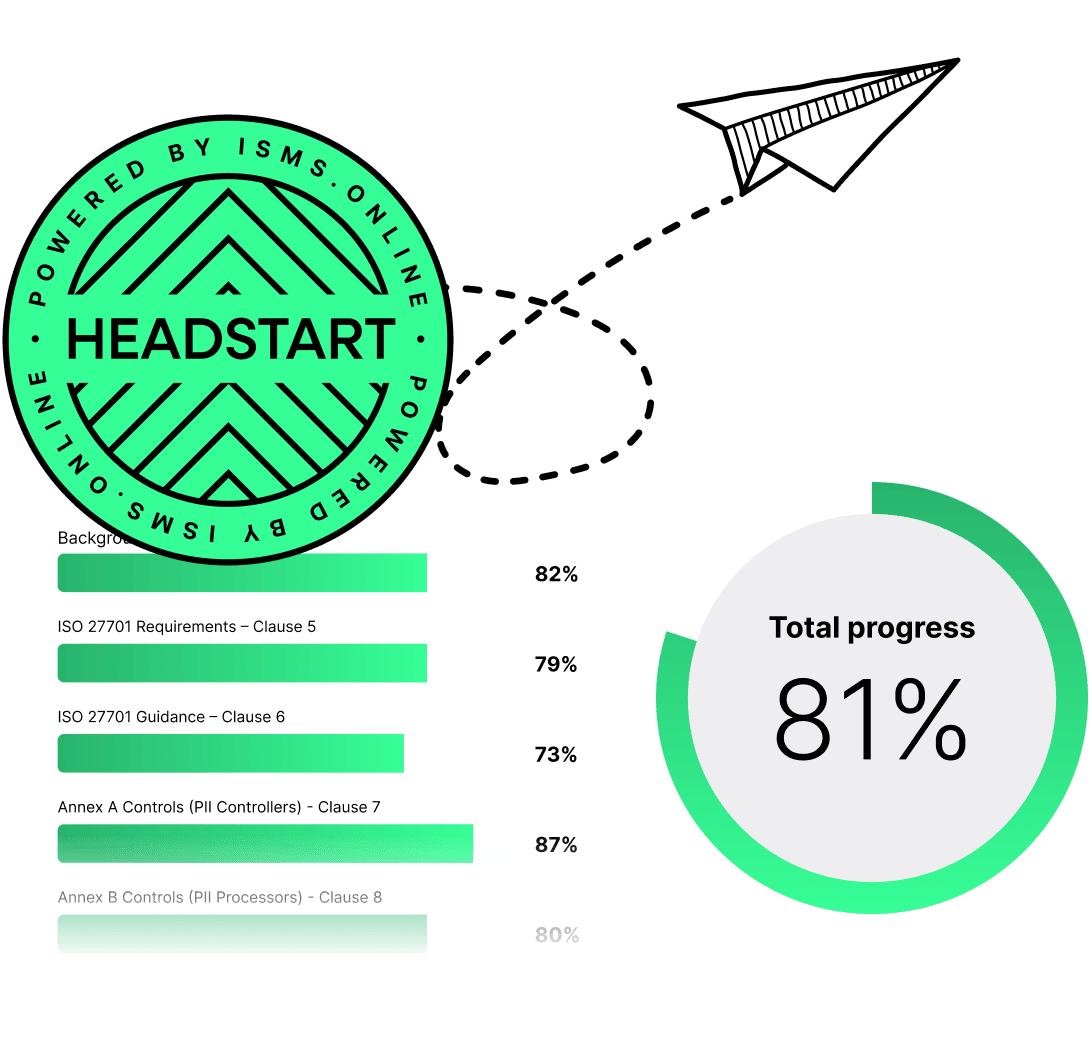
An 81% Headstart from day one
We’ve done the hard work for you, giving you an 81% Headstart from the moment you log on. All you have to do is fill in the blanks.
What Does Stakeholder-Driven Scope Design Actually Look Like?
The biggest silent sinkhole in scoping: leaving critical teams or partners out of the process. Strong compliance cultures convene cross-functional workshops early and revisit them regularly, drawing in not just IT or compliance but HR, privacy, operations, and legal. Each function owning or processing in-scope data must weigh in, challenging assumptions and adding “unknown unknowns” before they become audit findings.
Any department not represented in scope design becomes the next source of risk and the auditor’s first call.
The format? Blend visual mapping (physical diagrams, data flow visuals) and collaborative decision logs-a version-controlled, organisation-wide repository (ideally inside your ISMS platform-not a buried drive). Make it a policy to surface scope debates: “Should payroll integration be in-scope?” “Does the new SaaS vendor sit within our perimeter?” Document every input, every agreement, and every challenge. Auditors trust scope work they can see, track, and question.
Rushed, compliance-only scoping multiplies downstream costs and positions your ISMS as a box-ticking exercise, not a business advantage.
If you want to future-proof audits and vendor contracts, treat scope meetings as standing reviews, not one-time exercises.
How Does Practical Scope Lock-In Drive Audit Resilience?
The real discipline in ISO 27001:2022 Clause 4.3 is locking scope into your operations-everywhere. The standard demands a clear, written Scope Statement (sites, business units, data classes, and technologies-preferably with a visual map). Yet that’s just the beginning. This precise language must echo through:
- Your Statement of Applicability (SoA)
- Asset registries
- Risk logs
- Every relevant policy and procedure Any mismatch-a system in the SoA not included in the scope statement, an excluded SaaS tool referenced in audit evidence-becomes a red flag. The best-run ISMSes keep these docs auto-linked, update-able, and accessible (not buried in spreadsheets).
Audit resilience flows from traceability: every update, owner, and justification logged and visible.
Build a scope log with change control-what changed, why, who signed off, and how it was communicated. Every acquisition, supplier change, or technology overhaul triggers this update. Auditors (and, more importantly, your business) see not just what’s in scope, but that scope is a living, responsive part of your risk posture.
When “out-of-scope” assets exist, document the rationale-what’s excluded, why, who signed, and when it’ll be reassessed. This history isn’t bureaucratic-it’s defensive evidence in case of a breach or a tough external review.

Free yourself from a mountain of spreadsheets
Embed, expand and scale your compliance, without the mess. IO gives you the resilience and confidence to grow securely.
How Does the Law, Your Contracts, and Regulatory Change Rewire Scope Decisions?
What you’d like to keep out of scope may not be what the GDPR, HIPAA, or soon NIS 2 and AI regulations allow. Laws and frameworks regularly force you to broaden boundaries-mandating that certain processes, regions, or data flows remain protected and controlled.
You don’t control your ISMS boundaries-new deals, laws, and regulatory actions do.
Integrate contract reviews and regulatory horizon scanning into your scope workflow. For regulated sectors (finance, healthcare, SaaS for Enterprise), every new RFP or customer contract could introduce hidden in-scope requirements. Automate notifications for legal and compliance when such triggers occur.
Assigning a named privacy/compliance “scope steward” is now best practice-they monitor new requirements, ensure the scope is reviewed and updated, and maintain a live log of scope change rationale. This single point of accountability preempts the whiplash of rushed scope reviews and protects against future audit or legal review.
Always log scope changes driven by external mandates with board and legal sign-off. This not only withstands audits but protects against regulatory action or disputes over who was responsible.
What Does Effective Ongoing Scope/Risk Alignment and Accountability Look Like?
Your ISMS scope is inseparable from your risk register. For every asset, system, or process in scope, there must be a corresponding, owned risk entry; every exclusion needs documented justification and regular challenge.
| Core Task | Accountable Role(s) | Audit/Business Value |
|---|---|---|
| Asset cross-mapping | ISMS Manager, Risk Committee | Avoids evidence gaps |
| Exclusion approval | Board, Compliance Lead | Shields legal exposure |
| Scheduled reviews | Compliance/Privacy Owner | Deters audit surprises |
When scope changes, initiate a risk reassessment. Each new asset or integration is reviewed for threats, controls, and necessary SoA/statement updates. For excluded items, tie each to risk logs: “Excluded-justification: alternate control; sign-off: Board; review date: XX.”
What you exclude from scope must never be excused from scrutiny.
A secure, searchable, and accessible digital platform (not a private spreadsheet) locks these records for every review, audit, or incident. Best-in-class teams link risk entries, SoA items, and scope statements bidirectionally, powering both reviews and real-time decision-making.

Manage all your compliance, all in one place
ISMS.online supports over 100 standards and regulations, giving you a single platform for all your compliance needs.
How Does Multi-Framework Reality Transform Scope Management?
Most businesses face ISO 27001, but also SOC 2, GDPR/ISO 27701, NIS 2, sectoral regulations, and AI mandates. Each standard wants a slice of your operations. Scope becomes your leverage point. By harmonising boundaries and evidence, you:
- Reduce repeat controls (e.g., logical access controls for ISO 27001 and SOC 2).
- Minimise audit effort (one update maps to many standards).
- Build real resilience: mismatches don’t slip between standards.
| Framework | Scope Approach | Audit Complexity | Owner |
|---|---|---|---|
| ISO 27001 | Define core | Base | ISMS Steward |
| SOC 2 | Overlay, reuse | Reduced | Compliance Owner |
| GDPR/ISO 27701 | Extend for privacy | Moderate | Privacy Officer |
| NIS 2/AI Act | Add obligations | Higher | Legal/Regulatory Lead |
Centralise control mappings and evidence with powerful dashboards-showing cross-standard links and change histories. When roles, laws, or controls shift, automated notifications and workflow reminders keep all frameworks up to date. Assign a cross-framework “compliance architect” who owns harmonisation, so no division gets left behind.
Every audit after the first is easier when controls and scope are harmonised and changes ripple through all frameworks.
Why Does Transparent Communication About Scope Matter-and How Is It Maintained in Practice?
Your ISMS is only as strong as the engagement of the teams who live by it. Scope locked away in a PDF isn’t merely invisible-it’s dangerous. Build communication muscle by:
- Publishing the current scope (and changes) in your staff portal or LMS.
- Making the “scope steward” and escalation path clear to all teams.
- Embedding quick-scan scope statements in induction, training, and vendor contracts.
- Proactively looping in vendors on relevant updates, avoiding third-party breaches or noncompliance.
- Auditors and regulators expect to see not only up-to-date scope but evidence that it’s been shared, tested, and “lived” every day.
When staff and suppliers can explain the ISMS boundary in their own words, you’re truly audit-ready.
Schedule standing “scope awareness” campaigns: training refreshers, quarterly updates, workflow reminders. Keep change logs visible and accessible, with notifications triggered for any adjustment.
What Does ISMS.online Do to Make Scope Management Finally Achievable-and Audit-Proof?
ISMS.online is engineered to embed and automate everything top-performing ISMS projects need for resilient scope management and certification. From living dashboards and versioned maps to automated notifications and evidence banks, it places every owner, update, and rationale at your fingertips (isms.online).
Customers consistently report audit preparation time cut by 40% and vendor contracts accelerated by weeks, due to clear, collaborative scope workflows. Whether you’re going for ISO 27001, layering in SOC 2, navigating GDPR, or bracing for NIS 2, the same system underpins every control, asset, and change.
Verified customers achieve first-time certification with full audit traceability-no surprises, no war rooms.
For Compliance Kickstarters: “We make your first audit pass achievable, not guesswork-every step, every team, mapped.”
For CISO & Board: “Resilience and ROI go hand-in-hand-harmonised scope, centralised evidence, and readiness for every regulatory curveball.”
For Privacy, Legal, and Practitioners: “You honour your accountability-every inclusion, exclusion, and rationale recorded, tested, and defensible.”
When you’re ready to win audit trust, future-proof contracts, and keep teams accountable at scale, ISMS.online is your scope engine. Book your strategy session-make scope a source of confidence, not risk.
Frequently Asked Questions
Why does defining your ISMS scope early prevent confusion and reduce compliance rework?
Setting the ISMS scope at the outset provides a clear, shared understanding of what parts of your business are covered, eliminating ambiguity and last-minute “scope creep” that derails projects. By specifying included offices, systems, and processes, you avoid duplicated tasks, turf disputes between departments, and the costly cycle of revisiting work when expectations don’t match reality. Studies show that unclear scoping remains a leading cause of failed certifications and overruns-when teams don’t know what’s in or out, assumptions break down, leading to rework and audit delays ((https://www.dekracertification.com/en/news/is-your-iso-27001-scope-right/)). With a documented, team-reviewed boundary, you set a foundation for fast, frictionless collaboration and ensure every stakeholder can act with confidence from day one.
What hidden costs vanish with scope discipline?
When scoping is clear, you minimise wasted time, sidestep double-handling, and reduce audit stress. This discipline builds trust with executives and clients, signalling you control your risk perimeter-not just tick boxes.
How do you determine exactly which people, processes, and suppliers should be in scope?
Pinpointing your ISMS scope starts with a comprehensive map of data flows: who collects, stores, or transmits sensitive or regulated information? List every business site and remote operation, then catalogue cloud services, IT platforms, and partners with data access or custody-including SaaS vendors and outsourcers. Don’t ignore “shadow IT” or non-obvious locations (like remote staff or old systems still holding customer records). Each asset’s inclusion should be justified through risk assessments, legal and regulatory obligations, and contract commitments-especially as laws like GDPR and NIS 2 increase reach ((https://digitalguardian.com/blog/how-determine-isms-scope-iso-27001)).
| Typical Scope Items | Why They’re Included | Scope Review Trigger |
|---|---|---|
| Cloud HR System | Contains employee PII | Contract or vendor change |
| European Sales Office | Handles customer transactions | New regulation; acquisition |
| Third-Party Processor | Has privileged system access | SLA or contract update |
Why must this process be dynamic, not one-off?
Any material business change-like new suppliers, product launches, or legal shifts-demands immediate review. Regular workshops and visual maps help teams spot new “in scope” areas before surprises snowball into audit headaches.
Which specific records and routines prove your ISMS scope to auditors and regulators?
A robust ISMS scope for ISO 27001:2022 must be documented as an official statement-identifying every included location, team, system, and third party. This “in/out” list underpins foundational documents such as the Statement of Applicability (SoA), risk register, and core information security policies. Every exclusion must be justified and signed off, since unclear boundaries create audit weak spots (TÜV SÜD). Version control is vital: your scope record needs routine updates, with logs of stakeholder sign-off after every structural or legal change.
| Document/Process | Role in Scope Evidence |
|---|---|
| Scope Statement | Declares included boundaries |
| Statement of Applicability | Maps controls to the scope |
| Versioned Change Log | Proves due diligence |
Who owns scope sign-off-and how often is it reviewed?
Assign a cross-functional committee (Compliance, IT, Legal, Ops) to sign and review scope whenever your organisation a) changes structure, b) expands product lines, c) enters new markets, or d) faces new legislative mandates.
How do external forces-laws, contracts, and SLAs-reshape your ISMS scope over time?
As soon as you sign a new SLA, bring in a major supplier, or a law like NIS 2 or GDPR comes into effect, your ISMS scope may widen overnight-sometimes beyond your internal plans. Client contracts can obligate you to bring entire customer environments under your ISMS. Regulators now expect live, event-triggered scope updates, not annual check-ins. Best practice is to create an event log tracking every legal, contractual, or regulatory change, ensuring each is reflected in your scope and communicated to stakeholders ((https://www.contractworks.com/blog/how-to-handle-contract-changes-in-iso-27001-scope/)).
| External Event | Likely Scope Impact | Responsible Owner |
|---|---|---|
| Major New Contract | Add client’s systems/environments | Contract Manager, Legal |
| NIS 2 Enforcement | Add key digital services/processes | Security & Compliance Lead |
| Launch of AI Tool | Include new data/model assets | Product, DPO, Compliance |
Compliance isn’t just a checklist; it’s a radar-adjusting boundaries the moment your environment or obligations change.
What routines keep ISMS scope current and defensible amidst ongoing business and risk shifts?
Ongoing maintenance requires more than annual reviews: leading organisations implement quarterly (or risk-triggered) scoping reviews, exclusion registries, and sign-off trails for every change. Map exclusions back to business justifications-record explicitly what’s out, why, and who approved it. Each new system, vendor, or line of business should link from the risk register to scope records, ensuring nothing slips through the cracks. Centralising and archiving this data ensures you respond instantly to audit queries, regulatory investigations, or contract disputes ((https://hyperproof.io/resource/how-to-manage-scope-iso-27001/)).
| Exclusion | Business Rationale | Next Review | Approver |
|---|---|---|---|
| Archived CRM | System replaced/decommissioned | Q2 2025 | Technology Officer |
| Australian Office | Not handling client or PII data | New client onboard | Compliance Manager |
| WiFi Guest Network | Segregated/no business systems | Annual IT audit | IT Security Lead |
How does this foster a real risk management culture?
Instituting transparent, traceable exclusions and peer-reviewed sign-offs shifts compliance from reactive admin to proactive defence; blame turns into process, and every audit is backed by evidence, not guesswork.
How do you harmonise your ISMS scope for multiple certifications and keep every team aligned as standards evolve?
For organisations targeting multiple certifications (ISO 27001, SOC 2, GDPR, AI standards), harmonising scope is essential. Modular records-where every site, asset, or system is mapped to all regulatory frameworks-mean no more duplicative scoping when clients, auditors, or regulators ask for different artefacts ((https://www.controlcase.com/blogs/how-to-harmonise-isms-scope/)). Use a centralised, versioned evidence bank with mapped controls, and automate updates and notifications. Assign a “scope steward” to manage queries across teams and respond to external requests with confidence.
A living ISMS scope gives your business compliance agility-enabling you to scale, merge, or pivot while staying audit-ready.
How can ISMS.online make this seamless in practice?
ISMS.online brings together scoping, evidence, and audit trails in one real-time environment. You get automated change tracking, instant notifications across teams, mapped controls for every framework, and persistent version control-equipping your organisation to adapt, prove, and defend its boundaries no matter what’s next.
Move from compliance scramble to credible, future-proof control.
With ISMS.online, your organisation gains real-time scoping, live risk mapping, seamless role-based reviews, and evidence banks that evolve alongside your business. Stop firefighting scope dramas-build a compliance reputation that grows trust with investors, executives, and auditors at every turn. Now is your moment to lock down resilient ISMS boundaries and lead your industry toward audit-ready excellence.






