





































Do Most ISMS Failures Start with a Fuzzy Boundary-And How Can You Prevent the Cascade?
Every ISMS disaster starts quietly-usually with a muddled sense of “what’s in and out.” If your scope isn’t mapped with audit-ready precision, you open the door to confusion, wasted effort, and costly rework when the audit looms. Most teams aren’t tripping over technical detail-they’re being tripped by unclear ISMS architecture that leaves assets, teams, or risks floating outside the compliance net. Early clarity isn’t a luxury; it’s damage control.
When the scope is vague or too broad, your team grapples with endless back-and-forth, stalling audits and strangling deals. A sharp-edged ISMS, aligned with clear boundaries and reviewed annually, does much more than “pass” an audit. It builds day-one trust with executives, reduces the panic at contract review, and prevents slow-growing risks that undermine even robust technical controls. When boundaries are drawn with C-level approval and visible to every critical stakeholder, momentum flows; finger-pointing and last-minute scrambles shrink.
The difference between a living ISMS and a vulnerable one often boils down to the very first line you draw on the map.
Why Scope Errors Breed Last-Minute Drama
Scattershot scope leads to missed assets, orphaned vendors, and overlooked risks-most of which only appear when an external auditor or customer raises their hand. But when you revisit and refresh your ISMS scope each year, folding in business growth and new regulatory demands, you bake in resilience while avoiding painful accelerations.
Table: Scope Strategies-Which Path Fares Best Under Audit?
Before you commit, see where each scope mindset leads:
| Scope Approach | Likely Pitfalls | Audit-Ready Outcomes |
|---|---|---|
| Vague/Fuzzy | Missed assets, rework, audit stalls | Chaos, slow audits, lost trust |
| Precise, Maintained | Needs review discipline | Fast, focused audits, high business trust |
| Outsourced Only | Internal blind spots, surface fixes | Short-term pass, brittle long-term system |
Takeaway: Draw the line. Name your in-scope assets, processes, and people now-then set a date to redraw each year. Its not just procedure-its your best way to avoid scope-driven setbacks that almost always get costlier the longer you wait.
Book a demoDoes ISMS Ownership Stop at C-Level-Or Is Living Resilience Broader?
A living ISMS thrives only when responsibility is both visible and shared. While your executive team must stand behind your ISMS, true compliance draws on daily, cross-functional ownership that extends well beyond the boardroom. The biggest audit failures don’t happen because the CEO didn’t sign-they happen because the system died somewhere between sign-off and staff engagement.
An ISMS with a single owner is a house of cards. Shared, tracked accountability means real-world compliance survives staff changes, new threats, and evolving business.
Unlocking Real Value: Visible, Ongoing Engagement
Your ISMS shouldn’t sit behind glass until the next audit. Instead, show life through regular management reviews-each with logged decisions and visible executive buy-in. These moments of action turn the ISMS from a “compliance cost” into an asset: blockers vanish, resource requests get greenlit, audit surprises lose their sting.
Executives who stay engaged throughout-rather than delegating until year’s end-create a culture that’s ready for whatever the board or auditor brings next. Auditors (and your next investor) can spot the difference between “rubber-stamp” and living leadership in minutes.
Checklist: What Auditors Want to See Beyond Sign-Off
- Board-level decisions logged, with visible engagement in reviews
- Cross-team accountabilities mapped and named-not IT-only
- Ownership for policies, risks, reviews, and evidence distributed
- Evidence of engagement between audits, not just before them
Move: Elevate ISMS leadership from formality to asset; resilience is a whole-company sport.
ISO 27001 made easy
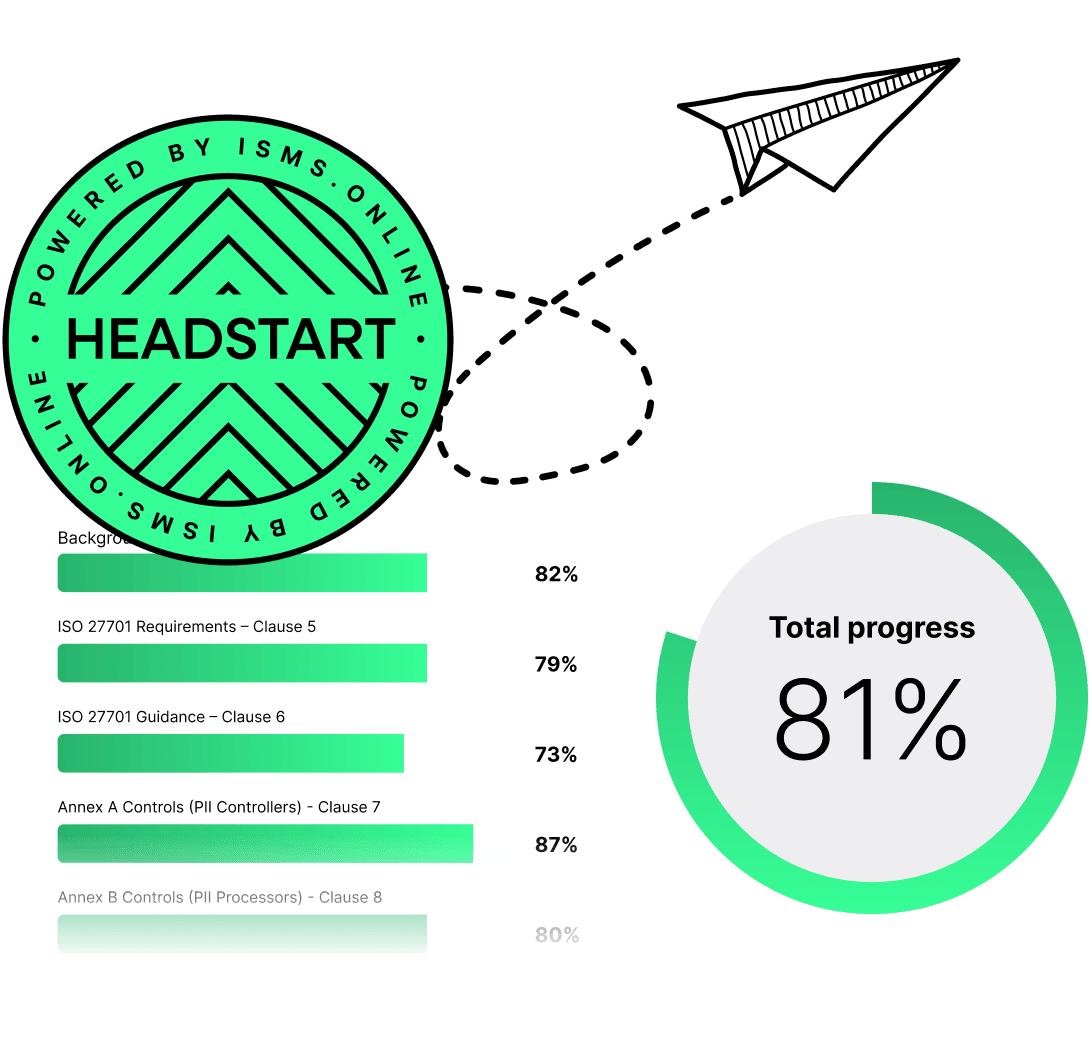
An 81% Headstart from day one
We’ve done the hard work for you, giving you an 81% Headstart from the moment you log on. All you have to do is fill in the blanks.
Is Clause 4.4 Still Just IT’s Domain, Or the Core of Modern Compliance?
Clause 4.4’s shift from siloed documentation to integrated, business-wide systems reflects today’s challenge: your information security isn’t separate from privacy, third-party, or AI governance anymore. Today, audit tables and risk matrices have real monetary effects-contracts delayed, revenue paused, or fines levied by regulators-not simply “audit findings” that stay in a report.
Where frameworks meet-security, privacy, supply chain, AI-real risk loves to hide.
Building a Unified Compliance Loop
Leading teams don’t “tack on” privacy or supplier mappings last-minute. Instead, they architect a compliance loop-connecting ISO 27001 to ISO 27701 (privacy), GDPR (regulator), and new AI guidance-all within a single, live ISMS. This unified loop reduces friction when frameworks change: a new customer or regulator input isn’t a panic, but simply an extension of your core process.
Customer demand for robust, mapped evidence, especially in the wake of rapid AI adoption and global privacy laws, means old-school “binder ISMS” models are obsolete. Mapping once and iterating everywhere makes compliance scalable, not overwhelming.
plaintext

Security (ISO 27001) ↔ Privacy (GDPR, ISO 27701) ↔ Supplier Risk ↔ AI Regulation

        ↑                |                               |

        +----------------+---------- Feedback -----------+
Why Is “Living” ISMS Evidence Different, and How Does It Drive Resilience?
If your ISMS is alive, reality matches what’s on the page. This means effectiveness (not just conformance) is measured by live evidence, up-to-date asset inventories, ongoing change logs, and real business buy-in. When change happens-staff turnover, acquisitions, a new risk unfolds-your system should flex, not fail.
Real compliance is a daily output, not an annual artefact.
Essentials for a Living ISMS
What separates resilient ISMS from paper-tigers? Digital asset inventories that update as the environment shifts; dynamic roles mapped to actual decision-makers; evidence and responses logged as they occur; regular (even if brief) reviews that catch drift early. Systems that update purely for the sake of audit season breed blind spots and delay risk discovery.
When policies, controls, and incidents are joined up-and accountability surfaces beyond IT-weaknesses can be fixed fast, not after-the-fact. This daily maintenance is the root of “audit confidence.”
Table: Living ISMS Characteristics in Daily Operations
| Essential | Living ISMS Approach | Binder ISMS Hazard |
|---|---|---|
| Asset Tracking | Automated, always up-to-date | Manual, static, out of date |
| Control Updates | Policy mapped to real decisions | “Dated and signed” only |
| Change Log | Automated, visible, reviewed | Reactive edits, poorly tracked |
| Evidence Storage | Linked, accessible | Scattered, missing at crunch |
| Staff Engagement | Integrated with workflows | Siloed, compliance is “extra” |
Tip: Use your ISMS as an operational system, not a reporting tool-and it will pay you back in audit ease and business agility.

Free yourself from a mountain of spreadsheets
Embed, expand and scale your compliance, without the mess. IO gives you the resilience and confidence to grow securely.
How Do Embedded Practices and Automation Transform Compliance Fatigue into Momentum?
A living ISMS blends into daily working patterns, replaces one-off fire drills with subtle prompts and check-ins, and leverages automation to keep teams engaged. It’s not more meetings; it’s the right moments, at the right level of friction, to maintain trust and avoid drift.
When compliance is part of everyday workflow, audits uncover proof-not surprises.
Making Practice Stick: From Boardroom to Breakroom
The best teams use tools that surface compliance tasks naturally within existing check-ins, sprints, or status reviews. Old gaps-like missing approvals, forgotten asset updates, or unacknowledged policies-become rare when team nudges and dashboards keep everyone honest. Automated reminders, rotating policy ownership, and role-based task assignment reduce bottlenecks and distribute responsibility.
Short, recurring meetings (every month or quarter) replace the annual “panic run” and radically improve audit survival rates. Staff see compliance as “part of work,” not an afterthought.
Daily and Weekly Habits That Anchor a Living ISMS
- Embed compliance tasks into weekly meetings and project routines:
- Collect evidence at task completion, not retroactively:
- Automate reminders for approvers and evidence collectors:
- Keep ownership visible-show logs and transitions:
- Run regular, short “pulse reviews” for continuous improvement:
Momentum comes not from more effort but the right, automated effort-turning overhead into advantage.
How Do Smart Metrics Move Compliance from Burden to Badge of Honour?
Metrics that actually matter-acknowledgements, closure times, audit findings and evidence readiness-transform ISMS from bureaucracy into a self-improving engine. Crucially, they build trust with execs and practitioners alike and support staff recognition as “compliance heroes,” not just “the admin.”
If you want to change behaviour, score what matters and celebrate the change.
Driving Executive and Practitioner Buy-In
When KPIs reflect true engagement-like rising policy acknowledgement rates or declining audit findings-executive trust grows, funding increases, and teams become proud of their resilience journey. Dashboards that make progress visible drive more compliance, not just reporting.
Automated tracking of evidence also proves to staff and boards that the system is working. Practitioners should use metrics to get the recognition (and resources) they deserve, showing measurable value well before audit day.
Table: Metrics That Fuel a Living ISMS
| Measurement | Who Cares Most? | Business Value Unlocked |
|---|---|---|
| Acknowledgement % | All staff | Proof of buy-in and awareness |
| Closure Rate | Management/Board | Rapid action, resilience, less risk exposure |
| Audit Finding Delta | Exec, Audit Team | Continual improvement, cost reduction |
| Evidence Turnaround | Practitioners | Less stress, time back, audit predictability |
A “before-and-after” snapshot-showing shorter audits, fewer findings, more engaged staff-cements your ISMS’s living status at every level of the organisation.

Manage all your compliance, all in one place
ISMS.online supports over 100 standards and regulations, giving you a single platform for all your compliance needs.
Do ISMS Fails Signal the End-Or the Next Level of Maturity?
Even the most diligent rollouts hit dead-ends: processes stall, staff avoid, audit findings return. But resilient teams treat every stumble as a step on the learning ladder, not a black mark. When organisations document the fix-not just the fail-they breed long-term maturity and resilience.
A living ISMS recovers and grows from every false start or stall; stagnation is the only real failure.
Turning Stalls into Stepping Stones
Big pitfalls (over-documentation, lost scope, executive drift, consultant dependency) all lead to the same place: rework, staff fatigue, and sapped credibility. The fix? Publicly log what didn’t work, trim to the essentials, and close gaps with visible reassignments and regular reviews.
Loop in new voices early and often-waiting until audit panic means enduring maximum pain with minimum learning. Consultants should help build, but never own, your core system.
Checklist: Reviving a Faltering ISMS
- Tighten scope and reduce everything non-essential:
- Patch orphan roles and re-assign responsibilities:
- Prioritise regular, open reviews over rare, high-stakes ones:
- Ensure early and repeated stakeholder inclusion:
- Document recovery: visibly close re-opened gaps and share lessons:
With every recovery edge logged, your ISMS moves steadily up the resilience curve-making audit wins part of the culture, not just luck.
Why Upgrade to ISMS.online-And Does It Really Turn Compliance into Competitive Edge?
ISMS.online is purpose-built to turn compliance into a living, breathing asset-driving real audit confidence, operational resilience, and company-wide engagement. Instead of fighting paperwork backlogs or audit anxiety, the platform gives you guided workflows, real-time visibility, and mapped responsibilities-so every stage, from first-timer to global expansion, is covered with clarity and speed.
You shouldn’t fear the audit. You should look forward to proving what already works.
External reviews confirm that ISMS.online turns checklists into achievements. Live dashboards replace tab-hopping confusion; digital evidence banks mean audits finish in weeks, not months; mapped roles keep every critical seat filled, even as teams shift or scale. And with expert support never more than a click away, even your first certification can be a confident one.
Table: ISMS.online at Each Step
| Need | ISMS.online Feature | Result/Benefit |
|---|---|---|
| Onboarding Confidence | Stepwise checklist, visible roles | Predictable, quick audit readiness |
| Live Visibility | Dashboards, digital evidence | Executive trust, fast pivots |
| Responsive Support | Expert guides, searchable docs | Less stress, 100% first-time pass |
| Easy Scaling | Control mapping, flexible frameworks | Ready for new regs, faster revenue |
Take the leap to a living ISMS with ISMS.online: make audit success predictable, showcase resilience to every customer, and turn each requirement into a competitive advantage. Reach out to our team or a trusted compliance consultant to calibrate your implementation for the risks and opportunities ahead.
Book a demoFrequently Asked Questions
Who must be involved in defining the ISMS scope for ISO 27001 Clause 4.4, and why is failing here so common?
Defining your ISMS scope under ISO 27001 Clause 4.4 demands hands-on participation from senior leaders, IT/security, department owners, compliance/legal, procurement, and key users-because a weak scope is almost always traced back to blind spots or missing voices at the table. Overlook even one group and you risk leaving out vital assets, shadow technology, or crucial supplier connections. Audits often falter when the scope is drafted in isolation or rubber-stamped without true consensus, leading to gaps that surface only under external scrutiny. Consistent audit stories show: the root of most findings is a scope no one truly owns, documented changes that lag behind business reality, or confusion about exactly what’s covered. To reduce risk, assemble a cross-functional team, invite explicit signoff from each group, and document how scope changes are triggered and approved. This collaborative model turns the scope from a one-and-done document into an active defence, ready to adapt as your business evolves.
Table: Key Stakeholders in Clause 4.4 Scoping
| Stakeholder | Their Critical Role | Typical Audit Evidence |
|---|---|---|
| Top Management | Sets boundaries, authority, final signoff | Signed scope, approval minutes |
| IT/Security Lead | Maps infrastructure & cloud | Asset/system inventory, network maps |
| Department Heads | Identifies data/processes in use | Ownership logs, process registers |
| Compliance/Legal | Regulatory & contractual reach | Clause mapping, DPO/privacy input |
| Procurement | Supplier/third-party boundary input | Vendor registers, due diligence files |
| Key Users/Admins | Show controls applied in daily work | Feedback, usage logs, training records |
Most scope problems start where business reality outpaces documentation-risking blind spots only caught when everyone’s involved.
See: (https://www.bsigroup.com/en-GB/iso-27001-information-security/) and (https://www.iso.org/isoiec-27001-information-security.html).
What evidence actually convinces auditors your ISMS scope isn’t just words on paper?
Auditors want hard proof your ISMS scope is both current and continuously applied-a living system, not just a document. Key evidence includes a signed scope that lists boundaries and exclusions, explicit sign-off trails from every stakeholder group, and a clear trail linking each asset and risk register entry back to your documented scope. Management review minutes should reflect updates to scope when new assets, suppliers, or business units appear. Automated dashboards showing live asset ownership, overdue actions, and control gaps further demonstrate ongoing health. Logs linking each improvement or incident back to changes in the scope tell auditors you aren’t just fixing issues-you’re adapting your boundaries to fit reality. Anything that ties daily decisions and records to the scope, and shows change is tracked and approved, earns immediate audit trust and reduces late-stage surprises.
How live tracking and review history boost trust
A dashboard showing each scope change, review date, and owner is far more powerful than a static file-auditors can interrogate the system and see real-time status, not just take your word for it.
When action and evidence are tracked alongside every scope change, compliance becomes transparent-and proof is always ready to show.
For more: (https://www.csoonline.com/article/3664696/how-to-implement-an-information-security-management-system-isms.html), AuditBoard’s ISO 27001 Update Summary
How does Clause 4.4 enable easy expansion to privacy, supplier, and AI compliance?
Clause 4.4’s power is in defining and linking processes, roles, and boundaries-the same roots needed for privacy (GDPR/ISO 27701), supplier oversight (NIS 2/DORA), and future AI rules. When your scope covers all assets, data flows, and third-party connections, it becomes a “single source of truth” that frameworks can share and mapping happens once, not in silos. Cross-referencing privacy assets, adding supplier registers, or preparing for AI/algorithm controls simply becomes another layer on top of your live scoping process. This streamlined approach means responses to audits-be they for security, privacy, or operational resilience-reuse the same evidence foundation, and businesses can adapt quickly as regulatory requirements evolve.
Table: Extending Clause 4.4 Scope for Multi-Framework Compliance
| Compliance Area | Scope Extension | Audit & Operational Benefit |
|---|---|---|
| GDPR/ISO 27701 | Privacy assets/processors | Faster SAR/DPIA response, evidence reuse |
| NIS 2/DORA | Supplier, chain-of-trust | Visibility, supply chain resilience |
| AI Governance | High-risk data/algorithms | Prepares for future AI rules |
A unified scope isn’t just for today-it’s your platform for whatever new rules tomorrow brings.
See IAB’s (https://www.iab.org.uk/iso-27001-iso-27701-gdpr-align/) and the (https://www.iso.org/isoiec-27001-information-security.html).
What red flags warn your Clause 4.4 scope will trigger audit problems?
Auditors repeatedly cite static or copy-paste scopes, missed scope changes, orphaned departments, and lack of linkage between assets, owners, and controls as classic blunders. Warning signs include: business units or cloud services showing up in audit but missing from the scope; scope reviews happening only before audits, not as soon as something changes; scattered evidence with no link back to registered boundaries; or management reviews filled with “open” issues that never close. If last-minute staff scramble to show “what’s in scope,” or repeated findings point to the same gap, the ISMS isn’t keeping up with reality-a sure sign of future nonconformity.
Audit patterns: Breakdown begins where scope and ownership disconnect
Most last-minute audit issues can be traced to boundaries and responsibilities not updated when the business evolves-usually because the process hasn’t been embedded into routine workflow.
An outdated or ambiguous scope quietly erodes compliance-until an audit demands accountability and clear answers.
Further reading: (https://www.glenngates.com/a-leveraging-the-isms-lean-management-approach-to-iso-27001-certification/), ISO 27001:2022 update guide
How do you make Clause 4.4 compliance habitual-not just a reaction before audits?
Build scope review and improvement into your business cadence with role-based task reminders, evidence prompts for new assets or suppliers, and routines that make quarterly review and lessons-learned the default. Integrate uploads of evidence (policy changes, asset adds, supplier onboarding) into daily workflows, so scope and responsibility checks happen automatically-not just when a checklist says so. Link status dashboards, alerts, and improvement logs to management review cycles, creating a rhythm where “audit readiness” is a living habit, not a stressful one-off. This approach not only smooths audits but equips you to spot problems before they grow.
Table: Making Continuous Improvement Real
| Habit/Process | How it’s Embedded | Audit Benefit |
|---|---|---|
| Automated reminders | Workflow and calendar tools | Roles & reviews stay current |
| Evidence in context | Uploads tied to To-dos | No missing or mismatched proof |
| Quarterly reviews | Pre-scheduled meetings | Adaptive learning, true review |
| Linked improvement logs | Actions connected to events | Traceable, closed-out issues |
| Live status dashboards | Role-based visual tracking | “Always ready” compliance |
Routine, real-time improvement is what separates audit scramble from quiet confidence.
See NIST’s (https://csrc.nist.gov/publications/detail/sp/800-53/rev-5/final) and AuditBoard’s audit update summary
Which ISMS platform features help you shorten audit timelines and build truly resilient Clause 4.4 compliance?
Organisations that consistently pass audits quickly and avoid last-minute firefights use ISMS platforms that centralise scoping, asset, owner, and evidence management. Look for platforms with interactive scoping tools, tracked signoffs and approvals, live asset and incident dashboards, built-in workflow automation, and immutable change records. These features ensure every team member knows their responsibilities, evidence is always one click away, and changes are traceable years down the line. Compared to manual methods or scattered spreadsheets, unified systems minimise evidence hunting and scope drift, giving both management and auditors full confidence in your ISMS health. Audit findings decrease, timelines tighten, and compliance becomes a business advantage, not a chore.
Table: Unified Platform vs. Manual ISMS Management
| Capability | Unified ISMS Platform | Manual/Spreadsheet Approach |
|---|---|---|
| Scoping and sign-offs | Guided, interactive, time-stamped | Separate docs, signatures, emails |
| Asset/role owner map | Live updates, change tracking | Manual lists, no traceability |
| Evidence capture | Integrated, linked, auto-notified | Scattered uploads, missing links |
| Review/improvement | Dashboard scheduled, tracked | Ad hoc, reliant on memory/emails |
| Audit pass rates | Higher, fewer rework cycles | Repeats, delays, gaps, confusion |
Business-proven compliance comes from systems that keep everyone connected and audit answers always visible-no matter how your business grows or changes.
Learn more: (https://www.uksme.co.uk/isms-online-secures-first-iso-27001-certification-for-firm/), UK Tech News-ISMS.online platform guide






