





































What Separates Real Security from Audit-Checked Boxes? Leadership as the Bedrock of Trust
Many organisations achieve ISO 27001 certification yet face the uncomfortable truth that a badge alone doesn’t secure trust-or the next customer deal. The difference between simply clearing the audit bar and establishing a true “culture of security” is leadership in action. Boards and C-suites who reduce Clause 5.1 (Leadership and Commitment) to an annual sign-off risk missing the latent threats that silent disengagement breeds. Buyers and auditors can readily spot whether leaders are merely box-tickers or daily stewards of security.
A confident, visible board makes compliance credible-anything less is just paperwork.
ISO 27001:2022 introduces a sea change in how leadership is measured. Gone are the days of plausible deniability and passive oversight. Security champions now appear not in empty mandates but in logged meeting attendance, resource approvals, and evidence of continuous engagement. Modern platforms like ISMS.online turn this boardroom visibility into a living asset, surfacing gaps, bottlenecks, and strengths in real time so that leadership behaviour matches the expectations of both the market and the standard.
The commercial reality is stark: organisations reporting disengaged leadership lose an estimated $450 billion annually to preventable errors, delays, and employee drift (Gallup). These costs are compounded when security is concerned, as compliance in name only offers little protection against breaches or the scrutiny of modern procurement teams (Gallup; ISACA). Leadership means staying engaged-visible, proactive, and willing to own both the wins and gaps.
Why Do Audit Failures Start with Board Drift and Stop with Real Engagement?
Audit findings don’t arise from missing paper trails alone. The root is usually weak, diluted, or inconsistent executive sponsorship. Teams sense when the board is only acting out of obligation, often leading to expensive “audit theatre” where compliance is more about performance than substance. The Ponemon Institute found organisations with active top-level engagement reduce breach costs and corrective work by up to 40%-and experience fewer repeat findings over time (Ponemon 2023 Cost of Data Breach Report).
True accountability is contagious; when leadership is present, commitment spreads.
ISO 27001:2022 demands evidence of continuous involvement: unambiguous board sponsorship, resource approvals, and management reviews that are more than “tick-box” exercises. Auditors increasingly seek documentation proving leadership wasn’t only present at the audit close, but at every stage of planning, risk resolution, and review. Market trends echo this shift-buyers now demand proof of genuine, live board participation during enterprise supplier vetting (Infosecurity Magazine).
Organisations that engrain leadership into their compliance rhythm report up to 40% fewer repeat findings and avoid the reputation traps that plague “audit-only” security programmes (NCSC UK; Deloitte). Resilient organisations don’t chase compliance-they lead it from the top, turning every audit into an opportunity for improvement and strategic differentiation.
ISO 27001 made easy
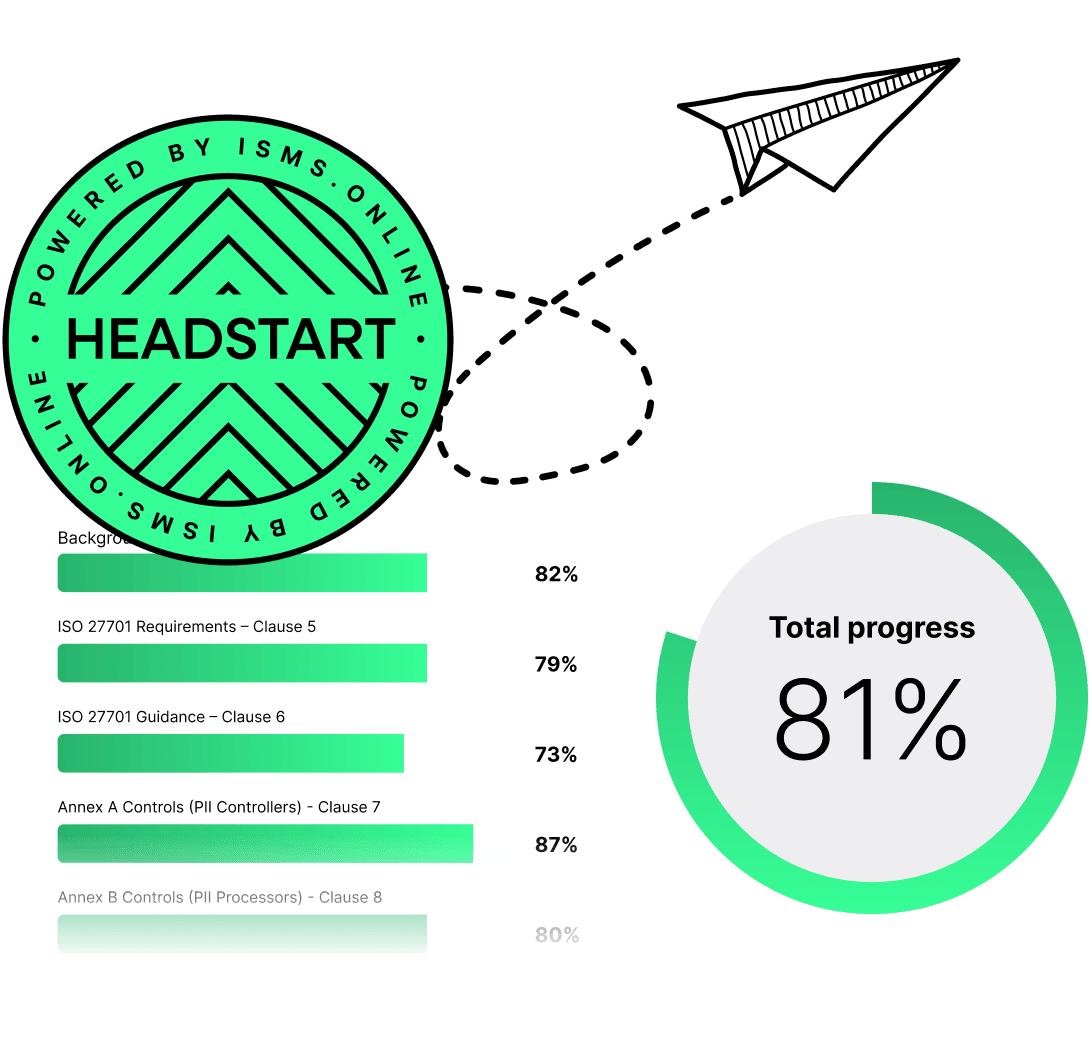
An 81% Headstart from day one
We’ve done the hard work for you, giving you an 81% Headstart from the moment you log on. All you have to do is fill in the blanks.
How Does Board-Level Stewardship Shift Compliance from Burden to Competitive Advantage?
The visible presence of executive sponsors is the linchpin. Policies and procedures are necessary, but without lived ownership, frontline teams lack the confidence-and the mandate-to escalate risks or close findings. When boards join ISMS meetings, review audit logs, and approve budgets on-record, they send a message every employee understands: security is the company’s problem, not IT’s alone.
Your ISMS is only as credible as the leadership habits behind it.
Platforms like ISMS.online enable companies to turn what’s usually dark data-board approvals, engagement metrics, decision logs-into a compelling proof of stewardship. A high-impact practice: name your ISMS executive sponsor publicly and record their ongoing participation in every review and approval. Teams will escalate risks with less fear, and audits become smooth, efficient checkpoints instead of annual gauntlets (Schellman; BSI).
When leadership is present and proactive, ISMS processes are more likely to yield results: risks get closed, rework drops, and policy engagement transforms from a chore to an embedded part of company culture. This is why platforms like ISMS.online provide board review logs and policy acknowledgment trails that anchor leadership actions to outcomes, making every audit cycle both rigorous and reputation-enhancing.
What Behaviours Turn Board Intentions into Audit-Ready Signals?
Clause 5.1 expects a living system, not a static folder of policy signatures. Board actions become security assets only when they’re tracked and regularly visible to your team and external eyes. The table below links everyday leadership behaviours to audit outcomes, so you can benchmark whether your current practices are market-leading-or leaving risk unchecked.
| **Leadership Behaviour** | **Audit Signal** | **Audit Outcome** |
|---|---|---|
| Hosts ISMS reviews | Recorded attendance logs | Proves steady board oversight |
| Funds and approves changes | Linked resource and budget records | Signals resource priority, not delay |
| Endorses key policies | Meeting minutes, signed approvals | Demonstrates real-time commitment |
| Assigns clear owners | Up-to-date ISMS owner mapping | Eliminates finger-pointing, confusion |
| Enables regular reviews | Time-stamped digital logs | Shows continuity, not one-off effort |
| Disengages from ISMS | Gaps, unsigned or dated evidence | Triggers queries, trust deficits |
This connection is more than academic-audit queries now routinely follow board “absence events” or missing review logs (UKAS; ISACA). When leadership activity is routine, traceable, and broadcast across management reviews and staff communications, your ISMS passes the “living system” test. Modern ISMS dashboards and logs, perfected by platforms like ISMS.online, remove the guesswork and manual errors that undermine most legacy systems.

Free yourself from a mountain of spreadsheets
Embed, expand and scale your compliance, without the mess. IO gives you the resilience and confidence to grow securely.
Can Leadership Visibility Make or Break Your Compliance Culture?
One-off executive involvement, whether for year-end audits or emergency response, can harm more than help. Durable compliance requires an ecosystem where leadership is constantly present, accessible, and measured. This isn’t about surveillance, but about normalisation-when boards are involved every month, staff don’t wait for annual events to surface issues.
What isn’t measured and made visible is quickly forgotten-especially in large organisations.
Clause 5.1 rewards leaders whose presence can be verified at all times. Meeting logs, up-to-date risk dashboards, policy review cycles, and escalation histories each contribute to this transparency (NIST CSF; ISO User Group). The result is resilience: companies that track and act regularly on key ISMS metrics not only close more findings, but adapt swiftly to new threats.
Automated platforms help encode these rhythms. ISMS.online lets you time-stamp every engagement, make reviews discoverable, and audit leadership behaviour continuously. This prevents drift, helps you pass audits the first time, and unlocks trust with buyers who increasingly demand proof-not promises-of compliance maturity (PwC; DLA Piper).
Are Your ISMS Owner Assignments and Escalation Paths Bulletproof or Built on Guesswork?
You cannot pass ISO 27001 audits-or protect your organisation-if ownership is fragmented across myths, org charts, and email threads. Clause 5.1 requires you to document and update every assignment, escalation, and handover. Board-approved platforms like ISMS.online keep every change, transfer, and new owner visible for auditors and teams alike (BSI Case Study).
Accountability survives HR churn, remote work, and complex orgs only when built into the tool-not left to chance.
When escalation maps are ambiguous, risks are not escalated, incidents get missed, and audits uncover systemic fragility (TÜV SÜD). Modern ISMS architects automate both assignment and escalation, so security incidents, privacy requests, and regulatory submissions have a clear path-never left to “who’s on holiday.”
ISMS.online logs every transition, giving privacy officers and CISOs a single pane of glass for compliance health. Regulators and buyers increasingly expect this: who owns the risk, who resolves the breach, and who is accountable for each handoff? If you can’t answer with evidence, your ISMS fails the Clause 5.1 test-and you feel the consequences in both audit and business relationships (OneTrust).

Manage all your compliance, all in one place
ISMS.online supports over 100 standards and regulations, giving you a single platform for all your compliance needs.
How Do Budgets, Communication, and Board Review Cycles Demonstrate Clause 5.1 in Action?
Boards planning to increase cybersecurity budgets by up to 30% by 2026 are not doing it for optics-they want every dollar visible in compliance logs, not just on paper (Gartner). Clause 5.1 expects funding, staff assignments, and communication cycles to run like any other business-critical process.
The strongest cultures show investment-not as a line in a budget, but as a rhythm in their operations.
This translates into real behaviour:
- Funds for staff, tools, and ongoing reviews are approved and visible in the ISMS log.:
- Board communications, meeting minutes, and KPIs are regularly reviewed and can be shown to stakeholders or auditors on demand.:
- Every improvement is linked to a record of who initiated, reviewed, and signed off on both the plan and the result.:
If you only see resource approvals at audit time, your culture is fragile. ISMS.online enables traceable, scheduled, and easily audited reviews-so your security storey is being written every week, not just in audit season (Forrester; EY; McKinsey).
Are You Ready to Lead with Credibility? Make Leadership a Living Asset with ISMS.online
Leadership sets the rhythm for everything beneath it. When executives are present, consistent, and visible, your ISMS does more than survive audit season-it fosters a culture of trust, speed, and resilience (Gartner). Internal policies are only the start; action and engagement are what competitors, regulators, and customers use to measure your brand’s promise.
Trusted organisations use platforms like ISMS.online to encode leadership into the compliance record, making sponsorship, decisions, and continuous improvement clear to everyone. Success moves from passing an audit to owning and showcasing a market-ready, credible, and deeply operational security storey (CSO Online).
The way your board leads compliance today will be seen in every future deal, audit, and incident-make that legacy a brand asset, not a liability.
Ready to unlock resilience, trust, and confidence through living leadership? See how ISMS.online turns every action and approval into a market signal-and empowers your organisation’s compliance from the top down.
Frequently Asked Questions
Who is directly accountable for Clause 5.1, and how does weak leadership actually erode an ISMS’s value?
Your executive leadership-board, C-suite, and top managers-bear non-delegable, year-round responsibility for ISO 27001:2022 Clause 5.1. This isn’t a paperwork role or a “check the box” signature; it’s about setting visible, lived direction. When senior leaders disengage or treat the ISMS as mere compliance admin, this indifference seeps into every corner of the company: staff disengage, priorities blur, auditors spot gaps, and compliance credibility vanishes. In fact, research highlights that lack of board leadership is linked to a 60% jump in unresolved security gaps (Ponemon Institute, 2023). To truly meet Clause 5.1, leadership must set information security at the heart of business decisions, visibly champion risk management, and remain accountable at every major review. Inattention at the top isn’t just a sign of weakness-it’s a signal to everyone that security is optional, not operational.
Why is the board’s visible engagement indispensable?
- Leadership’s routine involvement sets the cultural tone for all employees, reinforcing that security is not negotiable.
- Auditors and regulators demand ongoing, evidence-backed management involvement-no annual “rubber-stamping” allowed.
- Without top-level drive, information security fractures into isolated tasks, sapping momentum and resilience across the organisation.
As executive focus drifts, so does every layer of security and culture-risk thrives in the gaps leadership leaves behind.
What regular, proactive steps should top management take to satisfy Clause 5.1-making compliance routine, not reactive?
Compliance with Clause 5.1 becomes real only when leadership embeds information security into regular boardroom and operational rhythms. Begin by formally designating a senior executive or board sponsor to own ISMS outcomes, steering every decisive meeting, approval, and review. Schedule ISMS topics as standing agenda items in board and management sessions-never as last-minute add-ons. Set information security objectives that tie directly to the company’s growth or risk profile, and link these into performance metrics, budgets, and digital dashboards. Use platforms such as ISMS.online to log all critical actions-from issuance and signoff of policies, through risk acceptance, to shift handovers as leaders join or leave. Most important, ensure your leadership actively participates (not just observes) in policy discussions, incident escalations, resource decisions, and compliance communications. This converts leadership engagement from episodic to habitual-covering every quarter, new project, or significant change.
How do you turn leadership commitment into organisational habit?
- Make ISMS reviews a default item at every board meeting-build security into institutional muscle memory.
- Review and refresh security objectives with each business planning cycle.
- Require real-time digital signoff for every meaningful policy, risk, or role change-minimising human error and audit pain.
- Assign ISMS responsibility by name in leadership contracts and track when roles shift.
What “living” evidence do auditors expect to see for Clause 5.1 management commitment?
Auditors expect ongoing, time-stamped proof that leaders drive your ISMS-not occasional, static paperwork. This includes:
| Evidence Type | Auditor Focus | Role in the ISMS |
|---|---|---|
| Board-endorsed, current policies | Recent executive-signed policies, SoA, strategy docs | Confirms genuine authority and recent review |
| Minutes from ISMS-relevant meetings | Named executive attendance, actions, ISMS on agenda | Shows direct, recurring involvement |
| Budget/resource signoff logs | Senior approvals for key investments and training | Demonstrates priorities and real support |
| Risk escalation & acceptance records | Trackable leadership action on incidents and risk changes | Proves decisions are owned at the top |
| Leadership communications & memos | Company-wide updates, video addresses, bulletin boards | Infuses security into organisational DNA |
| Systemic audit trails | Digital logs of executive actions, role handovers, attendance | Shields against “backdated” evidence |
Crucially, auditors value consistent, “in-motion” evidence: records showing year-round habits and signals of leadership, not one-off, pre-audit document dumps. Automated platforms like ISMS.online simplify building and demonstrating this continuity.
What are the most common Clause 5.1 compliance pitfalls, and which concrete fixes move the needle?
Organisations most often stumble by relegating Clause 5.1 to a compliance side-task or letting technology leads “own” everything by default. Top errors include: letting policy signatures go stale, failing to log leadership attendance at critical reviews, losing track of owner changes during board turnover, or updating risk maps without board escalation or approval. Even well-intentioned processes are undermined by gaps in digital proof or transitions lost to memory.
Effective solutions include:
- Embedding executive participation into every risk, incident, and policy event-not just annual reviews.
- Logging approvals, resource signoffs, and escalation decisions digitally, with name, date, and outcome visible.
- Using structured onboarding/offboarding to hand over ISMS responsibilities when leaders change.
- Holding short, targeted training for executives on Clause 5.1’s real-world implications and audit expectations.
- Scheduling regular leadership-led communication pushes, reaffirming ISMS as a board business priority.
The greatest cause of audit failure isn’t missing paperwork-it’s missing leadership in moments that really mattered.
How does sustained Clause 5.1 leadership translate into stronger business outcomes and greater trust?
When leadership is present year-round-not just at audit time-security becomes a catalyst for trust, speed, and value. Companies with proactive executive engagement experience up to 40% fewer repeat audit findings, and incident response times that accelerate by half (Infosecurity Magazine, 2023). Externally, enterprise buyers now ask for hard evidence of board oversight before awarding contracts-so visible top-level ownership unlocks growth, not just compliance. Internally, staff morale, policy adoption, and escalation quality rise when leadership “shows up” for security. For the board itself, navigating regulatory reviews becomes less stressful, with fewer surprises and reduced risk of damaging findings, fines, or lost certifications.
Which routines and digital tools future-proof Clause 5.1 leadership for audits-and deliver ongoing organisational value?
Resilient organisations use formal, repeatable patterns backed by digital enablement to keep Clause 5.1 “audit ready” at all times:
- Hold board-level ISMS reviews quarterly, recording attendance, input, and outcomes with meeting minutes and approvals in ISMS.online.
- Assign, monitor, and update executive ISMS roles in a digital, time-stamped system-never in static spreadsheets.
- Script ISMS accountabilities into leadership job specs, performance reviews, and resource workflows.
- Deploy digital approval logs for all risky or material ISMS changes, instantly traceable at audit time.
- Schedule periodic training and escalation simulations, recording lessons learned and leadership actions.
- Ensure every incident, risk acceptance, and policy update is linked to named management input, with audit-proof digital trails from beginning to end.
This approach takes Clause 5.1 out of the realm of compliance anxiety and lands it squarely in daily leadership practice-reducing audit rework, accelerating renewals, and building lasting reputational capital for the company and its leadership.






