





































Why Do Business-Aligned Security Objectives Matter More Than Mere Compliance?
When your security objectives mirror business priorities, ISO 27001 becomes a value accelerator-not just a regulatory hurdle. Alignment moves information security from a check-the-box annual ritual into a catalyst for growth, resilience, and trust. Instead of aiming for the lowest bar to “pass the audit,” your objectives visibly support deals, protect the brand, and help launch new products or services. This section unpacks how Clause 6.2 transforms well-worn compliance checklists into strategic levers the board and executive team care about.
Security objectives written in isolation-full of jargon or technical targets-rarely gain cross-functional support or spark visible enthusiasm. Clause 6.2 of ISO 27001:2022 ups the ante, asking you to set objectives that matter to how your organisation actually runs (IRMS, 2023). When objectives flow from the top, they unify technical effort with business intent, nurture executive sponsorship, and provide everyone-from the front line to the boardroom-a clear sense of “why this matters now.”
When your security goals speak the language of business ambition, you don’t just achieve compliance-you secure your company’s future.
Creating Real-World Business Impact
Consider a common scenario: a sales leader faces stalled contracts because prospects demand evidence of robust information security. By directly linking an objective-such as “Enable sales to close deals by passing ISO 27001 on schedule”-to pipeline outcomes, your security function now delivers revenue impact everyone can recognise.
Executive Sponsorship Unlocks Resources
Objectives that have a named champion in leadership are taken seriously, both inside and outside the organisation. Audit history confirms that visible executive backing compels action and often speeds approval for the necessary tools or training-moving objectives from “wish list” to rapid progress.
Stakeholder Engagement Roots Objectives in Reality
Input from sales, legal, product, and customer success teams creates objectives that arent security for the sake of security. Instead, you end up solving for actual pain-be it onboarding friction, risk of downtime, or contractual obligations-building credibility and ensuring objectives do not drift into irrelevance (NCSC, 2023).
By making security objectives about more than ticking boxes, you engage more than just auditors. You unite your business around shared value, drive internal accountability, and set up information security as a reliable partner for growth and risk management.
Book a demoWhat Turns a “Passable” Information Security Objective Into a Strategic Asset?
Most organisations know they need SMART objectives for ISO 27001-but too many still submit generic, vague, or purely technical statements. These get you through an audit, but leave your team struggling to prove real impact or secure the resources to improve.
A strategic security objective must be: Specific, Measurable, Achievable, Relevant, and Time-bound (SMART), and ready to stand up under scrutiny from auditors, management, and peers. If you ever find yourself squirming when asked, “How will you show this actually worked?” that’s a flashing warning light.
If the objective doesn’t have evidence, accountability, and impact-you can’t expect buy-in or success.
Crafting Truly SMART, Evidence-Driven Objectives
“Reduce successful phishing attacks by 30% in Q4 2024 through mandatory simulation and training” is both SMART and audit-ready (CQI, 2023). You can show simulation results, training completions, and incident logs. Conversely, “Enhance information security awareness” is neither specific nor measurable-and instantly weakens audit confidence.
Audit-Ready Structure: Four-Point Test
Before you lock an objective, ask:
- Is it concrete?: (What, exactly, must be achieved?)
- Is it achievable with available resources?:
- Can you easily show evidence?: (Logs, review records, training stats)
- Whose risk or value does it address?:
Auditors increasingly require evidence to be embedded in operational routines, not retrofitted after issues arise. A passable objective gives assurance today, not “after the next review cycle.”
Preventing Objective Drift
Link each objective to a risk on your register and a control in your ISMS. Assign a single owner-not a department, not a process, but a human being. These steps convert compliance theatre into measurable progress. You move from “did we do it?” to “here’s our evidence-and our impact.”
Constructing objectives with this rigour not only satisfies Clause 6.2-it positions security as a board-level differentiator and systematically increases your value to the business.
ISO 27001 made easy
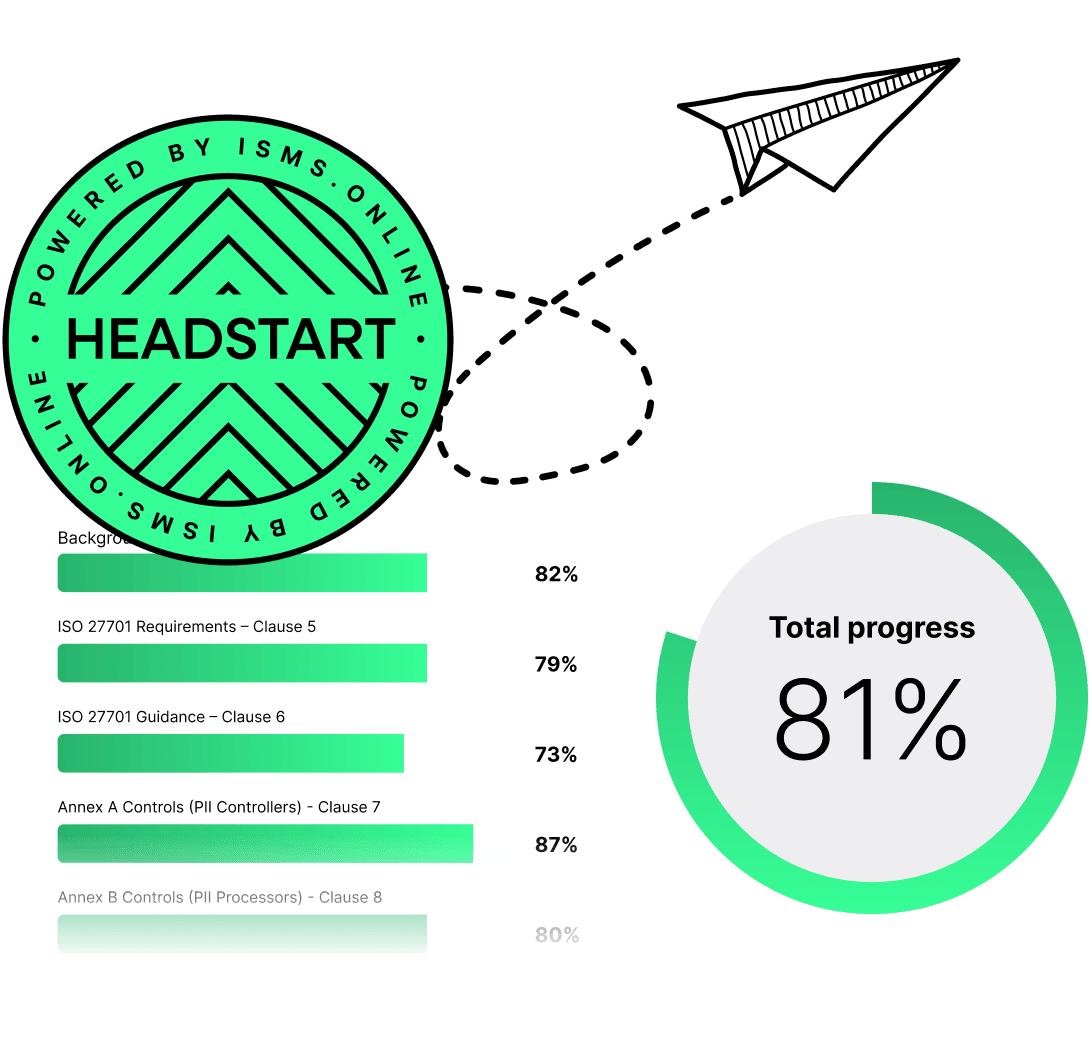
An 81% Headstart from day one
We’ve done the hard work for you, giving you an 81% Headstart from the moment you log on. All you have to do is fill in the blanks.
How Do You Map Information Security Objectives to Risks, Controls, and Audit Evidence?
Unifying objectives, risks, and controls into a single chain is the heart of effective ISO 27001:2022 compliance-and the foundation for audit-proof evidence and operational clarity. By making these connections explicit, you create a living map that guides everyone involved, from board sponsors to team leads, and dramatically shortens the audit process.
Instead of generic objectives floating in isolation, map each one to a specific risk on your risk register and the key controls that mitigate that risk. This isn’t just auditor-friendly-it’s a business clarity multiplier.
Mapping Table: Objectives, Risks, Controls
Before building your live dashboard or ISMS, use a simple table like the one below:
| Objective | Risk Addressed | Control(s) Mapped | Key Audit Evidence |
|---|---|---|---|
| Reduce phishing by 30% this year | Social engineering, financial loss | A.6.3 Security awareness; A.5.14 Email controls | Phishing simulation results; training logs |
| Achieve 100% security training by Q2 | Insider threat, non-compliance | A.6.3 Competency checks | Training completion reports |
| Encrypt all customer data at rest by Q3 | Data breach, regulatory penalty | A.10.1.1 Cryptographic controls | Encryption tool logs, audit reports |
Each row creates an audit-proof and business-relevant “thread”: from intent to risk to the mechanism (“control”) that provides evidence of action.
Continual Mapping and Dynamic Updating
The best organisations routinely update their mapping tables as risks, objectives, or controls evolve. When a new customer contract demands stricter encryption, for example, you can instantly see which objectives and controls to update and which piece of evidence proves compliance (IT Governance, 2023).
Tying objectives to controls isn’t paperwork-it’s the shortest route from good intentions to results people trust.
This mapping is also your best defence when facing tough auditor questions or when onboarding new team members. It lets everyone see, at a glance, what matters most, and ensures your security posture is flexible, relevant, and defensible.
Why Does Ownership and Resource Allocation Make or Break Security Objectives?
Many organisations miss their targets not because they set poor objectives, but because no one truly owns them-or because resources vanish as priorities shift. ISO 27001 Clause 6.2 calls for more than ambition: it hardcodes the need for responsibility, visibility, and sustainable support. Without this, even the best-written objectives quietly wither.
Locking In Real Ownership
Assigning ownership isn’t bureaucracy; it’s momentum. Every objective should be personally championed-named in plans, minutes, or dashboards. When a single, identified individual is answerable, action is vastly more likely and results become visible (IT Governance Asia, 2023).
Ownership is more than a job title; it’s someone’s reputation, pride, and credibility on the line.
Resource Planning: No Commitment, No Progress
Objectives are only as achievable as the resources available: time, budget, and supporting technology. Planning these up front and linking them explicitly to each objective ensures you don’t exhaust good will-or set anyone up to fail (Cyberproof, 2023).
Building Feedback and Correction Cycles
No project hits its mark perfectly every time. Successful organisations design regular touchpoints-monthly reviews, dashboard alerts, quarterly management reviews-where owners can escalate issues and agree resource adjustments without shame or blame (QualityMag, 2023). This creates resilience and continuous improvement, not finger-pointing.
Complex Objectives: Collective Responsibility, Clear Leadership
Where outcomes cross multiple teams, assign one primary “champion” to steer the ship. Define and document who coordinates support from each contributing area, and visibly recognise their leadership in success-or surface blockers early.
Securing ownership and resource allocation isn’t a compliance hurdle: it’s the engine that keeps your security programme from becoming a “set-and-forget” project.

Free yourself from a mountain of spreadsheets
Embed, expand and scale your compliance, without the mess. IO gives you the resilience and confidence to grow securely.
How Does Live Monitoring and Evidence Keep Objectives On Track and Audit-Ready?
Traditional compliance often means hunting for evidence at the eleventh hour, chasing missed emails or lost spreadsheets. This “audit scramble” breeds anxiety for practitioners and leaders alike, and can lead to audit delays, missed objectives, or even failed certification. Clause 6.2 demands that you move away from firefighting-towards continuous, visible, and actionable monitoring.
Living Dashboards: The Heartbeat of Progress
Platforms like ISMS.online replace static spreadsheets with dynamic dashboards. These provide traffic-light status, overdue alerts, evidence links, and instant access for both owners and auditors. Progress ceases being a mystery and becomes a shared, motivating journey (Adacom, 2023).
| Tracking Method | Drawbacks | Audit Advantages |
|---|---|---|
| Manual logs/emails | Error-prone, hard to track | Delays, gaps, blame-shifting |
| Automated ISMS dashboards | Needs initial setup | Live status, automatic evidence, instant audit-readiness |
The visibility you create today will pay dividends in audit outcomes, stakeholder trust, and team morale.
Escalations, Corrections, and Momentum
With continuous evidence capture, missed milestones trigger automated reminders or escalation pathways. Issues are flagged early, allowing you to correct course before non-conformities snowball (Fortra, 2023). Instead of being punished, the owner is empowered to solve.
Audit On-Demand: Evidence at the Click of a Button
Instead of panicked evidence hunts, you export a neat, time-stamped, and context-rich trail-ready to satisfy auditors, the board, or external regulators instantly.
Modern ISMS platforms don’t just reduce labour-they supercharge confidence, keep goals in focus, and make “audit day” just another ordinary day in a culture of continual improvement.
What Makes Management Reviews and Corrective Actions More than Annual Rituals?
Management reviews and corrective actions mark whether your ISMS is a living, breathing asset-or a dusty binder. Clause 6.2 in ISO 27001:2022 demands that objectives aren’t abandoned after the annual audit, but are continuously reviewed, tested, and realigned to business realities. This is where the real “value extraction” happens.
Management Review: The Strategic Reset Switch
Set a cadence (often quarterly) for reviews where objectives’ progress, barriers, and lessons learned are openly discussed (BSI Group, 2023). These aren’t finger-pointing sessions-they’re steering meetings for course correction, enabling leadership to deploy resources, adjust priorities, or commission improvements quickly.
Frequent, open review transforms compliance from a sunk cost into a compounding asset.
Unlocking Value from Corrective Actions
Missed objectives aren’t swept under the rug-they become opportunities. When performance falls short, log the cause, assign a corrective action with a clear closure timeline, and use this loop to drive process maturity. This strengthens your ISMS and builds trust with auditors and leadership (QMS UK, 2023).
From Audit Findings to Measured Improvement
Each non-conformity or audit finding should trigger a response plan and follow-up actions, not just a “tick.” Public sign-off by leadership, and scheduled follow-up in the next review, shift your objectives from reactive defence to proactive improvement (ISOcertification.training, 2023).
Management reviews and corrective loops form the spine of any resilient organisation. Rather than a box-ticking formality, these practices ensure your security objectives actually move the business forward, quarter after quarter.

Manage all your compliance, all in one place
ISMS.online supports over 100 standards and regulations, giving you a single platform for all your compliance needs.
How Can Security Objectives Serve Privacy, Cloud, and AI Mandates-Without Extra Complexity?
Security objectives need to do more than guard information assets-they must unify privacy (GDPR, ISO 27701), cloud contracts, and emerging AI standards into a single, coherent system the business can trust. This reflects modern customer, regulatory, and board expectations.
One Objective-Multiple Benefits
Define objectives that address overlapping requirements: an aim to “encrypt customer data at all points in the lifecycle” doesn’t just address ISO 27001-it delivers GDPR compliance, secures cloud provider obligations (often covered under ISO 27017/18), and anticipates AI accountability (Cloud Security Alliance, 2023).
| Objective Example | Frameworks Satisfied | Key Evidence |
|---|---|---|
| Encrypt all personal data in cloud | ISO 27001, ISO 27701, GDPR | Encryption logs, access logs |
| Document processing for AI training | ISO 27001, ISO 42001 (AI), GDPR | Data minimization report |
| Assign privacy officer for audits | ISO 27001, ISO 27701 | Role assignment doc, audit logs |
Integrated objectives collapse complexity-turning compliance from a patchwork of efforts into a seamless operating model.
Unifying Oversight
A unified system lets you assign owners, track evidence, and auto-generate reports for multiple frameworks-eliminating redundant work, audit fatigue, and siloed teams (Sword GRC, 2023).
Mapping Responsibilities and Language
By centrally mapping requirements (“encryption”, “access control”, “data minimization”) to objectives, you isolate gaps, discover synergies, and keep all stakeholders on the same page (Netzwork, 2023).
The organisations that master this see faster audit cycles, greater stakeholder confidence, and prove adaptability as new standards arise-without multiplying effort or budget.
What Sets Board-Ready ISMS Solutions Apart in Achieving Security Objectives and Demonstrating Value?
Spreadsheets and manual emails can’t keep up with the complexity, scale, and business demands facing security teams today. Board-ready ISMS solutions-like ISMS.online-turn Clause 6.2 from annual stress into everyday confidence, providing the backbone for measurable, agile, and scalable security management.
Seamless Assignment and Ownership
Modern ISMS platforms empower users to assign objectives, track ownership, automate reminders, and escalate issues across frameworks (ISO 27001, ISO 27701, SOC 2, AI), all in one central place (ISMS.online, 2023).
Automated Evidence: Always Audit-Ready
Every action, document, control, and review is time-stamped, easily linked to objectives, and a click away for the board, executive, or auditor (ISMS.online, 2023). Dashboards surface at-risk objectives and overdue actions instantly.
Unified Interface: Reporting and Growth
With a single view covering all compliance frameworks, you sidestep duplicate work, eliminate silos, and future-proof against new regulations. Metrics and trends are always visible, feeding board reports and management reviews with live data, not lagging snapshots.
Hard Proof, Fast
ISMS.online users routinely halve their certification timelines, boost audit pass rates, and win board trust by showing work-not telling stories (ISMS.online, 2023).
Board-ready platforms make your objectives resilient: tracked, evidenced, and articulated as business wins-not hidden admin.
Board-Ready Objectives Checklist
- Business focus: explicit, measurable, and non-generic
- Risk and control mapping, with tight evidence chains
- Singular ownership and visible resource backing
- Live documentation, updated as business needs shift
- Automated reminders and dashboard reviews
- Cross-framework alignment and reporting
- Evidence at-hand: for leadership and audits
From Compliance Cost to Strategic Influence
Armed with such a solution, your team is equipped not just for audits, but for strategic decision-making, reputation management, and continuous improvement-positioning information security as a centre of influence and business value.
Your next step:
Put your objectives-and your team-at the heart of business growth, resilience, and trust. Board-ready ISMS platforms transform intent into impact. Make ISO 27001 Clause 6.2 the springboard for security leadership.
Frequently Asked Questions
Who should take direct ownership of Clause 6.2 information security objectives?
Clause 6.2 information security objectives must be assigned to clearly named individuals-such as business leaders, department managers, or compliance champions-to guarantee true accountability and action. Assigning ownership to groups (“the IT team,” “Compliance department”) blurs responsibility and allows critical objectives to stall or fall between team members, especially as priorities shift or roles change. By contrast, a single-point owner for each objective ensures that deadlines are tracked, resources are allocated, and follow-through is steady-qualities that make progress visible to auditors, leaders, and your wider team (IRM 2023).
A named owner can be briefed, measured, and coached; a group cannot be held to account with the same clarity. Audit-ready organisations use platforms like ISMS.online to document not only the objective, but also the specific individual responsible for achieving it-backed by clear records of activity and resource support. This approach creates a culture where success and risks are both traceable and actionable, not hidden by anonymity.
When names drive objectives-not just titles-progress becomes visible, and compliance moves from paper into practice.
First, translate your risks, stakeholder demands, and business needs into concise, SMART objectives (Specific, Measurable, Achievable, Relevant, Time-bound). For every objective:
- Anchor it in a documented requirement-link back to a risk, requirement, or strategic goal.
- Appoint a single owner-someone with the authority to access needed resources and drive progress.
- Define outcome-oriented metrics-not just activities, but success criteria and timelines.
- Log each objective, owner, and supporting resources in a dedicated ISMS register or platform.
- Automate reminders and evidence collection-use integrated systems to prompt reviews, update statuses, and gather audit trails.
- Review and update regularly-quarterly at a minimum, or whenever context or risks shift substantially.
- Document all changes and review cycles-including corrective actions for missed or evolving objectives (AuditNet 2022).
How do you turn good intentions into auditable results?
By ensuring every objective is created with a business purpose, assigned to one owner, tracked in real time, and regularly reviewed. Where objectives have stalled or scope has changed, records should show how issues were spotted and resolved-not swept aside until audit season.
What evidence do auditors look for to confirm Clause 6.2 is truly working?
Auditors require transparent records that link business risk to objective, owner, progress, and outcome. Key evidence includes:
- Objective register: -a centralised log showing each objective written in SMART terms, with specific owners, links to relevant controls and risks, and due dates.
- Proof of ownership: -visible documentation in your ISMS and meeting records.
- Resource allocation summary: -clear indication that owners received necessary support.
- Live status dashboards: -exportable records and screenshots that show current objective progress and past change history.
- Management review minutes: -evidence that leadership tracks, discusses, and acts on objective status.
- Audit trails of updates, missed objectives, and remediations: -showing continual improvement, not static compliance (AuditBoard 2023).
What makes documentation audit-ready rather than just a list?
Evidence must be current, traceable to risk, and demonstrate a closed loop from planning through to review and remediation. Simply listing objectives without showing updates, ownership, and adaptation flags weak compliance.
What mistakes most often undermine Clause 6.2 effectiveness?
The most common breakdowns include setting vague, copy-pasted, or generic objectives (“Improve security awareness”) that can’t be measured or traced to business risk. Other errors:
- Failing to assign personal ownership, leaving objectives adrift within teams.
- Not linking objectives to risk assessments or legal drivers.
- Omitting to resource objectives adequately, so action never gets off the ground.
- Allowing objectives to drift, with only annual reviews-allowing risks and priorities to change unnoticed.
- Failing to log missed objectives, blocking the ability to review and resolve gaps.
- Treating Clause 6.2 as a checklist item, rather than a performance driver.
Objectives not reviewed, resourced, or owned will fail when the audit spotlight turns on-visibility reveals strengths and gaps alike.
Why do integrated ISMS platforms (like ISMS.online) outperform spreadsheets for Clause 6.2 management?
Spreadsheets and static logs are vulnerable to version drift, missed evidence, and blurred accountability, particularly as organisations grow or frameworks multiply. In contrast, ISMS platforms:
- Enable real-time owner assignment, reminders, and audit trail preservation.
- Provide live dashboards and auditable, exportable registers linking objectives to risks, resources, and controls.
- Map objectives directly to multiple frameworks (ISO 27701, SOC 2, GDPR)-eliminating duplicative effort.
- Centralise access for legal, security, and executive teams-improving oversight, cross-team transparency, and responsiveness.
- Reduce compliance fatigue: in user interviews, teams report up to 60% less time spent prepping for audits and more time available for value-adding security activities (ISMS.online 2024).
Teams using an integrated ISMS build not just compliance, but a proactive, evidence-driven management routine.
What metrics and reporting approaches demonstrate Clause 6.2 objectives are driving real value, not just passing audits?
High-performing organisations treat ISMS objectives as business assets, not paperwork. Effective reporting includes:
- Objective completion rates: -broken out by status (complete, in progress, overdue).
- Time to closure: for overdue actions and speed of corrective measures.
- Direct impact on risk exposure: -such as number of security incidents mitigated, or process weaknesses closed.
- Staff engagement: -training completions, policy acknowledgements, or awareness campaign participation.
- Multi-framework compliance mapping: -tracking objectives that simultaneously support ISO 27001, GDPR, and other standards.
- Evidence access time: -how quickly information can be produced in response to requests from the board or auditors, signalling operational maturity (G2 2024).
The ultimate measure is whether your Clause 6.2 objectives contribute to reducing risk, supporting growth, and building trust-not just ticking a box at audit time. If every objective has a named owner, measurable benefit, and a live record of progress, your ISMS becomes a strategic asset-amplifying your team's influence and your company’s resilience.






