





































How Does Communication Make or Break Your ISO 27001 Compliance?
When you consider why companies fail ISO 27001 audits, technology often gets the blame. But more often, it’s not missing firewalls-it’s missing logs of who said what, when, and whether anyone acted. Clause 7.4 communication failures are the quiet reason certifications stall, deals get stuck, and trust gets dinged by auditors. If policy changes, risks, or security incidents aren’t communicated, acknowledged, and evidenced, your compliance is built on sand.
The risks you can't see are often hiding in your communication logs.
Modern audits are less about whether you sent the message, and more about proving who got it, responded, and followed up. Lapses in tracked communication often explain audit nonconformities more than any technical gaps. Every key stakeholder-staff, contractors, suppliers-sits inside your information security fence, and failing to close the loop with any of them creates a hole in your compliance armour.
Security leaders realise compliance-with communication at its core-is no longer a niche team function but the rhythm of daily business. Your ability to map, evidence, and adapt these interactions marks the line between recurring anxiety and confident, repeatable success.
What Exactly Does Clause 7.4 Expect From Your Organisation?
Clause 7.4 is a decisive turn from “fire-and-forget” messaging to intentional, cyclical communication you can prove. The requirement covers not just messaging employees, but engaging every person who interacts with sensitive data-temps, vendors, board, and even occasional collaborators.
You’re compelled to:
- Define what needs to be shared: Policy changes, incidents, audit findings, and risk treatments-all mapped to specific roles and events.
- Specify who gets what, when, and how: Channel selection matters (portal, email, SMS), and so does showing “delivered” doesn’t mean “understood.”
- Record and evidence the full communication cycle: From sending to acknowledgement, with a trail linking back to risk and continual improvement.
You don’t own the message until you prove it was received and acted on.
Failure is rarely about not communicating-it is about failing to show that you did, and to the right people. Clause 7.4 surfaces this with raw clarity: missing logs, no digital signoffs, or gaps in responsibility quickly escalate into reportable audit gaps. The expectation? Every message tied to an event, every recipient matched by risk, every action evidenced as closed.
ISO 27001 made easy
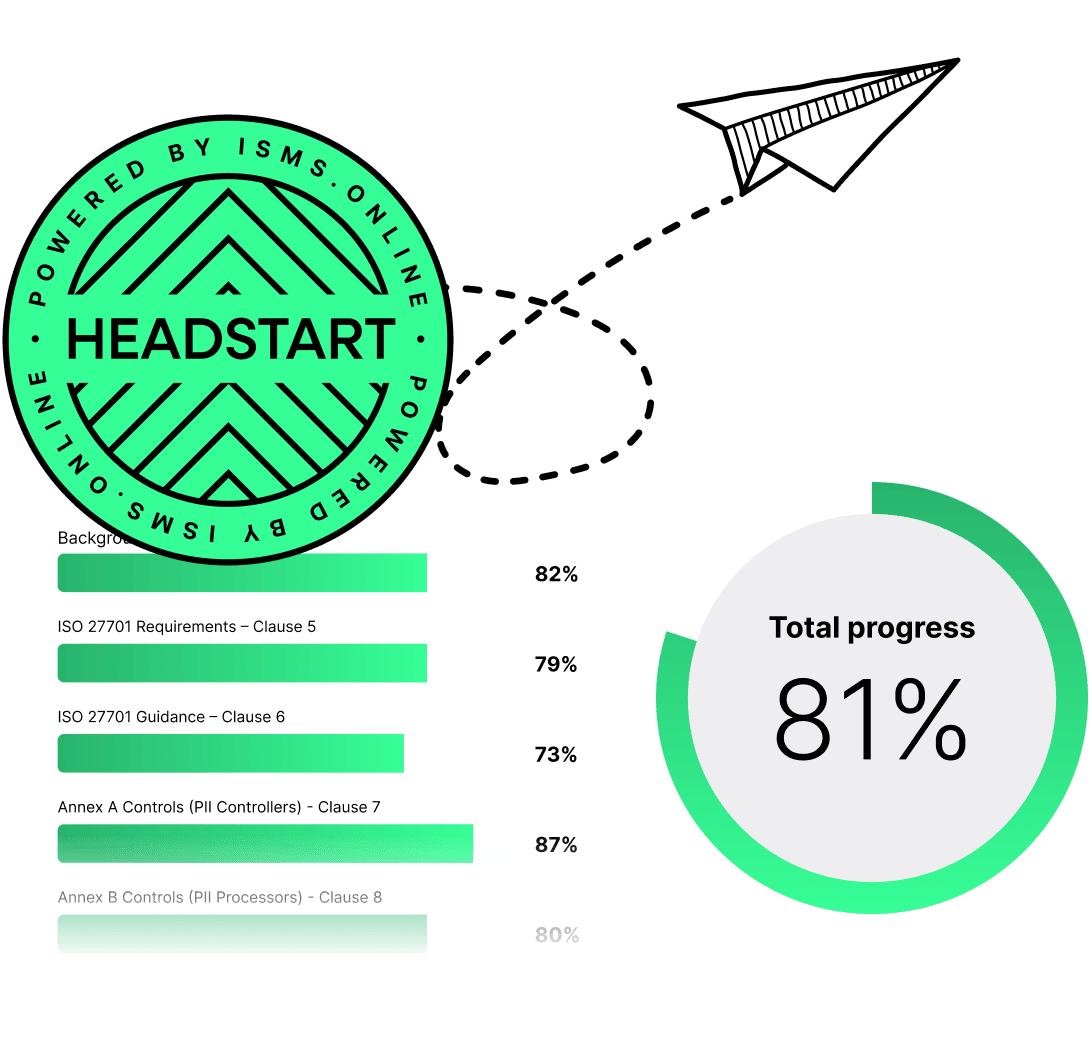
An 81% Headstart from day one
We’ve done the hard work for you, giving you an 81% Headstart from the moment you log on. All you have to do is fill in the blanks.
Can More Messages Backfire? Why Over-Communicating Erodes Compliance
A flood of security emails, policy notifications, and compliance reminders can actually choke your ability to certify. Audit studies consistently show that information overload means the most important messages get ignored, not read. Teams bombarded with non-urgent updates learn to tune out-even as real risks demand action.
Too many alerts don’t protect you-they create a smokescreen.
When your system is set to “broadcast all” rather than “targeted engagement,” staff and partners miss critical actions. A recent survey revealed that in firms with weekly generic security reminders, close to two in five staff overlooked urgent incident warnings. Instead, segmenting communication by urgency, outcome, and audience is now a compliance best practice.
The Role of Purposeful Communication
Batch low-priority updates and deliver urgent alerts through channels that cut through-like SMS for breaches or portal signoffs for new risks. Your audit trail becomes stronger when the evidence points to clarity, not clutter.
| Communication Type | Standard Frequency | Best Audit Evidence |
|---|---|---|
| Security Incident | Immediate | ISMS portal, digital signoff |
| Policy Update | Quarterly | Tracked email/read receipt |
| Training Reminder | Monthly | Compliance log, acknowledgment |
| Legal Notice | As needed | Contract portal export, signature |
If you want staff and stakeholders to react, send fewer, sharper messages whose delivery and acknowledgment are built into your audit log.
Where Do Communications Most Often Break Down During Audit?
Audit disaster rarely comes from never communicating-it comes from no one being able to prove who got the message, when, and what they did. Auditors increasingly go straight to:
- Central logs by event and recipient (“who heard about the new risk policy last Thursday?”)
- Evidence of acknowledgement on critical actions (“did the third-party contractor confirm?”)
- Single-point accountability: Who triggered, sent, received, and closed the loop
We sent the message won’t satisfy auditors-only a tracked receipt will.
External partners and hybrid teams create “blind spots.” Over 35% of last cycle’s communication non-conformities originated with vendors or contractors, whose onboarding or status change was never followed up with targeted, evidenced notification. When staff or suppliers fail to confirm key messages, you can’t “fill in” those gaps after the fact; comprehensive, dynamic evidence is the only way forward.

Free yourself from a mountain of spreadsheets
Embed, expand and scale your compliance, without the mess. IO gives you the resilience and confidence to grow securely.
How Can You Build a Clause 7.4-Proof Communication Matrix?
Leading compliance teams deploy a living communication matrix-an always-updated map linking every security, risk, or privacy event to recipient, channel, expected action, and audit evidence (bsi.blog). This isn’t a one-time spreadsheet but a workflow artefact owned by your ISMS.
Key Features of a Winning System
- Role-based targeting: Automatic, updated distribution lists tied to HR/workflow.
- Digital audit trails: ISMS-integrated logs showing “sent,” “opened,” “confirmed.”
- Review-and-test cycles: Quarterly data quality checks; dry-run audit reviews.
- Escalation logic: Repeated or critical misses generate timed reminders and management notifications.
| Channel | Audit Reliability | Use Case |
|---|---|---|
| ISMS Portal | High | Incidents, approvals |
| Medium | Policy updates | |
| Slack/Chat | Low | Informal reminders |
| Manual/Paper | Very low | Last-resort, non-core |
Digital-first, automated evidence isn’t “nice to have”-it’s now the audit default, reducing both workload and time-to-certification.
Who Needs What-And How Should You Map Channels to Stakeholders?
Your communication plan fails if it doesn’t match delivery to the real needs and habits of every stakeholder-from board to part-time supplier. Begin by mapping your loop:
Stakeholder Matrix
- Staff: Must have timely training reminders, incident alerts, and compliance deadlines.
- Contractors: Need onboarding, changes to access, and key risk briefings.
- Board/C-Suite: Require strategic, high-level dashboards, compliance milestone alerts.
- Suppliers/Partners: Demand regulatory updates, contract/incident notifications, and proof of sign-off.
Segmentation isn’t bureaucracy-it’s the only way to avoid critical gaps.
Each message should move across the most likely-to-get-acknowledged channel for the recipient (SMS for urgent incidents; portal for policy signatures; email for scheduled updates). Above all, every handover must be mapped, owned, and logged.
Example: Channel Match By Message
- Urgent incident: ISMS portal + SMS
- Policy update: Portal notification + read-tracked email
- Annual training: Signed log via staff portal
- Supplier contracts: Secure portal export, digital sign-off
When staff move teams or contractors change status, your matrix must update within weeks-every quarter, check and refresh to keep the evidence chain unbroken.

Manage all your compliance, all in one place
ISMS.online supports over 100 standards and regulations, giving you a single platform for all your compliance needs.
What Audit Evidence Actually Moves the Needle-And How Can You Improve Evidence Quality?
If you want to sail through audit, pursue digital, indexed evidence for every event-and treat your ISMS portal as your compliance compass. Auditors look for:
- Centralised logs with time stamps for sent, received, and acknowledged messages.
- Roles tied to every event-who was supposed to see, who did, and what they did in response.
Almost everyone saw it means you didn’t comply.
Some forms of evidence have much greater audit weight:
| Evidence Type | Audit Score (1–5) | Example |
|---|---|---|
| Portal sign-off | 5 | Digital signature, timestamp |
| Email receipt | 3 | Email open/read, not infallible |
| Chat “OK” | 2 | Informal, hard to aggregate |
| Paper signature | 1 | Manual, often partial |
| Vendor sign-off/export | 5 | Digital, role-mapped |
Aim for ≥95% acknowledgement per cohort-track what drops below. Automate reminders, and after every incident, run a mini-audit: did the loop close? Did every critical contact respond, and is this logged where auditors will look? Improvement comes from continual testing, feedback, and automation.
How Do Leading Teams Prevent Fatigue, Streamline Alerts, and Sustain Compliance?
Excellence isn’t more, it’s better: streamlined alerts, routine reviews, and automated evidence that serves staff-not the other way round. Best-in-class teams:
- Onboard staff directly into the evidence process: New hires see the “why” and “how” from day one.
- Standardise message templates: Subject lines computed, CTAs clear, responses tracked.
- Run routine, quarterly dry-run audits: You discover evidence gaps, not the auditor.
- Re-map stakeholders on every org or supplier change: No one gets left in the log shadows.
- Make audit-triggered reviews habit, not a scramble: Don’t wait for an incident-check, test, and tune in every audit cycle.
Routine proof builds resilience-a crisis drill today makes audit day a routine outcome, not a desperate scramble.
Companies who treat Clause 7.4 as a living system, not a checkbox, routinely halve first-time audit failures and withstand market and personnel churn with confidence.
Don’t Let Communication Gaps Stall Your Audit-Build Confidence With ISMS.online
When the clock ticks down toward audit or revenue is tied to a compliance milestone, the real risk isn’t in policies-it’s in missed, unacknowledged, or lost communications. ISMS.online provides a living, mapped dashboard: every message, sign-off, and role-mapped update traceable, exportable, and evidence-ready for any standard-so you’ll never be left hunting logs when it counts (isms.online).
Within days, your team can:
- Map all communication flows, owners, and evidence types.
- Enable live reminders, escalation, and closure tracking for every audit loop.
- Onboard multi-framework compliance (ISO 27001, SOC 2, NIS 2, GDPR, AI Act).
Audit stability is the byproduct of relentless, routine proof-build it once, and the next audit is just another walk in your calendar.
Confidently embed Clause 7.4 by operationalizing communication as an evidence factory-not just a good intention. Move from defence to certainty: secure your audit trail, empower your team, and make compliance communication your organisation’s strategic advantage.
Frequently Asked Questions
Why Is Trackable Communication the Key to Passing ISO 27001 Clause 7.4 Audits?
Trackable, audit-ready communication is the make-or-break factor behind successful ISO 27001 Clause 7.4 compliance-and audit failures most often come not from missed security intentions, but missing evidence that messages actually landed. Auditors don’t just ask what you communicated; they demand digital proof that every required recipient-staff, suppliers, contractors-received, acknowledged, and understood the information ((https://www.itgovernance.co.uk/blog/iso-27001-2022-changes-communication-requirements-explained)). If your organisation relies on scattered emails, ad-hoc Slack channels, or unlogged verbal updates, even a robust policy framework can falter at audit time. Many nonconformities and regulatory fines trace back to communication logs that are incomplete, patchy, or fail to show who received a vital message and when.
When delivery can’t be proven, intention isn’t enough-your controls are only as strong as your weakest evidence trail.
Clear, centralised, and export-ready communication records aren’t just a compliance checkbox. They’re your shield against delays, financial penalties, and reputational hits. As hybrid working and outsourced supplier relationships expand, so does your exposure if communication cannot be traced from sender to recipient-without gaps or grey zones.
Audit Gaps in Practice
- Missed supplier/contractor updates due to unclear ownership
- Outdated or manual records that fail real-time verification
- Broadcasts with no recipient acknowledgment
- No evidence that the right message reached the right role
Moving beyond basic communication means moving beyond risk-so you’re always audit-ready.
What Specifically Does ISO 27001:2022 Clause 7.4 Require-And Where Do Most Organisations Stumble?
Clause 7.4 sets the expectation for a structured, end-to-end communication system-not loose “sent” messages, but a mapped, tested, and centrally logged process. According to the (https://www.iso.org/obp/ui/#iso:std:iso:27001:ed-3:v1:en), your organisation must:
- Identify all information security stakeholders-employees, contractors, vendors, Board, etc.
- Map who receives different types of security notifications, by role and risk.
- Use channels that provide evidence of delivery (not just email chains).
- Track replies-or, crucially, recipient acknowledgments-for high-risk events, policy updates, and incidents.
- Review and improve your communication process at least quarterly, especially after organisational or regulatory changes ((https://iapp.org/news/a/the-iso-27001-2022-update-evolving-isms-for-the-future/)).
| Requirement | What Auditors Want | Risk If Missed |
|---|---|---|
| Stakeholder Mapping | Every group on record-incl. suppliers | Gaps, missed roles = nonconform. |
| Role-Based Targeting | Messages mapped to recipients/roles | “Blasts” dilute proof |
| Audit-Ready Logging | Digital, time-stamped, exportable | Lost/ambiguous evidence |
| Ongoing Review | Quarterly or incident-triggered | Out-of-date = audit failure |
Over 50% of Clause 7.4 audit failures are traced to missing or partial proofs-not technical system flaws, but lapses between intent and delivery ((https://legal.thomsonreuters.com/blog/five-key-update-iso-27001-2022/)). Without systematic, auditable comms, performance on the other controls is undermined.
Where Do Communication Breakdowns Most Often Cause ISO 27001 Nonconformities?
Audit pain doesn’t start with the obvious: it starts in the shadows-when “sent” can’t be proven as “received and understood.” Nonconformities, fines, and failed certifications repeatedly track back to:
- Fuzzy accountability: HR, IT, and Legal each assume the other owns the communication, creating gaps ((https://www.diligent.com/insights/iso/iso-27001-communication-and-new-isms/)).
- Supplier and temporary staff left off core update lists-raising risk and breaking the audit chain ((https://home.kpmg/xx/en/home/insights/2022/10/iso-27001-2022-and-new-supplier-communication.html)).
- Log evidence built on emails, spreadsheets, or paper files that lack the ability to trace or timestamp every message.
Audit disappointment doesn’t come from missing a piece of paper-it comes from missing the concrete line between intent, delivery, and proof.
Common Correction Moves
- Build a live communication matrix: every event matched to recipients, channel, and proof.
- Assign “communications champions” across teams and third parties for full audit coverage.
- Replace ad-hoc methods with digital logging and automatic reminders.
Making these actions routine moves your team from defensive firefighting to proactive audit confidence.
How Should You Design Communications for Clause 7.4-And What Tools Do the Best Programmes Rely On?
Start with a communications matrix for every kind of event-incident response, policy change, onboarding. Define recipient groups, delivery channels (ISMS, secure portal, SMS), and the level of proof needed ((https://www.bsigroup.com/en-GB/blog/ISO-27001/communication-matrix/)). No single channel is sufficient: best practice blends ISMS platforms with configured alerts, formal approvals, and export-ready logs.
Key design steps:
- Automated, digital delivery and acknowledgment logs for each message type.
- Named comms leads (“champions”) in each department/partner group ((https://www.sisainfosec.com/blogs/iso-27001-2022-isms-champion/)).
- Full shift away from paper, chat, or ad-hoc files towards exportable, central logs ((https://www.auditboard.com/blog/navigating-the-iso-27001-2022-updates/)).
| System Design Step | Audit-Proof Benefit | Why It Matters |
|---|---|---|
| Role/Event Mapping | No missed recipients, clear audit line | No “grey zones” in proof |
| Digital Logging | Real-time, export-ready trace | Passes the test, every time |
| Champion Ownership | Named responsibility prevents silence | Disputes stopped before they start |
| Log Reviews | Early detection of weak links | No last-minute scramble |
Layering these tools ensures resilient, future-proof communication chains that scale with your organisation’s growth and compliance needs.
Who Must Be Included-And How Do You Maintain Ownership as Your Organisation and Supplier Pool Grow?
Clause 7.4 demands everyone inside your compliance boundary-employees, partners, contractors, suppliers, executive teams-has a mapped channel and assigned owner ((https://securitybrief.co.uk/storey/iso-27001-2022-communications-pitfalls-and-accountability)). Static lists are not enough: set quarterly reviews, plus after any organisational or regulatory change, to keep your maps current ((https://www.techrepublic.com/article/iso-27001-communications-hidden-gaps/)).
| Group | Channel Example | Named Owner(s) | Review Frequency |
|---|---|---|---|
| Employees/Execs | ISMS, HRIS, email | CISO, HR, Managers | Quarterly, onboarding |
| Suppliers/Contractors | ISMS, secure portal | Procurement, Legal | Quarterly, contract term |
| High-Risk Roles | ISMS, direct alert | IT, CISO, Security Ops | Quarterly or new risk |
A live stakeholder-channel map-owned, reviewed, and actioned-is the difference between audit resilience and audit chaos.
Continuous review is your best insurance policy. Build it into your ISMS process, not as an afterthought.
How Do You Automate Reminders Without Causing Notification Fatigue-or Missing Urgent Issues?
Balancing urgency and over-communication is a real challenge. Over-alerting leads to stakeholder fatigue, under-communicating risks audit gaps and missed incidents. The answer is channel- and frequency-matched notifications: immediate alerts for critical incidents, quarterly for routine updates, annual or less for general wellness ((https://hyperproof.io/resource-centre/iso-27001-communications-planning/); (https://www.cyberark.com/resources/threat-research-blog/the-human-factor-in-iso-27001-communications)). Automated reminders targeted by role and risk deliver far higher acknowledgment and coverage.
| Message Type | Frequency | Recipients | Audit Evidence |
|---|---|---|---|
| Security Incident | Immediate | All/high-risk roles | Read/response, timestamp |
| Policy Update | Quarterly | All, role-specific | Read log, digital acknowledgment |
| Regulatory Change | Upon event | Compliance, Legal | Signature, digital confirmation |
| HR/Wellness Update | Biannual or less | All staff | Broadcast confirmation (optional) |
Automation reduces manual chasing and secures a real-time audit trail-without overwhelming those who need to take action.
What Does “Audit-Proof” Communication Evidence Look Like-and How Do You Maintain It Over Time?
“Adequate” evidence is no longer enough; audit-proof evidence must be:
- Digital and time-stamped (sender and recipient)
- Tied to the specific message and stakeholder
- Exportable across compliance standards (ISO 27001, SOC 2, GDPR, AI Act)
- Able to show log review, not just raw event history ((https://www.navex.com/blog/article/iso-27001-2022-communication-in-isms/); (https://trustarc.com/blog/2023/08/07/iso-27001-2022-how-to-document-communications))
An active ISMS is more than a document store-it’s a living, proof-generating audit partner that tracks every touchpoint, change, and acknowledgment.
Ongoing Readiness Checklist
- Each communication/event is logged digitally, in one place.
- Mapping links sender, recipient, timestamp, and action for every update.
- Logs can be exported in auditor-verified format as standard.
- Real-time dashboarding and quarterly “dry runs” catch gaps early-no surprises at audit time.
Leading organisations run scheduled log reviews and dry-run audits several times a year-ensuring their audit day is just another confirmation, not a crisis.
How Are Leading Firms Exceeding Clause 7.4-And How Can You Replicate Their Success?
Industry leaders don’t wait for auditors-they embed hands-on communication mapping, role-based onboarding flows, and live template use from day one ((https://www.infotech.com/research/iso-27001-2022-isms-onboarding-and-communication)). They set review routines and use ISMS platforms to ensure every message, incident, and policy change is covered and logged. These steps halve non-conformance rates and lift audit pass rates to over 95%.
| Rapid-Win Move | Outcome Achieved |
|---|---|
| Onboarding comms workflow | Faster onboarding, reduced audit drama |
| Quarterly log reviews | Spot gaps, avert nonconformities early |
| Template-guided comms | Less manual work, greater consistency |
| Multi-standard mapping | Smoother expansion to SOC 2, GDPR, AI |
Clause 7.4 is a living standard. With smart mapping, automated logs, and routine dry runs, audit-proof comms becomes how you work-not just how you pass.
Want Clause 7.4 clarity, confidence, and audit-proof readiness? ISMS.online lets you map, send, confirm, and prove every vital message-so audit success is not just a hope, but your organisation’s next headline.






