





































Why Do Document Control Failures Put Your Compliance at Risk?
If you’ve ever worried about a policy document getting lost in sharing folders or approvals disappearing in someone’s email, you’re not alone. Document confusion is the hidden saboteur of information security management, capable of undermining your best compliance intentions. The pain might not sting until audit time, but by then, a single outdated copy in circulation can snowball into non-conformities, wasted time, and jeopardised trust with customers and regulators. In fact, document control lapses consistently rank among the most common ISO 27001 audit failures, proving that even mature organisations can trip over missing approvals and version mix-ups.
Most document control problems start quietly, then roar to life when an audit or incident shines a light on old habits.
You may have strong policies, robust access controls, and dedicated intent, but if the documentation and its trail of approvals aren’t watertight, auditors are quick to find the cracks. Modern organisations can no longer afford to rely on “tribal knowledge” or fragmented file management. The best teams now move to unified ISMS platforms where every change, version, and approval is not only tracked but also easily surfaced and actioned. That’s the difference between hoping you’ll pass and having proof you can trust.
Are You Confident in Every Version and Approval?
For every compliance professional or security manager, these three questions loom large-especially in the run-up to a certification or surveillance audit:
- Can your team access only the latest, live, and approved document-never an obsolete draught?
- Is the entire lifecycle of each document-creation, modification, approval, in-force status-captured, trackable, and available on demand?
- If asked by an auditor, could you reconstruct the “chain of custody” for every important artefact, down to who signed off and why?
If the answer isn’t a resounding yes, your ISMS risks falling short not just in ISO 27001 Clause 7.5.2, but also in the daily trust that clients and staff place in your controls.
Why Proof Beats Promises for Auditors and Clients
Auditors, regulators, and enterprise customers trust what you can prove-not just what you say. Thats why a digital, auditable trail for every controlled document is foundational to any effective ISMS and why platforms like ISMS.online are architected to make every approval and change instantly replayable. Skipping document control hygiene leads to endless remediation cycles, eroded confidence, and potential business loss. In a discipline where documentation is king, only live, clear, and easily accessible records earn you the recognition of being audit ready.
Book a demoWhat Are the Hidden Costs of Weak Document Practices?
While audit non-conformities grab headlines, the true costs of poor document control leak out day-by-day in lost time, duplicated effort, and team insecurity. Every missing checklist, ambiguous policy, or untraceable approval slows response, multiplies rework, and leaves you exposed when it matters most. The ISO Council observed that organisations still dependent on informal file sharing or scattered approvals spend significantly longer preparing for audits, frequently miss deadlines, and operate on incomplete or outdated guidance.
The small missteps in documentation eventually show up as lost deals, late audits, or lower staff morale.
How Audit Confidence and Team Trust Erode
The subtle signs of weak documentation appear long before an audit:
- Outdated policies and procedures: remain in active use, putting staff and customers at risk of non-compliance or accidental breaches.
- Broken approval chains: -where decision-makers haven’t formally reviewed or signed off-invite scrutiny and raise liability for both compliance leads and managers.
- Too many “final” copies: in circulation muddy understanding; staff aren’t sure which version to trust, so mistakes compound.
Staff confidence decays as they’re forced to double-check, ask for clarification, or redo past work-making even the most sophisticated security programme feel fragile.
The Everyday Leaks in Control
Some risks are obvious; others seep in quietly. If your team maintains personal backups, makes quick document edits “under the radar,” or accepts verbal approvals outside the platform, you’re likely accumulating silent risk. Real-time audit trails-where every document’s journey is logged and unambiguous-don’t just avoid findings; they make ongoing compliance feel lighter and more credible.
When routine controls are automated, hours previously spent on policing and chasing can be invested in strategic improvements and team engagement.
Real-Time Trumps Retroactive Fixes
Instead of playing catch-up before each audit, the most resilient operations embed real-time feedback: platform-led ownership, review reminders, edit histories, and approval audits. This turns documentation from a risky afterthought into an always-on asset-delivering daily clarity and ironclad evidence when required.
ISO 27001 made easy
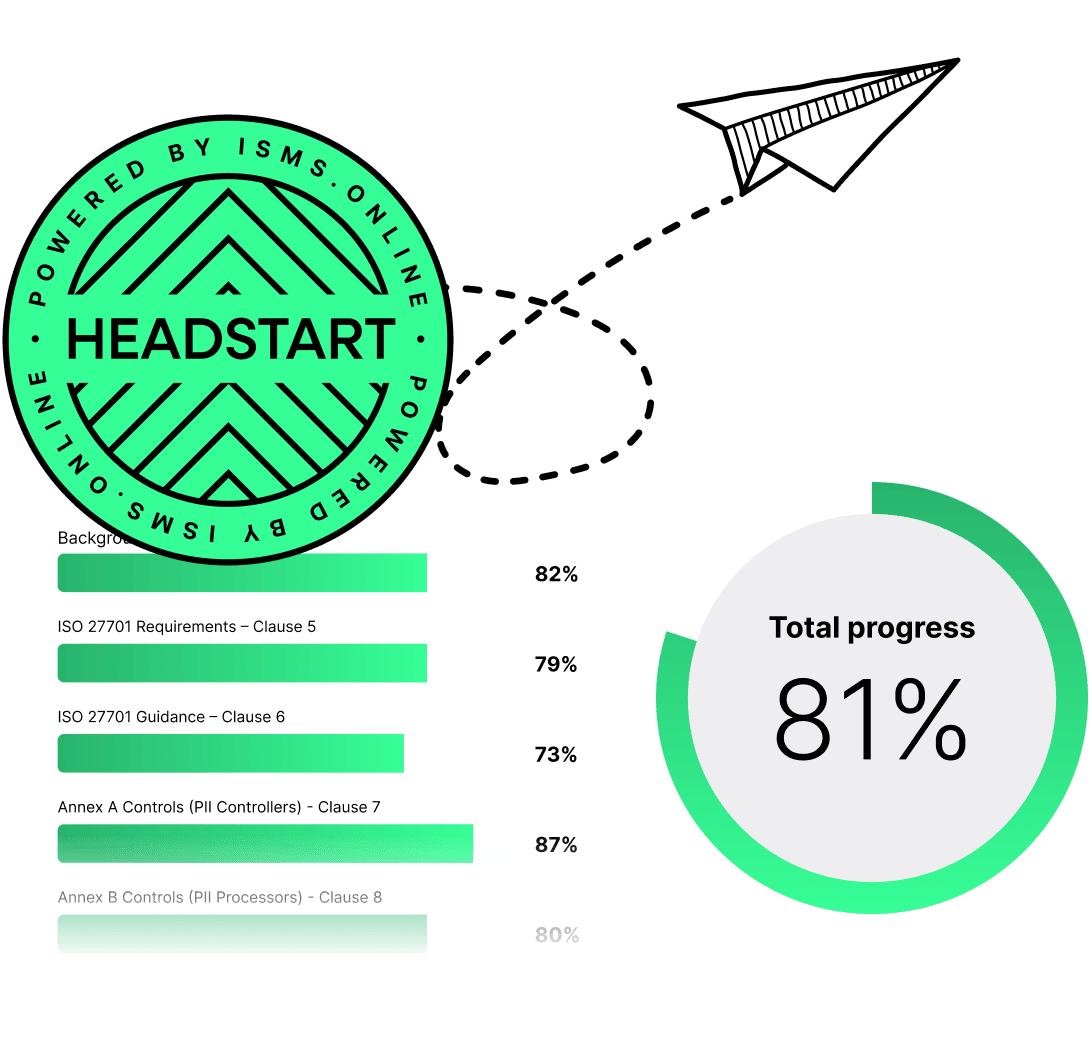
An 81% Headstart from day one
We’ve done the hard work for you, giving you an 81% Headstart from the moment you log on. All you have to do is fill in the blanks.
What Does Clause 7.5.2 Actually Require-And Where Do Most Teams Slip?
ISO 27001:2022 Clause 7.5.2 is exacting, and for good reason: the world has moved beyond paper sign-offs and informal digital practices. Clause 7.5.2 requires every controlled document to have a uniquely identifiable, transparent, and unbroken chain from creation to approval and ongoing review. No element of this lifecycle is left to chance. Each document must demonstrate who created it, when and why it changed, who reviewed and approved those changes, and where it resides-all within a central, access-controlled ISMS.
Good enough document management is now the hallmark of an outdated and non-compliant security posture.
Clause 7.5.2: Non-Negotiable Requirements
- Unique identification: Every policy, process, or record must have an identifier that eliminates confusion, not just a filename.
- Version and change tracking: Edits, authorship, dates, and rationale are logged in real-time, removing reliance on memory.
- Centralised, access-controlled repository: Documents are locked inside a formal system-no “shadow IT” or local desktop copies allowed.
- Complete audit trails: All changes and approvals are digitally captured; every approval and update should be easy to replay, with context.
- Error correction: The ISMS must anticipate mistakes and provide pathways to quickly amend and re-approve content, maintaining full visibility and traceability.
Most audit failures tie back to gaps in these fundamentals-not for lack of intent, but for lack of systemic support.
The Pitfalls: Handoffs and “Just This Once” Changes
Non-conformity creeps in through shortcuts and unclear processes:
- Documents without a clear owner risk being forgotten or multiplying in versions.
- Urgent edits that bypass the central ISMS, instead handled by ad-hoc emails or “emergency” side-channels, break the formal record.
- Compromises under deadline pressure-such as deferring scheduled reviews or accepting verbal approvals-invite scrutiny and erode trust.
Clause 7.5.2 brute-forces the issue: if you can’t answer “who owns this document, who last changed it, who approved and when,” the finding is automatic. Meeting this standard transforms compliance from a Herculean, event-driven overhaul into a managed, everyday discipline.
Where Do Most Organisations Fail-And How Can You Avoid Costly Mistakes?
The lion’s share of failures occur not through laziness, but from the collision of legacy process, ambition, and lack of enabling capability. Three critical pitfalls deserve your attention: ambiguous ownership, unclear permissions, and missed review cycles.
Why “Shared Ownership” Breeds Ambiguity
Overlapping or rotating edit rights may appear efficient, but experience shows they breed chaos. When everyone is responsible, no one is accountable: approvals slip, and corrections become unwieldy. Assigning a clear, singular owner for each document, with restricted edit rights and formalised handoff procedures, grounds the ISMS in clarity and accountability.
Skipping Reviews and Unlogged Approvals
The temptation to press ahead during backlog crises is real. But every missed review or unrecorded approval sows the seeds for compliance drift, outdated policies, and the risk of major non-conformity at the worst possible time. System-enforced review reminders and mandatory, in-platform approvals are the antidote-raising the bar without adding manual busywork.
The Audit Trap of Informal Approvals
Approvals by hallway conversation or scattered emails lack the authority and historical proof ISO 27001 demands. Only system-logged, role-attested approvals grant you the defensibility that withstands regulator or auditor inquiry. Cutting corners to save an hour often means scrambling for weeks to recover lost trust and retrace decisions.
Controls are strong when they are obvious to the user, invisible in hassle, and irrefutable to the auditor.

Free yourself from a mountain of spreadsheets
Embed, expand and scale your compliance, without the mess. IO gives you the resilience and confidence to grow securely.
How Do You Build a Resilient, End-to-End Document Lifecycle?
Resilience in document management means never having to wonder, retrace, or blame. Instead, you should be able to “flip open the book” of any policy or record and see its lineage, approval, and status-regardless of staff turnover or business changes.
Infrastructure for Ownership and Review
- Every document gets a single, visible owner at creation. If a key person leaves or roles change, your ISMS should alert for immediate reassignment to avoid ownership gaps.
- Automatic review cycles ensure policies remain actively maintained, not just archived; platform reminders smooth the path and keep fatigue at bay.
- Ownership chains and status boards-where everyone can see who is accountable, when each item was last touched, and when it is next due-replace “blind spots” with transparency.
Automation Makes Hygiene Routine
The strongest compliance environments do not rely on heroics or constant vigilance; they embed hygiene into the workflow by default. Look for solutions (like ISMS.online) that:
- Automate notifications for every key step-draught, review, approval, next review
- Capture every version and editor, down to minor revisions, with a click
- Restrict editing to assigned owners, while flagging anomalies or overdue actions for escalation This prevents drift, enables rapid recovery, and builds the muscle memory that makes audits feel anticlimactic rather than alarming.
Approval Trails That Trust with Evidence
The end-to-end record-from initial draught through review, approval, and evergreen updates-must be actionable, not aspirational. Digital signatures, platform approvals, and immutable logs provide the quality and completeness that regulators, auditors, and risk committees demand for true defensibility.
When an auditor or regulator asks for the storey behind a policy, you should deliver a clear, timestamped, and role-attributed timeline-never an apologetic guess.
How Does Clause 7.5.2 Transform Document Control? (Visual Comparison Table)
Clause 7.5.2 draws a bright line between traditional, ad-hoc record keeping and a modern, digitally mature compliance environment. Before 2022, patchy controls and policy “workarounds” might squeak past an audit. Now, the ISO standard calls for structural, system-enforced discipline.
| Core Practice | Legacy (Pre-7.5.2) | Clause 7.5.2 Control Architecture |
|---|---|---|
| Version Control | Manual naming/folder sorts | System-enforced version & change tracking |
| Ownership | Multiple/rotating, unclear | Single, named owner assigned & visible |
| Approvals | Email/word-of-mouth | Digital sign-off with visible chain-of-custody |
| Review Frequency | Irregular, often skipped | Automated cycle with reminders/escalation |
| Access | Distributed, uncontrolled | Centralised, role-based ISMS permissions |
Nearly compliant is a risk for auditors and business leaders alike. True compliance doesn’t just check a box-it burns away ambiguity.
This new paradigm elevates audit readiness from a once-yearly scramble to a calm, always-on state where risks are surfaced, fixed, and retired with speed and certainty. Your ISMS gains the strength to support growth, withstand change, and inspire confidence up the chain of leadership.

Manage all your compliance, all in one place
ISMS.online supports over 100 standards and regulations, giving you a single platform for all your compliance needs.
What Are the Practical Steps to Implement Clause 7.5.2 Today?
Translating good intentions into proven compliance is a matter of systems, people, and process. Here’s how leading companies make document management a source of confidence, not uncertainty:
- Centralise document inventory: Catalogue every ISMS-controlled artefact with unique IDs, clear ownership, and approval status. Platforms like ISMS.online centralise this view and provide real-time dashboards.
- Lock down permissions: Grant editing only to designated owners; all others request changes through controlled, logged workflows.
- Mandate complete change logs: Every edit-however small-includes a “why” and “by whom” entry, not just a timestamp.
- Automate review cycles and escalation: Deadlines are enforced, overdue reviews trigger alerts, and no policy languishes past its expiry.
- Capture digital approvals only: No change goes live without a recorded, role-authenticated sign-off; system logs form the “chain of custody.”
- Visualise the workflow for all users: Staff should understand not just what to do, but how their actions fit into the organisation’s live, audit-ready storey.
The most powerful controls fade into the background, but always show themselves the moment you-or an auditor-need proof.
A tech-enabled approach not only cuts admin time but also offers resilience when key staff change, as every ownership and approval history stays attached and instantly reviewable.
How Does Confident Document Control Feel With ISMS.online?
Imagine a compliance programme that rarely sees the word “panic.” Teams using ISMS.online are already there: they see “what’s due,” “who owns it,” “when it was last changed,” and “what’s next” in a single glance. Over 25,000 organisations trust ISMS.online to execute and evidence Clause 7.5.2 through:
- Embedded document workflows that lock in clause-aligned controls, roles, and sign-offs;
- Live dashboards surfacing documentation status and overdue actions for immediate follow-up;
- Onboarding and step-by-step guides that translate policy into practice, so new users learn by *doing* rather than by reading dense manuals.
With every document update, review, or approval logged, visualised, and instantly accessible, preparation for the audit becomes a confirmation of maturity-not a rushed fire drill or an after-hours effort.
True compliance feels like calm readiness-not a string of emergencies.
Build Your ISMS Confidence With ISMS.online-Trusted by Teams Who Make Audits Routine
Teams that sleep soundly through audit season have a secret: they’ve engineered out the chaos. With ISMS.online, you replace doubt and surprise with transparency, automation, and confidence. Every policy, procedure, risk record, and control assignment is right where it should be-owned, updated, approved, and audit-ready.
When your ISMS transforms from a source of stress to a strategic advantage, you’re ready not only for the next compliance cycle but for the demands of growing, scaling, and innovating. Invest in a solution that shifts audits from confrontation to confirmation, from fear to fluency, and from compliance cost centre to business growth engine.
Start today, and let your documentation become not a hidden risk, but the shield and showcase of your security, governance, and operational excellence.
Frequently Asked Questions
Why do organisations lose control of documents under ISO 27001 Clause 7.5.2?
Disorder takes hold when teams use shared drives, email threads, and ambiguous file names-habits that create confusion just when auditors demand proof. Clause 7.5.2 requires every ISMS document and record to be traceable: versioned, owned, reviewed, and easily retrievable. When competing draughts pile up and approvals aren’t logged, audits quickly reveal fragmented control as a top cause for ISO 27001 nonconformity. The risk isn’t just missing paperwork; it includes unprovable approvals and out-of-date policies that can expose your business to regulatory findings or contract losses. By centralising documents and control in a dedicated ISMS platform, you shift from firefighting chaos to a clear, controlled process-moving from forgotten draughts to real-time audit readiness.
What practical risks do weak controls create?
- Productivity loss: Staff waste hours hunting for the latest policy or tracking down outdated copies.
- Audit exposure: Missing or unlogged approvals become show-stopping findings for certifiers.
- Reputational harm: Inconsistent, outdated documents undermine trust with clients and regulators.
- Hidden liabilities: Unauthorised changes or “orphan” policies can become ticking compliance time bombs.
A disciplined approach to document control is often invisible-until the very moment you need to prove it.
How does Clause 7.5.2 reshape document lifecycle management?
Clause 7.5.2 does not just tweak administration; it transforms document control into an auditable, living process. Every ISMS document must carry a unique identifier, clear owner, tracked revision history, and explicit approval record. No more ad hoc edits, verbal thumbs-up, or “final_v7” versions: creation, modification, review, approval, and removal must be managed, logged, and if possible, automated. Instant access to current versions is vital, as is ensuring outdated ones are archived-not floating in team folders. Access isn’t left to chance or IT settings; permissions are assigned, regularly reviewed, and revoked when no longer justified. In short, Clause 7.5.2 demands end-to-end visibility, accountability, and reliable cycles-backed by system-generated audit trails.
What does effective Clause 7.5.2 implementation look like?
- Central ISMS registry: for all documents and policies, not scattered drives.
- Assigned owner: for every document, visible to all stakeholders.
- Automated change logs: -every edit, review, approval is tracked.
- Role-based access: to ensure only authorised users can edit, but everyone can find what’s current.
- Regular review cycles: built into the ISMS, not relying on memory or manual reminders.
- Automatic archival: removes expired or superseded documents from plain sight.
What are the invisible costs of poor document control for security and compliance leaders?
Broken document control quietly erodes operational agility, legal readiness, and audit confidence. Leadership loses weeks chasing approvals, patching gaps, or responding to auditors’ questions about document history. Teams relive audit panic trying to reconstruct who approved what, and when. Worst of all, lack of control leaves you unable to defend your evidence in the event of a breach: litigation, customer due diligence, or regulatory probes quickly expose fractured trails. Digital-first ISMS users routinely report faster audits and fewer “fire drills” than those managing evidence by spreadsheet or inbox, according to PwC. The real cost? Eroded trust, slower growth, and a compliance programme that collapses at the first real test.
Why do quick fixes and “last-minute” approvals persist?
They feel easier-one email, a hallway nod, an unsaved edit seem to save time until an auditor demands the paper trail. These “shortcuts” actually create blind spots, blocking accountability and trapping teams in cycles of panic and rework. Automated approval and review logs not only meet Clause 7.5.2-they foster cultural learning, making every update a trackable step toward continuous improvement.
How does ISMS.online provide control, automation, and trust for Clause 7.5.2?
ISMS.online automates every piece of Clause 7.5.2: each document is logged, uniquely identified, and assigned to an accountable owner. Version control, approval, and review flows are tightly tracked in-platform, with permission structures ensuring edits happen only where justified. Scheduled system reminders eliminate forgotten reviews. When policies are updated or superseded, the system archives old versions-no “shadow files” remain to trip up auditor or team. Cross-standard mapping functionality lets a single control set satisfy ISO 27001, SOC 2, GDPR, and more, streamlining compliance for growing organisations.
| Dimension | Fragmented Approach | ISMS.online Control |
|---|---|---|
| Version control | File names/folders | System-enforced, visible |
| Ownership | Team-shared, unclear | Accountable, assigned owner |
| Approval logging | Emails/discussions | Digital workflow, timestamped |
| Review cadence | Ad hoc/reminder emails | Automated, regular alerts |
| Access | Open/shared drives | Role-based, centralised |
What leadership and operational changes sustain good document control?
Enduring control is led by culture. Leaders should frame Clause 7.5.2 as essential risk protection, not mere paperwork. Make every staff member accountable for document checks, review cycles, and explicit approvals. Reward adherence, regularise spot-checks (“Can you show last month’s approval trail?”), and make evidence part of routine reporting to the board. Use digital platforms to remove “workarounds” as an option-everything must be owned, timed, and defensible as a live process. As your ISMS culture matures, link policy evidence across privacy (GDPR), resilience (NIS 2), and new frameworks, building trust with auditors, customers, and internal stakeholders.
Every policy you can prove on demand becomes a trust signal-protecting business, reputation, and growth.
How does digital lifecycle management future-proof your compliance approach?
With regulatory scrutiny rising and customer demands growing sharper, automating document lifecycle management moves you from reactive compliance to proactive security. Digital-first ISMS processes mean reviews, updates, and evidence are always within reach-shrinking audit preparation from months to days and drastically reducing human error. Organisations using ISMS.online often see 40–70% reductions in time spent chasing approvals and virtually eliminate last-minute audit surprises. Every controlled document becomes a living asset, strengthening your stance with regulators, accelerating customer onboarding, and building board confidence that your security programme is resilient-no matter what framework comes next.






