





































How Does Controlling Documented Information Become an Unseen Advantage in Security and Compliance?
When certifying to ISO 27001:2022, Clause 7.5.3 – Control of Documented Information – is much more than a checkbox. For your organisation, it’s the backbone ensuring every critical document is always current, traceable, and defensible, no matter who is watching or when scrutiny comes. Rather than just another policy requirement, tight control proves to your board, auditors, and customers that your security isn’t just claimed – it’s lived, logged, and regularly proven.
Control removes uncertainty; it’s how you turn audit anxiety into operational strength.
Uncontrolled documentation opens the door to confusion, version chaos, or lost evidence – risks that can trigger audit findings, break trust with clients, and, in some cases, bring regulatory action if records can’t be produced when required. Practically, this control secures every “who, what, where, when, and why” in your ISMS: from policies to incident logs, and approval trails through to audit reports.
A controlled approach delivers:
- Reliability: No more missing or outdated documents; everything is actively managed and update-safe.
- Retrievability: Crucial evidence is at your fingertips in minutes, not lost in email threads or archives.
- Integrity: Every change is tracked, timestamped, and associated with a real person – the definition of audit-ready.
| Documentation Approach | Average Evidence Retrieval Time | Audit / Business Outcome |
|---|---|---|
| Ad-hoc (emails/fileshare/Dropbox) | 2–10 hours | Gaps and last-minute audit fire drills |
| Controlled system (ISMS.online/ISMS) | <10 minutes | Seamless, audit-ready confidence |
Proof of consistent document control moves your organisation from reactive compliance to proactive assurance – a stance auditors, decision-makers, and customers immediately recognise.
What Does Real Ownership Look Like in Documented Information Control?
Compliance and audit defence collapse quickly when document responsibilities are muddy. ISO 27001:2022 explicitly expects you to assign and maintain clear “ownership” for every document – no ambiguity, no overlap, and no “everyone, so really no one” black holes.
Ownership is what turns policy from paper to practice. When ownership lapses, so does compliance.
Each stage of the document lifecycle – creation, review, approval, update, and retirement – must have a responsible, named individual who is accountable for the outcome. This isn’t just a procedural box-tick; it’s a key risk control. When roles are explicit and mapped in your system, you prevent version mix-ups, approvals going missing, or essential knowledge walking out the door with staff changes.
| Role | Primary Responsibility | Impact on Audit / Operations |
|---|---|---|
| Owner | Upkeep, approval, relevance | Ensures policies stay current, owned |
| Editor | Draught/revise, log changes | Enhances transparency, document health |
| Approver/Reviewer | Second check, formal sign-off | Audit-gate for every update |
| ISMS Admin | Manage rights, control logs | Blocks permissions creep or lock-out |
| Backup/Alternate | Fill-in during absence | Prevents bottlenecks, keeps momentum |
Best Practices:
- Always display the named owner on every document, and schedule periodic reviews, so responsibility never goes “stale.”
- Control permissions by role – only those with explicit assignment can approve or change key documents, blocking accidental or unauthorised edits.
- Set up succession tracking: if an owner leaves, the platform should instantly flag and require a new assignment.
- Train, retrain, and automate reminders. ISMS.online allows you to attach ownership details and view or escalate unassigned docs.
Explicit ownership is a sign of maturity – reducing risk and unplanned surprises – and stands up to any audit challenge.
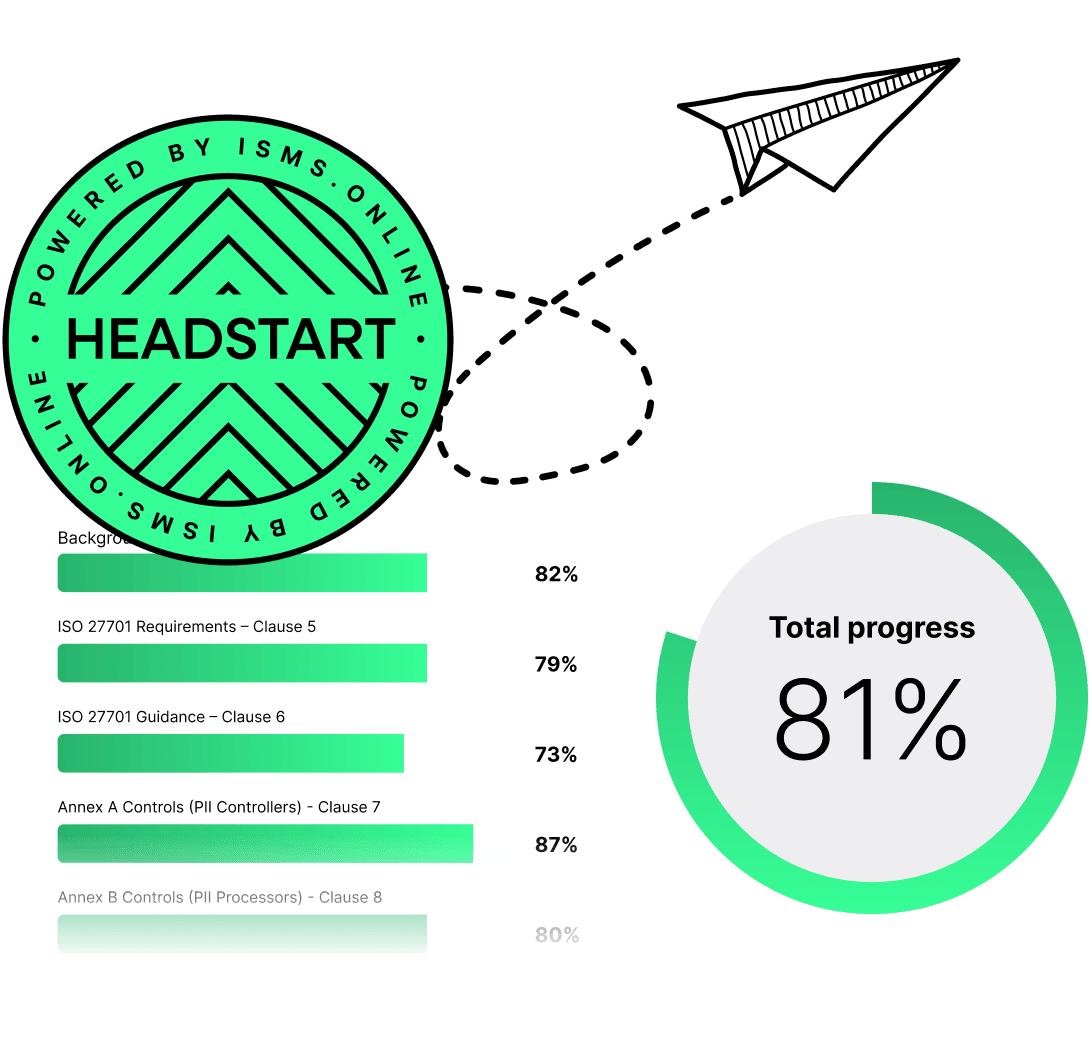
ISO 27001 made easy
An 81% Headstart from day one
We’ve done the hard work for you, giving you an 81% Headstart from the moment you log on. All you have to do is fill in the blanks.
How Do You Actively Govern a Document’s Lifecycle – from Creation to Deletion?
Treating document control as a living process, not a static policy, is what keeps your ISMS adaptive and robust. ISO 27001:2022 Clause 7.5.3 demands that you map the journey every document takes – and then prove you oversee each step.
Strong controls live in the workflow – not just on paper.
Lifecycle phases that must be mapped and managed:
- Creation: Drafted, assigned an owner, and versioned in the system.
- Review: Inputs solicited, tracked edits and change suggestions logged with clarity.
- Approval: Formal sign-off, with system record of who and when.
- Distribution: Made available with “right people, right time” permissions – and access logs.
- Review/Update: Triggered by date, event, or automated schedule; every update is logged (by whom, what changed, why).
- Archive/Destruction: Only obsolete docs are removed, strictly per policy and with an audit trail.
Visualisers and Automation
Digitally enforce each phase: a robust ISMS provides workflow steps that can’t be skipped, alerts for overdue reviews (eliminating “forgotten” policies), and lockdown for retired docs. Every touchpoint is logged-critical for recovery during incidents and when demonstrating process integrity to auditors.
Elevate lifecycle control by:
- Using built-in version controls (no more “Policy_v12_final_FINAL.docx” confusion).
- Enforcing segregation of duties (nobody approves their own draughts).
- Enabling only policy-linked deletion (legal, HR, or risk sign-off where regulators require).
If any stage is bypassed or only “implied,” your next audit could grind to a halt – visible, enforced workflows are a non-negotiable in 2024 and beyond.
How Can You Make Access and Change Controls Audit-Proof – Not Just Plausible?
The difference between “set and forget” controls and real operational discipline is instant, non-repudiable proof of every access, edit, and approval. Auditors don’t accept stories or memory – they verify logs and challenge assumptions.
If your system can’t show who did what, when, nothing else truly matters to your auditor.
Essentials for control:
- Role-based permissions: Only specified, trained staff should be able to view, edit, or approve – mapped in the system, not left to IT defaults.
- MFA (Multi-Factor Authentication): Especially for those with edit/approval powers, to close privilege-escalaion loopholes.
- Logged events: No manual records; every access, edit, approval, or deletion is system-captured and visible in a real-time log.
- Process enforcement: Documents can’t skip required reviews or approvals (“soft” workarounds are closed), even under tight deadlines.
- Notification loops: Every permission or status change triggers alerts – this transparency is essential for risk oversight at the board level.
Small access-control failures often cascade into major security, regulatory, or audit events.
Tables and permission matrices – especially for “high-value” information (policy, risk register, incident logs) – make it easy for stakeholders to see at a glance who owns, edits, reviews, or can trigger an archive/destruction event. Think like a risk committee: the more visible and automated the trail, the sharper your “compliance edge.”
If event-capture, rollback, or approval-chain clarity is missing, every audit and internal investigation becomes a scramble rather than a smooth demonstration. That’s an avoidable risk with any modern ISMS platform.

Free yourself from a mountain of spreadsheets
Embed, expand and scale your compliance, without the mess. IO gives you the resilience and confidence to grow securely.
Why Is Versioning and Traceability the Board-Level Litmus Test for Document Control?
Versioning isn’t about IT hygiene or document etiquette – it’s a direct test of risk maturity, management oversight, and legal defensibility. If you can’t pinpoint which policy, procedure, or incident log applied on a given date, your ISMS is exposed.
Version gaps erode executive confidence; clear trails build trust and safeguard business value.
Compare the consequences of lax versus robust traceability:
| Pitfall | Audit / Real-World Risk | Effective Control Mechanism |
|---|---|---|
| Overwritten/unlogged edits | Unverifiable change, audit issues | Locked edit, system timestamp |
| Shadow copies (PDFs/emails) | Employees reference old, risky info | Single authoritative system, alerts |
| Orphaned / “live” versions | Unclear action – out-of-date guidance | Scheduled reviews, autom. archival |
| Carry-over after departures | Evidence, accountability lost | Identity-linked approvals, handover |
Best-practice essentials:
- Every document is stamped with a unique ID, status/owner, version, and last review date.
- Formal approvals must be captured in-system (no “verbal” or “implied sign-off”).
- An audit trail must include rationale and reviewer context, reducing wasted time under audit.
- No document may be destroyed (especially PII or GDPR-sensitive data) without a multilevel workflow – legal, risk, and ops sign-offs (gdpr.eu).
CISOs and IT leaders should demand that “evidence retrieval time” and “version rework rate” are visible dashboard metrics – these are now considered resilience signals by security-conscious boards.
How Can You Guarantee Real-Time Audit Evidence and Robust Compliance – Every Day, Not Just Audit Week?
Being able to instantly surface audit trails and evidence is the only way to prove ongoing compliance – not just pass your annual audit. The modern audit is as much about speed and accessibility as it is about completeness; delays and disorder raise credibility questions for regulators and boards alike.
Audit maturity is measured not by your paperwork, but by how fast you can prove the right things are in place.
A strategic evidence workflow:
- Tamper-resistant audit logs: Capture not just content, but every access/change (immutable and timestamped).
- Benchmarked retrieval times: ISMS.online users regularly retrieve evidence in minutes, not hours or days, directly improving audit outcomes.
- Surprise audits and dry runs: Simulate real requests; plug leaks before auditors find them.
- System and infrastructure logs: Records should include both platform-level and system-level activity for redundancy and resilience.
- Regular backup/testing: Backups and disaster recovery aren’t nice-to-haves; they’re legal and operational imperatives.
Real-world operational readiness replaces audit panic with boardroom trust.
A live dashboard that illustrates evidence readiness – showing who did what, when, across policies, To-dos, approvals, and incident logs – positions your ISMS as a strategic asset. Practitioners shift from feeling exposed to being the drivers of compliance culture and business continuity.

Manage all your compliance, all in one place
ISMS.online supports over 100 standards and regulations, giving you a single platform for all your compliance needs.
How Do You Drive Staff Engagement and Build Compliance Culture That Lasts?
The secret to long-term documented information control isn’t software or processes – it’s your people. Effective controls only stick when staff buy in, know why document management matters, and see their actions and acknowledgements visible in a transparent system.
Engaged staff turn compliance from a chore into a living strength of the business.
Ways to embed engagement:
- Onboarding tied to document controls: Show every new team member how documentation protects them and the business, not just as a procedural hurdle.
- Track and report on learning: Policy acknowledgements, training modules, and assessment results are all logged in real time (no spreadsheet lag).
- Tabletop simulations: Run scenario-based exercises so teams can practice approvals, document updates, and evidence retrieval before the pressure is on.
- Escalation paths for blockers: Staff should know how to signal confusion or request help, with transparent loops for closing the feedback.
- Incident debriefs: Turn every audit, incident, or retrieval “failure” into a training asset; continuously update documentation and close process gaps.
A high-compliance, high-trust culture is, by definition, a resilient one – your staff are not just recipients, but active defenders of robust information control. Ownership and confidence drive results.
What Sets ISMS.online Apart for Document Control, Versioning, and Audit Readiness?
Moving from ad-hoc document management to system-driven control requires a platform that bakes in workflow, versioning, access-control, and audit trail capabilities by design. ISMS.online is built for exactly this: integrating all your ISO 27001 Clause 7.5.3 requirements into one seamless, auditable environment – eliminating the Franken-stacks of files, folders, and legacy approvals.
When defensibility is designed in, readiness is your default.
With ISMS.online, your entire document lifecycle is covered:
- Policy Packs & HeadStart: Pre-built templates and allocation ensure key docs are never missed – beginners and experts both get tactical guidance right from the first login.
- Audit-Ready Workflows: Approval chains, versioning, and non-repudiable logs – all visible, all time-stamped, all recoverable.
- Role-Based Access: Automated, permissioned access – only owners and designated deputies can edit or approve, with instant succession on role changes.
- Evidence Dashboard: “Pager-ready” audit trails and flash retrieval, surfacing mean times per document class and open compliance gaps.
- Lifecycle Automation: From automated review prompts to documented destruction, the system eliminates manual gaps and ensures only authorised, policy-sanctioned changes can occur.
- Accelerated Certification: ISMS.online customers report up to 50%+ audit-prep time saved, first-time pass rates, and stronger confidence from both staff and board alike.
Moving to ISMS.online means stepping out of “policy panic” – no more wasted hours or reputation risk due to audit fire drills or last-minute blind spots.
Are you ready for control, clarity, and board-ready confidence? Accelerate your audit-readiness and shift document chaos into demonstrable, scalable compliance with ISMS.online as your foundation.
Why Waiting on Document Control Is Costly – and How to Start the Shift Now
Delaying robust document control isn’t neutral-it risks missed audits, lost deals, avoidable rework, and board or regulatory embarrassment. In a landscape where trust, resilience, and evidence are core currency, the cost of waiting is steep-every day spent in spreadsheet chaos is a missed opportunity for frictionless operations and competitive assurance.
Every missed approval, every untracked change is a chance for audit pain-and for losing credibility with key clients or partners.
Whether you are a compliance kickstarter unblocking growth, a CISO cementing resilience, privacy counsel shielding your brand, or a practitioner wrestling hundreds of documents, the message is the same: Strong control, embedded roles, and automated audit logs are no longer “nice extras”-they’re essential infrastructure.
Three ways to get started:
- Map current risk: Inventory documents, log ownership, flag untracked changes. This shines a light on the first wins.
- Automate: Adopt ISMS.online or another audit-grade ISMS tool to remove manual steps and close the gaps fast.
- Upskill and embed: Train your team, delegate clear responsibilities, and rehearse the retrieval of evidence. Confidence grows with practice.
Don’t wait for the next audit, incident, or board request to expose the gaps. Make your team’s control over documented information a resilience signal that customers, regulators, and investors can trust – and build a culture where audit readiness is simply how you operate.
Frequently Asked Questions
What foundational policy and ownership steps ensure ISO 27001:2022 Clause 7.5.3 compliance stands up to audit scrutiny?
Audit-strong compliance starts by assigning clear, documented ownership for every ISMS asset, mapped to named individuals and responsibilities that survive staff turnover.
Effective policies do more than state intentions-they identify who is responsible for each document or record, assign alternates for coverage, and clarify how creation, review, and approval cycles work. This “living map” of accountability prevents orphaned or neglected files, which frequently cause audit pain when responsibilities are left to collective memory. A best-in-class ISMS makes these assignments and policies visible, ensuring every asset from policies to evidence is owned and stewarded through its lifecycle.
Auditors look for quiet confidence: someone who can point-instantly-to both the policy and its present, accountable owner.
Your policy should outline explicit handover and review steps. Use a matrix in your ISMS to connect document types with their owners, required review frequency, and backup contacts. Make updates part of routine onboarding, offboarding, and role changes. In audits, showcasing a dynamic responsibility map, regularly updated within ISMS.online, shifts you from passive compliance to active governance.
Accountability: From Words to Daily Practice
- Tie every policy and record to a designated owner and backup.
- Require regular confirmations and reviews-documented, not assumed.
- Use digital tools in your ISMS to automate reminders and updates for ownership changes.
By embedding ownership in daily workflows, you demonstrate to auditors that information control is active, resilient, and never left to chance.
How can automation and digital workflows guarantee end-to-end information control under Clause 7.5.3?
Digital workflows transform documented information control from a static aspiration to a provable, end-to-end chain-where no critical step relies solely on human memory or inboxes.
Each phase-from creating and editing, to reviewing, approving, distributing, retaining, and disposing-can be assigned as a workflow task within your ISMS. Every action is automatically captured: who performed it, when, and why. If a document needs review before a renewal deadline or deletion at end of retention, the system triggers alerts and requires evidence (e.g., review sign-off, multi-role deletion authorization), creating an irrefutable audit trail at every stage.
Gaps in information control show up where processes aren’t automated; workflows cement diligence into daily habits.
Configure workflows so that each stage requires completion-the system won’t let an approval slip by, or allow an unauthorised deletion. All steps are logged with time-stamps and user IDs, ensuring that if challenged, your ISMS can instantly show what happened to any record, from first draught to disposal. This rigour is especially valuable when demonstrating compliance with GDPR, contract law, or cross-framework controls.
| Lifecycle Stage | Workflow Mechanism | Required Audit Evidence |
|---|---|---|
| Creation | Owner assignment | Creator, time-stamp |
| Review | Scheduled reminders | Reviewer, outcome, date |
| Approval | Duty separation enforcements | Approver, comments |
| Distribution | Controlled, logged dissemination | Recipients, channel, confirmation |
| Retention | Policy-mapped timelines | Retention policy reference, expiry date |
| Deletion | Multi-signatory, logged approval | Who, when, why, deletion proof |
By automating and digitising these workflows inside your ISMS, you stand ready for any evidence request-no matter how granular.
Which access and edit controls truly protect your ISMS documents for audit, and how do you capture bulletproof evidence?
Robust protection demands restricting ISMS document access by explicit need-to-know roles, enforcing strong authentication, and generating immutable evidence every time a document is touched.
Every ISMS asset should have view, edit, approval, or delete rights limited to the smallest appropriate user group. High-privilege actions must use multi-factor authentication, and no one should edit and approve the same update. System-generated logs (not user notes or emails) capture who did what, when, and why-uneditable and exportable for any audit demand. These logs become the very “receipts” that prove control.
In audit and incident response, you’re only as credible as your system-generated trails-screenshots and ‘he said, she said’ won’t pass.
Real-time dashboards show access patterns and overdue tasks, while detailed historical logs satisfy the most sceptical auditor. Adjusting permissions, rotating owners, or making exceptions must trigger additional approvals and leave permanent marks in your ISMS history, ensuring transparency for years.
Best Practices in Access and Evidence Control
- Apply permissions strictly by group and role; never default to universal access.
- Require justifications for privilege escalations or unusual activity, all captured automatically.
- Ensure all logs are non-deletable by standard users; only the ISMS engine can create them.
With these controls, your audit response becomes an automatic export-not a panicked search.
What concrete versioning and traceability practices banish document chaos under ISO 27001:2022 Clause 7.5.3?
True order is achieved only when every document has system-controlled versioning, clear unique IDs, real-time status tracking, and a reliance on machine logs-not memories or manual naming conventions.
Every document should reside in your ISMS, identified by a unique ID and version number, accompanied by its current status (draught, under review, approved, obsolete). All changes-whether comment, edit, approval, or retirement-are logged automatically: tracking the user, the timestamp, the reason, and prior versions. Automated triggers flag overdue reviews and surface “stuck” records, keeping everything timely and compliant.
The difference between trusted control and chaos is a complete, system-driven history-no more guessing which ‘final’ is final.
Modern ISMS dashboards let you instantly see review status, overdue items, or prior edits, so that when the audit bell rings, you can point to the record without scrambling. Restoring past versions, justifying changes, and retiring outdated documents all become routine, not fire drills.
Table: Version Control at a Glance
| Versioning Element | Audit-Ready Outcome | Chaos Risk if Neglected |
|---|---|---|
| Unique IDs | Traceability for every asset | Duplicate/conflicting files |
| Status Workflow | Visibility into review/progress | Missed reviews, inaction |
| Automatic Log | Instant evidence of every action | Unverifiable changes |
Baked-in version control means your documentation weathers transitions, audits, and growth without ever losing the thread.
Which retention, deletion, and legal process steps are needed to guarantee defensible, audit-ready information control?
Defensible control means your retention and deletion policies are explicit, enforced by the ISMS, and can be proved to external regulators at a moment’s notice-not just described in a handbook.
For every asset, retention timelines must be hardwired into the system (not “remembered”), aligned to legal mandates like GDPR, financial contracts, or sector regulations. Deletion of any sensitive or regulated asset must require at least two independent approvals, producing a permanent, unalterable log (who, when, why, and what was deleted). Legal holds should be instantly applicable for investigations or requests, protecting data from premature destruction.
A deletion log isn’t just a record-it’s the first thing a regulator asks when compliance is questioned.
Automated reminders for expiring records, combined with approval chains and visible registers, ensure no asset is deleted out of schedule, and every removal can be reconstructed years later. ISMS.online’s built-in retention management minimises the risk of data surviving past its legal window or vanishing before compliance permits.
Key Steps for Defensible Retention & Deletion
- Assign assets to classes (business, legal, regulatory) with mapped retention periods.
- Automate review/alert cycles for records reaching end of life.
- Enforce multi-person (or multi-role) approvals for every deletion, logging all justifications.
This process converts the risk of unmanaged end-of-life records into a controlled, audit-strength practice.
How do you ensure ongoing audit readiness for ISMS documented information-beyond annual checklists?
Staying audit-ready means building documentation discipline into everyday business: fast retrieval, evidence drills, and real-time visibility, so you never panic when auditors come knocking.
Regular “fire drills”-spontaneous requests for a record, approval history, or policy version-train staff to use your ISMS as a living system, not archival storage. Dashboards should always surface overdue reviews and incomplete tasks, giving compliance teams actionable insights before problems compound. Every onboarding includes ISMS training; all departures trigger formal handovers, keeping ownership continuous.
The strongest ISMS platforms make audit readiness an embedded advantage-not a deadline project.
ISMS.online allows you to run these drills, monitor task progress, and export audit packages with a click. Build recognition and accountability into performance reviews, rewarding excellence in daily documentation, and turning your info control into a business asset, not just a standard to check off.
Steps for Perpetual Audit Readiness
- Schedule quarterly “retrieve and show” documentation exercises.
- Review ISMS dashboards at least monthly for status gaps.
- Connect documentation excellence to recognition and promotion criteria.
By living compliance daily, you turn routine operations into your organisation’s strongest audit shield.






