





































Are You Still Approaching Risk Assessment Like an Annual Fire Drill?
Too many organisations treat ISO 27001 Clause 8.2 risk assessments as a tick-box exercise-hurriedly completed just ahead of an audit or tender deadline. This mindset is why over half of all initial ISO 27001 risk assessments wind up causing audit delays, compliance headaches, and diverted resources (advisera.com; itgovernance.co.uk). The real pain isn’t just getting audited- it’s scrambling to justify incomplete registers, explain patches of missing evidence, or unpick a past year’s spreadsheet tangle.
The costliest risks are the ones your team never sees coming.
What fuels these failures? Compliance buyers often start with downloaded templates or “what did we do last year?”, assuming risk is an IT responsibility and that simple completion equals success. But audits aren’t fooled by bashful logs or static risk formats. The ISO 27001:2022 refresh has turned up the heat-auditors now expect your risk assessment to be an organic, evidence-driven process that evolves with every new business demand, vendor, or regulatory shift (bsi.group).
The hard truth? By the time your annual review comes around, the attackers, gaps, and business changes that matter most may already be old news for everyone except your risk log. To rise above mere compliance and secure your certification, you must convert risk assessment from an annual “event” into a living, actionable process-one that grows with your business, closes your blind spots, and commands respect from auditors, leadership, and your own staff.
What Risks Lurk Outside Your IT Department’s Radar?
If your risk register mostly features IT infrastructure, email phishing, and lost laptops, you’re probably missing the next big breach. Risk assessments confined to technology teams can overlook silent but deadly vulnerabilities-across suppliers, cross-team workflows, or third-party data dependencies. In a world where supply chain attacks now outpace direct cyber intrusions, such tunnel vision quickly becomes a liability.
True risk exposure comes from the places no one volunteers to check.
Calendar-based reviews or one-size-fits-all checklists often skip sudden changes: new partners, regulatory developments, business process pivots, or expansion into new markets. Auditors now expect a risk assessment that maps outward from your organisational goals-not just inward from last year’s spreadsheet. Teams that never think to ask HR, legal, or supply chain managers for input inevitably overlook people-driven or ecosystem-wide risks (techeu.com; kpmg.us).
Ask yourself: When did you last update your register due to a supplier change or staff restructure-not just when IT deployed a new firewall? If the answer isn’t “recently”, your organisation’s biggest exposures may already be accumulating quietly, placing your certification (and operational trust) at risk.
ISO 27001 made easy
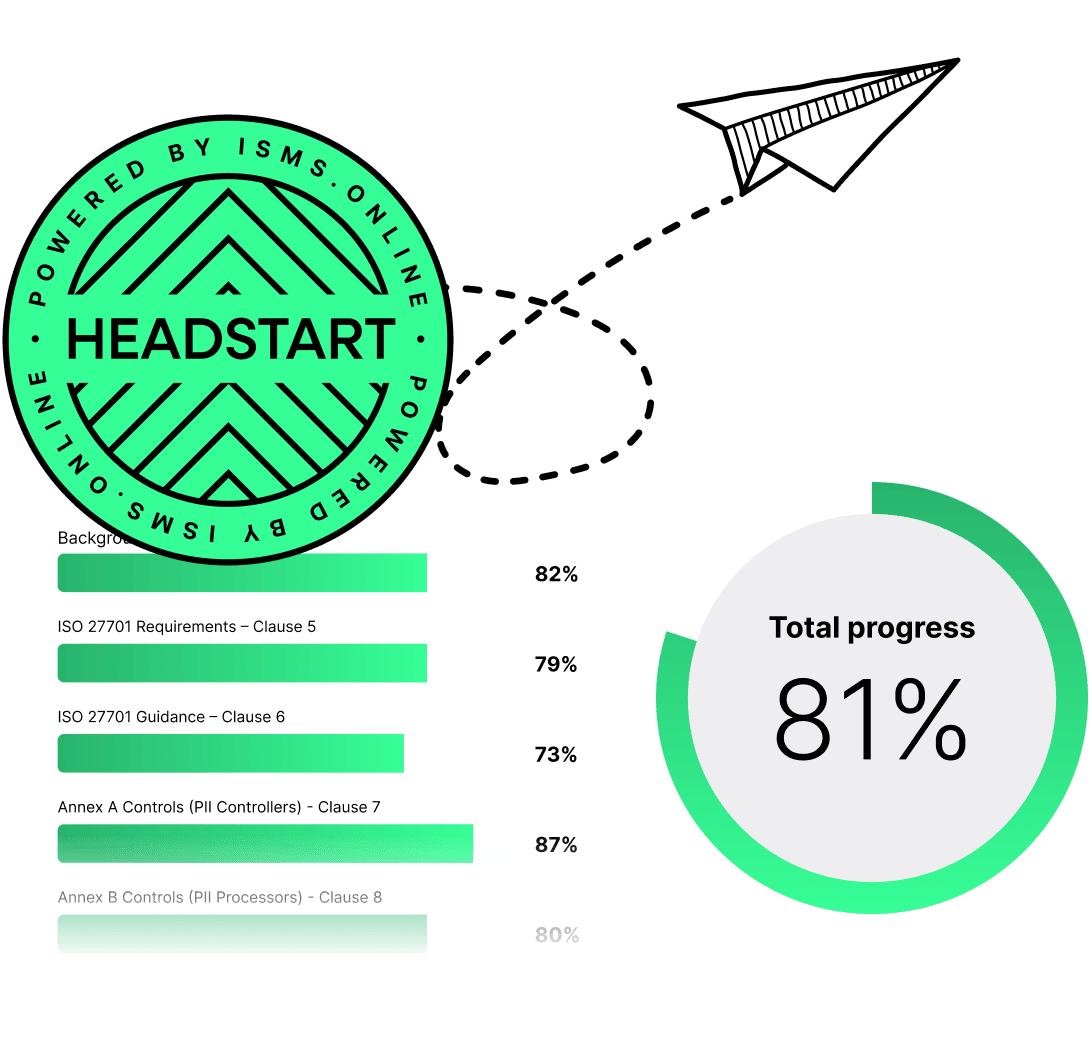
An 81% Headstart from day one
We’ve done the hard work for you, giving you an 81% Headstart from the moment you log on. All you have to do is fill in the blanks.
How Do You Build a Risk Assessment Engine That Actually Delivers?
Instead of ticking off static controls, high-performing organisations shape their ISO 27001:2022 risk assessments around their living business context. Every company faces its own blend of threats and ambitions, so your security risk process must flex to match-adapting to operational shifts, regulatory changes, supply chain moves, staff onboarding, or vendor churn. Including business owners, legal, HR, and privacy leads nearly doubles your chance of catching critical blind spots before auditors do.
Your Modern Risk Cycle-Built for Change, Not Just Compliance
A winning risk assessment system responds to clear, automatic triggers:
- Incident or near-miss: Each event, big or small, resets the clock-your register should capture every alarm bell, not just major breaches.
- Business/process change: New service? Vendor shakeup? Regulatory update? These are the moments when risk morphs quickest.
- Leadership demand: Stakeholders request a pulse-check in the face of business growth or looming regulatory change.
- Regular pulse, at minimum: Even if nothing changes, a quarterly cycle keeps you tuned to emerging threats.
Your business doesn’t freeze for audits; your risk process shouldn’t freeze, either.
Map these triggers as automated reminders, embed them in your workflow, assign clear risk owners, and schedule routine “pulse checks.” Now risk management is an operating rhythm, not a panicked project.
Are Your Tools Holding Back, or Accelerating, Resilience?
Here’s where most teams get stuck: treating risk assessment as a static, once-a-year affair-trapped in spreadsheets, siloed approvals, or dusty SharePoint folders. Auditors are now wary of these models; they look for digital footprints, cross-team workflows, peer challenge, and traceable changes (leapwork.com; csci.co.uk). Why? Because real-life resilience comes from automation plus a risk-aware culture-one that tracks who did what, when, with a living record.
When your risk register is everyone’s living map, you won’t scramble for audit evidence or worry what’s overdue.
Successful organisations harness modern ISMS workflows to:
- Link risks to controls that actually exist:
- Record justifications for every decision, including why some mitigations were rejected
- Capture evidence as you go-no bottlenecks awaiting quarterly uploads
- Invite peer review or C-level signoff, not just “security” as the sole owner
Simulations, “what if” runs, and pre-audit dry runs (as part of this system) can trim remediation costs by 30% or more, sharpening audit readiness even before an external audit looms. When compliance is always “on”, audit success is a byproduct-not a mad dash.

Free yourself from a mountain of spreadsheets
Embed, expand and scale your compliance, without the mess. IO gives you the resilience and confidence to grow securely.
Can Leadership and Culture Turn Risk Assessment Into Competitive Advantage?
Organisations with hands-on leadership-where risk registers are visible to the board throughout the year-experience up to half as many critical incidents as their peers (ec.europa.eu; gartner.co.uk). When you shift from a fear-based or compliance mindset to one of distributed ownership (including execs, middle managers, and the front lines), you get earlier warnings, real transparency, and faster pivots.
Compliance shouldn’t be a secret spreadsheet-it should be a shared source of confidence.
To build this, review risks monthly instead of annually, involve people across all functions, and make it painless for staff to escalate near-misses. Policy Packs, notifications, and visible acknowledgements in ISMS.online turn passive alerts into measurable staff engagement-showing auditors you walk the walk, not just talk the talk (sysgroup.com; ey.com).
Board sign-off on live registers demonstrates assurance, while real-time staff engagement metrics prove to auditors (and stakeholders) that risk isn’t just “managed”-it’s understood and owned.
What Makes a Risk Register Audit-Defensible Under ISO 27001:2022?
It’s not just about listing risks-today’s auditors, regulators, and certifiers demand real-time, linked evidence, clear ownership, and traceable review cycles. A workflow that tracks every risk from identification through mitigation, review, and closure is your best defence when the auditor calls.
Every risk should tell its storey from discovery to closure-without gaps, edits, or missing voices.
A few key ingredients make your register robust:
- Automated logging: Timestamps and owner tags on every entry
- Control linkage: Each item maps directly to the mitigating policy, technical control, or process, along with evidence of board sign-off
- Staff involvement: Every risk review explicitly tracks stakeholder acknowledgements, so you capture who’s aware, who challenged, and what action was taken
- Exportable packs: One-click output for audits-showing the detailed, living workflow, not just a spreadsheet snapshot
Centralising audit documentation and exporting it as a dynamic pack not only saves time but radically reduces stress, as there’s never a last-minute rush for emails or policy sign-offs (unichrone.com; batalas.com).

Manage all your compliance, all in one place
ISMS.online supports over 100 standards and regulations, giving you a single platform for all your compliance needs.
When Should You Trigger a Fresh Risk Review, and How?
Surviving on an annual schedule is obsolete in the post-2022 standard. The real world doesn’t wait for your calendar-so neither should your compliance engine. Each of these events should automatically trigger a risk assessment update (riskledger.com; idgconnect.com):
- Security incident or near-miss: – Immediately review, update, and re-challenge controls.
- Business/process change: – Any operational shift, expansion, or restructure.
- Product/service launch: – Especially those affecting data flows, customer interactions, or external exposure.
- Vendor onboarding/renewal: – All new critical suppliers, platforms, or third-party tools.
- Major regulatory updates: – Moves in GDPR, CCPA, NIS 2, or any cross-border change.
- Quarterly check: – If nothing above, do a pulse review anyway.
Smart platforms automate reminders for each trigger, streamline involvement of the right staff, and precisely log changes and rationale-shrinking remediation by as much as 40%.
Audit-readiness is a habit, not a scramble-capture every trigger and you’re always in control.
How Does ISMS.online Solve the Top Pain Points? (Problem–Feature–Outcome Table)
Many teams know what’s broken but not how to operationalise the fix. Here’s how you transform bottlenecks into a living system using ISMS.online’s modern platform:
| **Problem** | **ISMS.online Feature** | **Outcome** |
|---|---|---|
| Onboarding confusion or “where to start?” | **HeadStart content, Assured Results Method (ARM)** | Stepwise, jargon-free setup, rapid progress, team clarity |
| Evidence scattered or duplicated | **Linked Work, approvals, audit trails** | Everything tied together-single source, no audit anxiety |
| Weak staff buy-in | **Policy Packs, To-dos, notifications** | Measured engagement, transparent accountability |
| Audit defence is slow or inconsistent | **Dynamic documentation, exportable audit packs** | Audits run smoother, responses trusted immediately |
| Scaling to new frameworks is a mess | **Project maps and direct mapping** | Evolve from ISO 27001 to SOC 2/GDPR-no rebuilding required |
A leadership dashboard surfaces risk, owner, controls, and evidence to make audit and board engagements seamless and defensible.
Want an Audit-Defensible, Future-Proof Risk Assessment? Here’s Where You Start.
To unlock compliance as an operational advantage, not a burden, you need a platform that turns Clause 8.2 from a static exercise into a fluid, connected, and living system. With ISMS.online, every risk, action, and control synchronises in real time, every review is logged, and every piece of evidence is audit-ready-before the request comes in. With clear ownership, automated action loops, and measurable engagement from every staff level up to the board, you stop fearing audits-start winning them.
Your certificate is the beginning of real improvement. Make your compliance process a living storey, not a once-a-year footnote.
If you’re ready to be proud of your audit, bring your current risk register, trial a Policy Pack, and discover how ISMS.online makes audit-readiness and resilience ordinary parts of every working day.
Frequently Asked Questions
Why do so many ISO 27001 Clause 8.2 risk assessments fail to stand up in audits?
Most organisations falter on ISO 27001:2022 Clause 8.2 because risk assessments become rote exercises-relying on recycled templates or dated checklists that ignore real, evolving threats to their business. Rushed or box-ticking reviews frequently bypass unique risks introduced by shifts in suppliers, cloud services, or new business models. Auditors increasingly flag these one-size-fits-all assessments: in 2023, nearly 60% of first-time certifications faced delays, extra remediation cycles, or outright denials when evidence failed to link risks to current operations and actual stakeholder concerns (British Standards Institution, 2023).
Underestimating the importance of up-to-date, context-rich assessments leads to late discoveries of gaps-such as missing supply chain threats or overlooked stakeholder input. These issues commonly result in last-minute panic, blowing compliance budgets and undermining trust with executives and customers alike. Audit-ready risk management demands documented cross-functional involvement, transparent scoring, and clear rationale for why each risk is accepted, treated, or deferred. When you treat the risk review as a strategic roadmap, not a bureaucratic chore, you convert compliance from a drag on operations into a driver of business resilience.
Shortcuts in risk assessment only delay hard conversations-audits simply force them, with higher stakes.
How small lapses spiral into audit setbacks
- Excluding finance, HR, or procurement leaves critical risks undetected.
- Outdated registers fail to reflect new projects, acquisitions, or tech use.
- Asset lists and process maps don’t match real business operations.
- Lack of documented rationale invites auditor scepticism and rework.
Where are the invisible risks and blind spots in your ISO 27001 risk assessment?
Hidden vulnerabilities often reside beyond the IT department-inside vendor networks, outsourced service relationships, and unmonitored “shadow IT.” Over the past year, data shows that supply chain compromise, not direct hacking, has become the leading driver of major incidents (ENISA Threat Landscape, 2023). One-off or annual risk reviews routinely miss these shifting attack surfaces, especially as organisations expand through strategic partners, remote teams, or SaaS integrations.
Blind spots fester when risk management is handled in silos: IT may track core infrastructure, but risks in product, operations, or finance go unflagged. Regulators and auditors increasingly identify these “register gaps” as a root cause of late-stage findings and failed remediation. To counteract this, effective organisations use cross-functional teams and living risk registers-mapping threats not just to servers, but to revenue, customer trust, and regulatory drivers. Consistent, event-triggered updates ensure new risks are considered before they escalate to board-level or public concerns.
Risks that escape a risk register aren’t invisible to attackers-they’re just waiting to surface as tomorrow’s incident.
Table: Hidden Risks Often Overlooked
| Risk Type | Typical Oversight | Audit Impact |
|---|---|---|
| Vendor/Supply Chain | Not mapped outside IT or procurement | High-findings drive audit delays |
| Shadow IT | Unregistered SaaS/tools and endpoints | Untracked data, compliance failures |
| Departmental Silos | No input from HR/Finance/Operations | HR/product exposures missed |
| Business Change | No refresh post-M&A/strategy shifts | Evidence outdated, controls eroded |
How do you create a risk assessment approach tailored to your organisation and robust enough for scrutiny?
Start by abandoning generic “best practice” lists-each organisation faces its own threat landscape based on sector, geography, partners, and customer commitments. Auditors expect registers to reflect these specifics, with healthcare mapping both information security and privacy obligations, SaaS firms documenting processor chains, and finance tracking operational resilience under DORA and NIS 2.
Bring together a cross-functional team: legal and privacy to ensure GDPR and regulatory mapping, operations for frontline exposure, HR for insider and training risks, and IT for technology control. Don’t limit updates to the calendar-trigger refreshes anytime new systems, processes, or legal requirements arise. Each risk must connect to tangible business assets, customer contracts, or regulatory drivers, not just “technical” assets. Transparency is key: document your models, values, stakeholders involved, and explain not just the risks found but the decisions made and why.
Well-constructed risk assessments are living documents-upwardly visible to the board, regularly stress-tested, and dynamic enough to accommodate growth or disruption. ISO 27001:2022 Clause 8.2 demands this level of granularity and ownership, turning your risk register into the foundation of all credible compliance and business continuity planning.
Checklist: Elements of a Defensible Risk Assessment
- Risk mapping specific to sector, geography, and business change
- Input and signoff from all relevant business units
- Systematic linkages to privacy (GDPR, ISO 27701) where applicable
- Documented scoring logic and update triggers for new events
- Full auditability and board-facing transparency
What are the advantages of automated, ongoing risk management over spreadsheets and manual logs?
Manual or spreadsheet-based risk logs can’t keep pace with modern compliance standards. Digital platforms track every edit, review, and approval-so ownership is always clear, and no step is forgotten when staff or priorities change. When events such as acquisitions, regulatory updates, or incidents occur, automated systems prompt immediate refreshes, ensuring exposed areas are addressed before they turn into audit findings.
Organisations that leverage automated, peer-reviewed risk registers resolve findings and progress remediation up to 30% faster than those with static, manual approaches (ISMS Benchmark Group, 2024). These platforms enable simulated audit “playbooks,” uncovering process gaps before external scrutiny arrives, and building muscle memory for compliance events. Digital audit trails are valued by regulators and auditors alike, serving as the backbone of defensible, zero-surprise audit outcomes.
Table: Manual Logs vs. Automated Platforms
| Capability | Manual Logs | Automated Systems |
|---|---|---|
| Stakeholder Peer-Review | Difficult | Instant, trackable |
| Event-Triggered Updates | Rare/Manual | Built-in |
| Audit Trail Continuity | Prone to loss | End-to-end, secure |
| Remediation Tracking | Fragmented | Unified, transparent |
Automation is more than a technical upgrade-it’s the difference between scrambling for answers and showing proof at a click.
How do you win board-level trust and make risk management a leadership priority?
ISO 27001:2022 shifts responsibility for risk from compliance teams to the executive level-C-suite and boards must now review, approve, and stand behind the risk register. This top-down accountability is now hardwired in UK/EU governance: directors can no longer plead ignorance when gaps turn into security incidents or regulatory breaches. Publicised board sanctions and FRC guidance have intensified the demand for regular, documented engagement with risk management.
Elevate risk discussions from operationally tactical to strategically vital: tie treatment plans and mitigations directly to business priorities-be it protecting customer contracts, safeguarding intellectual property, or enabling expansion. Organisations where senior leaders regularly review, sign off, and ask meaningful questions not only earn higher auditor trust, but see stronger adoption of controls throughout the business. Empower teams to raise risks early by normalising open discussions and celebrating issue resolution, not just avoidance.
Risk literacy is now a leadership skill-boards that own the process don’t just avoid fines; they underpin business growth and reputation.
Steps to Secure Board Engagement
- Mandate C-suite/board signoff on risk register updates and strategic treatments.
- Schedule focused reviews at set intervals and after major business changes.
- Demonstrate how risk mitigations support growth, resilience, and commercial wins.
- Publicise leadership involvement internally to drive a risk-aware culture.
What forms of evidence impress ISO 27001 Clause 8.2 auditors-and how can you always be audit-ready?
Contemporary audits require real-time evidence: digital risk registers with time-stamped treatments, clear mappings from risk to controls, and visible board or executive signoff. Auditors expect rapid retrieval of “evidence packs”-exports showing who risk owners are, when controls were tested, and outcome traceability right back to the risk review. Gaps or delays in producing this clarity are now a leading cause of costly corrective actions.
ISMS.online is purpose-built for these demands, integrating risk registers with document libraries, automated approval workflows, and live dashboards. When an auditor or regulator calls, you can produce context-rich reports instantly, not scramble through files and emails. Audit readiness isn’t simply the ability to pass-it’s the conviction to defend every control, every treatment, and every business outcome as a deliberate, evidenced decision.
Audit defence is no longer reactionary-when your evidence is live and interconnected, confidence becomes the standard rather than the exception.
What to Supply for Clause 8.2 Audits
- Live, exportable risk registers with event-driven history
- Direct mapping of risks to controls and responsible owners
- Digital signoff trails up to the board and C-suite
- Evidence of regular, not just annual, updates and peer review
- Immediate access to policy documentation and audit logs
If you’re ready to upgrade risk management to a living, leadership-centric system where audits become an opportunity-not a scramble-explore how a unified platform like ISMS.online can help you pass every test, earn stakeholder trust, and future-proof your compliance journey.






