





































What Makes Internal Audit Under ISO 27001:2022 Clause 9.2 a Strategic Lever Instead of a Box-Ticking Exercise?
Many teams approach the internal audit requirement in ISO 27001 as a routine obligation, eager to “just get it done.” The reality? Treating Clause 9.2 as a tick-box activity leaves critical exposures undetected and reduces the audit to a paper shield-one that often fails when clients, auditors, or regulators look closer. An effective internal audit isn’t simply about compliance; it’s a built-in mechanism for resilience, improvement, and executive trust. Clause 9.2 transforms your ISMS from an administrative artefact into a dynamic risk management system-surfacing real control gaps and fuelling continuous improvement (isms.online).
Every undocumented gap in your internal audit becomes an unplanned fire when the stakes are highest.
A superficial audit process lulls organisations into a false sense of security. The real power of Clause 9.2 lies in its ability to animate controls-testing not just policy existence but their real-world execution, sustainability, and cultural uptake. Teams that internalise this shift-making Clause 9.2 an ongoing, candid feedback loop-gain a competitive edge and meet audit days with calm, not chaos.
Moving From Routine Audit to Risk Radar
Successful organisations leverage internal audits as proactive radar: surfacing silent process decay, collecting staff insights, and stress-testing independence. This transforms a policy library into an operational safeguard, reducing audit-day surprises and reinforcing a culture of transparency. If you’ve ever felt a post-audit sigh of relief, only to encounter the same lingering weaknesses months later, Clause 9.2 is the tool to break the cycle. Robust audits become visible proof-points for customers, board members, and external assessors-offering not just reassurance, but measurable value.
Practical Upshot: Compliance Without Burnout
Adopting Clause 9.2 as a living practice (not paperwork theatre) shortens external audit prep times, reduces nonconformities, and increases the return on security investments. Internal audit, managed correctly, shifts the narrative from compliance overhead to value multiplier-and your team earns the recognition of being a genuinely reliable supplier or partner.
Book a demoWhat Are the Risks and Costs of a Superficial Approach to Internal Audit?
Choosing speed over substance in your internal audit can feel efficient-until you review the downstream costs. Skipped findings, vague evidence, and recycled audit responses don’t just risk certification; they create a chain of latent vulnerabilities that often manifest as contract delays, customer distrust, or, in extreme cases, headline breaches (bsi.group; oecd.org).
Minor nonconformities left unaddressed in your audit today become major liabilities in tomorrow’s boardroom.
When audit findings are closed without actionable fixes, or tracking is left to memory and email, several predictable risks emerge:
- Surprises during external audits-fuelled by recurring, unclosed findings.
- Deal blockers from sales or procurement when evidence is lacking.
- Board or regulatory scrutiny linked to repeated minor lapses.
- Reputational impact if audit failure is made public.
Audit Fatigue and Burnout
Repeated audits that find the same issues, or treat symptoms superficially, sap team morale and create “audit fatigue.” In the worst cases, this demoralisation leads to talent attrition just as pressure to prove compliance rises.
Lost Revenue and Delayed Growth
A missed audit finding-such as an unpatched system or an incomplete process handoff-can delay deals, trigger regulatory action, or prompt internal reviews that consume time, budget, and leadership attention. In one real-world fintech example, a missed admin account review escalated from “low risk” to a costly incident, delaying onboarding and damaging client trust.
Board-Level Trust and Stakeholder Confidence
Executives increasingly demand full audit traceability, not just checklists. Clear, evidenced resolution of issues supports investment cases and speeds external audits, while “closed with no action” entries undercut your storey at the exact moment you need to be trusted most.
ISO 27001 made easy
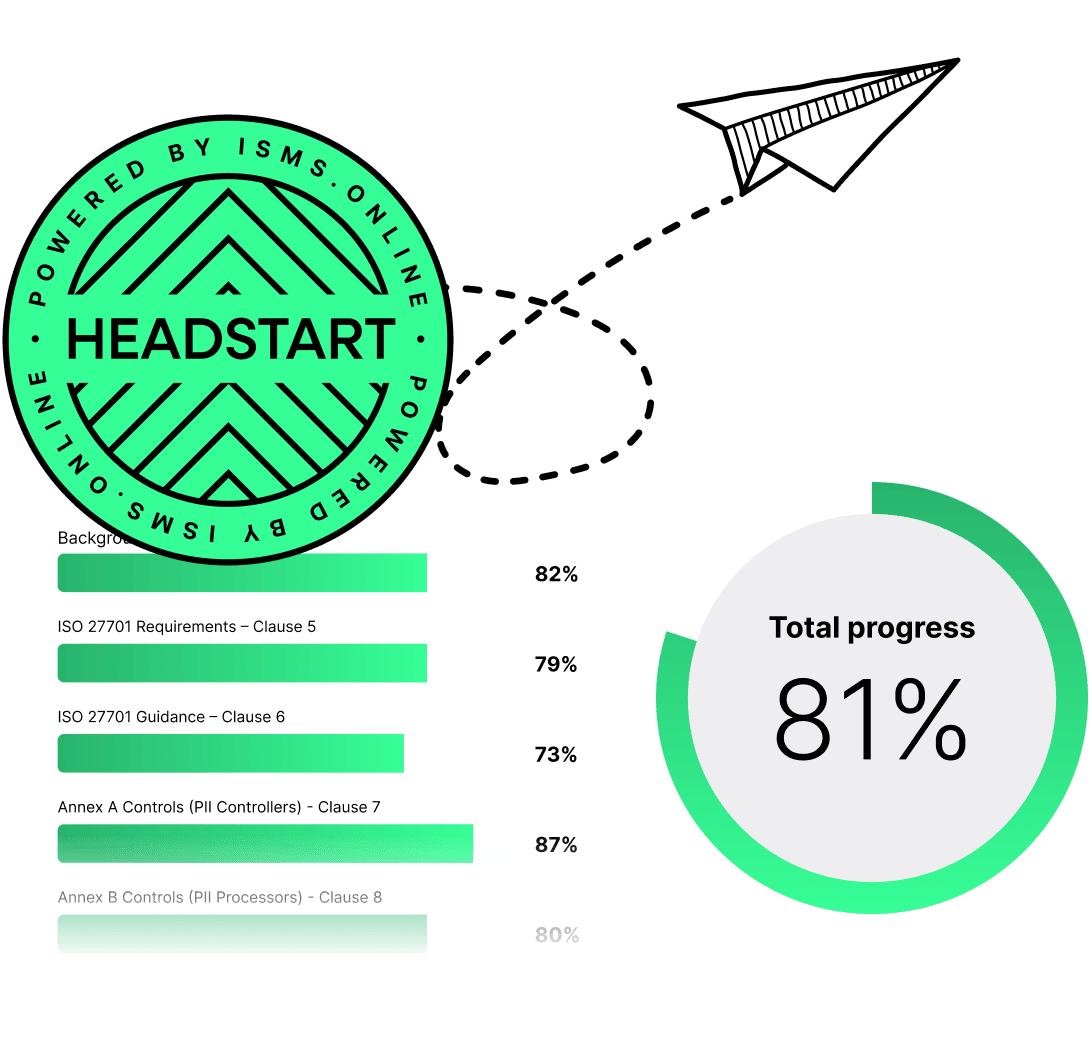
An 81% Headstart from day one
We’ve done the hard work for you, giving you an 81% Headstart from the moment you log on. All you have to do is fill in the blanks.
How Do You Build a Risk-Based Audit Programme That Delivers Real Defensibility?
A risk-based audit programme, as demanded by ISO 27001:2022, places your most critical information assets, processes, and controls under active surveillance-mirroring real-world threats, rapid tech changes, and evolving business priorities. Unlike static, calendar-driven audits, this approach prioritises review where exposure or business value is highest (iso.org; isms.online).
| Audit Method | Calendar-Based Approach | Risk-Based Audit Programme |
|---|---|---|
| Trigger | Fixed interval (e.g., annual) | Threat, business impact, change |
| Ownership | Rotational or generic | Named owner, risk accountability |
| Resource Allocation | Evenly distributed | Focused on high-risk areas |
| Impartiality Check | May conflict with roles | Logged rotation, separation |
| Audit Output | Routine findings | Actionable, risk-aligned fixes |
A living risk-based audit uncovers real threats-before your competitors, auditors, or regulators do.
Essential Steps to Craft a Risk-Based Programme
1. Map Your Audit Universe and Prioritise by Risk
Begin with your ISMS’s Statement of Applicability (SoA), listing all controls and processes. Score each for business and compliance risk, failure history, and threat landscape changes.
2. Assign Owners With Accountability
Each audit must have a designated owner-not a shared inbox or department. Link each audit to a process or risk champion who understands both the domain and the consequences of failure.
3. Enforce Separation of Duties
Never assign an individual to audit their own past work. Implement peer reviews or external spot-checks when in small teams.
4. Document Scope, Criteria, and Rationale
Explicitly state the rationale and scope for each audit-this is essential for both audit trail and board confidence.
5. Plan Corrective Action Follow-Ups
Don’t just log findings; schedule and document corrective reviews to ensure fixes are not just promised but delivered.
A true risk-based audit transforms your ISMS from compliance routine to board-level early warning system.
What Must You Document to Satisfy Clause 9.2 and Future-Proof Your Audit Trail?
Clause 9.2 mandates a specific, traceable audit trail that stands up to both regulator and legal review. Documentation isn’t just about ticking boxes-it’s your evidence when challenged, your record in disputes, and your learning archive for continuous improvement.
Core Audit Documentation Requirements
- Audit plans and risk rationales: Why this area, why now?
- Auditor assignments and proof of independence:
- Detailed findings, evidence, and nonconformity logs:
- Corrective action logs: owner, due date, fix evidence, sign-off
- Management review and follow-up decisions, with timestamps:
A defensible audit tells the storey: what you checked, what you found, what you fixed, and who verified it.
Documentation Depth-How Much Is Enough?
Your audit documentation should enable any future auditor, board member, or regulator to reconstruct what happened, why, and how weaknesses were addressed. If records are ambiguous, rely on email notes, or lack clear evidence of closure, your audit trail is at risk.
The Compounding Cost of Weak Documentation
Thin, inconsistent, or incomplete records make nonconformities more likely in recertification, increase audit remediation time, and can derail compliance-driven deals. Organisations that leave corrective actions undocumented or rely on vague comments (“pending IT fix”) expose themselves to customer, regulatory, and litigation risk.

Free yourself from a mountain of spreadsheets
Embed, expand and scale your compliance, without the mess. IO gives you the resilience and confidence to grow securely.
How Do You Prove Auditor Competence and Impartiality Without Room for Doubt?
Clause 9.2 explicitly demands your internal auditors are competent, independent, and capable of critical scrutiny-not just box-tickers (isms.online; bsi.group).
Demonstrate Auditor Competence
Document auditor names, training records (ISO 27001 certifications, past audits, workshops), and evidence of ongoing skills development. Log peer reviews and process rotation to show skills and independence are sustained over time.
Ensure Independence and Avoid Conflicts
Robust audit logs show:
- No individual audited their prior work.
- Rotations or peer reviews for small teams.
- Approval from an independent reviewer before findings close.
The clearest defence in audit challenge-from certification bodies or your own board-is a log that pairs auditor skills with role separation.
Checklist for Impartial Audit
- Assign auditors to areas they neither own nor influence operationally.
- Where small teams present challenges, demonstrate external checks or peer rotation.
- Document all review hand-offs and sign-offs.
A strong ISMS not only tracks competence but visibly enforces impartiality at every audit stage.
Why Is Evidence Chaining and Corrective Action Tracking the Heartbeat of the Audit Shield?
A finding unlinked to a correction is a risk waiting to compound. Clause 9.2 turns isolated audit results into business improvements only if closure is documented, verified by an independent reviewer, and linked to solid evidence (hightable.io; isms.online).
A complete chain-from finding to closure, with independent validation-is your ironclad evidence when the external audit arrives.
Corrective Action: Not Just a Checkbox, But a Proof Point
Modern audit platforms automate the corrective loop:
- Finding is logged with timestamped, supporting evidence.
- Owner is named and deadline set.
- Correction evidence (policy change, training, system screenshot) is attached.
- Peer sign-off, manager endorsement, and closure snapshot are logged.
Where audits are manual or rely on email, corrections often stall or evaporate-leaving the same issues open for years.
Regulatory and Legal Protection
Well-documented, independently closed audit trails aren’t just for certification-they’re key defence tools in demonstrating diligence to regulators (GDPR, SOC 2), legal teams, or insurers. Failing to close the loop increases exposure, lengthens remediation, and damages reputation in the event of investigation.

Manage all your compliance, all in one place
ISMS.online supports over 100 standards and regulations, giving you a single platform for all your compliance needs.
How Does Audit Integration Across Frameworks Fuel Compliance Without Exhausting Teams?
Compliance teams managing ISO 27001, SOC 2, NIS 2, GDPR, and more frequently burn out from siloed, repeated audits of the same systems. The solution is cross-framework evidence integration: consolidating audit artefacts, assignments, and corrective action into a single, mapped platform (isms.online; bsi.group).
| Model | Disconnected Audits | Integrated Platform (e.g., ISMS.online) |
|---|---|---|
| Evidence Storage | Many files and emails | Unified, mapped to all standards |
| Framework Overlap | Repeat effort for same proof | Single evidence, cross-mapped |
| Tracking Fixes | Manual, prone to error | Automated, closure reminders, linked proof |
| Audit Fatigue | High-duplicate work and confusion | Lowered by shared traction and visibility |
| Board/Auditor View | Fractured, difficult to analyse | Board-ready dashboards; live audit status |
A one-stop audit platform multiplies value-enabling you to meet ISO 27001, SOC 2, and GDPR without chasing your tail.
Strategies to Sustain Pace Without Sacrificing Quality
- Balance audit assignments, rotating logic to prevent bottlenecks and fatigue.
- Deploy dashboards for audit status, overdue actions, and cross-framework mapping.
- Regularly schedule retrospectives to free up resources and pinpoint friction points.
Teams that connect their audit cycles relieve burnout, dodge repeated work, and signal maturity to regulators and customers alike.
Achieving Real Audit Confidence: Start with ISMS.online
Getting your internal audit right is more than passing an external assessment-it’s the day-to-day driver of trust, security, and business growth. ISMS.online is built to make this not just possible, but practical at any stage of your compliance lifecycle. By centralising audit scheduling, enabling truly independent assignments, digitising evidence trails, and automating the loop from finding to remediation, ISMS.online supports both newcomers and seasoned security leaders (isms.online).
True audit confidence is built in the months before assessment, not on the day itself.
Whether your challenge is proving audit closure to your board, unblocking procurement deals, or aligning with regulations across geographies, ISMS.online gives your team the single source of audit truth, board-ready dashboards, and operational peace of mind that powers revenue and reputation.
Begin with a risk-free audit readiness check, explore interactive templates, or sync with our platform for a real-world demonstration of how integrated, evidence-driven audit transforms compliance from an annual scramble to a live business asset. Your first closed-loop audit cycle could mark your team as leaders in both compliance and resilience. Find out how to turn audit from a burden into your team’s most persuasive competitive advantage.
Frequently Asked Questions
Who is eligible to perform ISO 27001:2022 internal audits, and what guarantees true audit independence?
Anyone acting as an ISO 27001:2022 internal auditor must be qualified, impartial, and totally independent from the processes they examine, so the board and external certifiers can trust the results without hesitation.
To comply, you must select auditors with clear knowledge of information security, ISO 27001 requirements, and proven audit skills-often referenced through ISO 19011 or documented experience. Independence is not a minor detail: it means an auditor cannot assess any part of the ISMS in which they hold operational responsibility, whether that’s a system they’re maintaining or a process they designed. In practice, larger organisations rotate auditors across teams or use separate internal audit functions; smaller organisations might use peer audits or bring in an external consultant when internal objectivity cannot be assured. Whenever you assign auditors, always explicitly record their independence in relation to each audit’s scope. External assessors routinely challenge even indirect conflicts (like rotating IT managers auditing alternate years). This commitment to independence builds board trust and withstands regulatory scrutiny, reinforcing that your ISMS is more than a box-ticking exercise.
Internal Audit Independence: Who Can Audit What?
| Auditor Scenario | Eligible? | Why/Why Not |
|---|---|---|
| Peer from a separate function | ✓ | Objectivity, fresh perspective, no ownership of the process |
| Owner/operator of the process | ✗ | Direct conflict, lacks independence |
| Manager recently reassigned | ✗ | Risk of residual bias, need separation period |
| External impartial provider | ✓ | Professional detachment, special expertise |
An ISMS audit is only as credible as its auditors’ independence-never let convenience erode trust.
References: (https://www.bsigroup.com/en-GB/iso-27001-information-security/iso-27001-resources/iso-27001-faqs/), (https://www.iso.org/obp/ui/#iso:std:iso-iec:27001:ed-3:v1:en), (https://www.isms.online/iso-27001/internal-audit/)
What documentation and evidence are needed to prove Clause 9.2 (internal audit) compliance in ISO 27001:2022?
Clause 9.2 compliance is achieved-and proven-when you can produce a transparent record: an audit programme, documented risk-based planning, assignment and independence logs, evidence-gathering records, findings, and tracked corrective actions, all joined by clear ownership and timestamps.
This means keeping a current audit programme (calendar and plan), checklists or working papers for each audit, auditor competence and independence declarations, findings reports (including positive results and nonconformities), and a register tracing every improvement from root cause to resolution. Each action should have an identified owner, a target deadline, and supporting evidence, with final sign-off by someone other than the finder. All records should be organised and readily available for management review and for external auditors upon request. Boards increasingly expect dashboards summarising audit progress, closure rate, and risk alignment-evidence of living, breathing assurance rather than just an annual event.
Complete Audit Evidence Journey
| Stage | What to Document/Store |
|---|---|
| Plan | Audit programme, scope, rationale, named auditors |
| Prepare | Criteria, checklists, documentation requests, SoA mapping |
| Execute | Interview notes, evidence logs, draught findings |
| Report | Findings/nonconformities, independence proof, competence records |
| Act | Corrective action logs, follow-up, owner, closure, evidence |
| Review | Management review minutes, board summaries |
For a detailed breakdown, see (https://iso27001.com/iso-27001-clause-9-2-internal-audit/), (https://www.bsigroup.com/en-GB/iso-27001-information-security/iso-27001-resources/iso-27001-faqs/).
What common mistakes lead to ISO 27001 Clause 9.2 audit failures, and how do high-performing teams avoid them?
Three traps threaten Clause 9.2: assigning auditors with a conflict of interest, skipping documented audit trails, and underinvesting in auditor skills-each one risking certification and organisational trust.
A frequent misstep is assigning process owners or their direct reports as auditors, which immediately fails the independence test. Another is focusing only on “ticking boxes,” missing root causes or failing to document how findings lead to improvement. Many teams also overlook the importance of linking audit schedules to risk-sticking to flat calendars when risks have shifted. High-performing teams cultivate a strong audit loop by rotating audit assignments, upskilling every auditor, publicly logging all findings and improvements, and embedding audits into regular management review cycles. They use dashboards not only for reporting but as early warnings for upcoming risks or overdue corrective actions, surfacing problems before they can impact operations. Boards trust a system that closes every loop and proves improvements-failure to do so invites scrutiny.
Ignored gaps in audit trails or independence aren’t trivial-they’re the first thing a good external auditor will spot.
Explore more: ISMS.online’s common audit mistakes, (https://hightable.io/iso-27001-clause-9-2-internal-audit/).
How do you develop a risk-based audit programme that satisfies external auditors and strengthens board oversight?
A genuine risk-based audit programme prioritises reviews by the threat landscape, recent incidents, control effectiveness, and historical audit outcomes-not just by the calendar-building confidence at every level, from boardroom to audit trail.
To implement this, evaluate your Statement of Applicability alongside your risk register, rating controls not just by regulatory coverage but by threat likelihood, risk impact, and change velocity. Audit high-risk and high-change areas more frequently, and adjust schedules when incidents occur or assets change. Document the rationale for every decision-why some controls are examined quarterly versus annually, for example. Assign owners for planning, execution, and each corrective action, making sure these responsibilities are visible and understood throughout the business. Boards increasingly ask to see clear risk-to-audit logic, with dashboards connecting planned reviews, open findings, and closure rates for each significant risk.
Risk-Driven vs. Calendar-Driven Audit Programmes
| Approach | Method/Outcome |
|---|---|
| Calendar-based audits | Fixed annual/quarterly cycles, scope rarely shifts |
| Risk-based audits | Frequency tied to risk profile, scope adapts |
| Board impact | Stagnant assurance vs. living, risk-centric view |
| Ownership clarity | Generic or missing vs. documented, accountable |
Recommended: (https://www.iso.org/obp/ui/#iso:std:iso-iec:27001:ed-3:v1:en), Corporate Compliance Insights Risk-Based Internal Audits
Which technologies and frameworks streamline ISO 27001 audits alongside SOC2, GDPR, and NIS2, and address audit fatigue?
Modern integrated audit platforms-like ISMS.online-reduce effort and audit burnout by unifying evidence, mapping audit actions across frameworks (ISO 27001, SOC2, GDPR, NIS2, DORA), and providing real-time dashboards that make ownership and progress visible for every stakeholder.
Relying on spreadsheets for audit management quickly devolves into lost information, duplicated evidence requests, and deadline-pressure-induced stress, especially as frameworks multiply and expectations rise. Digital ISMS tools enable you to tag and cross-reference evidence, deliver audit actions tied to multiple frameworks at once, automate reminders, and protect ownership through role-based access. This means redundant work is reduced, progress becomes transparent across teams, and managers can focus on resolving real gaps rather than chasing paperwork. Audit dashboards reflect live status to staff, execs, and boards, helping shift the audit loop from reactive compliance to continuous improvement and trusted assurance.
Benefits: Standalone Audit vs. Integrated Platform
| Standalone Audit (Manual) | Integrated ISMS Audit Platform |
|---|---|
| Spreadsheet sprawl | Single system, mapped across frameworks |
| Manual reminders, tracking | Automation; no more missed deadlines |
| Fog on progress | Real-time dashboards; see gaps instantly |
| Audit fatigue | Ownership clarity; less last-minute stress |
See: (https://www.isms.online/iso-27001/internal-audit/), (https://www.g2.com/categories/governance-risk-compliance), (https://www.datadoghq.com/blog/iso-27001-internal-audit-framework-integration/)
What are the steps to close nonconformities properly so your ISO 27001 audit stands up to scrutiny and drives real improvement?
Every nonconformity should be followed by a corrective action assigned to someone outside the original process, traced step-by-step from finding through to independent closure-with supporting evidence, dates, and reviewer sign-off to stand up under board or auditor inspection.
Log each finding with an explicit action plan, clear owner, and closure deadline. Always require that the correction be verified and closed by someone other than the person who found the issue-that separation is central to credibility. Use tools or dashboards to highlight overdue actions or repeat nonconformities, and escalate unresolved items to management review for board visibility. Boards, auditors, and regulators are increasingly looking for proof that nonconformity handling is more than a paper process-it must be visible, structured, and reviewed, demonstrating both improvement and resilience at every step.
Every documented finding is a chance to build trust-with staff, leadership, and the auditor who’ll test your ISMS when it matters most.
References: (https://hightable.io/iso-27001-clause-9-2-internal-audit/), AuditBoard’s Internal Audit Steps, (https://iso27001.com/iso-27001-clause-9-2-internal-audit/)






