





































Understanding the Role of the Statement of Applicability in ISO 27001 Compliance
The Statement of Applicability (SoA) is a critical document within the ISO 27001:2022 standard, serving as a comprehensive guide to the security controls an organisation implements. It acts as a vital link between risk assessment and control implementation, ensuring that both regulatory requirements and business objectives are met (ISO 27001:2022 Clause 5.5).
Defining the Statement of Applicability
The SoA is more than a compliance formality; it is a strategic asset that outlines the security controls chosen based on risk treatment plans. By aligning with business goals, the SoA not only enhances information security management but also builds stakeholder confidence, showcasing a commitment to robust security practices.
The Importance of the SoA in ISO 27001 Compliance
The SoA is indispensable in demonstrating adherence to ISO 27001 standards. It offers a detailed overview of the control implementation status, justifying each control’s relevance to the organisation’s risk profile. This transparency is crucial for achieving certification and maintaining audit readiness.
Integrating the SoA into the Compliance Framework
The SoA complements other ISO 27001 documents, such as risk assessments and control implementation plans. It ensures that all security measures are documented, justified, and aligned with the organisation’s risk management strategy.
Essential Components of the SoA
A well-structured SoA includes:
- Control Selection: Based on risk treatment plans.
- Justification: Reasons for control inclusion or exclusion.
- Implementation Status: Indicates if controls are implemented, partially implemented, or not implemented.
- Continuous Improvement: Regular updates to reflect changes in the risk environment.
Advantages of a Comprehensive SoA
Organisations have reported a significant reduction in security incidents post-certification, underscoring the effectiveness of a comprehensive SoA. With over 40,000 organisations worldwide ISO 27001 certified as of 2022, the SoA's role in enhancing compliance and risk management is undeniable. A well-crafted SoA is essential for aligning security controls with organisational risks.
Explore how to create an effective SoA that aligns with your organisation's objectives and enhances your information security management.
Book a demoUnderstanding ISO 27001:2022 Requirements
Core Requirements of ISO 27001:2022
ISO 27001:2022 sets the foundation for developing a robust Information Security Management System (ISMS). The key components include:
- Risk Assessment: This involves identifying and evaluating security risks to determine necessary controls, as outlined in Clause 5.3.
- Control Selection: Choosing appropriate security measures based on risk treatment plans, ensuring alignment with Clause 5.5.
- Continuous Improvement: Regularly updating security practices to address evolving threats, as emphasised in Clause 10.2.
Impact on the Statement of Applicability (SoA)
These requirements directly shape the Statement of Applicability (SoA) by defining essential security controls for mitigating identified risks. The SoA becomes a strategic document that aligns with your organisation’s risk profile and security objectives. Understanding these requirements allows you to tailor the SoA to meet both regulatory demands and business goals, enhancing audit readiness and stakeholder confidence.
Importance of Understanding These Requirements
A thorough grasp of ISO 27001:2022 requirements is crucial for crafting an SoA that accurately reflects your organisation’s security measures. This understanding ensures your SoA is comprehensive, aligning with current best practices in information security management. Achieving and maintaining ISO 27001 compliance safeguards your organisation’s information assets and enhances its security posture.
Key Updates in the 2022 Version
The 2022 update introduces significant changes, such as a stronger focus on cybersecurity integration and a streamlined approach to risk management. These updates necessitate a thorough review of your SoA to ensure it aligns with the latest standards and effectively addresses new security challenges.
Aligning your SoA with ISO 27001:2022 requirements positions your organisation to meet compliance standards while enhancing overall security. Embrace these updates to fortify your information security framework and drive continuous improvement.
ISO 27001 made easy
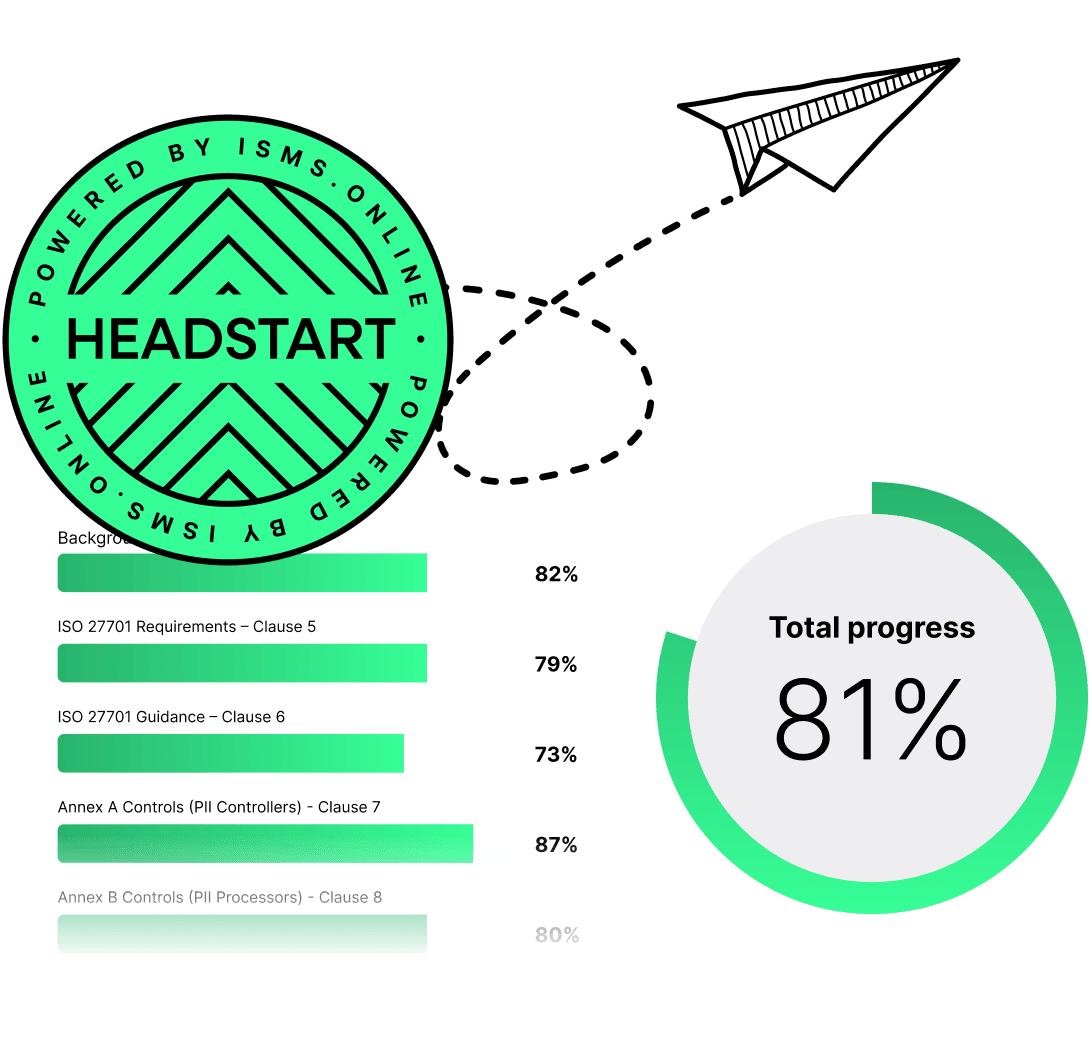
An 81% Headstart from day one
We’ve done the hard work for you, giving you an 81% Headstart from the moment you log on. All you have to do is fill in the blanks.
Conducting a Risk Assessment for ISO 27001
Crafting a Robust Risk Assessment
Embarking on a risk assessment for ISO 27001 is a strategic endeavour that lays the foundation for a comprehensive Statement of Applicability (SoA). This process involves identifying potential threats and vulnerabilities, ensuring they are addressed through appropriate controls. A well-executed risk assessment informs control selection, enhancing information security management.
Strategic Importance of Risk Assessment
Risk assessments are integral to SoA creation, identifying and evaluating information security risks. This process ensures that selected controls align with your organisation’s risk profile and security objectives. By conducting thorough risk assessments, you can select appropriate controls for your SoA, enhancing compliance and audit readiness.
Achieving Comprehensive Risk Assessment
To achieve a comprehensive risk assessment, organisations should utilise established tools and methodologies. Frameworks such as ISO 27005 provide guidelines for risk management. By employing these tools, organisations achieve accuracy and completeness in their assessments, facilitating effective control selection and implementation.
Tools and Methodologies for Risk Assessment
Several tools and methodologies support risk assessment for ISO 27001:
- ISO 27005 Framework: Offers guidelines for risk management.
- Risk Assessment Software: Automates the identification and evaluation of risks.
- Qualitative and Quantitative Methods: Provide different perspectives on risk evaluation.
Linking Risk Assessment and Control Selection
The connection between risk assessment and control selection is vital for effective information security management. By identifying potential threats and vulnerabilities, organisations can select controls that address these risks, ensuring a robust security posture. This alignment between risk assessment and control selection is essential for creating an effective SoA and achieving ISO 27001 compliance.
Incorporating these practices into your risk assessment process will enhance your organisation’s ability to manage information security risks effectively. Take the next step in strengthening your security framework by utilising our platform’s comprehensive tools and resources.
Selecting Appropriate Controls for ISO 27001 Compliance
Criteria for Control Selection in the SoA
Selecting the right controls is crucial for mitigating risks and achieving ISO 27001 compliance. Begin by aligning controls with risk assessment findings to address specific vulnerabilities. Consider these criteria:
- Risk Assessment Alignment: Ensure controls directly mitigate identified risks (ISO 27001:2022 Clause 5.3).
- Organisational Objectives: Align controls with your business goals to support strategic priorities.
- Effectiveness and Efficiency: Evaluate the risk mitigation effectiveness and cost-efficiency of controls.
Determining Necessary Controls
To determine necessary controls, evaluate the risk environment and consider both internal and external factors:
- Risk Treatment Plans: Guide control selection, ensuring each control is justified and relevant (Clause 5.5).
- Stakeholder Input: Engage stakeholders to understand business needs and regulatory requirements.
- Continuous Monitoring: Regularly review control effectiveness and adapt to evolving risks.
Importance of Aligning Control Selection with Risk Assessment
Aligning control selection with risk assessment findings ensures targeted and effective security measures:
- Enhances Security Posture: Addressing specific risks strengthens your overall security framework.
- Facilitates Compliance: Demonstrates adherence to ISO 27001 standards, supporting audit readiness and certification.
Overcoming Challenges in Control Selection
Organisations often face challenges like balancing security needs with budget constraints. Address these by:
- Prioritising High-Risk Areas: Focus resources on controls that address significant risks.
- Utilising Technology: Leverage tools like ISMS.online to streamline control selection and management.
By aligning controls with risk assessment findings and organisational objectives, you can enhance your security posture and achieve ISO 27001 compliance.

Free yourself from a mountain of spreadsheets
Embed, expand and scale your compliance, without the mess. IO gives you the resilience and confidence to grow securely.
Documenting the Statement of Applicability (SoA)
Crafting a Comprehensive SoA
Creating a well-documented Statement of Applicability (SoA) is essential for ISO 27001:2022 compliance. This document serves as a blueprint for implementing security controls, ensuring transparency and accountability. The SoA should include:
- Control Identifiers: Assign unique labels to each control for straightforward identification.
- Descriptions: Clearly articulate the purpose and scope of each control.
- Implementation Status: Indicate whether controls are fully operational, partially in place, or pending.
- Justifications: Provide detailed reasons for the inclusion or exclusion of specific controls.
Key Elements of SoA Documentation
Precise documentation is vital for maintaining a dynamic and relevant SoA. Essential elements include:
- Routine Evaluations: Conduct regular assessments to ensure alignment with current security practices.
- Timely Updates: Reflect changes in the Information Security Management System (ISMS) to address new threats (ISO 27001:2022 Clause 5.5).
- Collaborative Input: Engage stakeholders to ensure the SoA supports organisational goals.
Importance of Clear and Concise Documentation
Clear documentation is indispensable for audit readiness and compliance. It simplifies navigation and comprehension, minimising the risk of misinterpretation. By maintaining clarity, organisations can effectively demonstrate their dedication to information security.
Ensuring Effective SoA Documentation
To ensure the SoA documentation is effective, organisations should:
- Embrace Technology: Utilise platforms like ISMS.online to streamline documentation processes.
- Implement Best Practices: Follow industry standards and guidelines for consistency.
- Commit to Continuous Improvement: Regularly update the SoA to reflect changes in the risk environment and business objectives.
By adopting these strategies, organisations can strengthen their security posture and achieve ISO 27001 compliance.
Justifying Control Selections in the Statement of Applicability
The Critical Role of Justification in the SoA
Justifying control selections within the Statement of Applicability (SoA) is essential for demonstrating compliance with the ISO 27001 standard. Each control must align with your organisation’s objectives and risk assessment findings, providing a transparent rationale for its inclusion or exclusion. This clarity not only supports audit readiness but also enhances stakeholder confidence in your security measures.
Strategies for Effective Justification
To effectively justify control selections, consider these strategies:
- Articulate Clear Rationales: Clearly explain the reasons for each control’s inclusion or exclusion, linking them to specific risks and objectives.
- Document Decision-Making Processes: Maintain comprehensive records of decision-making, including stakeholder input and risk assessment findings.
- Provide Evidence of Effectiveness: Support justifications with evidence of control effectiveness, such as past performance data or industry benchmarks.
Addressing Common Challenges
Organisations often encounter challenges such as:
- Aligning Controls with Risks: Ensuring selected controls address identified risks can be complex.
- Balancing Security Needs with Resources: Finding the right balance between security measures and available resources is a common hurdle.
Solutions for Overcoming Challenges
To overcome these challenges:
- Align with Risk Assessment Findings: Use risk assessment results to guide control selection, ensuring alignment with organisational risks (ISO 27001:2022 Clause 5.5).
- Engage Stakeholders: Involve stakeholders in the justification process to ensure controls meet business needs and regulatory requirements.
- Utilise Technology: Employ platforms like ISMS.online to streamline the justification process and maintain comprehensive documentation.
By adopting these strategies, your organisation can effectively justify control selections, enhancing compliance and security posture. Strengthen your information security framework by utilising our platform’s tools and resources to support your compliance journey.

Manage all your compliance, all in one place
ISMS.online supports over 100 standards and regulations, giving you a single platform for all your compliance needs.
Maintaining and Updating the Statement of Applicability (SoA)
Frequency of Updates
Regularly updating your Statement of Applicability (SoA) is crucial for keeping pace with organisational changes and emerging threats. The timing of these updates should align with significant shifts in your risk environment or business objectives. This proactive strategy ensures your SoA remains a responsive and relevant document, ready to tackle new challenges.
Key Considerations for Updates
When revising your SoA, focus on these critical factors:
- Strategic Alignment: Ensure controls support your business goals.
- Regulatory Compliance: Stay informed about changes in compliance requirements.
- Risk Evaluation: Continuously assess risks to identify necessary control adjustments.
Significance of an Updated SoA
An up-to-date SoA is vital for demonstrating compliance with the ISO 27001 standard. It ensures that your controls are effective in mitigating risks, thereby strengthening your organisation’s security posture. By keeping your SoA current, you not only meet regulatory demands but also bolster stakeholder confidence in your security measures.
Ensuring SoA Relevance
To maintain the relevance of your SoA, integrate continuous improvement practices. Regularly review and update the document to reflect changes in your risk landscape and business objectives. Utilising platforms like ISMS.online can streamline this process, providing tools and resources to manage updates efficiently.
Keeping your SoA current is not just about compliance; it’s about safeguarding your organisation’s future. By aligning your SoA with evolving threats and business needs, you position your organisation for sustained success in the ever-changing realm of information security.
Further Reading
Overcoming Challenges in Creating a Statement of Applicability
Crafting a Statement of Applicability (SoA) for ISO 27001 compliance presents a unique set of challenges. Balancing comprehensive detail with clarity, while ensuring alignment with business objectives, requires strategic foresight. However, with proactive management and the strategic use of platforms like ISMS.online, this process becomes more manageable.
Common Challenges in Creating an SoA
- Detail vs. Clarity: Achieving the right balance between thoroughness and simplicity is crucial.
- Alignment with Objectives: Ensuring the SoA aligns with regulatory requirements and business goals can be intricate.
- Resource Constraints: Limited resources often impede the effective implementation of controls.
Strategies to Overcome Challenges
- Embrace Technology: Platforms like ISMS.online provide guidance and support, streamlining the SoA creation process.
- Engage Stakeholders: Involving key stakeholders ensures that the SoA aligns with organisational objectives and regulatory demands.
- Regular Reviews: Periodically assess and update the SoA to reflect changes in the risk environment and business needs.
Importance of Proactive Management
Addressing challenges proactively ensures that the SoA remains a valuable tool for information security management. By anticipating potential obstacles and implementing solutions early, organisations can maintain compliance and enhance their security posture.
Role of ISMS.online in Overcoming Challenges
ISMS.online offers a comprehensive platform that simplifies the SoA creation process. Its features facilitate stakeholder engagement, continuous monitoring, and alignment with business objectives, ensuring a robust and compliant SoA.
By addressing these challenges proactively and using the right tools, your organisation can create an effective SoA that aligns with ISO 27001 compliance and supports your information security management goals. Enhance your compliance journey with ISMS.online’s expert guidance and resources.
Best Practices for Creating a Statement of Applicability (SoA)
Crafting an Effective SoA
Creating a Statement of Applicability (SoA) that aligns with ISO 27001 compliance involves strategic alignment with business objectives and risk management strategies. By integrating these elements, your organisation can ensure the SoA remains a dynamic document that addresses security risks and compliance requirements effectively.
Implementing Strategic Practices
To implement these practices, a deep understanding of ISO 27001 requirements and your organisation’s risk management strategies is essential. Consider the following:
- Align with Business Goals: Ensure the SoA supports strategic priorities and enhances your security posture.
- Continuous Evaluation: Regularly assess the SoA to reflect changes in the risk environment and organisational needs.
- Embrace Automation: Utilise platforms like ISMS.online to streamline the SoA creation process and maintain consistency.
The Role of Best Practices
Adhering to best practices in SoA creation is crucial for maintaining compliance and enhancing information security management. This approach ensures the SoA evolves with your organisation’s needs and regulatory requirements. By following these practices, you demonstrate a commitment to robust security measures and build stakeholder confidence.
Support from ISMS.online
Our platform, ISMS.online, offers comprehensive support for implementing best practices in SoA creation. With features designed to streamline documentation, automate updates, and facilitate stakeholder engagement, ISMS.online ensures your SoA aligns with ISO 27001 standards and enhances your security framework.
Embrace these best practices to fortify your information security management and achieve ISO 27001 compliance. Discover how ISMS.online can support your compliance journey and elevate your organisation’s security posture.
What Tools and Resources Are Available for ISO 27001 Compliance?
Navigating the complexities of ISO 27001 compliance requires the right tools and resources to enhance both efficiency and security management. Our platform, ISMS.online, offers a comprehensive suite of solutions tailored to simplify compliance efforts and align with best practices.
Essential Tools for Compliance Management
Effective compliance management hinges on utilising the right tools:
- Automation Platforms: These streamline documentation and reporting, reducing manual effort and increasing accuracy.
- Risk Assessment Tools: Essential for identifying and evaluating potential security risks, ensuring appropriate controls are implemented.
- Policy Management Systems: Centralise policy creation and updates, maintaining consistency across the organisation.
Maximising the Use of Compliance Tools
Organisations can significantly boost their compliance efforts by strategically deploying these tools:
- SoA Creation: Platforms like ISMS.online automate the creation and maintenance of the Statement of Applicability (SoA), ensuring alignment with ISO 27001 requirements (Clause 5.5).
- Continuous Monitoring: Implement tools that provide real-time insights into security posture, enabling proactive risk management.
The Value of Utilising Available Resources
The significance of these tools lies in their ability to enhance efficiency and effectiveness in compliance efforts. By automating routine tasks and providing actionable insights, organisations can focus on strategic initiatives and improve their overall security framework.
ISMS.online: Your Partner in Compliance
Our platform offers a range of tools designed to support ISO 27001 compliance:
- Integrated Compliance Management: Streamline processes with our all-in-one platform, reducing complexity and ensuring consistency.
- Customizable Templates and Checklists: Access resources that simplify documentation and audit preparation, enhancing readiness and confidence.
By embracing these tools and resources, your organisation can achieve ISO 27001 compliance more efficiently, strengthening your information security management system and building stakeholder trust. Discover how ISMS.online can support your compliance journey and elevate your security posture.
The Role of the Statement of Applicability in ISO 27001 Audits
The Significance of the SoA in ISO 27001 Audits
The Statement of Applicability (SoA) is a cornerstone in ISO 27001 audits, serving as a definitive proof of compliance and the effective deployment of security controls. It reflects your organisation’s dedication to safeguarding information, aligning seamlessly with the Information Security Management System (ISMS) framework. A meticulously crafted SoA not only adheres to the ISO 27001 standard but also bolsters auditor confidence, paving the way for successful audit outcomes.
Preparing Your SoA for Audit Success
To ensure your SoA is audit-ready, focus on precise documentation that mirrors your ISMS and control framework. Key steps include:
- Thorough Documentation: Clearly document all controls, providing justifications for their inclusion or exclusion.
- Regular Updates: Keep the SoA current by integrating changes in the risk environment and business objectives (ISO 27001:2022 Clause 5.5).
- Stakeholder Involvement: Engage relevant stakeholders to ensure the SoA aligns with organisational goals and regulatory mandates.
The Importance of a Well-Prepared SoA
A well-prepared SoA is vital for audit success. It offers a comprehensive map of your security controls, aiding auditor comprehension and minimising the risk of non-conformities. By aligning the SoA with your organisation’s risk management strategy, you enhance your security posture and demonstrate a proactive stance on compliance.
How ISMS.online Can Enhance Audit Preparation
Our platform, ISMS.online, provides robust support in preparing your SoA for audits. We streamline the documentation process, ensuring your SoA meets audit requirements and aligns with ISO 27001 standards. With features designed to facilitate stakeholder engagement and continuous monitoring, ISMS.online empowers your organisation to achieve audit readiness and maintain compliance effortlessly.
Elevate your audit preparation with ISMS.online, ensuring your SoA is a robust reflection of your commitment to information security.
Why Book a Demo with ISMS.online?
Discover the Benefits
Booking a demo with ISMS.online offers your organisation a strategic edge, equipping you with the tools necessary to enhance compliance efforts. Our platform is meticulously designed to streamline the creation of a Statement of Applicability (SoA), aligning seamlessly with ISO 27001:2022 requirements.
Key Features of ISMS.online
- Efficient SoA Development: Our intuitive templates and automated processes simplify SoA creation, ensuring alignment with Clause 5.5.
- Comprehensive Risk Tools: Accurately identify and assess security risks, ensuring your controls are both effective and efficient.
- Centralised Policy Management: Seamlessly manage your policy creation and updates, maintaining consistency and compliance across your organisation.
How ISMS.online Supports Compliance
Our platform provides robust support throughout your compliance journey, offering features that facilitate continuous improvement and audit readiness. With ISMS.online, you can:
- Enhance Audit Preparedness: Keep your SoA current with real-time insights and automated updates.
- Foster Stakeholder Collaboration: Streamline communication and documentation with tools designed for engagement.
Why Consider a Demo?
A demo with ISMS.online is more than an introduction; it's a strategic step towards achieving ISO 27001 compliance. Experience firsthand how our solutions can align with your business objectives, streamline processes, and enhance your security posture.
Unlock the potential of ISMS.online to revolutionise your compliance strategy. Schedule a demo today and take the first step towards a more secure and compliant future.
Book a demoFrequently Asked Questions
Understanding the Purpose of the Statement of Applicability
The Statement of Applicability (SoA) is a cornerstone in the ISO 27001 framework, acting as a comprehensive guide to the security controls pertinent to an organisation. It serves as a bridge between risk assessment and control implementation, ensuring alignment with both regulatory requirements and business objectives.
What is the Statement of Applicability?
The SoA outlines the security controls chosen based on risk treatment plans. It transcends being a mere compliance requirement, functioning as a strategic tool that enhances information security management. By aligning with business goals, the SoA fosters stakeholder confidence and demonstrates a commitment to robust security practices.
Why is the SoA Important for ISO 27001 Compliance?
In the compliance process, the SoA is indispensable for demonstrating adherence to ISO 27001 standards. It provides a comprehensive overview of control implementation status, justifying each control’s relevance to the organisation’s risk profile. This transparency is key to achieving certification and maintaining audit readiness.
How Does the SoA Fit into the Compliance Framework?
The SoA complements other ISO 27001 documents, such as risk assessments and control implementation plans. It ensures that all security measures are documented, justified, and aligned with the organisation’s risk management strategy.
Key Elements and Structure of the SoA
A well-crafted SoA includes:
– Control Identification: Details controls based on risk treatment strategies.
– Rationale: Offers insights into the necessity of each control.
– Implementation Status: Clarifies whether controls are fully operational, partially in place, or pending.
– Continuous Enhancement: Adapts to reflect changes in the risk environment.
Benefits of a Comprehensive SoA
Organisations report a 30% reduction in security incidents post-certification, underscoring the effectiveness of a comprehensive SoA. With over 40,000 organisations worldwide ISO 27001 certified as of 2022, the SoA’s role in enhancing compliance and risk management is undeniable. A well-crafted SoA is essential for aligning security controls with organisational risks.
Discover how to create an effective SoA that aligns with your organisation’s objectives and enhances your information security management.
Frequency of SoA Updates
The Necessity of Regular Updates
Regular updates to the Statement of Applicability (SoA) are crucial for maintaining ISO 27001 compliance. As your organisation evolves, so do the risks it faces. Ensuring your SoA reflects current threats and business objectives is vital for effective risk management and audit readiness.
Influencing Factors for Update Frequency
Several factors determine how often your SoA should be updated:
- Business Changes: Significant shifts in operations or strategy necessitate a review of applicable controls.
- Regulatory Requirements: Changes in compliance mandates may require updates to align with new standards.
- Risk Environment: Emerging threats or vulnerabilities should prompt a reassessment of security measures.
Best Practices for Updating the SoA
To ensure timely updates, consider these best practices:
- Routine Evaluations: Schedule regular assessments to identify necessary changes.
- Stakeholder Engagement: Involve key stakeholders to ensure updates align with organisational goals.
- Utilise Technology: Platforms like ISMS.online can streamline the update process, ensuring consistency and accuracy.
Impact of Updates on Compliance
Updating the SoA regularly enhances its relevance and effectiveness. It ensures that controls remain aligned with the current risk environment, supporting continuous improvement and compliance (ISO 27001:2022 Clause 5.5). By maintaining an up-to-date SoA, your organisation demonstrates a proactive approach to information security, fostering stakeholder confidence and audit readiness.
Regular updates to your SoA are not just a compliance requirement; they are a strategic tool for safeguarding your organisation’s future. Embrace these practices to strengthen your security framework and drive continuous improvement.
Addressing Challenges in SoA Creation
Creating a Statement of Applicability (SoA) for ISO 27001 compliance involves navigating several challenges. These include balancing detail with clarity, aligning with strategic goals, and managing resource limitations. Recognising these hurdles is crucial for developing an effective SoA that enhances compliance and strengthens security.
Challenges in SoA Creation
- Balancing Complexity and Clarity: Striking the right balance between comprehensive detail and simplicity is essential for effective documentation.
- Strategic Alignment: Ensuring the SoA reflects both regulatory requirements and business objectives can be intricate.
- Resource Allocation: Limited resources often impede the implementation of necessary controls.
Overcoming Challenges
Organisations can address these challenges by:
- Implementing Technological Solutions: Platforms like ISMS.online simplify the SoA creation process, providing guidance and support.
- Engaging Stakeholders: Involving relevant parties ensures the SoA aligns with organisational goals and regulatory demands.
- Conducting Regular Reviews: Periodically updating the SoA to reflect changes in the risk environment and business needs is vital.
Importance of Proactive Management
Proactive management is key to maintaining an effective SoA. By anticipating potential obstacles and implementing solutions early, organisations can ensure their SoA remains a valuable tool for information security management. This approach not only supports compliance but also enhances the organisation’s overall security framework.
How ISMS.online Assists in Overcoming Challenges
ISMS.online offers a comprehensive platform that simplifies the SoA creation process. Its features facilitate stakeholder engagement, continuous monitoring, and alignment with business objectives, ensuring a robust and compliant SoA.
By addressing these challenges proactively and using the right tools, your organisation can create an effective SoA that aligns with ISO 27001 compliance and supports your information security management goals. Enhance your compliance journey with ISMS.online’s expert guidance and resources.
Implementing Best Practices for SoA Creation
Overview of Best Practices
Creating a Statement of Applicability (SoA) that aligns with ISO 27001 compliance requires a strategic approach. Key practices include aligning the SoA with business objectives, conducting periodic evaluations, and utilising advanced tools. These strategies ensure the SoA remains effective in addressing security risks and compliance requirements.
Importance of Following Best Practices
Adhering to best practices is crucial for maintaining compliance and enhancing information security management. It ensures the SoA evolves with organisational needs and regulatory requirements. By following these practices, organisations can demonstrate their commitment to robust security measures and build stakeholder confidence.
Strategies for Implementing Best Practices
To effectively implement these practices, organisations should:
- Align with Strategic Goals: Ensure the SoA supports your organisation’s priorities and enhances its security posture.
- Conduct Regular Evaluations: Regularly assess the SoA to reflect changes in the risk environment and organisational needs.
- Incorporate Advanced Tools: Platforms like ISMS.online simplify the SoA creation process, ensuring consistency and efficiency.
Support from ISMS.online
Our platform, ISMS.online, offers comprehensive support for implementing best practices in SoA creation. With features designed to streamline documentation, automate updates, and facilitate stakeholder engagement, ISMS.online ensures your SoA aligns with ISO 27001 standards and enhances your security framework.
Embrace these best practices to fortify your information security management and achieve ISO 27001 compliance. Discover how ISMS.online can support your compliance journey and elevate your organisation’s security posture.
Leveraging Tools for ISO 27001 Compliance
Available Resources for Compliance
Achieving ISO 27001 compliance demands a strategic approach, leveraging advanced tools to streamline processes and bolster security management. Key resources include:
- Automation Platforms: These tools reduce manual effort by simplifying documentation and reporting.
- Risk Evaluation Software: Identifies potential security threats, ensuring appropriate measures are in place.
- Centralised Policy Systems: Facilitate consistent policy creation and updates across your organisation.
The Essential Role of These Resources
Employing these resources is crucial for efficient compliance management. They automate routine tasks, provide real-time insights, and enable proactive risk management. This not only reduces operational burdens but also strengthens your organisation’s security posture, ensuring alignment with ISO 27001 requirements.
Maximising Resource Utilisation
To fully benefit from these solutions, organisations should:
- Ensure Seamless Integration: Integrate tools with existing systems to enhance operational efficiency.
- Engage in Continuous Monitoring: Use tools that offer real-time insights into security posture, enabling swift responses to emerging threats.
- Prioritise Staff Education: Equip your team with the knowledge to effectively utilise these tools, ensuring optimal performance.
Resources Offered by ISMS.online
Our platform, ISMS.online, provides a comprehensive suite of tools designed to support ISO 27001 compliance:
- Holistic Compliance Management: Our platform reduces complexity and ensures consistency across processes.
- Adaptable Templates and Checklists: These resources simplify documentation and audit preparation, enhancing readiness and confidence.
Embrace these solutions to fortify your compliance efforts, enhance your security framework, and build stakeholder trust. Discover how ISMS.online can support your compliance journey and elevate your organisation’s security posture.
Role of the SoA in ISO 27001 Audits
Significance of the SoA in Audits
The Statement of Applicability (SoA) serves as a linchpin in ISO 27001 audits, showcasing your organisation’s dedication to robust security practices. It offers a detailed map of implemented controls, aligning seamlessly with your risk management strategy. This alignment not only enhances audit outcomes but also fortifies stakeholder confidence.
Preparing the SoA for Audits
Crafting an effective SoA requires meticulous attention to detail, ensuring it mirrors your Information Security Management System (ISMS). Key steps include:
- Detailed Control Mapping: Clearly delineate each control, providing justifications for their inclusion or exclusion.
- Frequent Updates: Regularly update the SoA to reflect changes in the risk environment and business objectives (ISO 27001:2022 Clause 5.5).
- Stakeholder Collaboration: Engage stakeholders to ensure the SoA aligns with organisational goals and regulatory requirements.
Importance of a Well-Prepared SoA
A meticulously prepared SoA is crucial for audit success. It acts as a comprehensive guide to your security controls, facilitating auditor understanding and minimising the risk of non-conformities. By aligning the SoA with your organisation’s risk management strategy, you bolster your security posture and demonstrate a proactive approach to compliance.
Assistance from ISMS.online in Audit Preparation
Our platform, ISMS.online, provides comprehensive support in preparing your SoA for audits. We streamline the documentation process, ensuring your SoA meets audit requirements and aligns with ISO 27001 standards. With features designed to facilitate stakeholder engagement and continuous monitoring, ISMS.online empowers your organisation to achieve audit readiness and maintain compliance effortlessly.
Elevate your audit preparation with ISMS.online, ensuring your SoA is a robust reflection of your commitment to information security.






