





































Why should DPOs care about ISO 27701:2025?
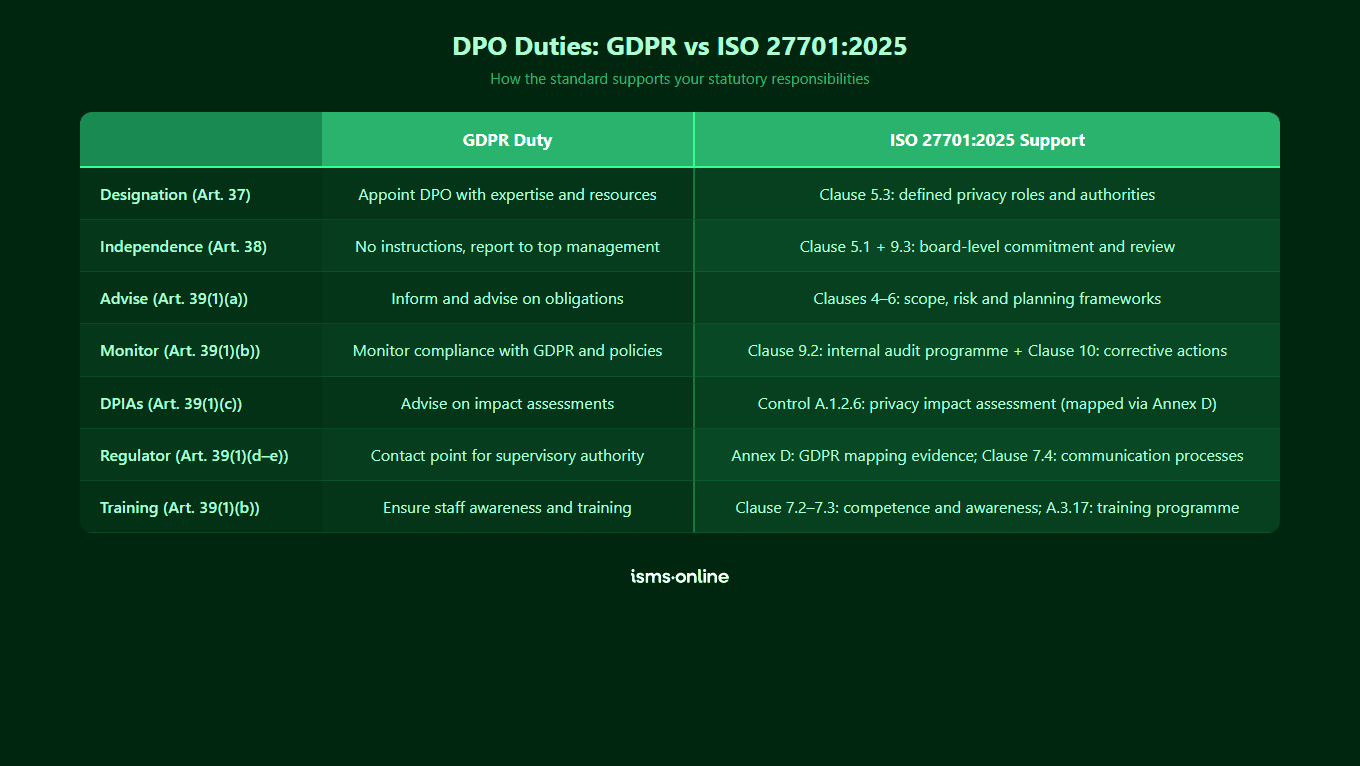
Data Protection Officers sit at the intersection of legal obligations, operational processes and stakeholder expectations. ISO 27701:2025 provides a privacy information management system (PIMS) that aligns directly with the responsibilities outlined in GDPR Articles 37 to 39, giving DPOs a structured framework rather than an ad hoc approach to privacy governance. Understanding common implementation mistakes helps DPOs steer the project effectively.
The 2025 edition is particularly relevant because it operates as a standalone management system standard. Organisations no longer need ISO 27001 as a prerequisite, which means DPOs can champion ISO 27701 certification as a dedicated privacy initiative without being dependent on a wider information security programme.
For DPOs, the standard provides three critical advantages:
- Demonstrable accountability — Certification provides auditable evidence that privacy management is systematic and continuous, directly supporting GDPR Article 5(2) accountability requirements
- Structured oversight — The management system clauses define clear responsibilities, risk processes and review mechanisms that map to the DPO’s monitoring and advisory duties
- Stakeholder confidence — An internationally recognised certificate gives regulators, customers and data subjects tangible proof that privacy is governed effectively
Which clauses are most relevant to DPOs?
While DPOs should understand the entire standard, several clauses have particular significance for the role:
| Clause | Focus area | DPO relevance |
|---|---|---|
| Clause 4 | Context of the organisation | Defines PII processing scope, interested parties and legal obligations — the foundation of the DPO’s oversight remit |
| Clause 5 | Leadership and commitment | Requires top management to assign privacy roles and responsibilities, ensuring the DPO has the mandate and resources needed |
| Clause 6 | Planning | Covers privacy risk assessment and treatment — the DPO must oversee or contribute to risk identification and mitigation planning |
| Clause 8 | Operation | Addresses operational planning, risk treatment implementation and change control — areas where DPOs advise and monitor compliance |
| Clause 9 | Performance evaluation | Requires internal audits and management reviews — DPOs are natural contributors to privacy performance monitoring and reporting |
What Annex A controls should DPOs prioritise?
The Annex A controls in ISO 27701:2025 are organised into five categories. DPOs should pay particular attention to the controls that directly support their statutory duties:
- A.2 — Conditions for collection and processing — Covers lawful basis identification, purpose limitation, consent management and privacy impact assessments. These controls map directly to the DPO’s obligation to advise on DPIA requirements under GDPR Article 35
- A.3 — Obligations to PII principals — Addresses data subject rights including access, rectification, erasure and portability. DPOs must ensure processes are in place and working effectively
- A.4 — Privacy by design and default — Requires privacy considerations to be embedded into system design and processing activities. DPOs advise on these requirements during project planning
- A.5 — PII sharing, transfer and disclosure — Covers international transfers and third party sharing — areas where DPO oversight is critical for GDPR compliance

Manage all your compliance, all in one place
ISMS.online supports over 100 standards and regulations, giving you a single platform for all your compliance needs.
How does ISO 27701 support GDPR compliance monitoring?
GDPR Article 39 requires the DPO to monitor compliance with data protection law and with the organisation’s own policies. ISO 27701:2025 provides the operational backbone for this monitoring through:
- Internal audit programme (Clause 9.2) — Systematic audits against defined controls provide DPOs with objective evidence of compliance gaps and improvement opportunities
- Management review (Clause 9.3) — Regular reviews at senior leadership level ensure privacy performance data reaches decision makers, supporting the DPO’s reporting obligations
- Nonconformity management (Clause 10.1) — A structured approach to identifying, documenting and resolving privacy failures ensures issues are tracked through to resolution
- Continual improvement (Clause 10.2) — The standard requires ongoing enhancement of the PIMS, giving DPOs a mechanism to drive privacy maturity over time
For DPOs working in organisations subject to the GDPR, the Annex D mapping table provides a direct cross reference between ISO 27701 controls and GDPR articles. This is an invaluable tool for demonstrating compliance during regulatory enquiries or supervisory authority audits.
What role does the DPO play in the PIMS?
Within an ISO 27701:2025 privacy information management system, the DPO typically fulfils several functions:
| PIMS function | DPO involvement |
|---|---|
| Privacy risk assessment | Advises on risk identification and evaluation. Reviews proposed risk treatment plans for adequacy |
| Policy development | Advises on privacy policy content and ensures alignment with legal requirements |
| Data protection impact assessments | Provides advice as required by GDPR Article 35(2) and reviews DPIA outcomes |
| Training and awareness | Contributes to privacy training content and monitors completion rates |
| Incident management | Advises on breach notification obligations and reviews incident response processes |
| Internal audits | May participate as an observer or reviewer. Should not audit their own work to maintain independence |
| Management review | Presents privacy performance data and recommendations to senior leadership (see our executive summary for board members) |
| Supervisory authority liaison | Acts as the primary contact point and ensures the organisation cooperates with regulatory requests |
It is important to note that the DPO’s independence must be preserved within the PIMS. GDPR Article 38 requires that the DPO does not receive instructions regarding the exercise of their tasks and reports to the highest management level. The PIMS should be designed to support this independence while still enabling effective collaboration.

Get started easily with a personal product demo
One of our onboarding specialists will walk you through our platform to help you get started with confidence.
How can DPOs build the case for ISO 27701 certification?
DPOs are often the natural champions for ISO 27701 within their organisations. When presenting the case to senior leadership (see our guide on getting management buy-in), focus on these arguments:
- Regulatory risk reduction — Certification demonstrates accountability to supervisory authorities, potentially reducing the likelihood and severity of enforcement action
- Customer trust — B2B customers increasingly require evidence of privacy management maturity. An ISO 27701 certificate satisfies due diligence questionnaires and procurement requirements
- Operational efficiency — A structured PIMS replaces ad hoc privacy management with repeatable, measurable processes that reduce the time spent firefighting
- Competitive advantage — As privacy regulation increases globally, early certification positions the organisation ahead of competitors who are still relying on self declaration
- Integration potential — ISO 27701:2025 can be integrated with ISO 27001 or operated standalone, giving flexibility as the organisation’s needs evolve
For a detailed financial framework to support this conversation, see our ROI business case guide.
Why choose ISMS.online for ISO 27701:2025?
ISMS.online is designed to make the DPO’s job easier:
- Pre-built PIMS framework — Start with all ISO 27701:2025 clauses and Annex A controls mapped and ready to populate, saving months of manual setup
- GDPR mapping included — Built in Annex D mapping links each control to the corresponding GDPR article, so you can demonstrate regulatory alignment instantly
- Automated evidence collection — Link policies, records and evidence to controls automatically, ensuring you are always audit ready
- Risk management workflows — Integrated privacy risk register with assessment, treatment and review workflows that align to Clause 6 requirements
- Audit programme management — Plan, schedule and track internal audits with findings linked directly to nonconformity and improvement processes
- Management review dashboards — Provide senior leadership with real time visibility of privacy performance, supporting the DPO’s reporting obligations
- Collaboration across teams — Assign tasks, track progress and ensure accountability across departments without relying on spreadsheets or email chains
FAQs
Does ISO 27701:2025 require organisations to appoint a DPO?
ISO 27701:2025 does not mandate the appointment of a DPO. However, Clause 5 requires organisations to assign privacy roles and responsibilities, and several Annex A controls address the need for a designated privacy contact. Where GDPR applies, the obligation to appoint a DPO comes from Article 37 rather than the standard itself. In practice, organisations pursuing certification typically benefit from having a DPO or equivalent role to coordinate the PIMS.
Can the DPO be the PIMS manager?
This depends on the organisation’s size and structure. In smaller organisations, the DPO may also act as the PIMS manager. In larger organisations, these roles should be separated to preserve the DPO’s independence under GDPR Article 38. For the CISO perspective, see our guide for CISOs. The key consideration is that the DPO should not be auditing or approving their own work, so if they manage the PIMS, an independent party should conduct internal audits of those areas.
How does ISO 27701 help with DPIA requirements?
ISO 27701:2025 includes controls that align with GDPR Article 35 DPIA requirements. The privacy risk assessment process in Clause 6 provides a systematic methodology for identifying and evaluating privacy risks, and the Annex A controls on conditions for processing address privacy impact assessment procedures. DPOs can use the PIMS risk framework as the foundation for DPIAs, ensuring consistency and traceability.
Is ISO 27701 certification recognised by GDPR supervisory authorities?
ISO 27701 certification is not an approved GDPR certification mechanism under Article 42. However, it is widely recognised by supervisory authorities as evidence of robust privacy management. The EDPB has acknowledged ISO 27701 as a relevant standard, and certification can support accountability arguments during regulatory enquiries. Many DPOs use the certificate as part of their compliance evidence portfolio.
What training does a DPO need for ISO 27701:2025?
DPOs should understand the structure and requirements of ISO 27701:2025, particularly the management system clauses (4 to 10) and the Annex A controls relevant to their organisation’s scope. Formal lead auditor or lead implementer training is beneficial but not required. ISMS.online provides built in guidance for each clause and control, which helps DPOs build their understanding progressively as they work through the implementation.






