





































How the NIS 2 Directive’s Article 1 Redefines Who Must Comply
Article 1 of the NIS 2 Directive is not just legislative housekeeping-it is a fundamental reset of Europe’s digital risk perimeter. Your organisation’s “out of scope” status may now be on shaky ground. The regulatory logic is blunt: any organisation with the potential to create systemic digital risk across Europe’s essential and important sectors is now called to account. This includes not just the giants of critical infrastructure, but also mid-market SaaS vendors, managed service providers (MSPs), cloud hosts, transport software, IT outsourcers, and even public sector contractors.
Where once exemption was taken for granted, today it has become a gamble. Frequently, entities discover their true obligations late-midway through an RFP, an annual vendor reassessment, or during a sharp audit that exposes a past blind spot. “It doesn’t apply to us” is a belief that can collapse under the weight of one compliance questionnaire. In 2024 and beyond, hoping to fly under the radar is a self-defeating myth.
A compliance wake-up call that redraws the boundaries around every digital and operational asset you touch.
The only smart move is to confront the new reality: map your operations, dependency chains, and supply lines-now, and with annual discipline. Failing to do so invites not only public fines and lost contracts but reputational bruises and prolonged procurement block. Readiness itself becomes a key signal to your market and an assurance to your board. Delay is not just risky; it is a decision to let compliance be forced upon you by outsiders, not shaped from within.
What Article 1 Actually Covers-No More Hiding on the Sidelines
Article 1’s boundaries do not simply target the obvious digital critical national infrastructure. Instead, they extend deep into the digital economy, recursively drawing in any medium or large organisation with material influence on “essential” or “important” sector functions: from healthtech and water utilities to financial market infrastructure, logistics, energy, transport, and core cloud and communications providers. The scope is also functionally recursive: if your operations are relied upon by a regulated actor, your compliance status shadows theirs-regardless of your own primary industry.
Micro-entities (<50 staff, <€10m turnover) are generally carved out, but this comfort is only skin-deep. If your digital product, service, or support creates downstream risk, the “size” guideline evaporates. Special attention is paid to SaaS, MSP, and digital platform providers, with “supra-sector” coverage emerging for cross-cutting risk.
When a SaaS firm hosts clinical team rota tools for a hospital, or a five-person cyber startup manages authentication for a major retailer, the Directive’s logic follows the data-requiring regulated methods, annual scope re-examination, and evidence of real oversight.
When in doubt, assume you’re in. The only defence is proactive mapping and expressly validating any out-of-scope claim.
Example: Scope Mapping for SaaS and Digital Services
- UK-based SaaS serving European healthcare is within scope-even if it’s supporting “non-medical” workflows-because the dependency pathway triggers mandatory inclusion.
- A managed detection and response (MDR) provider with a critical city client falls inside due to digital infrastructure dependencies.
- A specialist hosting provider with even a single “important” customer (e.g., public administration, water, power network) is swept in by the Directive’s expanded supplier chain logic.
Regulators are explicit-mapping and documenting your status is not a one-off task. It should be regularly refreshed, with reasons for inclusion or exclusion provided and, crucially, signed off from the board level down. In practise, modern supply chain risk assurance means customers, auditors, and government bodies are all now default sceptics requiring evidence, not verbal assurances.

Master NIS 2 without spreadsheet chaos
Centralise risk, incidents, suppliers, and evidence in one clean platform.
Sectors, Size, and the End of National Loopholes: Article 1’s Reality
With NIS 2’s Article 1 in force, the European Union’s intent is unmistakable: cyber-security is now consistent across member states, with no refuge for clever status arbitrage, cross-border location shifts, or sector carveouts. The focus is on pan-European systemic resilience, rejecting prior patchwork approaches.
A company’s regulatory relationship is not defined by HQ location or entity registration, but by where services are consumed-and whom they impact. Provide digital infrastructure for health, energy, or finance anywhere within Europe? You’re under the NIS 2 compliance regime, regardless of nationality. For groups with subsidiaries, subcontractors, or international supply chains, compliance must be harmonised up and down the value chain and left-to-right across national boundaries.
Every tender, procurement contract, or customer onboarding is now a checkpoint for NIS 2 readiness; buyers are increasingly moving to “compliance first” models where the absence of evidence is disqualifying.
- Supplier and partner chains are synchronised-weak links and omissions propagate risk to all parties.
- “Important entity” status is applied to operations and functions that have outsized downstream consequence, even if the company itself is small.
- Member-state nuance is vanquished: what mattered for compliance yesterday can, today, be wiped out by a regulated sector customer or a new national implementation.
NIS 2 isn’t simply a compliance standard-it is a new operating system for digital unity across every EU business touchpoint.
Slow action costs more than compliance: it means exclusion from contracts, last-minute audit panic, and cascading headaches whenever you try to respond to a new RFP or regulator review. Unified practise is the path-fragmented, reactive compliance simply cannot keep pace with what Article 1 now demands.
What Now Counts as Compliant Operation-Internal Teams on a Permanent Readiness Footing
What does practical NIS 2 scope mean for your operations and budget? For most, it requires a profound evolution-away from “last year’s audit binder” toward embedded, platform-driven, always-on compliance processes. No team, from IT and legal to procurement and HR, will be untouched. Every day can be an audit window.
All levels, up to and including the board, are now involved: leadership is named by the Directive as responsible not just for “enacting” policies, but for overseeing their continual operation, reacting to incidents, and validating supply chain resilience. Compliance is not just a matter for “the IT folks”-it’s a standing order for the entire business.
- Automated platforms: become crucial to link policy, risk, supplier engagement, audit trails, and responsive evidence chains.
- Compliance budgets are allocated permanently: -no longer “project spend,” but living operational expense to cover control reviews, management reporting, supplier risk reviews, and independent audit rehearsals.
- Audit risks now come with bigger price tags: a single failure can not only block deals but prompt regulator penalty, multi-year oversight, and force board resignations.
- The audit cadence is unrelenting: supplier lists, policy acknowledgements, and risk reviews move from “annual update” to “continuous evidence chain.”
Continuous compliance is not a luxury-it’s what keeps your doors open and your supply lines active.
Success is now measured by the frequency and completeness of evidence traceability. Volume is not the goal; instant provability of compliance, especially across critical supplier links, is the new currency.
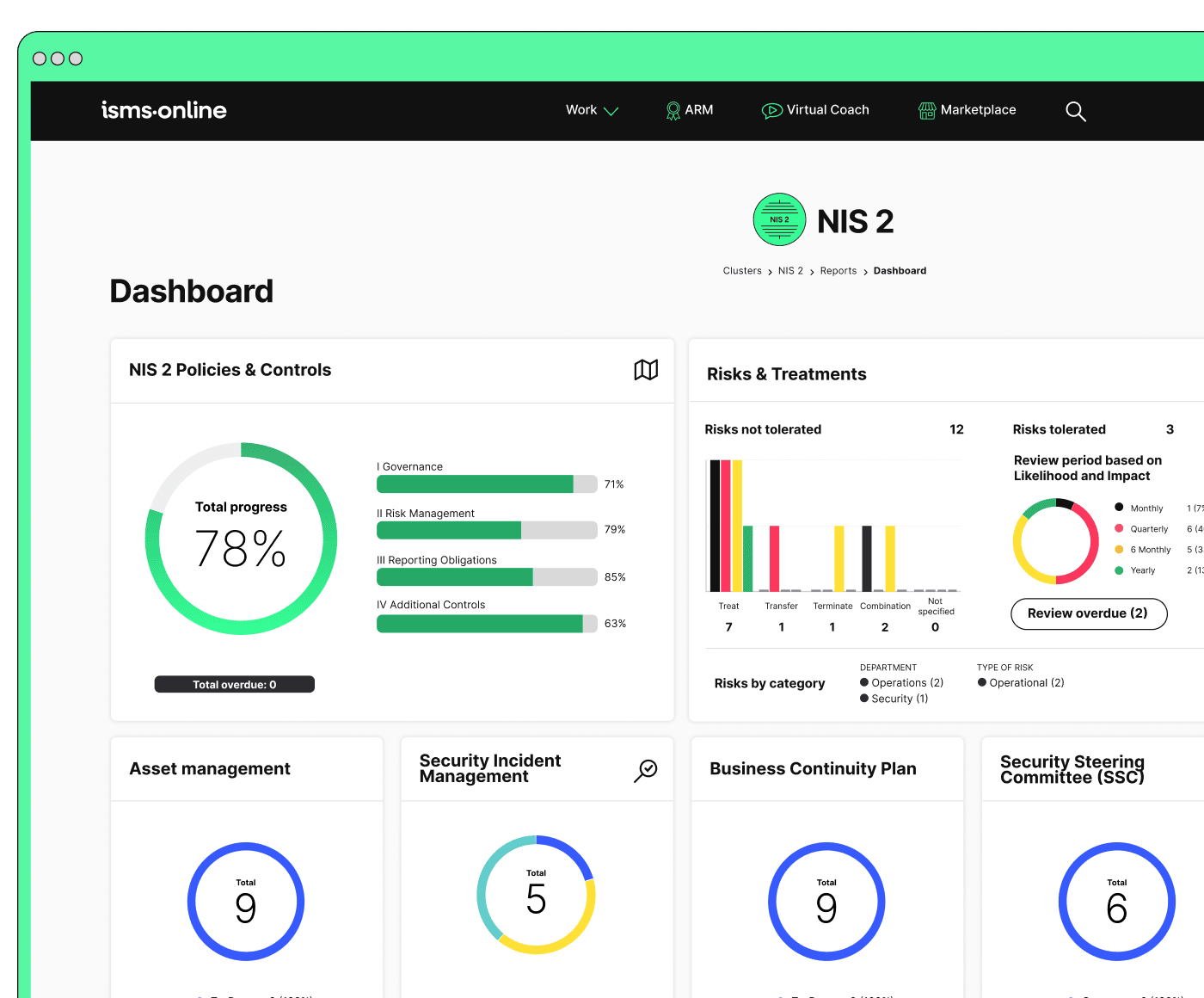
Be NIS 2-ready from day one
Launch with a proven workspace and templates – just tailor, assign, and go.
Controls and Supply Chain Resilience-Unified Evidence is Now the Minimum Bar
With the NIS 2 implementation, evidence silos are not only outdated; they are now major liability points. Modern compliance means every control must be linked to a living SoA (Statement of Applicability), with supplier checks, incident records, and approval chains centrally organised and audit ready.
A modern SaaS or managed service offering is only as strong as its weakest compliance link: a dormant risk register, a missing log from a cloud host, an uncollected supplier due diligence. These are the places audit and procurement will probe.
Supply Chain Compliance Cascade Example
From a core SaaS platform, risk and compliance flow through your hosting provider, any managed service layer (MSSP), your downstream security integrator, all the way to the regulated client or citizen. Each layer must be able to surface real-time compliance status and provide documented evidence linked to a named control and policy.
ISO 27001 / NIS 2 Bridge Table
Below, a focused mapping of compliance expectation to ISO and NIS/Annex A implementation-direct and operational:
| Expectation | Operationalisation | ISO 27001/Annex A Ref. |
|---|---|---|
| Supply chain risk mapping | Supplier registry, annual review | A.5.19, A.5.20, A.5.21 |
| Evidence readiness | Instant logs, approvals, auditable SoA | 9.1, 9.2, A.5.25 |
| Board-level resilience | Dashboards, tested BCP | A.5.29, A.5.30, 9.3 |
| Unified policy implementation | Digital policy registry, cross-mapped SoA | A.6.1, A.8.7, A.8.8 |
| Incident auditability | Event log, workflow with approvals | A.5.24–A.5.27, 6.1.2, 7.4, 10.1 |
NIS 2 success is measured not in files stored but in the traceability of every risk, control, and incident-across your entire digital environment, supply chain included.
The only way to prove it is to move fast and normalise live, auditable compliance operations using integrated evidence management tools.
Resilience Over Routine-How Article 1 Reshapes Compliance Practise
Gone are the days of “paper compliance.” Under Article 1, resilience is not judged on file archives or after-the-fact justifications, but on your organisation’s ability to respond live, in motion, and across the chain of command. Boards are named and held responsible for leading not just by edict but by example-ensuring active BCPs (business continuity plans), pre-approved incident response plans, logged policy updates after events, and tight vulnerability management.
Reporting timelines are non-negotiable: major incidents or vulnerabilities must be responded to in hours, not days. Evidence chains are followed up to the board, with all actions and approvals logged. Repetition of similar incidents, failures to document, or sluggishness in responding invite increasingly harsh penalties, including regulator scrutiny and public enforcement.
Resilience is the ability to recover and respond live-not explain or justify after the dust settles.
Compliance, woven into day-to-day operations, is now a mark of business resilience and market maturity-teams who succeed treat it as a living, breathing function, not a once-yearly hurdle.
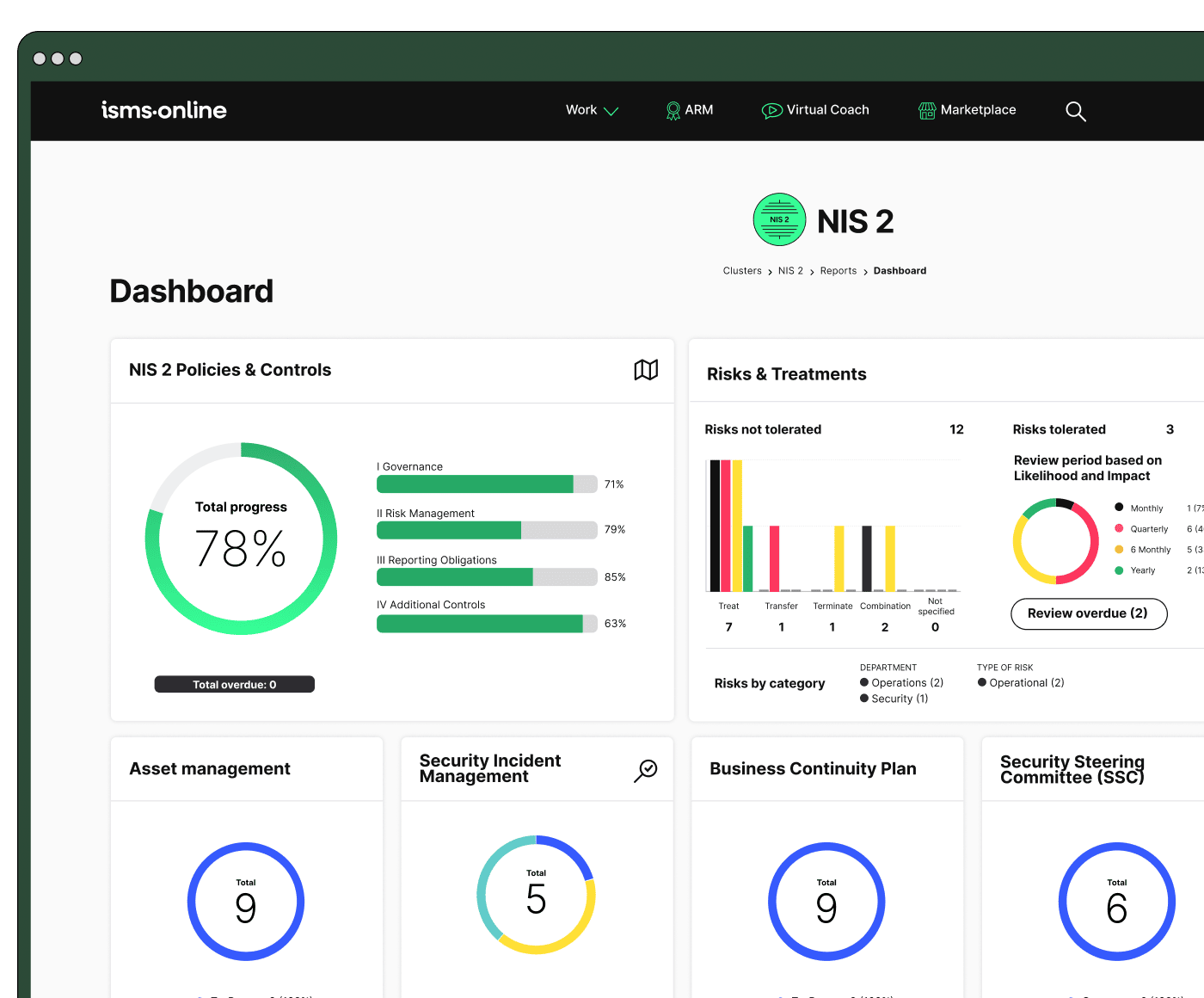
All your NIS 2, all in one place
From Articles 20–23 to audit plans – run and prove compliance, end-to-end.
Traceability in Action: From Incident Trigger to Audit Evidence Without Delay
The Directive’s 24/72-hour reporting windows render spreadsheets, emails, and manual checklists obsolete. You must be able to reconstruct the complete compliance trail at a moment’s notice: from incident (or regulation change, or supplier event) through every risk update, policy change, approval, and final audit document.
Traceability Table-A Compliance Chain in Practise
| Trigger | Risk Update Initiator | Control or SoA Link | Example Evidence Logged |
|---|---|---|---|
| Supplier change | Vendor reassessment | A.5.21, 8.2.1 | Due diligence, approval log |
| Security incident | Incident response | A.5.25–A.5.27, 9.1 | Event record, actions taken |
| Regulation update | Compliance review | 6.1.1, 6.1.2, 5.12 | Mapping file, updated policies |
| Third-party breach | Notification chain | A.8.7, A.8.8 | Notice receipt, downstream alert |
| Board policy amendment | Mgmt. review board | 9.3, A.5.1, 7.5 | Signed update, meeting minutes |
The winner in a compliance arms race is never just the company with the most controls, but the one that can instantly prove every connection from trigger to outcome.
Expectations from regulators, customers, and procurement have converged: instant traceability isn’t just best practise, it’s the baseline for operation.
The ISMS.online Advantage: The Compliance Loop That Proofs Your Future
Resilience has become the new compliance-moving beyond static standards to a dynamic, forward-driven approach, and this is where ISMS.online positions your teams for sustained success. We enable leaders, practitioners, and board members to transition into continuous, traceable Article 1 readiness: from initial mapping and supply chain onboarding to real-time dashboards, living policy packs, and management review boards.
What this looks like for you in practise:
- Reliability for audits: Achieve a first-time pass on every audit with unified, auditable workflows, trusted by regulators and external assurance bodies.
- Readiness speed-up: Reduce time-to-readiness by 70%; immediately access live mapping, scoping tools, and evidence dashboards.
- Unification across frameworks: Governance over security, privacy, and supply chain risk together-no more tool chaos or siloed evidence.
- On-demand traceability: Be prepared to provide the complete audit trail for any client, supply chain partner, regulator, or boardroom query-instantly.
Compliance is no longer about avoiding penalties; it is how resilient businesses win and keep trust in a shifting digital world.
Ready to see what resilience-in-action means for your sector-and how continuous ISMS.online compliance keeps your doors open and value growing? Start your journey now.
Frequently Asked Questions
How does Article 1 of Implementing Regulation EU 2024-2690 NIS 2 reshape the cyber-security compliance landscape-and why does it matter for almost every EU organisation?
Article 1 of Implementing Regulation EU 2024-2690 is a decisive expansion of EU cyber-security law, systematically rolling the scope beyond classic “critical infrastructure” to embrace a vast array of medium and large organisations across digital and physical sectors. Practically overnight, this provision sweeps in IT suppliers, SaaS vendors, managed service providers, health and food operations, utilities, logistics, even space services-any business offering essential or supporting functions to the EU economy. It abolishes national loopholes and regulatory wiggle room; instead, it enforces a cohesive compliance perimeter and places clear, continuous, board-level responsibilities on leadership.
Cyber-Security isn’t just for digital giants or utilities; Article 1 anchors every key supplier and public service under a single compliance spotlight.
Where did we come from-and what’s new?
- Under NIS 1: Coverage was patchy, focusing on a short list of “operators of essential services.”
- With Article 1: Scope is now almost universal for any medium or large entity shaping the EU’s digital or physical infrastructure, erasing fragmented national thresholds and subjective exemptions.
- Unified rulebook: Pan-European definitions and real-time reporting create a single regulatory ‘floor’, demanding continuous readiness for sector after sector.
Which organisations fall inside Article 1’s scope, and how do those sector boundaries actually work?
If your company has 50+ staff or >€10M turnover, and enables or supports core EU infrastructure, you are almost certainly “in scope.” Article 1 explicitly names both “essential” and “important” entities:
| Sector / Organisation | “Essential Entity” | “Important Entity” | Exempt? |
|---|---|---|---|
| National/critical IT suppliers | ✔ | No | |
| SaaS/cloud vendors for health/finance | ✔ | ✔ | No |
| Regional logistics, food, or waste | ✔ | No | |
| SME SaaS (<50 FTE / €10M) | *Usually*⁺ | ||
| Group with cross-EU presence | ✔ if any entity is | ✔ if subsidiary is | No |
⁺ Caution: If you support in-scope customers or supply chain, exemptions evaporate.
Any new digital contract, sector expansion, or post-M&A grouping can tip you into scope. The days of flying under the radar are over: regulators expect every eligible business to re-check scope annually or at each structural change.
If you’re not auditing your status after every deal, partnership, or acquisition, you’re gambling compliance on fast-shrinking loopholes.
What’s changed for groups, multinational operations, and sector transitions-are old carve-outs still valid?
Article 1 standardises the test: if any part of a corporate group, subsidiary, or business unit meets “essential” or “important” criteria, the whole group’s compliance posture must adapt. Multi-country enterprises must comply with the strictest requirement-no more navigating around local leniency. All subsidiaries, partners, or suppliers should be mapped right down to service delivery lines.
| Scenario | Compliance Impact |
|---|---|
| Subsidiary passes “essential entity” test | Group-wide review-no “innocent bystander” sub-companies |
| Multiple EU members, jurisdictions | Strongest NIS 2 requirement now applies everywhere |
| Supplier becomes critical via new contract | Both the supplier and its upstream partners now must comply |
| Recent acquisition, re-org, or joint ops | Immediate update to scope registers, risk, and SoA mandatory |
“Passive compliance” or deferring responsibility to local IT or procurement is replaced by group-wide, audit-traceable controls.
What new evidence and compliance routines does Article 1 require, practically speaking?
Article 1 transforms compliance from a paperwork exercise into a living, operational discipline. Organisations must:
- Build and regularly refresh a supplier and asset register, not just for audit day but as a live dashboard.
- Run real-time risk and incident management, documenting each incident within a 24h/72h window, including impactful supply chain events.
- Maintain a Statement of Applicability (SoA) and map all controls with real-world evidence, not just written policies.
- Assign board-level responsibility for compliance, with documented sign-offs and regular management reviews.
- Monitor third-party risk-suppliers and partners must be mapped, scored, and reviewed annually or at each material change.
| Compliance Area | Required Routine | NIS2/ISO 27001 Link |
|---|---|---|
| Supplier register | Live dashboard, annual audit | A.5.19–A.5.21 |
| Incident readiness | Workflows, 24/72h report logs | A.5.24–27, 9.1 |
| Board engagement | Review minutes, KPIs, sign-offs | 9.3, A.5.29 |
Successful audit is no longer about thick policy binders, but about demonstrating an active, continuous chain of checks, changes, and leadership oversight.
Are there any real exemptions left under Article 1, and which ‘edge’ organisations must still be most vigilant?
Article 1 formally carves out only national security, defence, and certain judicial or legislative functions. Micro-enterprises and very small public sector entities are generally exempt, unless they perform “essential” roles for regulated clients or infrastructure. However, any significant change-major contract, sector pivot, new business line, or acquisition-should immediately trigger a scope remapping. Regulators are watching for “regulatory evasion,” and the expectation is now proactive, not reactive, inclusion.
Don’t fall into these traps:
- Assuming old “national” or “size” exemptions still apply after a structural or partnership change.
- Overlooking IT, digital, MSP, or SaaS teams delivering critical functions via third-party contracts.
- Delegating compliance updates to admin teams without board-level sight-liability remains at the top.
Why does ‘traceable compliance’ now trump “documented” compliance-what does Article 1 demand in terms of audit chains and proof?
Article 1 demands that you can rapidly trace any event, supplier onboarding, policy change, or legal update-all the way from trigger to risk assessment, mapped controls, SoA entry, and logged evidence. If an auditor or regulator asks, you must instantly demonstrate the event-driven path for every control-no narrative gaps or lost signatures.
| Event Type | Risk/Scope Update | Control(s) (SoA) | Evidence Example |
|---|---|---|---|
| Supplier onboarded | Supplier risk updated | A.5.19, A.5.21 | Approved register, contracts |
| Policy changed | SoA & board review | 9.3, A.5.29 | Minutes, signed version |
| Security incident | Incident register, BCP | A.5.24–27, 9.1 | Timeline log, action trail |
| Legal update | Task & risk assigned | 5.12, 6.1.1 | Policy revision, log |
The speed and integrity of your compliance chain-changes to controls, board sign-offs, incident logs-are now the benchmarks for true readiness. Audit outcomes hinge on live traceability, not paper volume.
Platforms like ISMS.online are built to automate these audit chains, uniting registers, workflow approvals, and board reviews so evidence is always at your fingertips-never lost in someone’s desktop folder.
What are the actionable next steps to stay ahead of Article 1-and how does ISMS.online accelerate your compliance journey?
Start today:
- Map every legal entity, operational unit, and supplier against Article 1’s annex sector definitions-remap with any business change.
- Replace static spreadsheets and file-based “registers” with compliance automation platforms.
- Automate incident tracking and SoA links; implement board-level review cycles with real-time dashboards.
- Enable KPIs and alerting for scope changes-so business growth never leaves compliance behind.
- Choose a partner like ISMS.online:
– Instantly scopes your business with wizard-based mapping.
– Maintains always-on supply, asset, and incident registers.
– Automates sign-offs, management reviews, KPIs, and evidencing.
– Achieves 100% audit success and reduces admin by 70%-giving your leaders confidence.
Compliance is no longer a one-time project. The leaders who succeed now will be those who make traceability, board engagement, and evidence automation a daily business advantage.
Lead from the front-turn Article 1’s challenge into your competitive advantage with a living, board-ready compliance engine.






