





































Why National Crisis Readiness Is Non-Negotiable Under Article 9
Recent years in Europe have redrawn the stakes for cyber crisis management. No sector has escaped disruption: hospitals crippled by ransomware, energy grids manipulated, national supply chains unravelled-all against a backdrop of escalating regulatory pressure. The EU’s NIS 2 Directive, crystallised by Implementing Regulation EU 2024-2690, makes one thing clear: national cyber crisis readiness is no longer aspirational or optional. Article 9 transforms fragmented planning into a legal, operational, and cultural obligation. Every nation, operator, and essential supplier is now compelled not only to build but to prove-in detail and on demand-that its cyber crisis framework is current, effective, and ready for the unknown.
The line between a localised incident and a national cyber crisis is always thinner than it looks.
Gone are the days when a ring-binder of procedures checked the box for compliance. Authorities must show that frameworks live in real workflows: live drills with public–private partners, logged notifications, accountable resource assignment, and improvement cycles that close audit gaps rather than hide them. When an incident strikes, every lost minute in confusion, every missing audit log, can cost governments not just money, but public trust, health, and even diplomatic standing. The new yardstick is operational, not paper-based. Can you, right now, demonstrate functional readiness-not just good intentions?
The Regulatory Shift: Crisis Readiness as Minimum Viable Operation
By mandating resource-backed frameworks, cross-sector drills, and demonstrable improvement over time, Article 9 ends the era of set and forget compliance. Annual plan reviews and tokenistic exercises are being replaced by a living, watchful engine-where national readiness must be provable in days, sometimes even minutes. Failure to adapt is no longer a private embarrassment; it is a visible liability that can irreparably damage reputation and result in formal penalties (ENISA 2023).
Book a demoHow Article 9 Redefines Cyber Crisis Management
For leaders accustomed to treating crisis planning as an exercise in document drafting, Article 9 lands like a jolt. The Directive does not simply call for better crisis playbooks-it prescribes the operational behaviours and evidence that define “readiness” for a new Europe.
Every missed drill or unlogged escalation isn’t just a process failure; it’s now a visible liability.
Legal Obligations Translated into Operational Imperatives
Article 9 resets expectations:
- Mandated resource allocation: No plan is credible unless staff, budget, and tools are demonstrably ready. Unstaffed procedures or unapproved budgets constitute non-compliance (EU Council 2025).
- Live, repeatable crisis drills: Compliance requires logged, cross-sector exercises with real notification chains and improvement actions. These are measured and traceable, not annual box-ticks.
- Widened organisational scope: Telecommunications, energy, healthcare, finance, supply, and even primary vendors now have explicit and equivalent responsibilities for readiness; none can claim “peripheral” status when a crisis strikes.
- Evidence, not promises: Notification chains are logged in real time. Playbooks are version-controlled. Staff training, role review, and after-action improvements are audit-ready and immediately available.
Article 9’s Europe: “Ready” means every minute, every role, every obligation can be shown to an auditor or to the board-no ambiguity, no excuses.
The Stakes for Inaction
Falling short doesn’t mean a stern memo. Recent history-such as the 2025 Polish drone incursion-records the trail of missed alerts and fractured escalation. EU authorities now expect clarity, integrity, and speed over optimism or hand-waving. A single gap in the chain is more than a technical issue; it’s a point of legal, financial, and reputational exposure.
Fragmentation in response delivers fragmentation in results-and accountability always lands.

Master NIS 2 without spreadsheet chaos
Centralise risk, incidents, suppliers, and evidence in one clean platform.
Where Siloed Tools and Conflicting Roles Cause Failure
Despite stricter regulation, many organisations persist with outdated, fragmented toolchains: spreadsheets for assets, emails for incident notifications, SharePoint for playbooks, siloed runbooks scattered across teams. Under Article 9, this approach doesn’t just risk inefficiency-it directly contradicts the law’s call for a unified, auditable crisis backbone.
Recent audits across EU members highlight “silo fatigue”: notifications lost in inboxes, vendor self-assessments never cross-checked, drills staged on paper but forgotten during live incidents (ENISA 2024). The result is a menu of failure modes:
- *Escalation confusion*: If every stakeholder “owns” the response, no one does. Drills fail to harden real muscle memory.
- *Invisible gaps*: Disparate logs, orphaned notifications, and fragmented incident records yield critical blind spots exactly when clarity is needed most.
- *Audit mirages*: Supervisory authorities and boards increasingly probe beneath declared plans-seeking time-stamped audit trails, live test records, and role mapping that cannot be fabricated after the fact.
Accountability in cyber crisis isn’t something you write down-it's what the evidence proves when you’re under audit or attack.
Operational and Political Costs of Fragmentation
- Uncoordinated responses slow down crucial decision cycles and create dangerous “dead space” in national posture.
- If escalation thresholds and responsibilities are unclear, minutes are wasted in hand-offs, leading to delays in both containment and communication.
- False compliance-the paper-only exercise-leads to high-profile post-mortems, reputational harm, and shareholder scrutiny.
Article 9 takes these lessons seriously. By codifying real, logged, and rehearsed readiness, the Directive draws a bold line between “wishful thinking” and “defensible assurance.”
Decoding Article 9: Who Does What and How Do You Prove It?
No longer does compliance mean “everyone agrees something should be done.” Article 9 requires every organisation, from regulators to operators, to articulate precisely who activates, coordinates, notifies, and learns from each crisis-supplemented by logged, evidence-backed workflows.
Authority is now an ecosystem obligation, not a badge for one office.
Key Compliance Components Mapped to Real Operations
- Activation: Incident thresholds are defined in operational playbooks. When a certain type or scale of event is detected (e.g., ransomware on a critical system), an automated alert both notifies and logs the event, time-stamped for audit review.
- Coordination: Named coordinators-national and cross-border-are empowered to issue, track, and follow up on notifications, including digitally verifiable engagement (e.g., dashboard acknowledgment receipts) within required timelines (ENISA).
- Resourcing: Evidence of readiness means staff and systems are rostered, on-call, and authenticated-live, not in theory. Resource allocation is not assumed; it is attested in dashboards and drills.
- Evidence: Each stage-activation, notification, recovery, improvement-is logged, version controlled, and available to both internal and external auditors on demand.
- Escalation and After-Action: Reviews are codified; lessons must be owned, assigned, and the follow-up logged. No critical insight may “evaporate” without closure or improvement (ENISA Asset Checklist).
Role Clarity and Traceability
In today’s compliance environment, plans without clear ownership or evidence are, in effect, a liability. Your defensive posture is only as strong as the last action you can trace-by person, system, and record.
ISO 27001/Annex A Bridge – Operationalisation Table
| Expectation | Operationalisation | ISO 27001 / Annex A Reference |
|---|---|---|
| Timely notification & escalation | Automated alerts/logs + human confirmation | A5.24: Incident management planning |
| Documented drills & improvement | Scheduled/recorded; tracked action item closure | A5.27: Learning from security incidents |
| Resourcing provable in audit | Dashboard evidence: resource sheet, role assignment | A7.2: Role-based access, physical controls |
| Board & authority readiness review | Real-time dashboards, exportable logs | Cl9.3: Management review |
The difference between readiness and regret is that the former can be shown, step by step, to anyone who asks.
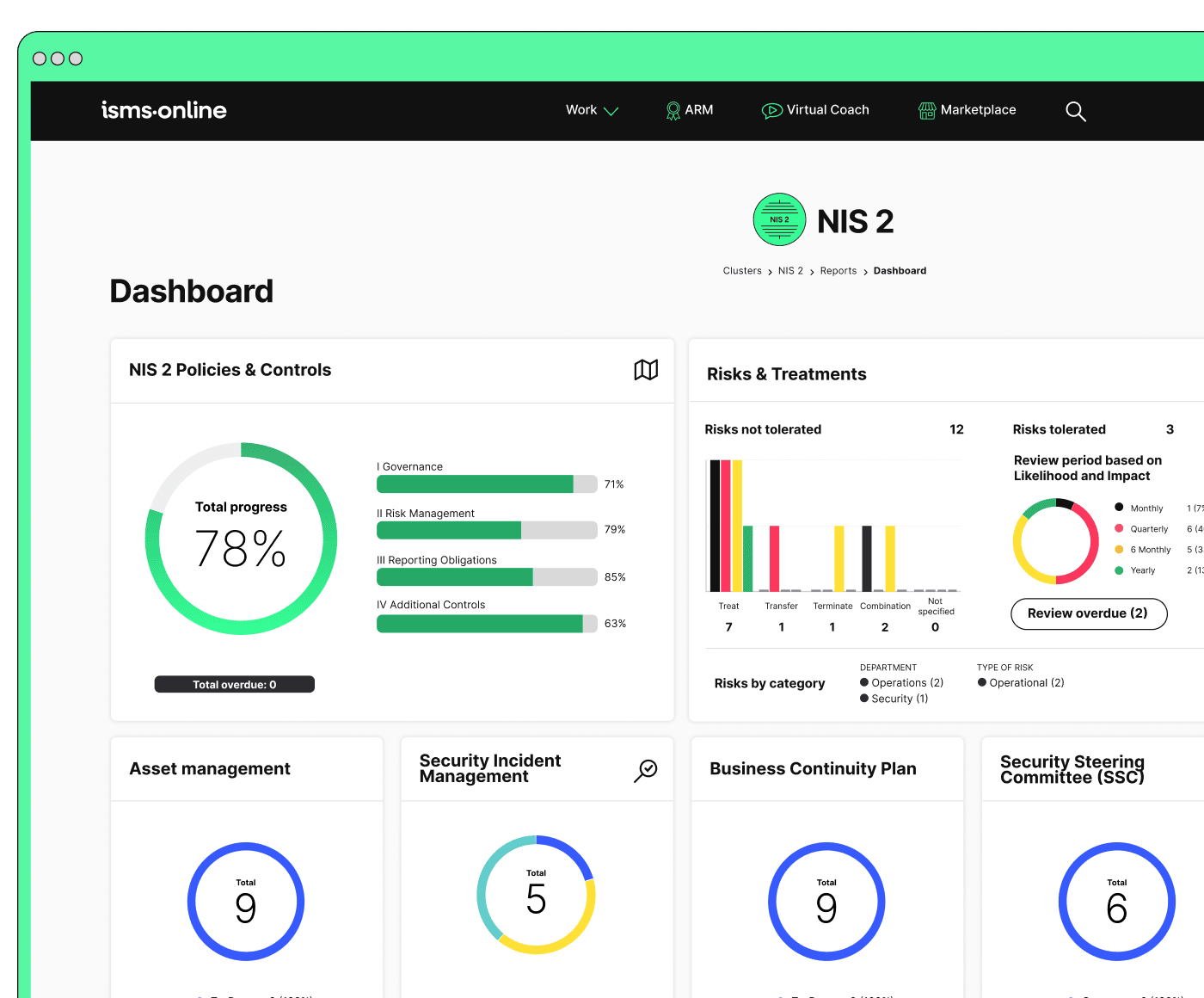
Be NIS 2-ready from day one
Launch with a proven workspace and templates – just tailor, assign, and go.
Interoperability: Unifying Sectors, EU Partners, and Shared Systems
A cyber crisis does not respect organisational boundaries or sector lines. Article 9 mandates not just internal consistency, but seamless interoperability-across sectors, with national authorities, and across EU borders. This means shared platforms, compatible escalation mechanisms, and evidence trails designed to work for both local and cross-border scrutiny.
Integration Beyond Your Four Walls
- Sectoral Silos: In complex environments, digital divides hurt incident response. Financial sector drills, such as the 2024 G7 exercise, revealed that only firms with real-time dashboards and centralised notification chains could share threat intelligence instantly with supervisors and EU partners, reducing risk of confusion or lag (Banque de France/G7 exercise).
- Jurisdictional Handoffs: Legal frameworks often trail crisis reality. When delays occur in legal consultations or formal “letters,” attackers exploit the seams. Platforms ready with machine-readable, auto-logged notification flows and dashboards aligned to Article 9 expectations close these gaps.
- Cross-Border Information Flow: EU-level engagement (like EU-CyCLONe or ENISA partners) depends on the ability to receive and review incident status, escalation logs, and asset lists in a unified, reviewable format. Pushes for tool-agnostic, exportable evidence flows are now central.
Resilience only works when information, playbooks, and response sync everywhere they should.
Platform Alignment: ISMS.online and Beyond
Tools such as ISMS.online respond to these imperatives by integrating asset inventories, incident logs, policy playbooks, and notification dashboards in one place-not just satisfying Article 9’s evidence requirements, but enabling rapid, trustworthy information flow during a live event or after-action review.
Crises expose the weakest link fastest-and it’s almost always a real-time handoff, not a policy.
Situational Awareness: Dashboards, Alerts, and Early Warning Systems
In a landscape where both incident velocity and regulatory expectations are rising, “being ready” demands more than information custody. Article 9 conditions readiness on the ability to synthesise, view, and share actionable status-on demand, across all critical stakeholders.
Visibility is the first thing the crisis will try to take away.
Hallmarks of Article 9-Compliant Situational Awareness
- Dashboards: Security and compliance leads require at-a-glance incident status, escalation chain progress, and risk alerts. Platforms must provide exportable, regulator-grade views-fit for both live crisis management and audit teams (ENISA example).
- Automated Notification Flows: Incidents, escalations, and all subsequent actions must trigger logged notifications-delivery and receipt confirmed and time-stamped, not hidden in sprawling inboxes.
- Live Threat Intelligence: Real-time updates across CSIRTs, sectoral authorities, and EU partners allow for adaptive response-not after-the-fact analysis.
- Audit-Ready Exports: Incidents, status changes, and risk escalations are available on-demand for compliance, regulatory, or management review-a foundation for “zero delay” culture.
- Cross-Border Coordination: When a crisis demands cross-jurisdiction escalation, dashboards trigger and log multi-lingual, multi-channel notifications. Linked acknowledgments prove compliance with regulatory timelines (EC Notification Timelines).
Example: From Threat Detected to Proven Response
A critical asset alert fires: the dashboard documents who was notified, what action was triggered, when, and how each handoff was completed. When the audit or crisis review occurs, every link is intact-proving a live, evidence-driven response.
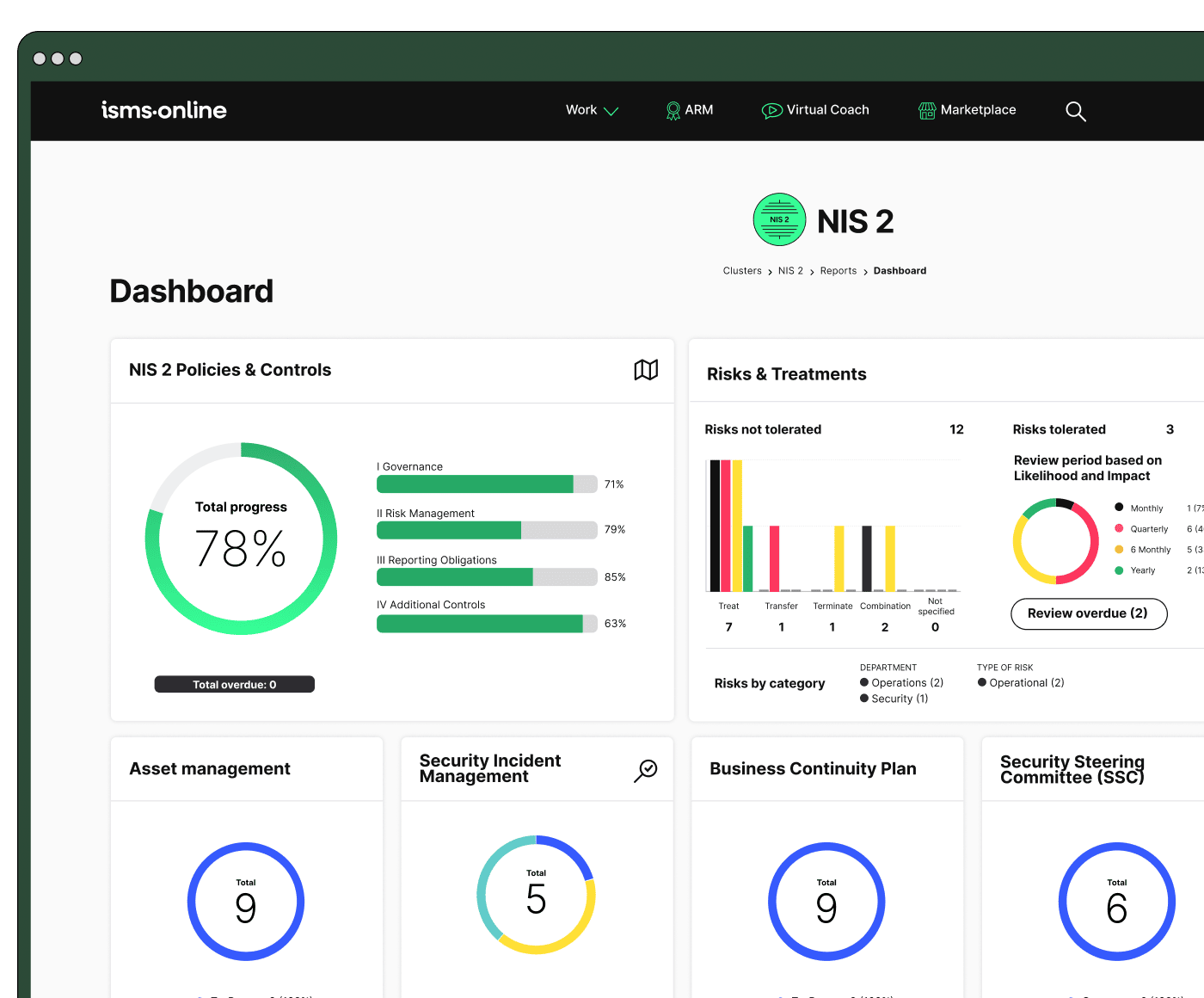
All your NIS 2, all in one place
From Articles 20–23 to audit plans – run and prove compliance, end-to-end.
Policy to Proof: Operationalising Readiness for Audit and Board Review
Article 9 sets a higher bar: plans, playbooks, and policies must move off the page and into the real, testable workflows. Management and regulators now expect compliance leaders to demonstrate “policy-in-action”-showing precisely how platforms, personnel, and processes close the loop.
If you can’t show it, it isn’t compliant.
How Teams Prove Operationalisation
- Automated Evidence Collection: Each action-notification, drill, role change, escalation-is logged, securely time-stamped, and mapped to the underlying control.
- Legal Reference Linking: Workflows must tie operational behaviour (like an escalation) back to specific COUNCIL or ISO 27001/Annex A requirements, so that boards and auditors can audit the evidence path.
- Live Simulation Outputs: Boards can instantly request a dashboard view of all open actions and log entries after drills or live incidents; authorities demand the same.
- Ownership and Accountability: Every control, notification, and corrective action is assigned, tracked, and reported-so that “ownership” is an activity, not a title.
| Expectation | Operationalisation | ISO 27001 / Annex A Reference |
|---|---|---|
| Timely notification & escalation | Automated incident alerts; time-stamped and logged | A5.24: Incident management planning |
| Documented drills & improvement | Logs of drills, follow-up actions with closure proof | A5.27: Learning from security incidents |
| Resources assignable and visible | Dashboard of real-time staff/on-call duty logs | A7.2: Role-based access, physical controls |
| Board review & performance status | Live dashboards and report exports | Cl9.3: Management review |
Example: Notification & Board Evidence Snapshot
When a potential ransomware outbreak is detected, the incident system fires automated alerts, logs the event, hands off to the national CSIRT-and within minutes produces a board-ready, regulator-auditable export of everything from escalation logs to staff rosters and planned corrective actions.
Compliance isn’t a plan. It’s what your evidence shows when it counts.
Continuous Improvement: Turning Drills and Lessons Into Real Resilience
Article 9 closes the “lessons-learned” loop with enforceable requirements for after-action review, improvement tracking, and cross-team adoption. The days when drills generated reports that gathered dust are over; now, actionable outcomes must flow directly into system updates, retraining, and control improvement.
A drill only helps if the lessons change tomorrow’s response.
The Compliance-Improvement Engine
- Live Drills as Audit Events: Full, end-to-end simulations are scheduled, logged, and followed up with action items-each tagged for closure and evidence.
- After-Action Reviews: Root cause analysis isn’t theoretical, but operational-feeding into service improvement plans, security roadmap updates, retraining initiatives, and policy realignment in days, not months (ENISA drills).
- Cross-Border Feedback: When a crisis reaches EU levels, the improvement is tested-whether all parties update playbooks, reporting mechanisms, and handoffs as required by findings.
- Board and Stakeholder Readiness: Open issues, completed improvements, and recurring gaps are surfaced for board review-ownership enforced beyond IT or compliance silos.
- Front-Line Empowerment: Drills reach not just management, but operational staff-the people on the end of the notification chain. Policy is translated to task, and every participant becomes an informed node in the crisis mesh.
Example: Drill → Audit → Improvement
After a live drill reveals a lag in cross-border escalation, the improvement plan is logged on the dashboard. The next iteration’s result is pre-filled with last cycle’s closure data, proving responsiveness to both board and EU authorities.
Audit by Design: Traceability, Trust, and Sustainable Readiness
The change wrought by Article 9, and the Implementing Regulation’s force, is that audit-readiness must be built into every workflow, across every escalation pathway and crisis scenario. Traceability is no longer a forensic hope; it is the operational norm.
Trust is built-not bragged about-when you can produce evidence at every stage of crisis management.
Traceability Mini-Table: From Trigger to Evidence
| Trigger | Risk Update | Control / SoA Link | Evidence Logged |
|---|---|---|---|
| Major incident detected by CSIRT | “Critical” escalation status | A5.24 / Art 9(2) activation | Time-stamped escalation, dashboard export |
| National coordinator notified | Cross-sector escalation | A5.25 / Art 9(3) | Operator receipt + notification logs |
| Board alert issued | Resource and evidence review | A9.3 review | Board dashboard audit + roster, action logs |
| EU-CyCLONe triggered | Cross-border notification | A5.27 / Art 9(4) | Notification receipt, EU-level engagement log |
Example: Article 9 In Action, Step by Step
- A CSIRT sees suspicious traffic: incident system classifies “critical.”
- National coordinator is auto-notified; the escalation is logged with time and recipient.
- Board is informed, actions are reviewed, and resource rosters exported to dashboard.
- Cross-border notification is triggered; evidence of send/receipt is filed.
- All steps post to the audit timeline, ready for management and regulator review.
Every action, every step, every role: mapped, logged, and able to be surfaced at a moment’s notice-making policy real and compliance both defensible and living.
Lead National Readiness-Adopt ISMS.online for Article 9 Today
In the new reality shaped by NIS 2 and Regulation 2024-2690, national cyber crisis readiness is neither a luxury nor a compliance formality. It is mission-critical, and it is measurable every day. Any gap-a missing audit log, a skipped drill, an ambiguous escalation-now risks not just legal sanction but loss of public and stakeholder trust. Resilience must be lived.
Resilience is no longer a hope-it’s a requirement, and the right platform makes it real-time.
ISMS.online stands as a practical, proven path from policy to operational assurance:
- Activate Article 9 Compliance Out-of-the-Box: Deploy sector-ready templates, playbooks, and checklists aligned to EU/ENISA standards.
- Real-Time Dashboards & Evidence: Instantly access audit logs, asset lists, resource allocation trails, and readiness reports-ready for board, regulatory, and cross-border review.
- Board-Grade Trust Signals: Demonstrate not just that you “intend” compliance, but that you live it, proving control at every incident, review, and escalation.
- Streamlined Improvement Loop: From after-action drills to closing lessons-learned tickets, operational improvements flow back into daily practise-by design, not accident.
This is the moment to shift national cyber crisis management from scattered efforts to accountable, logged, and board-visible workflow. With ISMS.online, you move from compliance anxiety to true confidence-establishing your organisation as an operational leader in an era where only proof, not intention, counts.
Are you ready to lead the standard? Contact ISMS.online today, transform your Article 9 compliance, and let your resilience be seen, trusted, and measured-by you, your board, and your stakeholders.
Frequently Asked Questions
Why Has Article 9 of NIS 2 Become the Priority for National Cyber Crisis Management?
Article 9 of NIS 2 has redefined effective cyber crisis management in Europe by forcing a shift from static planning to operational, auditable evidence of resilience. Instead of relying on compliance as a paperwork formality, national authorities are now required to demonstrate-at any given moment-that their crisis response truly functions and improves under pressure. Recent high-impact events-such as the 2025 “Poland drone incursion” and coordinated ransomware targeting energy and health-revealed how legacy plans simply broke down in real attacks, stalling responses and increasing the scale of damage.
Today, compliance with Article 9 means being able to produce real-time evidence showing that every role, process, and decision is understood, drilled, and can be scrutinised on demand. National approaches are converging around active dashboards, traceable actions, rapid escalations, and a documented chain of learning. This is not just an EU directive, but a survival imperative: governments, boards, and regulators want proof that operational resilience is more than an aspiration-it’s an output.
Resilience is no longer claimed by checklists, but proven by exportable, time-stamped evidence.
From Planning to Living Proof: Europe’s Crisis Management Reset
Article 9’s impact can be seen in how audit and regulatory reviews have evolved: authorities are expected to show “live control” of their crises-clear logs, instant export of actions, and closure of every incident learning loop-not just “good intent.”
How Does Article 9 Replace Siloed Response with Connected, Auditable Resilience?
The directive sets out to solve the well-known pitfalls of siloed response-sector-specific playbooks, missing links between authorities, and slow escalations that leave progress invisible or only reconstructed after the fact. Past ENISA reports have flagged failures like fragmented decision logs, duplicative incident notifications, “for show” exercises, and confusion about who is actually in control. Article 9 requires:
- A unified, documented national crisis management framework-no matter how many agencies, suppliers, or regions are involved.
- Connected, live dashboards and audit trails for roles, assets, incident status, and notification chains.
- Scenario-based, multi-stakeholder drills where every finding must be followed by proof of closure-remediation can’t remain on paper.
- End-to-end notification pathways that reach across sectors and into EU-level hubs, with evidence logs at every step.
- Continuous oversight-auditors or regulators can observe controls “in motion,” not just via annual paperwork.
Instead of ad hoc or post-hoc rationalisation following an incident, resilience now means export-ready evidence, continuous auditability, and documented improvement-available to any competent authority, board, or EU partner.
What Do Authorities Need to Demonstrate for Article 9 Audits and Reviews?
Effective Article 9 compliance requires clear assignments, rigorous tracking, ongoing exercises, and evidence that learning drives change. Authorities are expected to anchor their approach around these pillars:
Designated, Empowered Leadership
You must appoint crisis managers and sector leads with clear escalation rights and operational authority-not just for central government, but across all critical domains and suppliers. Lapses here frequently result in slow response, regulatory penalties, and lost public trust.
Mapped, Routinely Tested Capabilities
All relevant staff, functions, contracts, and technical assets should be inventoried. But unlike the old document-based style, Article 9 expects you to track these via live dashboards, schedule scenario-driven drills, and document outcomes (see ENISA, 2024).
Evidence-Based Live Exercises
Authentic readiness is measured by logs and after-action reviews, not by “tabletop” only. Essential suppliers, cross-sector dependencies, and partners must all participate in scheduled, logged, and followed-through exercises.
Immediate, Cross-Sector Notification and Audit Logging
Notifications must flow beyond legacy boundaries (public/private, sector/province, EU/national), forming the backbone of traceable, auditable escalation-every transition logged and export-ready.
Seamless, Up-to-date Evidence Trails
Every system, role, assignment, and remediation must be instantly exportable, not reconstructed later for audits or reviews.
Operational Table: Article 9/ISO 27001 Alignment
| Article 9 Outcome | Real-World Example | ISO 27001 / Annex A Link |
|---|---|---|
| Drill closure and evidence log | Multi-sector exercise, remediations tracked | A5.27: Post-incident learning |
| Instant incident escalation | Alert chain logs, cross-sector notification | A5.24: Incident mgmt planning |
| Real-time, regulator-ready dashboard | Up-to-date resource, notification, and role | A7.2: Role/asset mapping |
| Board/audit exportability | Drill reports, after-action logs, meeting mins | Cl9.3: Management review |
Why Must All Critical Sectors and Suppliers Now Operate in the Open-Not the Shadows?
Article 9 ends “peripheral” status for any entity whose failure poses a chain risk. This includes regulated suppliers, IT providers, critical cloud vendors, and health or energy operators. If your incident drills, notification pathways, or improvement cycles exclude third parties, it’s not just a gap, but an audit liability.
- Auditors explicitly require logs and documentation from all included entities-meaning everyone, from core sectors to strategic suppliers, must drill, document, and improve together.
- Playbooks must standardise escalation, cross-sector review, and after-action tracking, mapped back to EU-wide templates.
- Connected audit scope forces every vendor or contractor to demonstrate their readiness-not just prepare for next year’s audit (DLA Piper, 2025).
True resilience is a network effect. Chains break at the weakest, least prepared node.
What Systems and Technologies Are Needed to Meet Article 9’s Evidence and Oversight Demands?
Proving resilience and control isn’t feasible without integrated digital infrastructure. Article 9-ready organisations invest in:
- Early Warning/Detection Systems: Automated incident triggers and rules that escalate alerts immediately to authorities and partners.
- Unified Dashboards & Role-Based Export: Sector leads, board members, and regulators can access up-to-date logs, drill records, and resource maps-filtered by risk, incident, or asset.
- Threat Intelligence Platforms: CSIRTs and sector operators share threat data in real time, feeding into continuous oversight.
- Secure Communications: Logged, encrypted communications channel every notification or escalation, with recipient and handler roles logged for regulator review.
- Evidence & Lifecycle Platforms (e.g., ISMS.online): A platform linking policies, SOPs, drills, improvements, and after-action logs, with one-click export for audits and board packs (ISMS.online, 2024).
Table: Dashboard Integration Functions
| Function | Output Synthesised |
|---|---|
| Live attack/incident feed | Philtre by sector, asset, criticality, timestamped handoffs |
| Evidence/export view | Drill logs and after-actions mapped to SOPs/controls |
| Leadership/board snapshot | Resource allocation, open tickets, improvement closures |
How Does Article 9 Ensure Traceable Learning and Continuous Improvement-Not Just “Lessons Learned”?
Article 9’s closed evidence loop insists that every notification, issue, or drill creates traceable improvement-each with its own ticket, handler, and closure document. The learning never stops at “noted,” but moves through real assignments, retraining, policy edits, or SOP updates (ENISA, 2024).
- After-action findings feed directly into the next exercise cycle, reference dashboard, or audit trail, closing the operational loop.
- Internal and external reviewers can trace improvements from trigger to closure-boosting audit reliability, regulator confidence, and leadership trust.
- Mature Article 9 operations are measurable: higher audit pass rates, greater attacker friction, and-critically-increased speed and effectiveness across incidents.
Traceability Table: From Trigger to Evidence
| Trigger Event | Update Type | Annex/Control | Evidence Logged |
|---|---|---|---|
| CSIRT critical alert | Major incident escalation | A5.24; Art 9(2) | Log, timestamped alert |
| EU/Energy drill | Cross-border notification | A5.25; Art 9(3) | Notification dashboard |
| Board review | Resource/role adjustment | Cl9.3 | Meeting/exported logs |
| After-action review | Improvement closure | A5.27 | Ticket, closure doc |
How Can ISMS.online Accelerate Article 9 Compliance and Resilience?
ISMS.online delivers every operational pillar that Article 9 mandates-every step mapped, logged, and exportable for audit, review, or board inquiry.
- Mapped templates and lifecycle tools: From board-intent policies down to drills, notifications, and improvement tickets, every output is structured-and ready for audit or regulator check.
- Interactive dashboards: Live status, assignment, and escalation tracking formally replaces “paper-first” management; everything has logged ownership and closure evidence.
- Automation for reviews and lessons learned: After-action cycles and improvement tickets are triggered by drill or incident, drive retraining, and document closure-without siloed paperwork.
- One-click evidence export: Logs, drill reports, action trails-instantly ready for external validation.
This is not just a checklist tool, but a force-multiplier for cross-sector readiness and documented trust.
Take your next stride towards hands-on, evidence-powered Article 9 resilience-request a readiness checklist, demo ISMS.online’s platform, or test your crisis framework with live audit exports.
Move from intent to proof-before the next crisis makes the difference public.






