















Why Asset Evidence Under NIS 2 Requires a Strategic Overhaul
NIS 2 has upended the game for asset evidence: what once passed as “good enough” inventory is now a regulatory Achilles’ heel. Spreadsheets, manual logs, and point-in-time snapshots create gaps that invite auditor scrutiny and operational blind spots. Today, living regulatory expectations centre on dynamic, continuously updated records, owner attribution, and provable lifecycle traceability. Failure to adapt isn’t just an inconvenience-it’s a compliance fault line, detectable in spot-checks and instantly actionable by authorities.
Evidence is no longer just about assets you own-it's about knowing who owns them, what risk they carry, and exactly when that changed.
Organisations held to NIS 2 standards must demonstrate asset knowledge in real time. ENISA and sectoral supervisors expect to see ongoing records that evolve as assets move through assignment, operation, and retirement. The expectation: if an incident, audit, or regulator call comes, you produce immediate, attributed proof-who touched the asset, when, why, and what happened next-and bridge that log back to risk reviews and policy controls (ENISA, 2024). The bar for compliance is now “active audit readiness,” not annual evidence spring-cleaning.
The Stakes: Spot Audits Replace Annual Reviews
Regulators have moved to spot audits-surprise checks where asset evidence must be pulled in minutes, not days. Gaps or uncertainty (who approved that laptop disposal?; which engineer had SaaS admin rights on April 10th?) attract scrutiny, fines, or forced remediation. Static records put your organisation at risk, while automated, linked, owner-attributed logs dont just reduce the pain-they become proof of mature, modern compliance.
Book a demoWhat Actually Breaks in Manual, Siloed Asset Registers
Legacy asset management tools-spreadsheets, standalone ITAM lists, or SharePoint folders-no longer withstand regulatory demands. These environments hide silent risks: split ownership, missing change logs, and ambiguous asset status. Audit teams report the same story: every major gap traces back to fragmentation or missed hand-off in asset registers.
Siloed records mean it's never clear who owns the risk-or if it's even seen.
Manual registers rely on human discipline, which fades at scale as teams swap roles, cloud tools enter stealth mode, and contractors temporarily manage endpoints. What’s missing is never noticed-until something goes wrong, and at that point, you’re in audit defence, not audit confidence mode.
The Fragmentation Trap: Why Siloed Asset Management Fails Audits
Fragmentation means separate registers for IT, facilities, cloud, and “shadow SaaS.” This split leaves:
- Untracked assets (ghost laptops, forgotten admin accounts)
- Duplicates (same asset logged in three places but never reconciled)
- Missing life-cycle events (onboarding, reallocation, disposal-uncaptured or unaudited)
In practise, it’s these “hidden unknowns” that lead to post-incident chaos, data loss, or fines. Auditors don’t chase every device-they spot-check. And when silos or manual records can’t survive that test, trust vanishes.
Integrated asset management, conversely, provides a single source of truth. Integrated logs, mapped to compliance frameworks like ISO 27001 and NIS 2, make every asset’s journey traceable-no gaps, no duplicates, no ambiguous owners.

Master NIS 2 without spreadsheet chaos
Centralise risk, incidents, suppliers, and evidence in one clean platform.
How CMDB + ISMS.online Integration Transforms Asset Evidence
Modern compliance requires infrastructure and compliance teams to work from the same real-time dataset. By linking a live CMDB (Configuration Management Database) with ISMS.online, organisations establish a living digital backbone. Every asset event-assignment, handover, transfer, or disposal-propagates instantly into the compliance environment. This “asset evidence mesh” produces a continuous, tamper-evident chain that both risk managers and auditors can trust.
Regulators don’t want asset inventories. They want asset truth-live, attributed, and mapped to risk in every moment.
What CMDB Integration Delivers (and Manual Doesn’t)
Integrated CMDB + ISMS.online workflows bring:
- Continuous event logging: every asset allocation, ownership transfer, or disposal issues a timestamped, owner-attributed record
- Role-based export philtres: download audit-ready asset trails with fields tailored for IT, operations, or board review
- Automated linkage to controls and risks: every asset status change maps instantly to an updated risk register entry and relevant Annex A/SoA controls (ISO 27001 A.5.9, A.7.14, etc.)
- Immutable audit trails: events stored in tamper-resistant logs, ready for regulator review or incident forensics
With ISMS.online, even non-technical leadership can click from asset to change log to risk impact, or export a snapshot instantly-all based on the live operational reality.
An asset register that is always ready and mapped is the difference between regulatory pain and a passing score.
The Audit-Resilience Table: Bridging Asset, Risk, and Control
Traceability is now the heart of NIS 2 compliance. To prove conformity, you must show that each asset can be linked-at any moment-to its most recent event, risk impact, and mapped control. ISMS.online simplifies this by embedding traceability at each key point.
Mini Table: Asset Event to Audit Evidence (Practical Example)
| Asset Event | Risk Register Update | ISO 27001 / NIS 2 Control | Evidence Logged |
|---|---|---|---|
| New admin laptop assigned | Flags: new endpoint risk | A.5.9 Asset Inventory | Owner, time, device ID, risk-linked record |
| Cloud user access deactivated | Updates: loss of privileged access | A.5.18 Access Rights | Log of deactivation, risk drop, control verify |
| Legacy server decommissioned | Mitigates: obsolete hardware risk | A.7.14 Secure Disposal | Disposal cert, owner sign-off, control log |
Why this table matters: It moves you from “we have a list” to “we have a living, defensible, mapped evidence trail”-precisely what audits now check.
Audit-Ready Format: The ISMS.online Evidence Chain
Audit-ready evidence is exportable-complete with philtres for asset, event type, owner, mapped risk, and control references. That makes spot-audits low drama: you prove, in one click, who did what, when, why, and how it reduces risk. Compare this to manual “backfill” after the fact-your operational stress plummets, and audit outcomes improve.
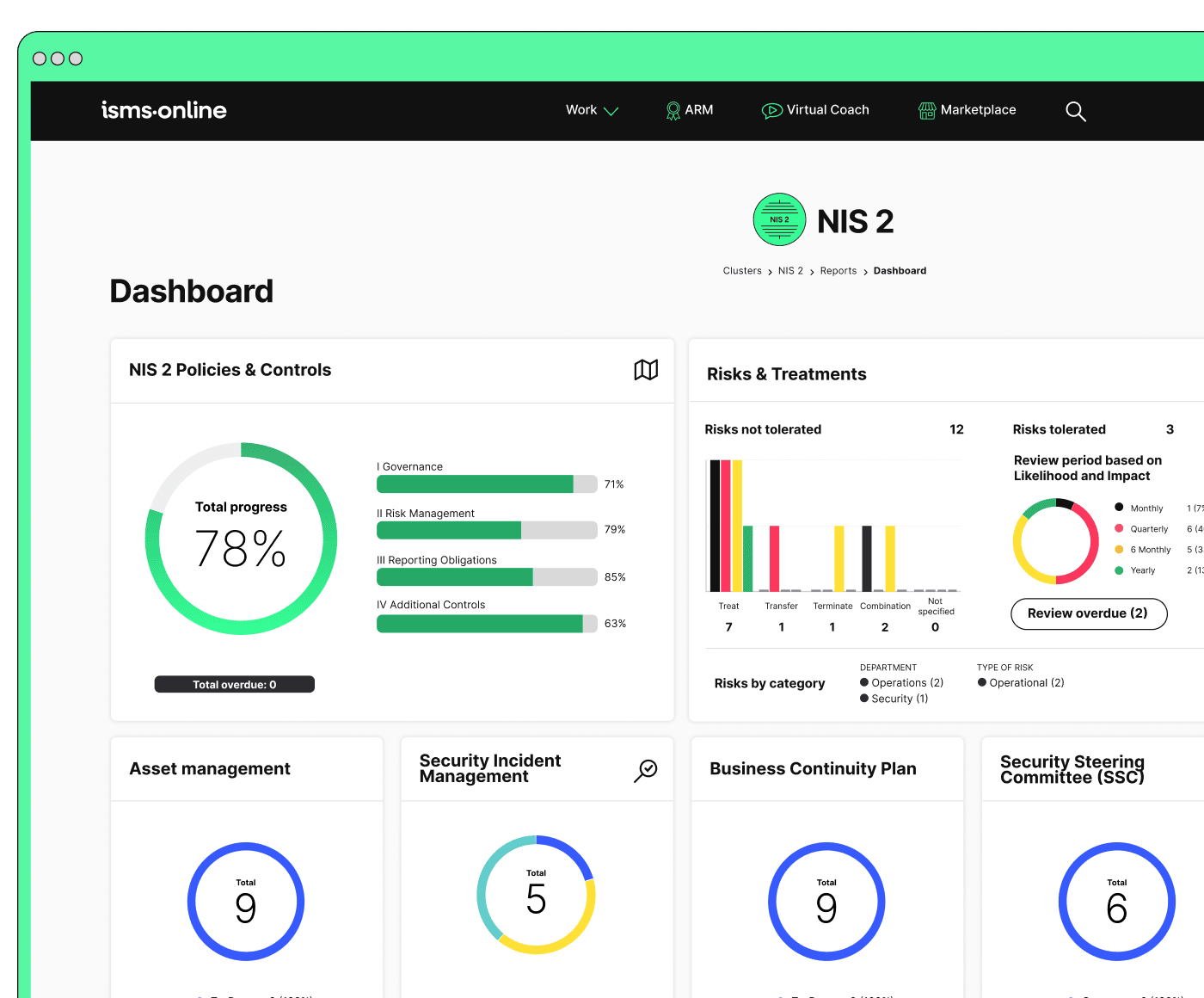
Be NIS 2-ready from day one
Launch with a proven workspace and templates – just tailor, assign, and go.
Automate or Miss: Why Real-Time Asset Logging Is the Compliance Core
A modern compliance regime is only as strong as its weakest log. Automation isn’t a luxury-it’s a regulatory expectation. ISMS.online, when integrated with trusted CMDB tools like ServiceNow, ensures every key asset event is captured the instant it happens. There is no forgetting, no late update, and no audit panic-just data, always current, tied to the right owner.
In the new compliance era, every manual step is a risk multiplier; every automation is risk reduction.
Event-Driven Asset Management in Practise
Integrated automation delivers:
- Immediate, timestamped event capture (assignment, handover, disposal)
- Owner attribution, enforced at every stage-empowering both surge resilience and clear accountability
- Tamper-proof logs, creating an immutable history for every asset-even under shifting operational realities
Every hour you spend not reconciling records is time spent on proactive security or operational excellence. Automation scales with growth, keeping risk coverage strong and asset truth up to date regardless of org size.
Formatting and Presenting Asset Evidence That Auditors (and Boards) Trust
Perfect records mean nothing if stakeholders can’t quickly follow the logic. The regulator’s new standard is clarity at speed-tables and exports that show asset, owner, event, time, risk, and mapped control in a glance. Everything else is context notes, attached docs, or drill-downs.
Fast audits reward clarity above all. Audit chaos comes from confusing tables and unclear owner records.
ISMS.online Outputs: Audit-Ready, Board-Readable
Exported asset registers from ISMS.online are formatted for regulator and board review:
- One line per asset event, with direct columns for asset id/name, owner, event, control, risk, and evidence store reference
- Role-based philtres: IT, risk, and board each see what they need
- Ready-to-go for external auditors or internal steering committees-no translation or deep-dive required
What’s more, these exports connect seamlessly with your Statement of Applicability (SoA) and ISO/NIS mappings, giving you both technical and business audiences in one structure.
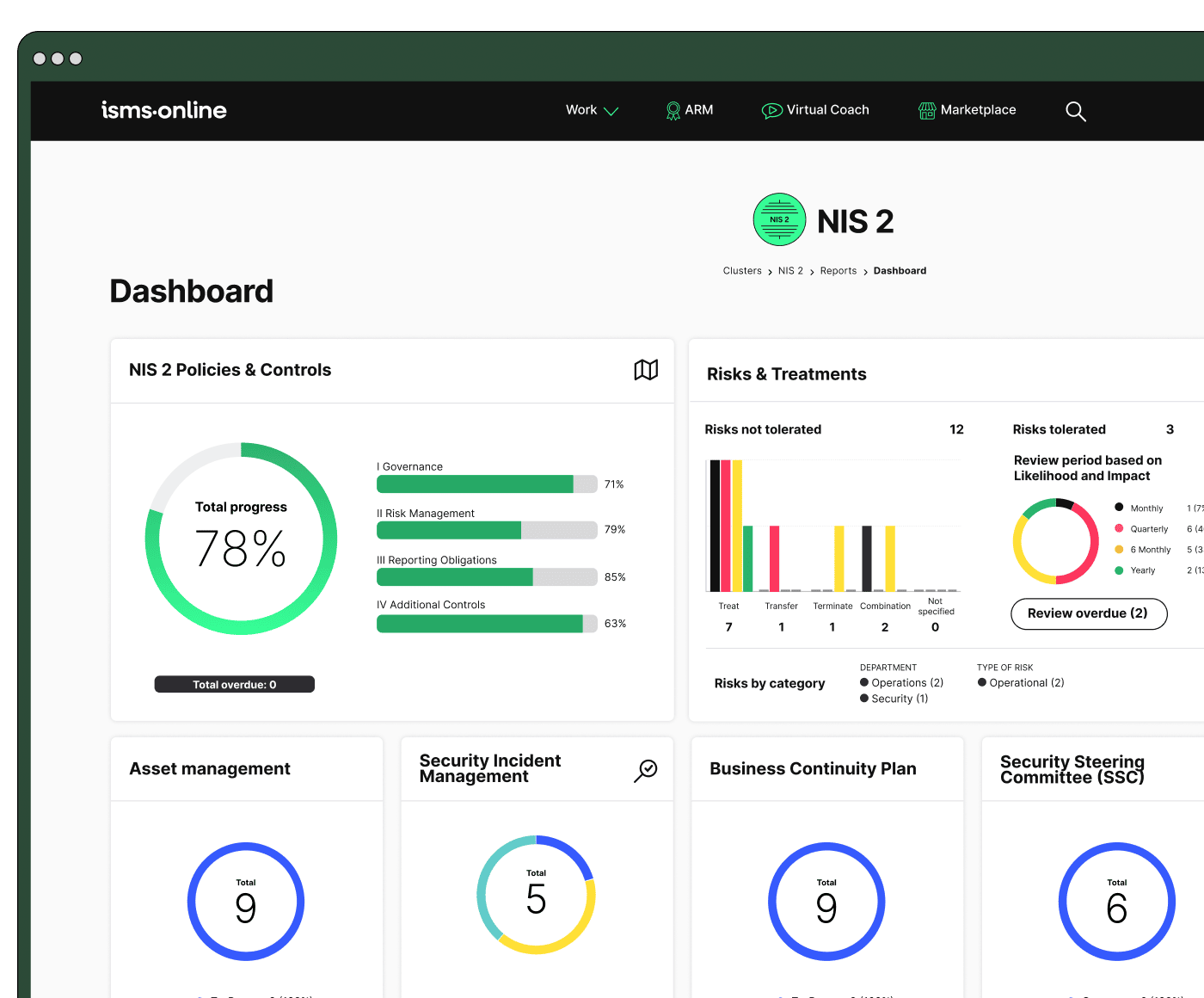
All your NIS 2, all in one place
From Articles 20–23 to audit plans – run and prove compliance, end-to-end.
From Stress to Strategy: Using ISMS.online for Next-Level Audit Confidence
A sudden audit, incident review, or risk management session: only one scenario feels like control, not chaos-the one where you can trace every asset in seconds, prove every owner and event, and map directly to your risk register and control environment. With ISMS.online and CMDB integration, you don’t scramble after the fact; you build confidence before the question is even asked.
Every asset, owner, and event-ready for inspection at any moment: that’s not just compliance; it’s leadership on display.
Now, imagine you need to prove, in minutes, the status and history of any asset-across on-prem, OT, or the cloud. With ISMS.online, you not only meet the letter of NIS 2 and ISO 27001 Annex A.5.9, A.5.18, and A.7.14; you show regulators, customers, and your own board that your organisation’s asset evidence is an operational advantage-not a weak point.
Frequently Asked Questions
Who sets the rules for NIS 2 asset evidence-and how does “real-time” redefine audit expectations?
NIS 2 compliance is enforced by a blend of European law, ENISA guidance, and national cyber authorities who now demand living, audit-ready asset evidence. “Real-time” changes everything: where once periodic asset lists sufficed, you must now prove, on demand, exactly who owns, touches, or decommissions any critical IT, cloud, OT, or personnel asset-with a timestamped trail and digital sign-off. Article 21 mandates these records, while ENISA’s 2023/2024 playbooks set the bar. Static spreadsheets or delayed updates risk regulatory findings, fines, or lost board trust, because today’s threat landscape and EU regulators treat asset truth as a moving target-measured in minutes, not months.
If you can’t instantly show who owns, moved, or approved a critical asset-auditors will treat it as uncontrolled risk.
What’s changed under NIS 2 asset evidence?
- Asset registers must be live, owner-attributed, and exportable within hours-no more “last updated” excuses
- Every assignment, transfer, or decommission must be tracked with immutable event logs and digital sign-offs
- Chain-of-custody isn’t optional-auditors expect to trace every asset’s journey in a few clicks
- All asset types (IT, SaaS, OT, people, physical) are in scope
See: ENISA NIS2 Guidance (2023/2024).
What records and integrations bridge ISMS.online and a CMDB to satisfy NIS 2 audits?
To pass a NIS 2 audit, your asset evidence must flow seamlessly between your ISMS.online environment and your CMDB (like ServiceNow, Freshservice, or ITAM). Auditors expect not just records but integration-ensuring changes, approvals, and evidence are mirrored and instantly retrievable.
Integration essentials:
- Asset register synched in real time: (unique ID, owner, status, risk classification)
- Immutable event logs: from both ISMS.online and CMDB, showing every assignment, handover, and change
- Workflow records: -approvals, exceptions, escalations-mapped to responsible owners in both systems
- Evidence attachments: (certificates, onboarding, destruction, incident logs) available directly from the asset record
- Automated integration: (API/ETL) to close evidence gaps and prevent “shadow” assets
- Exportable tables or dashboards: -asset-to-owner, risk/control linkage, event trails
| Data Element | ISMS.online | CMDB | Integration Best Practise |
|---|---|---|---|
| Owner & Status | Yes | Yes | Synched near real time (API/ETL) |
| Lifecycle Logs | Yes | Yes | Digital sign-off, time-stamped |
| Approval Workflows | Yes | If API | Linked and mapped across platforms |
| Evidence & Docs | Yes | Sometimes | Centralise in ISMS.online if missing |
| Risk/Control Link | Yes | Sometimes | Map to SoA/Annex fields |
A fragmented record is a red flag. Integration means auditors, customers, and your own team see one source of evidence-the backbone of NIS 2 defensibility.
How does linking assets to risks, controls, and incidents create a bulletproof audit lineage?
A bulletproof audit trail under NIS 2 means every asset’s unique ID is mapped in real time to its current risk status, control coverage (SoA/Annex/ISO), and incident/event history. Auditors expect to go from “asset” to “who owns it,” to “risk impact,” to “Mitigated by,” to “incident response,” with evidence in every step. If a laptop is reassigned, you document new owner, update risk, map to A.5.9/A.8.9, and log the onboarding-proving controls weren’t left to chance. Should a breach occur, you show when risk was reviewed, control amended, incident handled, and the proof attached.
| Asset Event | Risk Update | Control Mapping | Evidence Logged |
|---|---|---|---|
| Assignment/User | Owner’s risk entry | A.5.9, A.8.9 | Approval, onboarding doc |
| Transfer | Reassessed | A.5.18 | Digital handover record |
| Incident (e.g. loss) | New risk rating | SoA updated | Incident, correction log |
| Decommission | Residual risk | Asset removal | Certificate, disposal rec |
When every link in this chain is auditable and exportable, you turn asset compliance from a pain point into a source of trust-boardrooms, auditors, and regulators know you control the real story.
Why do manual or siloed asset registers fail audits-and how can integration close hidden risk gaps?
Manual spreadsheets, unconnected ITAMs, or siloed records cause assets to be lost, misattributed, or left without evidence-classic audit failures. Common problems:
- Assignment or transfer not tracked in both systems (no digital sign-off or timestamp)
- Orphaned assets-CMDB says decommissioned, ISMS.online says active
- No linked evidence of onboarding or destruction, making reviews impossible
Integrated systems fix this by logging every event, auto-checking for duplicates or conflicting status, and syncing linked risks/controls so one update triggers a holistic review.
With ISMS.online bridging to your CMDB:
- Asset lifecycle events are logged across both systems, with approvals and digital signatures
- Exception alerts catch “unmapped” assets before an auditor does
- Live dashboards reveal asset, risk, and control links instantly
Studies from ISACA (2023) and NHS (2022) show organisations with integrated asset-to-risk control chain see 60% fewer audit findings and drastically reduce readiness time.
Each asset with a digital fingerprint and mapped lineage is one less audit surprise-and reputational risk avoided.
Which export formats and dashboards do EU regulators and boards now favour for NIS 2 evidence?
Modern compliance is about actionable proof-not just “data dumps.” EU regulators and boards expect structured, filterable exports and dashboards that tell the asset risk/control story instantly.
- CSV, PDF, or Excel tables: showing asset, owner, risk, controls, and lifecycle history-sortable, filterable, indexed
- Versioned activity logs: (who, what, when) with digital signatures-traceable origin to disposal
- Bridge tables: mapping assets to risks, SoA/controls, incidents, and supporting evidence for every critical event
- Dashboards: that let boards, regulators, or buyers philtre by asset type, risk score, owner, or lifecycle status
- Bundled evidence packs: for spot checks, procurement, or due diligence
These formats accelerate audit closure. ENISA (2024) highlights that lineage-mapped and filterable exports close audit queries faster and boost regulator trust.
| Asset ID | Event | Owner | Risk | Controls | Evidence |
|---|---|---|---|---|---|
| IT-1234 | Assignment | S. Li | Breach | A.5.9/8.9 | Signed assignment |
| IT-1312 | Incident | T. Möller | Loss | A.8.8 | Incident log |
| IT-1431 | Transfer | D. Edwards | Priv. | A.5.18 | Handover record |
| IT-1542 | Disposal | IT Team | Residual | Asset rem. | Destruction cert. |
How do top performers stay ready for audits at any moment using ISMS.online and a CMDB?
Industry leaders shift from audit scramble to audit confidence by embedding traceability, role-mapped evidence exports, and continuous integration. They:
- Run regular reconciliation of asset/risk/control via ISMS.online gap/traceability dashboards
- Assemble “bridge” tables linking assets, risks, controls, and evidence-role-specific for boards, regulators, buyers, or procurement
- Simulate internal audits with live walkthroughs, showing execs or auditors every link in real time
- Ensure all activity (from all ITAMs/CMDBs/HR tools) feeds back to ISMS.online for “single source of audit truth”
- Bundle tailored evidence packs for any scenario: regulator demands, board review, or large-deal onboarding
If your team can export a complete asset-to-evidence lineage in under a day, you set the standard for compliance. Modern audit resilience comes from proactive integration, not defensive patchwork.
| Audit Task | Frequency | Owner | Export/Evidence |
|---|---|---|---|
| Asset reconciliation review | Quarterly | IT/Compliance | ISMS.online CSV/Dash |
| Evidence pack bundle | On demand | Compliance | Exported PDF/Role-based |
| Procurement SoA mapping | Quarterly | Compliance | Asset-risk-control link |
| Simulated audit | Biannual | IT/SecOps | Live dashboard demo |
| Integration check | Annual | IT/DevOps | API/ETL sync reports |
Modern compliance is engineered into every asset record-not hurried when the audit bell rings. Want to see your real audit readiness? Try a live ISMS.online export mapped to your asset CMDB.