





































Why NIS 2 Audit-Ready Backup & Restore Evidence is Non-Negotiable
In the world of NIS 2, “prove it now” is the new baseline-not just for security leads, but for every organisation. Regulators expect audit-ready, granular evidence that backup and restore systems are actually tested-not just described in policies or scattered across unrelated logs. It’s a stark departure from decades-old comfort zones where a policy PDF or an email chain might buy time in an audit. Now, any hint of ambiguity or the absence of tamper-evident logs can not only invalidate compliance, but harm your firm’s reputation and even your board’s standing (ENISA, 2024).
A backup plan that can’t be proven in the heat of a regulatory audit is no plan at all.
This shift hits all personas. Fast-moving compliance leads want the comfort of rock-solid proof to unblock revenue, not a future headache. CISOs glance over their shoulder knowing that the next restore gap could mean board-level risk or regulatory inquiry. Legal and privacy officers sweat over personal liability, especially when NIS 2’s reach crosses jurisdictions or brings GDPR, DORA, or sector overlays into scope. Meanwhile, practitioners live with the burden-scrambling to find a dated log, track down missing evidence, or reconstruct who did what after the fact.
The real challenge isn’t running backups-it’s proving operational resilience, linking every test (both clean runs and choked failures) to a transparent audit trail. NIS 2 evaporates relaxed standards: only audit-ready, digitally-linked, and role-attributed evidence satisfies today’s board, regulator, and market.
What “Audit-Ready” Backup Evidence Really Means in Practise
Can your team walk an auditor or board member through every restore test-showing not just successes, but failures, corrective actions, and exactly who signed them off and when? That’s what NIS 2 expects, and “audit-ready” evidence means far more than a date-stamped action list. Each instance must be contextual: role-linked, policy-mapped, risk-connected, and closed.
Privacy or legal teams-under regulatory spotlight-must be able to demonstrate the full “story” of each test or failure. For a restore failure, the evidence must track the discovery, action, closure, and tie it back to both the asset at stake and the policy/standard that governs it. In the harshest audit, a spreadsheet can’t replace a signed, tamper-proof log and a clear ownership trail (ENISA, 2024).
Audit credibility isn’t won by a list of passed tests-it’s earned by a chain of failures tracked to closure, with transparent sign-offs.
A strong evidence pack from ISMS.online is more than an inventory: it tells a story the board and regulators trust, from first backup schedule to the closure of your last failed test. For every persona, this lifts audit anxiety into confident demonstration.
Building Blocks of “Audit-Ready” Evidence
- Date-stamped Exports: Exports as PDF/CSV, fully versioned, with every event mapped to the time and actor.
- Role Attribution: Every action is linked to a named, accountable owner-no ambiguous “system” or “service account” assertions.
- Correction Loop Closed: Each failure prompts a corrective action, which must be closed and signed off before evidence is finalised.
- Policy/Standard Mapping: Entries reference Annex A of ISO 27001, NIS 2 Article 21, or sector overlays, clarifying the control and risk context.
- Approval Tracking: All approvals, reviews, and changes are captured and exportable-no invisible steps.
Audit Bridge Table: ISO 27001, NIS 2 Foundations
| Expectation | Operational Reality | Control Reference |
|---|---|---|
| Backups scheduled and tracked | Owner, frequency, timestamp in log | A.8.13; NIS 2 Art.21(2)a |
| Restore testing for all assets | Restore logs with failures, corrective action, closure and sign-off | A.8.13, A.10.1; NIS 2 Art.21(2)c |
| Correction and closure checking | Every failure triggers an action, tracked to signed closure with UTC time | A.8.8, A.8.13; NIS 2 Art.21(2)d |
| Link to policy and risk system | Entry links directly to policy/risk reference, responsible team/person | ISMS Policy Map/SoA, NIS/Annex |
| Audit trail to management | Management & board sign-off, date, change log exported with evidence | A.9.3, A.9.2; NIS 2 Art.23 |
This is the table you show-at audit, board review, or regulator demand-to tell the full story.
Traceability Mini-Table
| Trigger (Event) | Risk Update | Control/SoA Reference | Evidence File(s) |
|---|---|---|---|
| Restore test fail | RTO re-evaluated | A.8.13, NIS 2 Art.21 | “Test2123-fail.pdf”, signed |
| New schedule | BIA refinement | A.8.8, A.5.29 | Policy version, approval log |
| Audit exception | Correction action filed | SoA: ISMS-00123 | Action plan, sign-off |

Master NIS 2 without spreadsheet chaos
Centralise risk, incidents, suppliers, and evidence in one clean platform.
Structuring Your ISMS.online Evidence for Audit Survivability
The most common audit failure comes not from missing backups-but from poor evidence structure: missing closure, fragmented logs, or a broken chain from test to management review. ISMS.online addresses each pain by baking in policy mapping, role assignment, anomaly-tracking, and closure into every record (ISO Documentation, 2024).
An error logged, fixed, and signed is bulletproof; an error unclosed is an audit hazard.
Picture the workflow: every restore test assigned to a responsible team or role, outcome logged (success/fail), every fail triggers an action, with closure, sign-off, and policy/risk mapping all visible-and audit-exportable.
For auditors, board, or regulators: This creates confidence that what you say is what actually happens-no last-minute evidence scramble, no blame games.
Stepwise Evidence Structure
Schedule & Ownership Attachment
- Each critical system gets a frequency, owner, policy cross-link.
- No log is “orphaned”-ownership is transparent for every backup and restore.
End-to-End Test Logging
- All outcomes recorded-success, failure, “late”, context notes.
- Failures prompt a mandatory corrective action.
- Closure can’t be signed off until someone (with authority) logs the fix.
Policy & Risk Mapping On Every Event
- Each backup or restore links to policy clause (A.8.13 etc), mapped back to risk register.
- When failures are closed, reference is logged on the SoA (Statement of Applicability) or risk update-making board/exec queries easy to answer.
Exports: Audit-Optimised
- Philtre for only what the auditor or board wants to see: by date, system, role, risk.
- Ready-to-share, versioned PDF/CSV, always with the last update date and approval chain.
Longevity & Tamper-Proof Search
- Past events archived, never overwritten, always filterable.
- Approvals, closures, and remediations tagged to role, time, and policy.
How to Export, Present, and Defend Evidence with ISMS.online
No matter how strong your evidence, it’s worthless if misunderstood by the auditor, regulator, or board. ISMS.online is designed to make evidence not just stored, but explainable. Each export combines logs, role links, closure steps, SoA context, and board sign-offs-filterable by risk, system, or organisational role.
A well-mapped export can remove tension from an audit in 60 seconds.
When your CEO, CISO, or DPO is grilled about a failure, a few clicks surface every instance-first failure, remediation, signed closure, and board acknowledgement-mapped to policy and risk.
What happens in practise: Instead of days of “evidence archaeology,” you produce a table or report that walks anyone through the cycle: fail → action → closure → management sign-off → ready when the regulator or client wants proof.
Export Fields & Examples
| NIS 2/ISO Requirement | Export Field in ISMS.online | Example Output |
|---|---|---|
| Test event metadata | Time, owner, system | “2024-06-01 15:00Z, CRM1, Rest Fail, Paul” |
| Control/policy mapping | Clause, linked asset | “A.8.13; NIS 2 Art.21c → CRM1” |
| Reviewer sign-off | Approval chain | “Paul (IT), Closed by CISO: Board Q2/24” |
A report with this data, filtered per system or asset, gives each stakeholder confidence that backup and restore processes aren’t just running-they’re controlled, owned, and resilience-enabled.
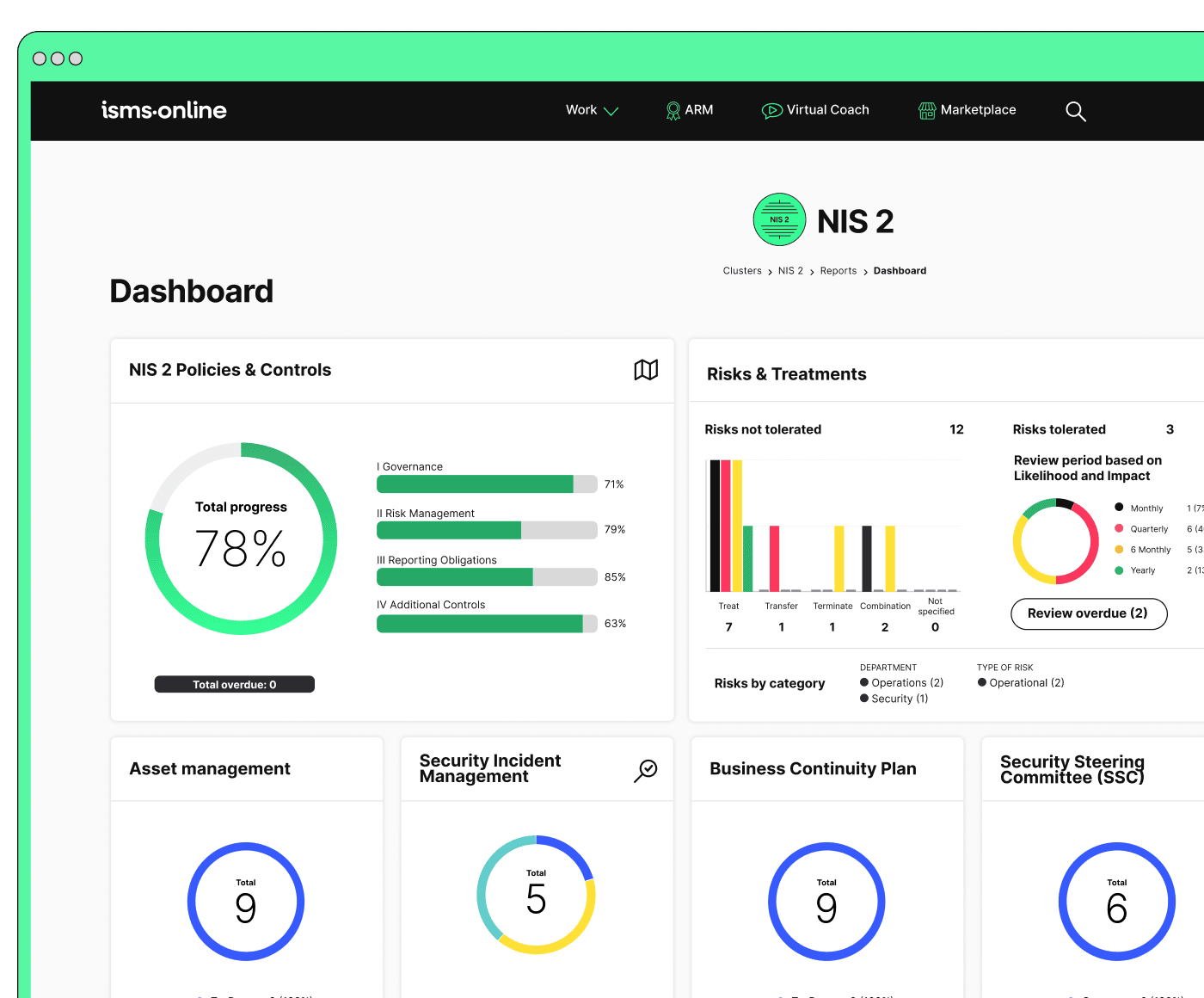
Be NIS 2-ready from day one
Launch with a proven workspace and templates – just tailor, assign, and go.
Error-Proofing: Avoiding Common Audit Pitfalls in Restore Evidence
All the tech in the world is useless if your restore test failures vanish in the ether or aren’t tracked to closure. Regulators care less about “how many passed” and more about “whether every error was found, fixed, and signed”-with all events visible, role-assigned, and mapped to a standard (NCSC, 2024).
Success only matters if every failure can be explained, closed, and shown at audit.
Think of it as a lifecycle: each restore event, success or fail, feeds the next-failure triggers a fix, fix gets closure and sign-off, with evidence logged for every role.
Missing closure or untracked errors are what trip even mature teams. An ISMS.online export can surface these instantly. If a row is missing a closure or owner (or if a “fail” didn’t result in a correction), it’s visible-and can be remediated before the audit becomes confrontational.
Preventing Mistakes in Evidence Chain
- Track every restore (not just the backups): each failure triggers workflow, not just an email.
- Enforce role and timestamp for every fix and closure; stray events are no longer hidden.
- Centralise all evidence; practitioners are spared last-minute evidence panic.
- Use exports with clear traceability: one glance tells who, when, what failed, what was done.
Traceability Table Example
| System | Last Restore | Failure | Correction | Closure | Owner |
|---|---|---|---|---|---|
| CRM1 | 2024-06-01 | Yes | Action#221 | 2024-06-03 | Paul |
| ServerA | 2024-05-20 | No | – | N/A | Sarah |
Bridging Evidence to Controls-NIS 2, ISO 27001, and Board Review
Audit-proofing isn’t just about showing an auditor a neat log-you must be able to walk any reviewer instantly from evidence to control, policy, and risk. Executive and board-level reviews demand not just the log, but its meaning: “Which control failed?” “How quickly did we fix it?” “Show me the sign-off and how it addresses our risk exposure.”
Bulletproof compliance means every artefact traces through policy, asset, incident, fix, closure, and sign-off-making your system explicit to all eyes.
With ISMS.online, every export is annotated to its origin: policy clause, asset, system, risk. This is critical, especially when sectors (finance, health), privacy overlays, or cross-border jurisdictions have specific demands.
Steps for Systematic Evidence Mapping
- Every log entry is cross-mapped to the originating policy/control (“A.8.13”, “NIS 2 Art.21c”).
- Remediation steps and closures update the SoA and risk register.
- Board and exec-level reports are derived without manual “join the dots”.
- Privacy/sector overlays (GDPR, healthcare) annotated as needed for one-click mapping in regulated environments.
Evidence Mapping Table
| Evidence File | NIS 2 Article | ISO/Annex Ref | Export Page |
|---|---|---|---|
| CRM1 backups (May-Jul) | Art.21(2)a,c,d | A.8.13, A.10.1 | 5–8 |
| Email restore failures | Art.21(2)d | A.8.8, A.8.14 | 9 |
| Board sign-off summary | Art.23 | 9.3, 9.2 | 11 |
| GDPR incident closure | Art.23,34 | A.5.34 | 13 |
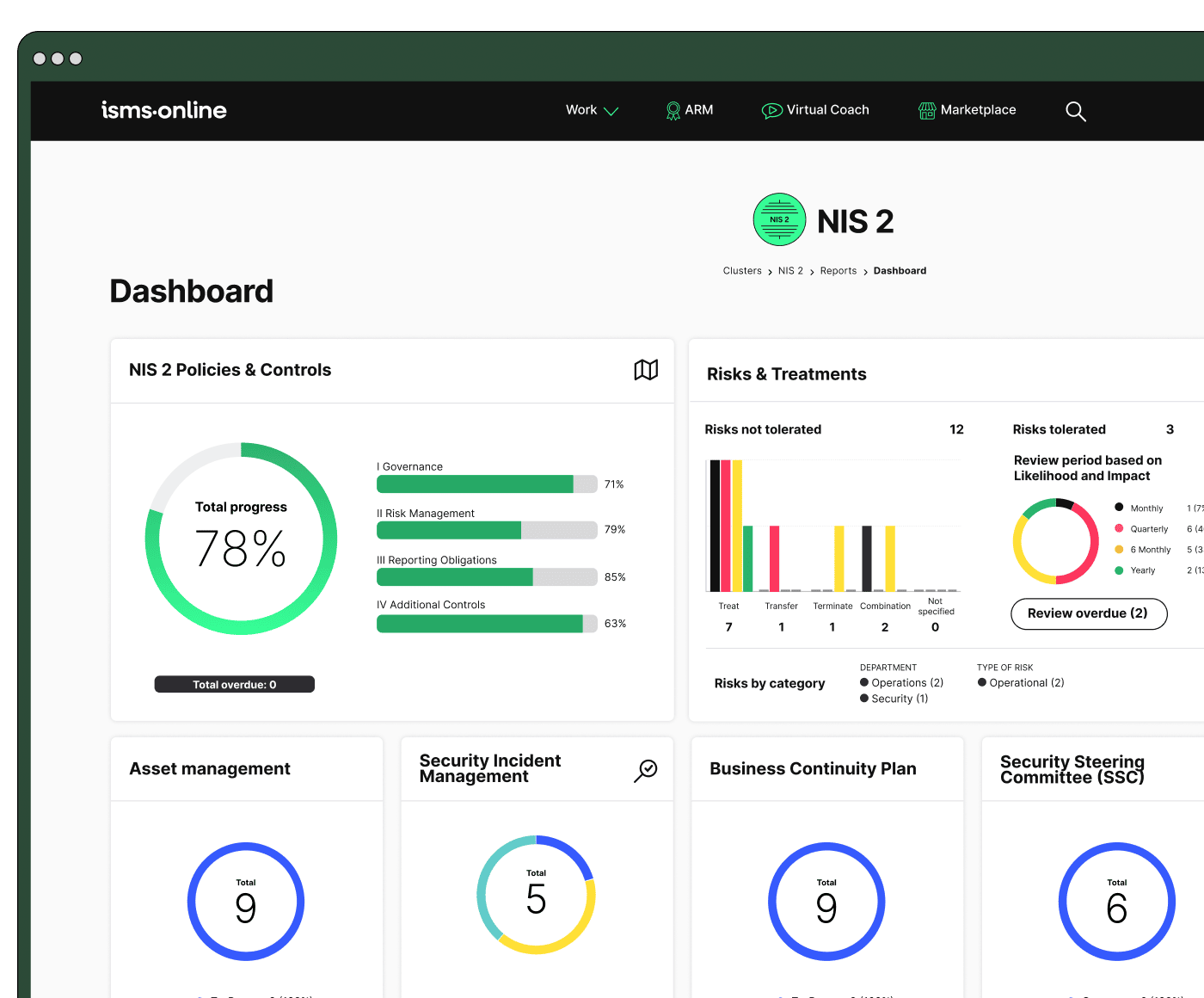
All your NIS 2, all in one place
From Articles 20–23 to audit plans – run and prove compliance, end-to-end.
Adapting Evidence for Boards, Regulators, and Sector Overlays
General backup/restore tables might pass a vendor product pitch, but sectoral regulators (finance, health, critical infrastructure) and boards expect specific overlays: additional closure fields, executive signatures, and sectoral timelines (ENISA, 2024).
Customising the evidence bundle for each audience is the difference between frictionless approval and audit fatigue.
Sector overlays (finance, health): ISMS.online lets you philtre and export evidence with required fields or signatures. Jurisdiction overlays (for cross-border or GDPR) can be pre-configured, ensuring nothing is missed during an audit. Board packets focus on closure, risk, and authorisation, supporting executive decision-making without technical confusion.
- Executive bundles: Summaries of assets, key restore tests, closure/approval cycles, with language suited to non-technical directors.
- Supplier/partner packs: Asset, test, and risk log filtered by entity/jurisdiction for outsourcing or procurement compliance.
- Custom overlays: Add required audit information by regulator, sector, or board need.
What this delivers: Precision, trust, and rapid turnarounds-no more panic or politics at review time.
Experience Audit-Ready Backup Proof with ISMS.online
There’s no substitute for seeing evidence mapped and ready for every audience, from the hands-on practitioner to the board and regulator. ISMS.online’s live audit exports surface every test, closure, and sign-off-mapped to control, policy, and sector overlays-filterable and explainable for each stakeholder in seconds.
- Live trial: Walk step-by-step from a restore fail through corrective action and closure to executive review, filterable by role, date, or system (ISMS.online, 2024).
- Sector templates: Use out-of-the-box packs for regulated sectors (banking, health, supply chain, critical infrastructure) with fields and overlays tailored to your compliance frame (BSI, 2024).
- Industry overlays: Add GDPR, DORA, or other sector overlays by toggling in export.
- Easy sharing: Share evidence, filtered per audience, directly-board, regulator, supplier.
Boards and regulators trust what they can verify-give them mapped, signed logs, not paper promises.
If your organisation is still running backup compliance as a patchwork of policy, recovering from every audit with a forensic search, it’s time for a zero-stress, evidence-first workflow.
Move Beyond Compliance-Build Unshakable Trust with ISMS.online
Resilience is not a claim-it’s a trackable story, proven line by line, asset by asset, mapped and closed for every audience. With ISMS.online, your audit pack becomes an asset, not a liability: every restore tested, every failure closed, every log traceable by role, date, and control. No more audit fire drills. No more evidence anxiety.
Live confidence, not just compliance. Export, present, explain, and prove your resilience story-one mapped, audit-ready log at a time.
Start your audit-ready journey. Be the team boards and regulators trust to deliver evidence that stands up when it matters.
Frequently Asked Questions
Who in your organisation must review and act on NIS 2 backup and restore test evidence?
Your NIS 2 backup and restore evidence draws scrutiny from a broad leadership coalition, not just IT. The board’s audit or risk committee is formally accountable for resilience oversight and must review, question, and sign off on the integrity of backup and restore test results. The CISO or delegated security head is centrally responsible-coordinating test scheduling, remediation, and closure, and mapping outcomes to regulatory controls. IT teams (including third-party providers if used) perform restores, log events, resolve failures, and escalate issues. Compliance managers and DPOs validate that evidence is mapped correctly and complete for audit. In regulated sectors, procurement or legal may review supplier evidence. Internal and external auditors need unbroken chains from test to sign-off; sector regulators or major customers may request access on demand.
Every backup isn’t just a technical matter-it’s a reputational safeguard for leadership and an operational proofpoint for auditors.
ISMS.online operationalises these lines of responsibility: every backup event is auto-mapped to an owner, closure is tracked, and board sign-off is logged-protecting against orphaned issues or surprise audit gaps.
Table: Who’s Responsible for NIS 2 Backup Evidence?
| Role/Function | Core Actions Performed | Audit/Regulator Visibility |
|---|---|---|
| Board/Audit Committee | Review, strategic approval | Yes |
| CISO/Security Lead | Schedule, approve, remediate | Yes |
| IT / System Admin | Perform, log, escalate tests | Yes |
| Compliance / DPO | Map evidence for audit, review | Yes |
| Procurement/Legal | Supplier review (if regulated) | Conditional |
| (I/E) Auditors | Validate completeness | Yes |
| MSP/Supplier (if relevant) | Provide/attest to event logs | Conditional |
What makes a backup/restore evidence bundle “regulator-proof” under NIS 2 (beyond just logs)?
A “regulator-proof” evidence bundle under NIS 2 is more than a dump of logs-it is a curated, closed, and cross-referenced file linking policy, test result, corrective action, and board review as a single thread. Every restore test and backup action must show its linkage: what asset, who owned it, the mapped NIS 2/ISO control, the final reviewer, and closure status. Documentation must cover:
- Current, version-stamped backup/restore policy: aligned to NIS 2 Art.21(2)c, ISO 27001 A.8.13.
- Restore test logs: with asset, timestamp, outcome (pass/fail), and next steps where failures arise-retained for at least 12–18 months.
- Corrective action/closure record: for every failed or late test, with owner and sign-off.
- Audit-approved sign-offs for each event: named reviewer, date-stamp, closure notes.
- Test-to-control mapping worksheet: making explicit connections between each event, control, and asset.
- Evidence that findings, open issues, and trends were reviewed by management or board.:
This creates a full circle for auditors and regulators: each log can be followed from risk identification to board discussion and management action, eliminating ambiguity.
Recent ENISA guidelines (2024) and ISMS.online’s own mapped export features are designed precisely to make these bundles export-ready.
Table: Regulator-Proof Bundle Checklist
| Item | What It Proves | Controls/References |
|---|---|---|
| Policy (versioned) | Requirement origin & current process | NIS 2 Art.21(2)c / ISO A.8.13 |
| Restore test logs | Activity, asset, outcome, traceability | Control/SoA/board review |
| Corrective action | Closure and accountability | NIS 2, ISO, internal policy |
| Reviewer sign-off | Ownership and responsible closure | Control/SoA/audit |
| Mapping worksheet | Test→control/event link | Policy, Asset, Owner, Ref |
| Board review record | Senior oversight, issue escalation | Risk register / Board |
How do you map backup/restore evidence for instant audit traceability against NIS 2 and ISO 27001?
Audit traceability means every backup or restore log, policy update, and corrective action is “tagged” to a regulatory article, ISO control, asset, owner, and closure status. In ISMS.online, this is managed via a mapping worksheet or export table embedded with every evidence bundle-so reviewers can philtre on control, status, or owner instantly.
Table: Backup Evidence Mapping Example
| Entry/Log | NIS 2 Article | ISO 27001 Control | Asset | Date | Owner | Status |
|---|---|---|---|---|---|---|
| RestoreTest#109 | Art.21(2)c | A.8.13 | PayrollServer | 2024-05-12 | L Esteban | Closed |
| PolicySnapshot | Art.21(2)a | A.8.13 | ALL | 2024-06-01 | M Brady | N/A |
| ActionClosure#4 | Art.21(2)c | A.8.13 | HR_Share | 2024-05-30 | Y Patel | Open |
ISMS.online’s mapped exports let you pull this mapping instantly for any event, so auditors and regulators track context, owner, and remediation without delay. This shortens audit time and prevents procedural gaps.
See the ISMS.online knowledgebase for a live workflow export.
What are common traps that cause audit findings or failures in NIS 2 backup evidence?
Even well-intentioned teams fall into five evidence traps that auditors penalise:
- Unclosed failed tests: Failed restore events are logged but never documented through to remediation and closure.
- Stale or siloed logs: Evidence is outdated, scattered, or doesn’t link assets/owners-proof of full coverage is impossible.
- Missing control references: Test outcomes not mapped to NIS 2 articles or ISO controls-making audits manual, slow, and error-prone.
- No timestamped reviewer sign-off: If logs lack named approvals or versioning, accountability and integrity are questioned.
- Last-minute “panic pack”: Evidence isn’t recorded as-you-go but scrambled together before the audit-leading to errors, omissions, and audit stress.
Break the loop: use ISMS.online’s role mapping, mapped reviews, and closure discipline. Schedule self-audits and automate test-to-control mapping so your evidence stands up to scrutiny before an external reviewer ever sees it.
How does ISMS.online reduce team burden and audit risk for NIS 2 backup/restore evidence?
ISMS.online acts as a workflow engine and audit safety net for backup and restore compliance:
- Centralised evidence management: All tests, remediation, and board reviews are logged, filterable, and version-controlled.
- Audit-ready mapped exports: Every test, corrective action, and closure is mapped to controls and asset owners-automatically.
- Role-specific notifications: Assigned owners and reviewers get real-time alerts for missing actions or open failures-ensuring nothing falls through the cracks.
- Export bundles for every audit type: Instantly generate evidence packs mapped to NIS 2, ISO 27001, DORA, or sector overlays as needed.
- Tamper-proof audit trail: Automated logs and closure events are locked and time-stamped, protecting your team from “who did what” disputes.
Instead of scrambling before audits, your team operates in a state where readiness is ensured by daily practise-not panic.
What are the continuous improvement actions for always-on audit readiness in NIS 2 backup/test evidence?
Build a cycle that transforms backup/restore evidence from static proof to operational advantage:
- Quarterly restore tests: Schedule, log, and map every outcome to controls, asset, and owner.
- Immediate ownership and closure: Unclosed or failed events stay on dashboards and trigger reminders until resolved.
- Rolling 60/90-day reviews: Surface and resolve stale logs or incomplete closures with scheduled self-audits using ISMS.online dashboards.
- Board/committee bundles: Regularly present mapped evidence and closure summaries to your board or risk committee.
- Update role and asset mapping: When team or supplier changes occur, update ownership and asset mappings in the platform-keeping evidence current.
- Sector overlay agility: Use philtres to create custom bundles for DORA, NIS 2 regulators, or customer requests-no manual repackaging.
Moving from reactive audits to a living, mapped compliance system closes the loop between IT, security, and risk-making proof effortless.
Ready to see how this continuous audit readiness cycle works in real time? Review mapped examples and walkthroughs on our ISMS.online knowledgebase.






