





































What Does It Really Mean to Be “NIS 2-Compliant” in Czechia? Claiming Compliance vs. Proving It
No matter what industry you’re in, NIS 2 compliance in Czechia is not just a matter of ticking regulatory boxes-it’s a living, ongoing commitment to operational resilience, proven governance, and demonstrable evidence flows. Too many organisations in 2024 still confuse compliance with a static file, an email chain, or a last-minute panic before the auditor arrives. The reality is more demanding: authorities, insurers, and even board members now expect instant proof of registration, supply chain review, and incident traceability-all cross-referenced to NÚKIB standards and Czech law.
Most failures in NIS 2 readiness trace back to missing, mismapped, or outdated evidence, not a lack of intent or effort.
In Czechia, the lines are clear: NÚKIB is your national regulator, but sectoral CSIRTs (cyber-security response teams) and industry authorities all play a part. You’re expected to know, record, and prove every contact, trigger, or chain of custody that could matter in a breach or an audit. “Good enough” is never enough-penalties, insurance denials, and reputational damage now land on the shoulders of directors, not just IT managers.
Compliance in Practise: Evidence, Accountability, and Board Value
Regulators and auditors in Czechia don’t just check forms-they trace the full chain: was an incident or change logged, time-stamped, exported for review, and highlighted to the board or owner? Is your Authority Directory live and accurate? Are suppliers traced to contracts, incidents to Board review, and all logs exportable on demand?
This is the new standard: living compliance. And it’s no longer reserved for the enterprise sector-mid-sized providers, hospitals, financial entities, and utilities are directly in scope. Without seamless process mapping, authorities can declare noncompliance even if your actual cyber hygiene is strong.
Belief Inversion: Compliance Is Not a Project, Its a Workflow
Projects can finish; compliance cant.
Your controls, directories, and incident chains must update the moment an owner or supplier changes, not at the end of the quarter, or when the auditor knocks. The strongest indicator of NIS 2 maturity in Czechia is this: You can export the trigger-to-evidence chain for any material event, without hunting through individual email threads or static Excel sheets.
If youre just starting, focus on trigger mapping and live directory maintenance before anything else-this is the heart of both Czech and pan-European audit defence.
Book a demoWhy “Who Handles My Incident?” Is No Longer a Rhetorical Question
For Czech businesses, assuming the enforcement map is a generic EU formality is out-of-date thinking; single-channel reporting can trigger cascading failures in compliance, audit, and insurance review. Czechia’s system distributes accountability across NÚKIB, sectoral authorities, and multiple CSIRTs. Each acts as a different bolt in the machinery-miss one, and the breach or incident goes from an operational headache to a legal and reputational crisis.
A one-size-fits-all incident process is a myth. Get the reporting chain wrong, and directors-not just IT-may face exposure.
Czech law-and the NIS 2 Directive’s full implementation (Act No. 264/2025 Coll.)-positions legal representatives, executive owners, and directors in the firing line for noncompliance. That means the first question after any material incident-“Who is responsible for notification?”-now divides organisations into two camps: those who can prove their contact and escalation list works, and those who can’t.
Multiplicity of Authority: Mapping Czech Enforcement So You Don’t Guess in a Crisis
Going beyond the “national CSIRT” headline, Czech enforcement creates a mesh of duty:
- NÚKIB: orchestrates national cyber regulation and overall compliance cadence.
- GovCERT.CZ: handles major incident triage for critical infrastructure and state-linked sectors.
- CSIRT.CZ: primarily supports digital providers and private/cloud sectors.
- Sector authorities: (e.g., CNB for finance, CTU for telecom, MoH for health) may have parallel reporting triggers-often with stricter or more rapid notification windows.
An eligibility check via NÚKIB’s site is your starting gate. From there, live directory management-and sector-specific contact flows-keep you aligned as the law and your business both evolve. Outdated contact chains remain one of the leading causes of noncompliance findings in 2024 audits. Anyone relying on a static PDF or spreadsheet for emergency reporting should expect scrutiny-from both their board and their regulator.
Objection: “But Our Incident Chain Starts with IT” – Rebuttal: Not Under Czech NIS 2 Rules
Incident initiation remains a team sport, but the legal onus has shifted: “IT will tell us when we need to act” is no longer defensible. Legal, board, and dedicated compliance owners all have to demonstrate their hand in every notification, update, and export-because regulatory risk now follows the management chain, not just technical leads.

Master NIS 2 without spreadsheet chaos
Centralise risk, incidents, suppliers, and evidence in one clean platform.
Why the Authority Directory Is Your Compliance Nerve Centre-And What Happens When It’s Outdated
An organisation’s Authority Directory is not just phone numbers and names-it is the single point of proof most likely to be requested by a regulator, auditor, or cyber insurer after an incident. Imagine being scrutinised, mid-crisis, on whether you even know who to call-or having your insurance claim delayed because a single role wasn’t updated in the last 10 days.
Most NIS 2 penalties in Czechia are triggered by directory lag, not technical breach.
The NÚKIB maintains a live, evolving directory. For sector-specific domains, additional lists exist-especially in banking, telecom, and healthcare (where regulatory complexity scales). Czech law mandates updates within 10 business days of any qualifying event-new director, incident, address change, or other material update. But timing is only half the puzzle: what matters is the evidence chain. If you cannot produce timestamped logs, confirmation emails, or platform exports showing instant synchronisation with the official portal, your directory is considered out of date.
Operationalising Directory Compliance: Automating Proof, Not Just Process
Modern ISMS platforms (including ISMS.online) bridge the gap by allowing all changes, confirmations, and exports to be unified in your evidence pack-no parallel emailing or “print-this-to-PDF” hacks. Real audit resilience requires the kind of workflow where, if an auditor or regulator requests a record, you can export the full event-to-directory chain within minutes, always with traceability.
Process Map: From Trigger to Audit-Ready Directory
- Identify material trigger (director change, incident, new contract).
- Update the directory via the official portal.
- Download/email system confirmation, or enter the log ID in your platform.
- Export evidence to your compliance repository or ISMS register.
- Include the update in board packs or management review notes-never leave it as “future admin.”
Fail this process, and you risk audit failure, delayed recovery, and director-level liability.
Reporting the Wrong Way: The Fastest Route to Audit Failure and Fines
In a Czech NIS 2 audit, the most frequent cause of failure is not a missing technical control, but one of two scenarios: (1) reporting incidents to the wrong authority or (2) late directory updates with no evidence of corrective action.
A delayed or misrouted incident report can cost your business far more than a technical fix.
Here are the main pitfalls:
- IT-only reporting model: Leaves the legal/board chain out. This can trigger regulator escalation, with fines for personal rather than just organisational neglect.
- Ad hoc/incomplete logs: Slack messages, call notes, or unsaved submission forms are not audit defensible.
- Static compliance files: These do not capture the rolling truth; Czech authorities expect “living” evidence, not a project from last quarter.
Time Pressure and Evidence Chain: “24/72-Hour Rule” and Beyond
The compliance clock in Czechia starts ticking from the moment your management knows of an incident, not when forensic reports conclude. A 24- or 72-hour window is common-and if incident detection > notification > evidence export isn’t seamless, legal exposure rises. The mantra: “Delay is risk; traceability is defence.”
Incident reporting, supplier chain tracking, and director directory updates must be mapped, logged, and referenced in your Statement of Applicability (SoA) and board reviews. Failing this, directors may personally face regulator inquiries or even financial penalty, especially as Czech law sharpens its teeth.
ISO 27001 Bridge Table: Expectation → Operationalisation → Reference
| Expectation | Operationalisation | ISO 27001/Annex A Reference |
|---|---|---|
| Timely incident notification | 24/72-hour incident workflow | A.5.25 (event assessment) |
| Supplier review/log | Register, contract cross-link | A.5.19–A.5.21 (supplier mgt) |
| Director evidence update | Directory proof, Mgmt review | 9.3 (Management Review) |
Audit survival in Czechia is increasingly evidence-first: if you can’t trace the event at every stage (who, when, what, how), you forfeit presumption of compliance. Boards now expect real-time traceability, not lagging documentation.
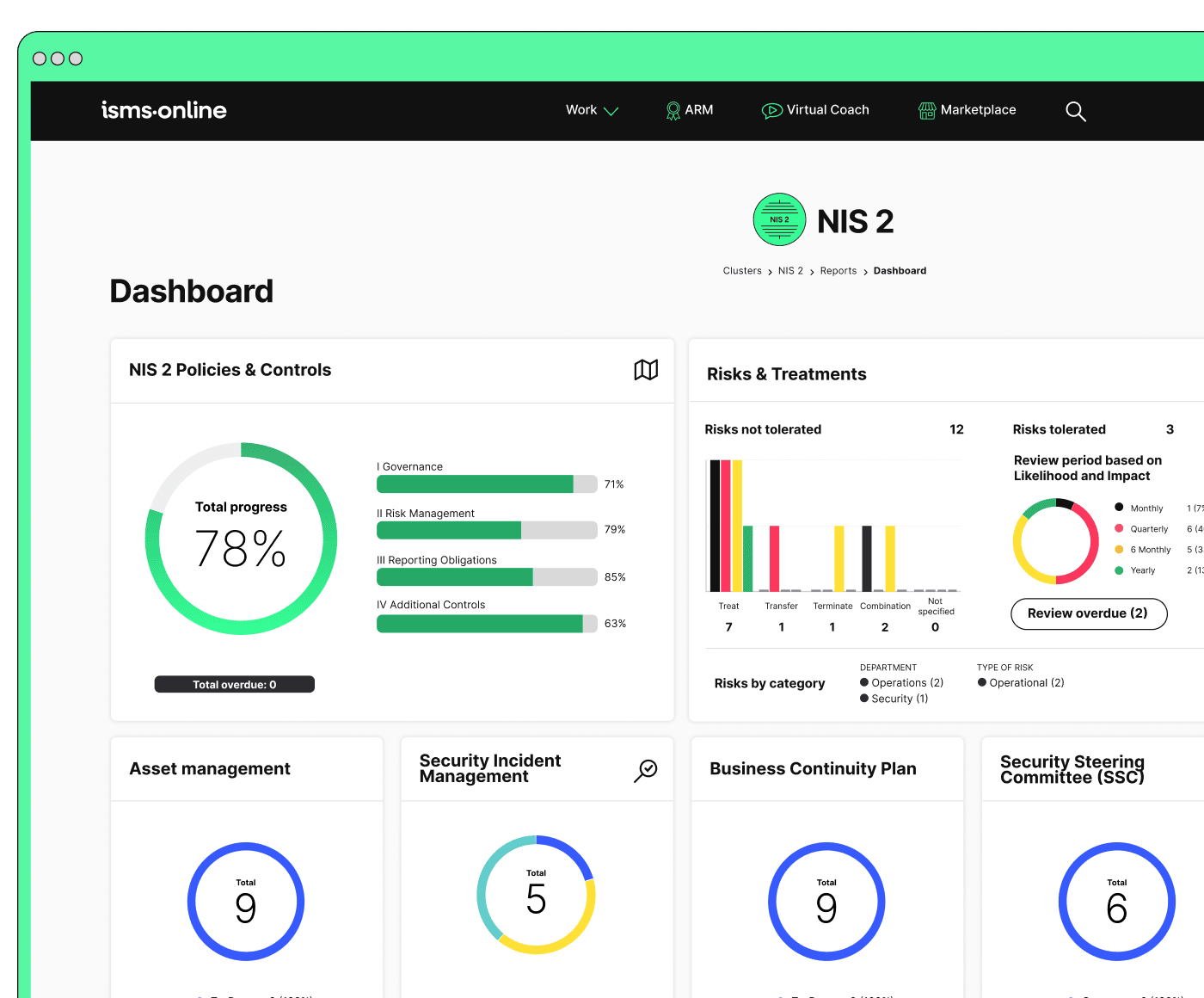
Be NIS 2-ready from day one
Launch with a proven workspace and templates – just tailor, assign, and go.
How to Turn Your Incident Chain into Boardroom and Regulatory Capital
No more “hopeful” compliance. Czech regulators and boards share rising expectations: every incident, near-miss, or supplier event must now be visibly linked to management review, risk register, and, for advanced organisations, quantified in risk-adjusted capital or insurance exposure.
The new competitive edge: the board that sees cyber risk as financial capital, not just a compliance penalty.
Workflow mapping is essential: your IT, procurement, legal, and compliance/board functions need to be in a continuous evidence loop-no more silos. In practise, this means:
- Incidents are not only recorded but referenced (and improved upon) in the Management Review.
- Supply chain events are fed back into biannual or quarterly reviews; gaps and near-misses receive documented corrective actions.
- Sector-specific workflows (health, finance, telecom) are mapped to relevant internal audits, ensuring Czech and sectoral authorities see cross-control.
Traceability Example Table: Trigger → Risk Update → Control/SoA Link → Evidence
| Trigger | Risk Update | Control / SoA Link | Evidence Logged |
|---|---|---|---|
| Detected incident | Incident log update | A.5.25, SoA, Mgmt Review | Exported ISMS log + board notes |
| Supplier fails biannual review | Vendor risk updated | A.5.19–A.5.21, Mgmt Review | Supplier register + links |
ISMS.online’s auto-exporting ensures each of these chains-incident, supplier, directory-can be produced instantly, greatly improving audit defensibility and director protection.
The New Board Expectation: Resilience Capital, Not Just “Compliance”
The best Czech compliance teams know boards no longer settle for “tick-box” proof. They expect living registers, cross-linked director/supplier logs, and Management Review packs that can be exported at quarter’s end-or during a regulator call in the middle of a breach.
Resilience is what’s visible in your evidence chain, not just in what you avoid.
Most mid-size companies now must map roles, evidence, and board updates at a minimum monthly cadence to stay in the clear. The Management Review (ISO 27001:9.3) is now both a strategic and operational checkpoint; it closes the “visibility-risk” gap between operational teams and the top table.
“Living” Registers: Audit-Ready Workflow Table
| Trigger Event | Responsible Owner | Required Action | Evidence Exported |
|---|---|---|---|
| Director onboarding | Legal / Board | Directory update | Timestamped export, minutes |
| Major incident | IT / Compliance | Incident log + notify | SoA export + authority receipt |
| Supplier onboarding | Procurement / IT | Register + risk review | Supplier log, audit extract |
Executives need to see compliance as a source of operational resilience and reputational capital. Linking management reviews to incident/supplier evidence is now the best-practise defence for every NIS 2 audit.
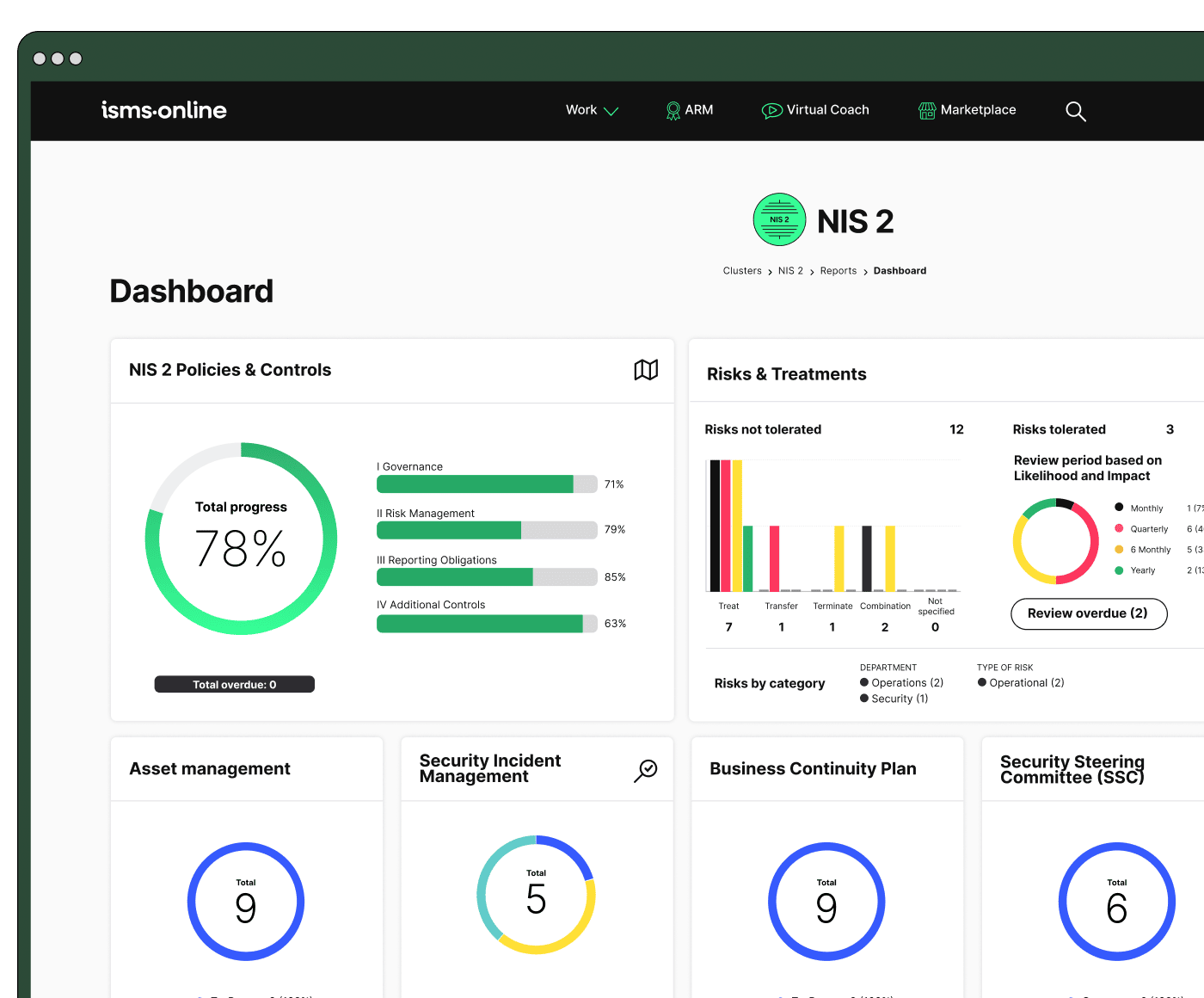
All your NIS 2, all in one place
From Articles 20–23 to audit plans – run and prove compliance, end-to-end.
Why ISMS.online Is Designed for the Czech NIS 2 Playbook
ISMS.online wasn’t built for theory-it responds to the real demands of Czech NIS 2: live registration, incident, and supplier logs that can be mapped, exported, and reinforced as law or best practise shifts. With a single compliance platform, you’re equipped to:
- Sync registration actions: with national and sectoral authorities.
- Timestamp, log, and export: every incident and directory change.
- Link supply chain evidence: to incidents, biannual reviews, and contracts-fulfilling both ISO 27001 and NIS 2 cross-control mandates.
- Import and leverage legacy compliance registers and policy logs: without starting from scratch.
ISMS.online enables every practitioner-whether a handy IT manager, a cautious legal owner, or a board-level risk leader-to build defensibility into every workflow step. Audits, authority queries, insurance reviews-all are met with confidence, not delay.
Board and Practitioner Assurance
With ISMS.online, your next audit, review, or regulator call is a source of assurance, not risk. The board isn’t left guessing-live registers and mapped evidence provide reputational, legal, and insurance value. With sector-mapped demo slots and templates, even the toughest sectors-health, finance, digital services-can move from basic compliance to resilient, auditable proof.
The capital you need-confidence, resilience, regulatory trust-is already latent in your data. The right systems just reveal and align it.
A Practical Czech NIS 2 Survival Routine: Who Leads, What Triggers, and Evidence Chains Mapped
Your NIS 2 routine is a living choreography-never a “set-and-forget” checklist. Assigning roles and time-stamped actions transforms compliance from a liability hedge to a resilience multiplier for the board.
Czech Compliance Timeline – Steps, Owners, Actions, and Evidence
- Eligibility Mapping: Board/Compliance uses the NÚKIB portal to determine sector/obligation-owner logs confirmation.
- Directory Synchronisation: Legal or board designate records all qualifying changes in the official portal, logs export for review.
- Incident → Directory → SoA Workflow: IT/Compliance team logs every incident in an ISMS platform (with evidence), triggers directory/authority update, exports log for audit.
- Supplier Chain Review: Procurement/IT team runs biannual or quarterly supplier reviews, risk updates, and logs evidence for integration in Management Reviews.
- Board Loop: Each review cycle, evidence packs and directory exports are presented to the board; sign-off is documented and exportable for audit or regulator queries.
Mini-Table: Trigger-to-Evidence Chain
| Trigger | Owner | Platform Action | Evidence (for Audit) |
|---|---|---|---|
| New director | Legal/Board | Directory update | Portal log export + board email |
| Detected breach | IT | Incident log, update | ISMS export, authority receipt |
| Supplier event | Procurement | Register, contract | Supplier audit extract |
| Board approval | Board Sec | Mgmt review docs | Signed meeting notes, exports |
At each phase, ask: Is the record current? Can it be exported for a regulator, insurer, or board query at short notice?
Final Word: Czech NIS 2 Compliance as a Continuous, Multi-Owner Workflow
True NIS 2 compliance in Czechia is not a finish line but a rolling choreography of triggers, live evidence, and mapped ownership-fused with board and regulatory visibility. Whether you’re new to these rules or migrating established workflows, your only route to resilience is through actionable, auditable proof at each step.
With ISMS.online, every sector- or entity-specific requirement-registration, incident chain, supplier review, management sign-off-becomes a defensible asset. The days of “Excel compliance” or “compliance as a project” are done. In Czechia, compliance is capital-and capital is in the evidence you export, not just the boxes you check.
Resilience isn’t what you promise. It’s what you prove with a living, board-ready chain of evidence.
Frequently Asked Questions
Who enforces NIS 2 compliance in Czechia, and how do NÚKIB, CSIRTs, and sectoral authorities actually coordinate?
NIS 2 compliance in Czechia is governed by a multi-layered system where NÚKIB (the National Cyber and Information Security Agency) acts as the central supervisory authority-handling registration, oversight, audit, and sanctioning for all regulated organisations. Incident response is shared: GovCERT.CZ (run by NÚKIB) is responsible for critical infrastructure and the state sector, while CSIRT.CZ covers digital providers and the wider private sector. Sectoral regulators-like the Czech National Bank, Ministry of Health, or Energy Regulatory Office-run parallel risk and incident notification chains, especially for organisations with regulated services (finance, health, energy, telecom).
If you’re in scope, you may have to notify both your designated CSIRT and your sectoral regulator during certain incidents or changes. The 2025 Cyber-Security Act defines these mandatory reporting lines; failures to notify correctly cause many fines and audit fails. Always verify your CSIRT and sector regulator using NÚKIB’s portal, and document all contact points to avoid communication gaps in a real-world breach.
Czech Enforcement Structure Overview
| Area | Lead Authority | Entities Covered |
|---|---|---|
| Registration & Audit | NÚKIB | All “essential/important” organisations |
| Incident Response | GovCERT.CZ (NÚKIB) | Critical infrastructure, state |
| Incident Response | CSIRT.CZ | Private sector, digital providers |
| Sectoral Oversight | Respective Regulator | Finance, health, energy, telecom |
Reporting to the wrong CSIRT, or missing your sector regulator, doesn’t just risk fines-it can cripple your claim with insurers and slow a breach response. Always cross-check the Authority Directory.
Further reading:
NÚKIB · ·
What does the NIS 2 Authority Directory do, and why is its accuracy always under the audit microscope?
The NIS 2 Authority Directory-run by NÚKIB-is the live, legal register of every entity covered by NIS 2 in Czechia. It documents your sector, leadership, contact info, technical context, and operational footprint. Directory accuracy isn’t a one-time box-tick: any material change (director, address, key supplier, process) must be logged through the online portal within 10 business days.
This directory is the “source of truth” for both regulators and sectoral authorities. Lapses or outdated records are the number-one reason Czech organisations get fined or have insurance claims denied-not failed technical controls. The submission receipt from the portal is vital legal evidence in audits and must be archived. Most sectoral regulators run their own supplementary registers (especially in banking or healthcare); organisations must check for and fulfil these parallel directory mandates.
| Task | What’s Required | Reference Authority |
|---|---|---|
| Initial registration | Complete core and sector details | NÚKIB (mandatory) |
| Material changes | File within 10 days via portal | NÚKIB, sector regulator |
| Audit evidence | Retain receipt from online submission | NÚKIB, sector regulator |
| Sectoral registers | Check and comply with sector overlays | CNB, Health, Energy |
More than half of Czech penalties come from missed directory updates-simple errors that leave firms exposed in both audits and real-world claims.
Dig deeper:
NÚKIB Contact Points · ·
What are the core operational duties and ongoing NIS 2 compliance steps for Czech organisations?
After confirming your eligibility through NÚKIB and registering in the Authority Directory, ongoing NIS 2 compliance in Czechia requires diligent process integration-not just annual checkboxes. Compliance stays audit-ready only if operational, technical, and board-level evidence are kept live.
Czech NIS 2 Weekly-to-Quarterly Obligations
- Annual (or trigger-driven) risk assessments: Update controls and insurance based on evolving threats, not just calendar cycles.
- Live incident and supplier registers: Every incident, near-miss, and new supplier or risky cloud arrangement is logged, evidence-traced, and includes outcome documentation.
- Biannual supplier reviews: More frequent if you on-board strategic/critical providers, especially in cloud or data hosting sectors.
- Incident notification by workflow: Initial “alert” to CSIRT and sector regulator within 24 hours, expanded detail by 72 hours, resolution within one month-all via the NÚKIB portal.
- Quarterly board & management review: Collate all NIS 2 records-risk, incidents, supplier reviews-for board sign-off; archive final minutes and the evidence pack.
- Ongoing directory updates: Any “material fact”-director changes, suppliers, address, ownership-must be updated in 10 days (with receipt).
| Compliance Event | Owner | Required Action | Audit Evidence |
|---|---|---|---|
| New director | Board/Admin | Update Directory | Portal receipt, board minutes |
| Supplier change | Procurement | Log review, update register | Supplier log, approval, receipts |
| Incident or breach | IT/Security/Compliance | Notify and document | Incident log, NÚKIB portal receipt |
| Quarterly Review | Secretary/Board | Evidence pack, sign-off | Board minutes, evidence archive |
Neglecting these ongoing workflows leaves management personally liable for failures-not just the compliance team.
For indexed frameworks and sector tips:
BDO: NIS 2 & CZ Cyber-Security Act ·
Which pain points undermine NIS 2 compliance most in Czechia, and what strategies protect against audit burnout and failure?
The biggest compliance failures aren’t technical-they’re operational: mismatched contacts, labour-intensive manual updates, conflicting or unclear sectoral chains, and evidence scattered across email, Excel, or incompatible tools. Organisations that silo compliance in IT or legal, excluding procurement, HR, or the board, face burnout and audit gaps.
How Czech leaders build audit-proof compliance:
- Move to live, assignable registers: Ensure every compliance action-directory change, incident, supplier onboarding-has a named owner, timestamp, and traceable workflow.
- Use Czech-calibrated ISMS solutions (such as ISMS.online) to automate audit trails, register reviews, and evidence packs. Automation reduces human error and ensures that events trigger review steps and legal records.
- Schedule routine, quarterly reviews of the Authority Directory, supplier register, and incident log-don’t leave these until crisis or internal audit windows.
- Pre-build relationships with NÚKIB and sectoral CSIRTs to clarify escalation paths in advance; waiting until an incident is risky and slow.
- Link directory, supply, and incident management so evidence is always retrievable, not reconstructed under audit pressure.
Auditors don’t forgive silos or last-minute fire drills-workflow integration is now the Czech standard for passing, not ‘heroic’ recovery.
In-depth resources:
Why Czech Firms Struggle – ITPro ·
How does regular board and management review unlock true resilience-and reduce compliance risk-under NIS 2 in Czechia?
The updated Czech Cyber-Security Act ties compliance directly to board and management performance. Auditors demand proof that quarterly reviews-covering directory, supplier, and incident logs-are routine, signed off, and archived. This “resilience by design” makes evidence integration a management habit, not a panic response.
Creating a resilient, audit-winning workflow:
- Board packs: Each quarter, export the combined Authority Directory, supplier and incident logs, and sign the archive-this becomes your primary audit artefact.
- Integrated sign-off chains: Have the board and management formally sign all compliance logs and evidence packs at each review. Minutes and signature archives offer legal backup in both audits and regulatory investigations.
- Real-time registers: Live, cross-linked records show your compliance is operational, not “project-based.” When regulators inspect, you can deliver evidence on demand-proving compliance is continuous.
ISMS.online is proven for Czech organisations-tying records, registers, and workflow automation into sector-tailored board reports that withstand scrutiny.
Key readings:
CMS LawNow – New Cyber-Security Act ·
What are the most serious regulatory risks under NIS 2 in Czechia, and how have leading firms avoided them?
Czech NIS 2 penalties are steep: up to €10 million or 2% of global turnover for “essential” entities, €7 million/1.4% for “important” ones, plus personal sanctions for directors. Public disclosure of violations is common. But the main triggers for sanctions are routine failures: missed directory updates, late notifications, unlogged supplier changes-not hacking, but basic admin lapses.
Proven defence strategies:
- Meet 10-day update windows without fail: ; archive portal receipts and review team logs to build a continuous audit trail.
- Automate connections between registers: so every event in incident, supplier, and directory logs pushes updates to a board-ready evidence pack-using platforms such as ISMS.online.
- Quarterly board-ready packs: Always be ready to produce a real-time compliance archive for sector or government review.
- Learn from Czech audit survivors: Leading organisations credit their audit pass and insurance coverage to early adoption of integrated, automated workflow-avoiding “stale evidence” and lone hero risk at the last minute.
Being ‘audit-ready’ is a living discipline at the management level; Czech regulators now penalise complacency more harshly than technical gaps.
For practical case studies:
GemSystem: Board Responsibility Risks · BDO: NIS 2 in Practise
Which concrete steps should Czech organisations adopt now-and how does ISMS.online make NIS 2 audit-readiness sustainable?
- Confirm your entity’s eligibility: by sector and validator chain through NÚKIB’s portal; proactively update directory, supplier, and leadership information “before” you’re chased.
- Create evidence chains: mapping every risk event or change (director, supplier, incident) to a digital, searchable register-linking portal receipts, logs, and signed board minutes.
- Tie reviews to board and management routines: -formalise quarterly check-ins, exporting integrated compliance packs and archiving each for the next audit.
- Engage with ISMS.online experts: for Czech sector-specific workflow templates, automated registers, and board evidence packs. These are calibrated from major Czech audits and operationalised with leading firms-ensuring every legal, supplier, and IT link is covered.
- Transform compliance into reputational and insurance capital: -by embedding visible, proactive evidence routines, not last-minute defence.
ISMS.online gives your team Czech regulator-tested workflows and automation: continuous compliance, board integration, and audit-chain evidence-moving you from crisis-driven audit sprints to durable, operational resilience under NIS 2.






