





































Are You Treating Digital Traceability as Your Leadership Edge? Lithuania’s NIS 2 Regime Demands It
What once passed as “IT housekeeping” is now an executive-level, digitally traceable race for trust. Lithuania doesn’t just flag NIS 2 as another compliance task-it makes digital audit records, live supply chain mapping, and real-time incident logs the new gold standard for market credibility, regulatory survival, and reputation. If your business still reviews policy folders quarterly or outsources compliance to “someone in IT,” that era is already obsolete.
When every supply chain misstep, late breach notification, or unsigned control is visible to regulators and customers, leadership means traceability-at board speed.
This article dissects exactly how NIS 2 enforcement lands in Lithuania: who’s responsible, what’s changed in legal accountability, and how real companies are closing the local–EU compliance gap. You’ll see the digital hooks-NCSC dashboards, CERT-LT readiness maps, executive sign-offs in ISMS.online-that define audit winners versus also-rans.
Carrier-grade clarity, and not just another NIS 2 explainer: every section is tuned to the persona building an ISMS that is impossible to challenge in court, on an RFP call, or in a regulator’s inbox. Lithuanian teams who master digital proof win tenders, earn board trust, and sail through multi-regulator audits-those clinging to last year’s process are already being left behind.
In Lithuania, Who Holds the Actual Power-and What’s Changed for Board Liability?
The 2024 NIS 2 regime in Lithuania isn’t academic. Enforcement now runs through the National Cyber Security Centre (NCSC), and not lurking in obscure committees-Act XIV-2902 gives the NCSC teeth: it assigns accountability, issues fines, and publishes official registers of responsible executives. Subordinate supervisors (Bank of Lithuania, CRAs, sectoral boards) may execute routine inspections, but the NCSC is the regulator’s “north star”-no more ambiguity about who “signs off” on gaps, fines, escalation (digital-strategy.ec.europa.eu; baltictimes.com). Audits, board briefings, and even incident investigations now unambiguously trace to one body.
More consequential: NIS 2 ties named executive and board liability directly to compliance function and response. The NCSC publishes a live directory of compliance leaders for each regulated entity-if your board or key manager isn’t on file, you’re non-compliant by default.
Visualise your compliance landscape: executives now open their governance dashboards to see an “NCSC Liaison” tile at the top-contact details, audit log, responsibility for every material decision. This isn’t busywork; NIS 2 audits now actively test if those digital records are real, current, and traceable. Lithuania’s shift is about operationalising responsibility, not just documenting it.
Your compliance isn’t a folder in Dropbox-it’s an active register, accountable and audit-ready, visible to your sector authority and the NCSC every day.

Master NIS 2 without spreadsheet chaos
Centralise risk, incidents, suppliers, and evidence in one clean platform.
Are You Sure You’re Not in Scope? Lithuania’s Expanded Boundaries and the Trap of Complacency
The myth that “IT companies, education, or local government probably aren’t in scope” is gone. Lithuania’s in-scope register exploded in 2024-over 8,000 organisations now meet NIS 2 requirements, from SaaS and utilities down to mid-sized suppliers for critical industries. The triggers are brutally specific:
- Essential: ≥250 staff or €50m turnover
- Important: ≥50 staff or €10m turnover
- Supplier: Serving any in-scope entity
You don’t need to guess. Monthly registrar updates from the NCSC and sectoral bodies publish every covered entity, with board-level accountability, contact, and live audit status. Key compliance moments are no longer hidden in legalese:
| Scope Trigger | Regulatory Contact | Board Action |
|---|---|---|
| ≥250 staff/€50M | NCSC or sector regulator | Assign executive, register, monitor |
| ≥50 staff/€10M | NCSC or sector regulator | Update contacts, prep audit evidence |
| Supplier to in-scope | Customer’s sector authority | Respond to evidence requests |
To check your true status:
- Check headcount and revenue-if you hit these thresholds, you’re visible.
- Verify listings with the NCSC registry-is your board liaison or CISO listed?
- Watch for direct regulatory notices-any request to an exec inbox is a compliance trigger.
- Don’t ignore your supply chain-SMEs can be pulled into audits simply by supplying in-scope entities.
Lithuania’s message is blunt: being listed is just Step One; building a continuous, documented, and updatable ISMS is now a standing board requirement-not a project.
Don’t expect grace periods-audits began in July 2024, and the portal for notification closes in April 2025. If you’ve received even a single notification, or support a covered client, your compliance clock is ticking, not paused.
Why Lithuania’s CERT‑LT Is Now at the Centre of NIS 2 Survival (Beyond “Incident Response”)
CERT‑LT, Lithuania’s national CSIRT, now runs as both digital fire brigade and resilience coach. Under NIS 2, its powers reach beyond “responding to breaches”-it proactively orchestrates readiness, runs sector “red team” drills, and checks whether your incident notification playbook is real or hypothetical (digital-strategy.ec.europa.eu; nis2certification.eu). Their timelines are non-negotiable:
- 24 hours: Initial incident notice, even if you only suspect severity
- 72 hours: Interim assessment-must include forensic data, containment measures
- 30 days: Final lessons and remedial plan
If you’re late, miss a beat, or file incomplete records, the penalty is not just a fine-it’s regulator attention, possible executive exposure, and public notification. Repeat offenders risk personal scrutiny for boards and C-suites.
Every minute from detection to report is recorded-CERT-LT’s log is the new chain of custody for reputation and regulatory trust.
Smart teams join CERT-LT’s readiness workshops-not just for compliance, but for real-time audit rehearsal. These sessions let you “fail safely” before the audit itself, tuning playbooks based on today’s threat landscape.
Lithuania’s CERT-LT pipeline also syncs your incident logs with ENISA and EU CyCLONe, so multinational and cross-border incidents don’t fall through cracks-reporting and evidence links are maintained even under pressure.
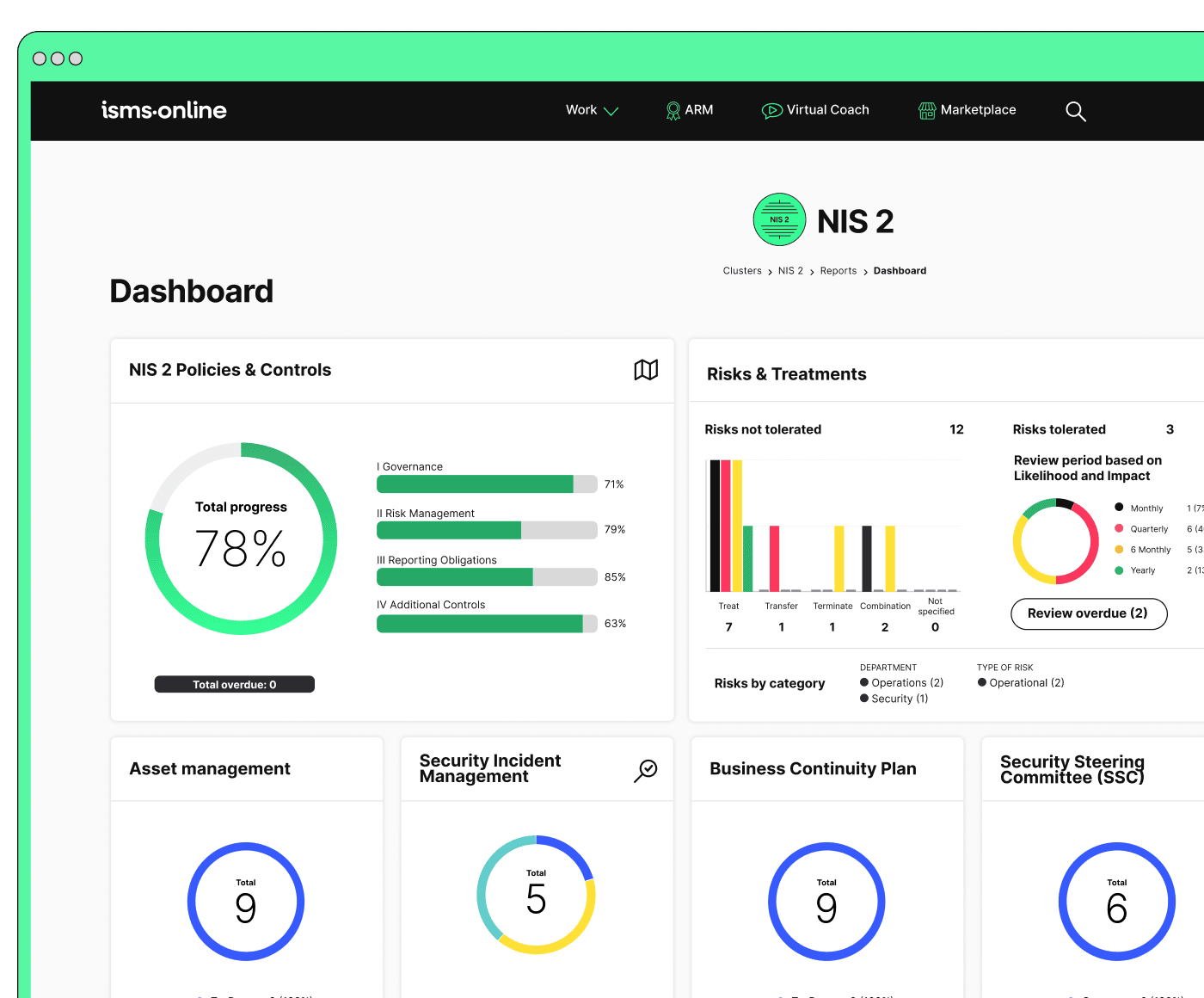
Be NIS 2-ready from day one
Launch with a proven workspace and templates – just tailor, assign, and go.
Is Your Supply Chain Really Audit-Ready? Why Traceability Is the Board’s New Weak Point
In Lithuania, risk isn’t the absence of a policy-it’s the inability to prove your supply chain is monitored, contractually governed, and actioned at board level. 2024’s audits flag systemic traceability as the difference between a pass and a deficiency:
- Map every supplier, including indirect/tier-2.
- Attach signed contracts and risk analyses to each vendor record.
- Annually review-and timestamp every review, listing the responsible board or exec.
- Escalate missing evidence or overdue actions to board review within 7 days.
Failures here are immediately visible in audits. The regulator notifies your board; chronic issues are published. Persistent non-conformance can escalate from penalty to public warning.
Template risk assurances don’t count. What matters is live, dated evidence-backed by board sign-off and ready to defend in any regulator inquiry.
For SMEs and lean teams, Lithuanian guidance is “proportionality first”-but only for prioritisation. Your critical vendors must have the same documentation as enterprise ones. The “promise to fix” era is over; document or be exposed.
How Multi-Regulator Coordination Changes the Audit Game: From Fragmented Reviews to Dual Compliance
The Lithuanian playbook no longer allows privacy, cyber, and sector audits to live in silos. Nearly every NIS 2 inspection is now co-managed by the NCSC and a sector body-State Data Protection Inspectorate, Bank of Lithuania, or industry supervisors. These dual audits bring new rules:
- Core reports: align with ENISA and EU CyCLONe templates for cross-EU consistency; using approved crosswalks is the most efficient way to avoid redundancy.
- Divergent deadlines: (GDPR, DORA, NIS 2): you must map, track, and maintain each in real time-expect to show timestamped logs for every submission.
- Smart escalation: Teams that “pre-query” their sector regulators 7+ days before deadline clean up audits faster and with less pain. Early visibility is now self-defence.
Your compliance team’s digital calendar is probably the single most valuable asset-colour-coded by type (privacy, cyber, dual), pre-building exports for each scenario.
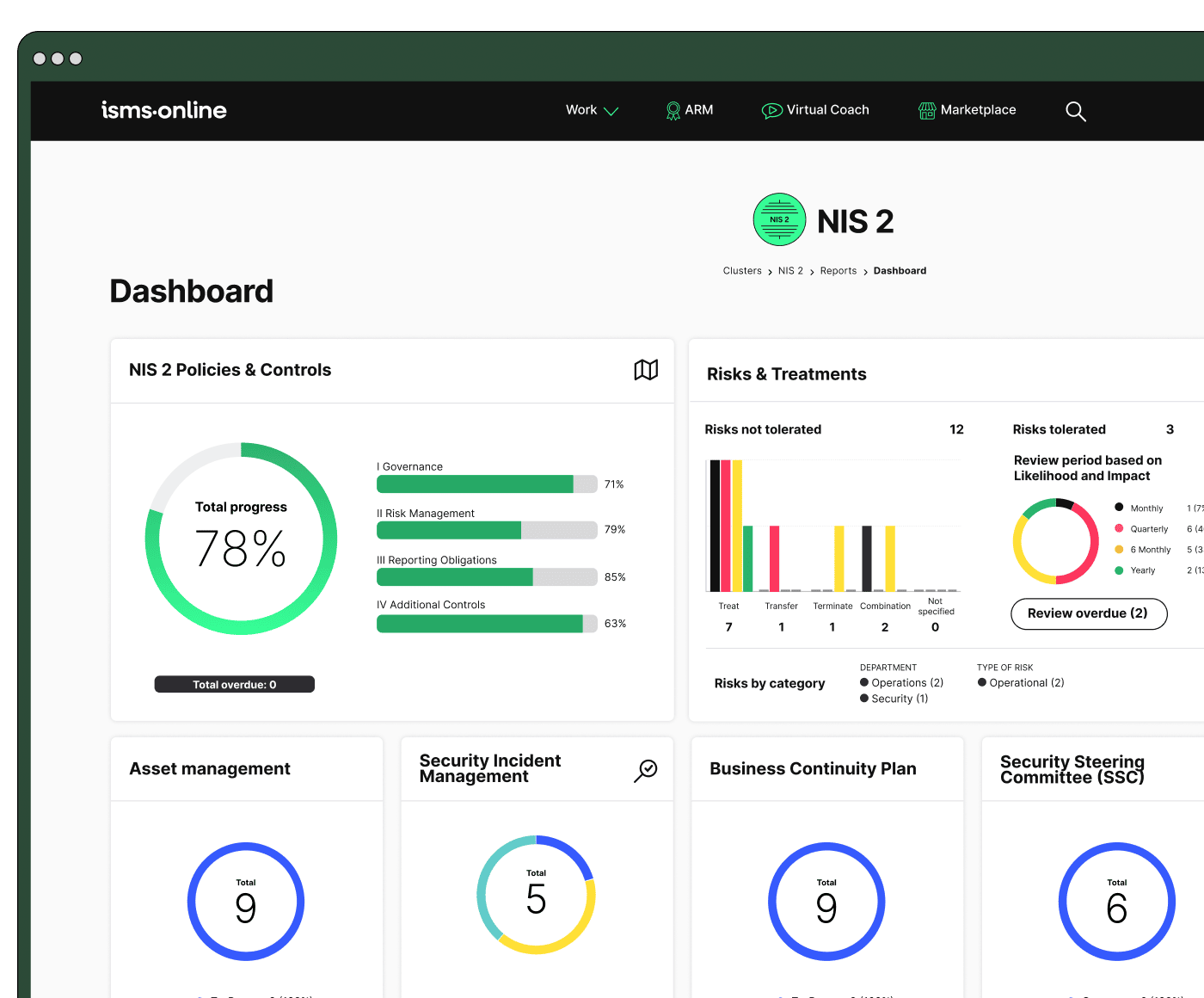
All your NIS 2, all in one place
From Articles 20–23 to audit plans – run and prove compliance, end-to-end.
Can You Prove Regulatory Harmonisation-Or Are You Still Chasing Three Separate Standards?
In Lithuania, “one action, three proofs” is now policy. Every mature organisation is expected to crosswalk NIS 2, GDPR, and DORA controls so that one evidence record can be shown to multiple authorities. But blowing audit smoke won’t do-the digital evidence bank must show live activity, not reference-only logs.
| Expectation | Operationalisation | ISO 27001 / Annex A Reference |
|---|---|---|
| Board signs off on supply chain risk | Risk register updated annually, contracts logged, executive sign-off each year | A.5.19, A.6.1, A.8.1, A.5.36 |
| Documented incident response 24h/72h | Incident plan, CERT-LT workflow, digital logs from ISMS.online or equivalent | A.5.24, A.5.26, A.8.14 |
| Evidence mapped once for DORA/GDPR/NIS 2 | Live digital evidence bank with mapped crosswalks, SoA-linked | Cl.9.2, Cl.8.2, A.5.30, A.5.29 |
What does “mature” look like? In ISMS.online, live crosswalks mean one action creates a mapped trail-ready for the board, for each auditor, and for sector supervisors. “Reference-only” tables are no longer enough-logs and exports must be updated and accessible on demand.
Are Your ISO 27001 Controls and Evidence Banks Strong Enough for Lithuania’s Modern Audit?
ISO 27001 is not just legacy “good practise”-it’s Lithuania’s baseline for NIS 2 investigations. Auditors scrutinise not simply the Statement of Applicability (SoA), but the connection between every SoA item and timestamped, user-attributed digital records (sgs.com; advisera.com). Fragmented registers, PDFs, or paper-based logs all risk immediate failure.
| Trigger | Risk Update | Control / SoA Link | Evidence Logged |
|---|---|---|---|
| Supplier contract renewal | Risk register, SoA updated | SoA A.5.19, A.5.21 | Updated contract, SoA log |
| Incident detected | Incident plan + CERT-LT contact | SoA A.5.24, A.5.26 | Incident log, hotline, sign-off |
| Board quarterly review | Board minutes, SoA approved | SoA A.5.36, Cl.9.3 | Board review record, evidence bank |
With ISMS.online, your compliance team can philtre any workflow or trigger-incidents, supplier reviews, board approvals-and instantly export digital logs for SoA mapping. When “anyone at any time” can request evidence, the only strategy is digital readiness. Audit-defensible records are now a team-wide attribute, not just an IT trophy.
Digital Audit-Readiness: The Lithuanian Standard No One Can Afford to Skip
Lithuania’s NIS 2 and cross-EU regulation regime no longer accepts “after-the-fact” documentation. The universal expectation is real-time, board-signed, digitally linked evidence. If an auditor appears-or a major customer runs a trust review-the answer has to be immediate: download, submit, or show on screen, linked back to SoA and with board sign-off.
Slack, fragmented, or unsigned policies flag a direct control gap. Even SMEs or small compliance teams risk red-flag attention for missing, outdated, or non-attributed evidence.
The flip side? Regulators and major customers now recognise teams who routinely maintain and test their digital audit logs-being ready before the audit is now reputation insurance and a competitive differentiator. Scrambling for last-minute PDFs signals risk; continuous, pre-tested audit packets are the new leadership muscle.
Ready to Lead in Lithuania’s NIS 2 Race? The Smartest Move Is Building Your Traceability Muscle
You don’t just want to “pass an audit”-you want your ISMS to be called out as the new Lithuanian standard for compliance and trust. ISMS.online unifies every requirement into one audit-ready digital command centre-every mapped control, every piece of evidence, every board sign-off visible in one view, on demand, and crosswalked for multi-regulator inquiries.
Empower your compliance team-one dashboard, every artefact, every control, audit-ready in a click.
Always connect your policies to SoA, tie risks to evidence, and turn executive sign-offs into an operational, regulatory, and reputational advantage. When the next audit or tender requests your evidence, you’re not hunting for files or signatures. You’re ready because your ISMS is ready, every day.
Take the first step: show your board and your clients how digital transparency, continuous traceability, and locally validated compliance can become your greatest business asset-turning audit fear into a true leadership edge.
Frequently Asked Questions
Who is Lithuania’s NIS 2 Authority and What Has Changed for Regulated Entities in 2024?
Lithuania’s National Cyber Security Centre (NCSC), under the Ministry of National Defence, now stands as the sole NIS 2 regulator and hosts the national CSIRT (CERT-LT). With the coming into force of the 2024 Cyber-Security Act (Act XIV-2902), this agency exerts direct authority: it classifies and audits every “essential” and “important” entity, maintains and publishes registries, and enforces compliance down to the board level. The new law compels explicit, ongoing board engagement-named compliance sponsors must be registered and kept current, their accountability tracked and visible in a national register.
Unlike the prior system, oversight is no longer annual and static: updates to your controls, risk logs, or incident notifications move almost in real time. Non-compliance or registry lapses can mean not just fines for the company, but personal sanctions for named executives.
You are no longer a silent stakeholder in compliance-Lithuania now binds board accountability and operational evidence at the national registry level.
The Key 2024 Shifts
- Executive accountability is now public: Compliance sponsors must be named and current-failure to update brings personal risk.
- Scope expansion: Over 8,000 organisations, including supply chain partners, are regulated (up from <1,000 previously).
- Live regulatory tracking: All significant evidence, incidents, and risk changes are logged and visible in real time.
Am I In Scope for Lithuania’s NIS 2, and How Does This Change the Everyday Reality?
Lithuania’s NIS 2 now extends to government, critical infrastructure, health, SaaS, education, energy, and the supply chains that serve them-well beyond previous coverage.
Essential entities: ≥250 staff or €50m turnover.
Important entities: ≥50 staff or €10m turnover, or a material supplier to anyone in scope.
Your inclusion generally means you must:
- Register a board-level sponsor: with the NCSC, kept up-to-date.
- Maintain live evidence: risk registers, incident logs, contracts-exportable at a moment’s notice.
- Be audit ready anywhere you appear on the supply chain registry: if your company is listed as a supplier, operator, or customer of an in-scope entity, you’re accountable for demonstrable compliance.
Assume you are in scope unless you or your suppliers are officially excluded by the NCSC-and ensure documentation backs this up.
Day-to-Day Impact Checklist
- Board registration and executive sign-off is enforced and transparency is public.
- Live compliance is the baseline-not annual fire drills. Every change is logged, reviewed, and monitored.
- Supply chain evidence is now a standard audit demand, not just an IT problem.
How Has CERT-LT’s (Lithuania’s CSIRT) Role Changed Under NIS 2?
CERT-LT (the Lithuanian CSIRT) no longer waits for escalations-it is now the frontline regulator for cyber-security incidents and compliance. Under NIS 2, you’re required to notify CERT-LT of any significant cyber threat or incident within 24 hours of detection or even strong suspicion. Follow-on reporting requirements are sharply time-bound and strictly enforced:
| Reporting Window | Required Action |
|---|---|
| 0–24 hours | Initial notification to CERT-LT (suspected/confirmed) |
| 24–72 hours | Detailed report: evidence, impact, board sign-off |
| Within 30 days | Full post-mortem, lessons learned, board validation |
Every action-from initial escalation to final corrective evidence-must be digitally logged and board-approved. Delays or failures to meet reporting deadlines almost guarantee audit scrutiny and possible sanctions.
Digital audit trails and timely reporting are not optional-real-time evidence delivery determines both audit and post-incident outcomes.
Where are Lithuanian Audits Focusing, Especially Around Supply Chain Security and Board Oversight?
Since 2024, NCSC audits have shifted from procedural checks to testing live digital evidence, supply chain transparency, and real board engagement. The old approach-annual supplier checks, off-the-shelf templates, or stand-alone policies-no longer passes muster.
Current audit priorities:
- Digital risk registers covering all critical suppliers: Not just lists, but up-to-date risk levels, contract files, and review histories.
- Third-party incident escalation logs: For every high-impact supplier, keep logs of communication, actions, and board review notes.
- Board-approved documentation: Routine supplier risk reviews, not just technical sign-off.
- Proportionality for SMEs: Start with major suppliers, but ensure all are tracked-even with minimal risk.
ISMS solutions like ISMS.online are being adopted rapidly to meet these requirements, making versioned logs and board endorsements an audit-ready standard.
Single-template policies or infrequent supplier reviews do not survive audit-board-signed, live-updating evidence is the new minimum.
How is Lithuania Managing Pan-EU and Cross-Regulator NIS 2 Audits-And How Should You Prepare?
The NCSC now coordinates across data protection (GDPR), financial resilience (DORA), and sector regulators for “joint audits.” This means a single incident or audit may be reviewed by multiple authorities, and evidence needs may overlap.
Preparation tactics:
- Cross-map controls: Align NIS 2, GDPR, and DORA requirements directly in your ISMS (ideally your Statement of Applicability), so evidence can be reused for all relevant audits.
- Export-ready logs: Ensure every event, board review, or supplier change can be packaged and delivered at request, digital and time-stamped.
- Engagement with sectoral CSIRTs: Don’t wait for an audit-reach out to clarify grey zones or multi-jurisdiction responsibilities before an incident.
| Regime | Reporting Timeline | Evidence Required | Joint Audit |
|---|---|---|---|
| GDPR | ≤72 hours | Breach log, DPA records | Sometimes |
| NIS 2 | 24h/72h/30d | Incidents, SoA, CERT-LT log | Yes (frequent) |
| DORA | 24–48h | Resilience dashboard, risk records | Sometimes |
A digital ISMS makes this unification practical-relying on fragmented or offline documentation is a risk in itself.
How Do Lithuania’s NIS 2 Rules Map Directly to ISO 27001 Controls and Evidence?
Lithuania’s adoption of NIS 2 takes ISO 27001:2022 and its Annex A controls as the compliance baseline. Audits frequently start from your Statement of Applicability (SoA), so each control, supplier update, or incident must be mapped (and digitally logged) by your named compliance sponsor.
Key Triggers and Control Mapping
| Event/Trigger | Evidence Required | ISO 27001 Mapping |
|---|---|---|
| Supplier update | Updated contract, SoA entry, risk log | A.5.19, A.5.21 |
| Incident notification | CERT-LT log, event record, board sign-off | A.5.24, A.5.26, Cl.9 |
| Board review | Signed SoA, snapshot export | A.5.36, Cl.9.3 |
A digital ISMS links all these: evidence is mapped, signed off, and readily exportable.
ISO 27001 / NIS 2 Bridge Table
| Expectation | Operationalised In Practise | ISO 27001 / Annex A Reference |
|---|---|---|
| Registered compliance sponsor (board) | Named in NCSC registry; promptly updated | Cl.5.3, A.5.4 |
| Digital, real-time incident reporting | CERT-LT log, board sign-off, ≤24h/72h | A.5.24, A.5.26, Cl.9 |
| Continuous supply chain review | Digital registers, contract logs | A.5.19, A.5.21, Cl.8.2 |
| Audit/SoA digital evidence | Export-ready, signed repository | A.5.36, Cl.9.3 |
Traceability Table – From Trigger to Logged Evidence
| Trigger | Required Update | Control / SoA Link | Evidence Required |
|---|---|---|---|
| Vendor breach | Supplier risk reassess | A.5.19, A.5.21 | Contract, log, supplier audit |
| New incident | Notify CERT-LT, sign-off | A.5.24, Cl.9 | Log, board-acknowledged action |
| Regulatory request | SoA/digital log export | A.5.36, Cl.9.3 | Signed SoA, snapshot |
How Do You Upgrade to Digital Audit-Readiness and Board Engagement?
In Lithuania, digital audit readiness and real-time board engagement are now the compliance minimum. Backfilled paper logs or “best effort” evidence are unlikely to withstand regulatory scrutiny or supply chain checks.
- Register your NCSC sponsor details: Confirm and keep current.
- Move all evidence online: Risk, supplier, incident logs must be digitised, versioned, and board-acknowledged.
- Convene a board-led compliance forum pre-audit: Involve legal, IT, and supply chain-log every action and update centrally.
- Adopt a unified ISMS (e.g. ISMS.online): Centralise evidence, ensure instant export and easy mapping across ISO, NIS 2, GDPR, and DORA.
Your digital audit trail is your competitive shield-board-acknowledged, regulator-approved, and always ready in Lithuania’s NIS 2 era.
What Concrete Steps Should You Take to Prepare for Lithuania’s NIS 2 Enforcement?
1. Check your registry status:
Verify with the NCSC that your board-level compliance sponsor is accurate and up-to-date.
2. Upgrade to digital, real-time evidence:
Ensure all controls, incidents, supplier engagements, and audits flow into a live, versioned digital system.
3. Schedule a board compliance alignment session:
Bring together privacy, legal, IT, and supply chain for a gap review-log results and act on needed updates promptly.
4. Adopt or configure an integrated ISMS:
Centralise compliance work. Tools like ISMS.online support everything from contracts to board minutes-linking evidence directly to controls and audit requirements.
Lithuania’s leadership in NIS 2 is defined by digital, board-driven, defensible audit trails-make that your baseline, not your aspiration.






