





































Who Enforces NIS 2? Mapping the Roles of ENISA, NCAs, and CSIRTs
The true shape of NIS 2 enforcement isn’t defined by a single agency or distant regulation. It is the dynamic, often high-stakes interaction between the EU’s architectural brains, national regulators, and technical first responders that determines whether your company stays ahead-or scrambles during an audit. ENISA draughts and evolves what “good” looks like, National Competent Authorities (NCAs) enforce those standards with real penalties, and Computer Security Incident Response Teams (CSIRTs) turn policy into operational reality when crisis hits. Their collaboration is not theoretical: a control missed or a risk unaddressed can move from boardroom oversight to a regulatory investigation in hours.
Accountability is no longer vague-every technical misstep or delayed response is mapped directly to a specific authority, and nobody escapes the chain.
The Enforcement Web: Three Authorities, Distinct Levers
ENISA, the European Union Agency for Cyber-Security, is your blueprint provider. It writes the reference frameworks, operational exemplars, and sector-specific playbooks that shape NIS 2’s living standards. Its guidance is not gentle suggestion; regulators and auditors reference ENISA’s language and expectations as quasi-law-the standard against which “enough” is measured (see: ENISA NIS2 Guidance).
National Competent Authorities are your principal regulators. You will face document requests, audits, and fines from your country’s NCA-without the buffer of “grace periods” or slow escalations. In many cases, cross-border issues (think: supply chain breaches) draw the attention of multiple NCAs, each with the authority to demand evidence, freeze contracts, or refer failures up the EU chain (CMS Lawnow).
CSIRTs, meanwhile, are your operational audit partners and, when incidents strike, your first responders. They receive 24/72 hour breach notifications, manage technical containment, and demand forensic evidence mapped to your controls and risk logs. CSIRTs don’t just log tickets-they call out holes in your defences and drive remediation cycles that are often visible to regulators and insurers (ENISA Incident Response).
How ENISA’s Guidance Shapes Operational Standards and Peer Pressure
ENISA’s influence isn’t felt through surprise audits but through continual technical pressure and evolving best practises. Its publications define the “state of play”-sector playbooks, risk assessment protocols, and recommended evidence bundles that, over time, become the baseline for NCA audits. ENISA’s role is both overt-issuing sector-specific guidance-and subtle: creating upward compliance pressure between countries and industries by benchmarking, reporting gaps, and recommending minimum thresholds for controls and traceability.
The most dangerous myth: If I follow my NCA's checklist, I’m safe. ENISA can lift the minimum standard overnight, and sector benchmarking means laggards are exposed, not just fined.
How ENISA’s Documents Directly Drive Compliance Reality
ENISA’s sector playbooks do more than define metrics; they shape the evidence and process requirements that auditors and NCAs expect to see in your ISMS, risk registers, and board reports (ENISA Reports). If you can’t map your controls to ENISA’s language-supply chain assurance, technical control update cycles, cross-border cooperation-you’re already behind the curve.
ENISA periodically reviews the performance of member countries and sectors, openly benchmarking and applying pressure for improvement (ENISA NIS360 2024). Gaps lead to both reputational harm and regulatory escalation: nobody wants to be named as the sector weak link.
The integration with ISO 27001, NIST, or other well-accepted frameworks is not optional. NCAs and CSIRTs expect to see your ISMS mapping ENISA guidance line-by-line to controls, processes, and evidence artefacts. Modern ISMS platforms automate and maintain this mapping (Skadden). Failure to adjust to evolving guidance is no longer excused; proactive reviews and updates are expected, especially after notable sector breaches (Mason Hayes Curran).
ISO 27001 Bridge Table
| Expectation | Operationalisation | ISO 27001 / Annex A Ref |
|---|---|---|
| Supply chain risk evidence | Vendor assessment, live risk log | A.5.19, A.5.21 |
| Incident logs & reporting | Timely CSIRT comms, audit log | A.5.24, A.8.15, A.8.16 |
| Board reporting | Dashboards, review minutes | 9.3, A.5.31, A.5.35 |
| Policy-process traceability | Change control, update logs | 5.2, 7.5, A.5.36 |
| Policy-control linkage | SoA mapped to evidence field | 6.1.3, A.5.1, A.5.37 |
“Traceability” isn’t a buzzword; it’s the standard-your SoA, policy log, and audit trail need to show exactly how you operationalised and updated controls based on ENISA’s living guidance.

Master NIS 2 without spreadsheet chaos
Centralise risk, incidents, suppliers, and evidence in one clean platform.
What National Competent Authorities (NCAs) Can Actually Do
Gone is the era of paper-based, infrequent audits. Today’s NCAs wield real authority: on-demand evidence requests, high-value fines, incident investigations, and even executive liability. Companies that once focused on passing annual reviews now face ongoing, sometimes surprise scrutiny.
Most compliance failures aren’t technical-they’re procedural: missing logs, untraceable updates, or roles not formally assigned can all result in sanctions or public notices.
Inside the NCA Toolbox
- Surprise Audits and Evidence Requests: An NCA might demand documentation-risk registers, incident logs, access records, board review notes-within 24 hours, testing your real-time readiness and evidentiary traceability (NIS 2 Directive Article 32).
- Fines and Penalties: Consistently severe: up to €10 million or 2% of global turnover. Amounts now increasingly calculated based on the inability to show linked controls, roles, and continuous improvement logs (CMS Lawnow).
- Remediation Orders: You may be required to adopt external oversight, publicise failures, or submit to time-bound improvement plans. Repeated or severe failures become public, impacting executive careers and company reputation (Kennedys Law).
- Sector & Media Intelligence: NCAs now monitor external signals-whistleblowers, sector KPIs, and even media stories-for triggers to investigate, raising stakes for every company in the supply chain (Skadden).
The New Audit Baseline
Being audit-ready means tracking not just documents, but also the who/when/why of every policy change and risk decision. These records must align to both ENISA sector guidance, your ISMS structure, and regulatory reporting lines.
How CSIRTs Operate: Incident Handling, Reporting Chains, and Forensic Assurance
When the alert goes out-whether malware, breach, or an operational mishap-CSIRTs transform your controls and policies from documents into actions. They own the 24/72-hour reporting cycle, orchestrate internal and external communications, and collect forensic records that test the backbone of your ISMS and risk logs.
Resilience under NIS 2 is proven by how well your CSIRT can reconstruct events, not by how many policy PDFs you have.
CSIRT’s Technical Engagement Cycle
- Early Detection: Rapid internal or vendor alert brings CSIRT into action.
- Activation: Incident response plan launches immediately; roles, logs, and checklists assigned.
- Notification: CSIRT alerts the NCA, often within 24-72 hours, with a high bar for detail and traceability.
- Evidence Management: In parallel, CSIRT aggregates logs, communications, emails, and technical artefacts-each mapped to relevant SoA clause, policy, and risk register (ENISA).
- Stakeholder Coordination: Continuous updates to NCA, with details on remediation, root cause, and improvements.
- Closure and Learning: Post-incident reviews become part of continuous improvement, with lessons directly feeding back into policy and control upgrades.
Automation Moves the Needle
High-performance organisations automate much of this cycle: system logs feed dashboards, incidents open tickets and comms templates, and after-action reviews directly enrich policies, avoiding “lost lessons” (ITPro).
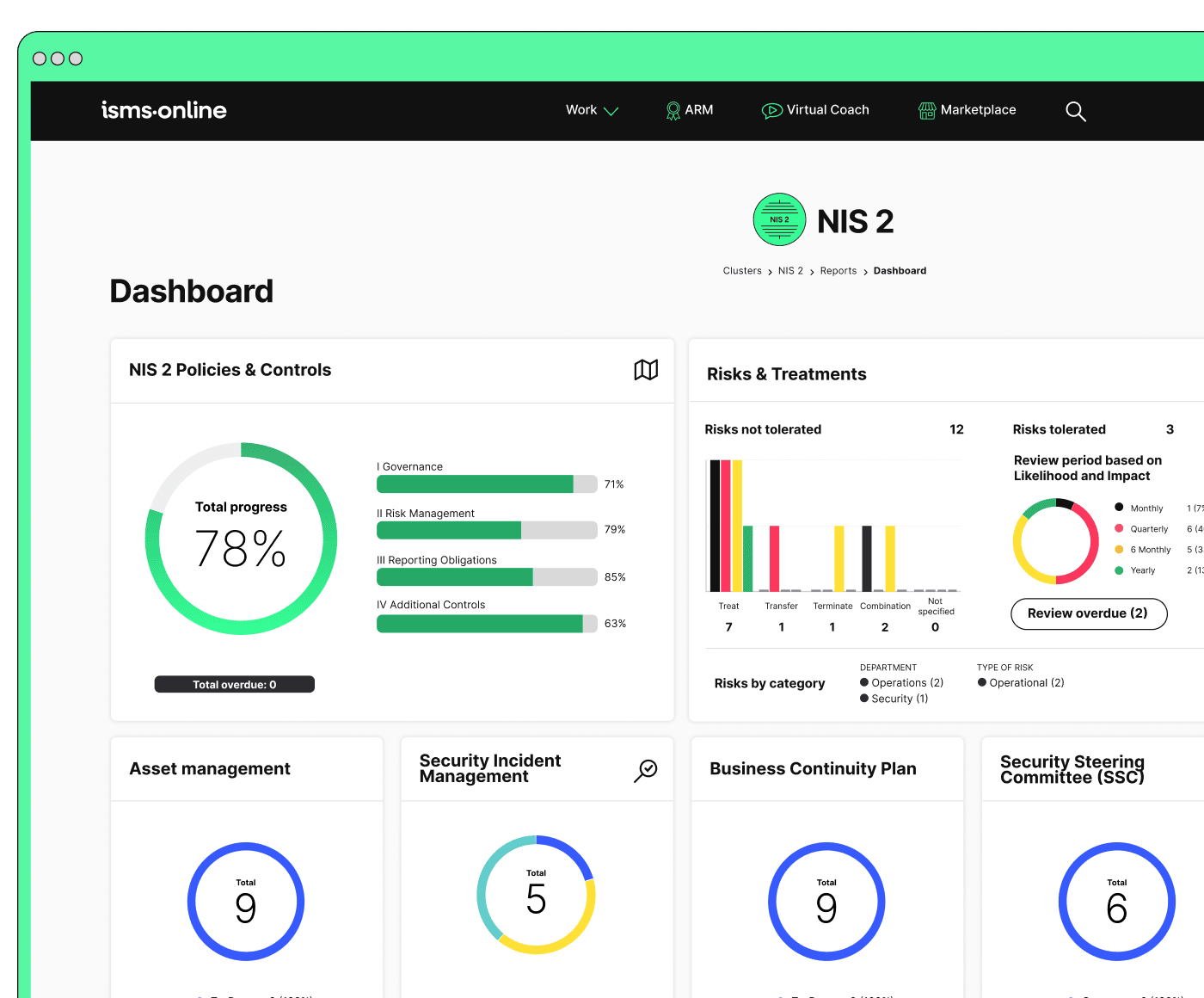
Be NIS 2-ready from day one
Launch with a proven workspace and templates – just tailor, assign, and go.
From Incident to Regulatory Investigation: Triggers, Evidence, and Response
A flashpoint-breach, failed control, whistleblower complaint-triggers the “fast audit” loop. Instead of a procedural review, teams must now supply mapped evidence, real-time updates, and remedial actions within hours.
The audit pain point isn’t just a missing policy-it’s a missing link between trigger, action, control, and evidence.
Trigger–to–Audit Traceability Table
| Trigger Event | Risk Update | Control / SoA Link | Evidence Logged |
|---|---|---|---|
| Ransomware attack | Add risk assessment | A.8.7, SoA | Detection, forensics, logs |
| Supply disruption | Update risk record | A.5.21 | Vendor comms, risk doc |
| Data breach notification | Escalate, document | A.5.24, A.8.15 | CSIRT & NCA notifications |
| Regulatory change | Review policies | 5.2, 5.36, 7.5 | Policy log, staff comms |
| Prior audit finding | Corrective log | A.5.35, SoA | Corrective plan, log |
Every element is cross-referenced. Auditors demand step-by-step documentation of incident actions, mapped to specific controls and real evidence records, not just “management says” or static reports (ENISA).
Peer Review, Sector Pressure, and Early Enforcement: Real Lessons from the Field
Early NIS 2 audits prove that pain is less about “missing evidence” and more about unmapped evidence-the logs, incident steps, and improvement measures not linked to their SoA controls or risk records.
True audit readiness looks like traceable action, not just a thick report.
Real-World Takeaways from Peer Review
- Benchmarking Drives Enforcement: ENISA’s benchmarking now publicly identifies laggards, which encourages NCAs to speed up audits and apply public pressure (ENISA NIS360 2024).
- Boards Are on the Hook: Lack of board engagement is increasingly considered a compliance failure and can lead to personal executive liability, not just organisational penalties (Marsh).
- Sector Knock-On Effects: A major incident or finding in one sector (e.g., healthcare) can prompt immediate reviews and audits in others-especially in linked supply chains (Skadden).
- Traceability is the Audit Edge: Companies with real-time mapped evidence, functioning dashboards, and robust feedback loops find audits less disruptive and their reputation enhanced-even relative to peers (CMS Lawnow).
The bottom line-your performance is measured not only by your own audit cycle, but by comparison to your sector and board-level engagement.
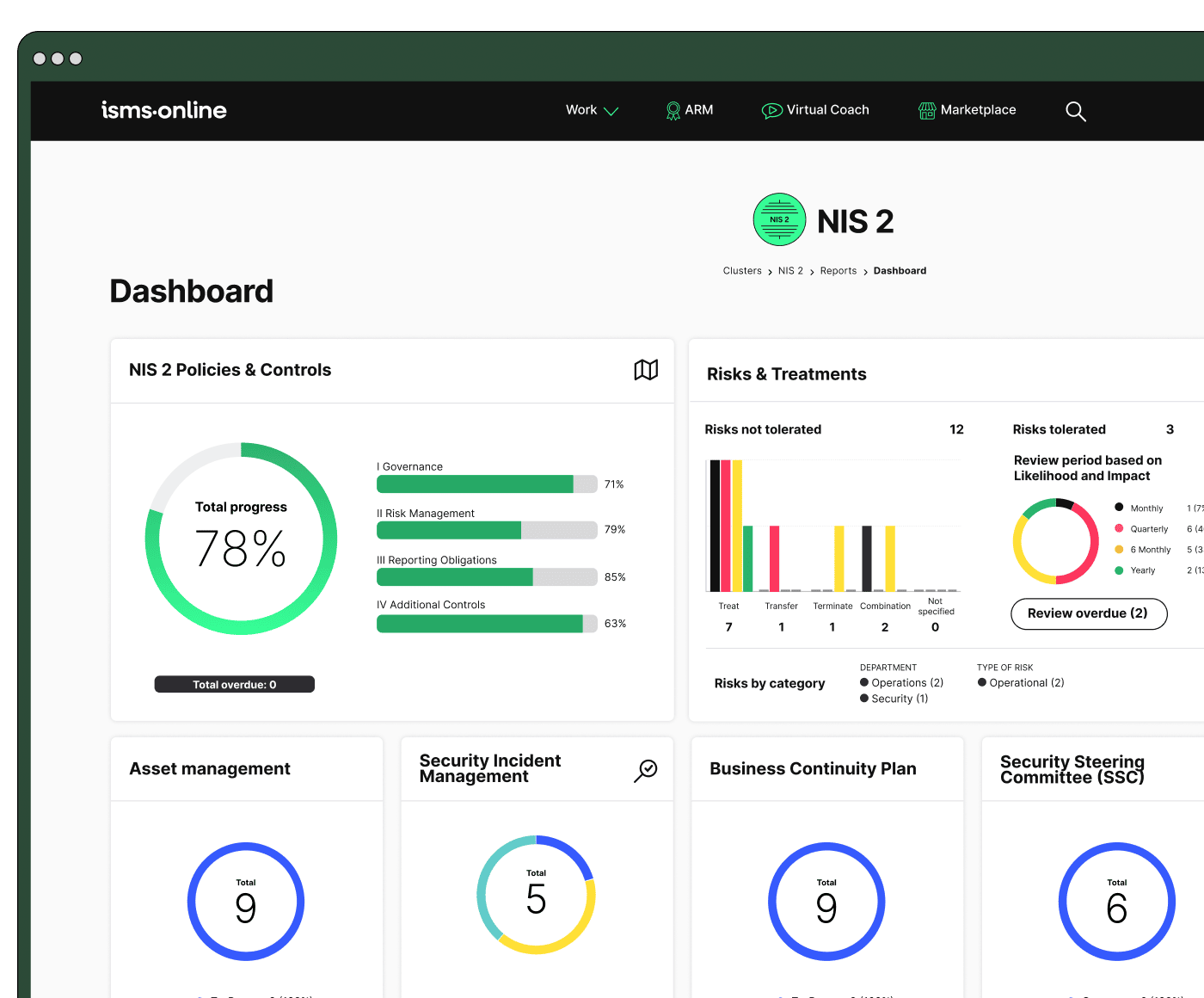
All your NIS 2, all in one place
From Articles 20–23 to audit plans – run and prove compliance, end-to-end.
Building Audit-Safe Evidence: Real-Time Dashboards and ISO 27001 Integration
Under NIS 2, desk-based document reviews no longer satisfy regulators. Companies must show a living, breathing system: mapped policy-to-action, real-time dashboards for stakeholders, and linked logs for every technical event, risk decision, and control update.
Paper compliance is obsolete-only system-proven controls, logs, and dashboards pass the bar.
What Auditors and NCAs Now Demand
- SoA/Policy Traceability: Your Statement of Applicability (SoA) is not just a PDF-it must map to logs, dashboards, and operational workflows (ENISA Guidance).
- Board-Level Dashboards: Leadership must run real dashboards, with views that mirror those of the regulator and sector KPIs (OneTrust).
- Continuous Improvement Cycles: Dry runs, incident reviews, and remedial updates must be recorded and mapped back to control updates (e.g., evidence shows the link from “lessons learned” to real ISMS/SoA improvements) (Mason Hayes Curran).
- Pan-European Consistency: The toughest audit pain? Explaining differences in compliance or evidence between your EU entities. Platform-based logs enable a unified story (Marsh).
ISO 27001 Operationalisation Table
| Expectation | Evidence & Action Log | ISO 27001 Ref (2022) |
|---|---|---|
| Policy update trace | Policy log, update record | 5.2, 7.5 |
| Risk review cadence | Risk register, dashboard | 6.1, 8.2, A.5.7 |
| Incident audit | CSIRT logs, corrective action | A.5.24–A.5.27, A.8.16 |
| SoA change rationale | SoA version, meeting minutes | 6.1.3, A.5.1 |
| Evidence retrieval | Audit-ready dashboard | 8.15, 8.16, 9.1 |
The companies that thrive under NIS 2 are those where audit readiness is a side effect of how they operate, not a last-minute scramble.
ISMS.online: Making NIS 2 Compliance a Living System, Not a Paper Exercise
When traceability, real-time dashboards, and mapped improvement cycles become the standard, “tick-box” ISMSs lose their value. ISMS.online was built with audit-readiness-not just compliance-in mind. It is engineered to bridge the gap between ENISA’s evolving architecture, the NCA’s enforcement edge, and the CSIRT’s operational reality.
Audit-readiness is not additional work-it's the organic result of a robust, operational ISMS.
How ISMS.online Delivers on the NIS 2 Audit Reality
- Live Mapping: Every risk, policy, and control are linked to relevant NIS 2 and ISO 27001 standards, streamlining the path from inquiry to evidence.
- Instant Traceability: Evidence is never siloed; dashboards and logs allow your team to answer regulator, auditor, or board inquiries with real-world proof in minutes.
- Sector Benchmarks Built-In: Peer comparison tools highlight whether your progress matches (or outpaces) competitors and regulatory benchmarks (Marsh).
- Continuous Assurance Workflows: Automation, actionable notifications, and dynamic coaching turn compliance into steady-state assurance, not a scramble (ENISA).
For forward-looking compliance and security leaders, audit readiness is no longer an end-of-year event-its a seamlessly embedded outcome. With ISMS.online, real-time mapped assurance becomes your default, so your board and your regulators can trust that resilience is documented, actionable, and continuously improving-even under pressure.
Book a demoFrequently Asked Questions
How do ENISA, NCAs, and CSIRTs each shape NIS 2 compliance, and who’s ultimately in charge?
ENISA, National Competent Authorities (NCAs), and CSIRTs occupy distinct seats in the NIS 2 compliance ecosystem-but real regulatory power sits with your national NCA, while ENISA and CSIRTs drive standards and incident response.
ENISA defines pan-European best practise, sector playbooks, and coordination protocols; it never audits or fines, but its guidance ripples directly into NCA checklists and CSIRT playbooks. NCAs are the legal backbone-they approve, audit, request evidence, investigate, and sanction. A formal letter from the NCA has the force of law, and your organisation must act. CSIRTs (Computer Security Incident Response Teams) become critical in live incidents: they collect evidence, direct technical responses, and can escalate matters to the NCA if traceability or response falls short.
Most organisations will interact lightly with ENISA (in the form of evolving guidance and frameworks), regularly anticipate NCA evidence requests or audits, and occasionally work with CSIRTs under time pressure. Knowing who performs what role-and who can levy fines or demand artefacts-protects your team from compliance missteps and misplaced effort.
Enforcement Matrix
| Entity | Primary Role | When They Engage You |
|---|---|---|
| ENISA | Sets EU-wide standards, playbooks, reviews | Indirect: sector guidance updates |
| NCA | Supervises, investigates, audits, sanctions | Audit, evidence request, investigation |
| CSIRT | Incident response, forensics, coordination | Incident notification/escalation |
When your board asks who can fine us, who can inspect us, and who shapes our checklists, this is the map to answer every time.
How does ENISA’s guidance directly influence both NCA audits and CSIRT demands?
ENISA’s sector guidance and technical frameworks are the templates which NCAs and CSIRTs rapidly embed into national checklists and incident response protocols. When ENISA releases a new supply chain framework or incident notification procedure, NCAs typically revise their evidence demands and audit focus within the year.
For example, ENISA’s 2023 Sectoral Cyber-Security Baseline for Healthcare set a new expectation for medical device monitoring-many NCAs referenced it in 2024 audit cycles, and CSIRTs updated their technical diagnostics accordingly. This means your compliance function can stay ahead by pre-emptively mapping ISMS.online controls, Statement of Applicability, and log exports to current ENISA documents. When audits or incidents arise, you’ll already have evidence in the form and language the authorities expect, eliminating confusion and delay.
ENISA to Audit Checklist Bridge
| ENISA Release | Operational Evidence | ISO/NIS 2 Ref |
|---|---|---|
| Supply chain security | Vendor risk logs, remediations | A.5.19 / NIS 2 Art 21 |
| Incident reporting requirements | Playbooks, mapped log exports | A.5.24 / Art 23 |
| Board-level oversight | Board minutes, dashboards | Clause 5 / A.5.36 |
Firms aligned to ENISA guidance find audit requests more predictable-and investigations close with less friction.
What triggers NCA investigations, and what enforcement powers should you expect?
An NCA can demand mapped, up-to-date evidence at any time, triggered by a major incident (CSIRT escalation), third-party or peer benchmarking, whistleblowers, or simply the annual audit cycle. Deadlines are often strict-24–72 hours for major incident evidence collection, one week for routine audit submissions.
NCAs review not just static policies, but operational proof: logs, To-dos, dashboards, management review minutes, evidence of supply chain monitoring, and corrective actions actually closed. If gaps are found, expect public sanction notices, mandatory remediation orders, or, for the worst breaches, fines up to €10 million or 2% of global turnover. In some regulated sectors (e.g., energy), an NCA can suspend your operations until controls are proven restored.
Example Triggers and Timelines
| Trigger | Your Evidence Deadline | Typical Artefacts Demanded |
|---|---|---|
| CSIRT escalated incident | 24–72 hours | Incident log, SIEM trace, chain of custody |
| Whistleblower/media leak | 3–5 days | ISMS, SoA, board notes, supplier audits |
| Routine audit/peer anomaly | 1–2 weeks | Risk register, dashboards, improvement log |
Regulatory action is now ‘always on’-audit and response must be living functions, not annual rituals.
What does a CSIRT demand in a real incident-and how do you get ahead of their escalation curve?
CSIRTs activate the moment an incident is declared: they request mapped logs, SIEM data, root-cause analysis, and proof you followed approved playbooks. CSIRTs typically expect:
- Rapid detection and notification: SIEM triggers, contacts for 24-hour Article 23 reporting
- Forensics-ready logs: Playbook actions mapped to evidence, e.g., every step from detection to containment is time-stamped and attributed
- Incident/response linkage: Risk logs updated to reflect the breach, supply chain disruptions mapped, lessons fed back into improvement cycles
If evidence is incomplete or inconsistent, the CSIRT escalates to the NCA, potentially involving sector-wide reviews or international notifications through ENISA and the Cooperation Group. Organisations that automate their incident-to-control mapping close cases rapidly-and avoid the spiral of repeated evidence requests and public scrutiny.
Incident Response Cycle
| Stage | Artefacts Needed | Cycle Time |
|---|---|---|
| Detection | SIEM logs, playbook triggers | Immediate |
| Notification | Incident report, contact rollup | 24 hours |
| Containment | Forensic logs, action updates | 72 hours |
| Closure | Lessons learned, Board review | 1–4 weeks |
What kind of evidence is actually demanded for NIS 2 audits, notifications, or investigations?
The new era of “mapped compliance” means audits demand live evidence: not just PDFs, but ISMS logs, action trails, SoA mapped to real incidents, policy changes, and proof the Board is engaged in every improvement loop.
Expect to supply:
- Mapped logs (incidents, policies, improvement actions)
- Live dashboards/screenshots of supply chain management and risk mitigation
- Incident reports time-stamped to notification deadlines
- Board action minutes, improvement logs with cross-links to corrective actions
ISMS.online uniquely supports these requirements by blending To-do tracking, mapped improvement cycles, and a central evidence bank for instant export. Teams that regularly run “mock audits” using ENISA and NIS 2 templates are rarely surprised-and exhibit the operational maturity NCAs now reward with shorter, less invasive interventions.
What do enforcement trends and peer reviews reveal-and what should boards focus on?
Recent Article 19 peer review cycles and first-wave public enforcement show that boards and CISOs who rely on fragmented, spreadsheet-based evidence struggle most: supply chain opacity, missing incident/playbook integration, and incomplete board minutes lead directly to repeat audits and sanctions.
Organisations automating ENISA/NIS 2 compliance, with ISMS.online’s mapped controls and live dashboards, outperform their sectors-closing ransomware audits in days, not weeks, and protecting reputations by getting ahead of negative headlines. For every healthcare audit closed in 10 days (with real-time evidence), there is a peer who endures repeat inspection and penalty owing to poor traceability.
Peer Review Snapshot
| Sector | Event | Evidence Quality | Outcome |
|---|---|---|---|
| Healthcare | Ransomware attack | Board dashboard + mapped logs | Audit closed, no penalty |
| Healthcare | Vendor failure | Missed supplier documentation | Audit dragged, fined |
How does mapped traceability and ISO 27001 alignment give you a competitive advantage in audits and sales?
Modern audit and procurement teams aren’t just looking for a “pass,” but for continuous, mapped evidence chains that show risks, incidents, policies, and board oversight are all interlinked and current.
ISMS.online maps every trigger (breach, regulation, board review) to current controls (SoA), updates risk logs and evidence trails instantly, and centralises proof for audit, procurement, or board review at the click of a button. This enables:
- Instant demonstration of resilience and adaptation to regulators and buyers
- Seamless alignment with ISO 27001, NIS 2, and sector frameworks (like DORA or GDPR)
- Credibility and buyer assurance in tenders or due diligence processes
Traceability Mini-table
| Trigger | Response Mapped | Reference | Audit-Proof Evidence |
|---|---|---|---|
| Supply chain breach | Vendor check, policy update | A.5.19, NIS 2 Art. 21 | Vendor docs, SoA entry |
| Regulatory update | Board review, control refresh | Clause 5, A.5.36 | Board minutes file |
| Ransomware | Risk recalc, improvement action | A.8.7, A.5.24, ISMS.audit | Forensic log, dashboard |
In procurement and audit, mapped, live evidence moves compliance from defensive overhead to active trust capital.
What extra challenges hit multinationals and regulated industries-and how do you harmonise your compliance mesh?
Organisations spanning countries or critical sectors face multiple NCAs, conflicting sector rules, and cross-border peer reviews. Supply chain shocks or incident triggers can lead to simultaneous, out-of-sync evidence requests from different authorities-especially if sector guidance and board minutes differ.
Best practise: schedule multi-entity mock audits, harmonise records to ENISA/NIS 2 guidance, and ensure your ISMS supports role-based, jurisdictional exports. Sector benchmarking with ISMS.online templates and live dashboards keeps you ahead of unsynced audit windows and minimises duplicated penalties.
How does ISMS.online make mapped NIS 2 and ISO 27001 compliance “living”-not just static paperwork?
ISMS.online removes information silos, automates evidence mapping, and embeds cross-entity resilience so you can:
- Map every control, risk, or improvement directly to NIS 2/ENISA/ISO 27001-instantly ready for audit
- Maintain unified dashboards for every stakeholder-no version gaps at board, audit, or ops level
- Implement sector templates and peer benchmarking as ENISA guidance evolves
- Stay ahead of regulatory deadlines with live notifications and compliance task tracking
When compliance becomes living and connected, you move from firefighting to proactive governance, and every audit becomes an advantage.
Ready to see mapped evidence turn compliance into trust and sales advantage?
Invite your team for an ISMS.online evidence mapping and resilience review-see how seamless, living compliance accelerates every audit, protects reputation, and drives your market credibility.






