





































What Does “Essential” vs “Important” Mean in NIS 2-and Why Does It Matter?
In Europe’s post-2025 compliance landscape, the line between Essential Entities (EEs) and Important Entities (IEs) under NIS 2 is more than mere paperwork. For decision-makers-from COOs to compliance leads-this status dictates everything from audit cadence and board risk to deal eligibility and supply chain continuity. Classification is not a bureaucratic exercise, but a live diagnostic of resilience, visibility, and operational credibility. Every company impacted by NIS 2 must now treat their regulatory status as a core component of business reputation and strategic risk.
The first judgement you face in an audit or procurement process is how thoughtfully you’ve tracked your regulatory status.
The EU drew these boundaries in the wake of escalating supply chain incidents and cross-sector threats (attacks on “top-tier” entities surged by 40% last year ENISA, 2024). Essential Entities span key critical sectors (energy, health, banking, major transport, core digital infrastructure, and certain public admin bodies)-organisations whose disruption could cascade across national borders or economies. Important Entities extend NIS 2’s reach further, sweeping in digital providers, food systems, logistics, research, and a spectrum of manufacturing businesses. National authorities calibrate the final sector lists-often expanding beyond the Directive’s base, especially as sectoral risks, headlines, and technology evolve.
Essential vs Important: How They’re Classified
| Criterion | Essential Entity (EE) | Important Entity (IE) |
|---|---|---|
| Sector Coverage | Power, Health, Banking, Digital Infra, Transport, Admin | Digital, Logistics, Food, Research, Mfg |
| Appointment | By Directive & National Authority | By Directive, size, and business type |
| Enforcement Mode | Proactive-even unannounced audits | Reactive-incident or tip driven |
| Maximum Fine | €10M or 2% of global turnover | €7M or 1.4% of global turnover |
| Board Liability | Direct, highly visible in findings | Indirect (but rising in 2025+) |
| Public “Shaming” | Yes-for systemic incidents/failures | Yes-if material incident documented |
(ENISA NIS2 Toolbox · Fieldfisher NIS 2 Key Points)
Is “Important Status” a Loophole? Not Any More.
If you think being labelled “important” is insulation, think again. Both entity types now face proactive scrutiny, public enforcement, naming-and-shaming-and, in pivotal supply chain cases, even retrospective audits. Digital firms ignored by “critical” lists are now prime targets after high-profile supply chain failures.
The biggest myth in the NIS 2 landscape? That important means safe. Today, one supplier incident can turn an IE into an immediate enforcement test case.
Board Implications and Market Impact
From 2025, board members risk being cited directly in public enforcement notices-with knock-on effects for insurance, procurement, credit, and reputation. More countries are now adjusting penalty caps and audit expectations in real-time, based on sector disruption and national mood (CMS Law Guide). Status is scrutinised throughout the contract lifecycle; even minor misclassifications can stall or kill deals.
Can My Status Shift Overnight?
Rapidly. Securing a major public contract, entering a sensitive supply chain, expanding to a new line of business-any of these can trigger an immediate classification review or even retrospective audit. Regulatory re-evaluation is part of the new normal (Mayer Brown, 2024).
Compliance: No Longer Just About Cyber Controls
Audit windows and insurance requirements are now set as much by supply chain and documentation practise as by technical firewalls. Treating NIS 2 as a living risk workflow-integrated, reviewed, and cross-checked-matters much more than last-minute, event-driven evidence scrambles.
Self-Check Audit
- Review NIS 2 Annex I/II-are you sure youre in the right sector?
- Track gold-plating extensions by national authorities (these change often).
- Monitor suppliers and partners quarterly for their status.
- Validate your own status before launching a new business activity (not annually!).
Curious whether youre currently classed as Essential or Important? ISMS.onlines Entity Status Checker instantly maps your position-triggering live alerts when NIS 2 landscapes shift.
Book a demoHow Does Enforcement Actually Differ for Essential vs Important Entities Under NIS 2?
The NIS 2 Directive redraws compliance not just through fines but audit patterns, documentation cadence, and the visibility of your board and leadership. Essential Entities face set-piece, recurring audits-annual at minimum, often with random or event-driven additions. Important Entities are typically reviewed reactively (often post-incident, upon notice, or in whistleblower scenarios), but the evidence and versioning standards are converging fast.
Audit Cadence: How Frequent, How Intense?
Essential Entities: Scheduled, anticipated, and surprise audits (sometimes quarterly), triggered by routine cycles and incident thresholds. You’ll see both desk-based and on-site audits, process walk-throughs, and live evidence requests.
Important Entities: Triggers remain incident led, but recent years have seen a spike in post-supply chain incident audits and random checks in digital sectors. The “reactive only” regime is a thing of the past (ENISA NIS2 FAQ).
| Entity Type | Audit Pattern | Trigger(s) | Approx. Frequency |
|---|---|---|---|
| Essential | Scheduled, random | Routine, incident, regulator notice | At least 1x/year |
| Important | Reactive, escalating | Incident, tip, sector impact | Unpredictable, rising |
Are Surprise Audits Real for IEs?
Yes. Exposure is real post-incident, or when a key supplier/customer triggers a sector re-review. Local authorities are empowered to define “sectoral impact” on the fly (GT Law, 2025).
National and Local Variations
France, Spain, and Germany routinely “add teeth,” expanding audit criteria, fine levels, and reporting duties atop the EU minimum (Deloitte Germany). Audits escalate when press or local authorities amplify sector distress.
In the new normal, your audit schedule often reflects media cycles more than your internal risk calendar.
Evidence Timelines and Audit Response
Essential Entities may have just 72 hours to provide full logs and artefacts; Important Entities, once prompted, must respond “in a reasonable time”-but that window is shrinking rapidly (PwC Malta). Outdated evidence or slow responses are red flags for enforcement escalation.
Practical Takeaway: Fire drills don’t prepare you for real-world audits; only live, always-on evidence does.
Write your own readiness check with ISMS.online. Our evidence checklist walks you through every required artefact for both Essential and Important status-validated against current NIS 2 authority expectations.

Master NIS 2 without spreadsheet chaos
Centralise risk, incidents, suppliers, and evidence in one clean platform.
Who Decides Your Status Under NIS 2-and How Quickly Can It Change?
Status under NIS 2 is formally set by national regulators, guided by sector lists and thresholds in Annex I (Essential) and Annex II (Important)-yet the reality is far more dynamic. National authorities reserve the right to upgrade or downgrade status anytime, prompted by business shifts, M&A, strategic partnerships, or even sudden market expansion. Those waiting for annual review cycles are already in delay.
The Regulator’s Decision Path
Regulator evaluation combines sector, business size, and activity profile, with thresholds on turnover and operational footprint. Authorities conduct both scheduled and event-driven status reviews (NIS 2 Article 3). Winning a major tender, entering new sectors, or even adding a high-risk vendor may move you overnight from Important to Essential (or vice versa).
| Trigger | Risk Update | SoA/Control Link | Evidence Logged |
|---|---|---|---|
| New market entry | Status reclassification | A.5.2, A.5.36 (ISO 27001) | Regulator notification, SoA update |
| Key supplier upgrade | Expanded audit scope | A.5.19, A.5.21, A.9.2 | Vendor status log |
| M&A / JV activity | Board assessment/risk | Board oversight, A.5.2 | Board minutes, legal docs |
Status is not fixed-it morphs with every strategic change, requiring vigilant and live response.
Third-Party Triggers
Suppliers or customers changing status often force partners to update governance or even absorb significant documentation costs (Mayer Brown). Modern due diligence must now review partner status quarterly and before activating any new deal, not just at contract anniversary.
Re-Check Status at Every Business Turning Point
- Prospecting new regulated sectors
- Adding major supply chain partners
- Approaching M&A or entering markets cross-border
- Scheduling annual reviews-minimum; but more frequently, preferred
Turn status management into a workflow, not a static document. ISMS.online automates real-time status checks and flags when your risk posture shifts-keeping procurement and compliance teams aligned ahead of any regulatory or board surprise.
Audits, Inspections, Penalties: What Happens If You’re In Breach?
For Essential Entities, expect deep-dive audits-walk-throughs, interviews, real-incident simulations, full log reviews-annually or quarterly, and randomly as agency resources allow. Important Entities see audits post-incident, on crisis notice, or due to partner escalation. In both cases, the difference between labels evaporates quickly after an incident: the burden is on you to prove live operational compliance.
Operational evidence is the new currency: the audit is just the moment you’re asked to show it.
| Entity Type | Max Fine | Audit Pattern | Public Reporting |
|---|---|---|---|
| Essential | €10M or 2% of global turnover | Recurring, unpredictable, deep | Yes-for all incidents |
| Important | €7M or 1.4% of global turnover | Incident-triggered, sometimes random | Yes-for material events |
(CMS Law Guide)
Evidence Demanded
Enforcement may start with the regulator-but increasingly, supply chain partners, venders, customers, and even board members are initiating inspections. Missing or outdated logs, policies, contracts, or Board minutes can be fatal for compliance, especially in recurring or post-incident audits.
| Trigger | Compliance Link | ISO 27001 Clause |
|---|---|---|
| Regulator inspection | SoA, contracts, board logs | A.5.1, A.5.36 |
| Vendor/whistleblower | Supplier register, contracts | A.5.19, A.5.21 |
| Board inquiry | Minutes, evidence, SoA | A.5.2, A.5.32 |
For IT and Security Teams
Missing or fragmented records = noncompliance. Your evidence system must be live, versioned, and mapped to controls. Long gone are the days when a static spreadsheet could “satisfy” the audit.
Centralise all your evidence, map compliance workflows, and automate logs: ISMS.online ensures the right artefact is available instantly-this readiness is the difference between a pass and a penalty.
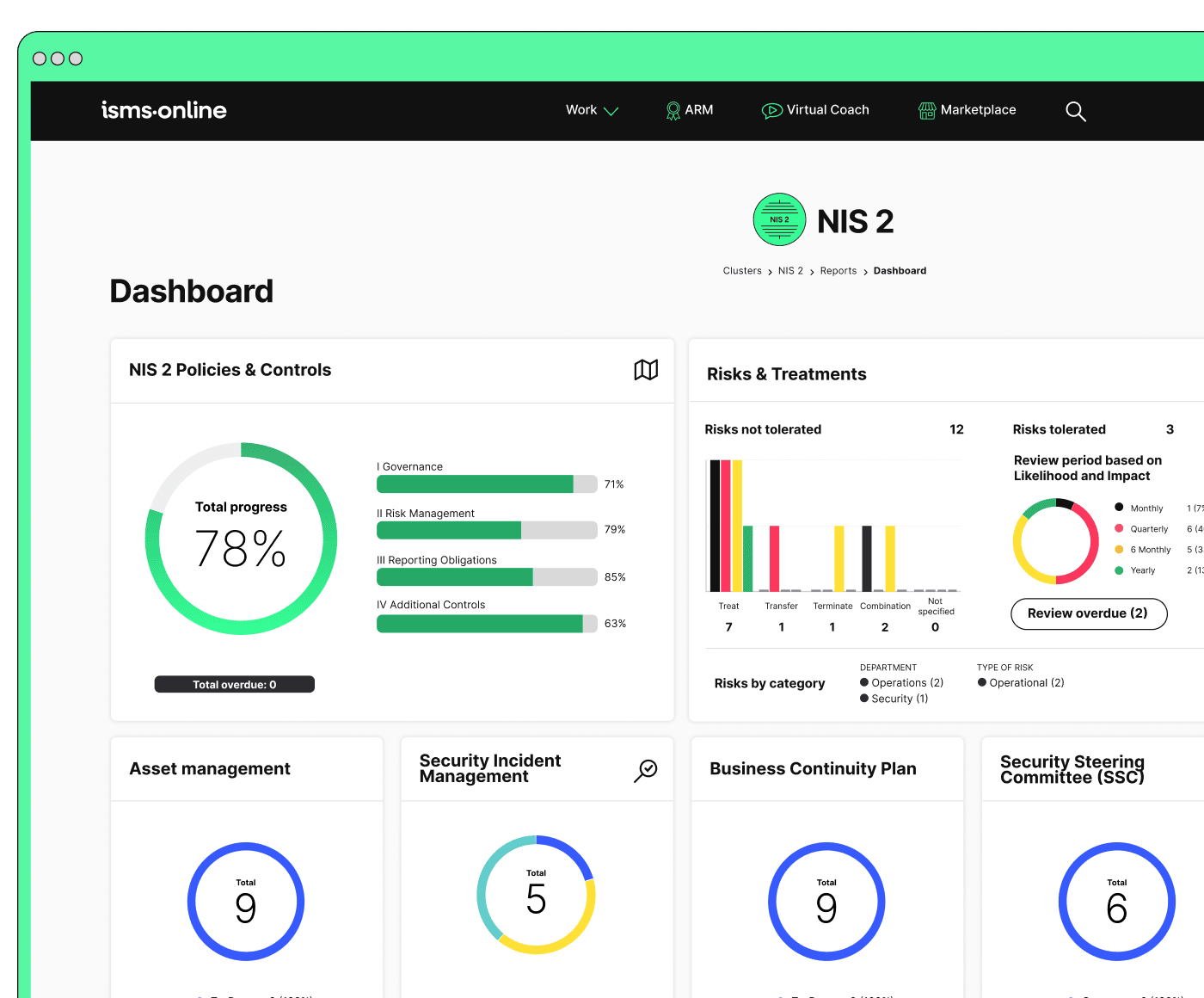
Be NIS 2-ready from day one
Launch with a proven workspace and templates – just tailor, assign, and go.
Pitfalls, Status Myths, and Compliance Traps
Compliance fatigue and status errors turn into pain only at the worst possible moment-when the regulator, biggest client, or insurance provider is asking.
Status Myths that Cost the Most
- “Important Entities Face Fewer Risks”:
This myth is fast eroding. Today’s enforcement patterns show fast-rising penalty exposure for IEs, especially after downstream supply chain incidents (ENISA NIS2 FAQ).
- “NIS 2 Enforcement Is Driven Only by the EU”:
In fact, national regulators extend, adapt, and escalate: local rules, local media, or even industry incidents can reset enforcement at any time (Digital Strategy EC).
- “Status Is Permanent”:
Large contracts, sector pivots, or supply chain events often cause abrupt status “upgrades.” Failure to revalidate can mean old documentation is rejected when most needed (ECS Org NIS2 Tracker).
- “Any Evidence Location Works”:
Fragmented files or unmanaged shares are insufficient: real-time, version-controlled, and workflow-driven logs are the expectation (Verve Industrial).
Downstream Dangers
Changing suppliers, opening new product/service lines, even winning a big client-each can introduce unknown penalty risks if compliance status and records lag the business’s real footprint.
The time for myth-busting is before-not after-the reclassification letter arrives.
ISMS.online automates alerts for contract and status changes, so the risk never lies hidden until it’s too late.
Living Compliance: Real-Time Evidence, Audit-Readiness, Daily Traceability
NIS 2 demands a living, real-time ISMS-not just a static worksheet or annual binder. Audit readiness is now a day-to-day practise, and “living evidence” is a non-negotiable, referenced directly in NIS 2 and its sectoral mappings.
What Must You Keep-And How?
- Risk register: Updated at least quarterly or upon event, cross-referenced to SoA and contracts
- Policy and staff training logs: Versioned, timestamped acknowledgements; mapped to policy changes
- Incident log: Real-time, with role/accountability linkage
- Supplier/SC register: Signed and versioned, links to vendor roles and notification trail
- SoA and audit trail: All changes, approvals, and evidence assignments tracked in-context
ISO 27001 Mini Table: Moving from Expectation to Evidence
| Expectation | Operational Practise | ISO 27001 / Annex A Ref |
|---|---|---|
| Evidence always live | SoA, approval & audit logs | A.5.2, A.5.36, A.9.2 |
| Board engagement | Training docs, attendance | A.7.2, A.9.3 |
| Supply chain logs | Updated contract, vendor file | A.5.19, A.5.21 |
| Living audit trail | Dashboards, linked artefacts | A.5.1, A.5.32, A.5.36 |
Traceability Table-Trigger to Proof
| Trigger | Risk Update | Control / SoA Link | Evidence Logged |
|---|---|---|---|
| High staff turnover | HR status update | SoA role change | HR record, sign-off |
| Supplier risk event | Contract check | Vendor register update | New contract, event log |
| Asset/system update | IT asset log | SoA file attachment | Asset log, approval |
How Long, How Accessible?
Most authorities now require 3–5 years of logs, fully accessible and versioned. Evidence must be supplied in response to audit triggers within days-not weeks (Twelvesec, 2024).
Supply Chain Evidence is Non-Negotiable
Procurement teams, insurers, and auditors demand live, always-accurate supplier logs as part of every contract review-this is now often a deal gate (Fieldfisher).
Benchmark your live compliance. ISMS.online’s audit dashboards reveal evidence gaps, surface required policy controls, and link traceability for essential and important entities alike.
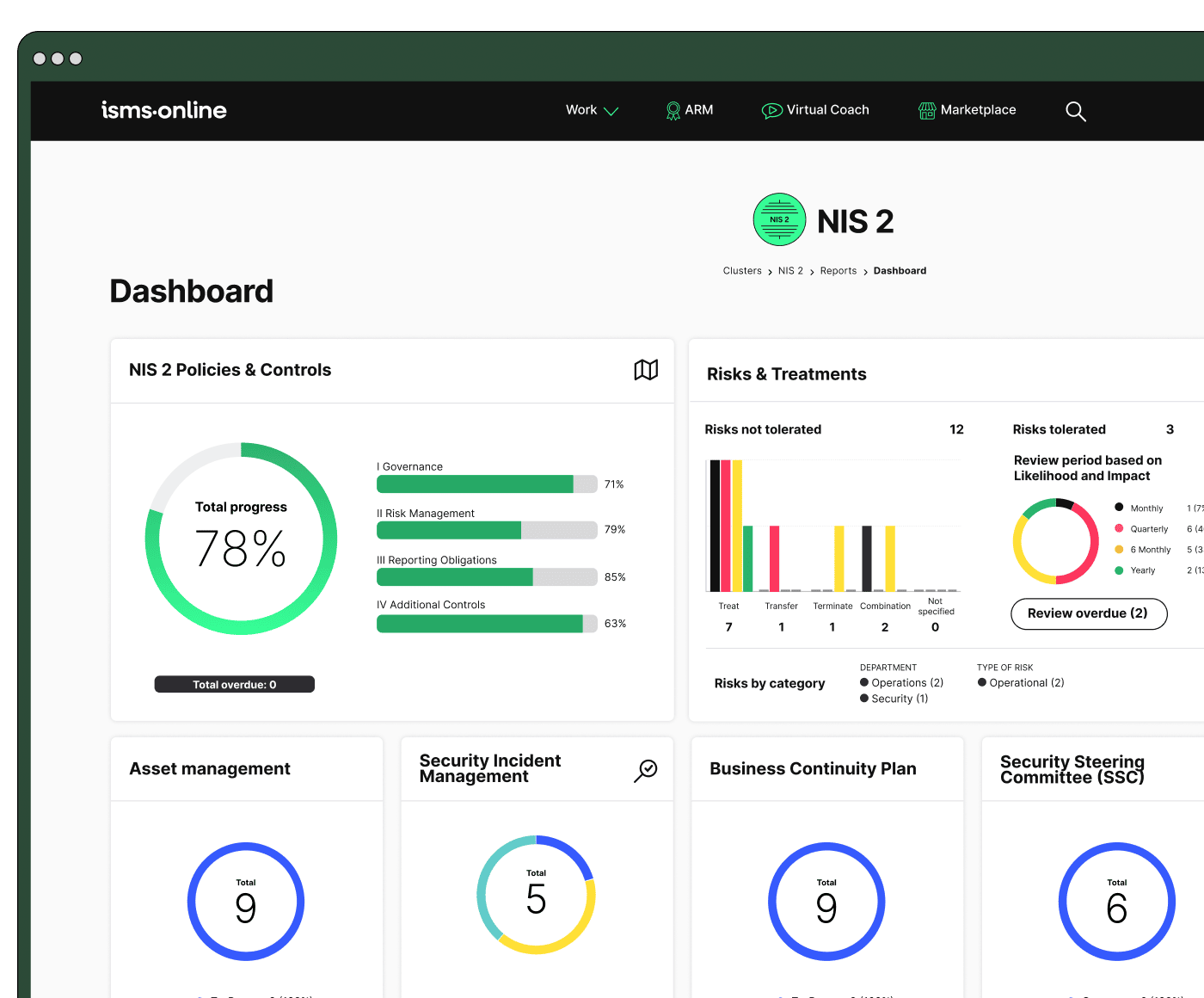
All your NIS 2, all in one place
From Articles 20–23 to audit plans – run and prove compliance, end-to-end.
Building the Integrated Compliance Team-People, Evidence, Platform
NIS 2 raises the bar: compliance is no longer an IT silo, but a company-wide, continuous process. Modern platforms (like ISMS.online) are specifically built to infuse workflow, reminders, role visibility, and status monitoring into every business discipline-legal, HR, supply chain, IT, board.
Living compliance is the hallmark of a trusted, resilient business-the difference between audit readiness and last-minute panic.
Platform Capability Across Teams
Contemporary ISMS platforms centralise:
- Evidence versioning: Assign and trace SoA, risk, and control logs
- Automated reminders: Nudge for audit, contract, and role changes
- Supply chain mapping: Contracts, vendors, and status live-linked
- Dashboards: Board and auditor visibility, instant reporting
| KPI | Outcome | Impact |
|---|---|---|
| Zero audit findings | on-time readiness, confidence | Board trust, fewer insurance snags |
| Days-to-evidence | rapid audit/contract turnaround | Wins deals, meets legal/board demand |
| On-time procurement | faster, lower-risk supply reviews | Vendor trust, penalty avoidance |
(DLA Piper · ENISA Toolbox)
Framework Harmonisation
Platforms now make ISO 27001, NIS 2, and GDPR a joined-up workflow-streamlining controls and gap-closing across global standards (DLA Piper).
Compliance Is Everyone’s Task
The best systems map ownership by workflow: IT scans assets, Procurement checks suppliers, Legal signs approvals, HR tracks staff engagement. Dashboards break silos, make gaps visible, and ensure no area gets neglected (PwC Luxembourg).
ISMS.online is architected for people-integrating task assignment, status push, reminders, and reporting so nothing is missed and readiness is visible from operator to board.
Elevate Compliance: Make Every Event a Readiness Check
Today, “Essential” or “Important” is not just about regulation-it’s a live indicator of risk, trust, and business velocity. Every boardroom decision, procurement milestone, contract rollover, or major staff change should auto-trigger a compliance review-not as a chore, but as a lever for confidence and leadership.
The mark of a resilient, audit-ready business is turning compliance from a static obligation into a competitive advantage.
| Step | ISMS.online Solution | Outcome |
|---|---|---|
| Status review | Entity mapping, live alerts | Avoid status errors, audit pain |
| Evidence tracking | Dashboard, automated gap alerts | No surprises in board/NCAs |
| Assignment | Workflow, reminder, approvals | Stakeholder clarity/completion |
| Supply chain | Real-time register, event notifications | Instant risk response |
| Audit review | SoA logs, full change tracing | Easier wins, confident board |
ISMS.online is designed to:
- Auto-track entity status and flag risk on all material business events.
- Surface evidence gaps as you move-not just when the audit call comes.
- Enable cross-team collaboration-from IT to the boardroom.
- Map confidence with dashboards, contract logs, and live entity status.
- Save your team hours, prevent missed risks, and make compliance a business asset.
Audit readiness isn’t just defence. It’s brand trust, deal velocity, and operating confidence.
See for yourself: Book a walk-through of ISMS.online and discover your true NIS 2 posture- Essential or Important, fully proven, ready for the board and any regulator.
Frequently Asked Questions
Who determines your “essential” or “important” status under NIS 2, and how can it change overnight?
Your company’s designation as “essential” or “important” is set-then constantly re-checked-by your national cyber-security authority (NCA), using the NIS 2 Directive’s Annex I (critical sectors) and Annex II (key sectors) as a baseline. But this tag isn’t static: a single major contract, supplier event, sector expansion, or security incident can prompt the NCA to immediately change your classification and compliance requirements-even between formal reviews (NIS2 Directive, Article 3, Mayer Brown, 2024). Because national regulators now maintain “live” registers and draw data from contract notifications, sector news, and incident reports, your compliance obligations, audit risk and board exposure can increase with little or no warning.
A contract won or a sector shift can transform your NIS 2 status, audit schedule, and risk burden before your team sees it coming.
What causes your status to change?
- Expanding, merging, or onboarding a new critical client or supplier.
- Becoming essential to another entity’s supply chain due to business growth.
- Incidents or disruptions at partners that ripple into your sector.
- Regulatory updates: your NCA may move faster (or increase requirements) even before EU-wide changes (Deloitte, 2024).
Action step: Integrate entity status monitoring into your ISMS or GRC (e.g. ISMS.online) to trigger alerts if major contracts, mergers, or incidents put you at risk of immediate reclassification.
How do audit, inspection, and enforcement really differ for Essential vs Important entities under NIS 2?
Essential entities (“EE”) face regular, often unannounced, full-scope audits and live evidence checks. NCAs may initiate reviews in response to scheduled cycles, sector or supplier incidents, stakeholder complaints, or as part of their risk-based strategy (ENISA, 2024). Expect auditors to scrutinise incident logs, supplier registers, board engagement, and continuous workflow-static “audit packs” are insufficient.
Important entities (“IE”) historically only faced audits after an incident or serious complaint. This has changed: spot-checks and event-driven audits are now routine-especially as supply chain complexity grows (GT Law, 2025). “Reactive only” is fading; random evidence demands are up.
| Entity Type | Audit Pattern | Trigger Events | Review Frequency |
|---|---|---|---|
| Essential | Scheduled & surprise | Annual, incident, new contract, escalation | Annual + real-time |
| Important | Reactive & spot-checks | Incident, complaint, authority action, escalation | Rising unpredictably |
Even a status of important is no shield-spot checks and fines for missing evidence have become normal.
What counts as valid audit evidence in NIS 2, and where do organisations get it wrong?
NIS 2 expects active, unified, and provable evidence: up-to-date risk logs, asset and incident records, incident playbooks, contract/supplier tracking, and board or management review documentation (Aikido.dev, 2024; TwelveSec, 2024). For Essential entities, these must be reviewed at least quarterly, or right after incidents, mergers, or supply-chain events. Important entities must meet similar standards if audited post-incident.
Where companies fail:
- Fragmented evidence: (contracts with procurement, risks with IT, incident logs in spreadsheets).
- Manual-only or point-in-time compliance (“project mode”): -raising the risk of missed logs, unsigned reviews, or out-of-date supplier assessments.
- No “system of record”: -lack of a central ISMS like ISMS.online, which links all data in real time.
Most NIS 2 audit failures aren’t about technology-they’re about missing registers, outdated board reviews, or scattered supplier lists.
Auditors zero in on supply chain and contract evidence-asking for “live” supplier registries, flowdown clauses, and real-time Statement of Applicability documentation (Fieldfisher, 2024; ISMS.online, 2024).
Can contracts, supply chain incidents, or M&A really change your compliance status and audit risk overnight?
Yes: every new high-value contract, division acquisition, major supplier onboarding, or entry into a regulated sector can instantly trigger reclassification, new obligations, and rapid audit escalation-regardless of your last review (Mayer Brown, 2024). Many regulators now monitor news feeds, regulatory registers, and supply chain events for status shifts.
Leading organisations configure their ISMS to flag “classification risk” whenever contracts, mergers, or incidents are logged-so every event triggers a compliance checkpoint, not just an opportunity or risk for one department.
If your contract or supplier register doesn’t talk to your compliance system, you’re always a step behind-sometimes until the audit letter arrives.
How do you prevent compliance fatigue-and convert year-round audit readiness into real business advantage?
Forward-thinking teams turn audit stress into resilience capital by adopting continuous evidence loops: automated reminders, live dashboards tracking policy, contracts, incidents, supplier reviews, and board engagement (DLA Piper, 2023; ISMS.online, 2024). Align ISO 27001 controls, SoA mappings, and operational KPIs with supply chain oversight to prove daily readiness to auditors and clients. Set SLAs for zero overdue contracts, keep versioned evidence (“if it’s not logged, it doesn’t exist”), and make management review an active instrument-not a passive annual stamp.
Year-round readiness not only satisfies auditors-it proves trust to customers, shortens insurance timelines, and keeps the board ahead of liability trends.
What are the serious differences in enforcement, reporting, and liability between Essential and Important entities?
Essential Entities (EE):
- Are always “audit-ready,” with evidence available inside 72 hours.
- Fines: up to €10 million or 2% of global turnover.
- Mandatory public disclosure of major failures (“naming and shaming”).
- Direct board/senior management liability (recent enforcement shows actual removals).
Important Entities (IE):
- Audit frequency and surprise spot checks are rising.
- Fines: up to €7 million or 1.4% of global turnover.
- Board liability is less direct-but tightening fast (trend: “EE” treatment for major failures).
- Both are obligated to keep all compliance evidence (including supply chain risk audits) for 3–5 years, and to maintain live, real-time risk/contract monitoring-annual reviews are no longer enough.
What are the best first steps to guarantee audit-readiness and ongoing NIS 2 compliance, whatever your status?
- Automate status/event monitoring: Use modern ISMS/GRC tools (like ISMS.online) to live map entity status, contracts/M&A, incidents, evidence, and supply chain risks across all teams.
- Track both national and EU NIS 2 changes: Regulators can change rules or classification windows without warning-subscribe to alerts from sector and NCA authorities.
- Centralise and version evidence: “If it’s not logged, it’s not compliant.” Dashboards should call out evidence, audit, or management review gaps in real time.
- Train all teams to surface “event triggers” on new contracts, deals, M&A, or incidents: Every business event is now a compliance checkpoint-treat it like one.
If you aim to replace audit anxiety with resilience and client trust:
Explore dedicated platforms that handle NIS 2 and ISO 27001 together. Automatic status mapping, live contract/supply chain audit triggers, and evidence dashboards can turn “compliance stress” into “resilience-as-a-service”-for your clients, your board, and your brand.
Table: ISO 27001 and NIS 2 Expectation Bridge
| Expectation | Operationalisation in ISMS.online | ISO 27001/NIS 2 Reference |
|---|---|---|
| Dynamic entity status tracked | Real-time status/classification alerts | NIS 2 Art.3, Annex I–II; ISO27001 Cl.4.1–2 |
| Risk/event evidence auto-logged | Linked audit trail for incidents/events | NIS 2 Art.21, 23; ISO27001 Cl.6.1–6.2 |
| Contracts drive audits & reviews | Contract/supplier-triggered risk updates | NIS 2 Art.24; ISO 27001 Cl.8.1, A.5.19–21 |
| Board review sign-off proves oversight | Approval log, management review history | NIS 2 Art.20; ISO27001 Cl.5.2, 9.3, A.5.1 |
Table: Event-to-Evidence Traceability
| Trigger Event | Review/Risk Update | Control/SoA Reference | Evidence Logged |
|---|---|---|---|
| New supplier acquired | Supply chain risk reassessed | ISO 27001 A.5.19 | Supplier register update |
| Critical contract signed | Entity status review | NIS 2 Art.3 (Annex I–II) | Status mapping log |
| Vendor breach/incident | Immediate risk/incident log | NIS 2 Art.23; ISO A.8.8 | Incident response record |
| Sector/M&A expansion | Classification re-check | NIS 2 Art.3, 21 | Board review minutes |
Summary:
NIS 2 status isn’t a once-a-year box-tick-it’s a live, dynamic signal that defines your compliance rhythm, audit profile, and board exposure. Only continuous evidence, automated status/trigger detection, and team-wide workflows keep you ready and resilient-transforming regulatory challenge into competitive advantage and trust.






