





































Why Are NIS 2 Enforcement Standards Diverging Across Europe?
NIS 2’s vision of pan-European consistency has unravelled into a patchwork of unique national approaches. The narrative of harmonisation promised regulatory predictability, but the lived reality is divergence-national regulators in Belgium, Hungary, and Germany have introduced bespoke deadlines, sector lists, and penalty mechanisms that outpace Brussels’ mandated minimums (ecs-org.eu, ba.lt). For compliance leaders, this means that an ISO 27001 certificate or off-the-shelf policy pack is not a shield against regulatory whiplash.
Regulatory divergence is no longer a hypothetical risk-leaders now measure influence by how fast they adapt to the messiest map, not the easiest.
Boardrooms crave certainty, but the regulatory map now evolves quarterly, even monthly, in some regions. Belgium’s CCB and Hungary’s DNSC have both demanded rapid board-level risk affirmation, shortened notification cycles, and introduced public accountability lists-all independently and at pace.
The Risk of Chasing “Minimal Change”
Relying solely on ISO 27001 or a standards checklist is increasingly risky. National transpositions often exceed EU requirements-Belgian enforcement now reclassifies sectors at short notice and requires incident cycles as rapid as 48 hours for certain industries; Hungary wants live, board-signed logs and now escalates directly to board warnings for late updates. Germany’s frequent sector revisions force quarterly executive reviews and automated contract changes.
Adapting Your Team to the Real World
All departments-InfoSec, Legal, Sales, Operations-must consume the same live compliance map or risk critical blind spots. Successful teams centralise compliance oversight on a single, referenceable dashboard overlaying deadlines, audit flags, and risk zones by country. This visual anchor aligns busy practitioners and leaders, preempting surprises and giving every stakeholder a shared operational reference.
Book a demoHow Do Fines and Deadlines Impact Your Business Before They’re Visible?
Fines are a symptom, not an origin. For most organisations under NIS 2, the real damage comes from loss of market access and eroding trust long before a regulator issues a formal notice. In markets like Belgium, Cyprus, and Germany, silent non-compliance triggers procurement “ghosting,” with companies quietly dropped from tenders or supply chains as soon as buyers detect outdated controls, missed logs, or unmapped new sector duties.
The revenue risk isn’t only regulatory-it’s being cut from contracts, tenders, or supply chains before the board even sees a warning.
How Penalties Enter Early
Silent enforcement is now commonplace:
- Missed incident notification deadlines: Hungary and Romania escalate both to regulators and buyers within a week of a late 24–72 hour report.
- Supply chain blind spots: If a supplier’s logs aren’t current, or your mapped controls are unproven, buyers implement “soft bans”-removing firms from critical spend, often without formal notification.
- Overdue compliance reporting: Failure to show evidence of management review or contract mapping triggers silent exclusion from renewal cycles.
Visualise these risks by embedding real-time deadline and contract renewal alerts in your compliance workflow. Business pain, unlike fines, is rarely announced with fanfare.
The Real Cost Is Opportunity Lost
Procurement teams often exclude “at-risk” suppliers silently if documentation or continuous proof is lacking-even if you never receive a formal warning. Every missed or outdated log can represent months of lost pipeline. In the era of divergent NIS 2 standards, being seen as “compliant enough” isn’t just a regulatory risk; it’s a revenue risk.
Streamlining compliance to match and preempt local expectations is now a growth lever, not just a defensive manoeuvre.

Master NIS 2 without spreadsheet chaos
Centralise risk, incidents, suppliers, and evidence in one clean platform.
Is Your “Essential” or “Important” Status a False Sense of Security?
NIS 2 sorts businesses into “essential” and “important” categories, but these buckets are more dynamic than they appear. Regulators in Hungary, Germany, and Belgium can-and do-revise classifications mid-year, changing audit frequency, evidence burdens, and supply chain obligations with minimal warning.
You’re not protected by the label-your true risk is in how quickly you trace and react to changes.
Downstream and Cross-Border Exposure
“Important” suppliers, SaaS vendors, and subcontractors can find themselves under intense scrutiny if a critical client is audited or breached-regardless of prior status. The sector map is fluid, and a supplier in one EU state may be held to the notification, audit, and reporting standards of another if they cross borders in their supply chain footprint. As a result, buyers now demand sector status mapping and cross-jurisdiction trigger tables as part of due diligence.
Traceability in Action
Here’s a concise reference for how high-performing organisations are updating compliance as labels and jurisdictions change:
| Trigger | Risk Update | Control / SoA Link | Evidence Logged |
|---|---|---|---|
| New sector listing | Re-tag risk in registry | SoA cross-mapped sector | Board log, notification record |
| Contract renewal | Update downstream mapping | Vendor risk controls | Timed supplier risk confirmation |
| Jurisdiction shift | Board reclass review | Notification protocol | Exportable country log |
| Breach at client | Spot audit, log review | Incident response plan | Timestamped incident record |
Efficient compliance is now contract-by-contract, territory-by-territory, with automated alerts and escalation paths when status or scope changes.
What Actually Triggers Enforcement-Beyond the Headlines?
The news covers massive fines and data incidents, but most NIS 2 enforcement is now quietly triggered by daily process failures. Repeated late filings, missing logs, or chronic delays are the real route to penalty escalation. Many firms first face censure not from the government, but from clients or partners flagging compliance drift in supplier audits.
Belgium, Hungary, and Cyprus have adopted “warning ladder” enforcement-progressing from written notices to public censure, executive bans, and ultimately market exclusion. In Cyprus, a missed six-hour notification is enough to trigger regulator and buyer attention. Both Belgium and Hungary escalate to named director lists for repeat failures (osborneclarke.com, ba.lt).
It’s not just your compliance, but your leadership’s diligence that’s being audited.
Queue your “Regulatory Divergence Dashboard” to track both official penalties and informal risk escalation in every applicable country. Having a side-by-side view of escalation ladders crystalises urgency for boards and practitioners alike.
Static checklists or after-the-fact document kits are no longer enough. Enforcement now means “living” compliance: active logs, continuous updates, and version-controlled audit trails-ready to respond instantly.
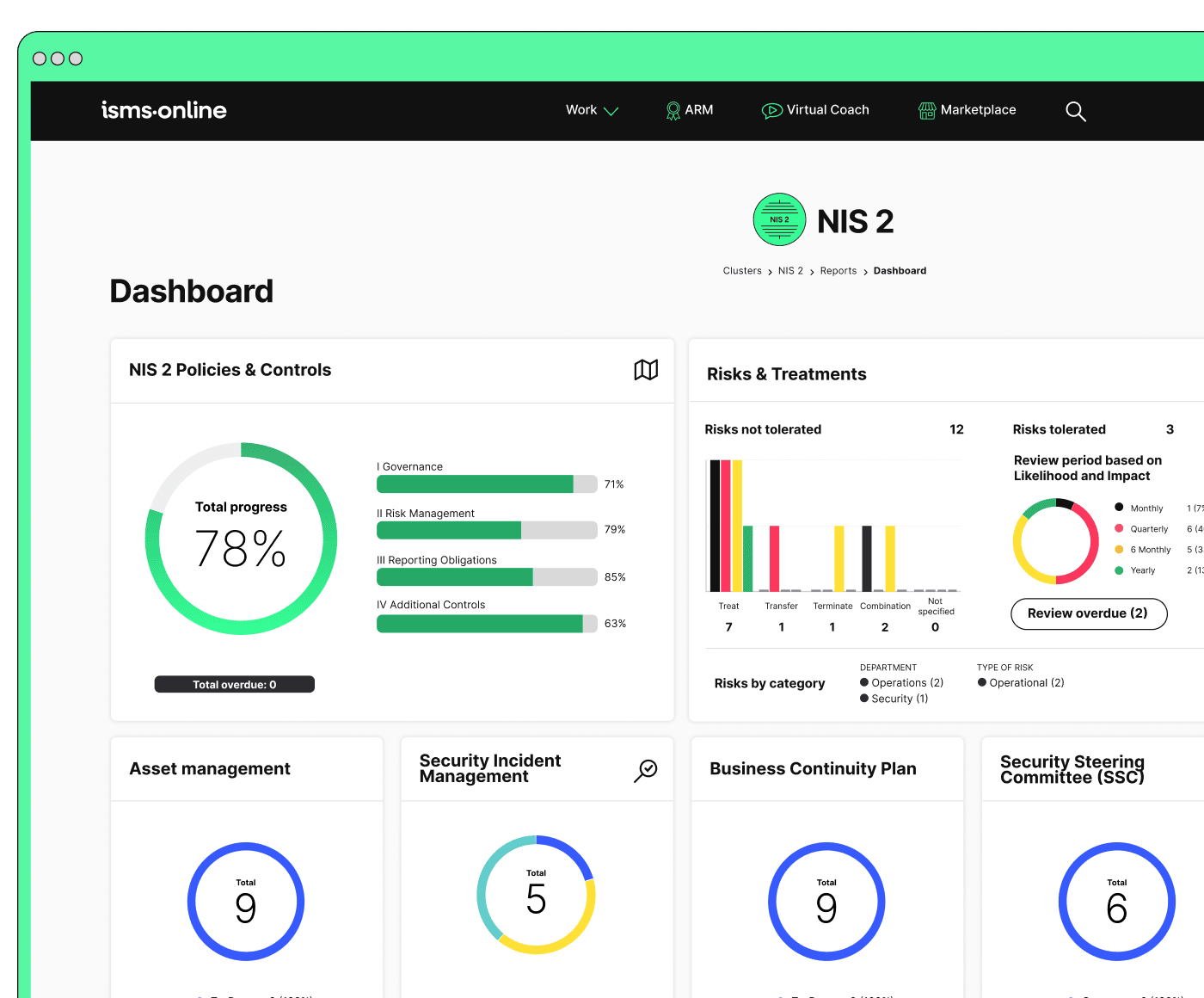
Be NIS 2-ready from day one
Launch with a proven workspace and templates – just tailor, assign, and go.
Are You Audit-Ready? Evidence, Risk, and Proof for Board and Regulator
Audit-readiness in 2024 means more than annual evidence folders. Belgium and Hungary now expect live, versioned risk registers-approved at board level, mapped to controls and instantly exportable across jurisdictions.
The recurring failing is outdated templates, stale logs, or evidence with no timestamped owner or real update history.
Audit-Ready Checklist:
- Board-approved, versioned risk logs linked to technical controls
- Quarterly (minimum) evidence of management review
- Traceable notifications, incident logs, and response actions for all reportable events
- Exportable, timestamped records for both local regulator and cross-border buyer audits
Your compliance dashboard is not just a status symbol-it’s an operational asset. Visual health bars and audit gap flags should empower board and practitioners alike to catch issues early, not explain them after a finding.
What’s at Stake for the Board and C-Suite? (It’s Not Just Fines)
Enforcement now follows individuals, not just entities. Director and executive sanction is a live risk, with Belgian and Cypriot regulators maintaining public lists of named non-compliant officers.
Damage moves beyond fines: “shadow bans,” public censure, and exclusion from supply chains can linger for years, damaging both market access and reputation.
Board-level shadow bans for compliance inaction have more lasting impact than any one-off penalty.
Progressive boards now monitor compliance dashboards alongside financials. Directors are accountable for ensuring evidence of risk review cycles, timely incident responses, and staff engagement logs-not just rubber-stamping policies. Compliance KPIs, scenario plans, and penalty ladder forecasts are entering the board pack-turning “proactive compliance” into a strategic differentiator.
Only a daily, visible routine-tracked and mapped for regulator and investor trust-will protect value, market position, and personal standing.
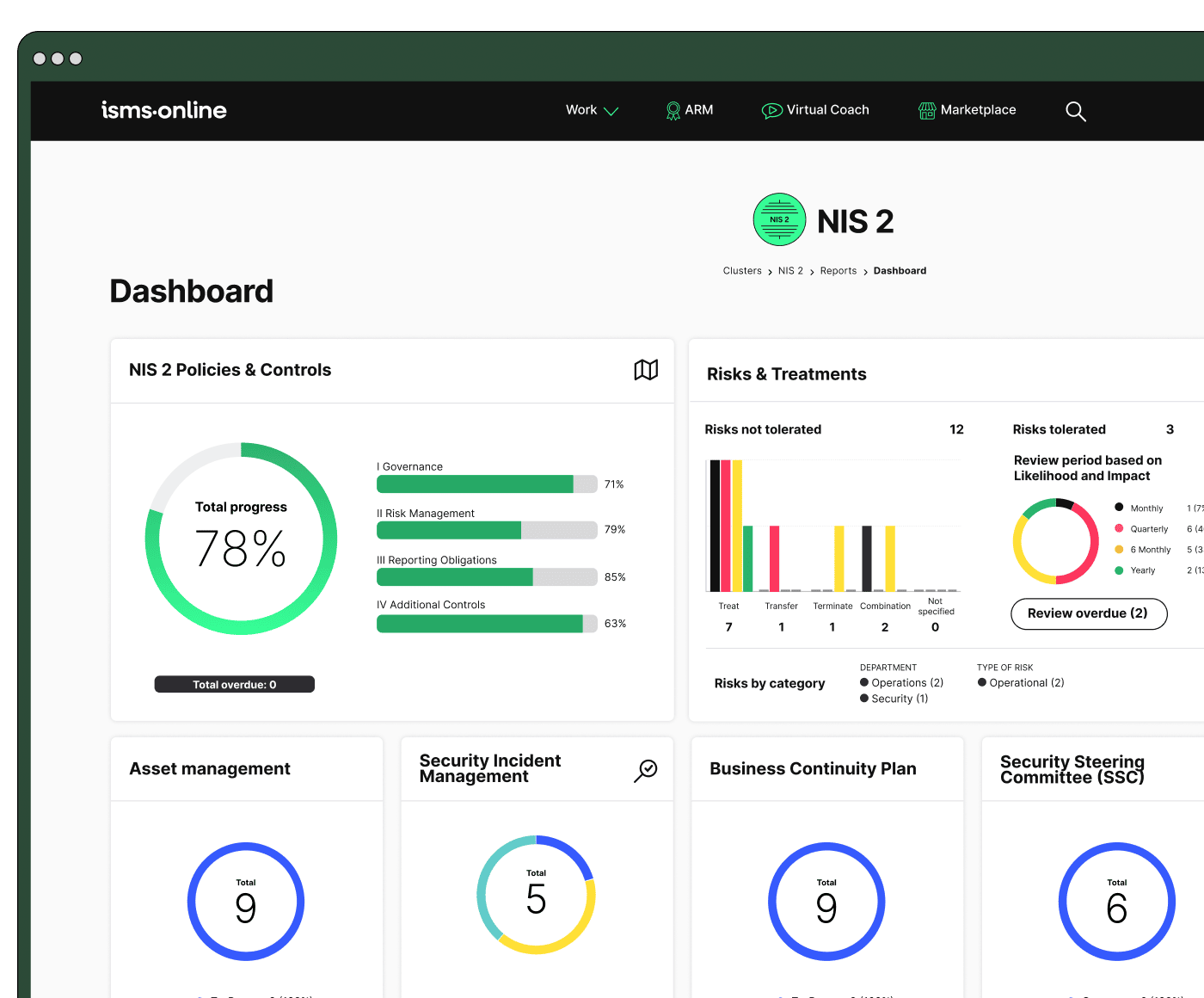
All your NIS 2, all in one place
From Articles 20–23 to audit plans – run and prove compliance, end-to-end.
How Can ISO 27001 Anchor NIS 2 Readiness-And Who Benefits?
ISO 27001 is vital, but it is not a shortcut or excuse. Teams that directly map their risk logs, policies, and supply chain controls to the ISO 27001/Annex A controls have audits accepted across buyers and regulators, and respond faster to shifting national expectations (marsh.com, seifti.io).
Concise ISO 27001 Bridge Table:
| Expectation | Operationalisation | ISO 27001/Annex A Reference |
|---|---|---|
| Up-to-date, mapped controls | SoA linked to real-time risk register | A.5.1, A.5.36, SoA |
| Board-level risk log review | Quarterly Mgmt review | Clause 9.3 |
| Timely incident notification | Simulation & evidence log | A.5.24, A.5.26 |
| Supply chain proof | Vendor risk register, mapped controls | A.5.19–A.5.21 |
| Continuous compliance tracking | Dashboard, workflow automation | Clause 9.1, performance evaluation |
All personas benefit:
- Kickstarters: Step-by-step policy packs become audit trail, not confusion.
- CISO/Security: Cross-framework dashboards drive both readiness and board reputation.
- Privacy/Legal: Automatable evidence bank covers GDPR, ISO 27701, and supplier integrations.
- Practitioner: Control logs and evidence ripple through workflows, lifting admin burden and raising audit confidence.
Are You Building Continuous Traceability-Or Just Chasing Annual Audits?
Readiness for NIS 2 is not a memo; it’s a daily, visible state managed with operational discipline. Any missing log, ambiguous evidence, or delayed update invites not just penalties but can result in exclusion from business opportunities and regulatory trust.
Health bars, automated workflows, and triggered reminders are the new muscle of compliance teams-enabling contractual, board, and audit success. Real audit readiness is an operational journey, not a static milestone.
Your operational health bar is now the real validator-a living record of control, proof, and readiness for audits and contracts alike.
Test your process: Map contract workflows against shifting deadlines in Germany, Belgium, and Hungary. Can you follow the journey from control or evidence update, through dashboards and notification triggers, to final evidence export-seamlessly, with nothing lost in translation?
Build, Harmonise, and Validate Your Compliance with ISMS.online
Legacy approaches-old audit files, spreadsheet firefights, and annual last-minute training-cannot match what modern NIS 2 enforcement demands. ISMS.online transforms compliance into a proactive, continuously validated discipline:
- Kickstarters: Pre-configured evidence mapping, rapid onboarding, clear audit milestones.
- CISO / Security: Unified dashboarding, cross-region risk visibility, live reporting to boards and regulators.
- Privacy / Legal: Evidence banks and workflow mapping instantly export for buyer, supplier, and regulatory needs.
- Practitioners: Automation eliminates repetitive admin; every update to a control, risk, or evidence record ripples through all required logs and audit trails.
One platform, one dashboard, one continually validated record-regardless of territory, deadline, or compliance standard.
With ISMS.online, your compliance universe is unified: deadlines, controls, risk logs, and cross-framework mappings all traced live from executive dashboards down to log-level evidence. Boards gain oversight, regulators see active compliance, and tenders are won not by promises but by proof.
Challenge yourself: Map your operational contracts and risk registers across the latest enforcement timelines for Germany, Belgium, and Hungary. See the journey from daily activity to audit output-ISMS.online aligns every step.
Build Continuous Readiness with ISMS.online Today
Security, privacy, and contract confidence require daily discipline-not annual drama. ISMS.online operationalises resilience, unifies dashboards, automates evidence, and centralises traceability-from board to practitioner and across every jurisdiction.
- Kickstarters: Fast, jargon-free audit preparation.
- CISOs: End-to-end visibility and reputational trust.
- Legal/Privacy: Living records for regulators and board.
- Practitioners: Workflow automation-no more spreadsheet panic.
Lead the market, win trust, and lock out risk-ISMS.online keeps your compliance agile, credible, and always ready.
Frequently Asked Questions
Will some EU countries enforce NIS 2 fines and compliance deadlines more strictly than others?
Yes-enforcement of NIS 2’s fines and deadlines varies significantly by country, with certain EU member states already setting higher bars on penalties, auditing, and reporting speed than the directive baseline. Belgium, Hungary, and Cyprus are at the forefront: Belgium’s Royal Decree implements tiered fines reaching €500,000 or more for late or incomplete compliance in key sectors, Hungary mandates bi-annual certified audits for high-risk organisations, and Cyprus imposes incident notification deadlines as short as six hours. The jurisdiction where your team, data, or supply chain touch-even indirectly-can dictate whether a missed deadline results in a warning or a fine that disrupts your entire business cycle.
A single hour’s delay in Cyprus or the wrong filing sequence in Belgium could trigger a penalty that exceeds your last year’s total compliance spend.
If you operate across borders or rely on external suppliers, it’s crucial to benchmark your minimum expectations against the “strictest” country your operations intersect. Update internal playbooks and contracts to track fast-changing sector definitions, notification routines, and risk reporting obligations. European consultancies and the ECSO Transposition Tracker (2024) recommend quarterly reviews of authority updates-especially from Belgium’s CCB, Hungary’s NCSC, Cyprus’s NIS Authority, and France’s ANSSI-so you can stay ahead of rule changes that can shift reporting burdens overnight.
Visual Tip: High-Enforcement Hotspot Overlay
- Belgium: 24–48 hour notification window, fines tiered to €500,000+, sector scope expanding through mid-2024.
- Hungary: Bi-annual audit requirement by NCSC for “essential” entities, plus a 24-hour incident rule.
- Cyprus: Six-hour incident warning as the strictest EU deadline.
- France and Germany: Quarterly updates to sector lists and obligations.
How do NIS 2 penalties and deadlines differ between national regulators?
Fines, response thresholds, and audit frequency now diverge sharply by country, altering risk for every regulated organisation. Belgium levies minimum €500,000 fines for “essential” entities and publicises violations. Hungary doesn’t just fine-its bi-annual audit checks mean non-compliance can trigger repeat spot inspections. Cyprus has set new precedent by making an initial six-hour incident notification standard for sensitive sectors; late reporting is penalised at €100,000 and above. Ireland, conversely, relies more on warning letters before escalating sanctions. France and Germany expand and revise sector lists quarterly, and Italy has indicated it will tighten enforcement by the end of 2024 (Osborne Clarke, 2024, Baltic Amadeus, 2024, OpenKRITIS, 2024).
| Country | Notification Deadline | Minimum Fine (Essential) | Authority |
|---|---|---|---|
| Belgium | 24–48 hrs | €500,000+ | CCB |
| Hungary | 24 hrs | Bi-annual audit | NCSC |
| Cyprus | 6 hrs (warning) | €100,000+ | NIS Authority CY |
| Ireland | 24 hrs | Case-by-case | NSD |
| France/DE | 24 hrs (updates quarterly) | Sector-dependent | ANSSI / BSI |
Deadlines and penalty “intensity” can change the risk calculus for board members and compliance teams. In Belgium, a simple reporting delay may earn a public registry entry; in Hungary, incomplete documentation may force a fresh audit or escalated review. Sector recategorization every quarter means that yesterday’s lower-risk status can become today’s audit trigger.
What’s a minor infraction at home could be a headline fine and audit trigger a single border away. Track your regulatory matrix as carefully as your asset inventory.
Which NIS 2 regulators are expected to impose the highest fines and strictest enforcement?
Belgium, Hungary, Cyprus, and Romania are the current “hot spots” for robust and swift enforcement under NIS 2. Belgium’s Royal Decree enables high-profile fines and public naming of non-compliant firms. Hungary’s NCSC mandates not just fast notification but double-annual, C-level-signed audits, and Cyprus’ NIS Authority sets a six-hour incident notification bar. Romania has turned to public “naming and shaming,” and France’s ANSSI has increased compliance visibility by extending sector qualification and audit listing.
Regional Enforcement Hot Spot Map:
- Belgium: Top fines, multi-sector surveillance, public registry listing
- Hungary: Certified C-level audits, spot checks, 24-hour notification
- Cyprus: Fastest incident deadline, rapid escalation
- Romania and France: Public sector exposure, regular sector reclassification
- Germany: Expanding list of included industries, tighter notification protocols
Being headquartered in a “mild” regime doesn’t shield you if you operate, contract, or supply into these zones.
Don’t assume a home field advantage-your risk is only as low as your highest-exposure jurisdiction or supplier.
What are the business risks when your country enforces NIS 2 more strictly than the EU minimum?
Stricter national enforcement introduces risks beyond higher fines. In Belgium and Hungary, organisations have faced pre-audit contract removals, supply-chain delisting, and public leadership accountability. A delay or shortfall in evidence submission can swiftly spiral into reputational damage, lost enterprise deals, and even leadership review under new board risk mandates. In Cyprus, a missed six-hour window is enough to prompt sanctions-and partners are often notified.
| Scenario | Trigger | Risk Update | Evidence Example |
|---|---|---|---|
| Sector relabel | Quarterly update by regulator | Audit frequency rises | Board-attested risk report |
| Contract renewal | Cross-border clause in supplier audit | Supplier delisted | Exported supply chain audit log |
| Incident delay | Missed notification deadline | Escalating fines, public sanction | Timestamped ISMS workflow |
Negative impacts cascade: an audit failure in Belgium may be reported to the press or procurement partners, triggering demand for fresh evidence elsewhere. With new national rules, your organisation might need to prioritise real-time logging, board-signed risk approvals, and automated notifications-not merely annual reviews-to future-proof business continuity and procurement relationships.
In enforcement, your market reputation and supplier access may erode faster than any single fine.
Practically, what should you do?
- Benchmark your practises against the toughest NIS 2 enforcers-at least annually, if not each quarter.
- Map all operational controls and notification routines to the strictest regime in your activity network.
- Embed continuous incident and evidence logging into your ISMS-don’t save reporting for “audit season.”
- Run regular, board-level compliance reviews-don’t wait for sector updates to force crisis mode.
- Consider a readiness review using a tracker like ISMS.online’s real-time tool to anticipate country-by-country escalations.
What can security and compliance teams do to stay on top of divergent NIS 2 rules and enforcement?
Transition from static, annual compliance to continuous, multi-country monitoring and response. Map all business relationships-data, contracts, suppliers-to see where regulatory “hot spots” reach your operations. Anchor every ISMS control or policy (incident response, supply chain updates, board dashboards) to the fastest notification requirement and highest penalty in your footprint. Track updates from the Belgian CCB, Hungarian NCSC, Cypriot NIS Authority, German BSI, and French ANSSI at least quarterly and respond dynamically in workflows when sectors or lists change.
Automate evidence collection, policy acknowledgements, and incident escalations wherever possible-platforms like ISMS.online are designed for this. Prepare a board- and contract-ready “risk matrix” dashboard that’s updated in real time and presented quarterly. This ensures decision-makers can see which countries or sectors have shifted exposure and respond preemptively-not reactively-when an update lands.
ISO 27001 / Annex A Bridge: Operational Reference Table
| Expectation | Operationalisation | 27001/Annex A Ref |
|---|---|---|
| Fast notification | Automated alerts, workflow dashboards | A.5.24, A.5.25 |
| Evidence retention | Continuous log and audit trails | A.7.5, A.7.8, A.8.15 |
| Audit readiness | Scheduled drills, quarterly reviews | A.5.35, A.8.29, 9.2 |
| Board oversight | C-suite reporting, digital sign-off | 5.3, 9.2, 9.3 |
| Trigger | Risk Update | ISO/Control | Evidence Example |
|---|---|---|---|
| Sector “up listing” | Audit freq increase | SoA A.5.35, A.8.29 | Board risk attestation |
| Supplier breach | Risk relabel | A.5.21 (supply chain) | Vendor audit contract |
| Missed notification | Escalation/fines | A.5.24 (notification) | Timestamped workflow |
How does ISMS.online help stay ahead of country-by-country NIS 2 enforcement risk?
ISMS.online empowers you with real-time dashboards, reporting, and audit-ready evidence that map not just to EU-level rules but to the strictest national requirements-so your workflows, notifications, and risk logs are always board- and regulator-ready. You can automate incident response, benchmark controls against Belgium, Hungary, or Cyprus, and preemptively link evidence to the latest sector scope. This proactive stance transforms compliance from a rushed scramble to a position of confidence and authority-ensuring you’re credible not just at home, but across all markets you serve.
Show your auditors, board, and customers that your organisation leads, not just survives, as NIS 2 enforcement accelerates. Book a bespoke readiness review with an ISMS.online expert and benchmark your controls against the fastest-moving European regimes.






