





































Is There a Real Grace Period After October 2024 for NIS 2? Separating Hope From Risk
Few deadlines in European cyber-security land with as much weight as NIS 2’s October 17, 2024 cut-off. It’s a line etched into EU law, promoted by policymakers, and broadcast by industry press. But as the deadline closes in, too many compliance teams-especially in services, SaaS, and supply chain roles-cling to the idea of a post-October “grace period.” The discomfort is understandable: with many national transpositions still incomplete and sector communications unclear, it’s tempting to assume enforcement will be soft, delayed, or forgiving.
Grace is not policy-it’s the illusion between inaction and audit.
The uncomfortable fact? There is no official, EU-level grace period after 17 October 2024 for NIS 2 compliance. Despite differences in national lawmaking or selective sector pronouncements, the onus lands squarely on covered organisations: show you’re ready on the date, or risk audit exposure from the start-no institutional leniency exists to catch latecomers (digital-strategy.ec.europa.eu/en/faqs/faqs-nis2, enisa.europa.eu/news/enisa-news/nis2-frequently-asked-questions-faqs).
Why the Confusion Persists: National Delays and Assumptions
The confusion is not just a byproduct of wishful thinking. Every Member State must transpose NIS 2 into law by October 2024, but many face legislative backlogs. This has led to contradictory guidance-some sector authorities hint at flexibility, others warn of immediate audits, and in major markets, enforcement divides by sector or criticality. Yet wherever you operate, the EUs public stance is clear: Regulators expect you to act as if the law is live on October 17th, regardless of domestic paperwork.
For every compliance leader, CISO, privacy officer, and practitioner, the only practical question is: will your board, audit file, and frontline staff be able to prove progress, or will you be judged as simply waiting for policy to catch up?
Book a demoWhich European Countries Have a NIS 2 Grace Period-and Does It Matter For Your Business?
Every multinational, group, and regulated supplier wants a spreadsheet fix: “Which countries grant more time, and who gets it?” The honest answer: there’s no universal grace period-only a confusing patchwork of phased enforcement, which rarely extends to the most critical sectors.
A grace period in one market offers little comfort if another jurisdiction or supply chain demands full evidence export on Day One. Critical infrastructure, digital service providers, healthcare operators, and financial services should especially assume the strictest regime applies everywhere they operate.
Select Grace Scenarios: Where Leeway Is Winding Down
- France (ANSSI): Temporarily delays some penalties for essential infrastructure through 2027, but digital services, health, and supply must register and show logs immediately. Documentation beats leniency every time.
- Belgium: Phased onboarding for new “important entities,” but documentation and registration must be completed by the deadline. Audits follow soon after.
- Germany: Most financial and digital sectors are subject to audits and penalties on deadline. Only reporting obligations for certain sectors are deferred, and only for a limited period.
- Hungary, Netherlands, Spain: Transposition still in the works, but regulators demand logs and readiness proof. Random audits are occurring, often with little warning.
A patchwork of grace means nothing to multi-country actors. The strictest rule you face is the only safe rule.
Who Might (Temporarily) Get More Lead Time?
- *Important Entities vs. Essential*: A handful of Member States offer phased audits or delayed penalties for those not supplying critical infrastructure. Yet, these organisations still must demonstrate proactive registration, risk mapping, and staff training.
- *Medium and Small Enterprises*: Some SMEs, especially in low-impact digital sectors, have sector-specific exemptions, but these are inconsistent and shrinking fast.
- *Delay Does Not Mean Risk-Free*: Even where phased enforcement occurs, evidence requests can land at any time. Registration, readiness logs, and board oversight documentation must be audit-ready from October, or you may face penalties the moment enforcement is finalised.
Takeaway for Multi-Sector, Multi-Jurisdiction Operations
The operational advice is basic: map your business to the strictest in-scope jurisdiction and sector-assume zero grace unless your lead regulator tells you, in writing, otherwise. Enforcement for supply chain and multinational incidents is coordinated; being compliant in Belgium means nothing if a German authority, customer, or partner triggers a spot check.

Master NIS 2 without spreadsheet chaos
Centralise risk, incidents, suppliers, and evidence in one clean platform.
Country-by-Country NIS 2 Deadline Table: Is There Any Real Grace Window?
A fast-reference table makes visible just how little room remains for complacency. It represents the minimum obligations-registration, audit, penalties-by country and sector, and signals what organisations must be able to show.
NIS 2 Deadline and Grace Status Table
| Country | Sector | Reg | Audit | Pen | Grace Note |
|---|---|---|---|---|---|
| France | Infrastruct/Digital | Y | Y | N | Penalty delays for core infra; logs needed |
| Belgium | Supply Chain | Y | N | N | Phased onboarding, registration essential |
| Germany | Finance/All | Y | Y | Y | Immediate audit/penalty for core sectors |
| Hungary | Digital/Health | Y | N | Y | Rolling audits, evidence checks ongoing |
| Spain | All | Y | N | Y | Law pending; evidence can be audited |
| Netherlands | All/Special | Y | Y | N | Phased audits for minor “important” entities |
| Poland | Digital/All | Y | Y | Y | Audit and evidence requests enforced |
| Italy | All | Y | N | Y | Law pending, logs still required |
Key: Reg = Registration, Audit = Audit power, Pen = Penalties. Sources: ENISA, national authorities.
Multi-Jurisdiction Caveat
For any business operating in more than one sector or country: if any jurisdiction has earlier or stricter requirements, your risk is anchored to the highest bar. That is the date audit files must be ready for across the entire group.
What Counts as Good Faith “Due Diligence” on NIS 2? What Do Auditors and Regulators Want to See?
The most dangerous compliance myth is that intent or “starting soon” counts as action. Regulators are explicit: evidence checks and audit demand logs, not plans. The litmus test across all sectors is whether you can produce, on demand:
- Registration applications or logs, even if approval is pending.
- Board/management review minutes discussing NIS 2.
- Initial or draught risk assessment files-polished or not.
- Up-to-date policies, even if marked “draught” or “pending approval.”
- Staff training lists and signed acknowledgments.
- Incident logs, drills, and change histories-centralised, timestamped, and export-ready.
Your strongest compliance defence is evidence. Weakest link logic governs multinational and cross-sector operations.
Table: Audit Trigger → Evidence Checklist
| Audit Trigger / Event | Required Evidence | ISO 27001 / Annex A | Sample Supporting File |
|---|---|---|---|
| Registration/audit letter | Registration export | A.5.1 / A.6.3 | Letter, dashboard export |
| Incident | Incident response log | A.5.24 / A.5.26 | Log, root cause notes |
| Spot audit | Board minutes, logs | 5.2 / 5.3 | Agenda, file note |
| Training check | Staff logs/training list | A.6.3 / A.8.7 | Attendance, ack receipts |
| Policy change review | Change log, doc version | A.5.4 / A.8.31 | Platform export, version |
Tip: Many ISMS platforms automate and centralise these logs. Unless your system supports rapid export and evidence versioning, “good faith” diligence is hard to demonstrate during an audit.
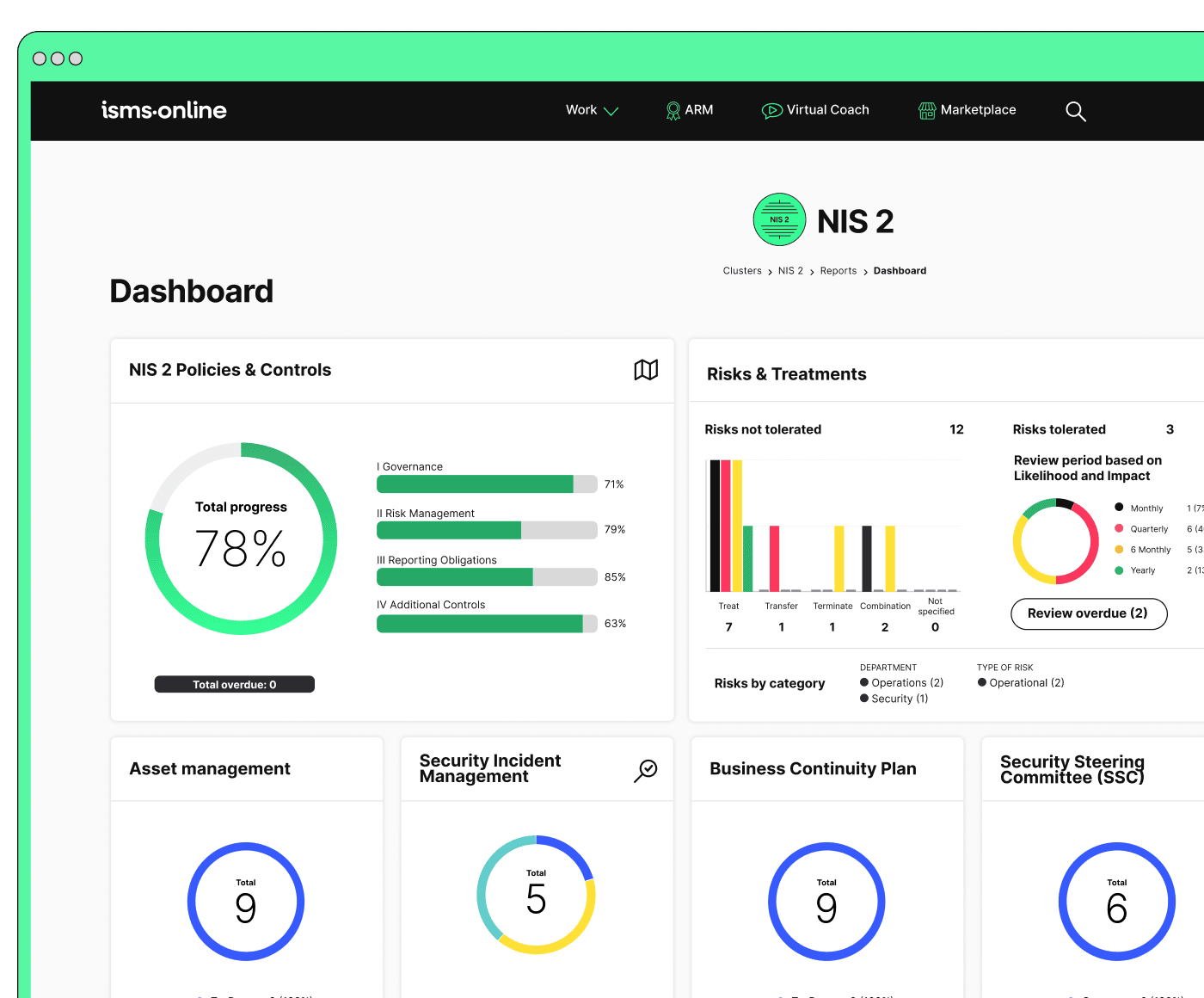
Be NIS 2-ready from day one
Launch with a proven workspace and templates – just tailor, assign, and go.
The Compliance Gamble: Does Waiting for Guidance Beat Early Action?
Every persona-kickstarter, CISO, privacy counsel, practitioner-hears the same siren: “Don’t move until we get clarity.” But the compliance trapdoor is built on waiting: regulators now signal that future “forgiveness” for organisations who took no action is off the table. “Preparation traces” and progress logs are your only true defences.
Inaction is a signal: it costs you when the first audit comes-no matter what the law says.
Three Risks in Waiting
- Regulatory Penalties: Countries like Germany and Poland have clarified that “evidence of inaction” post-October 2024 leads to immediate fines once law is transposed.
- Revenue & Partner Blockages: Major buyers and supply chains require NIS 2 evidence as table stakes for contracts-especially in digital, health, and infrastructure.
- Audit “Trapdoors”: Spot checks in digital and healthcare in 2023–2024 often focused not on technical failings, but for missing logs and change records.
Table: Proactive Action vs. Waiting
| Action | Penalty Risk | Revenue Impact | Audit Defence |
|---|---|---|---|
| Wait (do nothing) | High | Blocked deals | Weak |
| Show proof | Low | Deals flowing | Strong |
| Timestamp everything | Lowest | Business as usual | Strongest |
Persona-Specific Lessons
- *Kickstarters*: Quick, clear activity = deal wins; waiting undermines management trust.
- *CISOs/Risk Owners*: Early evidence is “insurance” for board and regulator; passivity is reputational risk.
- *Privacy Officers*: Regulators prioritise preparation logs over document polish.
- *Practitioners*: Every exportable log = agency in front of an auditor.
How to Build Audit-Grade NIS 2 Evidence: Platform Practises for 2024
Turning diligence into audit-defensible exports is simpler with discipline and systemization. The key is layering logs, policies, workflows, and reviews in a way that can be produced in seconds per trigger, not weeks.
Audit-Ready Evidence Types:
- Registration logs: Timestamped, owned, reviewed monthly or as changes occur.
- Policy assignment and acknowledgment: Clear trail from assignment to completion, plus renewal.
- Risk registers: Reviewed at least quarterly, updated after every significant incident.
- Incident and drill logs: Evidence of incident response, testing, and mastery of lesson capture.
- Minutes of board and management security reviews: Meetings, outcomes, and actions-exportable.
- Policy version tracking and change logs: Updates, reviewer trail, “evidence pack” for every major change.
- Supplier and contract management: Secure tracking for all NIS 2–relevant partners.
Platforms like ISMS.online enable:
- Centralised logs and workflows across all evidence types.
- Automated assignment, reminders, and record capture.
- Instant export of compliant bundles (per regulator, sector, or supply chain partner).
- Data security, permission control, and versioning-no risk of lost evidence.
Table: Key Evidence / Export Detail
| Evidence Category | Exportable | Frameworks | Update Cycle |
|---|---|---|---|
| Registration logs | Yes | NIS 2, ISO 27001 | Monthly or on changes |
| Policy tracks | Yes | All | Update/assignment-driven |
| Risk register | Yes | ISO 27001, NIS 2 | Quarterly/incident-based |
| Staff acknowledgments | Yes | All | Per assignment/completion |
| Incident logs | Yes | NIS 2, ISO 27001 | Ongoing (real time) |
| Board minutes | Yes | NIS 2, ISO 27001 | Annually at minimum |
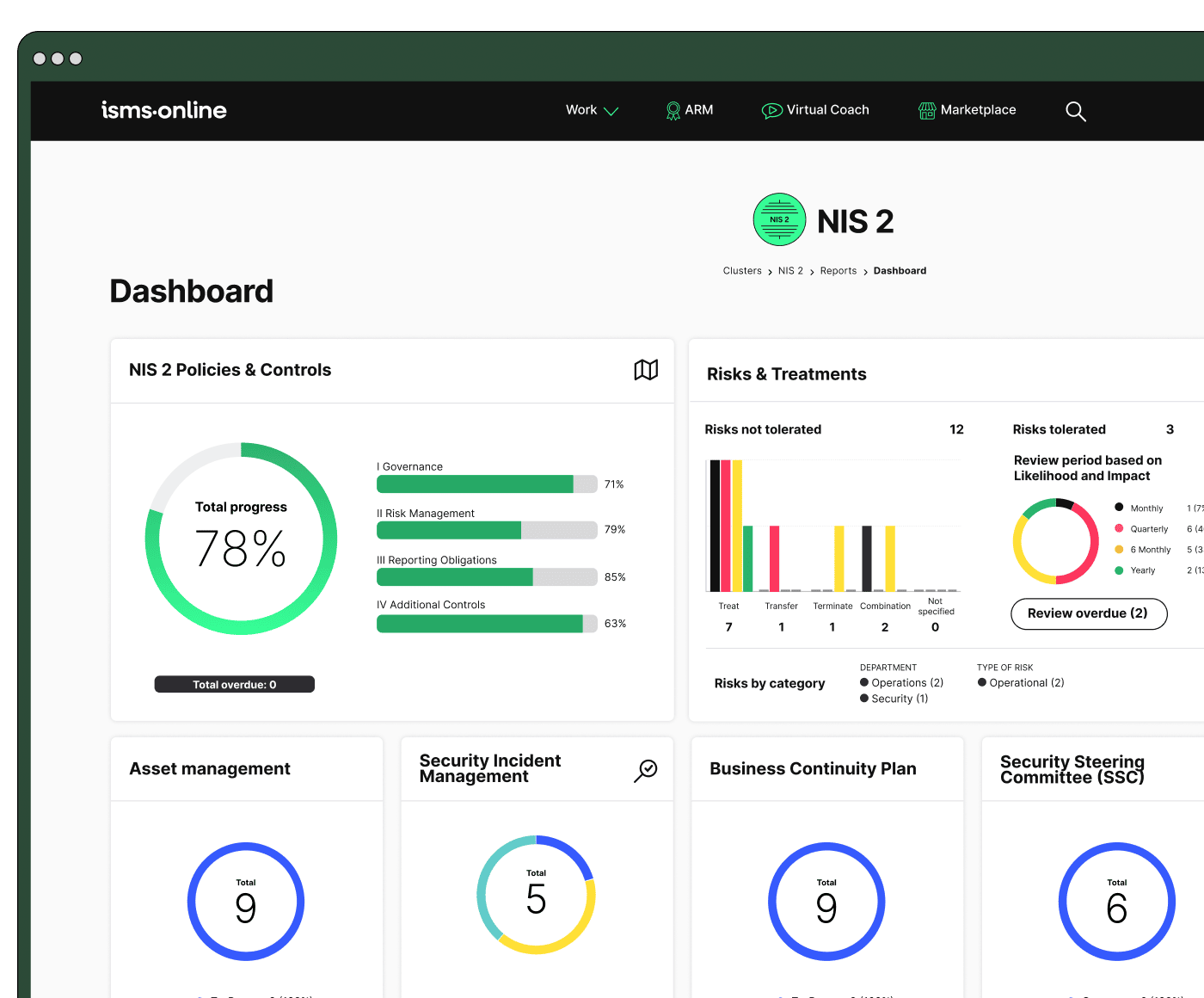
All your NIS 2, all in one place
From Articles 20–23 to audit plans – run and prove compliance, end-to-end.
Compliance Triggers: What Forces an Audit, and How Do You Prove Readiness?
Spot audits and investigations don’t happen at fixed windows-they are triggered by clear, observable events. Your “evidence pack” must be instantaneously exportable across all active compliance triggers:
- Missed registration deadlines: Authorities will demand file exports-fast.
- Cyber-Security incidents: Both incidents and closure notes, plus board review & evidence of lessons learned.
- Spot compliance checks: Random requests for key evidence (risk, training, registration, policies).
- Procurement/partner audits: Proof of compliance required as precondition for contracts, especially in the supply chain.
- Post-sector incident regulatory review: Sector authorities escalate logs and response details.
| Trigger | Export Required | ISO 27001 Ref | Evidence Example |
|---|---|---|---|
| Missed registration | Registration/export | A.5.1 / 8.21 | Registration file export |
| Security incident | IR log, closure | A.5.24 / 5.26 | Incident log, workflow, board note |
| Board review | Minutes, action log | 5.2 / 5.3 | Agenda + outcome files |
| Procurement audit | Policy/risk export | A.5.4 / 8.7 | Exported pack from ISMS.online |
Always-On Practises:
- Maintain evidence packs for every key event and trigger, by country, sector, and contract.
- Automate scheduling/reminders for exports; don’t leave preparations to memory.
- Adjust scope to strictest in-scope regime; build defence for “weakest link” (multi-sector, multi-country).
See Audit-Readiness and Compliance in Action: Centralised Evidence as Your Defence File
When penalties, supply chain blockages, and regulator “gotchas” arrive without warning, discipline and audit-automated workflows save more than time-they defend reputational and regulatory capital.
ISMS.online as Audit Defence System:
- Roles-based timelines and dashboards: Visualise every audit-priority deadline-per regulation, per sector, per country.
- Automated template assignment: Policy, risk, and registration templates aligned to roles and deadlines.
- Central export engine: Generate audit-ready evidence packs for any country, regulator, or client in seconds.
- Performance outcomes: Compliance leaders using ISMS.online report 60% less audit prep, near 100% first-time audit approval, and simplified supply chain onboarding.
Audit defence is about living evidence. Uncertainty is inevitable-non-compliance isn’t.
Serving Every Compliance Persona (Kickstarter, CISO, Privacy, Practitioner)
- Kickstarters: Guided evidence, clear next steps, rapid audit tracks for first-time pass.
- CISO/Security Leaders: Board-ready dashboards, cross-standard mapping, resilient compliance posture.
- Privacy & Legal: Integrated privacy mapping, defensible SAR logs, ISO 27701 aligned reporting.
- IT/Security Practitioners: Automated tasks, centralised logs, fast exports, audit hero status.
Identity CTA: Reputational Security and Regulatory Assurance
Arm your team for October and every day after-centralise your evidence, automate your exports, and move confidently past the NIS 2 milestone. Incomplete files are the only real risk. Audit-readiness is what sets your organisation apart.
Book a demoFrequently Asked Questions
Who sets NIS 2 grace periods, and why is your regulator-not your trade body-the only voice that matters?
National cyber-security regulators alone determine how, when, and even if grace periods exist for NIS 2 compliance-never industry associations or the European Commission. The baseline implementation deadline, 17 October 2024 (NIS 2 Art. 41), is universally fixed, but each member state’s regulator-such as ANSSI in France or BSI in Germany-can apply limited extensions or phase-ins. For example, France grants some critical utilities a deferral until 2027; by contrast, German and Polish authorities expect registration, exportable audit logs, and management engagement from day one, with no blanket extensions. Across most jurisdictions, unless your organisation receives a written exemption from the regulator, you must assume audit and enforcement can start on 18 October 2024. Relying solely on industry group advisories or template letters may leave you unprotected the moment regulators begin checks.
A rumour of delay from an industry newsletter won’t buy you 24 hours if the regulator asks for proof this quarter.
Table: NIS 2 Grace Periods (select EU states)
| Country | Regulator | Essential Sector Grace | Important Sector Grace | Registration/Evidence Required |
|---|---|---|---|---|
| France | ANSSI | Yes (utilities to 2027) | No blanket | Logs/registration needed by deadline |
| Germany | BSI | No blanket | No blanket | Audit logs and reg ready by deadline |
| Belgium | NCSC | Phased onboarding | Phased onboarding | Must register by assigned date |
| Poland | NASK | None stated | None stated | Logs and registration by deadline |
| Ireland | NCSC | None stated | None stated | Registration due by deadline |
Validation: Always check your national regulator’s official site or notifications.
What evidence demonstrates “good faith” if you’re not fully compliant by the NIS 2 deadline?
Regulators and auditors look for tangible, timestamped evidence-not plans, emails, or “intent” statements-indicating your organisation is actively working towards NIS 2 alignment. Accepted “good faith” evidence includes registration confirmations or export receipts, signed board or management minutes mentioning NIS 2, in-progress risk assessments, incident and event logs, staff training records, and centrally stored, exportable versions of updated policies or controls. Entries should be updated regularly, clearly labelled as “in progress” where actions are not 100% closed, and show board or responsible owner engagement. In recent audits, organisations have reduced or avoided penalties by demonstrating this living, version-controlled log-even if some controls remain open.
A living, central folder-exportable on demand and updated monthly-shields you more than any ‘workstream in limbo’ ever could.
Table: Event/Evidence Matrix for “Good Faith” Compliance
| Critical Event | Evidence | ISO 27001 Ref | NIS 2 Article |
|---|---|---|---|
| Registration | Export/receipt, letter | A.5.1, 5.2 | Art. 27 |
| Board review | Minutes, sign-ins, agenda | 5.2, 5.3 | Art. 20 |
| Training | Staff logs, sign-offs | A.6.3, 8.7 | Art. 21(2e) |
| Incident | Event/action log | A.5.24, 5.26 | Art. 23 |
| Policy update | Version log/change export | A.5.4, 8.31 | Art. 21(2d) |
How do supervision levels and penalty risks really differ for “essential” versus “important” NIS 2 entities?
Essential entities-power, water, health, and digital infrastructure companies-face real-time, proactive supervision: annual audits, higher board liability, advance registration, and stiff penalties up to €10 million or 2% global turnover. Even if a grace period applies, you must maintain audit-ready logs and board engagement from the first compliance date, as spot audits often precede “maximum fine” cases. Important entities (manufacturing, food, logistics, and supporting digital providers) are mainly monitored after incidents, with most enforcement “triggered” by events or request-which means readiness is still required from day one to avoid post-event fines (capped at €7 million/1.4% turnover). Across both groups, missing, incomplete, or stale logs are the top triggers for enforcement-even absent a major security event.
Supervision and Penalty Table
| Entity Type | Supervision Model | Audit Trigger | Max Penalty |
|---|---|---|---|
| Essential | Proactive, regular | Annual/spot audit | €10M or 2% turnover |
| Important | Event-driven | Incident/request | €7M or 1.4% turnover |
What triggers a NIS 2 audit-or enforcement, and how quickly can penalties follow the deadline?
Post-deadline, enforcement is event-triggered. Missed or incomplete registration, reported incidents by your company or clients, random regulator spot checks, sector-specific alerts, or supplier/partner requests to produce compliance evidence (logs, board minutes) can all prompt an audit. National authorities-especially in the energy, digital infrastructure, or health sectors-have initiated audits and issued penalty notices within weeks of compliance deadlines, particularly if industry bodies or press circulate rumours of lax enforcement. Prepare for a scenario where evidence needs to be export-ready within 48–72 hours of a request, no matter what your local trade association says.
Audit calendars may slip, but an incident or partner request can move your evidence review from ‘next quarter’ to ‘today’.
Can managed, versioned ISO 27001 “in progress” documentation fill gaps when NIS 2 controls aren’t finalised?
Absolutely. Regulators and sector auditors recognise that up-to-date, versioned ISO 27001 (Annex A) controls-maintained in live ISMS systems and mapped to NIS 2 requirements-offer a credible line of defence. Files should be centrally stored, marked “in progress,” updated per management meeting, and clearly traceable with date, owner, and version. Organisations using platforms like ISMS.online routinely report >90% audit pass rates, even if not everything is finalised, so long as the evidence register is living, mapped, and exportable on demand.
Traceability Table: Event → Evidence → ISO/NIS 2 Ref
| Event | Evidence | ISO 27001 | NIS 2 |
|---|---|---|---|
| Registration | Export file, confirmation | A.5.1, 5.2 | Art. 27 |
| Incident | Dated log, fixes/root cause | A.5.24, 5.26 | Art. 23 |
| Training | Sign-offs, logs | A.6.3, 8.7 | Art. 21(2e) |
| Board review | Minutes, sign-in, agenda | 5.2, 5.3 | Art. 20 |
Why is “waiting for national guidance” or industry templates a high-risk compliance strategy?
Waiting for your government, or for sector associations to publish more checklists, is an active risk-not a shield. National regulators only accept timely, version-stamped audit evidence; most penalties cited so far have hinged on missing, outdated, or fragmented documentation-not intentions or template use. Multinational supply chains must comply with the most stringent requirement applicable, so evidence must match the strictest jurisdiction linked to your contracts. Templates can help organise your progress but must be converted into living registers, signed board minutes, and traceable logs updated monthly. The organisations least at risk are those maintaining actively managed, centralised documentation even as guidance evolves.
What “grace period” failures accelerate penalties or failed audits?
- Only documenting plans or intentions: If logs aren’t timestamped, centralised, and immediately available, “in progress” counts for little.
- Fragmented compliance records: Scattered files, disconnected toolchains, and private email storage regularly trigger negative findings.
- Delaying formal board review or registration: Leaving these until after spot checks or incident reports typically results in fines.
- Letting evidence go stale: Logs must reflect regular (preferably monthly) updates with owner sign-off.
How does centralising and automating evidence (with ISMS.online) protect you in the grace window and beyond?
A managed, automated ISMS shifts your risk profile from unknown to always audit-ready. With ISMS.online, compliance deadlines and actions are visualised per jurisdiction and mapped to responsible owners. Registration, asset, and incident workflows are assigned automatically; evidence is instantly exportable-and always version-stamped. Peer organisations report audit prep time dropping by up to 60%, and pass rates above 90% in the first year. Most important, centralised logs and records give your board and regulators continual confidence, even as laws or sector guidance shift.
In an era of spot audits and rapid change, living logs beat perfect plans every time.
Is your organisation ready to pass the real compliance test?
Start by mapping your grace period to the regulator’s schedule, not the industry rumour mill. Centralise and automate your NIS 2 evidence with ISMS.online-so your “in progress” files become your organisation’s strongest legal shield when it matters most.
Further Reading and Validation Sources:
- EU Digital Strategy-NIS 2 Official Page
- PWC Malta-NIS 2 Guide
- CENTR-Policy Update 2024
- isms.online-Platform Resources
- RegTechGlobal-Compliance Analysis






